Donate ☕
201 Military Defense Forums
[🇧🇩] - Monitoring the political activities of BNP | Page 15 | PKDefense
Home Login Forums Wars Movies Watch Videos
Serious discussion on defense, geopolitics, and global security.

[🇧🇩] Monitoring the political activities of BNP

Reply (Scroll)
Press space to scroll through posts
G Bangladesh Defense
[🇧🇩] Monitoring the political activities of BNP
390
9K
More threads by Saif

BNP wants to reinstate caretaker govt system
Says Tarique

1725319887360.webp

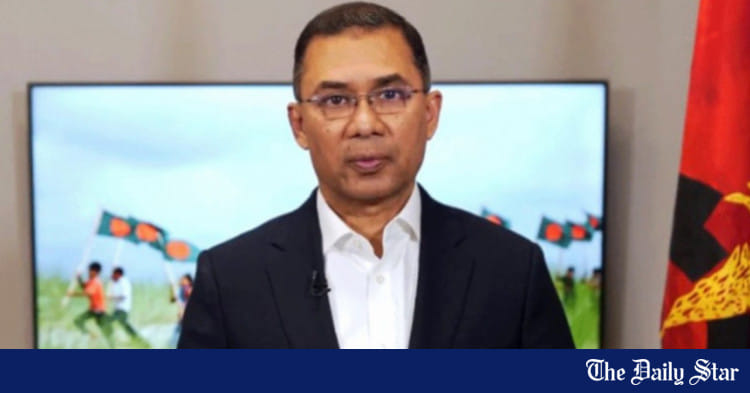
File photo of Tarique Rahman

BNP acting chairman Tarique Rahman yesterday said their party is willing to bring back the caretaker government system for elections to ensure the restoration of the people's voting rights.

"We want to reinstate the caretaker government system in the constitution to restore the people's right to vote," he said while exchanging views with BNP grassroots leaders and activists of Khulna division.

Stating that Bangladesh belongs to its citizens, the BNP leader said it is the people's justified democratic right to elect their representatives through the independent exercise of their voting rights.

He said the BNP introduced the caretaker government system in the constitution in 1996, replacing a partisan government, to safeguard the people's right to vote and ensure free and fair elections in the country.

"But in order to hang onto power, autocratic [Sheikh] Hasina removed it from the constitution and deprived the people of voting rights in three national elections," Tarique mentioned.

The BNP leader outlined the main objectives of their party's politics as ensuring security of the people, upholding freedom of speech, protecting the right to do business and trade peacefully, providing employment for youth, safeguarding the dignity and security of women, guaranteeing equal rights for all citizens regardless of religion, caste, or creed, whether they live on plains or hills, and establishing the rule of law throughout the country.

Tarique said the BNP's priorities also include ensuring a balance of power between the judiciary and executive branches, providing universal healthcare facilities, ensuring fair prices for agricultural products, and, above all, protecting the country's independence and sovereignty.

The BNP leader warned that their party will not tolerate any imprudent actions by a few wayward individuals within the party, regardless of who they are.

Tarique asked his party leaders to identify and resist those who dent the image of the party by not only expelling them from the party but also taking legal action against them.​
 
Analyze

Analyze Post

Add your ideas here:
Highlight Cite Fact Check Respond

BNP’s pledge for reforms sounds good
We would like to see the party match its words with actions

1731717684390.webp

Visual: Star

BNP's acting chairperson Tarique Rahman made a number of promises on Thursday, which we hope the party sincerely intends to fulfil. Such promises, however, are nothing new. We have heard similar promises when a party was not in power only to see them being forgotten after coming to power. Nevertheless, the promises made by BNP in its reform agenda sounds promising on paper.

Tarique emphasised building a Bangladesh where not even the prime minister could abuse power, highlighting principles such as the rule of law, human rights, freedom of speech, transparency, and accountability. Drawing from BNP's "31-point Outline for Structural Reforms," he reiterated some objectives that are both novel and ambitious. For instance, no party has previously placed much emphasis on ensuring a free press. But Tarique declared his resolve to enable the media to "speak truth to power" and openly criticise the government. If implemented, this would mark a significant departure from the Awami League's harsh persecution of dissidents and journalists. Furthermore, the proposed reforms to curtail the government's excessive power—including the introduction of a bicameral parliamentary system and limiting the prime minister's tenure to two consecutive terms—suggest that the party might be embracing more mature political practices.

Unfortunately, if we observe the party's actions, we can deduce that it is already faltering in realising some promises, mainly that of curbing corruption. For example, there have been multiple reports of "BNP-linked" groups extorting citizens, with its party members or activists allegedly filling the void of AL-established syndicates—as well as regular infighting within the party. While BNP leadership has issued warnings against such behaviour, more decisive actions are necessary. Otherwise, such incidents will continue to cast doubt on assurances from BNP's leadership and make it harder for citizens to place their trust in the party.

BNP's pledge to build an inclusive, liberal, and democratic Bangladesh—by balancing power among the legislative, judicial, and executive branches and dismantling the tools of oppression used by past governments—is commendable. However, sincerity is the key to achieving such a transformation. Much of the scepticism surrounding BNP—as well as other political parties—could be addressed if the party itself practiced democratic principles, such as decentralising its decision-making process. Additionally, it could move away from the failed dynastic politics of our region, which has acted as an obstacle to the democratisation process.

The July uprising demonstrated that people are fed up with dynastic politics driven by violence, oppression, and corruption. Many have sacrificed their lives to break free from this system and secure the rights of all citizens. All political parties, including BNP, must honour these sacrifices and ensure they are not in vain.​
 
Analyze

Analyze Post

Add your ideas here:
Highlight Cite Fact Check Respond

Holding fair elections key task of interim govt: BNP
Staff Correspondent 16 November, 2024, 00:28

1731719051378.webp


The Bangladesh Nationalist Party on Friday said that holding a fair and impartial general election was the key responsibility of the interim government.

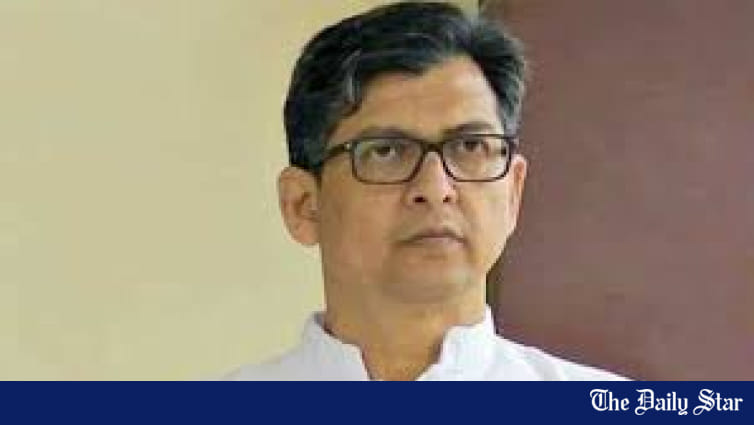
The party’s standing committee member Abdul Moyeen Khan made the remarks at a discussion organised by the Jatiyatabadi Baul Dal in the capital’s Mirpur, marking the ‘National Revolution and Solidarity Day’.

Moyeen Khan said that BNP acting chairperson Tarique Rahman had prepared the country’s people and guided the people in the right way to carry out the movement to restore voting rights.

‘We hope that the interim government will hold a fair and impartial election soon, and it is their main responsibility,’ he said, adding that through that election, democracy would make a comeback in the country.

Moyeen also said that the people of the country wanted their voting rights and longed for democracy since 1971.

‘The demand for voting rights and democracy was not a crime. The country became independent for democracy, but Awami League turned the country into a one-party BAKSAL [Bangladesh Krishak Sramik Awami League] between 1971 and 1975,’ he added.

Baul Dal president Rafiqul Islam Tuhin presided over the discussion, while Dhaka city north BNP member secretary Mostafa Zaman and joint convener Mostafizur Rahman Segun were also present, among others.​
 
Analyze

Analyze Post

Add your ideas here:
Highlight Cite Fact Check Respond

BNP came out stronger every time it faced obstruction: Amir Khasru
UNB
Published :
Nov 16, 2024 21:19
Updated :
Nov 16, 2024 21:19

1731805273985.webp


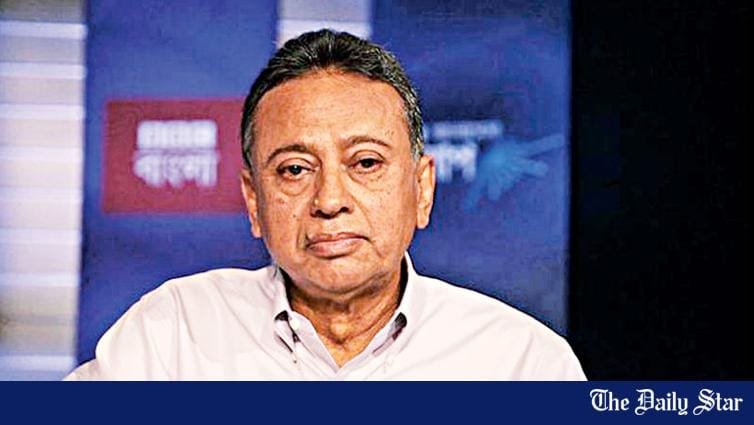
BNP leader Amir Khasru Mahmud Chowdhury has said the party has emerged stronger every time it faced evil-efforts to obstruct its progress.

Speaking at a rally in Chattogram on Saturday, the BNP leader highlighted the party’s resilience, despite numerous challenges over the years.

Central Jubo Dal arranged the rally at Biplob Udyan in Sholoshahar of the port city to mark National Revolution and Solidarity Day.

Reflecting on the party’s turbulent history, Khasru emphasised the sacrifices made by BNP members, including losing leaders, facing imprisonment, and enduring hardships. “In the past, we had shed blood on the streets, gone to jail, and lost many of our leaders and workers. But through all those struggles, BNP’s leaders and workers only become stronger, like pure gold forged in fire.”

Khasru said despite concerted attempts to break the party, BNP has not only survived but has grown in strength.

“Whenever those who tried to stop us came forward, they themselves were destroyed. BNP stands stronger today than ever before,” he said, pointing out that those who once sought to dismantle the party are now a thing of the past.

Khasru, also a standing committee member of the party, warned against any future attempts to curtail the party’s momentum.

He also said it is the people of Bangladesh, not any individual or group, who will determine the country’s political future. “No one can take away Bangladesh’s democracy or dictate what the future holds. The people will decide the course of the country’s politics,” he asserted.

He reminded his audience of the past attempts to shape the nation’s political direction, pointing out that leaders like Sheikh Mujibur Rahman, Ershad, and even Sheikh Hasina failed in their attempts to control the political landscape. “Let the people of Bangladesh decide. Attempts to impose decisions on the people have failed before, and they will fail again.”

Chaired by Abdul Monayem Munna, president of the Central Jubo Dal, and conducted by General Secretary Mohammad Nurul Islam Noyon, the programme was attended, among others, by BNP’s Organisational Secretary Mahbubur Rahman Shamim, City Mayor Dr Shahadat Hossain.​
 
Analyze

Analyze Post

Add your ideas here:
Highlight Cite Fact Check Respond

The wrongs of past 15yrs must be righted
Says Mirza Fakhrul

1731887659510.webp


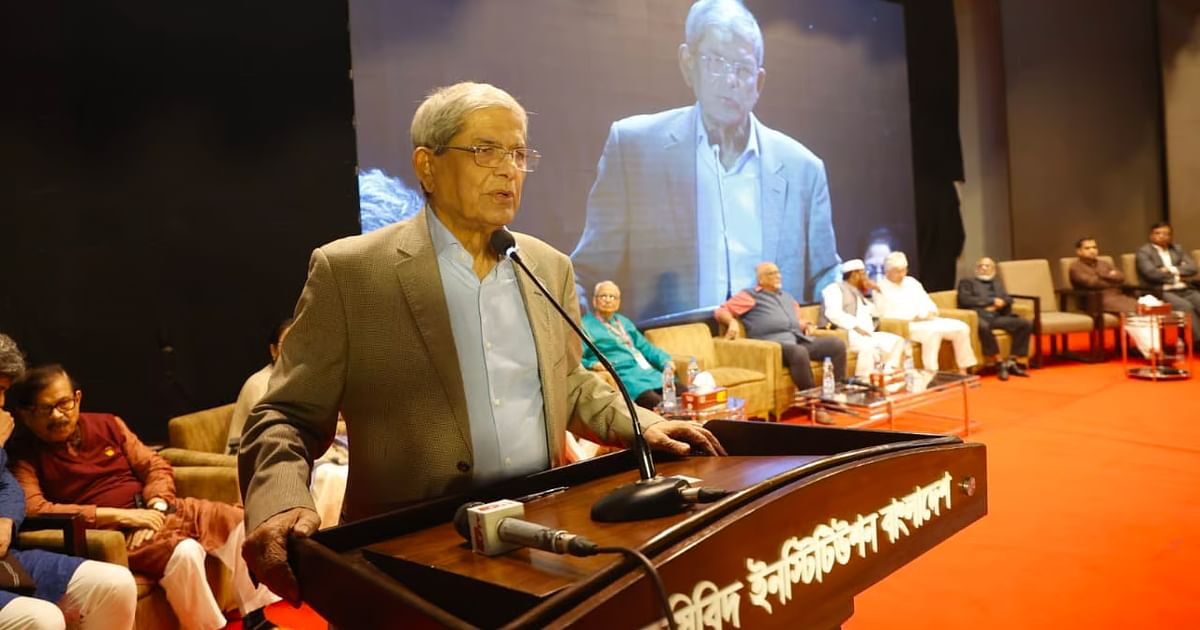
Having been the main opposition camp over the last 15 years, the BNP has been advocating for quick reforms followed by elections. The Daily Star's Golam Mortoza caught up with the party's Secretary General Mirza Fakhrul Islam Alamgir to talk about a host of issues ranging from elections to media freedom.

TDS: As the secretary general of one of Bangladesh's largest political parties, what are your thoughts on the current political situation. A successful mass uprising has taken place, and an interim government has taken over. Your party has been calling for elections within a timeframe that is both "quick" and "reasonable." Could you clarify what you mean by "quick" and "reasonable"?

Fakhrul:
Over 15 years of authoritarian rule destroyed the bureaucratic and political structures of Bangladesh. The institutions essential for a democratic state have been systematically ruined. As a result, following the student-led mass uprising, public expectations have skyrocketed. The primary expectation now is that this government will hold a fair and credible election, enabling people to form a parliament and government of their choice.

There is also another expectation -- to right all the wrongs done during this long bout of misrule.

TDS: How would you define a reasonable timeframe?

Fakhrul:
There are a few minimum requirements. For instance, the electoral system needs to be reformed to enable free and fair elections. The heavily politicised bureaucracy must be overhauled to make it neutral and capable of facilitating a credible election. Similarly, the judiciary, which has been politicised, needs to be reformed to the extent possible. Complete reform might not be achievable immediately, especially at the grassroots level, but these steps are critical.

TDS: Your acting chairperson, Tarique Rahman, has also spoken about this logical timeframe, making it clear that there's no rush. However, some of your party leaders have mentioned that elections should be held by March or April, leading to some confusion. What is BNP's official position on this?

Fakhrul:
We don't want to specify exact dates or deadlines because, as a party, we're being pragmatic. There may be some flexibility with the timeline, but elections must be held as quickly as possible for the good of the country and its people.

Having been in government ourselves, we understand that reforms require some time. However, we insist on timely elections because only an elected government can ensure legitimacy. The mandate of an elected government is entirely different from that of an interim administration. When we interact with foreign stakeholders, investors, and industrialists, they often express concerns about investing during the tenure of a temporary government. Timely elections will resolve many of these issues.

TDS: Regarding the interim government, particularly the current one -- there is a suggestion that although it lacks electoral legitimacy, it came to power after a mass uprising involving students and the public, with active participation from all political parties, including the BNP. Doesn't that give this government a mandate derived from the uprising?

Fakhrul:
The uprising undoubtedly aimed for reforms. But that doesn't mean this government can operate indefinitely, like what we saw during the 1/11 period [indicating the government that took power on January 11, 2007] or similar situations in the past. An unelected government must not exceed its logical timeframe. Prolonged tenure creates various complications, including difficulties in maintaining international relations.

Additionally, anti-democratic and fascist forces often take advantage of such transitions. During 1/11, the government's attempts at reforms ultimately failed, forcing them to hold elections and leave.

TDS: As someone who has spent the entire life in politics, would you say that the BNP, as a major political party, practises democracy internally?

Fakhrul:
I won't claim we do it perfectly well, but we are practising democracy. Our standing committee sits four times a month. Decisions are made collectively. The current situation has prevented us from holding councils everywhere, but we will address that.

Abolishing the caretaker government system was the greatest mistake. Elections under a caretaker government fostered democratic practices. In contrast, there has been no accountability in the last three elections. A country's democratic culture influences its political parties, and all of us must work together to strengthen it.

TDS: Are you concerned that the current government may delay elections or avoid them altogether?

Fakhrul:
At this point, I don't see any indication of that. We've had both formal and informal discussions with the student leaders, and I haven't felt that they intend to delay or avoid elections.

TDS: You are advocating for elections, and the government is too. You're suggesting elections at a reasonable time, while the government wants reforms first. But the government hasn't openly stated any intent to hold on to power indefinitely. Doesn't this align the BNP, the anti-discrimination student movement, and the government to some extent?

Fakhrul:
There isn't much difference in principle. However, several fundamental issues need clarification. For instance, some are suggesting rewriting the constitution rather than amending it. Even Dr Ali Riaz, who heads the reform committee, has stated that the constitution will be rewritten.

It remains unclear whether the constitution will be rewritten or drafted anew, or simply amended.

TDS: What's your stance on this?

Fakhrul:
We've also formed a committee on constitutional reform, which we'll share with the government. We're willing to cooperate in making the necessary amendments to the existing constitution for governance. However, fundamental changes to the constitution should be entrusted to the people. Only their representatives can undertake such tasks.

TDS: But it was the people who carried out the uprising.

Fakhrul:
Who exactly are "the people" behind the student-led uprising? Whose voices will you prioritise?

TDS: Those who led it.

Fakhrul:
How do you determine that? This issue is being debated from many perspectives.

TDS: You were indirectly aligned with the movement. While you may not have been formally involved, the students led it, and the world witnessed that. Isn't that clear?

Fakhrul:
We aren't denying that. We embrace it. We were also part of it. Our point is that any constitutional change requires the people's mandate. This government is not a revolutionary government.

TDS: Do you think they should form a party?

Fakhrul:
That's not for me to say.

TDS: If they form a political party, shouldn't they leave the government?

Fakhrul:
They absolutely should. Otherwise, the government becomes biased. You claim the government will remain neutral, establish a neutral Election Commission, and conduct impartial elections. But if you simultaneously run a political party and hold government power, doesn't that create a direct conflict of interest? If you want to discuss revolutionary change, then form a revolutionary government and run the country accordingly. But is your political party capable of handling such a transformation?

Take the Awami League in 1974, for example, when they implemented BKSAL. Even their intellectual supporters argued this should have been done earlier, perhaps right after the 1971 Liberation War. By 1974, however, it was too late, and the people rejected it. The lesson is clear: the people's verdict matters. And that verdict comes through elections.

TDS: What's your observation on the AL's politics?

Fakhrul:
As I've said before, the AL has become politically bankrupt. You can see it for yourself. The AL is not only defeated but has turned into a despised party. Even within their ranks, those who are somewhat sensible would admit that the party has made grave mistakes.

TDS: Have AL members changed?

Fakhrul:
No, I'm referring to those still in the country, not those who've fled. Even within the party, those who genuinely want to pursue democratic politics now believe their party has made serious mistakes.

TDS: When discussions arise about banning the AL -- given that its student wing, the Chhatra League, has already been banned --why does your party disagree with the idea?

Fakhrul:
I'm a liberal democrat to the core. No matter how bad the AL is, it's an old political party with a long history. Who am I to decide whether it should be banned? That decision rests with the people. An elected parliament, formed through fair elections will determine such matters. The AL will eventually be wiped out through elections anyway.

TDS: A discredited party, accused of killing hundreds, is still led by Sheikh Hasina in exile -- if a proposal comes to ban such a party, will it be irrelevant?

Fakhrul:
I didn't call it irrelevant. What I said is that it's not my responsibility to make that decision. That is for the people to decide.

TDS: Let's assume the BNP wins the next election and takes charge of the country. Would your parliament take the initiative to ban the AL?

Fakhrul:
That would depend on the situation at the time. What the party decides at that point is something I can't predict right now. I can't say whether we would take such an initiative or not because it will ultimately be a party decision.

TDS: After banning the Chhatra League, there's been speculation that Chhatra Dal could also face a ban. Some argue that's why the BNP opposed the Chhatra League's ban. Is that true, or is this about upholding democratic values?

Fakhrul:
Why view this negatively? Let's look at it positively. The Chhatra League had devolved into a completely terrorist organisation with no trace of democratic values. They wreaked havoc on the entire education system through their acts of terrorism. There are ample evidence and photographs of how the Chhatra League, acting as a political force, killed people during the student uprising -- you probably have more of that evidence than we do. The situation of the Chhatra League and Chhatra Dal isn't comparable at all.

TDS: I'm not comparing Chhatra League with Chhatra Dal. However, considering the allegations of Chhatra League using firearms, machetes, and cleavers to kill students, its ban has been justified. Yet, the BNP seems to believe that the decision was not right. Why is that?

Fakhrul:
No one from our party has said that banning Chhatra League was unjustified. What we've said is that the decision to ban any organisation should be made by parliament.

TDS: Allegations have surfaced that BNP leaders are now engaging in the same extortion and land-grabbing that AL leaders were accused of. What's your take on this?

Fakhrul:
You can't generalise such claims. Yes, there have been isolated incidents, and we've acted decisively. Over 700 members have been expelled for misconduct. We're well aware of the issue and remain vigilant.

TDS: Final question. There seems to be a growing narrative against certain media outlets in Bangladesh, particularly The Daily Star and the Prothom Alo, labelling them as accomplices of fascism, with even calls from some quarters to shut them down. Though this sentiment may not be widespread, it does exist. As the secretary general of a major political party, what is your stance on this, and what do you think should be done in this regard?

Fakhrul:
Our position is very clear: we strongly believe in the complete freedom of the press. It was Ziaur Rahman who first brought this principle forward.

That being said, media freedom must be exercised with responsibility. For example, some time ago, a newspaper published a report claiming that all arrangements had been made for Begum Khaleda Zia to leave the country, but she refused to go. This was utterly baseless and a completely false report. The media must refrain from publishing such unfounded news, especially when it concerns national leaders. There must be a solid basis for such claims. Baseless reporting should not happen.

Right now, the media's most significant responsibility is to contribute towards ensuring that this government quickly holds fair elections. Another crucial role for the media is to avoid maligning the parties that are genuinely involved in the movement for democracy. These are our expectations. There may be differences of opinion, and that's fine, but deliberate misrepresentation is unacceptable.

We're vocal about press freedom. For instance, we welcome the decision to repeal the Digital Security Act and Cyber Security Act. This is a very positive step, and it is what we've been advocating for. However, we also want everything to be done with a sense of responsibility. In a democracy, rights are essential, but so is accountability. Everyone must act responsibly.

As for the calls to shut down media outlets or burn them down, we're entirely against such actions. Some isolated incidents may have occurred, but we've protested against them to the best of our ability.

TDS: Thank you very much for your time.

Fakhrul: Thank you as well. We're always in support of ensuring that you can continue to speak the truth freely.​
 
Analyze

Analyze Post

Add your ideas here:
Highlight Cite Fact Check Respond
  • Like (+1)
Reactions: Bilal9

A moment of truth for BNP
The party’s reform agenda will achieve sustainability if it is accompanied by its internal democracy and promotes a culture of collective decision-making.

1731975758597.webp

VISUAL: SALMAN SAKIB SHAHRYAR

In an otherwise high-profile meeting attended by diplomats from 38 countries and organisations, senior leaders from various political parties, teachers, journalists, intellectuals, and prominent citizens, held in Dhaka on November 14, BNP's Acting Chairman Tarique Rahman declared that, if elected to power, his party would not establish a family dynasty like the Awami League. Speaking virtually from London, Rahman pledged to build a prosperous and happy nation based on the 31-point agenda his party had unveiled in July 2023. He also committed to implementing a policy that would prevent any individual from serving as the prime minister of the country for more than two consecutive terms.

In the brain-storming session titled "BNP's 31-Point Outline to Reform the State Structure," 56-year-old Rahman said no individual, including the prime minister, can abuse power or act arbitrarily in the future Bangladesh. "Accountability will be ensured at every level of government, from the highest ranks of the state down to every government tier. If BNP takes charge of governing (the country), we aim to restore freedom of expression for all citizens, regardless of party affiliation," he said.

"Our goal is to build a state structure where no one will be harassed for expressing their thoughts on platforms like YouTube, Facebook, or other online mediums, even when commenting on the prime minister or other prominent figures. The mainstream and social media will not be compelled to conceal the truth, nor will the government pressure anyone to spread false information."

The promises are both welcome and reassuring against the backdrop of the fall of the autocratic Hasina government, brought down by a mass uprising reflecting the public's aspiration to reform the structure of Bangladesh's state and society.

With the Awami League—the immediate past ruling party and the BNP's chief rival—being forced to retreat from the political process, at least for the time being, after party chief Sheikh Hasina fled to India, the responsibility now rests on the BNP and its acting chairman, Tarique Rahman, as the major political force to lead the reforms demanded by both the youth and the broader public for an inclusive and democratic Bangladesh. Given the fact that the previous ruling party displayed traits of a fascist regime, the BNP leadership's pledge that no future head of government will abuse power or act arbitrarily must also be reflected within the party itself. Without genuine internal reform, such declarations risk being dismissed as mere rhetoric. As the saying goes, charity begins at home.

Notably, the powers and authority granted to the party chairman, as outlined in the BNP constitution available on its website, should be consistent with the state reform proposals the party advocates. Organisational culture flows from the top down, and for the BNP's reform agenda to gain sustainability, it must simultaneously demonstrate a commitment to internal accountability and inclusivity.

Having examined BNP's constitution, it is evident that the party chief wields near-absolute authority, calling all the shots, attracting all the spotlight, and essentially doing or undoing anything he or she wishes. For instance, the 19-member standing committee, the party's most powerful policymaking body, has the authority to revoke or temporarily suspend membership or take punitive measures against anyone charged with misconduct, breaching discipline, or engaging in anti-party activities. However, if convening a meeting of the standing committee is not possible, the party chairperson, at his or her discretion, may take immediate punitive action against any member deemed punishable in urgent circumstances or withdraw any previously imposed punitive measure. Nonetheless, such decisions must be ratified at the next meeting of the body.

The party chief emerges as the ultimate authority in disciplinary matters. The constitution explicitly states, "The aggrieved person may appeal to the Chairman against the penalty, but the decision of the Chairman will be considered final."

Moreover, according to the party charter, all metropolitan and district executive committees require approval from the secretary-general, who acts on the chairperson's advice. This provision starkly undermines internal democracy within the BNP.

The BNP chairperson is entrusted with immense power, enabling the leader to make key decisions and both enforce and reverse actions at will. For example, the party constitution grants the chairperson the authority to dissolve the 470-member national executive committee, the national standing committee, thematic sub-committees, and other committees. The chairperson may reconstitute these bodies, provided the decision is ratified by the next council.

Additionally, the party chief is empowered to fill vacancies in the national standing committee, the national executive committee, and thematic sub-committees. The chief may even alter the number of members in the national executive committee in special cases, though the total number of members cannot exceed the limit by more than 10 percent.

The party charter also allows for the creation of one or more organisational bodies within the BNP. However, no organisation is recognised as an affiliate of the BNP without the chairperson's approval.

Even amendments to the party constitution can bypass the national council under certain conditions. The charter states, "If any amendment becomes necessary due to urgent reasons, then the Chairman of the Party may amend the constitution, but the said amendment must be accepted by a majority at the next meeting of the National Council."

Given such provisions, it is imperative for the BNP to prioritise internal democracy and foster a culture of collective decision-making.

At the high-profile meeting on November 14, one speaker cautioned that if the state reform promises were not fulfilled, the BNP would be labelled by the public as a failure.

It is, however, reassuring that the BNP is not only discussing reforms now, but has been proposing state structure reforms since 2016. This consistent advocacy raises hope that the BNP is serious about implementing these proposals.

The BNP should remember that Bangladesh is on the verge of transitioning from authoritarian rule to a path of democracy, achieved through the sacrifices and blood of hundreds of people. This transformation is rooted in the sacrifices of the students and people during the July uprising, as well as the BNP's prolonged struggle enduring imprisonment and oppression. BNP leaders and activists have also faced extrajudicial killings and thousands of lawsuits. Certainly, no one made these sacrifices for yet another authoritarian and undemocratic regime.

Shamim A. Zahedy is a journalist.​
 
Analyze

Analyze Post

Add your ideas here:
Highlight Cite Fact Check Respond
  • Like (+1)
Reactions: Bilal9

Members Online

⤵︎

Latest Posts