โ˜• Support Us โ˜•
[๐Ÿ‡ง๐Ÿ‡ฉ] - Monitoring the political activities of BNP | Page 30 | PKDefense

[๐Ÿ‡ง๐Ÿ‡ฉ] Monitoring the political activities of BNP

Reply (Scroll)
Press space to scroll through posts
G Bangladesh Defense
[๐Ÿ‡ง๐Ÿ‡ฉ] Monitoring the political activities of BNP
348
7K
More threads by Saif


BNP expels thousands of partymen over unlawful activities: Rizvi

FE REPORT
Published :
Jul 05, 2025 08:25
Updated :
Jul 05, 2025 08:25

1751759048202.png


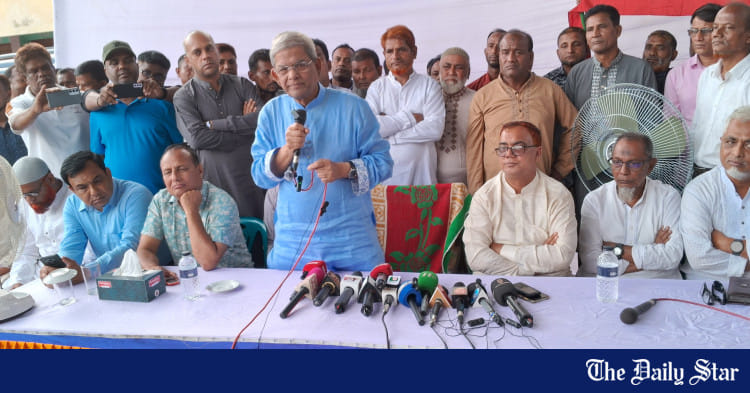
BNP on Friday reassured its position against any form of 'mischief' and 'unlawful' activities saying that the party had already punished four to five thousand partymen.

"Some individuals, who are making mischiefs, creating panic among people using our party name, we are taking action against them. The acting chairman is closely monitoring and taking swift action if anyone found involved in any form of wrongdoing," said BNP Senior Joint Secretary General Ruhul Kabir Rizvi.

The BNP leader said that four to five thousand leaders and activists have been expelled recently for their involvement in wrongdoings and activities that tarnished the party's image.

He highlighted some recent incidents and announced party action against unruly party activists.

Rizvi was speaking at an emergency news conference held at the party's headquarter in Dhaka in the backdrop of growing allegations of mischief and internal clashes in different stages across the country. These decisions have been taken in light of the 'zero tolerance' policy. In particular, in the case of an attack on women by a Jubo Dal leader in Banani, the person involved was expelled immediately after the incident.

Stating that BNP has never condoned mafia rule or terrorism, Rizvi said that strict steps are being taken to maintain the party's structural reforms and discipline, there is no compromise on this.

Meanwhile, in response to journalists, he said that talking about throwing away the constitution does not make it null and void.

Earlier on Thursday, National Citizens Party (NCP) convener Nahid Islam in a Nilphamari meeting demanded the 'throwing away of the current constitution.' The BNP leader said that amending the constitution by adding and subtracting is a democratic continuity. "It is not possible if someone talks about throwing away the constitution," he added.​
 

When is Tarique Rahman returning to Bangladesh?

Selim ZahidDhaka
Published: 05 Jul 2025, 13: 20

1751760072919.png

BNP acting chairman Tarique Rahman File photo

Speculation has been growing in political circles that BNPโ€™s acting chairperson, Tarique Rahman, is returning to Bangladesh soon. The BNP leaders could not provide any specific timing on his return, but said they are preparing for his homecoming which is expected to happen soon.

According to a senior BNP source, Tarique Rahman is likely to return home by the end of August, though it is not final yet. Different media outlets reported that preparations are being made over his security, residence, and political office in Dhaka, but these activities are not yet visible.

Speaking to Prothom Alo, several top BNP leaders said they are prepared to give the partyโ€™s second-in-command a massive public reception. However, his return is yet to be finalised. Here, multiple factors are being considered, including the upcoming national election schedule, the political climate, and his personal security. The party is weighing when his return would have the greatest political impact โ€“ for both the BNP and Tarique Rahman personally.

There has been much discussion within the party that he may return in July or August. The BNP chalked out a 36-day programme to mark the anniversary of the July uprising. They are planning a large rally in Dhaka to celebrate the Sheikh Hasina regimeโ€™s fall. There is a perception that Tarique Rahman may appear in the rally in-person. However, senior party officials could not confirm it.

1751760123732.png


A meeting has begun between interim government chief advisor Professor Muhammad Yunus and BNP acting chairman Tarique Rahman.courtesy of the chief adviser's press wing

It was learned through conversations with BNP leaders that they want to make the acting chairpersonโ€™s return a historic event, with large gatherings at the airport as well as in the city. The ongoing monsoon season has added uncertainty, as bad weather during his return could disrupt the grand public gathering the party hopes to stage.

Some party insiders mentioned another potential window for his return โ€“ either just before or right after the national election schedule is announced. The idea is that his presence could spark momentum for the BNP and help secure better results in the election.

Another idea is that his return might be inevitable to create pressure on the government, if any uncertainty emerges over holding the election in February next year. So far, no such critical situation has emerged. If all goes as planned, the election schedule could be announced by the end of December or early January.

Given this complex backdrop, BNP leadership continues to deliberate on the perfect timing for Tarique Rahmanโ€™s return. Political analyst and writer Mohiuddin Ahmed believes Tarique Rahmanโ€™s homecoming will likely be part of an electoral showdown. He is probably preparing to return in that context.

Upon his return to Bangladesh, Tarique is likely to reside at 196 Gulshan Avenue. The house was originally allotted to his mother, former prime minister Khaleda Zia, after the assassination of president Ziaur Rahman in 1981. The house was rented to British American Tobacco for several years. The company vacated the property earlier this year, and renovation work is currently underway. Recently, the interim government handed over documents of the residence to Khaleda Zia.

Tarique Rahman was arrested on 7 March, 2007, during the caretaker government. He was granted bail on 3 September 2008 and left for London with his family on 11 September. With political asylum, he has been living in the UK for nearly 17 years. After Khaleda Zia was jailed on 8 February, 2018, he was made acting chairperson of the party.

On 5 August, 2024, the student-people mass uprising ousted the Awami League regime. Later, Tarique was acquitted in nearly all cases against him. Home affairs adviser Lt Gen (retd) Md Jahangir Alam Chowdhury has confirmed that there are no legal barriers to his return.

When asked about the timeline, BNP leaders simply say โ€œSoon.โ€ On 10 June, BNP secretary general Mirza Fakhrul Islam Alamgir told journalists at the Gulshan office, โ€œMr Tarique will surely return โ€“ of course, he will.โ€ Asked when, he replied, โ€œVery soon,โ€ without giving a date.

At a meet the press programme at the Dhaka Reportersโ€™ Unity on 26 June, BNP joint secretary general Shahid Uddin Chowdhury Annie also said preparations are being made not just within the party but at the national level for the return of their acting chairperson.

During the Awami Leagueโ€™s rule, a slogan became popular among BNP activists and leaders, which translates as Tarique Rahman will return to Bangladesh as a hero. Referring to the slogan, a BNP insider said his return may happen in one of two ways โ€“ as a triumphant, red-carpet return, either after winning the election or forming the government, or as a strategic move to ramp up political pressure if the election process stalls.​
 

Allies of fascists trying to create anarchy: Rizvi

Published :
Jul 06, 2025 23:01
Updated :
Jul 06, 2025 23:01

1751843099133.png


Bangladesh Nationalist Party (BNP) Senior Joint Secretary General Ruhul Kabir Rizvi on Sunday said that collaborators of the โ€œfallen Awami fascist governmentโ€ are attempting to create chaos in the country.

โ€œWe want civil rights of the people and real democracy. If real democracy is practiced, the truth can be spoken. Free and fair elections are the expectation of the people, which will be completed under the leadership of Chief Adviser Professor Muhammad Yunus,โ€ he said.

Rizvi said this while talking to reporters after meeting Naima Erin Nitu, the ailing wife of Muttakin Billah, who was martyred in the July mass uprising, at Tolarbagh in the capital this afternoon, reports BSS.

BNPโ€™s senior joint secretary general hoped that the interim government will not extend the election timeline to give some advantage to any political party or individual.

โ€œThey will not do that. They will hold a free and fair election within the specified time frame that they have said,โ€ he added.

BNP Joint Secretary General Khairul Kabir Khokon, Religious Affairs Secretary Rafiqul Haque Jamal, executive committee members Kazi Rawnkul Islam Shraban and Abdus Sattar Patwary, Jubo Dal leader Omar Faruk Kawsar, and others were present on the occasion.​
 

A viral photo, a lesson for BNP

It all began with one picture. Just one.

Nadim, a young man who lost his leg during the July Uprising movement, was seen standing in front of the stage at a BNP event held on July 1 at the Bangladesh-China Friendship Conference Centre. Behind him, other BNP leaders and guests were sitting on chairs.

A photo of this moment went viral on Facebook. And then, came chaos.

People started sharing the photo, saying that BNP had disrespected a young protest hero. Some said, "Why is he standing when others are sitting? Doesn't he deserve more respect?"

Others accused BNP of treating Nadim badly. Angry posts, emotional reactions, and harsh comments poured in.

But there was a problem. The story wasn't true.

Later, Nadim himself spoke in a TV interview. He said that he was standing for just a short moment to take a photo. He clearly said he was happy with how he was invited and treated. He even said he felt respected and had no complaints at all.

Still, the damage had already been done. Thousands of people had already judged the photo. They didn't wait to learn the real story. They just believed what they saw and shared it.

That's how social media works.

Even some BNP leaders got confused.

One of them even shared the photo himself, thinking that is what had happened. Later, he deleted it when he found out the truth.

BNP did try to fix the problem.

The next day, they posted Nadim's interview and the full video of the event on their official Facebook pages.

Some online activists also shared the correct information.

They hoped this would clear the confusion. But many people had already made up their minds.

This is a big lesson for BNP.

BNP hasn't built a strong online communityโ€”one that doesn't just promote its goodwill, but actively speaks on its behalf.

And this shows the bigger challenge. Today, the real fight is not just in speeches or rallies, but in what people see and believe on social media platforms.

Social media is powerful. One post can spread faster than the truth. In today's world, especially in the age of AI and fast information, lies can look like facts. And if you are slow to reply, even the truth can be ignored.

Right now, BNP is trying hard to rebuild trust. After many years of struggle, people are starting to listen to them. More and more people are speaking up for BNP. But that means any mistake or confusion can hurt the party deeply.

That's why BNP must become smarter online.

They need a special team that monitors social media all the time. This team should quickly find lies, share the truth, and make sure people don't get fooled.

Other large political parties around the world are already at it. It's called a rapid digital response team.

If BNP had one, they could have shared Nadim's full story within minutes. They could have prevailed over the false narrative. They could have stopped the spread of lies.

Also, BNP leaders should be careful about what they share. If a leader shares a fake story by mistake, it gives the wrong message.

The public gets confused.

This event also shows how social media can be used to spread propaganda. Some people may purposely spread half-truths or lies to hurt a political party.

In this case, even a well-known influencer shared the photo and blamed BNP. The post got over 1.8 lakh likes and thousands of shares. That's a lot of people seeing a false story.

Even a high official of the Press Institute of Bangladesh, made the mistake of sharing the picture and later had to apologise.

So, what should BNP do now?

The party is at a turning point. People are paying attention again. But with great attention comes great responsibility.

This time, they need to protect their message from false noise. And that can only happen with preparation, speed, and smart action.

Let this viral photo be not just a bad memory, but a good lesson.​
 

No space for extortionists, wrongdoers in BNP: Rizvi

FE ONLINE REPORT
Published :
Jul 08, 2025 19:17
Updated :
Jul 08, 2025 22:49

1752016384703.png


BNP's Senior Joint Secretary General Ruhul Kabir Rizvi on Tuesday accused the police and administration of not cooperating in taking action against the troublemakers who use the party name in their interest.

โ€œAlthough BNP has repeatedly asked to take legal action against criminals and troublemakers, the administration remains silent,โ€ Ruhul Kabir Rizvi said at an emergency news conference at the party headquarters in the cityโ€™s Nayapaltan.

โ€œThere will be no place for extortionists and wrongdoers in the BNP,โ€ he said.

โ€œSeveral leaders and activists have already been expelled, dismissed, suspended from their posts, and given show cause notices,โ€ he said alleging that โ€œWe have noticed that the media has not mentioned much about such ongoing organisational measures by the party. Moreover, the lax role of the law enforcement agencies is mysterious.โ€

The police administration has not been very active since the interim government came to power. Rather, in some cases, it is clearly seen that some are deliberately stirring up trouble, he alleged.

The prevalence of โ€œmob cultureโ€ was increasing due to administrative stagnation. Under the influence of illegal black money and secret activities, attempts are being made to create chaos in the society in the name of โ€œmob cultureโ€.

โ€œDue to the black money and underground activities of their cronies during the Awami era, the criminals are getting exposed and there are signs of creating the possibility of creating anarchy in the society,โ€ he continued.

Furthermore, self-interested circles are using technology in a very planned way to spread various propaganda through social media against the BNP.

โ€œThe people believe that this planned propaganda, misdeeds, and artificially created social unrest are a far-reaching plan to obstruct the path of democracy and postpone the elections,โ€ he claimed.

Like the strange development narrative during Sheikh Hasina's tenure, various kinds of narratives are now being made about postponing the elections, he said.​
 

Democracy hardly practised in Bangladesh: Fakhrul

Published :
Jul 08, 2025 22:52
Updated :
Jul 08, 2025 22:52

1752016475820.png


BNP Secretary General Mirza Fakhrul Islam Alamgir on Tuesday said democracy has rarely been practised in Bangladesh.

โ€œItโ€™s unfortunate that democracy has rarely been practised in Bangladesh. Perhaps this stems from the legacy of Pakistan politicsโ€ฆ..We saw democracy being practised only for a short time, and then we went far away from this practice again,โ€ he said, UNB reports.

Fakhrul made the remarks while addressing the closing ceremony of a national debate competition titled โ€˜Civil Discourse National 2025โ€™, organised by The Bangladesh Dialogue and Dhaka College Debating Society at Abdul Karim Sahityabisharad Auditorium of Bangla Academy in the capital.

He said BNP believes in liberal democracy where freedom of speech must be guaranteed.

โ€œWe believe in liberal democracy. We believe I must have the freedom to speak. And you (dissidents) must have the freedom to speak. That is the essence of a functioning democracy,โ€ he said.

The BNP Secretary General stressed the need for ensuring the space for dissenting voices to strengthen a democratic state system.

โ€œItโ€™s not about suppressing dissent; rather, we must create room for it. Even if someone disagrees with me, I must do everything to protect their right to express that opinion,โ€ he added.

Fakhrul expressed optimism about the future of Bangladesh, saying, โ€œIโ€™m hopeful that better days will come for Bangladesh. One day, we will proudly stand tall as a nation.โ€

Expressing satisfaction with the activities of todayโ€™s youths, he said โ€œMany say nothing will change. But our youths have already surpassed us. I am now very hopeful that change will come. There will be debates, disagreements โ€” and we must defend each other's right to disagree. Even if I don't agree with someone, Iโ€™ll risk my life to defend their right to express their view. That is what we believe in.โ€

Referring to a word โ€˜honourableโ€™ used during the debate earlier, Fakhrul said he has an objection to one thing in the debate. โ€œDo we really need to use the word โ€˜honourableโ€™ before saying โ€˜Prime Ministerโ€™ or โ€˜Speakerโ€™? I believe the excessive use of such terms breeds authoritarianism.โ€

In the event, BNP Chairpersonโ€™s Foreign Affairs Committee member Israfil Khossru, Supreme Court lawyer Barrister Rasheda Imam and Dhaka College Principal Prof AKM Elias were, among others, present.​
 

The five crises that BNP faces

Asif Bin Ali
Updated: 10 Jul 2025, 13: 19

1752191842608.png

Flag of BNP

Everyone at the moment feels that BNP will win an absolute majority in the next election and form the government. Such thoughts have perhaps given rise to a sort of elation among BNP's leaders and activists, and anger among its opposition.

But reality is that politics is unlikely to be all that easy for BNP. Even its hope of coming to power through a credible and peaceful election may not be so easily attained. Let's look into the crises BNP might face in this context.

BNPโ€™s main crisis at the moment is its popularity. In the absence of the Awami League, BNP appears to be the largest party in the country. This very popularity is enough to create pressure on BNP. In other words, since BNP is a major party, public expectations from it are also very high. Ernesto Laclauโ€™s concept of โ€œpopulist demandsโ€ may clarify things further.

BNP is now becoming an "empty signifier," a symbol into which various groups project their own hopes and aspirations. And this very burden of expectation is being used by its opponents as a political weapon. This is quite natural in politics. As a result, BNP is having to shoulder, as a party, the burden of any wrongdoing by any of its leaders. In the last nine months, BNP has expelled more than 4,000 leaders and activists for violating party discipline.

We really do not know much about what measures other parties are taking against their workers who violate discipline. But BNP's opponents have quite successfully managed to project that it is BNP men who are responsible for all the wrongdoings and misdeeds in the country (undoubtedly many BNP men are involve in misdeeds, but most of the politics is more about tarring them, than bringing them under the law).

BNPโ€™s second crisis is that the party itself is unsure which of its leaders actually enjoy genuine public support.

It may seem surprising, but letโ€™s think about it this way: between 2014 and 2024, BNP did not participate in two out of three elections, due to widespread rigging. As a result, just as in Awami League, where so-called โ€œhybridโ€ leaders have bought nominations and become MPs, BNP leadership has also been unable to gauge how much public support any individual BNP leader actually commands. The only credible way to determine that is through elections. So what has this led to?

Once in power, the BNP will have to deal with the strong online presence of Jamaat and NCP, the street power of the Islamists, and international pressure from Awami Leagueโ€™s allies. How BNP navigates this three-pronged pressure, will determine its future.

This has resulted in the formation of "power blocks" at all levels within the BNP -- leaders who believe they have public support, but for whom there is no electoral data to prove or disprove that belief. As a consequence, when these small internal power blocks exert pressure on the central leadership to advance their own agendas, the leadership cannot make decisions based on the actual public backing of these factions because the data doesnโ€™t exist. They are then forced to make decisions based on personal loyalty instead.

This process weakens the party and increases the tendency to bypass the constitution and fuel internal power struggles. The reality is that if no national election is held, this trend will intensify and the BNP will suffer severely. BNPโ€™s opponents are well aware of this. In other words, it is only natural that the opposition will try to politically exploit this weakness by repeatedly pushing to delay elections.

The third major problem for BNP is its pragmatic stance on reforms. To understand this issue, one must grasp Machiavellian political realism. Since BNP aims to come to power, the responsibility of implementing reforms will ultimately fall on them. On the other hand, their opponents who broadly agree on most reform agendas (with some minor disagreements), do not expect to be in power anytime soon and therefore have little to lose at the moment.

In fact, if all reforms are implemented, they stand to gain significant influence as the opposition, without having to bear the burden of governance failures, which the BNP will have to shoulder. From the BNPโ€™s perspective, some reform proposals seem designed in such a way that, if implemented, the next elected government would be forced to operate with limited power, such as in the case of forming the NCC (National Constitutional Council). And this is where politics comes into play.

Now, if the BNP vetoes many of the reforms and pushes hard for elections, other parties, such as Jamaat, NCP, AB Party, the group led by the Pir of Char Monai, and other Islamic groups, may jointly boycott the election and even threaten to resist it. In that case, the BNP would find itself with very limited options.

If the Islamic groups boycott the election, will BNP contest in the election alone? Again, if these blocs try to resist the election, will the government use to force hold the election? The government is not likely to do that. That would be the worst case scenario. That is not likely to happen, though there are certain signs in that direction. The bottom line is, the opposition has blackmail weapons which BNP does not. That is reality. And that is why BNP is having to make the most compromises. Rather than populist rhetoric, the matter much been viewed from a purely political angle.

Another crisis facing BNP is the absence of any governing memory since 2006. To elaborate further, whenever a political party forms a government, it gains experience through the act of governing, and this process creates a kind of "governing memory" within the party. This memory helps build a competent group within the party, which is crucial for effective governance.

But since 2006, almost 19 years now, BNP has not developed any governing memory. Meanwhile, the realities of state governance have significantly changed.

In this new reality, any structurally weak government that may emerge without governing memory will face serious challenges to its success. If all the proposed constitutional reforms are accepted for now, we will undoubtedly get a weak government in the coming days, one that will constantly face obstruction from the opposition.

In our countryโ€™s politics, the blame for any failure always falls on the government; the opposition bears no responsibility. That is why opposition politics here is easier.

Another crisis for the BNP is the discontented youth. There are frustrated young people all around us. They do not get what they want, and do not want what they get. This conflict between their wants and reality has sparked a fire within them, which played a central role during the July movement. That fire is still there and is likely to grow in the future, because the willingness to take responsibility has not increased, yet public expectations have. These expectations pose as the greatest risk for BNP if it comes to power.

Once in power, the BNP will have to deal with the strong online presence of Jamaat and NCP, the street power of the Islamists, and international pressure from Awami Leagueโ€™s allies. How BNP navigates this three-pronged pressure, will determine its future. The reality is, once in government, BNP will not receive any support from its former allies who are now in the opposition. First and foremost, BNP will have to confront the resurgence of political Islam. Will BNP be able to handle that?

Much of BNPโ€™s political future will depend on how it deals with these five crises. If BNP wants to govern the country for at least the next ten years with public mandate, it has no choice but to modernise the party.

On the other hand, there are some crises that the BNP can do little about other than exercise patience, such as if the opposition decides to boycott the election. In truth, there are no easy solutions to these crises. That is why the future of BNPโ€™s politics is not likely to be easy in any way. The question is, how prepared is BNP?

* Asif Bin Ali is currently a doctoral fellow at Georgia State University.​
 

Jubo Dal expels 2 leaders over murder in Old Dhaka

UNB
Published :
Jul 11, 2025 23:57
Updated :
Jul 11, 2025 23:57

1752279070400.png


Jatiyatabadi Jubo Dal on Friday expelled two of its leaders for life following the murder of a scrap trader in front of the main gate of Sir Salimullah Medical College (Mitford) Hospital in the old part of the capital.

The expelled leaders are Jubo Dalโ€™s former Climate Affairs Assistant Secretary Razzab Ali Pintu and its Dhaka South City unit Joint Convener Sabah Karim Lucky.

In a statement, Jubo Dal President Abdul Monayem Munna and General Secretary Nurul Islam Nayan said the two have been expelled from all posts, including primary membership, for life.

They said the decision has come into effect immediately.

The statement said trader Mohammed Sohag, 39, was hacked and beaten to death in broad daylight at the hospital gate.

Shohagโ€™s family later filed a case, naming several accused, including the two Jubo Dal leaders.

Jubo Dal said it will not take responsibility for any criminal acts committed by the expelled leaders.

It instructed all party activists and members to sever organisational ties with them.

The party also urged law enforcement agencies to take immediate legal action without any leniency.​
 

Tarique pledges change, but are his party men listening?

1752367776523.png

File photo

First, they beat him. Then they smashed his head and body with bricks and stones. They kept hitting him with iron rods, heavy sticks, and concrete blocks. At one point, they tore off his clothes. Some even jumped on him.

That's how they killed Lal Chand, also known as Sohag, 39. And after the killing, they cheered.

The most shocking part? Sohag and his murderers belonged to the same political partyโ€”BNP. These were not enemies or hired goons. For 339 days since the fall of the Awami League government, BNP had begun to earn back public trust. But in just a few moments of horror, its own activists demolished that fragile progress with their bare hands.

BNP had a historic opportunity. After years of repression, it emerged as the face of a growing mass movement. People were finally listening. There have been bouts of misgivings over the party's internal clashes, there have been fits of doubt when party cadres ran amok harassing people, vandalising businesses or purely extorting people. But this murder dealt a heavy blow to the party's reputation and this time again, it was BNP's own party members who were responsible.

After Sohag's death, students at a university in Dhaka held a protest where slogans erupted. These were not against the party. But against Tarique Rahman, BNP's acting chair. And these weren't isolated voices; the anger spilled across social media, spreading faster than any party memo ever could. At this moment, the BNP must stop defending the Sohag murder case.

Over the last 11 months, 77 party men have been killed and 3,653 injured in 323 incidents of internal clashes, according to Ain o Salish Kendra statistics.

How do they justify this?

How do you defend 77 lives lost to infighting? What does the party say about 3,653 injured due to internal violence? How do you explain away 323 incidents of party members attacking each other?

While Tarique has tried to present himself as a mature political leader since Awami League's fall, he now faces criticism for the gross misconduct, and at times complete thuggery, of his party members. Their quick expulsion, relating to the incidents that came to light, is not sufficient to deny responsibility. The party is bleeding from within, and the public is watching.

After weathering through years of persecution, BNP, the party hoping to lead Bangladesh's next government, now finds its gravest threat from within its ranks. It shows that party's face from London hardly has any effect on party cadres.

On 31 August last year, in a meeting with party leaders in Mymensingh, Tarique said: "BNP must protect the people now. So, every member should get ready."

"BNP is still the opposition. If we want people to trust us, our activists must speak and behave properly," he added. But why didn't Sohag's killers care? Why did they ignore Tarique's calls? Is it because they think no one is watching? Do they not consider Tarique as their leader? As for Tarique Rahman, why doesn't he control his party men?

These questions are growing in the public's mind. The top leaders are asking for discipline, but the people at the bottom are choosing to fight and break things. It's not just about age or different opinions anymore. Now, it's about saving the party.

And in the middle of all this, the party is slowly falling apart.

Does Tarique realise his activists aren't listening anymore? Does he understand that his leadership is being quietly defied across the country? Is he still in control? Or has he become a symbolic figureheadโ€”revered in posters but irrelevant in practice?

There is one obvious question that comes to mind. If Tarique can't control his own men, how can he be trusted to run the country? It's high time Tarique takes control. If he can't control his own party members, and if his own men ignore his words, then his speeches hold no weight, his promises mean nothing, and his leadership becomes hollow.

We've seen it before: the attack on Patgram Police Station in Lalmonirhat, a rape in Bhola, a police officer dragged and beaten in Khulna. Again and again, BNP activists have been linked. These aren't isolated accidents. They're symptoms of a deeper decay.

After Sohag's murder, Jubo Dal expelled two members, Chhatra Dal expelled two, and Swechchhasebak Dal expelled one.

But is expulsion enough? The BNP has removed over 5,000 activists in recent months. Has anything changed?

These punishments look good on paper. But they don't cure the rot. At best, they're bandages. At worst, they're public relations stunts.

At this rate, the party may soon run out of cadres. That sounds like satire. But it's dangerously close to truth.

The time has come for BNP to decide: reform or implode? Tarique Rahman cannot claim to lead a nation if he cannot even command his own party. And a party that fails to protect its own peopleโ€”from itselfโ€”has no right to ask for the people's trust.​
 

Fakhrul alleges conspiracy to eliminate Tarique from politics

UNB
Published :
Jul 13, 2025 19:51
Updated :
Jul 13, 2025 22:39

1752449045094.png


BNP Secretary General Mirza Fakhrul Islam Alamgir on Sunday alleged that a planned and evil campaign is being carried out as part of a conspiracy to destroy the nationalist forces and eliminate Tarique Rahman from politics.

โ€œOne thing we must remember is that a targeted propaganda and campaign is going on. A specific conspiracy lies behind it with the aim to destroy Bangladeshโ€™s nationalist forces and eliminate and defame the rising and potential leader Tarique Rahman,โ€ he said.

The BNP leader made the remarks while speaking at a book unveiling event at a city hotel. The book titled โ€˜Tarique Rahman: The Hope of Bangladeshโ€™ edited by Jatiyatabadi Krishak Dal General Secretary Shahidul Islam Babul, was officially launched at the event.

He said BNP is currently facing a serious, dangerous and well-planned cyber-attack from all sides, designed to undermine and discredit the party.

โ€œThe most alarming part is that, for the first time, our leader Tarique Rahman has been directly targeted by name. There is an effort to defame him and harm his reputation by spreading many things. This is extremely alarming,โ€ Fakhrul said.

In such a situation, he said BNPโ€™s young leaders and activists must be properly educated. โ€œThey need to truly understand and embrace BNPโ€™s political ideology. Without this, they will not be able to find their rightful place in politics.โ€

The BNP leader said they have been busy fighting for the restoration of democracy for many years, but during this long period, many party members failed to gain the proper knowledge to enrich their political struggle. โ€œOtherwise, we would not have to hear the kind of remarks we are forced to hear today.โ€

He urged nationalist cyber activists to be more active in the digital space by involving more young people and promoting a merit-based political practice in the cyber world.

โ€œThe big weakness of our BNP is that our people do not want to read. This habit must be changed. We need to read. The more we gain knowledge, the stronger we can fight. We need to read about everything. We must know what they are saying and how to respond,โ€ Fakhrul said.

He said there is no alternative to fighting with intelligence and applying merit. โ€œThere is no alternative to meritocracy. We need to move forward with that merit. Young cyber warriors need to come forward with their intellect.โ€

Fakhrul also recalled the role of BNP-backed online activists and bloggers during past movements and promised to always stand beside them.

Saying that social media platforms now have strong influence over people alongside traditional print, electronic, and online media, he admitted that BNP is weak in the cyber world. โ€œWe must strengthen our partyโ€™s presence online, and young people should take the lead in this effort.โ€

The book Tarique Rahman: The Hope of Bangladesh highlights the political journey, visionary leadership, experiences during the 1/11 crackdown, political struggles, and state-building vision of BNPโ€™s acting chairman, Tarique Rahman.

In his speech, Fakhrul praised Tarique Rahmanโ€™s role in shaping the partyโ€™s direction and described him as a symbol of hope for Bangladeshโ€™s future.​
 

Members Online

Latest Posts

Latest Posts