[🇧🇩] Political Activities of Jamaat-E-Islami

[🇧🇩] Political Activities of Jamaat-E-Islami
107
3K
More threads by Saif

G Bangladesh Defense

Jamaat MP slams President’s speech in Parliament

Published :
Apr 27, 2026 20:01
Updated :
Apr 27, 2026 20:01
1777333502014.webp


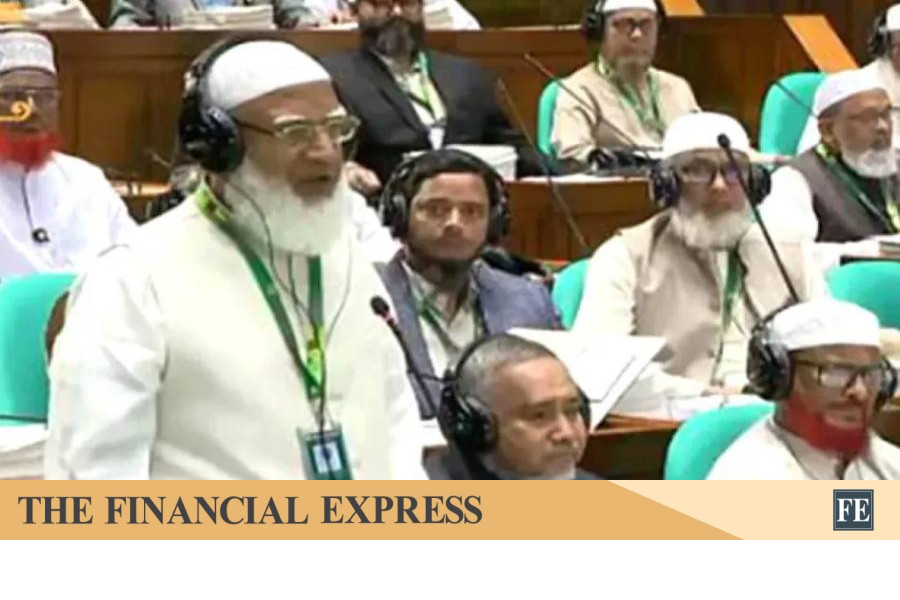
Bangladesh Jamaat-e-Islami MP on Monday elected from Narail-2 Ataur Rahman lashed out at the President’s recent address, suggesting the head of state has lost his independence to the ruling power.

Participating in the discussion on the motion of thanks on the President’s speech in Parliament, Ataur Rahman dismissed the praise offered by the treasury bench members, including those he referred to as his "friends", UNB reports.

He used a provocative metaphor to describe the President’s current standing, invoking the memory of late Salahuddin Quader Chowdhury.

The Jamaat MP stated that after listening to the speech, he felt that either the President’s spine had become much stronger or that someone had bent it, concluding that the latter seemed most accurate.

He expressed a total lack of "love from the heart" for the speech, accusing the President of providing a legal veneer to what he termed "fascism."

Ataur Rahman specifically highlighted the treatment of three-time former Prime Minister Begum Khaleda Zia, claiming the President legalised her "murder by keeping her in the dark of prison."

He added that he believed Begum Zia's soul would suffer immensely due to MPs thanking the President and urged them to take stock of their words.

The Jamaat lawmaker also referenced a previous interaction reported by Home Minister Salahuddin Ahmed regarding the implementation of the July National Charter.

He recounted a story where the President allegedly admitted to being forced into making specific orders, comparing the situation to a swan being forced to lay eggs.

Ataur Rahman argued that a swan that changes the colour of its eggs when the owner changes does deserve the gratitude of the house.

He observed that even their own colleagues often smile in scepticism when the treasury bench members’ praise becomes excessive.​
 

Pre-independence Jamaat and current Jamaat not the same: Golam Porwar

Correspondent
Cumilla
Published: 01 May 2026, 18: 56

1777680534630.webp


Jamaat-e-Islami Secretary General Mia Golam Porwar delivered the keynote speech as chief guest at a workers’ rally in Cumilla. He later spoke to journalists following the event. The programme was held at the Cumilla Town Hall ground at around 11:00 am on 1 May 2026. Prothom Alo

Jamaat-e-Islami Secretary General Mia Golam Porwar has said that the party today is not the same as it was before Bangladesh’s Liberation War in 1971.

He made the remarks while speaking to journalists after delivering the keynote address as chief guest at a workers’ rally organised by the Bangladesh Labour Welfare Federation at the Cumilla Town Hall ground at around 11:00 am on Friday.

“In the political context of the Pakistan period, there may be discussions about the policies and roles of political parties of that time. But many things have changed after independence. The Jamaat-e-Islami of that period and the Jamaat of today are not the same. There have been repeated changes in the party’s constitution, policies and methods,” Golam Porwar said.

He further said, “If you read the Jamaat’s constitution, you will see that in the introduction itself we have stated that we respect the struggle and sacrifices of the freedom fighters of the Great Liberation War. One cannot become a member of Jamaat-e-Islami without recognising the sacrifices made for the independence and sovereignty of this country. Despite such constitutional changes, when a section continues to raise this debate, it is not patriotism or love for independence. It is a foreign conspiracy aimed at dividing the nation.”

The Jamaat leader added, “The Leader of the Opposition and the Jamaat-e-Islami Ameer made a very constructive statement regarding the proposed bill on the definition of the Liberation War. He said we want to move away from politics that divides the nation. Even during the interim government, we had drawn attention to the fact that there were political motives behind this bill and that it should be amended. However, the definition has been changed repeatedly; it did not exist in this form under previous governments. Those who are active in dividing the nation are responsible for keeping it in this manner.”

Golam Porwar said, “Jamaat-e-Islami believes that in world history, political debates may exist, but no nation can move forward by repeatedly debating old issues 50 to 60 years after independence. The Ameer of Jamaat has said, ‘if we remain stuck in history, we can never create history’. Most members of the current parliament are young people born after independence. If you label them as anti-independence or razakars (collaborators), the public do not accept it; rather, it becomes a subject of ridicule.”

In his speech as chief guest at the rally, the Jamaat Secretary General said that although communism speaks about workers’ rights, in practice it has failed to establish them. Likewise, he argued, it is not possible to implement Islamic labour rights in a state dominated by western democracy, socialism, and nationalism.

An Islamic governance system is necessary to implement Islamic labour policies, he stated.

The rally was chaired by Rafiqur Islam, president of the Cumilla city unit of the Bangladesh Labour Welfare Federation. Special guests included central adviser Maulana ATM Masum, city unit chief adviser Kazi Din Mohammad, central adviser Maulana Yasin Arafat, and central vice-president Md Mujibur Rahman Bhuiyan.

The event was conducted by city unit secretary Zillur Rahman and assistant secretary Md Main Uddin Sarkar. Other speakers included labour leaders Aktaruzzaman, Md Shafiullah, Nizam Uddin, Kalim Ullah, Mohiuddin Ripon and others.​
 

Jamaat holds protest rally in Dhaka against fuel, power price hikes

UNB

Published :
Jun 04, 2026 22:23
Updated :
Jun 04, 2026 22:23

1780626648204.webp


Bangladesh Jamaat-e-Islami on Thursday staged a protest rally and demonstration in the capital against repeated increases in fuel and electricity prices, as well as the rising cost of essential commodities.

The programme, organised by the party's Dhaka city units, was held at the north gate of Baitul Mukarram National Mosque at around 5 pm.

Addressing the gathering as the chief guest, Jamaat Secretary General Mia Golam Parwar urged the government to curb corruption instead of increasing electricity tariffs.

He claimed that public dissatisfaction with the government had become evident within three months of its assumption of office and alleged that people were expressing frustration through slogans directed at ministers.

Parwar alleged that the government had failed to fulfil its election pledges and accused it of ignoring public opinion on various issues, including constitutional reforms and electricity pricing.

He said stakeholders at a recent public hearing had recommended against raising electricity prices, but the government was proceeding with plans to increase tariffs by nearly 17 percent.

The Jamaat leader called on the government to withdraw the proposed electricity price hike immediately.

Speaking as a special guest, Jamaat Assistant Secretary General Rafiqul Islam Khan alleged that the government had increased fuel prices twice within a month and raised gas prices earlier, contributing to inflationary pressure on consumers.

He also expressed concern over the country's law and order situation and criticised the appointment of the chairman of Islami Bank Bangladesh PLC, alleging that the appointee had previously resigned from a senior position at the central bank amid allegations of irregularities.

Rafiqul Islam Khan further accused the government of politicising state institutions and rehabilitating individuals linked to the former Awami League administration.

He urged the government to respect public opinion and avoid policies that, according to him, go against public interests.

The rally was conducted by Shafiqul Islam Masud. Among others, central executive council member Mubarak Hossain, Dhaka South Nayeb-e-Ameer Helal Uddin and Dhaka North Assistant Secretary Yasin Arafat addressed the gathering.

Following the rally, a procession marched from the north gate of Baitul Mukarram through Paltan intersection and Bijoynagar before ending at Kakrail. Party leaders claimed that thousands of activists participated in the demonstration.​
 

What lies behind the Jamaat chief's 'civil war' remark?

Tanim Ahmed

1782519211694.webp

VISUAL: STAR

It is customary for politicians to campaign against the other side: the opposition speaks against the government and the government against the opposition. It is not unusual for the opposition to wage strong campaigns against the government either. After all, the ultimate goal of any party is to highlight the shortcomings of the ruling party and win the next election. So, it is quite understandable that the incumbent leader of the opposition rails against the government in his public speeches. But when he says, as he did early this week, that they had accepted the February 12 election results just to keep a civil war from breaking out, it sits uncomfortably beyond the normal line of political rhetoric.

It means that Shafiqur Rahman, the chief of Jamaat-e-Islami, is hinting at something far more dangerous than just a political campaign. But before even getting there, one should perhaps first examine what is manifestly implied by the statement, “We don’t want disorder in the country. We love the country. With immense pain in our hearts, we accepted the election results. But let no one think that we accepted them out of fear; we did so to prevent the country from descending into a civil war.”

Here, the Jamaat leader is all but alleging that the election was rigged or, at least, that there were widespread irregularities. That is a rather curious suggestion to make more than four months after the national polls that were, by and large, acknowledged as peaceful, fair and participatory. Granted, Jamaat had sought a recount in 32 constituencies where they believed narrow defeats were the result of counting errors. However, that only came after the gazette was published and, notably, the party had not registered their complaint at the polling centres where they were supposed to. The results were not reversed. But Jamaat’s actions surrounding these seats, the timing of their protest, and the manner in which they did it have always belied that it was merely political theatre. Had they been sincere about the recounts, the party’s representatives would have protested at the polling centres and demanded recounts where they had the prerogative.

Instead, they waited until the gazette notification to file their complaint. Further, such an issue could have been raised at the election tribunal, where it could have been duly resolved, or at the dozens of public rallies since the election in such a forceful manner.

But now the Jamaat chief raises this issue again, indicating that the 32 seats were indeed significant. So significant that the party, in an alternate scenario, would put up a strong fight to secure what they deemed due—strong enough that it might lead the country down the path of a civil war.

That remark, besides revealing a disturbing proclivity for violence, also indicates something deeper. It shows that Jamaat is not quite the vocal opposition that we need in the interest of a vibrant parliament. It is conflating its own interests with those of the entire nation; why else would a civil war even be contemplated? The remark also betrays a confidence the Jamaat chief had that he could command enough forces that could be unleashed but were held back. Does it suggest that he might not next time? One is, therefore, wont to wonder what possible reason a political party could have to potentially possess such forces as to trigger a civil war.

Surely, the opposition leader is not trying to make himself so inconsequential that we roundly dismiss his public speeches as mere theatre? In that case, even floating the idea of such violence, especially so soon after the bloody political changeover of 2024, sounds irresponsible at best, and sinister at worst.

Shafiqur Rahman continued his speech to invoke his predecessors who, as he put it, had walked the gallows and smirked at the noose. These leaders, he said, had taught how to lay down one’s life for one’s country. These predecessors that the Jamaat leader invoked were hanged for war crimes during Bangladesh’s 1971 Liberation War. They had collaborated with the Pakistan Army and were punished for heinous crimes such as murder, arson and rape. Jamaat had actively opposed the liberation forces of Bangladesh in 1971 and the party’s leaders were hanged for their misdeeds. The party may well contest those war crimes trials and they may well question the entire legal process, but these verdicts have not been challenged at any competent court, let alone reversed. But when the current Jamaat leader threatens a civil war while invoking the very party leaders who had once opposed Bangladesh, it begs the question whether it is their ideals that he also champions.

Both Jamaat and its student wing have demonstrated time and again that neither is ready to wean themselves off their once-tainted past and former leaders when they hail those leaders as martyrs in photo exhibitions and propose condolence motions in parliament. Hence, when Shafiqur Rahman says he seeks forgiveness for the “mistakes” that his party members have made since 1947 (when Jamaat was founded), without clearly acknowledging their roles in 1971, it becomes difficult to accept that apology in good faith. Instead, those “semi-apologies” feel rather like attempts to placate public emotions. Jamaat has spent decades trying to shed their 1971 legacy but never turned around to face it head-on. Until they do, the albatross may continue to hang from their neck.

Regardless, Jamaat is currently the main opposition in parliament, which is a grave responsibility. As such, even the party’s staunchest detractors would like them to succeed in their role as a watchful and worthy opposition. This is also a unique opportunity for the party to serve the country. But vitriolic pronouncements like the above may fail them even as they have just embarked on this new journey. It does not suit the main opposition, nor does it bode well for the future of our democracy.

Tanim Ahmed is digital editor at The Daily Star.​
 

Latest Posts

Back