| Global Defense, OSINT & Geopolitics Wire

[🇧🇩] Press Freedom in Bangladesh

[🇧🇩] Press Freedom in Bangladesh
85
5K
More threads by Saif

G Bangladesh Defense

Targeted intimidation of media disconcerting
26 November, 2024, 00:00

THE untoward incident of chaos and anarchy in front of the office of the daily Prothom Alo is deeply concerning. As reported in New Age on November 24, a group of individuals, some of them identifying themselves as ‘anti-India protesters,’ staged a sit-in programme in front of the Prothom Alo office and also tried to block the surrounding roads, including the road to the city’s largest kitchen market in Kawran Bazar. In the evening, when the protesters tried to slaughter a cow and prepare a meal blocking the entryway of the Prothom Alo and obstructing vehicular movement to the kitchen market, police charged batons and lobbed teargas and sound grenades, which left at least 10 protesters injured. A similar sit-in protest was attempted in front of the Daily Star office. On November 22, the protesters similarly demonstrated in front of the Daily Star office. They alleged that India was dominating Bangladesh in various ways, and the newspapers were working as ‘India’s agents.’ It is unfortunate that a 10-year-old boy was injured in the police action, but the protesters’ way of expressing their displeasure with the newspapers is also disconcerting. The protesters relied on physical intimidation, which amounts to an attempt at silencing an opinion that the group does not ideologically approve.

Ideological opposition to a foreign policy or an opinion against an unequal political-economic relationship with the government of a neighbouring country should be raised and debated, and it is all the more important at a time when democratic transformation is high on Bangladesh’s agenda. The protesters claimed to challenge the India appeasement policy that the deposed Awami League government had pursued and alleged that the Prothom Alo and the Daily Star have served the interest of India. However, taking the path of physical intimidation targeting particular media is rather worrying because, by doing so, the protesters appear to have resorted to somewhat similar authoritarian tools that the AL deployed to muzzle opinions critical of their policies. Instead of mobilising public opinion or relying on other civil means to discuss the many issues contributing to the unequal India-Bangladesh relationship, including unresolved transboundary river water sharing with India, the Indian Border Security Force’s unabated border killings, and numerous unfair economic agreements with India, especially in the energy sector, the protesters have created chaos and public nuances in front of the two newspaper offices. Such targeted intimidation of media is absolutely unacceptable, and the group involved in the said protest should give it a second thought.

It is, however, assuring that the government has taken early steps to protect the press, played a proactive role in containing the situation, and the law enforcers exercised relative restraint when dispersing the protesters. The group taking part in the protest denouncing the opinion of the two newspapers ought to reconsider their direct action strategies.​
 

Troublemakers are out to destroy press freedom: Mirza Fakhrul
BSS
Published :
Nov 26, 2024 20:39
Updated :
Nov 26, 2024 20:55

1732667748276.webp


Bangladesh Nationalist Party (BNP) Secretary General Mirza Fakhrul Islam Alamgir has said some troublemakers and instigators are making evil attempts to destroy freedom of the press and freedom of expression.

“It is very unfortunate that a dangerous matter has begun, which is launching attack on newspapers and attack on freedom of expression for which we have always struggled and fought,” he said while speaking at a book launching ceremony in a Gulshan hotel in Dhaka on Tuesday.

Fakhrul said: “Today we are witnessing that some troublemakers and instigators have resorted to impede and destroy the freedom of press. Any conscious or patriotic person cannot accept such attempts by any means“.

The BNP secretary general urged all, who are making such attempts, to get rid of this “suicidal path” and extend cooperation to the government to give democracy an institutional shape.

He said the country’s media enjoyed the highest level of freedom during the tenure of BNP from 2001-2006.

A book titled “Tarique Rahman: Politics and Policies Contemporary Bangladesh”, authored by writer, journalist and researcher Mohammad Zainal Abedin, was launched on the event with former Speaker of the Jatiya Sangsad and BNP Standing Committee member Barrister Jamiruddin Sircar in the chair.

About the recent clashes of students in the capital, Mirza Fakhrul urged all to remain patient and extend cooperation to the interim government.

“If the government fails, the revolution and mass uprising will also fail. And again, we will fall in darkness. So, we will have to think positively over these issues,” he said.

Mentioning the remarks of BNP Acting Chairman Tarique Rahman over the reform programme, Fakhrul said BNP is not opposing the reforms. “Reforms must be done.

We want to go for election following minimum required reforms. ” he added.

About why he is repeatedly talking about elections, he said without elections, many problems cannot be resolved and many challenges cannot be faced.

The BNP secretary general said an elected government can face many challenges with people’s mandate.

About the current situation of the country, Fakhrul said: “Today many people are becoming anxious and concern about what is happening in the country. Actually, we have to understand that our enemies, who left from our front but they are creating unrest again in the country from behind the scene. We all will have to remain alert to this end”.

Fakhrul said BNP Chairperson and two-time Prime Minister Begum Khaleda Zia and her family members, including Acting Chairman Tarique Rahman, had to endure severe and inhumane physical and mental torture since the political changeover of one-eleven as well as during the previous Awami League regime.

Khaleda Zia was sent to jail in false cases during the AL regime while Tarique Rahman was forced to leave the country by giving false cases but they never gave up and bowed down head rather they continued their struggle, he said.

The BNP secretary general said Tarique Rahman has been leading the party with his organizational efficacy and democratic mindset since Begum Zia was sent to jail in false cases.

About maintaining democracy inside the party, he said Tarique Rahman has been holding regular meetings with the party leaders for drawing up programmes of the party and taking any policy decision and maintaining contact with party workers at grassroots, including union level.

It has been possible to oust the Sheikh Hasina’s regime in students-led mass uprising, he said, adding that, “I think Tarique Rahman has the highest contributions to this end. He organized and inspired the nation for long. At the final stage of the mass uprising, he always kept communication with all (stakeholders), even the coordinators.”

Around 422 leaders and activists of Chhatra Dal, Jubo Dal and different other organizations of the party embraced martyrdom during the mass uprising, he mentioned.

About the struggle and sacrifice of BNP during the AL regime, he said 60 lakh leaders and activists faced false cases, 20,000 partymen were killed, over 700 others including BNP MPs became victims of enforced disappearance.

Veteran journalist Shafik Rehman, writer of the book Mohammad Zainal Abedin, Honorary Professor of Department of Oriental Art of Fine Arts Faculty of Dhaka University Dr. Md. Abdus Sattar, Jahangirnagar University Vice-Chancellor Prof Mohammad Kamrul Ahsan, Bangladesh Open University Pro-Vice-Chancellor (Academic) Dr. Dil Rowshan Zinnat Ara Nazneen and academician Mubashar Hasan, spoke on the occasion, among others.

Senior BNP leaders, academics, civil society figures also joined the event.​
 

RSF condemns attacks on Daily Star, Prothom Alo

1732753001264.webp


Reporters Without Borders (RSF) has strongly condemned attacks on the offices of two prominent independent newspapers in Bangladesh, The Daily Star and Prothom Alo.

The press freedom organisation urged authorities to end such acts of intimidation and work towards rebuilding a safe and pluralistic media environment in the country.

"RSF condemns the unacceptable attacks and attempts of intimidation against The Daily Star and Prothom Alo. The two newspapers tried to maintain their independence at all costs under Sheikh Hasina's authoritarian regime, despite the legal harassment they suffered in retaliation. It is now up to the interim government to help them to work freely, without restrictions or harassment," said Celia Mercier, head of RSF's South Asia Desk.

"An impartial, thorough investigation into the instigators and perpetrators of the recent violent attacks -- and the necessary subsequent legal proceedings -- are crucial to curbing the development of an unsafe work environment for journalists," she added.

In its report, RSF highlighted multiple incidents of violence targeting these newspapers, with coordinated attacks carried out on their headquarters in Dhaka and several regional offices. In Rajshahi, around 200 protestors attempted to storm Prothom Alo's office, vandalising its signboard.

RSF said the attacks are orchestrated by "radicalised anti-India religious groups," who accused the newspapers of being "agents of India and promoting values contrary to Islam.

The attackers issued demands for the newspapers to shut down unless they issued public apologies and retracted their allegedly "anti-Islamic" stances. A concurrent smear campaign on social media further fueled hostility toward the media outlets.

RSF emphasised the urgent need for Bangladesh's interim government to implement reforms to safeguard journalists.​
 

Assaults on media houses deeply alarming
Authorities must act decisively to protect press freedom

1732754315602.webp

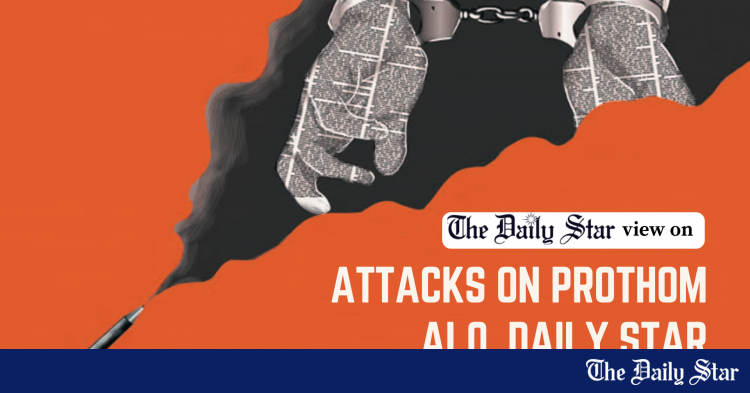
VISUAL: STAR

We're deeply concerned about the ongoing threats to press freedom as epitomised by the spate of attacks, vandalism, hostile mobilisations, and inflammatory rhetoric targeting Prothom Alo and The Daily Star. This is a rude awakening for those who expected the culture of intimidation and repression against journalists to recede with the ouster of an autocratic regime—which, over 14 years, saw Bangladesh's position plummet 42 notches on the World Press Freedom Index. Instead, threats to the media appear to be intensifying in the current political climate, with coordinated campaigns aiming to stoke hostility against media houses that have long stood as pillars of independent journalism. This raises troubling questions about the future of the press in Bangladesh.

The campaign against Prothom Alo has been particularly vociferous since October 25, when a group announced plans to lay siege to its head office in Karwan Bazar but failed to mobilise. Later, starting last Thursday, protesters held sit-ins and caused disorder outside the office for several days, prompting law enforcement to intervene. On Monday, two of the paper's regional offices came under attack: masked individuals vandalised its signboard and windows in Bogura, while in Rajshahi, a group attempted to break into its office, destroyed its signboard, and burned copies of Prothom Alo and The Daily Star. Hostile gatherings against both papers were also reported in Chattogram, Sylhet, Barishal, Chandpur, Munshiganj, and at Savar's Jahangirnagar University. On Friday, a group also demonstrated in front of The Daily Star's head office.

While we welcome and indeed look forward to any constructive criticism of the media—which can be a learning experience for journalists—the current campaign, rooted in neither truth nor reason, offers no such opportunity. No credible grievances or evidence have been presented to justify these attacks and disruptions. Instead, they appear driven by an agenda to discredit independent media and deter it from fulfilling its watchdog role, exploiting the fluid security situation. As the Editors' Council and the Newspaper Owners' Association of Bangladesh (Noab) have rightly pointed out, any objections to the news or editorial policy of a newspaper can be expressed constructively, through writing. There are also legal means available to anyone feeling aggrieved. Even peaceful protests are permissible. But intimidation or violence targeting newspapers—and by extension their staff—are not only unacceptable but also a disservice to the democratic aspirations of the July uprising.

We are, however, encouraged by the solidarity shown by various platforms amid ongoing assaults. Government officials, including the information adviser, have also condemned this wave of aggression, vowing to prevent any unlawful activities to silence the media. We hope these assurances will be matched by swift action to create a secure environment for journalists, and that those behind ongoing assaults will be held accountable. The anti-media campaign coincides with the ongoing trend of disruptive activities by various errant groups, highlighting the complex challenges facing the pro-uprising forces. It is, therefore, imperative that civil society, political leaders, and the public stand united in protecting our hard-earned freedoms.​
 

Political parties strongly endorse press freedom
Call for an end to intimidation of the media during talks with Noab

1732839174881.webp

Participants at a views exchange meeting with political leaders on recent attacks on independent journalism and media outlets. The event was organised by the Newspaper Owners Association of Bangladesh at the Sonargaon hotel in Dhaka yesterday. Photo: Rashed Shumon

Political parties yesterday expressed their unwavering support for press freedom, highlighting its vital role in strengthening democracy and securing the nation's future.

They blasted the recent attacks on the press and called for an immediate end to such activities. They also cautioned that if such activities go on, the aspirations of the July uprising would not be fulfilled.

Top leaders of 13 political parties made these remarks at a views-exchange meeting on "Independent Journalism and Media Institutions Under Threat".

The Newspaper Owners' Association of Bangladesh (Noab) organised the programme at the Pan Pacific Sonargaon Hotel.

Speaking at the event, BNP Secretary General Mirza Fakhrul Islam Alamgir said it is quite unfortunate that he had to discuss press freedom in a free environment after the fall of a fascist regime.

"Over the last 15 years, people, including political activists, had been in constant fear of being sued or landing in jail for writing in newspapers or speaking out. It is unfortunate that even after a mass uprising, attacks on media outlets remain a concern," he said.

He said the BNP always fought for freedom of speech, right to vote, and democracy.

"Some people are attempting to divide the people. Certain remarks are being made that could lead to complete anarchy. Together, we must stop this; or else, the sacrifices of the students and the masses will go in vain."

Fakhrul pointed out that certain actions lead to depoliticisation at times, which must be consciously avoided. He said that an elected government is the best option, but imposing control on it or on democracy is unacceptable.

"Creating anarchy or acting recklessly would lead the nation towards the gravest danger."

Urging caution, he warned against taking actions that could allow the ousted prime minister Sheikh Hasina to manipulate incidents from abroad and this would ultimately spoil the opportunity to rebuild the nation.

He reaffirmed his party's commitment to protect freedom of the press, freedom of expression, and voting rights at all costs.

Andaleeve Rahman Partho, chairman of Bangladesh Jatiya Party, said it is not unlikely that press freedom would be under threat after the fall of such a fascist regime.

He said that when the interim government assumed office on August 8, the media outlets had said that the government should stay in power for two to three years. "They also said there is no difference between an Awami League government and that of the BNP's, and that the two parties are two sides of the same coin. This view of the media hurts us."

Partho said no one should think that if one government is replaced by another one, nothing will change. "Thinking along such line is another form of fascism."

"It is ultimately up to the people to decide. A gap has been created between political parties, the government, and the media. Many have tried to capitalise on this gap."

He also said the interim government has failed to keep in touch with the people.

"Had the government maintained more matured informal and formal relationships with the political parties, these problems would not have arisen."

Terming the incumbent government a weak government, Partho said no one can expect they would be protected by such a weak administration.

"Only a people's government, be it good or bad, can be held accountable. A political government can stand by the media and protect it."

Hamidur Rahman, assistant secretary general of Jamaat-e-Islami, said democracy and independent journalism are intrinsically linked.

He said his party thinks any attempt to weaken independent journalism is a conspiracy to undermine the state.

"Such actions constitute a new conspiracy aimed at obstructing the path of democracy and paving the way for the return of old fascism."

Highlighting Jamaat's continued support for independent journalism, Hamidur said, "Arson and other attacks and vandalism targeting newspaper offices are regrettable. We do not support such activities."

He called for a national consensus to address any such crisis.

Nagorik Oikya President Mahmudur Rahman Manna said, "When you talk about practising inclusive politics and democracy, you will also have to accept the idea of letting a hundred flowers to bloom. You cannot gag any opinion. Democracy is undoubtedly the rule of the majority, but at the same time, you must also acknowledge you cannot muzzle the minority communities."

He said every opinion must be allowed to be expressed.

"From this perspective, I believe that be it the Prothom Alo, The Daily Star, or any other newspaper or TV channel, they must be granted full freedom. If we cannot foster the expression of diverse opinions freely, it will be difficult for us to move forward."

Zonayed Saki, chief coordinator of Ganosamhati Andolon, said press freedom was the "key verdict" of the 1971 Liberation War and the 2024 mass uprising.

"For that, we need to stand for the media and its rights. Even if a media outlet is ideologically opposed to me, I will stand for its rights as well."

He said he believes there should be one standard for everyone.

"Even if we do not consider a particular media outlet ideologically correct, it still has the right to exist as a media entity. Ideological and political debates will continue, but committing a nuisance in front of a newspaper office aligns with fascist practices. Shutting a media outlet is an extension of this approach, and everyone should realise this."

Saki said there can be criticisms, and ideological differences among the people, but their freedom of speech should not be obstructed by any means.

"These issues should be clearly mentioned in the constitution in future."

There should be no compromise on press freedom because people rely on the media, he added.

Nasiruddin Patwary, convener of the Jatiya Nagorik Committee, called for unity among the stakeholders to resolve the problems facing the media through dialogue.

"Those who have resentment or complaints about any particular media outlet can resolve those issues through discussions," he said.

Nasir urged the media owners, workers, political figures, and all other stakeholders to come to a common platform so that no media house in the country would fall victim to aggression.

"Wherever there is an attack, we will collectively stand against it," he added.

Bazlur Rashid Firoz, general secretary of Bangladesh Samajtantrik Dal, said attacks on newspapers and media outlets are effectively assaults on democracy and the mass uprising of 2024. "To counter these attacks, we must unite and move forward collectively."

Saiful Haque, general secretary of Biplobi Workers Party, described the slaughter of a cow for a feast in front of a newspaper office as an unbelievable, unimaginable and worrying act.

Condemning the incident, he said, "The question of who was behind this remains unaddressed. Who will uncover this? There must be provocation and instigation behind it."

Communist Party of Bangladesh General Secretary Ruhin Hossain Prince criticised the arbitrary cancellation of the accreditation cards of some journalists and filing of murder cases against some others.

He said people must stand united against the attacks on the media.

Rashed Khan, general secretary of Gono Odhikar Parishad, said his party strongly believes in freedom of speech and freedom of press.

"If the journalists cannot write independently even after the mass uprising, it would be deeply saddening."

He said the media did not play its due role over the past 15 years, and the authorities should investigate into this failure.

Mujibur Rahman Manju, member secretary of Amar Bangladesh (AB) Party, highlighted a "gap" between the media stakeholders and those protesting against some media outlets.

"It was the government's responsibility to engage with the demonstrators outside the Prothom Alo office. What could have been resolved through discussion has instead been allowed to evolve into an ideological or commercial issue."

Manju suggested that the Media Reform Commission or the Noab make recommendations to prevent such incidents.

Maulana Imtiaz Alam, assistant secretary general of Islami Andolan Bangladesh, said, "We believe in freedom of the media and we want to assist them. However, the media also need to make sure it do not write or say anything that goes against the belief of the majority. The media also need to show respect to our belief."

Jalaluddin Ahmed, joint secretary general of Bangladesh Khelafat Majlish, urged the owners of media outlets not to discriminate between political parties while running news on them.

Reading out a written statement, Noab President AK Azad expressed deep concern that at a time when media outlets should be operating in a pressure-free environment after the mass uprising, some newspapers and media houses are still facing threats, and even warnings of closure.

He said incidents such as laying siege to newspaper offices in the name of protests, creating chaos, attacking regional offices, and obstructing the distribution of newspapers in different parts of the country are totally unacceptable.

These actions are fostering an atmosphere of fear and intimidation, posing a serious threat to press freedom, he said.

"The actions and campaigns against the Prothom Alo and The Daily Star are not merely protests or expression of dissent, rather those involve issuing threats, making provocative statements, spreading hatred, creating chaos outside their offices, and resorting to violence whenever possible. Such actions are causing financial losses to the newspaper industry."

Azad stressed the need for taking strong measures against such undemocratic activities that threaten press freedom.

He said the safety of the media outlets and their employees must be ensured at all costs.

The Noab leader called upon all political parties to assist and cooperate with the media to safeguard press freedom.

Mahfuz Anam, executive member of Noab and also the president of the Editors' Council, said the media want to see an end to the oppressive measures taken to suppress independent journalism and stifle the press over the last 15 years.

He said the media had hoped that the situation would improve after the mass uprising, allowing journalists to carry out their duties freely and independently.

"Unfortunately, independent journalism is being attacked in new ways, which is highly condemnable and alarming. We believe political parties play a significant role in supporting independent journalism," said Anam, also the editor and publisher of The Daily Star.

He urged political parties to ensure press freedom.

Muntasir Ali, joint secretary general of Khelafat Majlish, also spoke at the event.

Khalekuzzaman, adviser of Basod; Maj (retd) Abdul Wahab, convener of AB Party; Jahangir Hossain, senior joint secretary general of Khelafat Majlish, and its Joint Secretary General Mahabubul Haque; and Abdul Kaiyum, central publicity affairs secretary of Islami Andolan Bangladesh, were present at the meeting, moderated by Dewan Hanif Mahmud, editor and publisher of daily Bonik Barta.

Shahidullah Khan Badal, Noab vice-president and publisher of New Age; Matiur Rahman, editor and publisher of Prothom Alo; Nurul Kabir, editor of New Age; Altamash Kabir, editor of Dainik Sangbad; Saiful Alam, editor of daily Jugantor; Shamsul Haque Zahid, editor of Financial Express; Mozammel Haque, editor of daily Karatoa; and Mostafa Mamun, editor of Desh Rupantar, were also present.​