Bangladesh Defense

Saif
Senior Member
- Joined
- Jan 24, 2024
- Messages
- 21,818
- Likes
- 9,805
- Nation

- Residence
- Axis Group

The price of climate finance
An embankment can prevent enormous losses without earning a taka to repay the loan that built it. That distinction—between an investment’s value to society and the cash available to service its debt—should be at the centre of Bangladesh’s climate finance agenda at COP31. [Of
The price of climate finance
Bangladesh's COP31 agenda
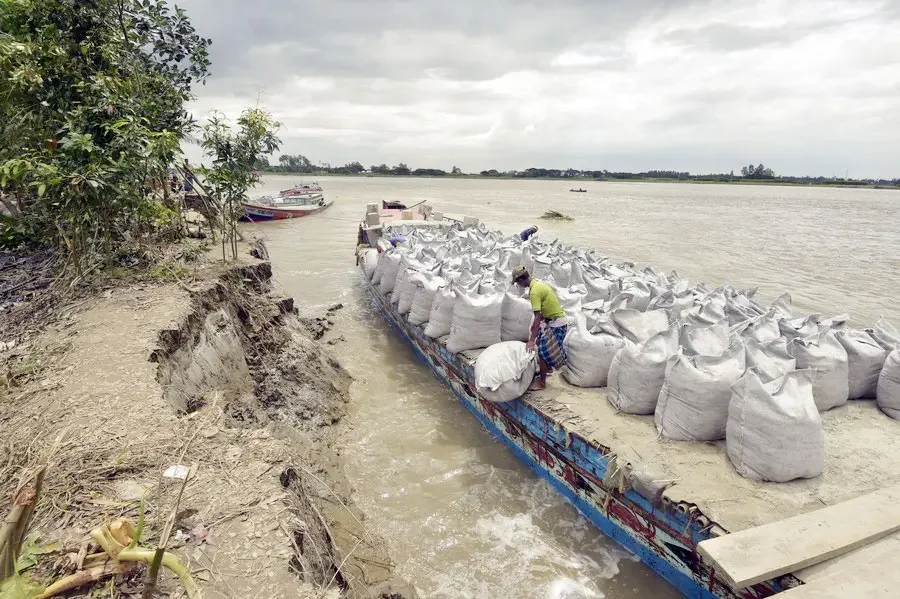
A man throws sandbags into the river to prevent river erosion in Munshiganj district, Bangladesh, September 19, 2022. The country is highly climate vulnerable —Xinhua Photo
An embankment can prevent enormous losses without earning a taka to repay the loan that built it. That distinction—between an investment’s value to society and the cash available to service its debt—should be at the centre of Bangladesh’s climate finance agenda at COP31. [Officially, COP31 stands for the 31st meeting of the Conference of the Parties (COP) to the UN Framework Convention on Climate Change (UNFCCC), a landmark international treaty agreed in 1992, and parent treaty to the 2015 Paris Agreement.]
At the recent Pre-COP31 meetings in Fiji, Pacific representatives made a related point: countries facing rising climate costs cannot borrow their way out of every threat. This scribe joined those discussions with colleagues from Monash University’s Pacific Action for Climate Transitions (PACT). As the scribe prepares to travel with Monash’s delegation to COP31 in Antalya, Türkiye, he is thinking about what each financing offer would mean for Bangladesh’s public budget and for the households that ultimately bear the costs.
This scribe grew up in Khulna, near the Sundarbans, and his research on recovery after Cyclone Aila in the same region has brought those household costs into focus. When support is delayed, families may face difficult choices between meeting immediate needs and preserving the assets on which future earnings depend. Climate finance should reduce the need to make such choices.
Climate-related losses extend beyond damaged infrastructure. UNICEF reported that extreme weather disrupted schooling for 35 million children in Bangladesh in 2024—a reminder that financing decisions must consider human capital as well as physical assets.
Look beyond the headline amount: Bangladesh should ask of each financing offer: what are the terms, when will funds arrive, and who carries the risk?
A grant and a loan with the same face value are not equivalent. Even a concessional loan creates repayment obligations. A foreign-currency loan can become more expensive in taka if the exchange rate moves adversely. A long grace period postpones repayments; it does not eliminate them.
This does not make all climate borrowing inappropriate. Investments that generate reliable savings or revenues may justify concessional debt. However, the financing decision must distinguish between an economic return to society and the cash available to repay a lender. An embankment may prevent substantial losses without generating revenue, but its debt service must still be funded by taxes or other public resources.
Bangladesh should therefore prioritise grants for essential adaptation that benefits poor communities. If borrowing is proposed, the appraisal should assess repayment capacity under additional climate shocks and the expected benefits. It should also include maintenance costs: infrastructure without a funded maintenance plan can become another liability.
Negotiators should also ask whether a promised contribution is new or a repackaging of an existing aid budget. Shifting funds from health or education into a climate category may inflate the reported climate total without providing Bangladesh with additional resources. Donors should clarify the baseline for their claims.
The same discipline applies to private capital. Energy efficiency, storage, and productive enterprises may attract investors, but many protective services will not. Public guarantees can encourage investment, but they also create contingent liabilities for the state. Before offering a guarantee, the government should establish why support is needed, what private investors will contribute, and how much taxpayers could lose.
Take a financing program to Antalya: COP31 can shape international commitments and build relationships with funders, but it cannot replace prepared proposals. Negotiating ambition and project preparation must proceed in tandem. [[COP31, the United Nations Climate Change Conference, is taking place in Antalya, Türkiye from 9 to 20 November 2026.]
Bangladesh should present a small set of costed programs with clear implementation responsibilities and financing requirements. These programs should distinguish investments with credible repayment capacity from essential services that require grants. Coastal water security, resilient housing, and drainage deserve attention, including provisions for maintenance.
National institutions already have relevant experience. PKSF’s coastal homestead and livelihood project, backed by a US$42.2 million Green Climate Fund grant, shows one route for financing locally led adaptation. Bangladesh should build on that experience by seeking preparation grants and sustained in-house technical capacity rather than repeatedly commissioning disconnected studies.
Finance officials, sector agencies, and local authorities should agree on costs and delivery responsibilities before approaching funders. Delays can lead to missed construction seasons or revised estimates as costs rise. Bangladesh should identify bottlenecks in international review, domestic approval, and procurement.
In Antalya, negotiators should seek support during preparation and establish clear review milestones. Once agreements are finalized, payment schedules should reflect realistic implementation plans. A pledge, an approval, and a payment are separate stages, and reports should clearly distinguish between them.
Arrange support before losses deepen: Bangladesh’s shelters, warning systems, and volunteers have significantly improved cyclone protection. Protecting livelihoods also requires sustained investment.
Timing can be as important as financing terms. Cash arriving after a family has sold its productive assets may relieve hunger but do less to preserve its livelihood. Bangladesh already has experience with anticipatory assistance. A joint report by the World Food Program and the Ministry of Disaster Management and Relief records 15 activations in 2024, reaching nearly 430,000 people across 20 districts ahead of floods, cyclones and heatwaves.
Bangladesh needs to seek funding to expand arrangements that release support based on agreed forecasts and triggers. These arrangements require reliable early warnings, identified recipients, and payment systems ready to operate. Contingency provisions are also needed for households whose losses are not captured by a trigger. Such arrangements can complement, but not replace, longer-term adaptation and recovery finance.
Some losses remain despite preparation. The destruction of homes and livelihoods requires support beyond immediate relief.
The Fund for responding to Loss and Damage offers a path, though its resources remain limited. Its first funding round raised US$342 million. By the close of the application window, 119 countries had submitted 176 funding requests totalling about US$2.8 billion. Demand far exceeds available resources.
Working with other vulnerable countries, Bangladesh should press for predictable replenishment and accessible procedures while preparing evidence for its own requests. That evidence must include losses beyond damaged buildings and crops. Lost work, disrupted schooling, and relocation costs are harder to document but critical to recovery.
The government should disclose the status of all previously submitted requests and identify who is responsible for follow-up. The fund covers both slow-onset losses and extreme events. Bangladesh should develop proposals to address salinity and deteriorating freshwater supplies rather than treating every funding opportunity as a response to the latest cyclone.
Measure finance by what it delivers: International access is only part of the problem. My research on housing reconstruction assistance after Aila found that political connections were associated with bribery and missing grant funds. Funds reaching an affected locality did not ensure fair allocation and delivery to households.
Delivery arrangements belong in financial design. Budget from the outset for publishing eligibility criteria, accessible complaint procedures, and independent checks. Electronic payments may leave a clearer record, but fair delivery starts with who is included on the list.
A national climate-finance register should record funding sources, instruments, terms, implementing agencies, disbursements, and results. The finance ministry needs a consolidated view of loans, repayment schedules, and guarantees, including contingent liabilities that become payable if specified events occur. Public reporting should track delivery without exposing households’ personal information.
Pacific countries and Bangladesh can cooperate on these demands despite their different circumstances. Both have an interest in grant-based adaptation, predictable financing, and stronger emissions reductions. More borrowing cannot indefinitely offset rising climate risks.
Bangladesh should arrive in Antalya with a clear account of its financing needs and obligations, costed programs matched to appropriate funding, and proposals to accelerate support to households. For families in southwestern districts such as Khulna and Satkhira, success means fewer assets sold under pressure and less borrowing simply to survive until earnings recover.
Asad Islam is Professor of Economics and a Professorial Fellow at Pacific Action for Climate Transitions (PACT), Monash University.
Bangladesh's COP31 agenda
A man throws sandbags into the river to prevent river erosion in Munshiganj district, Bangladesh, September 19, 2022. The country is highly climate vulnerable —Xinhua Photo
An embankment can prevent enormous losses without earning a taka to repay the loan that built it. That distinction—between an investment’s value to society and the cash available to service its debt—should be at the centre of Bangladesh’s climate finance agenda at COP31. [Officially, COP31 stands for the 31st meeting of the Conference of the Parties (COP) to the UN Framework Convention on Climate Change (UNFCCC), a landmark international treaty agreed in 1992, and parent treaty to the 2015 Paris Agreement.]
At the recent Pre-COP31 meetings in Fiji, Pacific representatives made a related point: countries facing rising climate costs cannot borrow their way out of every threat. This scribe joined those discussions with colleagues from Monash University’s Pacific Action for Climate Transitions (PACT). As the scribe prepares to travel with Monash’s delegation to COP31 in Antalya, Türkiye, he is thinking about what each financing offer would mean for Bangladesh’s public budget and for the households that ultimately bear the costs.
This scribe grew up in Khulna, near the Sundarbans, and his research on recovery after Cyclone Aila in the same region has brought those household costs into focus. When support is delayed, families may face difficult choices between meeting immediate needs and preserving the assets on which future earnings depend. Climate finance should reduce the need to make such choices.
Climate-related losses extend beyond damaged infrastructure. UNICEF reported that extreme weather disrupted schooling for 35 million children in Bangladesh in 2024—a reminder that financing decisions must consider human capital as well as physical assets.
Look beyond the headline amount: Bangladesh should ask of each financing offer: what are the terms, when will funds arrive, and who carries the risk?
A grant and a loan with the same face value are not equivalent. Even a concessional loan creates repayment obligations. A foreign-currency loan can become more expensive in taka if the exchange rate moves adversely. A long grace period postpones repayments; it does not eliminate them.
This does not make all climate borrowing inappropriate. Investments that generate reliable savings or revenues may justify concessional debt. However, the financing decision must distinguish between an economic return to society and the cash available to repay a lender. An embankment may prevent substantial losses without generating revenue, but its debt service must still be funded by taxes or other public resources.
Bangladesh should therefore prioritise grants for essential adaptation that benefits poor communities. If borrowing is proposed, the appraisal should assess repayment capacity under additional climate shocks and the expected benefits. It should also include maintenance costs: infrastructure without a funded maintenance plan can become another liability.
Negotiators should also ask whether a promised contribution is new or a repackaging of an existing aid budget. Shifting funds from health or education into a climate category may inflate the reported climate total without providing Bangladesh with additional resources. Donors should clarify the baseline for their claims.
The same discipline applies to private capital. Energy efficiency, storage, and productive enterprises may attract investors, but many protective services will not. Public guarantees can encourage investment, but they also create contingent liabilities for the state. Before offering a guarantee, the government should establish why support is needed, what private investors will contribute, and how much taxpayers could lose.
Take a financing program to Antalya: COP31 can shape international commitments and build relationships with funders, but it cannot replace prepared proposals. Negotiating ambition and project preparation must proceed in tandem. [[COP31, the United Nations Climate Change Conference, is taking place in Antalya, Türkiye from 9 to 20 November 2026.]
Bangladesh should present a small set of costed programs with clear implementation responsibilities and financing requirements. These programs should distinguish investments with credible repayment capacity from essential services that require grants. Coastal water security, resilient housing, and drainage deserve attention, including provisions for maintenance.
National institutions already have relevant experience. PKSF’s coastal homestead and livelihood project, backed by a US$42.2 million Green Climate Fund grant, shows one route for financing locally led adaptation. Bangladesh should build on that experience by seeking preparation grants and sustained in-house technical capacity rather than repeatedly commissioning disconnected studies.
Finance officials, sector agencies, and local authorities should agree on costs and delivery responsibilities before approaching funders. Delays can lead to missed construction seasons or revised estimates as costs rise. Bangladesh should identify bottlenecks in international review, domestic approval, and procurement.
In Antalya, negotiators should seek support during preparation and establish clear review milestones. Once agreements are finalized, payment schedules should reflect realistic implementation plans. A pledge, an approval, and a payment are separate stages, and reports should clearly distinguish between them.
Arrange support before losses deepen: Bangladesh’s shelters, warning systems, and volunteers have significantly improved cyclone protection. Protecting livelihoods also requires sustained investment.
Timing can be as important as financing terms. Cash arriving after a family has sold its productive assets may relieve hunger but do less to preserve its livelihood. Bangladesh already has experience with anticipatory assistance. A joint report by the World Food Program and the Ministry of Disaster Management and Relief records 15 activations in 2024, reaching nearly 430,000 people across 20 districts ahead of floods, cyclones and heatwaves.
Bangladesh needs to seek funding to expand arrangements that release support based on agreed forecasts and triggers. These arrangements require reliable early warnings, identified recipients, and payment systems ready to operate. Contingency provisions are also needed for households whose losses are not captured by a trigger. Such arrangements can complement, but not replace, longer-term adaptation and recovery finance.
Some losses remain despite preparation. The destruction of homes and livelihoods requires support beyond immediate relief.
The Fund for responding to Loss and Damage offers a path, though its resources remain limited. Its first funding round raised US$342 million. By the close of the application window, 119 countries had submitted 176 funding requests totalling about US$2.8 billion. Demand far exceeds available resources.
Working with other vulnerable countries, Bangladesh should press for predictable replenishment and accessible procedures while preparing evidence for its own requests. That evidence must include losses beyond damaged buildings and crops. Lost work, disrupted schooling, and relocation costs are harder to document but critical to recovery.
The government should disclose the status of all previously submitted requests and identify who is responsible for follow-up. The fund covers both slow-onset losses and extreme events. Bangladesh should develop proposals to address salinity and deteriorating freshwater supplies rather than treating every funding opportunity as a response to the latest cyclone.
Measure finance by what it delivers: International access is only part of the problem. My research on housing reconstruction assistance after Aila found that political connections were associated with bribery and missing grant funds. Funds reaching an affected locality did not ensure fair allocation and delivery to households.
Delivery arrangements belong in financial design. Budget from the outset for publishing eligibility criteria, accessible complaint procedures, and independent checks. Electronic payments may leave a clearer record, but fair delivery starts with who is included on the list.
A national climate-finance register should record funding sources, instruments, terms, implementing agencies, disbursements, and results. The finance ministry needs a consolidated view of loans, repayment schedules, and guarantees, including contingent liabilities that become payable if specified events occur. Public reporting should track delivery without exposing households’ personal information.
Pacific countries and Bangladesh can cooperate on these demands despite their different circumstances. Both have an interest in grant-based adaptation, predictable financing, and stronger emissions reductions. More borrowing cannot indefinitely offset rising climate risks.
Bangladesh should arrive in Antalya with a clear account of its financing needs and obligations, costed programs matched to appropriate funding, and proposals to accelerate support to households. For families in southwestern districts such as Khulna and Satkhira, success means fewer assets sold under pressure and less borrowing simply to survive until earnings recover.
Asad Islam is Professor of Economics and a Professorial Fellow at Pacific Action for Climate Transitions (PACT), Monash University.