Home Watch Videos Wars Movies Login

[🇧🇩] Save the Rivers/Forests/Hills-----Save the Environment

[🇧🇩] Save the Rivers/Forests/Hills-----Save the Environment
528
14K
More threads by Saif

G Bangladesh Defense

Climate victims testify at Americas rights court in historic case

Activists and residents hold a banner reading 'Climate emergency' while standing near houses destroyed by rising sea levels, forcing villagers to relocate, in El Bosque, Mexico November 7, 2022.

From Mexicans left homeless by rising seas to Colombians affected by coral bleaching, hundreds of people are telling the top human rights court in the Americas what climate change means to them in a historic case that could shape international law.

Environmental lawyers also hope the hearings at the Inter-American Court of Human Rights (IACHR), which were requested by Colombia and Chile, will define the duties of states to confront the climate crisis and stop it from infringing on human rights.

As well as receiving submissions from climate victims, the Costa Rica-based court, which started its inquiry in Barbados in April, will hear from UN agencies, legal experts, grassroots environmental campaign groups, and youth groups.

The next sessions are due to be held in Brasilia and then in Manaus, Brazil at the end of May, and an advisory opinion is expected by May 2025.

"We're hoping that the court's legal opinion is a guide and reference for Mexico, and other states, to develop public policies from a climate justice perspective," said Nora Cabrera, a lawyer and head of Our Future, a Mexico-based youth climate justice campaign group.

"And that it includes loss and damage compensation for affected communities, and adaptation policies for those not yet directly affected by climate change," said Cabrera, who will be speaking at the next hearing in Manaus.

In January, Colombia and Chile asked the IACHR to issue an advisory opinion, saying that they were experiencing the "daily challenge of dealing with the consequences of the climate emergency," including fires, landslides, droughts and floods.

"These events reveal the need for an urgent response based on the principles of equity, justice, cooperation and sustainability, with a human rights-based approach," they said in their petition.

"There is a close relationship between the climate emergency and the violation of human rights," they added.

It is this link between climate change and human rights that the IACHR will seek to define, while also examining how climate change affects migration and looking at the disproportionate effect on children, women and Indigenous people.

Chile and Colombia also asked the court for clarification on a state's duties to protect environmental activists.

Latin America is the most dangerous place in the world for environmental and land defenders, according to advocacy group Global Witness. Around 90% of the 177 killings of environmental activists recorded in 2022 took place in the region.

"The hearing aims to ask for clarity about human rights obligations and the climate crisis," said Jacob Kopas, senior attorney at the Earthjustice environmental group, one of a group of lawyers who spoke at the Barbados hearing on April 26.

"It will help to create a more concise framework to guide state behavior and policy to confront the climate crisis and protect human rights," said Kopas.

WE'RE LIVING CLIMATE CHANGE NOW

Among those submitting testimonies will be the residents of the El Bosque fishing community in Tabasco, Mexico, where rising sea levels caused by climate change have swept away about 200 meters of coastline.

Since 2019, the school and more than 50 homes have been destroyed, forcing about 200 people to leave.

El Bosque community leader, Guadalupe Cobos, said she and 10 neighbors will probably have to leave within a year and resettle in an area about 12 km away, where new homes are being built by the government.

"We depend on the sea but coastal erosion has affected our way of life. It's important for the court to know that we're living climate change now and that this isn't something that will happen in the future in 20 or 50 years' time," said Cobos.

"We want the court to hear our experiences and to know that our rights have been violated, that we have been forced to migrate," Cobos told the Thomson Reuters Foundation.

The court's advisory opinion could have important implications for climate litigation across Latin America and the Caribbean and make it easier for communities living with the effects of global warming to take legal action.

The opinion will apply to all signatories of the American Convention on Human Rights, most of whom are members of the Organization of American States. The United States and Canada have not ratified the treaty however.

The advisory opinion will help shape the region's legal systems as many countries incorporate its jurisprudence into their laws and constitutions.

"We're hoping that the court makes the link between the climate crisis and human rights violations and that it recognizes climate displacement," said Cabrera, whose organization has been supporting the El Bosque community.

FUTURE CLIMATE LITIGATION

The IACHR is known for its progressive stance on climate justice and human rights.

In March, it recognized that citizens in Peru have the right to a healthy environment when it ruled in favor of people living in the Andean mining town of La Oroya, who had suffered from decades of environmental pollution.

Other courts are also breaking new ground in this sphere.

In Colombia in April, in response to a lawsuit filed by a farming couple who were driven out of their home by flooding caused by heavy rains, the country's constitutional court recognized the links between environmental disasters and climate change and people being forcibly displaced.

Across the world, other top courts are also examining the connection between human rights and climate change. On April 9, the European Court of Human Rights (ECHR) ruled that the Swiss government had violated the human rights of its citizens by failing to do enough to combat climate change.

Two other courts - the International Court of Justice (ICJ) and the International Tribunal for the Law of the Seas (ITLOS) - are also expected to give advisory opinions on the international legal obligations of states regarding climate change.

Kopas said the IACHR ruling could lead the way by delivering a "forward-reaching and progressive" advisory opinion.

"It's historic because of the climate crisis we are in. This is the crisis of our lifetime and of all future generations."​
 
Analyze

Analyze Post

Add your ideas here:
Highlight Cite Respond
  • Like (+1)
Reactions: Bilal9

Sundarbans fire rages on
Firefighters yet to start working to douse the blaze for lack of water

1714865092746.webp

Photo: Collected

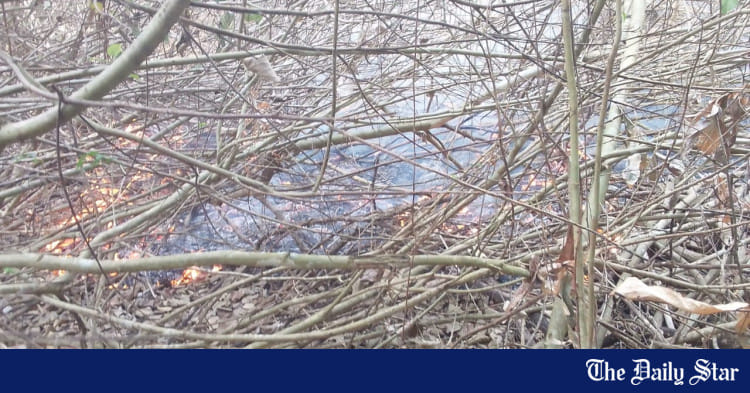
A fire that broke out at Chandpai range of East Sundarbans in Bagerhat this afternoon is yet to be doused for lack of a nearby water source.

The fire originated in Latif's Chila area near Amurbunia patrol post of the mangrove forest around 3:30pm, said Kazi Mohammad Nurul Karim, divisional forest officer (DFO) of Sundarbans eastern division, reports our Bagerhat correspondent.

Mohammad Kayamuzzaman, station officer of Mongla Fire Station, said on information, fire service members from Morrelganj and Mongla stations rushed to the spot but could not start working to control the fire due to lack of water.

They said the nearest source of water (Bhola river) is about two kilometres away.

"We will start working to douse the fire tomorrow morning," added Kayamuzzaman.

Rana Dev, assistant conservator of forests (ACF) of Chandpai range of Sundarbans, said forest guards and locals first saw the fire in the forest and tried to control it.

Later in the evening, the firefighting units reached the spot.

Meanwhile, DFO Kazi Mohammad Nurul Kabir and Morrelgonj UNO Md Tareque Sultan also visited the spot.

The forest officials are yet to confirm how the fire broke out.​
 
Analyze

Analyze Post

Add your ideas here:
Highlight Cite Respond
  • Sad (0)
Reactions: Bilal9

A novel approach to waste management
Can DNCC's cash-for-waste initiative help tackle dengue?


1714865896274.webp

VISUAL: STAR

The Dhaka North City Corporation (DNCC) under its current leadership has been known to approach civic issues with a degree of innovation sometimes, even though its impact hasn't been widely felt. Innovation is still necessary and should be encouraged with proper supervision given the magnitude of the problems facing the city. One of these is littering or improper waste disposal leading to pollution of water bodies, environmental degradation, diseases, etc. Against this backdrop, the recent initiative by the DNCC to purchase discarded items from residents as a means of combatting dengue deserves to be acknowledged.

The month-long campaign will encourage residents to collect and exchange these waste items for cash. According to officials, purchasing rates will vary from item to item: Tk 1 for each packet of chips, Tk 2 for each coconut shell, Tk 10 for each ice-cream packet, and Tk 50 per kilogramme for discarded polythene. Furthermore, containers made of clay, plastic, melamine, or ceramic will be purchased at Tk 3 each, abandoned tyres at Tk 50 each, and abandoned commodes and basins at Tk 100 each. These items and containers are potential breeding grounds for Aedes mosquitoes, and the DNCC aims to take them out before the monsoon season begins.

We have to admit that if done right and later scaled up to include a large number of residents, the project has the potential to help in our fight against the menace of plastics. But it is crucial to ensure transparency in the process as public funds are involved. More importantly, it is important that such initiatives are taken as part of a bigger plan to address our plastic problem of which a dengue outbreak is but a side-effect. Plastic pollution needs holistic interventions that not only incentivise waste collection but also ensure proper disposal and recycling of all plastic products.

We, therefore, urge the authorities to ensure that all such initiatives are properly planned, aligned and executed. The city corporations and municipalities also must ensure that their own waste management departments function properly to advance these goals.​
 
Analyze

Analyze Post

Add your ideas here:
Highlight Cite Respond
  • Like (+1)
Reactions: Bilal9

Sundarbans fire now under control: ministry

1714950125192.webp

Photo: Collected

A fire that broke out in the Amurbunia area at Chandpai range of the Sundarbans East Zone yesterday afternoon is now under control.

The Ministry of Environment, Forest and Climate Change issued a statement in this regard this afternoon.

"Although the fire is under control, fire extinguishing activities will continue for the next few days," the statement read.

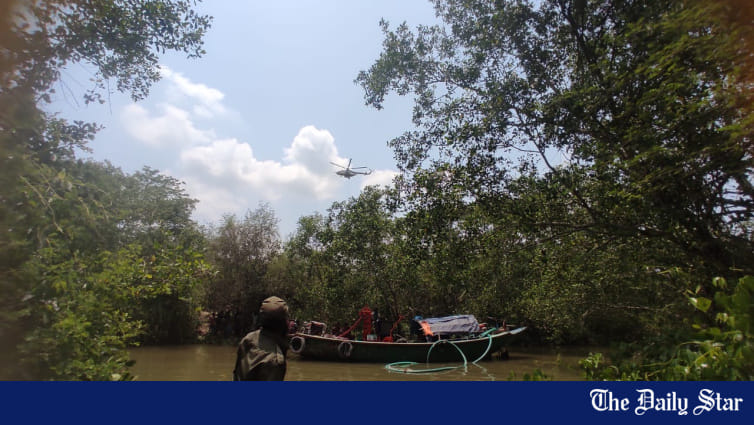
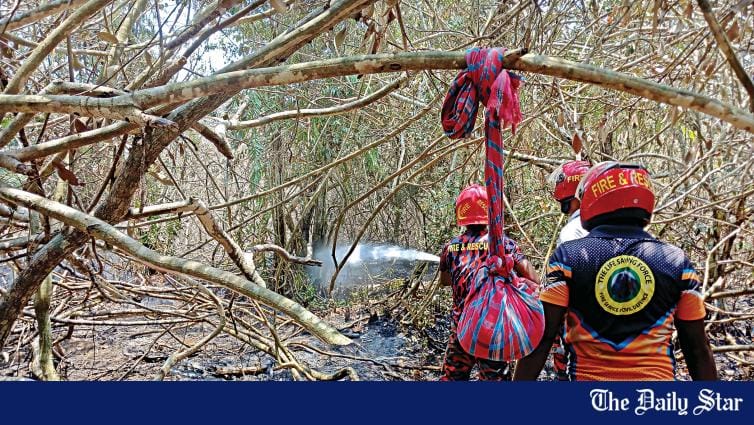
Apart from the forest department, several units of fire service, navy, police, district administration, upazila administration, public representatives, Community Patrol Groups, volunteers, and locals are assisting in extinguishing the fire.

Besides, an air force helicopter assisted in extinguishing the blaze by spraying water from above, it added.

A three-member committee has already been formed by the DFO, east of Khulna Circle of the forest department, to investigate the exact cause of the fire.

The Forest Department workers, fire service, and other related government agencies reached the spot immediately after the fire was first reported around 3:30pm yesterday, added the statement.​
 
Analyze

Analyze Post

Add your ideas here:
Highlight Cite Respond
  • Like (+1)
Reactions: Bilal9

Brick kilns on river question govt's will to protect rivers
06 May, 2024, 00:00

The sorry state of rivers is blamed, among others, on an unabated grabbing of river land by entrepreneurs and individuals enjoying political and moneyed clout. Some entrepreneurs setting up brick kilns, as a photograph with a number of kiln chimneys sprouting on the river that New Age published on May 5 shows, on the Dhaleshwari at Sirajdikhan in Munshiganj shows the extent of river land grabbing and the nonchalance of the authorities concerned. Dhaleshwari river land grab have made headlines many times in the past, too. A lawmaker is reported in 2018 to have set up a power plant on the Dhaleshwari. The Inland Water Transport Authority in 2019 identified 256 illegal structures on the river banks, conducted eviction drives and reclaimed some land. Local people then alleged that the authorities only evicted small grabbers, leaving out influential grabbers and large industries. Even the areas reclaimed went back into the hands of grabbers within months. Such incidents appear to characterise all river land reclamation efforts.

It largely appears that eviction drives, often conducted on court orders, have done nothing to sort out the problem. In most eviction drives, influential people manage to somehow save themselves and the land grabbed. The court intervened a number of times and ordered the government to make a list of grabbers. The government made such lists, too, but failed to take a holistic approach to reclaim the grabbed land and save the rivers. The lists of grabbers, as various official estimates say, vary in the ranges of 50,000–65,000 and the grabbers include not only people with political clout but also public agencies. The court asked the government to prepare an action plan detailing the timeframe, logistics and resources required to free rivers of encroachment and demarcate river boundaries for their protection, evict encroachers and restore the rivers to their original state. The court also asked the government to make the National River Conservation Commission an independent and effective institution, but the commission has lived to be a mere 'recommending body', without any statutory power of intervention or implementation. All this points to a worrying lack of political will on part of the government.

The authorities concerned must, therefore, take action against those who set up brick kilns on the Dhaleshwari. Most important, the government must take a holistic approach to save all rivers from being encroached. The government must draw up a comprehensive plan to reclaim the rivers, restore them to their original state and establish a mechanism to make the reclamation sustainable. It is high time the government drew up the plan and effectively executed it to end the circle of reclamation and reoccupation.​
 
Analyze

Analyze Post

Add your ideas here:
Highlight Cite Respond
  • Sad (0)
Reactions: Bilal9

ADB's climate financing should be concessional, says finance minister
FE ONLINE DESK
Published :
May 05, 2024 15:17
Updated :
May 05, 2024 19:42

1714952386483.webp


Finance Minister AH Mahmood Ali has called upon the Asian Development Bank (ADB) to make its climate financing concessional.

The minister said this while placing five specific proposals regarding measures for tackling immediate economic concerns of the developing member countries (DMC) at the turbulent time.

In placing the proposals on Sunday, he said geo-political uncertainties are disproportionately affecting impoverished segments of the globe, reports UNB.

Taking macro economic predicaments into consideration, policy-based support and concessional financing would be instrumental in tackling immediate economic concerns of the developing member countries, Ali said while delivering his statement at the business session of the Board of Governors 57th ADB Annual Meeting in Tbilisi, the capital of Georgia.

"We expect that ADB's climate financing should be concessional," he said.

Moreover, the Bangladesh finance minister said, as rightly expressed by Prime Minister Sheikh Hasina, climate finance must also meet three other criteria: sufficiency, regularity, and accessibility.

He called upon ADB to undertake more projects to minimise existing digital disparities on the one hand and unlock the potential of 4IR technologies on the other hand.

Due to heightened volatility and a widening spread of commodity prices, Ali said the prime minister has given directives that not a single inch of agricultural land be kept unused.

"Aligned with her vision, we want ADB will undertake projects to induce smart technologies in our agriculture, facilitate modern marketing facilities and eliminate barriers to fully unlock the potentials of agro-businesses," said the finance minister.

Under fiscal constraints, he said, Bangladesh seeks ADB's upstream knowledge support for framing strategies to meet its immediate energy needs.

Moreover, Ali said, it wants ADB to bring more investment in renewable energy with appropriate tech solutions.

"As our own Asian Bank, to ADB we held higher expectations. I have strong hopes that this conference will set the just vision for us to steer through a muddled world, determine strategies for addressing real challenges, scale up concessional climate finance, and harness newer opportunities in digital economic cooperation and building regional connectivity," he said.

Ali said they are currently living in a world that is plagued by weak and uneven global growth, decades-high inflation, reduced fiscal space, high real interest rates and elevated debt incidences.

"Facing all these odds, our assembling here at the crossroads of East and West drums up the urgency of building robust connectivity as well as consolidating our collective actions for bridging to the future," he said.

With a clear national vision and under the prudent leadership of Prime Minister Sheikh Hasina, the minister said, Bangladesh rode on a high growth trajectory before the pandemic.

"ADB lent to us fitting support in this epic journey. However, for prolonged war, rising geopolitical tensions and frequent raids of extreme weather events, Bangladesh, like many other developing economies, is currently experiencing persistent headwinds and continued volatility," Ali said.

For Bangladesh, he said, the challenge is now how to manage macro fundamentals while pursuing a path for sustained higher growth.

"Our challenge is now how to garner additional funds while counterbalancing debt accumulations," he mentioned.

President of ADB Masatsugu Asakawa and Chair of the Board of Governors Lasha Khutsishvili, among others, were present at the event.​
 
Analyze

Analyze Post

Add your ideas here:
Highlight Cite Respond
  • Like (+1)
Reactions: Bilal9

Fire in the Sundarbans: How can we stop it from happening again

1715038179978.webp

PHOTO: COLLECTED

People in Bangladesh, and even the rest of the world, view the Sundarbans with a certain reverence. But, unfortunately, policymakers and those who are responsible for taking care of the mangrove forest do not view it the same way.

For Bangladesh, the Sundarbans is its protector. It protects our land from various natural disasters. Particularly, cyclones coming from the southwest are impeded by the Sundarbans. However, although the forest protects us, we do nothing to protect it. Whether it is through deforestation, or polluting the waters around it, or building industrial plants around it—we have continued to take on activities that severely harm this natural body.

Now, speaking of the fire that we learnt of on Saturday, this is not something that has happened for the first time. This sort of incidents have been common during this time of the year for quite some time. So this fire should not be viewed as an accident that could not have been prevented. Firstly, as this is something that keeps happening every year, we need to figure out the underlying reasons that cause it. And the process through which this investigation is to be conducted should be made transparent and inclusive. Furthermore, it should be communicated to the local people. Without transparency and decisive action, this would become yet another administrative exercise in our country that serves no purpose other than lining the pockets of a select few. Thus, the first thing that must be done is to identify the problem, and the second thing should be making sure that those who were responsible for it are held accountable before the public.

As activists who have been working in and around the Sundarbans for years know quite well, fires can start naturally. It could also be because of intruders who enter the forest. It could be from the cigarettes they smoke. It could be done intentionally by poachers who want to attack wild animals. In fact, there may even be particular reasons for starting fires. There is a fish called Kain Magur (Black eeltail catfish) that is prevalent in the Sundarbans area, which is difficult for fishermen to catch due to the vines and leaves sprouting from the forest floor. So, some fishermen start fires to clear off these vines and leaves so they can catch the fish easily.

It is also important to note that we did not get to know immediately about the fire in question. In this era of information technology and instant communication, this is an anomaly. It is also not like Bangladesh is behind in terms of technology. We are advancing on par with the world. We have a science and technology ministry. We regularly allocate budget for technological advancement in various areas. We are trying to become Smart Bangladesh and have become so in many aspects. The important point to note is that we do have the capability to protect the 6,500 square kilometres of this mangrove forest, and we do keep watch. If a university student flies a drone even 70 kilometres deep into the forest, then he is caught using technology. Yet, when there has been a fire, technology suddenly fails us. In truth, we lack the mindset and the determination to protect the Sundarbans. We are unable to properly use the technology available to us. There is no proper monitoring in place.

As the Sundarbans is a World Heritage Site, upon UNESCO's repeated requests, the Bangladesh government eventually undertook its Strategic Environmental Assessment (SEA) in 2020. But following on from this assessment, the goal of which was to see if the Sundarbans was being harmed in any way, what remedies have been taken? In the end, these goals were not achieved. To make sure that the Sundarbans is not brought into consideration, they called it the SEA for the southwest region. They did not cover Barguna in it, nor did they cover Patuakhali. Here, the intention was to find out loopholes. Thus, we could not get the benefits from this assessment that we could have gotten. This is only helping those who are making investments in industry around the area and harming the Sundarbans and our country.

In order to show a strong commitment to protecting the Sundarbans, the government must identify exactly why this fire started and take preventative measures so similar incidents does not occur again. We must take actions against those who are responsible for it. Then, if there is a fire again, we should analyse it again to see what steps should be taken.

Sharif Jamil is coordinator of Waterkeepers Bangladesh and member secretary of Dhoritri Rokhhay Amra (DHORA).​
 
Analyze

Analyze Post

Add your ideas here:
Highlight Cite Respond

Is the last stronghold of Bangladesh's tigers at risk?

1715235598631.webp

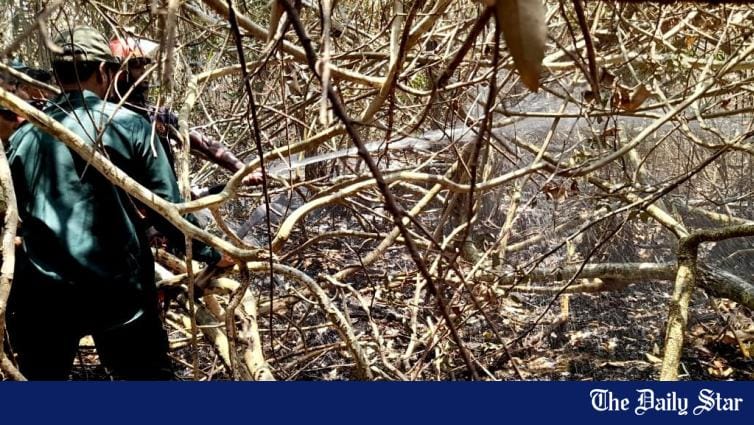
Firefighters spraying water on a smouldering fire at the Amurbunia forest of eastern Sundarbans in Bagerhat yesterday. The fire was spotted Saturday afternoon but the firefighting was initially delayed due to a lack of water sources nearby. PHOTO: TANJIR H RUBEL

The fire that broke out in Amarbunia, under the Chandpai range in the eastern region of the Sundarbans in Bagerhat on Saturday afternoon (May 4), continued to burn for nearly three days before rain doused it completely. On top of that, several units of the Fire Service, Bangladesh Navy, police, district administration, upazila administration, public representatives, and locals worked to control the fire in the Sundarbans during this time, according to the latest update from the chief conservator of forests.

It harks back to May 3, 2021, when a fire broke out in Bharani under the Sarankhola range, which is not far from Amarbunia. Before that, in 2016, there were four different incidents of fire in the eastern part of the Sundarbans.

This time, the distance of the fire from the nearest water source—almost two kilometres—proved to be a particular challenge, hindering the efforts to extinguish the fire. Along with the Forest Department, the Fire Service, Community Patrolling Groups (CPG), Village Tiger Response Team (VTRT), and members of the navy, air force, police, and coast guard joined the operation, helping to cut off the fire line the next day.

We understand that in the past 22 years, the Sundarbans East Forest Division has faced 32 fire incidents. And every time, the community joined the Forest Department and fought against the fire risking their lives. They are driven by a sentiment, which is Sundarban Mayer Moton (motherly Sundarbans). The Sundarbans protects them from cyclones, gives them food and shelter, and nurtures them the way a mother would.

I had the opportunity to become one of the founders of WildTeam, a national conservation organisation that engages the community through its Village Tiger Response Teams (VTRT), BaghBandhus (friends of tigers), Tiger Scouts, and Forest Tiger Response Teams (FTRT) to protect the Sundarbans and its biodiversity, including the majestic Bengal Tiger. Today we have about 450 such volunteers spread around the 76 villages of the Sundarbans. We believe people are the solution. Under the leadership of the Forest Department, we successfully engaged these volunteers during any natural or anthropogenic crisis in the Sundarbans. Our friends in the Indian part of the forest have replicated our model.

Our slogan is "Save Tigers, Save Sundarbans, Save Bangladesh." Bangabandhu Sheikh Mujibur Rahman, in one of his speeches in 1972, said that were it not for the Sundarbans, we wouldn't be able to protect Bangladesh (he was specifically talking about natural catastrophes, meaning the Sundarbans acts as a shield—as we saw during a number of cyclones in recent times). Tigers are the natural guards of the Sundarbans. Thus, they are the guardians of the Sundarbans.

The increased disturbance of the forest cover caused by fires such as the one this week will force the wildlife to leave the forest in search of food inside the villages, which will enhance the chances of human-wildlife conflict.

We used to have tigers in almost all the forests in Bangladesh. Today, Sundarbans is the last stronghold of Bangladesh's remaining tigers. According to the last tiger survey in 2018, Bangladesh has 114 tigers. However, we feel concerned about the fact that three tigers have reportedly died in the last five months.

On November 25, 2023, the Forest Department recovered a tiger's carcass from the Kachikata area adjacent to the Raimangal River in Satkhira range. On February 12, 2024, a dead tiger was spotted in the Kachikhali area of the Sarankhola range located under the Sundarbans East Forest Division. On April 30, 2024, the forest guards recovered a floating carcass of a tiger from the Karamjal area in the Sundarbans east.

The Forest Department is the custodian of the country's forests and wildlife. They are forced to work with huge limitations in the Sundarbans. We need to focus on these foresters by increasing their capacity and facilities—the sooner the better. At the same time, we need to engage the community as well and build up their social capital, before we lose our national pride: the Sundarbans and the Bengal Tiger.

Then again, on April 20, 2024, we lost one of the honey collectors in the Sundarbans. He was attacked by a tiger at Notabeki under Satkhira range. The tiger attacked Maniruzzaman and tried to drag him into the deep forest. His fellow honey collector rescued him from the clutches of the tiger, but he died soon after. Maniruzzaman was a resident of Gabura, where most of the "tiger widows"—whose husbands died in tiger attacks—live. He, too, left behind two wives.

Most of the breadwinners living around the Sundarbans largely depend on the forest resources. Infertile and inhabitable land, habitat loss, dense population and climate change make the situation complex. Researchers predict that due to climate change and sea level rise, there will be no remaining tiger habitats in the Sundarbans by 2070. About 3.5 million people live on the fringes of the Sundarbans, where fishing, honey and wood collection are their mainstays for living.

More than 40 percent of the people are on the edge of poverty. Salinity, siltation, and climate emergencies make people's lives much harder. Poison fishing, unsustainable fishing, and many other anthropogenic threats are on the rise. These days, the fish catch has gone down, which forces the community to venture inside the forest, making them easy prey to tigers.

The Forest Department is the custodian of the country's forests and wildlife. They are forced to work with huge limitations in the Sundarbans. We need to focus on these foresters by increasing their capacity and facilities—the sooner the better. At the same time, we need to engage the community as well and build up their social capital, before we lose our national pride: the Sundarbans and the Bengal Tiger.

Enayetullah Khan is founder of WildTeam and editor-in-chief of the United News of Bangladesh (UNB) and Dhaka Courier.​
 
Analyze

Analyze Post

Add your ideas here:
Highlight Cite Respond
  • Like (+1)
Reactions: Krishna with Flute

Members Online

Latest Posts

Back
 
G
O
 
H
O
M
E