Donate ☕
[🇧🇩] - Sea Ports/Air Ports/River Ports/Bridges/Mega Projects | Page 11 | PKDefense

[🇧🇩] Sea Ports/Air Ports/River Ports/Bridges/Mega Projects

⤵︎
Reply (Scroll)
Press space to scroll through posts
G Bangladesh Defense
[🇧🇩] Sea Ports/Air Ports/River Ports/Bridges/Mega Projects
179
7K
More threads by Saif


Road over Jamuna Bridge to be widened by 11ft
Anowar Hossain Dhaka
Published: 12 Aug 2025, 19: 57

1755046105037.webp

The railway track on the Jamuna Bridge Prothom Alo

A new rail bridge has been launched over river Jamuna. Trains no longer use the Jamuna Bridge. Therefore the authorities have decided to remove the railway track on the Jamuna Bridge. It will create an additional 11 feet space on the bridge.

The Bridges Division has planned to convert the additional space into roadways which will further ease the journey towards the northern part of the country.

Sources in the Bridges Division, the regulatory body of the Jamuna Bridge, said that they will have to do some additional work to extend the road up to the space used for the railway track. It requires funds. The interim government has agreed to the plan. Experts have been appointed to determine a suitable process for road extension, assess the cost and for design. However, this time only local experts have been appointed. The six engineering and technology universities are also involved in the process.

Speaking to Prothom Alo, Bridges Division chief engineer Kazi Mohammad Ferdaus said the work on road extension would start after getting expert opinion and their design. He hoped to start the work by the next six months.

A new railway bridge over the Jamuna River (the Jamuna Railway Bridge) was opened last February. Following this, train operations on the railway track of the Jamuna Bridge were stopped.

The 4.8-kilometre-long railway bridge, built parallel to the Jamuna Bridge, is the longest railway bridge in Bangladesh. It has two dual-gauge, double-track lines. The construction cost was about Tk 167.81 billion. The bridge was built with funding from the Government of Bangladesh and the Japan International Cooperation Agency (JICA).

1755046151121.webp

The new railway bridge can be seen from the Jamuna Bridge Prothom Alo

The road bridge over the Jamuna River was opened in 1998. According to the Bridges Division, the bridge was not originally designed to accommodate trains. Later, the then prime minister Sheikh Hasina instructed that a railway track be added to the bridge. The design was modified, and a railway track was installed on one side of the Jamuna Bridge, narrowing the roadway slightly.

In 2006, cracks appeared on the bridge. After that, the speed of trains on the bridge was reduced, and heavy freight trains were barred from using it. To facilitate the movement of passenger and freight trains to the north, a project to build a new railway bridge over the Jamuna River was undertaken in 2016.

Jamuna Bridge to get back original shape
The Jamuna Bridge has four lanes. According to the Bridges Division, the width of its carriageway does not meet international standards. Compared to the Padma Bridge and other new bridges in the country, the Jamuna Bridge has a much narrower carriageway. As a result, long traffic tailbacks form on both ends of the bridge not only at weekends or the start of the week, but also during Eid and other major festivals.

Work on road extension would start after getting expert opinion and their design. He hoped to start the work by the next six months---Kazi Mohammad Ferdaus, chief engineer, Bridges Division.

Currently, an average of 22,000 vehicles cross the Jamuna Bridge daily. During last Eid-ul-Azha, a record of more than 64,000 vehicles crossed the bridge in a single day.

Experts say that under ideal standards, a four-lane bridge or road should have a divider in the middle, with each carriageway at least 24 feet wide. However, the current carriageway width of the Jamuna Bridge is just over 41 feet, meaning each direction is a little over 20 feet wide. Once the railway track is removed from the bridge, an additional 11.5 feet of space will be available. By shifting the central divider slightly, it will be possible to create nearly six extra feet of carriageway on each side.

On the other hand, the four-lane highway on either side of the Jamuna Bridge is 24 feet wide in each direction, allowing two vehicles to pass side by side with room to spare. In contrast, it is difficult for two vehicles to travel side by side on the Jamuna Bridge. According to the bridge division, there is also no walkway on the bridge for maintenance work or for staff movement. As a result, vehicles coming from the wider highway on both sides often get stuck at the bridge’s entry point because the bridge is narrower than the highway. In addition, vehicle speed slows slightly at the toll plaza.

1755046225611.webp

The Jamuna Railway Bridge File photo

Officials at the bridge division said the Padma Bridge does not have this problem. Each carriageway on the bridge is more than 31 feet wide, with ample space on the sides for easy maintenance work. At present, all major bridges in the country—both existing and under construction—have a median in the middle, with a minimum width of 26 feet for each carriageway. Some bridges have even wider carriageways.

Railway track being removed

In the last week of June, work began to remove the railway track from the Sirajganj end of the Jamuna Bridge. The nuts and bolts were removed first, and now the railway track is being dismantled. Railway sources said the removal work could be completed within the next three months.

Last month, Sheikh Moinuddin, the chief advisor’s special assistant for the Ministry of Road Transport and Bridges and Railways, inspected the expansion work of the Jamuna Bridge’s carriageway and the removal of the railway line. He gave instructions for the swift removal of the railway track.

Once the road on the Jamuna Bridge is widened, vehicles will be able to move in line with the wide highways on either side. This will make travel across the Jamuna Bridge easier and reduce traffic congestion at both ends of the bridge---Sheikh Moinuddin, Special assistant to the chief adviser.

Ahmad Hossain Masum, chief engineer of western region of railways, told Prothom Alo that during the inspection by the chief advisor’s special assistant, officials from the bridge division and the ministry of railways were present. They discussed the work plan for the expansion of the Jamuna Bridge’s road. They expect to complete the railway line removal within the next three months. Meanwhile, other preparations by the bridge division will also be finalised.

It was known at the time of the Jamuna Rail Bridge project that once the new bridge was built, trains would no longer run on the road bridge. Therefore, the design and necessary preparations for the expansion of the Jamuna Road Bridge could have been made in advance, but that was not done.

The Bridge’s Division said that about two years ago it had sought the government’s opinion on expanding the road on the Jamuna Bridge’s railway track. However, the then Awami League government showed no interest in the matter.

Since the then Prime Minister Sheikh Hasina had added the railway track to the Jamuna Bridge, she was against its removal. Because of this, the bridge division did not proceed further. But after the interim government took office, when the bridge division again submitted a proposal, it was approved by Muhammad Fouzul Kabir Khan, adviser to the Ministry of Road Transport, Bridges and Railways. Soon after, at the beginning of this year, the process of appointing consultants for design preparation began.

Sheikh Moinuddin, special assistant to the chief adviser, told Prothom Alo that once the road on the Jamuna Bridge is widened, vehicles will be able to move in line with the wide highways on either side. This will make travel across the Jamuna Bridge easier and reduce traffic congestion at both ends of the bridge.​
 
Analyze

Analyze Post

Add your ideas here:
Highlight Cite Fact Check Respond

Businesses, govt officials push for foreign operators to boost port efficiency

FE Online Report
Published :
Aug 17, 2025 19:44
Updated :
Aug 17, 2025 19:56

1755471503983.webp


Business leaders and government officials have urged support for the move to appoint foreign operators at Bangladesh’s ports to enhance efficiency and align with international standards, instead of opposing it.

They made the call at a roundtable on “Challenges and Opportunities in the Logistics Sector”, held at Lakeshore Heights hotel in Gulshan on Sunday. Dr Ahmed Ullah, director general at the Chief Adviser’s Office, attended as the special guest. Professor Md Mamun Habib of Independent University, Bangladesh, delivered the keynote address. The discussion was chaired by Shamsul Huq Zahid, editor of The Financial Express, while Shiabur Rahman Shihab, head of online at The Financial Express, moderated it.

The event was organised by The Financial Express with the support of Bangladesh Garment Manufacturers and Exporters Association (BGMEA), Bangladesh Knitwear Manufacturers and Exporters Association (BKMEA), Conveyor Group, Bangladesh Shipping Agents Association (BSAA), Anchorage Container Depot Limited, and Bangladesh Container Shipping Association (BCSA).

Mohammad Hatem, president of BKMEA, said foreign operators could help enhance management efficiency while enabling local manpower to learn modern technologies and international-standard practices.

Referring to the sudden 40 per cent hike in charges at Chattogram Port, he said, “A port is a service-oriented organisation. Such a steep rise in charges without any discussion or logical explanation is unjustified.”Hatem also questioned why a government institution should seek excessive profits.

He stressed the need to operationalise the Bay Terminal quickly and fully utilise the capacities of Mongla and Payra ports to help achieve the $100 billion export target. Beyond ports, he highlighted the urgency of addressing gas and electricity shortages, ensuring uninterrupted energy supply, and improving law and order to boost exports.

Echoing his concerns, BGMEA Senior Vice President Inamul Haq Khan said container handling at Chattogram Port currently takes five to six days, compared to the global standard of one to two days. “Often, we are forced to send goods by air to meet buyers’ commitments, which costs four times more than seaway shipments,” he noted.

Former Bangladesh Freight Forwarders Association (BAFFA) President Kabir Ahmed also backed the inclusion of foreign operators, saying a vested group continues to oppose such reforms. He further stressed the need for reforms at Biman Bangladesh Airlines and Hazrat Shahjalal International Airport, pointing out that all four Explosive Detection System (EDS) machines remain inactive.

Kabir Ahmed identified the National Board of Revenue (NBR) as the biggest hurdle for logistics, urging policy reforms to improve port efficiency and hold those responsible for delays accountable.

Bangladesh Garments Accessories & Packaging Manufacturers & Exporters Association (BGAPMEA) President MD Shahriar said every truck in metropolitan areas is forced to pay Tk 50–200 in bribes, while port delays keep trucks waiting an extra three to four days, pushing up exporters’ costs. He alleged that officials at Chattogram Port Authority behave as if they are running Singapore Port, while the reality is far less efficient.

BRVIDA President Abdul Haq observed that infrastructure costs in Bangladesh are higher than global standards, whereas countries like Vietnam have reduced costs through reforms. He lamented that multiple ministries are responsible for transport but none effectively manages multi-modal transformation.

BSAA Chairman Syed Mohammad Arif criticised the recent port charge hike imposed without consultation with stakeholders, which has triggered a chain reaction of rate increases across services.

BCSA General Secretary Shamsuddin Chowdhury said berth operator appointments should be decided by container agents. He warned that Chattogram Port has already reached its maximum capacity and that alternative solutions are essential to achieving the $100 billion export target by 2030.

Meanwhile, the government said infrastructure expansion is under way.

Addressing the event as chief guest, Senior Secretary of the Ministry of Shipping Mohammad Yousuf announced that construction of a multi-modal logistics hub at Bay Terminal in Chattogram would begin soon. The planned facility will integrate rail, road, and sea transport, along with a new railway container terminal in Halishahar.

He said the Bay Terminal Breakwater Project, financed by the World Bank, is advancing. “A subsidiary loan agreement will be signed today, following an earlier deal between ERD and the World Bank in Washington,” he noted.

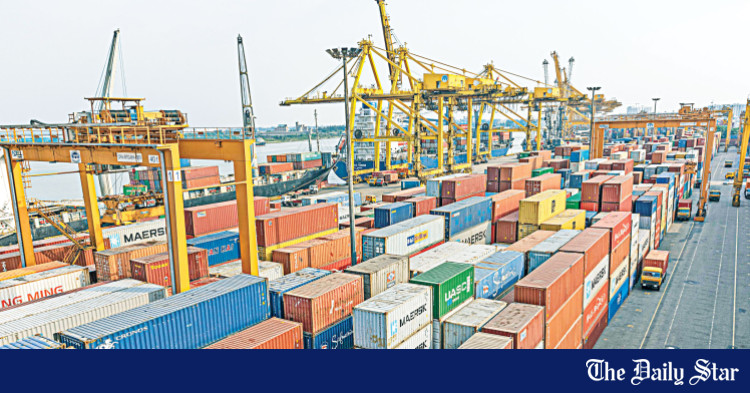
Tender evaluation for the Bay Terminal is expected within one to two months. Three terminals will be developed there, one each by CPA, PSA Singapore, and DP World. By 2036, the Bay Terminal is projected to handle 5.36 million TEUs, compared to Chattogram Port’s current 2.86 million TEU capacity, which is already overstretched, handling 3.3 million TEUs annually.

“Although stakeholders are pushing to expedite the Bay Terminal, it is being implemented under a PPP model on a G-to-G basis, which requires the appointment of a transaction adviser,” Yousuf explained. Ernst & Young, the previous adviser, has exited, and the ministry is now in talks with ADB to reduce costs.

A report from the new adviser is expected by October, and by December at least one Bay Terminal will be handed over to a contractor, he said. Yousuf also expressed hope that the New Mooring Container Terminal (NCT) would be handed over to a global operator under a transparent agreement by October.

On the National Logistics Policy, he said it would be amended soon, with two high-powered committees—chaired by the Chief Adviser and the Principal Secretary—already formed. An action plan under the policy is expected within a month, incorporating recommendations from the FE roundtable, the World Bank, and relevant ministries.

While physical infrastructure is vital, Bangladesh continues to create barriers to foreign direct investment (FDI), he noted. In 2023, the country received only $3 billion in FDI, mostly from the expansion of existing investors rather than new entrants. “We are lagging behind India and Vietnam in attracting FDI. Without reducing logistics costs, we will not be able to enhance export competitiveness,” one official added.

The shipping secretary also disclosed plans to develop a Port Community System to integrate Mongla, Payra, and Chattogram ports, based on a World Bank design. He requested businesses to move empty containers to off-docks or return them to ships to ease congestion.

He said the railway adviser has agreed to hand over at least one container train on the Dhaka–Chattogram route to the private sector. A master plan for Matarbari Phase-II is also underway, including LNG and LPG terminals and a new dockyard to be constructed by CPA.

On port tariffs already approved by the Ministry of Finance, Yousuf said rates will only be finalised after consultations with stakeholders. CPA stressed the need to raise revenue to finance infrastructure development but assured that tariff hikes will not be implemented immediately.

Some equipment installed at NCT, which began operations in 2007, has become faulty and needs replacement. NBR, CPA, and the Shipping Ministry are working in coordination on port reforms.

Yousuf also conveyed the Chief Adviser’s instruction to waive 7.5 per cent VAT on ship imports, as the tax is discouraging investors. However, he added, the issue must be settled in consultation with the IMF.

Masrur Reaz, Chairman of Policy Exchange Bangladesh, said the country is “five decades behind” in logistics development, as the sector lacked a proper policy, regulatory framework, and market development until the recent logistics strategy was initiated.

He argued that higher export and production costs due to US tariffs and LDC graduation could be offset by greater logistics efficiency. Bangladesh could also benefit from shifts in global value chains and higher US tariffs on other countries, but only if it upgrades its logistics system.

Reaz criticised delays in enacting the National Logistics Policy, saying Bangladesh is already a decade behind. Stressing the need for reform, he argued that Chattogram Port must be opened to private operators. “There is no alternative to engaging a global operator at Chattogram Port to raise efficiency,” he said.

Bangladesh Ocean Going Ship Owners’ Association (BOGSOA) President Azam J Chowdhury accused the government of excluding the private sector from decision-making processes.

Delivering the keynote paper, Prof Mamun Habib of Independent University, Bangladesh, noted that Bangladesh continues to lag its South Asian peers in global logistics rankings.

According to the World Bank’s 2023 Logistics Performance Index, the country ranked 88th, compared to India at 38 and Sri Lanka at 73.

“We are consistently weakest in infrastructure and business fundamentals, which makes it difficult to compete globally,” Prof Habib said.

Key challenges, he added, include poor integration of transport networks, inadequate warehousing and distribution facilities, and delays in implementing the national logistics strategy. A lack of skilled manpower and limited adoption of modern technology further weaken the sector.

Despite these constraints, Prof Habib pointed to opportunities in the recently approved but still unimplemented national logistics strategy, growing private sector interest in ICD investment, and the potential of automation, AI, blockchain, and other digital technologies in supply chain management.

“Bangladesh must embrace automation, ethical practices, and human resource development to build a smart, resilient, and environmentally sustainable logistics ecosystem,” he stressed, calling for greater coordination among port authorities, customs, civil aviation, and regulatory agencies.​
 
Analyze

Analyze Post

Add your ideas here:
Highlight Cite Fact Check Respond

BKMEA chief bats for foreign operators at ports to enhance efficiency

FE Online Desk
Published :
Aug 18, 2025 00:06
Updated :
Aug 18, 2025 00:06

1755471915041.webp


Bangladesh Knitwear Manufacturers and Exporters Association (BKMEA) President Mohammad Hatem has urged the government to engage foreign operators to run the country’s ports, saying it would boost efficiency and help local workers learn modern technologies.

Speaking at a roundtable on “Challenges, Opportunities, and Way Forward in Shipping & Logistics Landscape” organised by The Financial Express (FE) in Dhaka, , Hatem criticised a recent 40 per cent increase in charges at Chattogram Port, calling it “unjustified”.

“A port is a service-oriented organisation. Such a steep rise in charges without any discussion or logical explanation is unjustified,” he said, questioning why a government agency should seek excessive profits.

The BKMEA president stressed the need to operationalise the Bay Terminal without delay and make full use of Mongla and Payra ports to help achieve the $100 billion export target.

He also pointed to chronic gas and electricity shortages, along with poor law and order, as major obstacles for exporters.

Hatem called for uninterrupted energy supply and stronger security measures to keep the sector competitive.

Professor Md Mamun Habib of Independent University, Bangladesh delivered the keynote address.

Shipping ministry senior secretary Mohammad Yousuf attended as the chief guest.

The event was chaired by FE Editor Shamsul Huq Zahid, while Shiabur Rahman, head of online at the newspaper, moderated it.​
 
Analyze

Analyze Post

Add your ideas here:
Highlight Cite Fact Check Respond

THRUST ON LOGISTICS UPGRADE TOWARDS $100B EXPORT
Multimodal hub integrating rail, road, Ctg seaport in sight
Also planned 'port community system' interlocking three seaports on WB model, FE seminar told


FE REPORT
Published :
Aug 18, 2025 00:18
Updated :
Aug 18, 2025 00:18

1755473309966.webp


A multimodal logistics hub integrating railway, road, and Chittagong seaport facilities will be developed near the Bay Terminal to boost Bangladesh's trade-facilitating efficiency, as efforts are geared towards US$100-billion annual export earnings.

To this end, the World Bank-financed Bay Terminal Breakwater Project is moving ahead, with a subsidiary loan agreement to be signed today, following an earlier deal made between ERD and the Bank in Washington, said Senior Secretary, Shipping, Mohammed Yousuf at a roundtable organised by The Financial Express on Sunday in Dhaka.

The Financial Express organised the event with the support of Bangladesh Garment Manufacturers and Exporters Association (BGMEA), Bangladesh Knitwear Manufacturers and Exporters Association (BKMEA), Conveyor Group, Bangladesh Shipping Agents Association (BSAA), Anchorage Container Depot Limited and Bangladesh Container Shipping Association (BCSA).

1755473347162.webp


Three Bay Terminals will be developed by CPA, PSA Singapore, and DP World. Tender evaluation is expected within a month or two. By 2036, the Bay Terminal is projected to handle 5.36 million TEUs, compared to Chittagong Port's current 2.86-million-TEU capacity, which is already overstretched handling 3.3 million TEUs annually.

The project is being implemented under a PPP G-to-G model, requiring a transaction adviser. Foreign firm Ernst & Young has exited, and the ministry is in talks with the ADB to cut costs.

A TA report is expected by October, with at least one Bay Terminal likely to be handed over to a contractor by December, Yousuf said.

He also expressed the hope that the New-mooring Container Terminal (NCT) would be handed over to a global operator by October under a transparent agreement.

On the National Logistics Policy, Yousuf said it would be amended soon and that two high-powered committees -- led by the Chief Adviser and the Principal Secretary -- were already formed.

An action plan under the policy is expected within a month, incorporating inputs from the FE roundtable, the World Bank, and relevant ministries.

Mr Yousuf also announced plans for setting up a Port Community System integrating Chittagong, Mongla and Payra seaports, based on a World Bank design.

He urges businesses to move empty containers to off-docks or return them to ships to ease congestion at the Chittagong seaport.

The railway authority has agreed to hand over at least one Dhaka-Chittagong container train to the private sector. A Matarbari Phase-II master plan is also underway, including an LNG and LPG terminal and a new CPA dockyard.

The Finance Ministry-approved port tariffs will only be finalised after consultation with stakeholders. The CPA has emphasized raising revenue for infrastructure but assured that tariff hikes will not be forthcoming.

Some NCT equipment, installed in 2007, now requires replacement, while the NBR, the CPA, and the Shipping Ministry are coordinating on wider port reforms.

The official also conveyed the Chief Adviser's instructions for waiving the 7.5-percent VAT on ship imports to encourage investment, though the matter remains subject to IMF concurrence.

Despite progress in physical infrastructure, Yousuf notes, Bangladesh continues to lag behind India and Vietnam in attracting foreign direct investment (FDI), receiving just US$3 billion in 2023, mostly from existing investors.

"Without reducing logistics costs, we will not be able to enhance export- competitiveness," he alerts.

Director-General at the Chief Adviser's Office Dr Ahmed Ullah told the meet that the chief adviser's office has decided to revisit the logistics policy. There are many issues yet unaddressed could be added to the policy.

"Reform is going on -- the government is trying its best, but it is slow," the DG said.

Terming the sector not-enough-recognised, Editor of The Financial Express Shamsul Huq Zahid said the financial daily would organise another seminar on a larger scale to give the trade-facilitating backbones a much-needed shot in the arm.

"With increased efficiency in the logistics sector, there is possibility of increase in export and decrease in the cost for end-consumer," he said.

He also said The Financial Express would prepare a set of recommendations for the policymakers on the basis of the inputs that came out from the roundtable.

Bangladesh Oceangoing Shipowners' Association (BOGSOA) President Azam J Chowdhury appeared critical of the government for not engaging the private sector in the decision-making process.

He said, "Developed logistics sector would be able bring increasing amounts of foreign currencies."

Addressing the event, Mohammad Hatem, president of Bangladesh Knitwear Manufacturers and Exporters Association (BKMEA), said foreign operators could help raise management efficiency and allow local manpower to acquire modern technology and international-standard practices.

"A port is a service-oriented organisation. Such a steep rise in charges without any discussion or logical explanation is unjustified," he said, referring to a sudden 40-percent hike in charges at Chattogram Port.

Hatem shot a question as to why a government institution should aim to make excessive profits.

He stressed the need for operationalising the Bay Terminal quickly, while fully utilising the capacities of Mongla and Payra ports to help achieve the $100-billion export target.

Also, he said, addressing the gas and electricity crises, ensuring uninterrupted energy supply, and improving the law-and-order situation are vital for boosting exports.

Other business leaders echoed similar concerns about inefficiencies at Chattogram Port -- Bangladesh's commercial lifeline, up till now -- and the need for international standards.

AmCham President Syed Ershad Ahmed notes that logistics industry in Bangladesh is still shaping. "The country's infrastructures do not involve logisticians in the building process, which in turn, doesn't help the infrastructure to utilize."

Senior Vice President of BGMEA Inamul Haq Khan notes that container handling at the port takes 5 to 6 days, compared to the global standard of 1 to 2 days. "Often, we are forced to send goods by air to meet buyers' commitments, which costs four times more than seaway shipments."

Former BFFA president Kabir Ahmed also urged the government to allow foreign operators, saying a "vested group" continues to oppose such moves. He stressed the need for reforms at Biman and Hazrat Shahjalal International Airport, where all four EDS (Explosives Detection Systems) machines remain inactive.

He identified the National Board of Revenue (NBR) as the biggest challenge for logistics, urging policy measures to improve port efficiency and punish those causing delays.

MD Shahriar, president of BGAPMEA, said every truck in metropolitan areas is forced to pay Tk 50-200 in bribes, while port delays force trucks to stay an extra 3 to 4 days, raising exporters' costs.

He also alleged that the behaviour of Chattogram Port Authority officials "suggests they think they are running Singapore Port, while the reality is far worse".

Abdul Haque, president of Bangladesh Reconditioned Vehicles Importers and Dealers Association (BARVIDA), points out that Bangladesh's infrastructure costs are higher than global standards, while countries like Vietnam have lowered costs through reforms. He laments "multiple transport ministries exist, but none effectively manages multimodal transformation".

Syed Mohammad Arif, chairman of Bangladesh Shipping Agents Association, criticised the recent port- charge hike imposed without stakeholder consultation, which has triggered a chain reaction of rate hikes across services.

Shamsuddin Chowdhury, general secretary of Bangladesh Container Shipping Association, told the meet that berth-operator appointments should be decided by container agents. He warns that Chattogram Port has already reached its maximum capacity and that alternative solutions are necessary to achieve the $100-billion export target by 2030.

The government has, meanwhile, said it is moving forward with infrastructure expansion.

Masrur Reaz, Chairman of Policy Exchange Bangladesh, finds the country "five decades behind" in developing logistics as a sector, as it was never recognised with proper policy, regulatory framework, or market development until the recent logistics policy framework was initiated.

He notes that higher export and production costs stemming from US tariffs and LDC graduation could be offset by greater logistics efficiency. "Bangladesh could also benefit from shifts in global value chains and higher US tariffs on other countries, but only if its logistics system is upgraded."

Reaz criticised delays in enacting the National Logistics Policy, saying that Bangladesh is already a decade behind since its formulation.

Stressing the need for reform, he argues that Chittagong Port must be freed from exclusive government operation and opened to private operators to realise its full potential. "There is no alternative to engaging a global operator at Chittagong port to raise efficiency," he told the seminar.

Delivering the keynote on 'Challenges, Opportunities and Way Forward in Logistics Landscape', Prof Md. Mamun Habib of the School of Business & Entrepreneurship at Independent University, Bangladesh, pointed out that Bangladesh continues to lag behind its South Asian peers in global logistics rankings. In the World Bank's Logistics Performance Index (LPI), the country ranked 88th in 2023, compared to India at 38 and Sri Lanka at 73.

"We are consistently weakest in infrastructure and business fundamentals, which makes it difficult to compete globally," the academic observed.

Key challenges, he said, include poor integration of transport networks, inadequate warehousing and distribution facilities, and delays in implementing the long-awaited national logistics strategy.

Despite the constraints, Prof. Habib sees opportunities, including the recently-approved but yet-to-be-implemented national logistics strategy, growing private-sector interest in ICD investment, and the scope for automation, artificial intelligence, blockchain, and other digital technologies in supply chain management.

"Bangladesh must embrace automation, ethical practices, and human-resource development to build a smart, resilient, and environmentally sustainable logistics ecosystem," he stressed, calling for greater coordination among port authorities, customs, civil aviation, and regulatory agencies.​
 
Analyze

Analyze Post

Add your ideas here:
Highlight Cite Fact Check Respond

Multimodal logistics integration at seaports

FE
Published :
Aug 19, 2025 00:16
Updated :
Aug 19, 2025 00:16

1755559903667.webp


Bangladesh's poor global logistics ranking in the World Bank's Logistics Performance Index (LPI) speaks volume for the country's inability to utilise its trade potential and competitiveness. In today's stiffly growing competition in accessing markets abroad, integrated logistics serve as the basis for international trade, providing competitive edge and even global branding of products. It is exactly for this reason, the seaports in several countries have been transformed into multimodal transit points optimising their capacities. If container handling at the Chittagong Port takes five to six days instead of the global standard of one to two days, it is indeed pitiable. How business fails to connect with the global value chain becomes clear from this inefficiency. This is, however, just one aspect of the process, the port or ports concerned also fail to attract foreign vessels to call at such facilities.

The roundtable organised by the Financial Express brought together both government functionaries and astute businesspeople in order to collate their opinions and suggestions for riding the rough time ahead in international trade. To the meeting's credit, it has found pragmatic suggestions including greater participation in the process of logistical capacity building. One unanimous verdict that emerged from the deliberations is that there is no alternative to developing and integrating logistics in the form of a multimodal chain. It means that rail, road and the Chittagong Port will get connected through integration of an efficient transport network of both rail and road, sufficient warehouses including inland container depot preferably under public-private partnership and an upgraded distribution system. The bottom line is that the capacity development of not only the Chittagong Port would be enough but other ports ought to be put to optimal use with complementary innovative way of facilitating business. Another large-scale roundtable to be held on the same subject, as informed by the editor of the FE, may give further insight into the way forward.

Currently, though, the interim government is talking about the much-hyped reform to the Chittagong Port, the main task to be undertaken is to develop three bay terminals by the Chittagong Port Authority, PSA Singapore and DP World. Hopefully, the track records of the two foreign port operators and supply chain companies will be of tremendous help in expanding the port and the bay terminals' capacities, allowing those to have a competitive edge in real time export. Alongside the World Bank-financed Bay Terminal Breakwater Project, a 'port community system' interlocking the three seaports on the WB model is on the cards.

Undeniably, to stay in competition there is no alternative to taking advantage of the cheapest export mode -- sea routes that is, particularly after the hawkish global business environment set off following the reciprocal tariffs imposed by Donald Trump on both his friends and foes. A small country like Bangladesh with a limited basket of export goods must develop and diverse its export basket in order to get over the adversities facing business. It has to seize the least opportunities in the shifting global channels emerging from the higher levies slapped on some countries. However, one note of caution: the agreement on handling operation by foreign port operators and supply chain companies should be limited to a reasonable period during which time, the local operators, automation and other related logistics support will match the world's best.​
 
Analyze

Analyze Post

Add your ideas here:
Highlight Cite Fact Check Respond
Asian Highway passing through South Western Bangladesh


Analyze

Analyze Post

Add your ideas here:
Highlight Cite Fact Check Respond
 
Analyze

Analyze Post

Add your ideas here:
Highlight Cite Fact Check Respond
Three separate old/new terminals in Chittagong Port - Laldia, New Mooring and Bay Terminal have been handed over to foreign operators, namely DP World Dubai, PSA S'pore and APM Netherlands.

However - there should have been provisions made to employ locals first in management (instead of foreigners) which should have been one of the conditions (not sure if it was one).

 
Analyze

Analyze Post

Add your ideas here:
Highlight Cite Fact Check Respond
  • Like (+1)
Reactions: Saif

CPA signs 30-year concession deal with APM Terminals for Laldia Container Terminal

Published :
Nov 17, 2025 13:28

1763429114939.webp


The Chittagong Port Authority (CPA) on Monday signed a concession agreement with the Denmark-based APM Terminals for development and operations for 30 years of the Laldia Container Terminal (LCT) under a Public-Private Partnership (PPP) framework.

Shipping Adviser Brigadier General (Retd) Dr M. Sakhawat Hussain attended the signing ceremony as the chief guest, held at the Intercontinental Hotel in the city.

State Secretary of the Trade and Investment of the Ministry of Foreign Affairs of Denmark, Lina Gandlose Hansen, and Ambassador of the Embassy of Denmark, Christian Brix Møller, were present as special guests.

Chief Executive Officers of the PPP Authority, Chowdhury Ashik Mahmud Bin Harun, presided over the signing ceremony.

In his speech, Sakhawat Hussain said the investment is expected to significantly boost employment, particularly for the youth.

“Once the project is complete, many young generations, particularly the educated youth of Bangladesh, will get jobs,” he added.

He highlighted the presence of a skilled workforce domestically, noting that the hardworking people of Bangladesh often work outside the country in Europe and America.​
 
Analyze

Analyze Post

Add your ideas here:
Highlight Cite Fact Check Respond

Laldia Terminal construction to begin next year, operational by 2030
Masud Milad Chattogram
Updated: 19 Nov 2025, 22: 21

1763600569313.webp


A view of Laldia Char in Patenga on the right bank of the Karnaphuli River. The Chittagong Port Authority has signed an agreement with Denmark’s APM Terminals to build a container terminal here. The char is covered with grass up to the boundary wall. Photo taken yesterday, Tuesday afternoon in the Bijoynagar area of Laldia Char, Patenga. Jewel Shill.

Exiting Chittagong Airport and moving along the main road, a large walled area appears on the right. Passing through the iron gate, one sees that the entire space is empty. This riverside area is fully covered with grass. There is a small room for security personnel. This was the scene observed on-site yesterday afternoon, Tuesday. The Laldia Container Terminal will be constructed on this vacant land along the banks of the Karnaphuli River.

To construct and operate the terminal on Laldia Char, the Chittagong Port Authority signed an agreement last Monday at a hotel in Dhaka with APM Terminals, a company under Denmark’s Maersk Group. The concession agreement with the Danish company is for 33 years for construction and operation of the terminal. If conditions are met, the company will have the option to operate it for an additional 15 years. QNS Container Services is involved as a local partner in the project.

When asked when the land will be handed over to APM Terminals, Chittagong Port Secretary Md Omar Faruk told Prothom Alo yesterday, Wednesday, “The agreement has just been signed. The next steps will now be taken according to the agreement.”

Sources associated with the agreement say that major construction work may begin in the second half of next year, after the land is handed over. Before that, several procedural steps need to be completed, including preparation and approval of the detailed project design. Typically, it takes three to four years to fully construct and operationalise a terminal.

APM Terminals is the second foreign company to join port operations in Bangladesh. Earlier, in June last year, Saudi Arabia-based port operator Red Sea Gateway Terminal International (RSGTI) became involved in the operation of Chittagong’s Patenga Terminal. Meanwhile, the process to appoint an operator for the New Mooring Container Terminal is ongoing.

This project, under a public–private partnership (PPP), is being handed over to DP World of the United Arab Emirates (UAE). To evaluate the project’s tender, the port authority formed a seven-member committee and sent it to the Ministry of Shipping on 16 November for approval.

Amirul Haque, Managing Director of Sea Com Group, told Prothom Alo that appointing two international operators will elevate Chittagong Port to international standards. Increasing the port’s capacity will stimulate foreign trade. However, if tariffs are increased gradually and reasonably rather than all at once, there will be no negative impact on business.

If the depth at the mouth of the Karnaphuli River is increased, APM Terminals, operated by Maersk Line, will be able to berth relatively larger ships by taking advantage of the tides. With the ability to berth large ships, Maersk Line could offer direct shipping services to Europe and America. Since most of the global apparel buyers are Maersk Line customers, this will create an opportunity for Bangladesh’s export sector to become more competitive internationally.
Former member of the Port Authority Md Zafar Alam

Laldia to become operational in 2030

Currently, Chittagong Port has four operational terminals. Three of these were opened after Bangladesh gained independence, while one was operational during the Pakistan era. Once Laldia is operational, it will become the fifth container terminal at Chittagong Port.

After signing the agreement on Monday, APM Terminals issued a notice on their website stating that the terminal will be operational in 2030. At that time, the annual container handling capacity is expected to increase by 800,000 TEUs (twenty-foot equivalent units). Official statements mention that the terminal will open in 2029.

According to Germany-based consulting firm Hamburg Port Consulting, the four existing container terminals at Chittagong Port currently have an annual handling capacity of 3.5 million TEUs. When Laldia Container Terminal opens in 2030, this capacity will increase by 0.8 million to a total of 4.3 million TEUs.

The APM Terminals notice states that the construction of Laldia Terminal will involve an investment of over 550 million USD. During construction, around 1,000 people will be employed, and once operational, the terminal will provide employment for 500 people.

At container terminals, containers are loaded onto and unloaded from ships and then stored in open yards. These operations require heavy and specialised machinery. Significant investment is needed for everything from jetty construction to equipment procurement.

Laldia to allow accommodation of large ships

Laldia Char is located on the right bank of the Karnaphuli River, just before Guptabank near the river’s mouth. Beyond Laldia Char, the river bends upstream, known as Guptabank. After Guptabank are the RSGTI Chittagong Terminal and, further upstream, the port’s three main terminals. Ships must navigate the river bends to reach these terminals, making nighttime berthing risky and preventing large ships from docking. Constructing a terminal on Laldiaa Char will eliminate these obstacles.

On-site observations show that ships will be able to sail directly from the sea to the jetty to be constructed on Laldia Char without navigating any bends. This will remove the risks associated with nighttime berthing. Additionally, the terminal will be able to accommodate larger ships than other terminals.

APM Terminals has stated that currently, the main terminals at Chittagong Port can berth ships with a container capacity of 2,800 TEUs. Once Laldia Terminal becomes operational, it will be able to accommodate ships with a capacity of 6,000 TEUs.

Appointing two international operators will elevate Chittagong Port to international standards. Increasing the port’s capacity will stimulate foreign trade. However, if tariffs are increased gradually and reasonably rather than all at once, there will be no negative impact on business.
Amirul Haque, Managing Director of Sea Com Group Sees the light after 11 years.

The Laldia Terminal construction project began in 2013. That year, the Economic Affairs Committee of the Cabinet approved a competitive process to appoint an operator for the project. After completing all procedures, in 2017, five foreign companies were shortlisted from six applicants to participate in the main tender. However, the process was canceled midway during the Awami League government’s tenure.

After the competitive operator selection process was canceled, the government decided to implement the project on a government-to-government (G2G) basis. In June 2021, a G2G agreement was signed between Bangladesh and the Government of Denmark. On 16 May 2023, Denmark’s APM Terminals expressed interest and submitted a proposal to construct the Laldia Terminal. In January 2024, the project was selected during a joint meeting between the two countries. After the interim government came into office, the project gained momentum, and on Monday, it finally came to fruition with the signing of the agreement.

Greater advantages at Laldia Char

In Bangladesh, 99 per cent of container transport takes place through Chittagong Port. Containers are handled using the port’s four terminals. All exports are transported in containers, and a significant portion of imports, from raw materials for industries to commercial goods, also arrives in containers. Due to the shortage of container terminals, Chittagong Port experiences congestion for most of the year. Port officials believe that constructing a new terminal will help address this shortfall.

When asked, former member of the Port Authority Md Zafar Alam told Prothom Alo that Laldia will offer more advantages compared to the other terminals. If the depth at the mouth of the Karnaphuli River is increased, APM Terminals, operated by Maersk Line, will be able to berth relatively larger ships by taking advantage of the tides. With the ability to berth large ships, Maersk Line could offer direct shipping services to Europe and America. Since most of the global apparel buyers are Maersk Line customers, this will create an opportunity for Bangladesh’s export sector to become more competitive internationally.​
 
Analyze

Analyze Post

Add your ideas here:
Highlight Cite Fact Check Respond

Ctg port deal beyond interim govt’s mandate: Tarique
It is making long-term commitments that will shape the country’s economic future, he says

1764035700040.webp

Tarique Rahman

Criticising the interim government for its long-term contract to lease out a key container terminal of Chattogram port to a foreign company, BNP acting chairman Tarique Rahman today said such steps should not be made by an unelected government.

"Now look at Chattogram Port, the gateway to Bangladesh's economy. What happens there shapes the lives of millions more than any political speech ever will. Recent long-term decisions about the port are not routine," he said in a Facebook post Monday night.

Google News LinkFor all latest news, follow The Daily Star's Google News channel.
He added that these were "strategic commitments over a national asset, pushed forward by an interim government without a democratic mandate to bind future generations."

Tarique also added that moving ahead with Bangladesh's planned LDC graduation in 2026 without an elected government's mandate could increase economic pressure.

"The BNP has stated this before that moving ahead with the 2026 graduation timeline without keeping the option of deferral alive is purely a political decision, being taken by an interim government that does not carry an electoral mandate," he added.

"And yet, is making long-term commitments that will shape the country's economic future for decades," he added.

The BNP leader said the situation at the port mirrors the approach to LDC graduation, where "strategic options are shut off, public debate is dismissed as inconvenient, and valid concerns are ignored in the name of speed and inevitability."

Bangladesh remains on track to sustainable graduation from the least-developed country (LDC) category, reflecting its resilience and strong policy commitment, according to the annual country report sent by the government to the UN Committee for Development Policy (UNCDP). The report was submitted to the UN panel early this month.

Tarique, however, said workers and small factories will bear the immediate burden of any shock linked to LDC graduation.
Referring to small garment factories in Narayanganj and Gazipur, he said, "When export pressure builds, overtime disappears first. Then shifts are cut. Then jobs. These are not headlines. These are silent crises inside ordinary homes."

"They never voted on that decision. They were never asked. They were never shown the real numbers. That is why the debate around Bangladesh's LDC graduation matters so much more than official statements make it seem," he added.

He further said the public is being told that any delay is "impossible" and that even asking for a deferral would be considered a "humiliation," which the UN would not consider.

"But if we all look closer, history tells a more complex story. Countries such as Angola and Samoa have had their graduation timelines adjusted. The UN rules themselves allow flexibility when countries face economic shocks. Asking for time on country-shaping consequences is just responsible governance by an interim government," he said.

Tarique said even government documents acknowledge pressures already being felt in the banking sector, foreign exchange market, rising debt risks, and slowing exports.

"This is not an argument against graduation. Bangladesh has earned the right to move forward. But having the 'right' to graduate is not the same as being 'ready' to graduate," he said.

"I consider real national strength not as the absence of doubt in decision-making. Real national strength is to have the discipline to ask hard questions before the cost becomes irreversible," he added.

He also said the issue was not about personalities or attacking individuals but about "protecting institutions and the principle that decisions which shape decades of national life should be made by governments that are accountable to the people."

"No one is saying we should not graduate from LDC status or reform our ports. The argument is simpler, and more fundamental: the future of a nation should not be locked in by a government that the nation did not elect," he said.

Earlier, on September 16 this year, Tarique said Bangladesh's graduation from the UN's LDC category in November 2026 is a milestone, but warned that the accompanying risks and challenges to the economy and people must be addressed urgently to reap its benefits.​
 
Analyze

Analyze Post

Add your ideas here:
Highlight Cite Fact Check Respond

International liner trade of Bangladesh--partnering with leading terminal operators

Khandaker R Zaman
Published :
Nov 27, 2025 00:04
Updated :
Nov 27, 2025 00:04

1764205298881.webp


The recent initiatives of the interim government of Bangladesh in the terminal operations of Chittagong port, awarding two terminals to global operators, as well as the operations of Pangaon inland terminal have raised controversies. Reading the reports and submissions at the apex court and arguments of our civil society, it appears that our people are oblivious of global trade patterns of date and happy to live in a cocoon. The economy of a nation and its progress are largely dependent on its external trade, and ports and terminals are vital to the competitiveness of its maritime trade. The world has gone through a transition from a closed economy to an open economy since the 1980s and free trade, i.e., liberalisation and privatisation has turned the world into a global village.

The fundamental criterion in privatisation or deregulation should be that there is a definitive gain in efficiency and assets are not merely given away as happened during the previous successive governments. Consideration for privatisation should have a certain set of criteria including first, the gains will be much more impressive than the current ones; second, it will make considerable technological and structural improvement; third, it will break up monopolies; and fourth, investor's capabilities because the success of an enterprise is largely dependent on the quality of management.

What is presently happening in the waterfronts of Bangladesh is that the interim government has invited and successfully engaged leading global port and terminal operators to invest and operate terminals of Chittagong port. In other words, the port is not given away as the reports suggest that has given rise to public misconceptions and hence the unsubstantiated controversies. Moreover, the concessions awarded to the global operators is not about surrendering the ownership but leasing out the operation of the assets so they could become as efficient and competitive as their global counterparts. One of the two terminals -- the New Mooring Container Terminal (NCT) is already built, and the UAE-based DP World is the contender to secure its operation. The other one is a green field, an empty land of Laldia char (shoal) which is awarded to AP Moeller Group of Denmark for development, which, once commissioned, is expected to be as good and efficient as any of its terminals in Europe. The inland river container terminal at Pangaon is reported to have been awarded to the logistics subsidiary of one of the leading container shipping lines, Mediterranean Shipping Company (MSC) of Switzerland. These are interesting developments, and all three operators fulfill the four criteria listed above in the privatisation of terminal operation but not of ownership.

So the question is why it is necessary for foreign investment in our ports and terminals and the answers are many, first, it will infuse substantial foreign investment, second, it will improve the efficiency and productivity making our external trade competitive, third, it will improve our knowledge and expertise in port and terminal management, fourth, it will remove corruption that currently is rampant at our ports, and fifth, it will support the growing traffic and generate revenue. Bangladesh does not have any real expertise in maritime sector including waterfront management, and currently it is in all practicality an administration, a branch of government, rather than a business or commercial entity. It is, therefore, necessary that it be positively managed rather than passively administered, and foreign operators will just do that because they will not be here to waste their resources but to earn a desired return on their investment and that can only happen if there is marked improvement in efficiency and productivity. They will be at liberty to make their own decisions as to the strategy in planning and development. It will be free from undue interference from any quarter including the mafia cartels which thrive on the inefficiency and corruption at the terminals of Chittagong port.

Questions may arise as to the terms and conditions of the agreement with foreign investors-cum-operators and whether national interests are well protected in the awards issued to foreign operators. Bangladesh, among the least developed countries (LDCs), boasts one of the fastest-growing economies and is poised to transition into a developing country. It is therefore all the more important for our external trade to be more competitive and diversified, and waterfronts play a vital role in the competitiveness of our trade. It is undeniable that Chittagong is one of the most inefficient ports in Asia, lagging significantly in capabilities and performance; therefore, one of the most effective ways to enhance capacity building is to allow foreign operators access to our waterfronts to invest, build and operate our seaports and terminals on par with the technological and commercial efficiency of those in Europe. The ideal option would have been a joint venture between the Chittagong Port Authority and the foreign operator, with both parties sharing equity in the venture. This arrangement should include terms and conditions that outline the purpose and objectives, responsibilities and liabilities, guarantees and indemnities, environmental protections, compliance with current and future laws and regulations, as well as dividend determinations for both parties involved. Furthermore, it would have been better to begin with a single project rather than hastily giving away all the opportunities, which could lead to regret later for missing out on options that might have been more beneficial for Bangladesh in future ventures.

Foreign investment at waterfronts is a common feature of world trade today, and even in the Indian subcontinent, foreign operators have been operating terminals for long. As a matter of fact, AP Moeller operates terminals at 60 ports in 33 countries, of which two are in India and one in Sri Lanka. DP World operates terminals at 91 ports in 42 countries, of which four are seaport terminals, including the most modern Nhava Sheva (NSICT), and five are ICDs in India, QICT Karachi terminal and one ICD in Pakistan. None of these countries ever raised any national security issue because port developments have nothing to do with defence or security; they merely interface the shore and the sea enhancing trade facilitation. It is therefore a fallacy to call foreign investment at our seaports a national security issue. I was very surprised to read in the news that a submission has been made to the apex court terming foreign investment in the waterfront a national security issue. I find we have a serious knowledge gap in maritime trade, including maritime law and business, that often leads to legal and administrative bottlenecks. We should concentrate on enhancing our knowledge in this area.

One of the demands of AP Moeller, as per information, has been to make the navigability of the channel to their proposed Laldia Container Terminal be maintained at an 11.5-metre permissible draught with an LoA of 250 metres. We have no data, so far, as to the length and number of berths of the proposed terminal, but presuming the terminal would have multiple berths, Bangladesh should insist on a guaranteed berth for Bangladesh flag vessels. Our national fleet presently does not have container vessels, but discussions are initiated on possibilities of developing a container fleet by procuring cellular container vessels to facilitate direct sailing from Chittagong to European ports, which, if materialised, will reduce the transit time, cut down the transportation costs and make our exports more competitive.

This idea is what I proposed in one of my earlier papers: that Bangladesh should look for the maximum size of gearless container vessels for procurement because they are less expensive than geared vessels and in the capacity range of 5000 TEU, provided the Laldia terminal offers a draft of 11.5 metres to avail the benefits of economies of scale. The rationale behind the argument is that garments dominate our exports that are very light with a payload of between 5 and 10 metric tonnes per TEU, and with 5000 containers on board, the loaded draft of the vessels should be within the permissible draught. People may also argue that imports from Europe to Bangladesh are few, and vessels are likely to incur losses on the return leg. Here comes the planning aspect of shipping and the solution is to schedule the sailings in a way that ensures vessels operate at optimum capacity, with the proposed routing being Chittagong > UK/Continent > Singapore > Chittagong. The flag vessel should be full on its outward voyage by invoking the Bangladesh Flag Vessels (Protection) Act, but to fill the space on the return voyage, it should come via Singapore. The rationale for the proposed route is that there is a regular volume of traffic between Europe and Singapore; therefore, flag vessels should participate in this traffic and then invoke flag protection to fully load on their voyage from Singapore to Chittagong in order to maximise the revenue of the national fleet.

Finally, the ultimate purpose of having efficient waterfronts is to facilitate convergence of carriers and cargo. However, this is not the primary objective. Like train stations, the objective is the journey but not the station. Similarly, the objective of ports is to facilitate maritime trade, the more efficient the port the more competitive is the trade. My focus therefore lies on establishing a national fleet to proudly fly the Bangladesh flag in our international liner trade, making our products cost-effective and competitive. This initiative, if taken and materialised, would help expand our external trade, improve the national economy, generate employment for seafarers and shore-based professionals, and partially reduce our reliance on imported shipping services by lowering the outward flow of foreign currency on account of freight charges. In other words, having a national fleet is the import substitute for shipping services.

The interim government has been relentlessly working on attracting foreign investment, and the participation of operators like AP Moeller in the development of our waterfronts, like Laldia Container Terminal, should serve our national interests and put the name of Chittagong Port among the leading ports of the world in terms of efficiency and performance.

Khandakar R Zaman, an alumnus of the Australian Maritime College, University of Tasmania, served in Australia and Bangladesh on maritime trade and transport.​
 

Foreign or local, Bangladesh cannot afford a port monopoly

1764206375959.webp

Bangladesh must adopt a clear anti-monopoly policy for port management because of its geopolitical location in the context of the Bay of Bengal. FILE PHOTO: RAJIB RAIHAN

Bangladesh's ports have always been at the centre of our economic life, shaping our ability to trade, compete, and connect with the world. As the global logistics landscape shifts and the Bay of Bengal takes on new geopolitical weight, the governance of our seaports has become a defining national issue. Foreign operators running terminals is a common practice across advanced and emerging economies. What matters is how a country selects these operators, enforces competition, and safeguards its long-term strategic interests. Foreign participation in port management is not inherently risky, but Bangladesh lacks the regulatory discipline in this sector that other countries—including those criticising us for appointing foreign operators—have long established.

Interestingly, India, whose media has been vocal about Bangladesh's recent port decisions, has itself handed numerous terminals to foreign operators—such as DP World, APM Terminals, PSA, and other international players—years ago. The difference is that India regulates them; their port policy includes explicit competition safeguards. As a result, no single operator can control multiple terminals in the same port region, and in several cases, operators are barred entirely from bidding for adjacent facilities. This ensures that no one company, domestic or foreign, can dominate a port's cargo flow or pricing power. In other words, India's criticism may be politically convenient, but the underlying principle that guides its own policy is sound.

Bangladesh, by contrast, has been moving towards a structure that risks concentration. The proposal to award the New Mooring Container Terminal (NCT)—our most advanced and profitable existing facility—to DP World, while also considering the same operator for one of the major terminals at the new Bay Terminal, effectively gives one foreign entity a dominant position in Chattogram. The concern is not mistrust of foreign firms such as DP World, but ensuring that no single operator, regardless of origin, has excessive control over our national logistics backbone. Globally, ports are among the sectors where monopolies are most closely regulated as efficiency gains can quickly be overshadowed by long-term dependency and loss of bargaining power. Bangladesh has not yet institutionalised these safeguards, which is a serious gap.

It is equally important to recognise the genuine value that foreign operators bring. When the Navy-backed team managed NCT temporarily, productivity rose noticeably within days, proving that managerial discipline, digital processes, and coordinated planning can dramatically improve efficiency without requiring new infrastructure. International operators have technology, systems, global network relationships, and operational depth to lift our performance even further. Their presence is not a threat to sovereignty; it is a chance to modernise. Yet, efficiency alone cannot justify opaque processes or rushed decisions. A strategic asset cannot be leased out with limited public disclosure or competitive bidding. An interim government, in particular, must operate with extra caution because commitments affecting decades should be built on extraordinary transparency and legitimacy.

Therefore, the main debate should be whether Bangladesh has created the right framework to invite foreign operators responsibly. A strong framework would begin with transparency. Port concessions are public-interest contracts; their financial terms, performance benchmarks, investment obligations, and dispute mechanisms should be disclosed. Opacity weakens public trust, fuels political suspicion, and diminishes the government's negotiating leverage for future concessions. While certain commercial details may be confidential, most of the agreement should be open to public scrutiny.

Equally essential is competitive tendering. Around the world, top operators prefer bidding in open, rules-based processes because it creates legitimacy and reduces the risk of political friction. Bangladesh has leaned heavily on government-to-government arrangements, which often bypass competition and create the impression—fair or not—that deals are being negotiated privately rather than secured through merit. Terminal operation is not the same as financing a mega-project; it is a commercial service best awarded through competitive processes. If we want the best global players and the best deal for the country, competition is our greatest ally.

The third critical pillar is a competition regime that prevents concentration. Bangladesh should adopt clear anti-monopoly rules, similar to those in India, Singapore, and the European Union (EU). No operator should be allowed to control more than a defined percentage of capacity within a port. Operators that run one terminal in a region should not automatically qualify for another unless a clear competitive case exists. Additionally, future concessions should be distributed across multiple partners to avoid the structural risk of having one actor, foreign or domestic, shaping the logistics flows of the entire country. This kind of diversification is not only a commercial safeguard; in the Bay of Bengal context, it is a strategic imperative.

The geopolitical reality cannot be ignored. Bangladesh sits at the intersection of major global rivalries. China, India, Japan, the US, and the Gulf states all view the Bay of Bengal as critical to their strategic and economic interests. Every port concession, therefore, has geopolitical weight. A balanced mix of partners spreads risk, enhances Bangladesh's negotiating power, and positions the country as a connector rather than a captive. If one state-linked corporation—whether from the Gulf, East Asia, or elsewhere—dominates multiple terminals, Bangladesh's strategic space narrows. Strategic diversification, rather than dependence, is what allows a small state to navigate big power competition with confidence.

Yet, the long-term goal cannot simply be diversified foreign participation. Bangladesh must also build its own capability. Every concession agreement should include mandatory commitments for training, technology transfer, and local managerial development. Ports are becoming digital, data-driven, and increasingly automated. Bangladesh must ensure that its young professionals and engineers gain the skills to eventually lead and innovate in this sector, rather than remain permanently subordinate to foreign expertise. The best global operators are accustomed to such arrangements and often welcome them; it strengthens the operation itself and builds goodwill. We should demand nothing less.

All these concerns—competition, transparency, geopolitics, and capability—have been voiced by experts as well as by young political and civic leaders. Their central message is not opposition to reform, but a call for rules, fairness, and long-term thinking. What they fear is the possibility that modernisation without safeguards will leave Bangladesh more vulnerable, not more empowered.

Bangladesh has an opportunity now to rethink its port governance in a way that aligns efficiency with sovereignty, global expertise with national interest, and foreign participation with domestic capability. If we adopt strong competition rules, enforce transparent bidding, and secure a balanced set of partners, our geography can become a source of enduring strength. Without these, we risk creating dependencies that future generations will have to undo at a great cost. We deserve modernisation that strengthens the country, not shortcuts that weaken its negotiating position. If we are thoughtful, disciplined, and transparent, our ports will not only become more efficient; they will become pillars of national power, economic resilience, and strategic autonomy in a rapidly changing region.

Ahamedul Karim Chowdhury is adjunct faculty at Bangladesh Maritime University and former head of the Kamalapur Inland Container Depot (ICD) and the Pangaon Inland Container Terminal under Chittagong Port Authority.​
 
Analyze

Analyze Post

Add your ideas here:
Highlight Cite Fact Check Respond

Why we should prioritise Matarbari over Bay Terminal development

1764725561699.webp

Accelerating the completion of the Bay Terminal prematurely could undermine the Matarbari Deep Sea Port. FILE PHOTO: RAJIB RAIHAN

Bangladesh's port congestion has long shaped the popular perception that our maritime gateways are straining under unmanageable pressure. Images of vessels lining up at the outer anchorage, overflowing container yards and choking access roads have fuelled a narrative that the country is running out of port capacity. This conclusion, though emotionally compelling, is strategically misleading. Congestion does not necessarily signal failure; rather, it often signifies growth. It reflects an economy whose trade demands are expanding faster than its legacy infrastructure—exactly the pattern observed in Vietnam, India, Malaysia, and even China during their busiest years of industrial acceleration.

In other words, Bangladesh is emerging as a more active node in global commerce, which gives rise to a far more consequential question: how do we interpret this growth pressure, and which strategic choices will determine whether Bangladesh becomes a competitive logistics hub or remains tethered to outdated systems?

The answer hinges on the sequencing of our port investments. Bangladesh today stands at a pivotal juncture in its maritime and economic landscape. Global supply chains are undergoing dramatic realignment as multinational firms diversify production networks and shipping lines restructure their routes in response to geopolitical, environmental, and economic pressures. In this shifting environment, the Bay of Bengal is gaining unprecedented prominence. Carriers are consolidating port calls, preferring fewer, deeper, and more efficient gateways rather than fragmented networks reliant on feeder vessels. For Bangladesh, which aspires to move beyond its historical dependence on transshipment via Colombo, Singapore, or Port Klang, the moment is both urgent and potentially transformative. But it also requires clarity of purpose and discipline in prioritisation.

At the centre of this strategic crossroads sits the Matarbari Deep Sea Port. It is our only true deep-sea facility capable of receiving mainline vessels directly. The difference between a deep-sea port and a feeder port is not merely a matter of draft depth or quay length; it reflects a fundamental shift in economic identity. A deep-sea port can attract the world's largest carriers, reduce freight costs, shorten transit times, stimulate foreign investment, and anchor Bangladesh more firmly in regional and global value chains. Unlike Chattogram Port, which has served the country well but remains constrained by draft limitations and tidal windows, Matarbari offers a path toward a different future, one in which Bangladesh is not merely an endpoint of feeder routes but a strategic node in global shipping networks.

Recent updates underscore this potential. Construction progress at Matarbari has accelerated, with significant advancements in channel dredging, breakwater structures, and berth readiness. These milestones bring Phase-1 closer to operational reality and strengthen the case for Matarbari as the country's next-generation maritime gateway. Complementing this momentum is a major development involving Japan's JICA, which has advanced its proposal for extensive upgrades to the Chattogram-Cox's Bazar-Matarbari highway corridor.

A port's strength is defined not only by what arrives at its berths but by how efficiently cargo moves inland. Without robust and reliable connectivity, even the most advanced port becomes a stranded asset. Matarbari's viability depends directly on its road and rail links to the country's industrial and commercial heartlands, particularly Dhaka.

Yet, it is precisely here that Bangladesh faces its most significant bottleneck. Road capacity along the Matarbari-Karnaphuli Tunnel corridor remains limited, rail integration will require substantial engineering work and time, and Dhaka-bound routes remain chronically saturated. These constraints do not diminish Matarbari's potential; they merely emphasise the necessity of completing the inland connectivity before expecting deep-sea benefits to materialise. That is why the sequencing of national port projects is a matter of strategic importance rather than administrative preference.

In contrast to Matarbari's transformative potential, the Bay Terminal at Chattogram represents a different, though entirely valid, kind of project. It promises to expand the existing port's capacity, reduce dependence on lighterage operations, and improve operational efficiency. It is fundamentally an expansion of a legacy system—not the creation of a new strategic frontier. Over the past weeks, however, Bay Terminal has gained renewed political momentum, with discussions, meetings, and advocacy intensifying. While no one disputes the usefulness of Bay Terminal in the long run, accelerating it prematurely could undermine Matarbari at the very moment when Bangladesh needs to direct its full institutional, financial, and diplomatic energy toward the deep-sea gateway.

If Bay Terminal progresses too quickly, carriers could be drawn back into the traditional Chattogram ecosystem, cargo volumes could shift toward the familiar rather than the future, and investment attention could be diverted away from the inland infrastructure that Matarbari urgently requires. Bangladesh would risk reinforcing its dependence on feeder systems just as global shipping moves in the opposite direction.

This is why the argument is not about choosing between Matarbari and Bay Terminal. It is about sequencing—about recognising which project unlocks a new era of competitiveness and which project supports that transformation as a second step. Prioritising Matarbari does not diminish the importance of Bay Terminal; it simply ensures that Bangladesh does not dilute its deep-sea ambition at the most critical stage of its development.

An additional strategic layer further strengthens the case for Matarbari. Global shipping lines—including Mediterranean Shipping Company, Maersk, the French CMA CGM, and new cooperative ventures such as the Gemini Cooperation—are increasingly seeking integrated port-to-inland solutions rather than standalone terminals. They prefer ecosystems that combine deep-sea capabilities with predictable, multimodal inland logistics. Bangladesh is uniquely positioned to offer such a system by pairing Matarbari with the Pangaon Inland Container Terminal. Pangaon already provides direct access to Dhaka through river routes and is underutilised relative to its potential. By presenting Matarbari as the deep-sea gateway and Pangaon as the stable inland anchor, Bangladesh can offer carriers a seamless deep-sea-to-Dhaka corridor while longer-term road and rail upgrades are underway. This combination strengthens Bangladesh's ability to attract a major terminal operator or carrier partnership at a scale that could reshape the country's logistics landscape.

Meanwhile, congestion in the existing port system—though real—can be mitigated without rushing into large-scale infrastructure commitments that risk misalignment. Recent customs modernisation initiatives, including digital queueing, automated clearance processes, and improved container yard management, have already begun reducing inefficiencies. Upgrading off-dock inland container depot (ICD) capacity, streamlining inspections, and adopting predictive berth allocation systems can further improve flow without diverting national focus away from Matarbari. These reforms cost only a fraction of what new terminals require and provide immediate relief while the deep-sea strategy matures.

Bangladesh's maritime moment has arrived, shaped by global realignments that may not recur for decades. Seizing this moment requires disciplined prioritisation. The country must first invest where the return is highest: in building deep-sea capability, completing Matarbari's inland connectivity, and leveraging the Matarbari-Pangaon corridor to attract major international partners. Only after these foundations are laid should Bay Terminal move forward as a complementary and supportive expansion.

The future of Bangladesh's maritime advancement depends not on how quickly we build, but on how wisely we sequence what we build. Matarbari is the gateway to a new era in global trade. Pangaon is its inland anchor. Together, they offer Bangladesh an opportunity to move beyond its feeder-bound past and into a position of regional prominence. So, focus on the deep-sea future first, and build the rest in the right order.

Ahamedul Karim Chowdhury is adjunct faculty at Bangladesh Maritime University and former head of the Kamalapur Inland Container Depot (ICD) and the Pangaon Inland Container Terminal under Chittagong Port Authority.​
 
Analyze

Analyze Post

Add your ideas here:
Highlight Cite Fact Check Respond

CTG PORT TERMINAL DEAL MOVE: HC delivers split verdict
Senior judge finds no authority of interim govt, violation of PPP law, security threat, junior gives opposite view

M Moneruzzaman 04 December, 2025, 13:00

1764899518781.webp

Front view of Supreme Court in Dhaka. | File photo

A two-judge High Court bench on Thursday delivered a split verdict on a writ petition challenging the government’s move to award the operation of the New Mooring Container Terminal to a UAE-based company, DP World, under a public-private partnership arrangement.

In the observations, the senior judge, Justice Fatema Najib, said that the public interest petition filed by Mirza Walid Hossain, the president of the Bangladesh Juba Arthanitibid Forum, was maintainable. The junior judge, Justice Fatema Anwar, however, ruled that the petitioner had no legal standing to file the case.Travel guide book

Justice Fatema Anwar found no merit in the case and dismissed the writ petition.

Additional attorney general Aneek R Haque told New Age that the matter would now be sent to the chief justice, who would assign a single-judge bench to hear and settle the petition.

He added that the government would face no barrier in continuing the process for the terminal’s operation.

Justice Fatema Najib, the senior judge, declared illegal the government’s move to award the New Mooring container terminal’s operation to a foreign company, ruling that it violates the PPP Act 2015 and the 2017 G2G project policy by excluding local operators.

The court examined five key questions: whether the petitioner had locus standi, whether the writ was premature, whether the 2019 memorandum of understanding between Bangladesh and the UAE complied with the PPP Act 2015, whether the interim government could lawfully act on an MoU signed by the previous government, and whether there was any urgency to proceed while a national election is due in early February next year.Daily newspaper subscription

‘This government has no jurisdiction to make such major policy decisions,’ Justice Fatema Najib observed, adding that the upcoming parliament should have the opportunity to express its views in the upcoming election.

On national security concerns, the judge highlighted that the port’s location is highly strategic. It is close to Myanmar, near Bangladesh’s largest naval base, and adjacent to the country’s submarine cable.

‘These factors raise serious security concerns,’ she said, adding that such issues must be handled by an elected government.

‘Considering the legal and security implications, I do not find any urgency to lease out the port to foreigners,’ Justice Fatema Najib said. ‘The decision should wait for the elected government, which is expected to take office within weeks.’

Justice Fatema Najib ruled that the petitioner, as a leader of an economic policy forum overseeing economic and port affairs in Chattogram, met all requirements to file the writ as a public interest litigation.

On the attorney general’s claim that the petition was premature, the court noted that despite its request to halt actions based on the MoU, the government proceeded to form a committee to review the tender process.

‘The government is clearly serious about moving ahead and wants to finish the process quickly,’ the judge observed.

She added that, under the PPP Act 2015, the government had already approved Tk 400 crore, which also indicated that the petition was not premature.

Justice Fatema Najib further found that the 2019 MoU was not a genuine government-to-government agreement. The MoU was signed by the PPP Authority on behalf of Bangladesh after inviting the Dubai government, but the Dubai government itself did not sign it.

‘This is a non-binding MoU, not a G2G deal,’ the judge said.

Regarding compliance with PPP rules, the judge held that the project violated the PPP Act.

She also noted inconsistencies in the project’s cost estimates, stating that construction would logically exceed Tk 1,200 crore, while the project profile mentioned only Tk 200 crore.

Justice Fatema Najib said there was no urgency to push the project before the upcoming general election.

She noted that a foreign-led project of this scale is highly sensitive and requires approval from the highest elected authority.

After former prime minister Sheikh Hasina fled, the president formed an interim government based on the Supreme Court’s opinion.

The attorney general argued that the chief adviser is equivalent to a prime minister, but the court disagreed.

According to the judge, the PPP Act 2015 is a special law, and its provisions make clear that only an elected cabinet can make decisions. An interim government, she said, cannot assume the powers of an elected prime minister or cabinet.

Justice Fatema Anwar, on the other hand, gave the opposite view and said that the MoU and the government’s subsequent actions were legal.

She noted that although the advisers were selected through political consensus, the interim government was created out of necessity after the former executive head left office, leaving a power vacuum. Because of that, she said, this interim administration is effectively the executive government of Bangladesh.

Justice Fatema Anwar added that the chief adviser and advisers were performing the roles of the prime minister and cabinet and therefore had the full authority to exercise executive powers, not merely symbolic roles.

The court also recalled that the legitimacy of the interim government had already been challenged in the High Court, which rejected the challenge. The Appellate Division later upheld that decision.

The interim government is supported not only by legal instruments but also by the public mandate that emerged from the July mass uprising, the judge observed.

On concerns about commercial viability and potential revenue loss, she noted that these issues are well known to industry stakeholders.

Earlier, the previous local operator, named Saif Powertec, lacked the facilities to fully realise the terminal’s potential, and the current operator is the Bangladesh Navy, not a commercial entity.Travel guide book

Leasing the New Mooring Container Terminal to an experienced global operator is seen as part of the broader modernization of Chattogram port. Such a move would reduce delays in vessel handling and cargo clearance, and provide international-standard facilities, she said, quoting the attorney general.

She pointed out that several major projects in Bangladesh are already being run with the involvement of internationally reputed foreign companies.

She said that the petitioner’s claims about national security and public interest were based on assumptions and rhetoric, with no factual basis.

She noted inconsistencies in the petitioner’s arguments and described some of their claims as speculative.

On the investment issue, the judge, referring to the government’s argument, said that the final cost would likely be higher than the minimum estimate, but since the project is still at the stage of seeking proposals and negotiations, it is too early to make any firm predictions.​
 
Analyze

Analyze Post

Add your ideas here:
Highlight Cite Fact Check Respond

Members Online

Latest Posts

Latest Posts

Post