Home Login Watch Videos Wars

[🇧🇩] Smart Flood Management for Bangladesh

[🇧🇩] Smart Flood Management for Bangladesh
55
2K
More threads by Saif

G Bangladesh Defense
I'm not too aware of the situation, do many Bangladeshis feel that India was somewhat responsible for the recent floods in Bangladesh? @Bilal9 @Saif @Mb444
Yes, many people in Bangladesh blame India for the recent devastating flood in the country. India did not even share advance flood forecasting data. We need to develop our own flood protection mechanism in the country. India is a hostile and unreliable neighbor and must not be trusted.
 
Analyze

Analyze Post

Add your ideas here:
Highlight Cite Fact Check Respond
  • Like (+1)
Reactions: Bilal9
I'm not too aware of the situation, do many Bangladeshis feel that India was somewhat responsible for the recent floods in Bangladesh? @Bilal9 @Saif @Mb444

Yes - that is exactly the belief in Bangladesh, that Indian Govt. (Modi) exacted revenge for Bangladeshis ousting Indian agent Hasina.

Indian govt. has always been irresponsible about notifying Bangladeshi authorities about opening up floodgates for Indian dams upstream, and this is not simply a question of incompetence. There was deliberate intent. However we will answer this heinous act in a place and time of our own choosing.
 
Analyze

Analyze Post

Add your ideas here:
Highlight Cite Fact Check Respond
  • Like (+1)
Reactions: Saif

August floods wreaked destruction of over Tk 14,000 crore
Earlier, the adviser held a meeting with 40 secretaries of all key ministries and divisions to discuss post-flood rehabilitation efforts

1726617009088.webp

Residents pick up the pieces after the devastating flood left behind a trail of debris and mud in the Jagatpur area of Fulgazi, Feni. The embankment that used to protect this neighbourhood from being inundated by the Muhuri has been broken in 13 places. Photo: Nahid Mazhar/Star

The sudden floods in August, which killed 74 people and injured 68 others across the country, caused a total financial loss of Tk 14,269.68 crore.

The financial loss was calculated based on the damage to agriculture, housing, roads, and overall infrastructure in 11 districts in the eastern parts of the country, including Feni -- the worst affected district.

Disaster Management and Relief Adviser Farooq-e-Azam revealed the assessment of the damage to the media at the secretariat today.

Earlier, the adviser held a meeting with 40 secretaries of all key ministries and divisions to discuss post-flood rehabilitation efforts. The cabinet secretary was also in attendance.

According to the adviser, 9,42,821 people were affected by the floods, with 45,56,111 people displaced from their homes and seeking shelter elsewhere.

The devastating floods, triggered by heavy rainfall and upstream hill runoff, began on August 20 and rapidly spread across districts such as Feni, Cumilla, Chattogram, Khagrachhari, Noakhali, Moulvibazar, Habiganj, Brahmanbaria, Sylhet, Lakshmipur, and Cox's Bazar.​
 
Analyze

Analyze Post

Add your ideas here:
Highlight Cite Fact Check Respond

Flood damage warrants serious, sincere rehabilitation efforts
19 September, 2024, 00:00

THE government has come up with details on the damage that flash flooding of the east, north-east and south-east for a fortnight beginning in the third week of August has caused. The disaster management and relief ministry has estimated the damage from the flooding to the tune of Tk 142.69 billion, warranting that the government needs to put in serious efforts in rebuilding and rehabilitation. The ministry estimate says that flooding has destroyed 28,386 houses, rendering 150,000 people homeless, and damaged 319,219 houses in the 11 affected districts. The flood has washed away 423 culverts and damaged 1,097 others. Highways and roads spanning 3,684 kilometres have been destroyed; 13,782 kilometres of roads and highways have been damaged. About 10,000 kilometres of road stretches have been affected in the countryside, pointing to the vulnerability of road communications. Twenty-one educational institutions have been destroyed and 3,033 educational institutions damaged. Ninety places of worship have been swept away and 3,263 places of worship have been damaged. Flood protection embankments spanning 61 kilometres have been destroyed and 286 kilometres have been damaged. Forested land and nurseries spanning 48,520 hectares have been destroyed and 18,074 hectares damaged. The flood destroyed 45,719 tube wells and damaged 137,140 tube wells. Fish farms on 35,092 hectares of land were damaged.

The official estimate of the damage suggests that the flood has laid waste to infrastructure, housing, road communications and livelihood. It has also left people, especially along the coast, at risks of further jeopardy of high tide as large stretches of embankments have been destroyed and damaged. The damage in Cumilla has been extensive because of a sudden increase in river heights resulting from the discharge of water upstream in India, coupled with extremely heavy rainfall. In two weeks after the flood water has receded, certain flood-hit districts faced further losses because of incessant rainfall that had continued for three days. In such a situation, relief efforts, especially, of public agencies appear to have been inadequate as people cried out for food and medicines even when the flood water started receding. The government is reported to have so far received Tk 795.2 million in relief funds opened to help the flood victims, but it has distributed only Tk 50 million in food and cash aid. The government efforts in flood relief supplies and mitigation have so far been visibly poor. Now that it has an estimate of the extent of damage, it will be easy for the government to work out a comprehensive rehabilitation plan and put the plan to work in a coordinated manner. But it needs to begin shoring up the issues without delay.

The government should, in such a situation, work out a comprehensive rehabilitation plan in view of the extent of damage to put the flood victims back to normal life. Repairs of the damaged infrastructure are also important in view of the risks the victims face and the problems they face in communications. The government should also shell out the money required for the sustainable rehabilitation of the flood victims.​
 
Analyze

Analyze Post

Add your ideas here:
Highlight Cite Fact Check Respond

Lessons from recent floods: Coordination key to the success of relief efforts
Were we able to cash the “positive emotions” of people with our experience?

1726793458946.webp

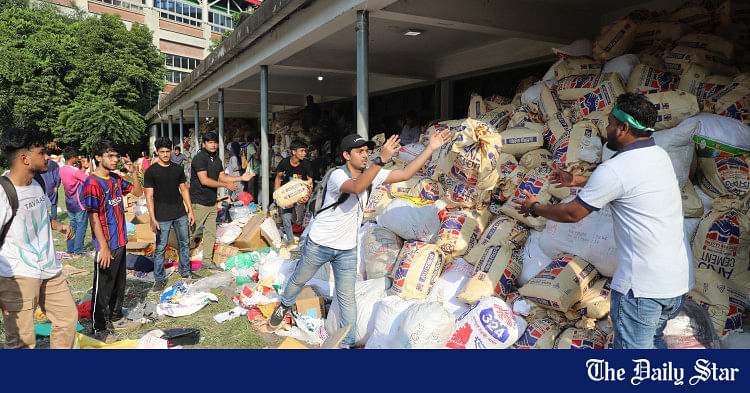
In response to students’ call for relief donations, people from different parts of the capital rushed to Dhaka University with relief as per their capacity and abilities. PHOTO: PALASH KHAN

In every humanitarian crisis created out of natural disasters, people come forward to help those who need support for life and livelihood. This is a global trend and Bangladesh is no exception to that. Dr Hanna Zagefka and her team of researchers at Royal Holloway, University of London, have revealed that one reason that natural disasters switch on the altruism button within us is our perception that the affected populations are somehow less to blame for their circumstances. Besides, most studies show that helping others makes us happier and ultimately leads us to give more.

The sacrifice of Abu Sayed in the July-August uprising boosted people's level of empathy, especially during the flood, which occurred just after the victory of August 5. People from all walks of life and every corner of the country tried to rush to the affected zone with whatever they had. This positive state of emotion could have been guided professionally. As a disaster-prone country, government and non-governmental organisations in Bangladesh have had significant disaster response experiences over the past 54 years. But were we able to cash the "positive emotions" of people with our experience?

In response to students' call for "gono-traan," people from different parts of the capital rushed to Dhaka University with relief as per their capacity and abilities. Even persons with disabilities living in the street and rickshaw pullers responded to the call. I couldn't control my tears when they said, "We are happy to be a part of this. For decades we have been searching for this real Bangladesh." Students of various institutions also collected funds from busy intersections and mosques. People donated generously—cash, basic medicines, dry food, clothes, sanitary napkins, water, life jackets, and even unnecessary things that could not be used. Although there are several disaster management departments and institutions, nobody advised people about what should be donated. Within a few days, the games room, the TSC cafeteria, the gymnasium, and rooms in the social science faculty filled up with relief goods.

Collections versus distribution

Last week, a friend of mine visited the campus and shared photos of piled-up undistributed relief materials on his Facebook page. He advocated for quick disposal of these materials and wrote, "The students are very good at participating in movements, moving forward fearlessly, and have also shown their skill in collecting donations during calamities. But transporting them to flood-affected areas, and distributing them requires another kind of expertise and logistical support. That task will not be easy for them. So, it would be good to give the remaining materials to a well-reputed NGO or Red Crescent, working in the flood-affected area. The relief can be divided and given to several organisations."

In an ideal situation, the collections could have been sent to the affected upazila administrations for distribution. They have an established system of distribution guided by Standing Orders on Disaster (SoD). Over the years, the country has managed to establish this comprehensive disaster management framework. SoD was initially introduced in 1997 and has undergone several revisions, with the most recent update occurring in 2019.

The framework establishes a clear command and control structure, ensuring a well-defined line of authority from the central government down to local entities.

With the help of the union disaster management committees, the respective Union Nirbahi Officers could have distributed the received goods as per the list of the affected people. In the past upazila and district administrations came forward proactively and took control of relief distribution to avoid duplication and reach the marginalised communities in the remotest areas. But unlike other times, on August 24, the administration did not do its best or they hesitated to perform their duties.

Coordination was needed not only for distribution but also for ensuring the security of new aid workers arriving from outside. The names and contact details of these aid workers, who went to the affected districts, should have been recorded at the district level or the upazila relief coordination centres, which the government prefers to call the control room. Many youth groups and individuals faced fatal accidents and confronted unpleasant situations in trying to distribute relief. In some cases, the army had to intervene to rescue the new aid workers.

Until recently, the administration functioned under a political boss and somewhat within a bureaucratic chain of command. For the first time in the history of Bangladesh, local civil administration could have set an example by conducting relief and rescue management operations in the absence of a politically biased authority. In the past, they had to think twice before making a decision. They would have to wait for the confirmation of the local MP. Sometimes, MPs or their cronies would communicate "uporer nirdesh" or the instructions of a higher authority. Government circulars, cabinet calls or letters would be issued. Moreover, they had to remain busy with the protocol of VIPs visiting the affected areas. This time they could have planned professionally and guided the youths to deliver the relief materials, where needed.

Coordination was needed not only for distribution but also for ensuring the security of new aid workers arriving from outside. The names and contact details of these aid workers, who went to the affected districts, should have been recorded at the district level or the upazila relief coordination centres, which the government prefers to call the control room. Many youth groups and individuals faced fatal accidents and confronted unpleasant situations in trying to distribute relief. In some cases, the army had to intervene to rescue the new aid workers.

Another type of coordination failure also took place this time. In the past, the Bangladesh Red Crescent Society played a strong role in relief distribution and rehabilitation through its district Red Crescent committees. Sadly, these committees too have fallen silent under the clutches of politicisation. Almost all the committee members, being from the ousted political party, went into hiding this time.

In addition to that coordination system at NGO level also got impacted. NGOs have developed their own institutions for coordination, which have been functioning long before the establishment of the NGO Bureau. Without respecting the present practice, the NGO Bureau, on August 28, issued a letter nominating NGO representatives in "regional coordination centers" for combating the flood situation. This letter created confusion in the existing, clear coordination system of NGOs.

The remaining thread of the coordination system is the union parishads. Though some UP chairmen and members are also on the run, almost all the women representatives are still in their respective localities. Instead of disbanding the union parishads now, they should have been entrusted with the relief coordination at the field level.

What should be done?

The union committees should be reconstituted and young people from Girl Guides, Scouts, Bangladesh National Cadets Corps, etc should be included as full members in the union disaster management committees. A circular from the interim government will be enough to do this. Needless to say, there are no posts for youths in disaster management committees at district, upazila or union level, though they play a vital role in rescue and relief operations. Upazila committees should also be formed with the representatives of the reconstituted union committees. There too the youth should be made full members constituting one-third of the total number of members.

If we want to build a discrimination-free Bangladesh, we have to move forward by implementing a proper system and putting the right persons in the right places, while making them accountable to the people. If our target is right, we will surely create the land that Abu Sayed, Snigdho, Fayyaz and all the others, who sacrificed their life for democracy, dreamt of.

Gawher Nayeem Wahra is a researcher and writer.​
 
Analyze

Analyze Post

Add your ideas here:
Highlight Cite Fact Check Respond

Members Online

Latest Posts

Back
PKDefense
G
O
 
H
O
M
E