Tarique Rahman’s Japan visit: Japan’s bet on Bangladesh is really about the Bay of Bengal
Mohd Amdadul Haque
Prime Minister Tarique Rahman’s October 26–29 visit to Japan is framed around strengthening the strategic partnership and coordinating on Japan’s updated Free and Open Indo-Pacific (FOIP) vision. Japan does not view Dhaka merely as an aid partner, a market or a stop on a diplomatic itinerary. It sees a strategically located country on the Bay of Bengal that can connect maritime routes, supply chains and markets across South and Southeast Asia. Bangladesh, in turn, should see the visit as a negotiation over the terms of that connection. Tokyo’s core interest is a predictable and open regional environment. Dhaka’s interest is to turn that preference into national capabilities, economic value and greater foreign-policy options.
The relationship has already moved beyond development assistance. In 2023, the two governments elevated their ties to a strategic partnership. Their joint statement brought together freedom of navigation, regional connectivity, quality infrastructure, supply-chain resilience and maritime cooperation. That combination is revealing. Japan’s approach links economic integration to regional order: ports and roads move goods, but they also embed financing terms, technical standards, commercial networks and security arrangements. Bangladesh’s challenge is to shape those connections so that they expand its choices rather than simply make it a corridor through which other countries’ interests pass.
The Bay is more than a shipping map
Japan’s primary interest is maritime. Its foreign ministry has described the Bay of Bengal as lying along vital sea lanes for Japan. The point is not that Bangladesh controls those routes; it does not. Rather, the Bay’s stability affects the wider maritime system on which Japan’s trade depends. Safe passage, reliable information about activities at sea and the ability to respond to disasters are therefore strategic concerns for Tokyo. For Dhaka, the same conditions matter for trade, fisheries, coastal livelihoods, disaster response and any credible plan to develop a blue economy. The overlap creates room for cooperation, but the two countries approach it from different geographical positions and with different capabilities.
The clearest recent signal is Japan’s Official Security Assistance (OSA). In July 2026, Japan handed over five patrol boats to the Bangladesh Navy. Tokyo said the boats were intended to improve monitoring, surveillance and disaster-relief operations in the Bay. Its explanation of OSA is also unusually direct: the programme is designed to strengthen partner countries’ security capabilities, deepen security cooperation and help create a desirable security environment for Japan. That statement identifies both sides of the transaction. The equipment can help Bangladesh perform practical tasks, while the relationship also gives Japan a deeper role in the region’s maritime security landscape.
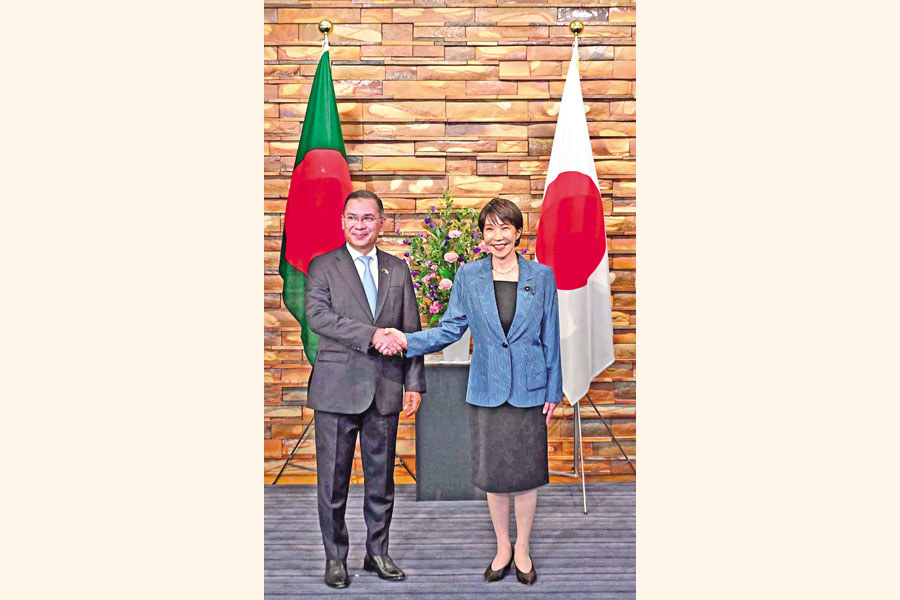
Prime Minister Tarique Rahman meets a Japanese parliamentary delegation led by former Prime Minister Taro Aso in Tokyo on 26 October 2026. During the meeting, he sought Japan’s support for the safe and voluntary repatriation of Rohingya refugees. Photo: PMO
That dual purpose should be discussed openly, not treated as evidence of a hidden alliance. A patrol boat is not a treaty commitment, and Bangladesh should not turn a limited capability-building project into a promise of geopolitical alignment. At the same time, acknowledging that Japan has its own strategic interests makes cooperation easier to negotiate honestly. Dhaka can ask what the assistance enables, how maintenance and training will be funded, which agencies will use the information gathered and what safeguards apply to operational data. Such questions make the partnership more durable because they define responsibilities before a crisis tests them.
Bangladesh also has concrete reasons to improve its maritime capacity. The Bay is a source of livelihoods and a route for commerce, but it is also exposed to cyclones, accidents, smuggling and other risks that do not stop at national boundaries. Boats alone cannot provide maritime awareness. They need trained crews, reliable communications, maintenance budgets, legal procedures and coordination among the Navy, Coast Guard, ports and disaster management agencies. Japan’s contribution will matter most if it helps build that system over time. For Tokyo, deeper day-to-day cooperation can strengthen confidence in the region’s security environment. For Bangladesh, the test is whether each new capability remains under clear national command and addresses an identified national need.
Connectivity is a form of influence
Japan’s second core interest is economic connectivity. The 2023 statement described Bangladesh as a potential bridge between the large markets of South and Southeast Asia. Japan’s Diplomatic Bluebook links the Bay of Bengal Industrial Growth Belt (BIG-B) with a broader industrial value chain extending towards India’s northeast. This is more than a plan to move containers faster. If roads, railways, ports and industrial zones connect across borders, they can influence where firms locate, which suppliers secure contracts and which technical standards become standard practice. Connectivity changes the geography of production as well as that of transport.
That is why Japan’s interest in infrastructure has a geopolitical dimension, even when a project is described in commercial or developmental terms. A long-term infrastructure network creates enduring relationships among lenders, contractors, regulators, operators and businesses. It can reduce logistical costs and make production more resilient, but it can also shape future choices through the standards and financing arrangements attached to it. Japan has promoted “quality infrastructure” alongside transparency, life-cycle costs and debt sustainability. Those principles are not merely decorative. They are part of the rules Japan wants to normalise across the region, and they matter to Bangladesh because the cost of a poorly chosen project can outlast the government that approved it.
Prime Minister Tarique Rahman is briefed on the layout plan of Matarbari Deep Sea Port during an inspection of the project site in Maheshkhali, Cox’s Bazar, on 9 August 2026. Photo: PID
The distinction between being a bridge and being a hub is equally important. A bridge carries traffic between places; a hub captures some of the value created by that traffic. Bangladesh cannot become a regional production centre merely by sitting between markets or allowing goods to cross its territory. It needs reliable links between ports and factories, predictable customs procedures, power and logistics services, skilled workers and local firms capable of supplying larger production networks. If those elements are missing, the country may bear the land, financing and environmental costs of connectivity while firms elsewhere capture most of the gains. Japan’s interest in a connected Bay can serve Bangladesh’s development, but only if Dhaka negotiates for domestic value creation rather than treating connectivity itself as the outcome.
The Economic Partnership Agreement (EPA), signed in February 2026, gives the relationship a rule-making dimension. Its official text and related documents establish a framework for closer trade and investment ties; they do not, by themselves, generate new exports or employment. The full agreement text also covers customs, product standards, services, investment, e-commerce, procurement, labour, the environment and transparency. Businesses need to understand the rules, meet standards and find buyers.
Public agencies need to ensure that customs procedures, certification and implementation are predictable. Japanese firms need a stable commercial environment, while Bangladeshi producers need practical support to enter supply chains. The EPA’s geopolitical value will depend on whether both sides use it to generate reciprocal economic activity, rather than treating its signing as proof that the hard work is finished.
Why Japan matters to Dhaka’s foreign policy
Japan matters to Bangladesh because it can expand the country’s foreign-policy options. Japan’s own evaluation of its development assistance describes it as Bangladesh’s largest bilateral development partner and recognises its long record of support in infrastructure, power, transport, health and education. That record has built trust, but the relationship cannot rely indefinitely on the donor-recipient model. Bangladesh needs investment, technology, market access and skills that support a more diversified economy. Japan needs credible partners and stable regional networks. A strategic relationship is valuable precisely when both sides have something to gain and the terms are clear.
For Dhaka, a closer relationship with Tokyo can also reduce the risk of relying too heavily on any single external partner. This should not be presented as a choice between Japan and China, or between Japan and India. Bangladesh has substantial relations with its neighbours and other major economies; its geographical and economic realities make those relationships unavoidable. The foreign-policy objective is not to keep every partner at an identical distance. It is to retain the capacity to make decisions on an issue-by-issue basis, compare offers and reject terms that do not serve national priorities. Diversification creates that capacity only when Bangladesh’s institutions can assess projects, negotiate contracts and enforce agreed rules.
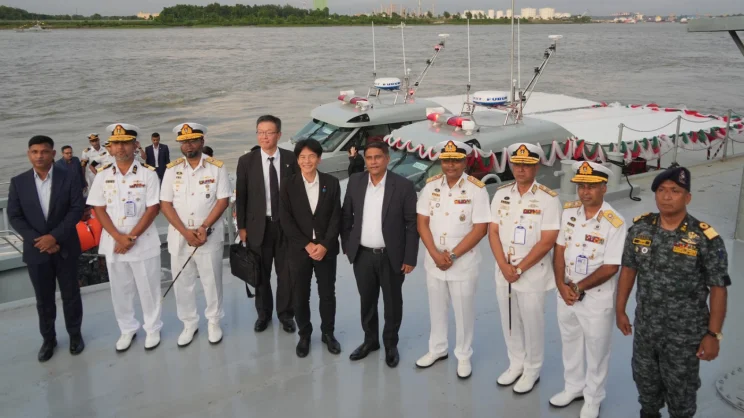
Prime Minister’s Defence Adviser Brig Gen (retd) Dr AKM Shamsul Islam and Japan’s Parliamentary Vice-Minister for Foreign Affairs Shimada Tomoaki pose with senior officials following the formal handover of five patrol boats to the Bangladesh Navy under Japan’s Official Security Assistance (OSA) programme in Chattogram on 2 July 2026. Photo: ISPR
Strategic autonomy is sometimes mistaken for silence or equidistance. In practice, it means having sufficient economic and diplomatic room to make decisions without any one partner becoming indispensable. Bangladesh’s own Indo-Pacific Outlook describes its regional vision as free, open, peaceful, secure and inclusive, while grounding engagement in sovereignty, international law and the UN Charter. That formulation gives Dhaka a useful foundation: it can support freedom of navigation, peaceful dispute settlement and resilient trade without adopting every aspect of another government’s strategy. Japan’s FOIP is a Japanese policy framework, not an obligation for Bangladesh to adopt it wholesale.
Nor should Bangladesh assume that Japan’s approach is politically neutral. Tokyo’s development policy explicitly treats cooperation as an important tool of diplomacy, and its regional strategy seeks to strengthen a rules-based order in which Japan has influence. The question is not whether Japan has strategic interests; every major international partner does. The question is whether those interests can be reconciled with Bangladesh’s priorities through transparent terms and reciprocal commitments. That distinction is especially important as security cooperation grows. If Dhaka explains each step in terms of specific capabilities and public benefits, it is less likely to be perceived as joining a bloc. If it leaves the terms vague, other governments may define their meaning for it.
What the Tokyo visit should test
The visit should therefore be judged by the quality of the arrangements it initiates, not by the number of agreements, the status of a new partnership label or the warmth of the photographs.
On maritime cooperation, the two sides could set out practical next steps for training, maintenance, disaster response and information-sharing. Data access and command authority should be agreed upon in advance. Bangladesh should identify which agencies will use the new capabilities and how they will coordinate. These details may attract less attention than a headline about new equipment, but they determine whether cooperation improves public safety and strengthens Bangladesh’s own institutions.
On the economic side, a useful agenda would link the EPA to the readiness of firms and public agencies. That means making rules understandable to exporters, helping smaller suppliers meet certification requirements and aligning infrastructure decisions with sectors that can create local production and jobs. Major connectivity proposals should be assessed for commercial demand, public costs, debt exposure, environmental effects and the distribution of benefits. Publishing the reasoning behind those decisions would help build confidence at home and abroad. Japan’s emphasis on quality and transparency is most valuable when Bangladesh applies those principles to projects it chooses for itself.
Prime Minister Tarique Rahman arrives in Tokyo on 26 October 2026 for a four-day official visit aimed at strengthening bilateral ties, attracting investment and expanding economic cooperation. Photo: BNP Media Cell
The leaders should also treat regional diplomacy as part of the economic relationship. The Bay’s stability cannot be separated from developments in Myanmar, the Rohingya displacement crisis, climate shocks or the interests of India and Southeast Asian states. Japan has experience and diplomatic reach that can support dialogue and humanitarian cooperation, while Bangladesh has direct knowledge of the costs of regional instability. Neither country can resolve these problems alone. Regular consultations can help them coordinate their positions without requiring Bangladesh to endorse every Japanese assessment or turning bilateral cooperation into a substitute for regional institutions.
A final measure of success is whether the relationship becomes more institutionalised and less dependent on individual visits. Targets, responsible agencies, review dates and public reporting can turn political intent into accountable action. This is not merely bureaucratic detail. It is how Bangladesh ensures that an agreement serves national development after the visiting delegations leave. It is also how Japan can be confident that commitments will survive changes in government and translate into reliable partnerships.
Japan’s interest in Bangladesh is neither charity nor a single security transaction. It is a bet on a stable, connected Bay of Bengal and on Bangladesh’s ability to participate in the regional order taking shape around it. Bangladesh should welcome the opportunity while resisting the temptation to define its value solely through geography. A bridge without local production is a passageway; a strategic partnership without domestic capacity is merely a label. Tarique Rahman’s Tokyo visit can lay the groundwork for a more balanced relationship if Dhaka uses Japan’s interest to build capabilities, broaden its economic choices and preserve the freedom to make its own decisions. The Bay may give Bangladesh strategic relevance. Only deliberate policy can turn that relevance into power.
Mohd Amdadul Haque is a doctoral candidate in the Department of International Politics at Shandong University and an assistant professor in the Department of Political Science at Gopalganj Science and Technology University.
 Bangladesh Defense