
 Bangladesh Defense
Saif
Senior Member
- Jan 24, 2024
- 19,052
- 8,851
- Nation

- Residence
- Axis Group

Date of Event:
May 16, 2026
Strategic perspectives on the Teknaf-Tentulia growth corridor
M. Rokonuzzaman
Published :
May 16, 2026 00:32
Updated :
May 16, 2026 00:32
It is intriguing that major global lenders view infrastructure investment as a powerful pathway to accelerate Bangladesh's economic prosperity. Large-scale financing for transport, energy, ports, and urban development can unlock productivity, improve connectivity, and stimulate private sector activity. However, the traditional development formula-where governments ensure macroeconomic stability, invest in human capital and infrastructure, and rely on markets to drive growth-is increasingly being questioned. Bangladesh faces emerging structural challenges that complicate this model. Rising public debt, decreasing local value addition in industrial activities, and growing graduate unemployment signal deeper inefficiencies. At the same time, automation is gradually shrinking labour-intensive opportunities, weakening one of the country's historic growth engines. These realities suggest that infrastructure-led growth alone may not deliver sustained economic transformation. Bangladesh must adopt a more strategic approach-aligning infrastructure investment with industrial upgrading, innovation capacity, and workforce adaptation. Without grounding ambitions in on-the-ground realities, the promise of rapid growth risks becoming difficult to achieve.
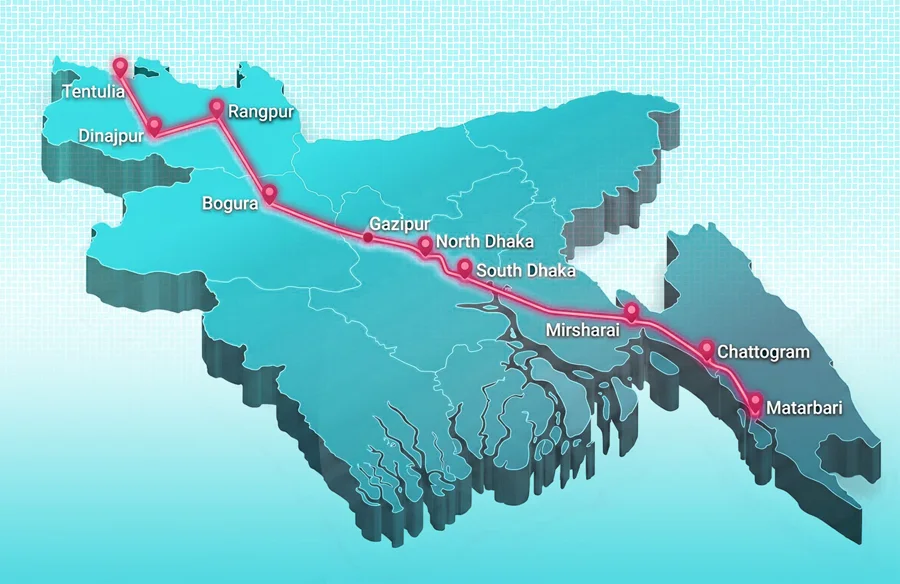
According to media reports, the Asian Development Bank has proposed an ambitious 20-year, $79 billion plan to develop a major economic corridor stretching from Teknaf to Tentulia. The initiative envisions world-class road, rail, and port connectivity linking key growth hubs such as Matarbari, Chattogram, Mirsharai, Dhaka, Gazipur, Bogura, Rangpur, Dinajpur, and Tentulia. Development activities would span a 100-kilometre-wide belt, covering 44 districts, with significant investments in healthcare, education, and energy infrastructure. The goal is to ease population pressure on Dhaka and Chattogram by encouraging decentralisation. In addition, the corridor aims to foster small and medium enterprises across emerging urban clusters. If realised, this large-scale investment is expected to boost Bangladesh's GDP growth by two percentage points, create around 10 million jobs within a decade, and lift nearly 12 million people out of poverty.
A closer look at ground realities raises important strategic questions about the proposed large-scale infrastructure plan. Bangladesh's banking sector is already under severe stress, with non-performing loans (NPLs) reaching an alarming 35.73 per cent as of September 2025. While governance challenges play a role, a deeper issue lies in rising production costs and declining local value addition, which are eroding firms' competitiveness and repayment capacity.
Equally concerning is the impact of automation on employment. In the ready-made garments sector, producing $1 million worth of exports required 220 workers in 2013, but only 94 in 2024. Despite a decade of manufacturing growth, employment has declined by 1.4 million jobs. This signals a structural shift where output expands without proportional job creation.
Moreover, significant infrastructure investments over the past 15 years have not delivered commensurate economic returns. Graduate unemployment has surged to nearly 50 per cent, reflecting a disconnect between education and market demand. At the same time, rising external debt repayment obligations-exceeding $5 billion this fiscal year-have intensified fiscal pressure, prompting higher tax burdens. Besides, despite advancement of infrastructure, Bangladesh's trade deficit with China widened by nearly 23 percent to approximately US$ 20.66 billion (Tk 2.54 trillion) in the 2024-2025 fiscal year (FY25).
In this context, the critical question remains: how will additional infrastructure spending address these structural inefficiencies rather than deepen existing economic vulnerabilities?
The next critical issue concerns the modality of implementation. As in the past, will major infrastructure work packages be contracted out to foreign firms, or will Bangladesh adopt a more strategic approach? Valuable lessons can be drawn from countries like Japan and China. Both nations used infrastructure development not merely for connectivity, but as a vehicle for technology absorption and industrial advancement. Japan, for instance, leveraged such investments to acquire and refine high-speed rail technology, while China followed a similar path-resulting in globally competitive firms and high-paying jobs for their graduates. Moreover, both Japan and China eventually expanded into the global infrastructure market, turning domestic capability into export strength.
Bangladesh should aim for comparable outcomes. Infrastructure projects should be designed to increase local value addition, build domestic technical capabilities, and create quality employment opportunities. Importantly, many lenders financing Bangladesh's infrastructure are also active in other developing countries. Therefore, Bangladesh should not only seek financing but also negotiate commitments for developing local firms and facilitating their entry into international markets.
The challenge of developing small and medium enterprises (SMEs) and digital infrastructure for job creation must be examined from a strategic perspective. Over the past 15 years, Bangladesh has made notable progress by investing in infrastructure for high-tech parks and expanding technology training. Besides, universities are now producing more than 25,000 engineering graduates annually. However, despite these advances in physical infrastructure and human capital, job creation remains deeply unsatisfactory. Besides, due to technology import-centric strategy for productivity growth, local value addition has been shrinking despite infrastructure advancement.
At the same time, large-scale investments in nationwide fibre optic connectivity have yet to deliver meaningful contributions to economic growth. This raises important questions about the effectiveness of current approaches. The limited scalability of SMEs and their clusters is particularly concerning. Why are these enterprises struggling to increase value addition and reduce costs to compete in global markets?
It is worth questioning whether connectivity alone is the binding constraint on growth, or whether deeper structural issues-such as capability gaps, limited innovation, and weak integration into global value chains-play a larger role in constraining employment and productivity. Suppose the envisioned high-speed connectivity is already in place. The critical question then becomes: what will be transported at sufficient scale and value to justify such massive investment? Halving the time to move Dinajpur's lichi to Chittagong port may bring marginal gains, but is it economically transformative? If high-speed transport had a linear relationship with growth, Japan would not face stagnation today. Moreover, due to cost-benefit considerations, even in advanced economies, high-speed systems are not universally utilised by all passengers or freight.
There is no denying that Bangladesh needs infrastructure development to sustain economic progress. However, unlike resource-rich economies, it cannot depend on borrowing heavily and outsourcing projects to foreign firms, as seen in parts of the Middle East. Instead, infrastructure investment must be treated as a strategic opportunity to acquire technology, build domestic capabilities, and nurture globally competitive, high-performing firms. Such an approach can also generate high-paying jobs for the country's growing pool of educated graduates.
At the same time, infrastructure alone cannot address broader challenges of job creation and economic transformation. Bangladesh must carefully assess what capacities are required to convert human competence into economic value. This calls for aligning education, industry, and innovation systems with long-term development goals. Equally important is learning from past investments, many of which have fallen short in delivering expected gains in employment and growth. Without such reflection, large-scale borrowing for infrastructure risks repeating earlier shortcomings rather than unlocking sustainable prosperity.
Rokonuzzaman, Ph.D, academic and researcher on technology, innovation and policy.
M. Rokonuzzaman
Published :
May 16, 2026 00:32
Updated :
May 16, 2026 00:32
It is intriguing that major global lenders view infrastructure investment as a powerful pathway to accelerate Bangladesh's economic prosperity. Large-scale financing for transport, energy, ports, and urban development can unlock productivity, improve connectivity, and stimulate private sector activity. However, the traditional development formula-where governments ensure macroeconomic stability, invest in human capital and infrastructure, and rely on markets to drive growth-is increasingly being questioned. Bangladesh faces emerging structural challenges that complicate this model. Rising public debt, decreasing local value addition in industrial activities, and growing graduate unemployment signal deeper inefficiencies. At the same time, automation is gradually shrinking labour-intensive opportunities, weakening one of the country's historic growth engines. These realities suggest that infrastructure-led growth alone may not deliver sustained economic transformation. Bangladesh must adopt a more strategic approach-aligning infrastructure investment with industrial upgrading, innovation capacity, and workforce adaptation. Without grounding ambitions in on-the-ground realities, the promise of rapid growth risks becoming difficult to achieve.
According to media reports, the Asian Development Bank has proposed an ambitious 20-year, $79 billion plan to develop a major economic corridor stretching from Teknaf to Tentulia. The initiative envisions world-class road, rail, and port connectivity linking key growth hubs such as Matarbari, Chattogram, Mirsharai, Dhaka, Gazipur, Bogura, Rangpur, Dinajpur, and Tentulia. Development activities would span a 100-kilometre-wide belt, covering 44 districts, with significant investments in healthcare, education, and energy infrastructure. The goal is to ease population pressure on Dhaka and Chattogram by encouraging decentralisation. In addition, the corridor aims to foster small and medium enterprises across emerging urban clusters. If realised, this large-scale investment is expected to boost Bangladesh's GDP growth by two percentage points, create around 10 million jobs within a decade, and lift nearly 12 million people out of poverty.
A closer look at ground realities raises important strategic questions about the proposed large-scale infrastructure plan. Bangladesh's banking sector is already under severe stress, with non-performing loans (NPLs) reaching an alarming 35.73 per cent as of September 2025. While governance challenges play a role, a deeper issue lies in rising production costs and declining local value addition, which are eroding firms' competitiveness and repayment capacity.
Equally concerning is the impact of automation on employment. In the ready-made garments sector, producing $1 million worth of exports required 220 workers in 2013, but only 94 in 2024. Despite a decade of manufacturing growth, employment has declined by 1.4 million jobs. This signals a structural shift where output expands without proportional job creation.
Moreover, significant infrastructure investments over the past 15 years have not delivered commensurate economic returns. Graduate unemployment has surged to nearly 50 per cent, reflecting a disconnect between education and market demand. At the same time, rising external debt repayment obligations-exceeding $5 billion this fiscal year-have intensified fiscal pressure, prompting higher tax burdens. Besides, despite advancement of infrastructure, Bangladesh's trade deficit with China widened by nearly 23 percent to approximately US$ 20.66 billion (Tk 2.54 trillion) in the 2024-2025 fiscal year (FY25).
In this context, the critical question remains: how will additional infrastructure spending address these structural inefficiencies rather than deepen existing economic vulnerabilities?
The next critical issue concerns the modality of implementation. As in the past, will major infrastructure work packages be contracted out to foreign firms, or will Bangladesh adopt a more strategic approach? Valuable lessons can be drawn from countries like Japan and China. Both nations used infrastructure development not merely for connectivity, but as a vehicle for technology absorption and industrial advancement. Japan, for instance, leveraged such investments to acquire and refine high-speed rail technology, while China followed a similar path-resulting in globally competitive firms and high-paying jobs for their graduates. Moreover, both Japan and China eventually expanded into the global infrastructure market, turning domestic capability into export strength.
Bangladesh should aim for comparable outcomes. Infrastructure projects should be designed to increase local value addition, build domestic technical capabilities, and create quality employment opportunities. Importantly, many lenders financing Bangladesh's infrastructure are also active in other developing countries. Therefore, Bangladesh should not only seek financing but also negotiate commitments for developing local firms and facilitating their entry into international markets.
The challenge of developing small and medium enterprises (SMEs) and digital infrastructure for job creation must be examined from a strategic perspective. Over the past 15 years, Bangladesh has made notable progress by investing in infrastructure for high-tech parks and expanding technology training. Besides, universities are now producing more than 25,000 engineering graduates annually. However, despite these advances in physical infrastructure and human capital, job creation remains deeply unsatisfactory. Besides, due to technology import-centric strategy for productivity growth, local value addition has been shrinking despite infrastructure advancement.
At the same time, large-scale investments in nationwide fibre optic connectivity have yet to deliver meaningful contributions to economic growth. This raises important questions about the effectiveness of current approaches. The limited scalability of SMEs and their clusters is particularly concerning. Why are these enterprises struggling to increase value addition and reduce costs to compete in global markets?
It is worth questioning whether connectivity alone is the binding constraint on growth, or whether deeper structural issues-such as capability gaps, limited innovation, and weak integration into global value chains-play a larger role in constraining employment and productivity. Suppose the envisioned high-speed connectivity is already in place. The critical question then becomes: what will be transported at sufficient scale and value to justify such massive investment? Halving the time to move Dinajpur's lichi to Chittagong port may bring marginal gains, but is it economically transformative? If high-speed transport had a linear relationship with growth, Japan would not face stagnation today. Moreover, due to cost-benefit considerations, even in advanced economies, high-speed systems are not universally utilised by all passengers or freight.
There is no denying that Bangladesh needs infrastructure development to sustain economic progress. However, unlike resource-rich economies, it cannot depend on borrowing heavily and outsourcing projects to foreign firms, as seen in parts of the Middle East. Instead, infrastructure investment must be treated as a strategic opportunity to acquire technology, build domestic capabilities, and nurture globally competitive, high-performing firms. Such an approach can also generate high-paying jobs for the country's growing pool of educated graduates.
At the same time, infrastructure alone cannot address broader challenges of job creation and economic transformation. Bangladesh must carefully assess what capacities are required to convert human competence into economic value. This calls for aligning education, industry, and innovation systems with long-term development goals. Equally important is learning from past investments, many of which have fallen short in delivering expected gains in employment and growth. Without such reflection, large-scale borrowing for infrastructure risks repeating earlier shortcomings rather than unlocking sustainable prosperity.
Rokonuzzaman, Ph.D, academic and researcher on technology, innovation and policy.


