Home Watch Videos Wars Movies Login

[🇧🇩] Tea Industry of Bangladesh

[🇧🇩] Tea Industry of Bangladesh
23
3K
More threads by Saif

G Bangladesh Defense

Tea garden workers warrant the same support as other industry labourers

1739231738157.webp


In the tapestry of Bangladesh's socio-economic landscape, tea gardens and industrial parks stand as silent pillars that uphold the lives of millions, weaving together tradition and modernity. A morning that begins with a cup of tea mirrors the soul of every Bangalee heart. Alongside, the sprawling Beximco Industrial Park symbolises industrial ambition and global competitiveness. Yet, these two worlds converge in the shared plight of labourers whose sweat fuels our economy. As we savour the warmth of tea or don garments stitched with care, do we pause to acknowledge the unseen hands shaping these moments? This is not just a narrative of labour; it is the story of Bangladesh where every worker's life is intricately woven into the fabric of national progress.

While the media's spotlight shines on the recent turmoil surrounding Beximco Industrial Park, the plight of tea garden workers of the tea estates owned and operated by National Tea Company remains woefully underreported. These crises reveal deeper structural and political issues that threaten the livelihoods of thousands and ultimately, the economic resilience of Bangladesh.

The closure of the National Tea Company due to political instability exemplifies the precarious position of marginalised workers. The sudden shutdown of Madhabpur Tea Estate in Moulvibazar has left families stranded without income or alternative employment opportunities. Sanu, a worker at the estate, paints a grim picture of this reality. With five family members, including a sick mother, he struggles to provide even the most basic meals, resorting to muri (puffed rice) and cha pata bhorta (mashed tea leaves) for sustenance. Occasionally, a tourist's tip is all that stands between his family and hunger. This tragic narrative is emblematic of countless others, yet it garners little attention because tea workers lack the platforms or influence to amplify their voices.

Meanwhile the crisis at Beximco Industrial Park dominates the headlines, as workers demand their rightful wages and reinstatement. While both cases highlight the vulnerability of workers, they also expose an unequal distribution of concern and urgency. The media's focus on high-profile industrial hubs often eclipses the struggles of those in remote areas, perpetuating a cycle of neglect for sectors like the tea industry.

Both situations underscore the need for immediate and comprehensive government intervention. The current approach of relocating displaced workers to other factories or gardens is short-sighted and counterproductive. Such measures ignore the broader implications: abandoned infrastructure, loss of industry-specific expertise, and a diminishing industrial base. The parallels with the decline of Bangladesh's sugar and jute mills are stark and cautionary. These once-thriving industries now stand as relics of mismanagement and neglect, offering lessons that must not be ignored.

Bangladesh's status as a growing economy demands prudent and proactive policies to safeguard its industries. Political instability and labour exploitation cannot become recurring narratives. The government must prioritise the reopening and stabilisation of the tea estates under the National Tea Company and Beximco Industrial Park. This involves ensuring fair wages, addressing worker grievances, and fostering an environment conducive to sustainable operations.

For tea workers, the solution lies in comprehensive industry reform. The systemic exploitation that keeps wages at starvation levels must end. The government, alongside industry stakeholders, should implement wage standardisation, social security measures, and skill development programmes. For larger industrial hubs like Beximco, the focus should be on transparent conflict resolution mechanisms, timely payment of dues, and robust labour policies that prevent future disruptions.

It is time for Bangladesh to heed the silent cries of its labour force and walk resolutely towards reform and equity. The stories of Madhabpur's tea workers and Beximco's factory labourers are not isolated, and they remind us of the delicate balance between progress and humanity. Their struggles are a clarion call for a nation striving to achieve middle-income status while ensuring that nobody is left behind. Let us not allow these crises to become forgotten tragedies; instead, let them fuel a collective resolve to create a future where every sip of tea and every stitch of cloth represents not just an industry but the dignity of those who make it possible. Advocacy groups, unions, and policymakers must work together to amplify the voices of the voiceless, ensuring that every worker, regardless of their location or industry, is afforded dignity and justice.

Rafad Asgar is research associate at Bangladesh Institute of Governance and Management (BIGM).​
 
Analyze

Analyze Post

Add your ideas here:
Highlight Cite Respond

Strict oversight of tea worker rights a must
05 March, 2025, 00:00

EARNINGS from tea export have been progressively increasing amid allegations of gross violations of worker rights in tea gardens. Tea workers’ union leaders in Moulvibazar demand that their festival allowance for Phagua, a major festival for the tea workers community, should be paid in full and in time. All tea workers are entitled to a festival allowance of Tk 3,713 for Phagua in keeping with the latest minimum wage board award. Some tea estates, however, try to replace the festival allowance with an attendance-based incentive, which is a violation of the agreement signed between the tea estates and the government. In recent times, other similar attempts to delay or withhold festival allowance have been reported. In March 2024, workers of the Kuchai tea estate in Moulavibazar took to the streets protesting at an arbitrary decision of garden owners to reduce their festival allowance on the occasion of Dol Purnima. When the minimum wage structure is considered inadequate, the denial to pay the full allowance in time is not only a labour rights violation but also inhuman.

The irregular payment of wages and employment benefits is, rather, characteristic of the tea industry. In September 2024, about 1,500 workers of the state-owned National Tea Company Ltd rallied, demanding their wages unpaid for three weeks and alleged that their families were starving as the company had also suspended their ration and access to treatment. In July 2023, workers at Imam and Bhabani Tea Garden went on strike with demands that included the payment of their wages and festival allowance, the reimbursement of the provident fund and the ensuring of their house rent and medical allowances. There are loopholes in laws and regulations that allow owners to make such arbitrary decisions and withhold festival allowances or severance benefits. Tea workers do not receive 5 per cent of the net profit of the previous year of the company they work for, as specified in the labour law and the Workers’ Welfare Foundation Act. Rarely are any actions taken by the authorities against such gross violations.

The government should, therefore, take initiatives to protect the rights of tea garden workers. The labour ministry should take early steps to address specific concerns of the tea workers of Moulvibazar and ensure a timely payment of the festival allowance. The labour law should be revisited to ensure that owners cannot make an arbitrary decision to deny or withhold festival allowance or severance payments. Tea garden workers should have the right to negotiate their minimum wage and employment benefits. The labour ministry should ensure an effective oversight of tea gardens so that labour rights are not violated.​
 
Analyze

Analyze Post

Add your ideas here:
Highlight Cite Respond

Only 5 of 28 locally developed tea varieties popular

1747792144590.webp


Out of the 28 varieties of tea plants developed by state-run Bangladesh Tea Research Institute (BTRI), only five are widely cultivated in the country, based on their high yield, quality, and climate resilience.

These varieties are also called tea clones -- plants produced through vegetative propagation like cuttings or grafting from a single, selected parent plant, rather than from seeds.

This method allows for the creation of genetically identical plants with specific desirable traits, like high yield or disease resistance.

The five clones, named BT-1 (developed in 1966), BT-2 (1975), BT-4 (1981), BTS-1 (1985), and TV-1 (1949), yield around 3,000 to 4,000 kilogrammes (kg) of tea per hectare on average, said BTRI Director Md Ismail Hossain.

BT-2 is the most popular due to its drought tolerance and flavour resembling Darjeeling tea, which is appreciated for its delicate taste, floral aroma, and wine-like notes reminiscent of muscat grapes, he added.

Speaking to The Daily Star yesterday, Hossain said BT-2 can be used to produce premium-quality black tea and green tea.

However, he added that, given the size of the country's tea industry, the number of clones developed so far is not sufficient and research is ongoing for new ones.

Traditionally, people tend to trust what is old and proven -- and the same holds true in the tea sector, he said. Tea garden owners prefer cultivating older, tried-and-tested clones, while adoption of newer ones remains limited, the researcher also added.

As such, garden owners usually cultivate three to five select clones to ensure that their operations are not commercially affected in any way, he added.

He informed that developing a high-quality clone takes around 13 years and its economic lifespan is around 50 years.

However, industry insiders said this has led to a lack of product diversification.

Tea garden owners said the BTRI needs to develop more clones focusing on climate resilience and high quality to boost tea production and sales.

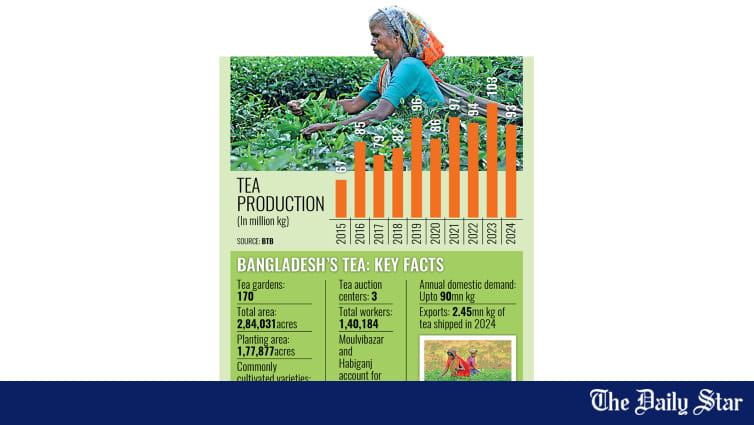
Bangladesh's tea industry dates back 184 years. There are currently 170 tea gardens, mostly in the northeast. In 2024, 93.04 million kg of tea was produced in the country against an annual demand of 85–90 million kg, according to industry sources.

What tea garden owners and officials say

An official of one of the leading tea manufacturers, requesting anonymity, said they were cultivating BT-2 on nearly 50 percent of their plantation area given its high yield, quality, low susceptibility to pest attacks, drought tolerance, and low mortality rate.

They also planted TV-1, said the official, opining that more clones, focused on climate resilience for product diversification, were required.

Kamran Tanvirur Rahman, chairman of the Bangladesh Tea Association (BTA), a platform of tea garden owners, said there was a shortage of high-yield varieties and the BTRI needs to focus on this.

More drought-tolerant clones must also be developed as the country experiences little to no rainfall for five to six months of the year. Irrigation is not feasible everywhere, as it would increase production costs, he added.

Luthful Kabir Shaheen, director of business development at City Group, a leading conglomerate which owns the Bengal Tea brand and eight tea gardens, said their plants include the popular BT 1, BT 2 and TV 1 varieties.

"These clones have been prioritised due to their climate resilience, superior aroma, and sweetness, which make them more desirable in the market," he said.​
 
Analyze

Analyze Post

Add your ideas here:
Highlight Cite Respond

Bashir slams vicious cycle of tea industry
Bangladesh Sangbad Sangstha . Dhaka 21 May, 2025, 23:17

1747871218685.webp

Commerce adviser Sk Bashir Uddin poses for a photo at a function marking the 5th National Tea Day held at the Osmani Memorial Auditorium in the capital on Wednesday. | Sony Ramani

Commerce adviser Sk Bashir Uddin on Wednesday expressed his hope to find out a way to protect the national resource tea from the vicious cycle of the tea industry.

‘If we can ensure balanced distribution, then we’ll be able to find out a way forward to protect the national resource tea from the vicious cycle of the tea industry. We’ll have to take integrated steps to seize the vast potentials of the tea industry,’ he said.

He also called upon all to highlight the tea industry both at local and international markets and said that the government was working to enhance the export of tea after meeting the local demand.

The commerce adviser was addressing a function marking the 5th National Tea Day held at the Osmani Memorial Auditorium in the capital.

Referring to the issue of not getting fair prices for tea, he said that if 9.30 crore kilogram of tea was produced in the country, its market value stood at Tk 3,700-4,000 crore. However, if it is converted into street value, then an expected expenditure of about Tk 8,000-10,000 crore happens at consumer level, he said.

Putting emphasis on ensuring the prosperity of the tea gardens, the commerce adviser said that concerted efforts were needed in this regard from the tea garden owners and the workers.

He also underscored the need for ensuring diversification of tea products and making those attractive.

Presided over by commerce secretary Mahbubur Rahman, Bangladesh Tea Board chairman Major General Sheikh Mohammad Sarwar Hossain gave the address of welcome.

Tea Traders Association of Bangladesh president Shah Moinuddin Hasan, Bangladesh Tea Association president Kamran T Rahman, National Tea Award-2024 winner and tea worker Jesmin Akhter and Bangladesh Tea Workers Union acting president Nripen Pal spoke on the occasion.

The commerce adviser handed over crests and certificates to the winners of the National Tea Award 2025 in eight categories and two special awards in the highest tea producing factory category.

Earlier, Bashir inaugurated the operations of the 5th National Tea Day through releasing balloons. Later, he visited various stalls set up in the tea fair.​
 
Analyze

Analyze Post

Add your ideas here:
Highlight Cite Respond

Tea garden workers warrant the same support as other industry labourers

View attachment 14260

In the tapestry of Bangladesh's socio-economic landscape, tea gardens and industrial parks stand as silent pillars that uphold the lives of millions, weaving together tradition and modernity. A morning that begins with a cup of tea mirrors the soul of every Bangalee heart. Alongside, the sprawling Beximco Industrial Park symbolises industrial ambition and global competitiveness. Yet, these two worlds converge in the shared plight of labourers whose sweat fuels our economy. As we savour the warmth of tea or don garments stitched with care, do we pause to acknowledge the unseen hands shaping these moments? This is not just a narrative of labour; it is the story of Bangladesh where every worker's life is intricately woven into the fabric of national progress.

While the media's spotlight shines on the recent turmoil surrounding Beximco Industrial Park, the plight of tea garden workers of the tea estates owned and operated by National Tea Company remains woefully underreported. These crises reveal deeper structural and political issues that threaten the livelihoods of thousands and ultimately, the economic resilience of Bangladesh.

The closure of the National Tea Company due to political instability exemplifies the precarious position of marginalised workers. The sudden shutdown of Madhabpur Tea Estate in Moulvibazar has left families stranded without income or alternative employment opportunities. Sanu, a worker at the estate, paints a grim picture of this reality. With five family members, including a sick mother, he struggles to provide even the most basic meals, resorting to muri (puffed rice) and cha pata bhorta (mashed tea leaves) for sustenance. Occasionally, a tourist's tip is all that stands between his family and hunger. This tragic narrative is emblematic of countless others, yet it garners little attention because tea workers lack the platforms or influence to amplify their voices.

Meanwhile the crisis at Beximco Industrial Park dominates the headlines, as workers demand their rightful wages and reinstatement. While both cases highlight the vulnerability of workers, they also expose an unequal distribution of concern and urgency. The media's focus on high-profile industrial hubs often eclipses the struggles of those in remote areas, perpetuating a cycle of neglect for sectors like the tea industry.

Both situations underscore the need for immediate and comprehensive government intervention. The current approach of relocating displaced workers to other factories or gardens is short-sighted and counterproductive. Such measures ignore the broader implications: abandoned infrastructure, loss of industry-specific expertise, and a diminishing industrial base. The parallels with the decline of Bangladesh's sugar and jute mills are stark and cautionary. These once-thriving industries now stand as relics of mismanagement and neglect, offering lessons that must not be ignored.

Bangladesh's status as a growing economy demands prudent and proactive policies to safeguard its industries. Political instability and labour exploitation cannot become recurring narratives. The government must prioritise the reopening and stabilisation of the tea estates under the National Tea Company and Beximco Industrial Park. This involves ensuring fair wages, addressing worker grievances, and fostering an environment conducive to sustainable operations.

For tea workers, the solution lies in comprehensive industry reform. The systemic exploitation that keeps wages at starvation levels must end. The government, alongside industry stakeholders, should implement wage standardisation, social security measures, and skill development programmes. For larger industrial hubs like Beximco, the focus should be on transparent conflict resolution mechanisms, timely payment of dues, and robust labour policies that prevent future disruptions.

It is time for Bangladesh to heed the silent cries of its labour force and walk resolutely towards reform and equity. The stories of Madhabpur's tea workers and Beximco's factory labourers are not isolated, and they remind us of the delicate balance between progress and humanity. Their struggles are a clarion call for a nation striving to achieve middle-income status while ensuring that nobody is left behind. Let us not allow these crises to become forgotten tragedies; instead, let them fuel a collective resolve to create a future where every sip of tea and every stitch of cloth represents not just an industry but the dignity of those who make it possible. Advocacy groups, unions, and policymakers must work together to amplify the voices of the voiceless, ensuring that every worker, regardless of their location or industry, is afforded dignity and justice.

Rafad Asgar is research associate at Bangladesh Institute of Governance and Management (BIGM).​

Tea Garden workers are all migrant poor workers from India. Mostly Santaal ethnic indigenous people I believe.
 
Analyze

Analyze Post

Add your ideas here:
Highlight Cite Respond
  • Wow (+2)
Reactions: Saif
Tea Garden workers are all migrant poor workers from India. Mostly Santaal ethnic indigenous people I believe.
Why do they hire Indians in our tea gardens? We have our own poor. Our poor should be given priority when the tea garden owners hire labors.
 
Analyze

Analyze Post

Add your ideas here:
Highlight Cite Respond
Why do they hire Indians in our tea gardens? We have our own poor. Our poor should be given priority when the tea garden owners hire labors.

These people have been here since British Raj times when the British set up the tea gardens (Sylhet especially) and Santaals and other adibasis (indigenous folks) were brought here by the British.

Santaal people have more ability to work in the heat for longer periods.
 
Analyze

Analyze Post

Add your ideas here:
Highlight Cite Respond
  • Like (+1)
Reactions: Saif

Ailing tea sector seeks lifeline

Syful Islam
Published :
Jul 20, 2025 10:31
Updated :
Jul 20, 2025 10:31

1753057560754.webp


Having sold products at lower than the production costs for years, the Bangladeshi tea industry is now experiencing severe hardship and seeks the government's policy and financial support to survive.

Bangladesh Tea Association, a body of private tea garden owners, in a recent letter to Bangladesh Bank Governor Dr Ahsan H Mansur sought the assistance, saying "the industry would not survive unless the gardens are given low-cost loans".

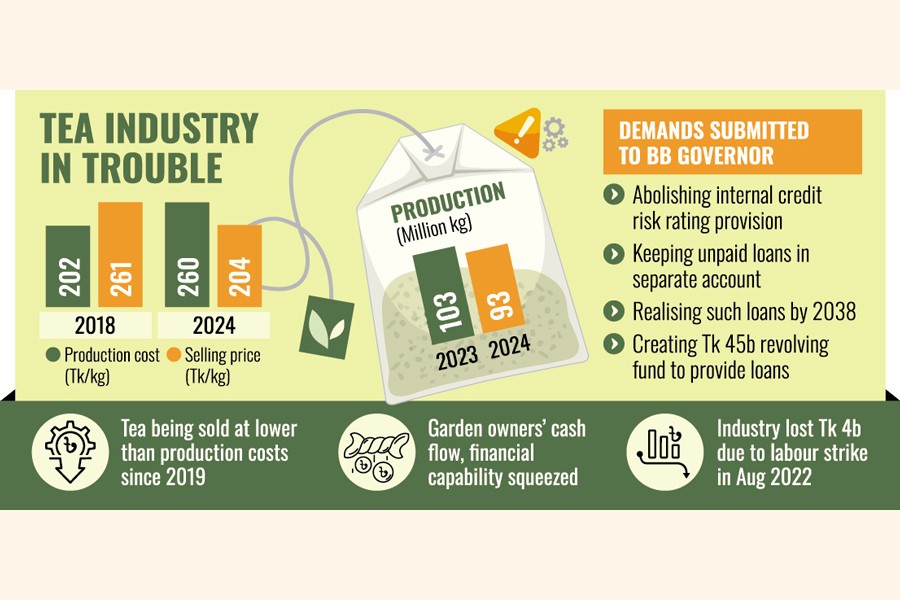
Its Chairman Kamran T Rahman mentioned in the letter that the production cost of each kilogram of tea was Tk 260 in 2024, while the selling price was Tk 204 per kg.

Before the Covid-19 pandemic, the selling price of tea was Tk 261 per kg in 2018 against the production cost of Tk 202 per kg, he said.

The garden owners have been selling tea at lower than the production costs since 2019 and "due to the price fall of tea in 2023 and 2024, their cash flow and financial capability have largely squeezed," he said.

The industry incurred losses of Tk 4.0 billion due to the strike enforced by the workers in the peak season for the tea sector in August 2022.

The then prime minister raised the daily cash wage by nearly 42 per cent to Tk 170 from Tk 120 to help resolve labour unrest.

The daily total wage for each worker, since August 2024, stood at Tk 512, and the monthly amount was Tk 15,355, Mr Rahman mentioned.

In almost every auction, a large volume of tea remains unsold, and their prices further fall in the next round.

In 2024, the country grew some 93 million kilograms of tea, down from around 103 million kg in the previous year.

"Tea production in Bangladesh is much higher than the demand. Thus prices are lower than expectations," Mr Rahman told The Financial Express.

He put forward some demands to the governor as the industry is facing a severely hostile situation.

These include abolishing the provision of internal credit risk rating (ICRR) in case of the tea industry as the producers have no control on fixing tea prices and the prices are being fixed through auctions, keeping unpaid loans in a separate account and realising them by 2038, and creating a revolving fund of Tk 45 billion for providing loans.

He said Bangladesh Krishi Bank in early June sent some loan proposals to the central bank for approval.

However, until mid-July, the central bank did not approve them. Thus, the tea gardens are not getting loans, which caused labour unrest.

Mr Rahman also pointed out that due to the acute fund crisis caused by the sales of tea at lower than production costs, over 80 gardens have been failing to make payments for workers' provident funds for up to 26 months.

Some 20 gardens are failing to make regular payments of wages, bonuses, and instalments of due payments, while five have shut production.

According to Mr Rahman, some 2.0 million people are directly and indirectly involved in the tea industry.

The lives and livelihoods of some 0.5 million tea workers and their dependents will face severe problems if the tea gardens are forced to shut production due to fund constraints.

The country will have to meet the demand by importing tea worth Tk 20 billion annually if production in the local tea industry stops, he wrote.

"Any unemployment in the tea gardens may cause social unrest in that area," he told The Financial Express.

He said the tea industry is "neglected" by the government and needs proper attention to survive.​
 
Analyze

Analyze Post

Add your ideas here:
Highlight Cite Respond

Members Online

No members online now.

Latest Posts

Back
 
G
O
 
H
O
M
E