☕ Support Us
[🇧🇩] - Tea Industry of Bangladesh | Page 2 | PKDefense

[🇧🇩] Tea Industry of Bangladesh

Reply (Scroll)
Press space to scroll through posts
G Bangladesh Defense
[🇧🇩] Tea Industry of Bangladesh
23
3K
More threads by Saif


Tea workers demo for arrears

1731717105459.png

Photo: Collected

Hundreds of tea workers took to the streets in Sylhet yesterday, demanding immediate payment of unpaid wages and rations.

Organised by the Sylhet District branch of the Bangladesh Trade Union Centre, the protest march highlighted the dire financial and humanitarian crisis faced by thousands of workers from tea estates across the region.

Abul Kalam Azad, acting president of the Sylhet District Trade Union Centre, presided over the rally.

Speakers urged the government and tea estate authorities to swiftly address the crisis and ensure the basic rights of tea workers. "Our struggle is not merely for wages; it's for survival and dignity," a labour leader declared.

The march, which began at 2:00pm from Keane Bridge premises and proceeded through Zindabazar, called for urgent government intervention to alleviate the plight of approximately 12,000 workers from 12 tea estates managed by the National Tea Company (NTC).

Workers alleged that they have been deprived of wages and rations for nearly three months, pushing their families to the brink of desperation.

Despite submitting memorandums to the government and staging a 26-day continuous strike, they claim no action has been taken, they added.

Protesters warned that over 40,000-50,000 individuals, including tea workers and their families, are now facing starvation.

"At a time when living costs are soaring, we are denied even the meager daily wage of Tk 178.50. How can we survive?" one protester questioned.

The workers demanded immediate implementation of a fair minimum wage structure for 2023-24, aligned with current market conditions, as well as regular payment of wages and rations. Other demands included full rations for families, land rights, democratic labour laws, and the resolution of disparities in casual and earned leave entitlements.

Key labour leaders, including Harinarayan Hazra, general secretary of the Moulvibazar Tea Workers Union, and other union representatives, also addressed the rally.

The protest concluded with a call for unity among workers and a pledge to continue their movement until their demands are met.​
 

National Tea out of production as workers demand arrears before joining work
Mohammad Mufazzal
Published :
Nov 25, 2024 01:06
Updated :
Nov 25, 2024 01:06

1732497964557.png


Production at the state-run National Tea Company (NTC) has remained suspended for nearly three months as workers have abstained from work for non-payment of wages.

Wages of around four months are due as the company suffers an acute shortage of working capital. About 12,000 permanent workers now seek the intervention of the government, with their demand for the arrears.

As per the auditors' report, workers' gratuity fund had zero balance as of June 30 last year, falling short by at least Tk 306 million. That means apart from unpaid wages NTC's workers are being deprived of guaranteed retirement benefits.

"Workers are not getting retirement benefits as pension and gratuity funds have no money," said Md. Abul Hossain, a director at the NTC board, nominated by the Investment Corporation of Bangladesh (ICB).

Meanwhile, work abstention and suspension of production threaten further losses in FY25.

Already, NTC's liabilities have exceeded assets by Tk 318 million, according to the company's latest financial statements for FY23.

With persistent losses since FY20, the company's negative earnings ballooned to Tk 2.12 billion until March this year.

To help the NTC overcome the working capital shortfall, the Bangladesh Securities and Exchange Commission (BSEC) approved its proposal in April 2023 to raise Tk 2.80 billion by issuing placement shares to existing shareholders.

As per the regulatory approval, the commerce ministry was supposed to subscribe to 31 per cent of the placement shares while the ICB and Sadharan Bima Corporation would each make 10 per cent of the equity investment.

But the ratio set for the distribution of placement shares to state-run enterprises led to the filing of a writ petition challenging the regulatory decision.

What do workers say?

Talking to the FE, Bijoy Chotri, whose parents are among the workers of the NTC, said tea workers had no other option of earning money in the tea states.

"It's tough to imagine the situation of 12,000 workers who are yet to get wages for more than three months."

The meager daily wage of Tk 170 that a worker is entitled to is far less than what is necessary given the rise in the prices of essentials.

Apart from the daily wage, permanent workers get up to 5 kilograms of rice or flour each week under a ration scheme. But those, who are not permanent, and the workers, who have been given a piece of land, are not within the purview of the scheme. In many cases, the lands given are not cultivable.

Nripen Paul, secretary of the Bangladesh Teach Workers Association, said around 70 per cent of the population in the tea states were fully dependent on tea gardens for their livelihoods.

The association sent letters to the chief adviser, ministries concerned and deputy commissioners of the Sylhet division, urging them to solve the problems surrounding the NTC.

"A solution is urgent for the sake of workers, shareholders' interests and the governments' revenue," Mr Paul said, adding that workers were willing to join work for their own existence.

High cost of operations

NTC's Director Abul Hossain said the company's cost of operations was higher than income as it was unable to process tea leaves properly and timely.

For the lack of capital, the company could not ensure tree plantation within the right time. On top of that, tea leaves could not be processed, maintaining quality due to rundown machines.

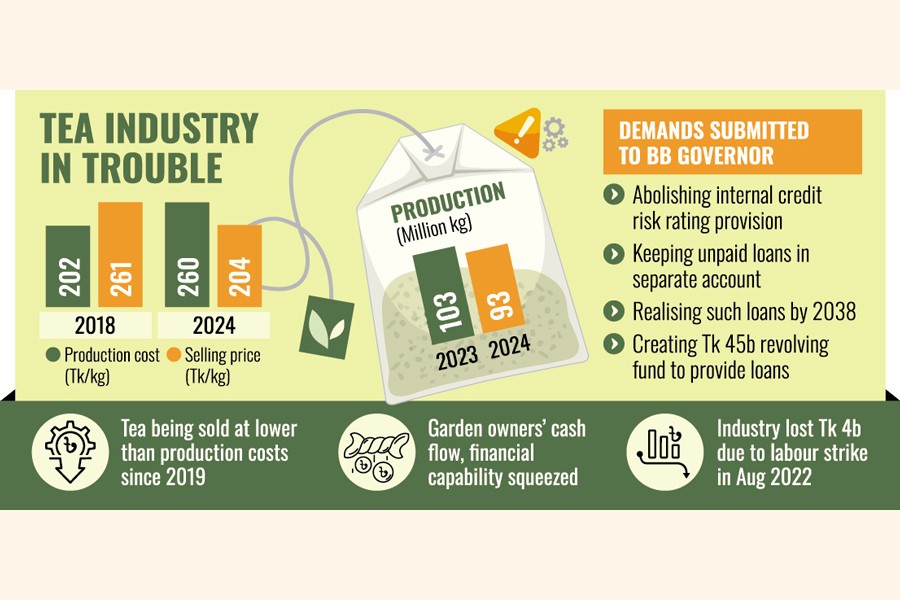
The NTC sells processed tea leaves at Tk 180 per kilogram at the auctions whereas the cost of the produce is Tk 250 per Kg.

Mr Hossain said the company started experiencing losses in 2020 following the outbreak of the Covid pandemic when the demand fell drastically.

Later, the company continued operations taking loans from Krishi Banka. The NTC now owes more than Tk 3 billion to banks.

To tackle the recent crisis of funds, the NTC sought a fresh loan of Tk 460 million from Krishi Bank to pay workers. But the bank has disbursed a very small amount.

Against this backdrop, those in the management are also not receiving salaries.

Mr Hossain said division and disagreements among employees were other major reasons behind the mismanagement at the NTC.

NTC to experience further revenue loss

The company's revenue had been on a persistent decline in the four years to FY24. The NTC is likely to see another steep fall in the ongoing FY25 as the production is still halted.

The peak season in the tea states is April to November. The NTC completely stayed out of production for almost half of the duration. The peak season is about to end a week from now.

The impacts of the production loss will be reflected in the financial statements for the ongoing fiscal year.​
 

Tea industry needs climate-adaptive varieties: experts

1734565593542.png

Workers pick tea leaves at the Tarapur tea garden in Sylhet, some 240 kilometres northeast of capital Dhaka. In Bangladesh, 1,740 kilogrammes (kg) of tea can be produced on an average from each hectare of land, while the output is 2,500 kgs in India and 3,300 kgs in Sri Lanka, according to an expert. Photo: Star/file

Bangladesh Tea Research Institute (BTRI) alongside universities need to conduct advanced scientific research to come up with tea plant varieties that can adapt to climate change while providing quality and high yields, suggested speakers at a seminar yesterday.

Commonwealth Journalists Association Bangladesh organised the seminar, styled "The State of Tea Industry in Bangladesh: Challenges and Prospects", at Sylhet Agricultural University.

In Bangladesh, 1,740 kilogrammes (kg) of tea can be produced on an average from each hectare of land, said Prof AFM Saiful Islam of the Department of Crop Botany and Tea Production Technology of Sylhet Agricultural University.

The output is 2,500 kg in India and 3,300 kg in Sri Lanka, he said in a keynote speech.

Three quarters of the tea trees in the gardens of Bangladesh are decades-old varieties, for which these produce a low volume of tea leaves, he said.

Besides, droughts lead to a 21 percent to 32 percent reduction in tea production while pest infestation leads to a drop in output of 25 percent to 30 percent annually, said Islam.

Three quarters of the tea trees in the gardens of Bangladesh are decades-old varieties, for which these produce a low volume of tea leaves, said an expert

In 1990, 45.03 million kg of tea were produced, 19.21 million kg consumed locally while 25.40 million kg exported, he said.

Last year, 102 million kg were produced while local demand stood at 95 million kg and only 1.04 million kg were exported, he added.

Sylhet Agricultural University has established a germplasm centre for tea and developed four sustainable tea plant varieties which are awaiting trials before they are offered for commercial introduction, said Islam.

The BTRI, the only state-run research centre for tea in Bangladesh, has developed 23 varieties of tea plants, he said.

The BT2 is the most popular, while the other varieties have not been able to spark that much of an interest from the cultivators, he said.

The professor urged the government for allocating more funds and manpower for the BTRI and establishment of research facilities specialising in genetical engineering for enhancing the quality of tea.

Climate change has been having an adverse impact on tea production, said AKM Rafiqul Hoque, director of the Project Development Unit of Bangladesh Tea Board.

Tea cultivation is suitable within a temperature range of 18°C to 32°C, he said.

However, the climate in regions where tea gardens are situated are experiencing higher temperatures, resulting in droughts and an increase in pest infestations which ultimately affect tea cultivation, he said.

Prices of fertilisers, a labour crisis, disputes over land, disruptions to power and gas supplies, a lack of availability of bank loans, outdated machinery and disputes over auctions are also affecting the industry, added Hoque.

He also urged the government to take up initiatives to counter the adverse effects of climate change, along with ensuring artificial irrigation and new climate change-adaptive varieties and training for cultivators.

A technological hub should be established in Sylhet through a collaborative approach of all stakeholders of the industry, said the seminar's chief guest, Prof Md Alimul Islam, vice chancellor of Sylhet Agricultural University.

In this place, scientists and researchers can showcase their innovations and the growers can decide on availing innovative solutions, he said.

Many stakeholders of the industry are engaged in unethical practices which need to be stopped to ensure quality production to increase exports, said Maj Gen Sheikh Md Sarwar Hossain, chairman of Bangladesh Tea Board, as the guest of honour.

"We should also break the trend of adhering to the traditional auction method to ensure good prices, while the cultivators should come out of the mindset of prioritising quantity over quality," he said.

Parveen F Chowdhury, president of Commonwealth Journalists Association Bangladesh, presided over the event.

Osman Gani Mansur, general secretary of the association, moderated the seminar while Julhas Alam, a member of the association, gave the vote of thanks.​
 

Stop the exploitation of tea workers in Bangladesh and fix the industry
Tea workers at Bawani tea garden in Habiganj

View attachment 9261
Women tea workers of Bawani tea garden in Habiganj carrying headloads of green tea leaves, on August 26, 2024. PHOTO: PHILIP GAIN

For nearly seven weeks, more than 12,000 tea workers in 12 tea gardens under the National Tea Company Limited (NTC) have been living in anxiety about the payment of their wages. After they were paid Tk 595 on August 12, which is half of the weekly payment, the payment was halted till September 25, the day they were paid another instalment of the same amount. This is pretty bad for these workers as the Durga Puja festivities are set to begin on October 9. Thankfully, they have not stopped work and production.

However, to keep the management under pressure, the tea workers blocked consignments of made tea out of the garden warehouses. After a negotiation with the management and relevant state agencies, they allowed the release of two consignments from Patrokhola Tea Estate in Moulvibazar's Kamalganj upazila, the largest tea garden of the NTC, and one consignment from each of the 11 other tea gardens on October 1. In exchange, they were paid a week's salary on the same day, confirmed Shipon Chakraborty, panchayat president of Patrokhola. Now the deal is, these workers will release the next consignments from the warehouses when the NTC management clears dues and bonus before Durga Puja.

What we see in the NTC gardens is bad management. NTC is a public limited company formed in 1978 under the Companies Act, 1913. The state holds 51 percent of the shares, and 49 percent are traded in Dhaka and Chattogram stock markets for the general public. Of its 12 tea gardens, seven are located in Moulvibazar, four in Habiganj, and one in Sylhet.

The NTC management, for which the government is responsible, is polluted by politics. The tea gardens, taken over by the government after independence, are located in a good topographic zone, yet they perform very poorly. According to a news report, between July and December of 2023, the company posted a net loss of Tk 26.66 crore. The company's lousy tea garden management is manifested in the look of its gardens: tea plants are sparse and without enough shade trees, among other things. The company's troubles have gotten worse since the sudden political change on August 5, following which the chairman of the company's board of directors, Sheikh Kabir Hossain, reportedly a relative of ousted Prime Minister Sheikh Hasina, has disappeared and the board has almost collapsed.

The tea workers and their lone union, Bangladesh Cha Sramik Union (BCSU), are trying to negotiate with the NTC management. Half-fed or with an empty stomach, these workers have been showing their patience and working regularly in the hope that the management will stay true to its words and clear the full payment of their due wages and bonus before Durga Puja, the biggest festival of Hindus in Bangladesh.

However, NTC now faces many insurmountable challenges. According to a top government official dealing with tea gardens, it has a debt of Tk 380 crore with the Bangladesh Krishi Bank. This year, the company requested for a loan of Tk 150 crore, but the bank sanctioned Tk 86 crore only, which got exhausted by July, said a government official dealing with tea gardens, on condition of anonymity. Per the arrangement of loan repayment, brokers in auction houses transfer the bank's share of sale proceeds directly to its account. The owners get their shares. But the workers are left with no other option but to block the made tea consignments.

While NTC gardens show serious anomalies—which is typical of state-run businesses—there are other private companies and proprietors in the industry that are also plagued with mismanagement and corruption that put their workers in deep crisis. The Imam and Bawani tea estates in Habiganj are a prime example here. The government official disclosed that Imam tea garden was completely shut down along with its factory in October last year after a prolonged crisis. The responsibility for the management of Bawani estate was vested on the deputy director of labour (DDL) in Sreemangal as a result. But the DDL has been having a hard time managing the estate. And the workers of these two gardens are also suffering.

The recent strike called by the Bangladesh Cha Sramik Union (BCSU) has brought the sufferings of our tea workers to the fore. They are demanding a minimum wage of Tk 300 a day to improve their day-to-day lives.

Another example of bad tea garden management is Fultala Tea Garden in Moulvibazar's Juri upazila. Around 1,600 workers in this tea garden have not gotten paid for 12 weeks, as a government official told me. The owner lives in London and has reportedly shut down the garden, though it is still in production to some extent because of the workers. With a bank loan of Tk 50 crore, the owner is in deep trouble, the government official disclosed.

The official further revealed that 79 tea gardens are in terrible shape. These gardens have not made their due contributions to the Provident Fund (PF) for months. Gas and power lines have been cut off in a number of the gardens for not paying the bills. Many of them are selling green tea leaves to other tea gardens for processing as their own factories are not running.

View attachment 9262
Tea workers busy at Bawani tea garden in Habiganj, on August 26, 2024. PHOTO: PHILIP GAIN

Many tea garden owners argue that they are in trouble because the price of tea has gone down while the production cost is rising. Indeed, the government has a policy to expand the tea-growing areas that contribute to increasing production.

Of course, there are examples of good companies that manage their gardens well, take good care of their workers within the existing framework, and make good profits. One such company is Ispahani Tea Limited, which has four gardens. The best among them is Zareen, located in Moulvibazar. While the average production per acre is around 1,600kg, its per acre production is 3,000kg, and the per acre production of all four gardens averages around 2,500kg, according to management. The price that the company gets is good. Almost all houses in the labour lines at Zareen Tea Estate are pucca. The condition of houses in other tea gardens of Ispahani are also much better than in other tea gardens. The workers get better deals with other fringe benefits, the Ispahani management claims.

It is in the best interest of the tea industry in Bangladesh, not to mention the workers, that changes happen for the better. The interim government, which has committed itself to reforms to end discrimination and inequality, should consider giving immediate attention to the tea industry that is in disarray as a whole. The tea garden workers, around 140,000 of them, and their community of around half a million people have been facing severe discrimination for generations, since the beginning of the industry during British colonial times.

First of all, the tea industry, specifically the tea gardens, need proper mapping. Good gardens and bad gardens need to be identified and the reasons must be explained for chalking out recommendations to bring the necessary changes so that none of the tea gardens are beyond scrutiny for mismanagement, corruption, and financial misappropriation. All parties involved with the tea industry must come under scrutiny and be made accountable.

Second, clear attempts must be made to ensure the well-being of tea garden workers, who are deprived of equal treatment and dignity as citizens of Bangladesh. To begin with, a just and respectable wage structure must be fixed for these workers. The former prime minister fixed their daily cash wage at Tk 170 in August 2022, which is certainly not fair. She was allegedly guided by the owners of tea gardens, and her move was political when the minimum wage board was made to fail. Now the time has come to overhaul the tea industry to ensure justice for the tea workers.

Another concern while dealing with their well-being is discrimination in the labour laws and regulations for them, and the owners' routine violation of several sections of the labour legislation, which cannot be justified in any way. While these anomalies have been exposed on various platforms, fresh consultations with tea workers, their trade union and others concerned, will definitely help bring out more details. It is a test for any government to make sure that the state agencies under the labour ministry who are responsible for executing the labour law and rules act honestly.

Tea garden workers, most of whom belong to minority communities, are largely invisible and voiceless. Wage deprivation and social exclusion from the British colonial times have rendered them a weak population, left behind in terms of education and economic progress. Equal opportunities are not enough for them. They deserve some preferential treatment to help them get out of their current condition. The interim government has a big responsibility here.

Philip Gain is researcher and director at the Society for Environment and Human Development (SEHD).​

I believe the tea garden workers are almost all of Tamil descent (some are indigenous tribal descent, called Santals). Extremely poor and subject of rampant Tea Garden abuse. the British imported these Tamil laborers from South India and they decided to become Pakistani (then Bangladeshi) citizens. The Santals came from various West Bengal communities.

Very sad. Govt. must establish laws to protect their identity and livelihood.
 

Tea production falls amid bad weather, quality push

1738623888236.png


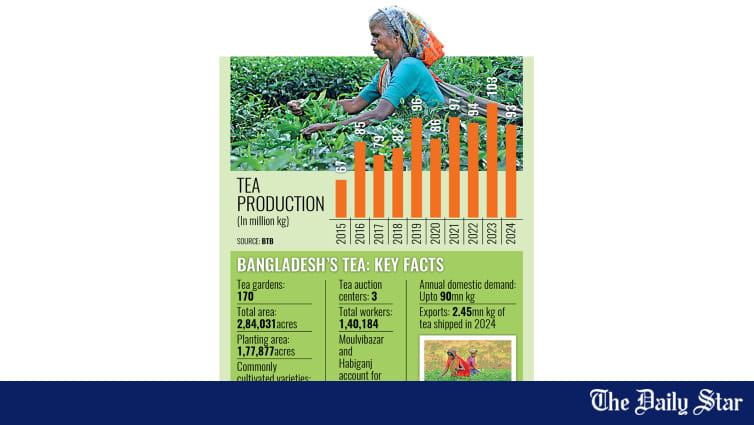
After a record high output in 2023, the country's tea production declined last year because of unfavourable weather conditions and tea estates opting for quality improvement to secure better rates.

Tea production stood at 9.30 crore kilogrammes in 2024, down from 10.2 crore kilogrammes the previous year, according to the Bangladesh Tea Board (BTB).

Pijush Dutta, a member of research and development at the BTB, said the decline was mainly due to erratic rainfall last year, which made weather conditions unsuitable for tea cultivation.

The tea industry in Bangladesh dates back 184 years. Most tea gardens are located in the north-eastern swathe of Bangladesh, while many northern districts have also started growing tea in recent years.

However, the quality of tea produced in the northern region is lower than that of its north-eastern counterparts.

1738623928084.png


According to Dutta, tea estates, including those in the north, focused on quality improvement last year, which could have contributed to the lower production.

Another factor behind the decline was the prolonged closure of 12 state-owned tea gardens under the National Tea Company for more than 10 weeks in 2024 after the August political changeover, he told The Daily Star.

Dutta said the board was working to ensure that both quality and quantity improve simultaneously.

Meanwhile, tea garden owners see no potential shortage in the domestic market despite the decline, as the surplus from the record production in 2023 can cover the shortfall.

According to them, the country also does not need to import tea, as local demand has decreased.

Similar to the tea board, the Bangladesh Tea Association, a platform for garden owners in the greater Sylhet and Chattogram districts, blamed inconsistent rainfall and climate change for the production decline.

Kamran Tanvirur Rahman, chairman of the association, said that tea cultivation requires moderate rainfall, but higher-than-usual rainfall during the monsoon season last year adversely affected the yield.

Bangladesh has 169 tea gardens spanning more than 280,000 acres.

Of these, 90 are in Moulvibazar district in Sylhet, which accounts for 55 percent of the country's total production. The second-largest producer, Habiganj, contributes 22 percent.

The peak tea production season in Bangladesh is from June to November, and the country's annual tea demand is currently 8.5–9 crore kg, according to industry sources.

EXPORTS HIT 7-YEAR HIGH

In 2024, Bangladesh's tea exports reached their highest level in seven years, as competitive pricing gave the country an edge over major exporters like India and Sri Lanka.

Exporters said a key driver of the increase was the preference of Bangladeshi diasporas for tea sourced from their homeland.

As of December 2024, Bangladesh exported 24.5 lakh kilograms of tea — the highest annual volume since 2017, when exports stood at 25.6 lakh kg — according to the BTB.

Last year's exports fetched the country Tk 382.52 million. However, tea exports have fluctuated widely in recent years.

BTB data shows that exports stood at 6.5 lakh kg in 2018 before falling to 6 lakh kg in 2019. While exports rebounded to 21.7 lakh kg in 2020, they plummeted to 6.8 lakh kg in 2021.

The volume has been rising since, reaching 7.8 lakh kg in 2022 and 10.4 lakh kg in 2023.

Industry insiders attributed the recent growth to competitive pricing, as Bangladesh offers tea at lower prices while Indian and Sri Lankan brands cater to premium segments.

Bangladesh is currently the world's ninth-largest tea producer, accounting for around 2 percent of global production, according to the BTA.

China is the largest producer, followed by India, while Sri Lanka, Kenya, South Korea, and Japan are also among the top tea-producing nations.

After independence in 1971, Bangladesh had been exporting tea to several countries, including the UK, until 1990.

Despite recent export fluctuations, the BTB has set an ambitious export target of more than 1.5 crore kg for 2025 — far higher than trends in the past two decades.

The highest amount of tea exported in a single year was 1.5 crore kg in 2002, according to the BTB.​
 

Tea industry needs deep reforms
Mir Mostafizur Rahaman
Published :
Feb 04, 2025 00:14
Updated :
Feb 04, 2025 00:14

1738627213805.png


The local tea industry that is deeply rooted in history and culture of Bangladesh is currently facing significant challenges. These challenges range from mismanagement and financial irregularities to poor working conditions and economic inefficiencies. If Bangladesh wishes to maintain its position as a major global tea producer (9th largest), the government must take urgent steps to reform and modernise the sector. It is to be in the best interest of not just the industry but also the 140,000 tea garden workers and half a million members of their community.

One of the primary issues in the tea industry is the lack of transparency in management. While some tea gardens are well-run, many suffer from poor administration, financial misappropriation, and corruption. To address this, the government must conduct a comprehensive mapping of all tea gardens, identifying well-managed ones and those that need urgent intervention. This process will help create a roadmap for necessary reforms and ensure that no tea garden is beyond scrutiny. Without such accountability, the sector will continue to struggle with inefficiencies that harm both workers and producers.

While social issues remain critical, economic factors are also putting immense pressure on the tea industry. Production costs have skyrocketed due to reliance on imported machinery, fertilisers, and pesticides. Recent hikes in diesel, electricity, and gas prices have further increased operational expenses by 15-20 per cent, making it harder for producers to stay competitive.

At the same time, productivity in Bangladesh is lagging behind the neighbouring countries. While India produces around 2,137 kg of tea per hectare, Bangladesh yields only 1,270 kg. Many tea plants are old and produce less, necessitating heavy investment in replanting and expanding cultivation. Since new plants take at least 10-12 years to generate profits, long-term financial planning is crucial. Without modernisation and better agricultural practices, the industry risks falling further behind.

Tea garden workers, most of whom belong to minority communities, remain among the most marginalised groups in Bangladesh. For generations, they have been deprived of education, economic opportunities, and social mobility. Simply, offering equal opportunities is not enough; these workers require preferential treatment to overcome the barriers imposed by historical injustices. Special educational programmes, skills training, and access to healthcare must be prioritised to uplift this community. The interim government carries a moral and social responsibility to address these inequalities and integrate tea workers more into the national economy.

Tea garden workers in Bangladesh have historically been subjected to extreme exploitation, dating back to British colonial rule. Even today, their daily wages remain shockingly low. The previous government set the minimum daily wage at Tk 170 bypassing the minimum wage.

The interim government now has an opportunity to correct this mistake by establishing a fair and respectable wage structure that truly reflects the workers contributions to the industry.

Beyond wages, labour laws governing tea plantations are rife with discriminatory practices. Employers routinely violate labour regulations, and state agencies under the Ministry of Labour often fail to enforce the rules. Fresh consultations with workers, trade unions, and stakeholders can help identify further gaps and ensure that tea garden workers receive the legal protection they deserve. This is a crucial test for the government's commitment to labour rights and social justice.

Another major concern is the stagnant price of tea at auctions. Despite rising production costs, auction prices have remained nearly unchanged for a decade. Tea estate owners argue that they bear the brunt of this disparity, as they are merely growers, not traders. Only a handful of growers are involved in packaging and direct sales, leaving most at the mercy of auction houses and intermediaries.

Studies show a significant gap between auction prices and retail prices, raising questions about whether the current auction system is the right mechanism for setting prices. The government should explore alternative pricing strategies, such as direct trade models, cooperative selling platforms, or government-backed pricing regulations, to ensure fairer compensation for producers.

A less-discussed but equally serious challenge is the brain drain in the tea industry. Due to poor financial incentives and out-dated facilities, fewer qualified professionals are joining the sector. During the Pakistan era, Bangladesh produced a variety of teas, including high-value orthodox black and green teas. Today, the industry primarily focuses on lower-quality CTC teas, limiting its market potential.

Additionally, the inclusion of lower-grade tea from North Bengal in the mainstream market has further diluted prices. Other tea-producing countries have embraced tea-centered tourism as a way to boost revenue, but restrictive lease agreements in Bangladesh prevent estate owners from diversifying into tourism. The government should consider revising these policies to encourage innovation and attract fresh talent into the industry.

The tea industry in Bangladesh is at a crossroads. Years of neglect, economic mismanagement, and social injustice have left it struggling to compete globally. However, with proper reforms, this vital sector can still be revitalised. The government must take decisive action by ensuring accountability in tea garden management, establishing fair wages, addressing social exclusion, modernising production, reforming auction pricing, and attracting skilled professionals.

If these reforms are not undertaken now, Bangladesh risks losing not just its global tea market share but also the well-being of thousands of tea workers who have toiled for generations. The interim government has a historic opportunity to change the course of the industry. Whether it rises to the challenge remains to be seen.​
 

Tea garden workers warrant the same support as other industry labourers

1739231738157.png


In the tapestry of Bangladesh's socio-economic landscape, tea gardens and industrial parks stand as silent pillars that uphold the lives of millions, weaving together tradition and modernity. A morning that begins with a cup of tea mirrors the soul of every Bangalee heart. Alongside, the sprawling Beximco Industrial Park symbolises industrial ambition and global competitiveness. Yet, these two worlds converge in the shared plight of labourers whose sweat fuels our economy. As we savour the warmth of tea or don garments stitched with care, do we pause to acknowledge the unseen hands shaping these moments? This is not just a narrative of labour; it is the story of Bangladesh where every worker's life is intricately woven into the fabric of national progress.

While the media's spotlight shines on the recent turmoil surrounding Beximco Industrial Park, the plight of tea garden workers of the tea estates owned and operated by National Tea Company remains woefully underreported. These crises reveal deeper structural and political issues that threaten the livelihoods of thousands and ultimately, the economic resilience of Bangladesh.

The closure of the National Tea Company due to political instability exemplifies the precarious position of marginalised workers. The sudden shutdown of Madhabpur Tea Estate in Moulvibazar has left families stranded without income or alternative employment opportunities. Sanu, a worker at the estate, paints a grim picture of this reality. With five family members, including a sick mother, he struggles to provide even the most basic meals, resorting to muri (puffed rice) and cha pata bhorta (mashed tea leaves) for sustenance. Occasionally, a tourist's tip is all that stands between his family and hunger. This tragic narrative is emblematic of countless others, yet it garners little attention because tea workers lack the platforms or influence to amplify their voices.

Meanwhile the crisis at Beximco Industrial Park dominates the headlines, as workers demand their rightful wages and reinstatement. While both cases highlight the vulnerability of workers, they also expose an unequal distribution of concern and urgency. The media's focus on high-profile industrial hubs often eclipses the struggles of those in remote areas, perpetuating a cycle of neglect for sectors like the tea industry.

Both situations underscore the need for immediate and comprehensive government intervention. The current approach of relocating displaced workers to other factories or gardens is short-sighted and counterproductive. Such measures ignore the broader implications: abandoned infrastructure, loss of industry-specific expertise, and a diminishing industrial base. The parallels with the decline of Bangladesh's sugar and jute mills are stark and cautionary. These once-thriving industries now stand as relics of mismanagement and neglect, offering lessons that must not be ignored.

Bangladesh's status as a growing economy demands prudent and proactive policies to safeguard its industries. Political instability and labour exploitation cannot become recurring narratives. The government must prioritise the reopening and stabilisation of the tea estates under the National Tea Company and Beximco Industrial Park. This involves ensuring fair wages, addressing worker grievances, and fostering an environment conducive to sustainable operations.

For tea workers, the solution lies in comprehensive industry reform. The systemic exploitation that keeps wages at starvation levels must end. The government, alongside industry stakeholders, should implement wage standardisation, social security measures, and skill development programmes. For larger industrial hubs like Beximco, the focus should be on transparent conflict resolution mechanisms, timely payment of dues, and robust labour policies that prevent future disruptions.

It is time for Bangladesh to heed the silent cries of its labour force and walk resolutely towards reform and equity. The stories of Madhabpur's tea workers and Beximco's factory labourers are not isolated, and they remind us of the delicate balance between progress and humanity. Their struggles are a clarion call for a nation striving to achieve middle-income status while ensuring that nobody is left behind. Let us not allow these crises to become forgotten tragedies; instead, let them fuel a collective resolve to create a future where every sip of tea and every stitch of cloth represents not just an industry but the dignity of those who make it possible. Advocacy groups, unions, and policymakers must work together to amplify the voices of the voiceless, ensuring that every worker, regardless of their location or industry, is afforded dignity and justice.

Rafad Asgar is research associate at Bangladesh Institute of Governance and Management (BIGM).​
 

Strict oversight of tea worker rights a must
05 March, 2025, 00:00

EARNINGS from tea export have been progressively increasing amid allegations of gross violations of worker rights in tea gardens. Tea workers’ union leaders in Moulvibazar demand that their festival allowance for Phagua, a major festival for the tea workers community, should be paid in full and in time. All tea workers are entitled to a festival allowance of Tk 3,713 for Phagua in keeping with the latest minimum wage board award. Some tea estates, however, try to replace the festival allowance with an attendance-based incentive, which is a violation of the agreement signed between the tea estates and the government. In recent times, other similar attempts to delay or withhold festival allowance have been reported. In March 2024, workers of the Kuchai tea estate in Moulavibazar took to the streets protesting at an arbitrary decision of garden owners to reduce their festival allowance on the occasion of Dol Purnima. When the minimum wage structure is considered inadequate, the denial to pay the full allowance in time is not only a labour rights violation but also inhuman.

The irregular payment of wages and employment benefits is, rather, characteristic of the tea industry. In September 2024, about 1,500 workers of the state-owned National Tea Company Ltd rallied, demanding their wages unpaid for three weeks and alleged that their families were starving as the company had also suspended their ration and access to treatment. In July 2023, workers at Imam and Bhabani Tea Garden went on strike with demands that included the payment of their wages and festival allowance, the reimbursement of the provident fund and the ensuring of their house rent and medical allowances. There are loopholes in laws and regulations that allow owners to make such arbitrary decisions and withhold festival allowances or severance benefits. Tea workers do not receive 5 per cent of the net profit of the previous year of the company they work for, as specified in the labour law and the Workers’ Welfare Foundation Act. Rarely are any actions taken by the authorities against such gross violations.

The government should, therefore, take initiatives to protect the rights of tea garden workers. The labour ministry should take early steps to address specific concerns of the tea workers of Moulvibazar and ensure a timely payment of the festival allowance. The labour law should be revisited to ensure that owners cannot make an arbitrary decision to deny or withhold festival allowance or severance payments. Tea garden workers should have the right to negotiate their minimum wage and employment benefits. The labour ministry should ensure an effective oversight of tea gardens so that labour rights are not violated.​
 

Only 5 of 28 locally developed tea varieties popular

1747792144590.png


Out of the 28 varieties of tea plants developed by state-run Bangladesh Tea Research Institute (BTRI), only five are widely cultivated in the country, based on their high yield, quality, and climate resilience.

These varieties are also called tea clones -- plants produced through vegetative propagation like cuttings or grafting from a single, selected parent plant, rather than from seeds.

This method allows for the creation of genetically identical plants with specific desirable traits, like high yield or disease resistance.

The five clones, named BT-1 (developed in 1966), BT-2 (1975), BT-4 (1981), BTS-1 (1985), and TV-1 (1949), yield around 3,000 to 4,000 kilogrammes (kg) of tea per hectare on average, said BTRI Director Md Ismail Hossain.

BT-2 is the most popular due to its drought tolerance and flavour resembling Darjeeling tea, which is appreciated for its delicate taste, floral aroma, and wine-like notes reminiscent of muscat grapes, he added.

Speaking to The Daily Star yesterday, Hossain said BT-2 can be used to produce premium-quality black tea and green tea.

However, he added that, given the size of the country's tea industry, the number of clones developed so far is not sufficient and research is ongoing for new ones.

Traditionally, people tend to trust what is old and proven -- and the same holds true in the tea sector, he said. Tea garden owners prefer cultivating older, tried-and-tested clones, while adoption of newer ones remains limited, the researcher also added.

As such, garden owners usually cultivate three to five select clones to ensure that their operations are not commercially affected in any way, he added.

He informed that developing a high-quality clone takes around 13 years and its economic lifespan is around 50 years.

However, industry insiders said this has led to a lack of product diversification.

Tea garden owners said the BTRI needs to develop more clones focusing on climate resilience and high quality to boost tea production and sales.

Bangladesh's tea industry dates back 184 years. There are currently 170 tea gardens, mostly in the northeast. In 2024, 93.04 million kg of tea was produced in the country against an annual demand of 85–90 million kg, according to industry sources.

What tea garden owners and officials say

An official of one of the leading tea manufacturers, requesting anonymity, said they were cultivating BT-2 on nearly 50 percent of their plantation area given its high yield, quality, low susceptibility to pest attacks, drought tolerance, and low mortality rate.

They also planted TV-1, said the official, opining that more clones, focused on climate resilience for product diversification, were required.

Kamran Tanvirur Rahman, chairman of the Bangladesh Tea Association (BTA), a platform of tea garden owners, said there was a shortage of high-yield varieties and the BTRI needs to focus on this.

More drought-tolerant clones must also be developed as the country experiences little to no rainfall for five to six months of the year. Irrigation is not feasible everywhere, as it would increase production costs, he added.

Luthful Kabir Shaheen, director of business development at City Group, a leading conglomerate which owns the Bengal Tea brand and eight tea gardens, said their plants include the popular BT 1, BT 2 and TV 1 varieties.

"These clones have been prioritised due to their climate resilience, superior aroma, and sweetness, which make them more desirable in the market," he said.​
 

Bashir slams vicious cycle of tea industry
Bangladesh Sangbad Sangstha . Dhaka 21 May, 2025, 23:17

1747871218685.png

Commerce adviser Sk Bashir Uddin poses for a photo at a function marking the 5th National Tea Day held at the Osmani Memorial Auditorium in the capital on Wednesday. | Sony Ramani

Commerce adviser Sk Bashir Uddin on Wednesday expressed his hope to find out a way to protect the national resource tea from the vicious cycle of the tea industry.

‘If we can ensure balanced distribution, then we’ll be able to find out a way forward to protect the national resource tea from the vicious cycle of the tea industry. We’ll have to take integrated steps to seize the vast potentials of the tea industry,’ he said.

He also called upon all to highlight the tea industry both at local and international markets and said that the government was working to enhance the export of tea after meeting the local demand.

The commerce adviser was addressing a function marking the 5th National Tea Day held at the Osmani Memorial Auditorium in the capital.

Referring to the issue of not getting fair prices for tea, he said that if 9.30 crore kilogram of tea was produced in the country, its market value stood at Tk 3,700-4,000 crore. However, if it is converted into street value, then an expected expenditure of about Tk 8,000-10,000 crore happens at consumer level, he said.

Putting emphasis on ensuring the prosperity of the tea gardens, the commerce adviser said that concerted efforts were needed in this regard from the tea garden owners and the workers.

He also underscored the need for ensuring diversification of tea products and making those attractive.

Presided over by commerce secretary Mahbubur Rahman, Bangladesh Tea Board chairman Major General Sheikh Mohammad Sarwar Hossain gave the address of welcome.

Tea Traders Association of Bangladesh president Shah Moinuddin Hasan, Bangladesh Tea Association president Kamran T Rahman, National Tea Award-2024 winner and tea worker Jesmin Akhter and Bangladesh Tea Workers Union acting president Nripen Pal spoke on the occasion.

The commerce adviser handed over crests and certificates to the winners of the National Tea Award 2025 in eight categories and two special awards in the highest tea producing factory category.

Earlier, Bashir inaugurated the operations of the 5th National Tea Day through releasing balloons. Later, he visited various stalls set up in the tea fair.​
 

Members Online

Latest Posts

Latest Posts