Home Watch Videos Wars Movies Login

[🇧🇩] Telecommunication Industry in Bangladesh

[🇧🇩] Telecommunication Industry in Bangladesh
77
4K
More threads by Saif

G Bangladesh Defense

New policy to end 15 years of telecom irregularities: Taiyeb

UNB
Published :
Jul 12, 2025 23:54
Updated :
Jul 12, 2025 23:54

1752362924392.webp


The interim government is working on a new telecom policy aimed at reforming the sector, ending 15 years of what it termed “fascism,” and ensuring a generational transformation in service delivery, said Faiz Ahmad Taiyeb, Special Assistant to the Chief Adviser on Posts, Telecommunications and ICT.

Speaking at a roundtable titled “Telecom Network and Licensing Policy Reform”, organised by the Telecom and Technology Reporters Network, Bangladesh (TRNB) at a hotel in Dhaka on Saturday, Taiyeb said the policy is being shaped to shift from mere connectivity to service-oriented networks.

“The new generation demands a new kind of transformation. That’s why we are preparing a policy focusing on next-generation services. We are clearing out the clutter in the sector—even if it hurts vested interests,” Taiyeb said.

“Logical suggestions will be considered, and the government's positive initiatives should be welcomed,” he added.

Referring to operator profits, he said, “Operators are earning Tk 400 crore in dividends and still express dissatisfaction. It’s time they look out for national interests.”

Taiyeb made it clear that licences will no longer be limited arbitrarily.

Instead, he said, the number will depend on performance and obligations.

Licences issued merely for toll collection in the past will be discontinued, he added, noting that research would determine the optimal number of licences and foreign company representatives must work in the country’s broader interest.

On improving services, he warned, “Mobile operators must enhance service quality or risk losing customers.”

He also highlighted efforts to free up low-band frequencies and reform the existing telecom ecosystem.

BTRC Chairman Major General (retd) Md Emdad Ul Bari said telecom is a real-time service and any changes must be sustainable.

“With less than 50% of the population using the internet, licence cancellation is not on the table. The policy includes a migration plan, and stakeholder collaboration is essential,” he said.

Posts and Telecommunications Division Secretary Zahurul Islam said the new policy would attract both domestic and foreign investment.

ISPA President Aminul Hakim called for eliminating tax disparity, stating, “ISPs meet 65–70% of the 7.5 terabit demand yet pay 15% tax, while mobile operators with 35% market share pay none.”

MTAB Secretary General Mohammad Zulfikar, presenting the keynote, said telecom operators are central to the digital economy. “Despite 65 million social media users, 90 million remain unconnected. Rising operating costs, along with investment caps in the proposed policy, are alarming for the sector,” he warned.

The discussion was chaired by TRNB President Samir Kumar Dey, with a welcome speech by General Secretary Masuduzzaman Robin.

Grameenphone CEO and MTAB President Yasir Azman, Banglalink CEO Erik Aas, Teletalk MD Nurul Mabud, corporate affairs heads from major operators, World Bank consultant Mahtab Uddin Ahmed, and Fiber@Home CIO Suman Ahmed Sabir also spoke at the event.​
 
Analyze

Analyze Post

Add your ideas here:
Highlight Cite Respond
  • Love (+3)
Reactions: Bilal9

Govt forms panel to review draft telecom policy
1753062403819.webp


The government has formed a committee to review the draft Telecommunications Network and Licensing Policy 2025, according to a notification issued by the Cabinet Division yesterday.

Planning Adviser Prof Wahiduddin Mahmud will lead the panel, which has been tasked with reviewing the proposed policy's economic, technical and implementation aspects.

The development comes as local firms in the telecom sector expressed concern that the new policy would disfavour them.

The committee will also analyse the policy's background, assess possible unintended consequences, and evaluate its long-term economic impact and technical viability.

It has the authority to bring in more members if needed, and may invite relevant officials, experts or stakeholders to its meetings.

Other members of the committee include Environment, Forest and Climate Change Adviser Syeda Rizwana Hasan, Commerce Adviser Sk Bashir Uddin, and Special Assistant to the Chief Adviser for the Ministry of Posts, Telecommunications and Information Technology Faiz Ahmad Taiyeb.
 
Analyze

Analyze Post

Add your ideas here:
Highlight Cite Respond
  • Like (+1)
Reactions: Bilal9

Bangladesh telecom sector: the case of state-owned Teletalk

TIM Nurul Kabir
Published :
Aug 11, 2025 23:25
Updated :
Aug 11, 2025 23:25

1754960100088.webp


Mobile telecommunication in Bangladesh is rapidly transforming from primarily a voice and SMS service to a mobile data-dominated market. Exponential growth in mobile internet adoption is driving significant market expansion. With changing technological capabilities and shifting consumer preferences, the mobile telecom industry landscape in Bangladesh is evolving at a rapid pace.

Bangladesh's telecom market is primarily dominated by the private mobile operators. Grameenphone, the market leader, is a joint venture between Grameen Telecom and Telenor. The second largest mobile operator in Bangladesh, Robi Axiata is owned by Axiata of Malaysia and Bharti Airtel of India. Third largest operator, Banglalink is owned by VEON Ltd.

The mobile network operators (MNOs) of Bangladesh are increasing market segmentation to deliver innovative digital services such as education and healthcare services, mobile financial service (MFS), mobile bill payment, mobile ticket reservation, e-commerce, video streaming, music, IPTV and value-added services for target consumer segments.

In comparison with private operators, the lone state-owned mobile operator Teletalk Bangladesh Limited has failed to secure a competitive position and thrive in the telecom market although the state-owned enterprise (SOE) gets various privileged support from the government.

TELETALK INCURS LOSS DESPITE GOVERNMENT SUPPORT: When Teletalk launched commercial operation with 2G services in 2004, the primary mission of the company was to acquire a significant market share of the booming telecom sector by providing countrywide network coverage. Launch of Teletalk created huge enthusiasm among customers. Nevertheless unsatisfactory service quality of Teletalk impelled many customers to gradually switch to other operators.

Because of its being the state owned operator, Teletalk was given the priority to introduce 3G mobile phone services in Bangladesh and was therefore the first operator to launch 3G services in 2012. Private mobile operators officially launched 3G mobile data service in October 2013. The government gave privilege to Teletalk by making the use of its SIM cards mandatory for availing significant government services. Teletalk was also given priority in the radio frequency (spectrum) allotment for both 4G and 5G. As was the case, Teletalk was the first operator to launch 5G services on a trial basis in December 2021. Of the remaining three mobile operators, Banglalink Digital Communication Limited launched 5G services on a trial basis in selected locations in July 2022, while Robi Axiata Limited and Grameenphone Limited launched 5G services on a trial basis in selected locations in September 2022.

Despite getting priorities and privileges from the government, Taletalk has failed to ensure quality service and attain significant number of subscribers. According to data of the Bangladesh Telecommunication Regulatory Commission (BTRC), the total number of mobile subscribers reached 186.22 million in March 2025, of which Grameenphone had 84.09 million subscribers, Robi, 56.36 million and Banglalink, 38.23 million. Teletalk had only 6.58 million subscribers in March 2025, which is merely 3.53 per cent of total subscribers.

The state-owned operator has a persistent trend of incurring net losses since its inception. According to the audited financial report published in the Directors' Report of the Company, Teletalk incurred a net loss amounting Tk. 179.89 crore in the fiscal year ending on June 30, 2024.

BTCL RESOURCES REMAIN UNDERUTILISED: Teletalk was initially launched by Bangladesh Telephone and Telegraph Board (BTTB) as a subsidiary project of mobile network service, named BTTB bMobile. Later the company was rebranded to Teletalk Bangladesh Limited as the only state-run mobile operator of Bangladesh.

BTTB became a public limited company on July 1, 2008, and was renamed Bangladesh Telecommunication Company BTCL. As SOE, BTCL offers services such as telegraph, local telephone networks, nationwide dialing (NWD), international telephone call facilities, international circuit leasing, international maritime satellite communication, and internet and data services.

BTCL has more resources than any other major mobile operator in Bangladesh. According to the BTCL annual report, the company holds total assets of around Tk. 70,000 crore. Among these, the assets related to exchange equipment, transmission, and outside plant are valued at approximately Tk. 12,000 crore. The value of BTCL's buildings is around Tk. 1,000 crore. BTCL holdings claim the highest value, estimated at Tk. 50,000 crore.

Despite vast resources possessed by the SOE, core business operations of BTCL remain deeply flawed. Revenue from key segments such as the International Gateway (IGW), telephone services, and value-added services has reportedly continued to decline. Poor service quality and lack of technological expansion have contributed to the decline of operational efficiency and service revenue.

According to the Annual Report of BTCL, the SOE claimed a net profit of Tk. 67 crore in fiscal 2023-24 on account of non-operating income obtained from fixed deposit receipts (FDRs), which stood at Tk. 168 crore in FY23. Within this declining business scenario, the extensive infrastructure owned by BTCL, including towers used for telephone and internet services remain underutilised.

POLICY PROVISION FOR SOE-PRIVATE PARTNERSHIP: Bangladesh's telecom market is characterised by intense innovation and forward-looking business strategies. The mobile industry has seen significant investment in network expansion and technological upgrading, particularly in 4G technology deployment and preparation for 5G services. The private MNOs including Grameenphone, Robi and Banglalink are actively investing to expand their digital services portfolios.

When the National Telecom Policy was formulated by the Ministry of Post and Telecommunications in 1998, it was envisaged in the policy objectives that: resources to the sector are to be maximised through participation of both public and private entrepreneurs in operating the services in areas where it is economically and socially justified. Efforts shall be geared up and coordinated to create an investment climate to help optimisation of resources from both national and international sources (Article 3.7).

For enhancing competitiveness of SOE, article 7.10.1 of the National Telecom Policy 2018 has the provision to: encourage the state owned telecommunication enterprises to adopt competitive business strategies including human resource development, management restructuring, partnering with private sector and attracting local or foreign investment.

BUSINESS FOOTPRINTS OF SOES: Telenor, the 58.8 per cent shareholder of Grameenphone, is a state-owned multinational telecommunications company of Norway. Grameenphone was the first Telenor venture in the Asian telecom market. The success of Grameenphone led Telenor to increase focus in Asian markets with successful entries in Pakistan, Myanmar and other Asian countries.

Similarly, Axiata of Malaysia holds a major controlling stake of 61.82 per cent in Robi, the second largest mobile network operator in Bangladesh. Axiata was incorporated in 1992 as the mobile and international operations arm of Telekom Malaysia Berhad, the national telecommunications company of Malaysia.

If SOEs such as Telenor and Axiata can run successful businesses operations and create global and international footprints, it is sheer misappropriation of resources and lack of utilisation of business opportunities on the part of Teletalk to keep incurring losses for decades.

PROSPECTIVE TRANSFORMATION OF TELETALK: In present-day world businesses are immensely dynamic and require situation-wise decision-making along with long-term planning and projections. Due to lack of on-time effective decision-making by the board of Teletalk and absence of competency to chalk out business strategies, the state-run mobile operator has remained incapable to formulate significant short-term action plan and/or long-term strategic plan.

As is obvious from the decline in subscriber numbers, quality of services and revenue, the business condition of Teletalk has worsened to such an extent that the auditor of the company reportedly expressed doubt on the company's ability to continue operations. And for some time now, there has been speculation regarding handing over the state-run mobile operator to local or foreign investors for improving its services and making the company profitable.

According to a report by the global market research firm Mordor Intelligence, Bangladesh telecom market size is estimated to be $5.08 billion in 2025, and is expected to reach $6.27 billion by 2030, with a compound annual growth rate (CAGR) of 4.31 per cent during the forecast period (2024-2030).

If business-terms are successfully negotiated with prospective foreign investor, there is a bright prospect of attracting substantial foreign direct investment (FDI), which would thus bring in much required capital for network expansion, management restructuring and service improvement of Teletalk. With the right mix of investment, competitive strategies and long-term planning the state-owned telecom operator can transform its loss-making business to a profit-making venture.

T.I.M. Nurul Kabir, Executive Director, Foreign Investors Chamber of Commerce and Industries (FICCI), is an analyst on business, technology and policy.​
 
Analyze

Analyze Post

Add your ideas here:
Highlight Cite Respond
  • Like (+1)
Reactions: Bilal9

Telecom reforms revolve around efficiency, price cuts

1755224397219.webp

Photo: star/file

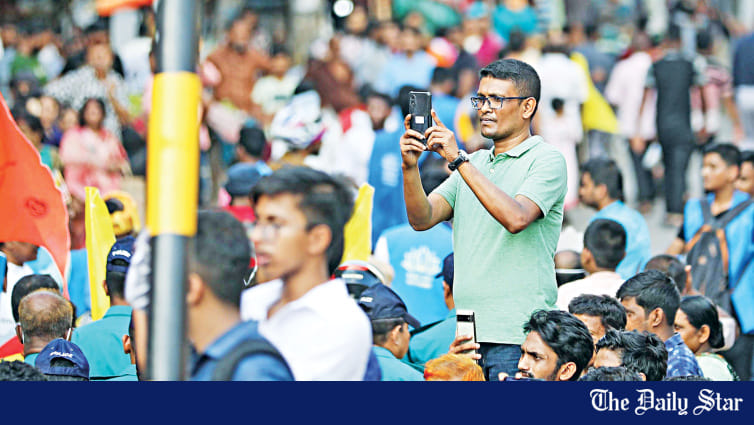
Over the past year, the interim government has pushed reforms in the telecom sector to improve service, remove unnecessary layers, and lower costs for consumers.

Some initiatives are already in place, while others remain on paper. Authorities say full implementation could bring the sector in line with international standards.

At the centre of the overhaul is the draft "Telecom Network and Licensing Reform Policy 2025", prepared by the Ministry of Posts and Telecommunications and the Bangladesh Telecommunication Regulatory Commission (BTRC). The draft is yet to be finalised.

It proposes a simplified licensing system, limits on foreign ownership, and the removal of costly intermediary layers that inflate prices.

Currently, the sector operates a confusing network of six or seven licensing layers. The draft reduces this to three: international, national, and service.

Foreign ownership would be capped at 49 percent for the international layer and 55-60 percent for the national layer. Internet service providers (ISPs) would benefit from a "light-touch" regime with less paperwork.

The biggest change is the planned removal of middle-layer companies, including Interconnection Exchanges (ICXs), International Gateways (IGWs), and International Internet Gateways (IIGs).

Introduced in 2008 to stop illegal internet calls (known as VoIP), these companies often acted as middlemen, charging fees without adding value.

Mobile operators were banned from connecting calls from each other directly, forcing them through ICXs.

A cartel was formed by some of these companies in 2014, called the IGW Operators Forum, controlling call termination and funnelling Tk 631 crore to a Beximco-linked account. The BTRC cancelled their authority earlier this year.

IIGs, originally to manage international internet traffic, are now redundant as ISPs and mobile operators can handle bandwidth directly.

"Despite minimal infrastructure investment, often with just a few crores of taka, licensees extracted hundreds of crores through strategic positioning and regulatory shielding," said Faiz Ahmad Taiyeb, special assistant to the chief adviser for posts and telecom.

With many ICX and IGW licences expiring in 2027, the BTRC says it will not renew them. Removing these layers should lower prices and improve efficiency without harming security or monitoring.

Telecom operators have cautiously welcomed the changes.

"Overall, the policy is a good start, and we welcome it," said Shahed Alam, chief corporate and regulatory affairs officer at Robi Axiata.

"However, we have raised some concerns, like curbing foreign shareholding, and introducing irrelevant parameters such as rollout obligations, spectrum configuration, and fibre rollout obligations," he added.

FIBRE FOR ALL

Another major reform targets the country's internet "motorways". Until now, Fibre@Home and Summit Communications dominated the national network.

Mobile companies were barred from installing their own equipment on these cables, making them reliant on these providers.

That restriction has been lifted, allowing mobile operators to install data transmission equipment on leased fibre networks.

The government also aims to create a national "fibre optic bank", using unused cables from state-owned utilities such as the power grid and railways.

About 40 percent of the country's 78,400km of fibre is unused. Sharing it could reduce internet costs, speed up 5G rollout, and bring fast connections to rural areas.

POWER AND INDEPENDENCE

The government is revising the Bangladesh Telecommunication Act, 2001, which strengthened ministerial control in 2010.

The new plan gives the BTRC more autonomy in operational matters such as approving new products or staff promotions, while major decisions, including licence renewals, spectrum allocation, and changes involving state-owned companies, remain under ministerial oversight.

"The intent is to create a checks and balances model," Taiyeb said, adding that it ensures strategic alignment across ministries.

Experts caution that true independence is limited.

Barrister Fatema Anwar, a lawyer at the Supreme Court, said, "By allowing more freedom only in operational matters while retaining control over major decisions, particularly those involving six state-owned telecom entities, the risk of conflict of interest and political interference persists."

BTRC Chairman Major Gen (retired) Md Emdad ul Bari said neutrality is a must. "If we continue to treat state-owned and private operators under different standards, we undermine the very rationale for having an independent regulator."

However, Taiyeb argues that public operators are needed to guarantee coverage in unprofitable areas. "We must protect public interest through these institutions."

RIGHTS AND BANDWIDTH

The ministry has ordered the removal of laws that allow internet shutdowns, and called for phone and internet surveillance to have more oversight, bringing practices closer to international standards.

It also proposed reforms to the National Telecommunication Monitoring Centre (NTMC) to improve accountability, transparency, and judicial supervision.

Support from Chief Adviser Muhammad Yunus helped bring Starlink, Elon Musk's satellite internet service, to Bangladesh.

State-owned Bangladesh Submarine Cables PLC (BSCPLC) now handles 4 terabits per second of international bandwidth, more than double last year's capacity. The upcoming SEA-ME-WE 6 cable will add 17 terabits per second.

LONG-TERM VISION NEEDED

A review panel, led by Planning Adviser Wahiduddin Mahmud, is currently assessing the draft Telecom Network and Licensing Reform Policy amid protests from local firms wary of foreign dominance.

Telecom analyst Abu Nazam M Tanveer Hossain said reforms must follow a clear sequence. First, the National Telecom Policy should be updated with a 10-20 year vision.

Subsequently, there should be amendments to laws and rules, said Hossain. "Only afterwards, there could be adjustments to rules and licences."

"Any deviation from this structure leads to inconsistency, reduces investor confidence, and compromises consumer protection," he said.​
 
Analyze

Analyze Post

Add your ideas here:
Highlight Cite Respond
  • Love (+3)
Reactions: Bilal9

New telecom policy must be assessed after political transition: Khosru

1763863195806.webp

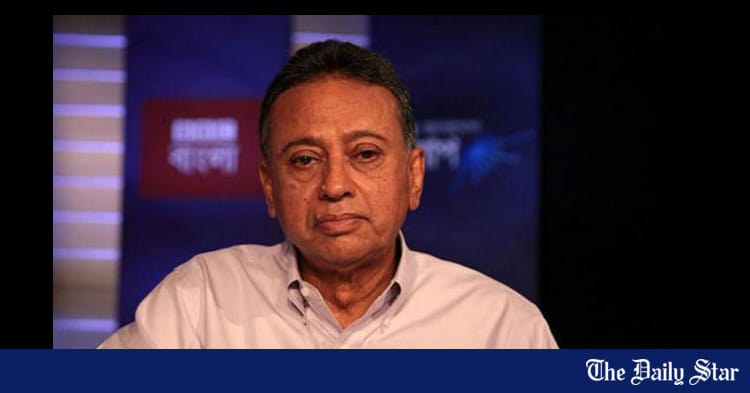
Amir Khosru Mahmud Chowdhury. File photo

The new telecom policy should be reviewed once Bangladesh returns to a democratic order to safeguard the interests of citizens, the nation, and investors, BNP Standing Committee Member Amir Khosru Mahmud Chowdhury said today.

"I think this is the responsibility of those who will be elected in the coming days," he said, adding that the BNP would not discriminate between local and foreign investors when formulating a policy.

Khosru made the remarks at a seminar titled "Challenges in Shaping the Bangladesh of Tomorrow: The Future of Local Entrepreneurs in the Telecommunications and Information Technology Sectors," organised by the Telecom and Technology Reporters' Network, Bangladesh, at a hotel in Dhaka.

Earlier, in late September, the Telecommunications Network and Licensing Policy 2025 was gazetted.

"The ICT (information and communication technology) and telecom sectors involve critical economic decisions for Bangladesh, so investment, ICT, and telecom policies must be thoroughly assessed before major decisions are made," Khosru said.

He noted that the Bangladesh Telecommunication Regulatory Commission should be an independent authority, but its independence was undermined during the previous government.

"Over the past 14-15 years, licences were issued without accountability. Where five licences were necessary, 30 were issued," he said. "The telecom sector is in a complete mess."

Khosru emphasised that major reforms are needed but insisted that any changes must protect local investment, employment, digital security, and national sovereignty.

"We need foreign investment. But that doesn't mean we will replace local investment with foreign capital. That cannot happen," he said.

"The returns in the telecom sector are high. Foreign companies will naturally remain interested. So, I don't understand why our own people cannot invest in a sector that promises such profits," he added.

Sumon Ahmed Sabir, deputy managing director of Fiber@Home, warned that several provisions in the new telecom licensing policy could hinder local entrepreneurs while giving extra advantages to foreign multinational companies.

"This may create future risks of market monopoly, national security vulnerabilities, and losses for domestic investors," he said.

According to Sabir, the policy introduces major changes to Bangladesh's telecom infrastructure, investment climate, and competitive market structure.

The draft allows multinational companies with up to 65 percent foreign direct investment (FDI) to get cross-layer licences, while similar opportunities remain limited for local operators.

"This will create discriminatory barriers for domestic players," he added.

He also cautioned that investors who have spent substantial capital over the past 15–20 years might struggle to recover their investments, noting the "real risks of super dominance" by one or more multinational firms.

Long-established local, infrastructure-based businesses could face existential threats, he said.

Moynul Haque Siddiqui, chairman of Fiber@Home, said local operators have invested billions of dollars to build Bangladesh's telecommunications infrastructure. "But now their business will be jeopardised if telecom service providers are allowed to enter the same business," he cautioned.

Telecom expert Abu Nazam M Tanveer Hossain added that the new policy and guidelines are being developed in a scattered way, without a long-term strategic vision.

Ganosamhati Andolon Chief Coordinator Zonayed Saki warned, "After a revolution, people will not accept any policy that hands control of the telecom sector to foreign operators."

BNP Chairperson's Advisory Council Member Jahiruddin Swapan said the draft policy highlights certain technological competencies to favour foreign investors, effectively side-lining local entrepreneurs.

He added that since 2007, successive governments have issued licences without proper oversight, creating a culture of unaccountable business practices.

"No policy—whether for domestic or foreign investors—can function without accountability, nor should it," he said.

Journalist Masood Kamal also spoke at the event.​
 
Analyze

Analyze Post

Add your ideas here:
Highlight Cite Respond

5G handset production hits 1 lakh again amid rollout

1766710818371.webp


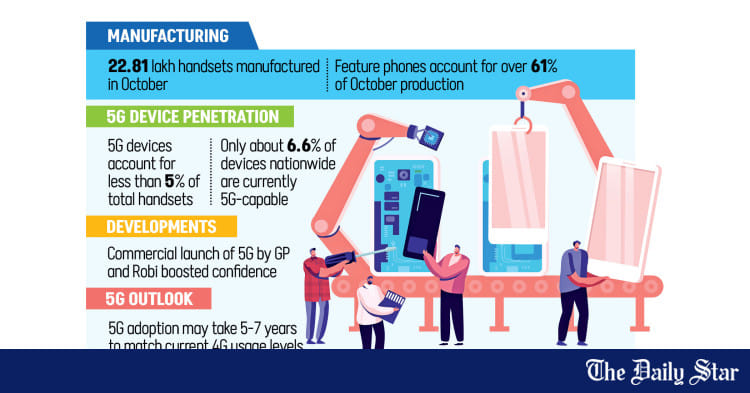
Local manufacturing of 5G handsets crossed the one lakh mark in October for the second time since June 2024, as manufacturers grew optimistic following the commercial launch of 5G services by mobile operators.

In October, local assemblers produced 1.08 lakh 5G handsets, up from 63,000 units in September, according to the Bangladesh Telecommunication Regulatory Commission (BTRC).

Earlier, in June 2024, production had also exceeded one lakh units, reaching 1.55 lakh.

Despite the increase, 5G devices accounted for only 4.74 percent of the total 22.81 lakh handsets manufactured in Bangladesh in October. Feature phones dominated production with a 61.21 percent share, while 4G handsets accounted for 34.29 percent.

The rise in local 5G handset production followed the limited commercial rollout of 5G services by Robi Axiata and Grameenphone from September 1, 2025.

Grameenphone introduced 5G across all eight divisional headquarters, though coverage remains limited to selected areas. Robi launched 5G services in parts of Dhaka, Chattogram, and Sylhet.

"5G penetration has started in the country as customers are increasingly looking for 5G handsets. That's why we have stepped up and started manufacturing," said Rezwanul Hoque, CEO of ISMARTU Technology BD Limited, the local maker of Tecno handsets.

He added that Tecno has already launched four 5G smartphone models locally.

Hoque also said that the global supply chain is now dominated by 5G devices, prompting many local manufacturers to shift their production. "After the launch of 5G, customers prefer the handset to come with 5G-support if the price goes beyond Tk 30,000," he added.

According to BTRC, around 62 percent of devices currently in use nationwide are smartphones, most of which are 4G-enabled. Industry estimates suggest only 6.6 percent of devices can connect to 5G networks.

Imported and expatriate-gifted handsets make up roughly 50 to 60 percent of the smartphone market. Many of these are high-end 5G-ready devices, though a significant portion is refurbished models, industry insiders said.

Robi Axiata said 5G adoption will be gradual. "In 200 areas, 5G penetration among devices is already 12-15 percent, with 120 areas reaching nearly 20 percent penetration. Our initial focus will be rolling out 5G to these areas," said Shahed Alam, chief corporate and regulatory affairs officer of Robi Axiata.

He added that most imported and gifted handsets registered on Robi's network are compatible with 5G.

According to Robi estimates, it may take five to seven years for 5G adoption to reach current 4G levels, as affordability and economic factors remain key challenges.​
 
Analyze

Analyze Post

Add your ideas here:
Highlight Cite Respond
Joint effort needed for quality telecom services: Taiyeb

UNB
Published :
Dec 29, 2025 22:44
Updated :
Dec 29, 2025 22:44

1767055244744.webp

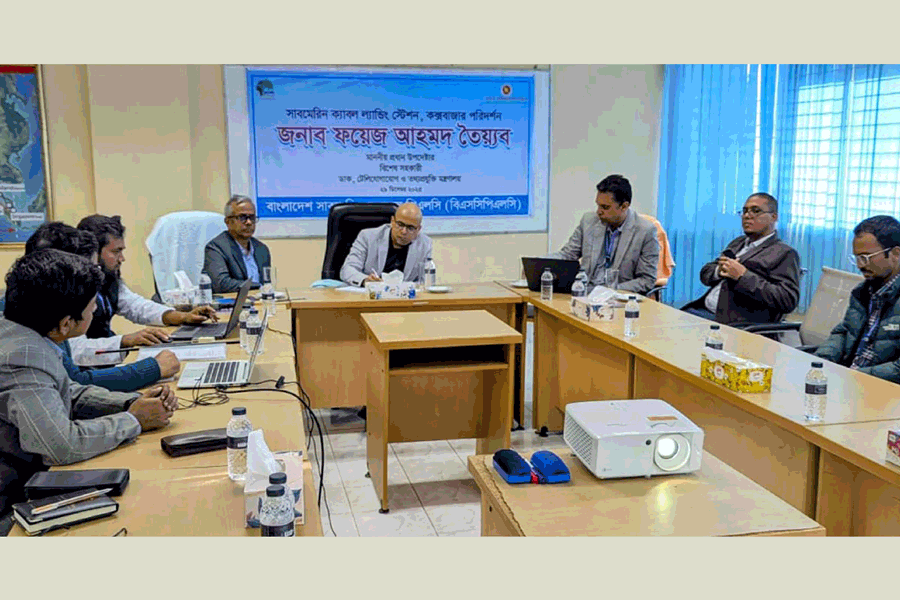
Chief Adviser's Special Assistant for the Ministry of Posts, Telecommunications and Information Technology Faiz Ahmad Taiyeb on Monday urged the concerned authorities to work together to ensure uninterrupted and improved telecommunication services.

He made the call while inspecting the Third Submarine Cable Laying (2nd revised) Project and the associated landing station of Bangladesh Submarine Cables PLC (BSCCL), aimed at expanding the country’s international telecommunications network.

During the visit, he was briefed on the project’s progress, technical capabilities, operational management, and future plans. He also toured key facilities of the landing station and exchanged views with officials and employees, said a hand out.

Faiz Ahmad Taiyeb said the submarine cable project plays a crucial role in strengthening the nation’s digital infrastructure.

“Through the implementation of the SMW-6 project, the country’s internet bandwidth capacity will increase, along with enhanced international telecommunication facilities, which will indirectly contribute to socio-economic development and the creation of a prosperous Bangladesh,” he added.

He urged the officers and employees of Bangladesh Submarine Cables PLC to work with professionalism, dedication, and sincerity to ensure uninterrupted and quality telecommunication services.

The third submarine cable (SMW-6) will extend from Cox’s Bazar to Singapore on one side and France on the other, enabling connectivity to major data centers in Singapore, India, Djibouti, and France through the core cable.

After the inspection, Faiz Ahmad Taiyeb planted Thai longan saplings on the premises of Bangladesh Submarine Cables PLC. Bangladesh Submarine Cables PLC Managing Director Md Aslam Hossain and other senior officials were present.​
 
Analyze

Analyze Post

Add your ideas here:
Highlight Cite Respond
2025 telecom reset: Policy rewritten, but fault lines remain

1767057578184.webp

As 2025 draws to a close, Bangladesh's telecommunications sector stands at a pivotal juncture, reshaped by a wave of policy interventions that have altered how connectivity is regulated, owned and governed.

Over the year, the government rolled out sweeping reforms to telecom licensing, amended decades-old surveillance laws, fast-tracked the entry of satellite internet through Starlink and revived plans to block unauthorised handsets through the National Equipment Identity Register (NEIR).

Faiz Ahmad Taiyeb, special assistant to the chief adviser for telecom and ICT, who led much of the reform drive, has argued that under the previous regime the sector had descended into what he described as "anarchy".

According to him, thousands of licences were issued on political considerations, while intermediaries extracted large sums without adding meaningful value.

Industry leaders and policy experts broadly agree that reform was overdue. But many warn that several provisions risk undermining competition, discouraging investment and entrenching the dominance of large multinational players.

Telecom expert Abu Nazam M Tanveer Hossain said the changes were being pursued without a coherent long-term roadmap. "There should first be a national telecom policy with a 10-year vision, followed by revisions of the act and then the licensing guidelines, rules and regulations."

NEW LICENSING ARCHITECTURE, OLD FEARS

The centrepiece of the year's reform agenda was the new Telecommunication Licensing Policy, approved in September.

The policy dismantles a patchwork of over 20 licence categories and replaces it with four core licence types: access networks, national infrastructure, international connectivity and non-terrestrial networks. Telecom-enabled services will require registration rather than licensing.

Mobile, internet and satellite service and submarine cable operators, are to be brought under this framework. Existing licences -- such as for international internet gateway, interconnection exchange, national internet exchange and internet gateway -- will be allowed to expire naturally, with most set to lapse by 2027.

"We have already drafted guidelines accordingly, and these guidelines are awaiting government approval," said Bangladesh Telecommunication Regulatory Commission Chairman Maj Gen (retd) Md Emdad ul Bari.

Yet the policy has triggered unease within the industry, particularly over ownership rules. It caps foreign equity in mobile operators at 85 percent, effectively requiring at least 15 percent local ownership.

Among private mobile operators, only Grameenphone already meets this threshold. Malaysia-based Axiata holds 61.82 percent of Robi, India's Bharti Airtel 28.18 percent, while Banglalink is fully foreign-owned by Dubai-based VEON.

Shahed Alam, Robi's chief corporate and regulatory affairs officer, warned that mandating a 15 percent local share offload "may concern investors who have already invested billions with long-term plans."

Taimur Rahman, Banglalink's chief corporate and regulatory affairs officer, welcomed provisions for active network and spectrum sharing, but warned ownership mandates could discourage foreign investment.

Critics, meanwhile, also point to another asymmetry: multinational companies with up to 65 percent foreign direct investment can obtain cross-layer licences, while similar opportunities remain constrained for local firms.

Sumon Ahmed Sabir, deputy managing director of Fiber@Home, said this could marginalise domestic entrepreneurs and entrench market dominance.

Policy expert Tanveer Hossain added that weak cross-ownership limits could distort competition.

SURVEILLANCE LAW REFORM

Another major development came with the approval of the Bangladesh Telecommunication (Amendment) Ordinance, 2025. It bars state-led internet shutdowns and introduces limited transparency and accountability measures in lawful interception.

Under the amended framework, interception requests will be overseen by a three-member quasi-judicial council composed entirely of executive officials, with the minister of law, justice and parliamentary affairs as chair. It must document all decisions, allow appeals and file complaints over unlawful interception.

Unauthorised interception or misuse of data will carry penalties of up to five years' imprisonment, a fine of Tk 1 crore, or both. Budgetary sanctions of up to Tk 99 crore may be recommended against offending agencies.
Tanveer Hossain said although safeguards that were absent in the 2010 law have been introduced in the ordinance, the council's composition may not ensure independent assessment.

The National Telecommunication Monitoring Centre will be abolished and replaced by a Centre for Information Support under the home ministry. Lawful interception will be limited to national security, law and order, emergencies, judicial or investigative needs, and cross-border matters.

Crucially, the amendment restores some balance between the ministry and the regulator. The ministry will approve only nationally significant licences, while the BTRC regains authority over others.

Even so, BTRC Chairman Bari has cautioned that certain accountability provisions may still encroach on regulatory independence.

THE NEIR STALEMATE

Few telecom initiatives have generated as much controversy as the launch of NEIR. Revived again in 2025, NEIR was announced amid strong resistance from small handset traders, prompting authorities to retreat from immediate enforcement.

Although the system is designed to block unauthorised mobile phones, enforcement has been deferred until late March next year in the face of continued protests. The BTRC has extended the deadline for registering unauthorised devices until year-end, and no handsets will be disconnected before enforcement begins.

The system aims to curb illegal handset imports in a market where grey-channel phones account for an estimated 50 to 60 percent of sales.

STARLINK CHANGES EQUATION

The arrival of Starlink added a new dimension to Bangladesh's connectivity landscape. The satellite internet provider received fast-track approvals through a three-month accelerated process.

Starlink obtained its operating licence on April 29, began test operations on May 8, and officially launched on May 20. Residential packages were priced at Tk 6,000 and Tk 4,200. Gateways were established in Gazipur, Rajshahi and Jashore, supported by local data centres and fibre partners.

Commercial momentum increased after Robi Axiata PLC and Bangladesh Satellite Company Limited signed reseller agreements worth $2.5 million.​
 
Analyze

Analyze Post

Add your ideas here:
Highlight Cite Respond

Members Online

Latest Posts

Back
 
G
O
 
H
O
M
E