[🇧🇩] Textile & RMG Industry of Bangladesh

[🇧🇩] Textile & RMG Industry of Bangladesh
500
22K
More threads by Saif

G Bangladesh Defense
As an import source we should replace India with Brazil and other Latin American countries. Unlike India, Latin American countries are not a security threat to Bangladesh. India is ungrateful which never acknowledges Bangladesh's huge contribution to it's economy. Bangladesh should distance itself from India for geopolitical reason.

Indians not only not acknowledge our contribution to their economy, they claim that Bangladesh cannot survive without a vassal relationship with India.

It is high time that the real face of Indian trade dependency on Bangladesh be shown. Eventually full boycott of Indian agri goods and FMCG products must be implemented, by gradual raising of tariffs for these products.

Since we hardly export anything to their country, they have zero leverage for any retaliatory move.
 
Indians not only not acknowledge our contribution to their economy, they claim that Bangladesh cannot survive without a vassal relationship with India.

It is high time that the real face of Indian trade dependency on Bangladesh be shown. Eventually full boycott of Indian agri goods and FMCG products must be implemented, by gradual raising of tariffs for these products.

Since we hardly export anything to their country, they have zero leverage for any retaliatory move.
The pro-India bureaucrats won't allow 'India boycott' program to succeed. We need to conduct a reform program to boot out the pro-India section of our bureaucracy.
 

BD import policy incompatible with new EU, US trade rules

Jasim Uddin

Published :
Jun 01, 2026 00:24
Updated :
Jun 01, 2026 00:24

1780271341407.webp


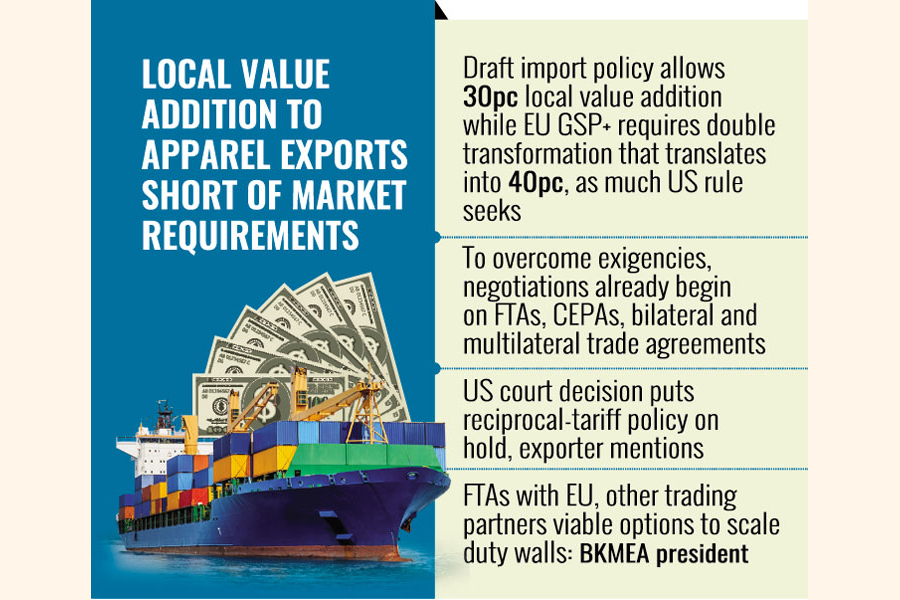
Bangladesh's import policy in the making appears at odds with emerging trade requirements in the European Union and the United States as it proposes allowing apparel exporters to qualify for incentives with a minimum 30-percent local value addition.

Industry leaders say the EU's proposed Generalised Scheme of Preferences Plus (GSP+) framework will require "double transformation" for garment exports, which they estimate would translate into around 40-percent local value addition.

Similarly, exporters say recent US trade rules require at least 40-percent local value addition, failing which shipments could be treated as transshipments.

To qualify for the EU's proposed GSP+ framework, Bangladeshi garment exporters will need to comply with the double-transformation requirement, which industry leaders estimate would require around 40-percent local value addition - a level already achieved by many knitwear manufacturers, though.

However, woven-garment manufacturers, which typically have lower domestic value addition, may find it more difficult to retain duty-free access to the EU market following Bangladesh's graduation from least-developed-country (LDC) status in November 2026, according to trade economists and industry insiders.

The government, however, has also sought a deferral of the country's graduation process to leave the world's poor-country club.

"We proposed lowering the threshold to 20 per cent," says BKMEA President Mohammad Hatem, in reference to the draft Import Policy Order 2026-2029.

He argues that high-value products, particularly those made from man-made fibres (MMF), would struggle to meet the proposed 30-percent threshold, as raw material costs for such products are significantly higher than those of cotton-based items.


"If the government does not revise the provision, it will discourage local industrialisation and efforts to increase domestic value addition in export-oriented apparel production," he predicts.

Hatem also raises concern over a proposed restriction on knit fabrics import in the draft policy. Referring to Commerce Ministry Additional Secretary Abdur Rahim Khan, he says the ministry had indicated that the issue would be addressed in the final version of the policy.

A recent Ministry of Commerce document states that following Bangladesh's graduation from the LDC status, exports to key destinations such as the EU, the United Kingdom, the United States, Japan and other markets will no longer enjoy duty-free access.

To maintain export competitiveness and safeguard market share, the ministry, in collaboration with stakeholders, has already initiated negotiations on free-trade agreements (FTAs), comprehensive economic partnership agreements (CEPAs), bilateral and multilateral trade agreements, and other preferential trade arrangements with major trading partners.

According to the document, maintaining duty-free market access after graduation will require major export-oriented sectors to raise local value addition to above 40-50 per cent. In some cases, compliance with product-specific rules (PSRs), including double-transformation requirements, will be necessary.

The policy on the anvil further notes eligibility for GSP+ preferences may require a minimum value addition of 40 per cent. Exports to countries such as Australia and Canada, which currently enjoy duty-free access, are already required to meet a value-addition threshold of at least 50 per cent.


"In nearly all recent trade negotiations, the requirement for double transformation as a condition for granting duty-free access to Bangladeshi exports has been strongly emphasised," the document reads.

It also highlights that Bangladesh has offered commitments in ongoing negotiations under which garments produced using yarn and fabrics originating from importing countries would be eligible for preferential tariff treatment in proportion to the share of such inputs used in production.

"Accordingly, if Bangladesh's garment industry, particularly knitwear manufacturers, becomes increasingly dependent on imported yarn, securing duty-free market access in the future may become significantly more challenging," the document forewarns.

Seeking anonymity, an apparel-sector leader says the government may consider cash support only for new product categories with 20-percent value addition, which could help diversify export offerings.

"The new items could include sportswear, wedding wear and tech wear, which may require imported fabrics and accessories. Once we start producing such products, the local industry will gradually develop around them," the exporter says.

BKMEA Executive President Fazlee Shamim Ehsan mentions that a recent US court decision put the implementation of the reciprocal-tariff policy on hold, meaning it is currently not applicable to Bangladesh or other countries.

According to the draft Import Policy Order, RMG exporters will be required to maintain a 30-percent value-addition threshold for children's garments, up from the current 15 per cent.


Knitwear and woven garment exports will also be required to attain 30-percent value addition, compared to the existing requirement of 20 per cent.

Exporters of underwear and other specialised garments made from synthetic fibres may face a minimum 40-percent value-addition requirement. Footwear exports, including both leather and non-leather products, may be subject to 30-percent threshold, while ship exports could face 40 per cent, and wooden furniture exporters 50 per cent.

Under the proposed policy, exporters who fail to meet the prescribed value-addition requirements will not be eligible for cash incentives or duty benefits on imported raw materials.

The Ministry of Commerce held a stakeholder consultation on the draft policy on May 22, bringing together industry representatives ahead of its finalisation.​
 

20th edition of denim expo to begin on June 10

FE ONLINE REPORT

Published :

Jun 06, 2026 20:21
Updated :
Jun 06, 2026 20:21

1780791873700.webp


The 20th edition of Bangladesh Denim Expo will kick off on June 10, positioning the nation's denim industry to navigate the challenges of the future.

Minister of Commerce, Industries, Textile and Jute Khandaker Abdul Muktadir will inaugurate the two-day expo at International Convention City, Bashundhara in the city, according to a statement.

More than 50 exhibitors from 10 countries will showcase the entire gamut of the denim supply chain from fabrics to finishes.

Founder and CEO of Bangladesh Denim Expo Mostafiz Uddin said, “The exhibitors will not only show their innovative products but also new ideas that are shaping the future of the denim industry.”

The theme of this edition of the expo is ‘Frontline to Future’.

For more than four decades, Bangladesh’s apparel industry has stood at the frontline of global fashion — absorbing pressure, driving growth, and delivering value to the world.

This theme is not merely a reflection of where the Bangladesh apparel industry stands; it is a declaration of where it is headed, organisers said, adding from unlocking green and responsible investment to navigating post-LDC trade agreements, from championing a just transition for its workforce to pioneering product diversification beyond apparel, Bangladesh is not waiting for the future — it is building it.

Apart from the exhibition, there will be five panel discussions on 'Negotiating the Future: Trade Agreements and Bangladesh Apparel in the Post-LDC Era’, ‘Stitching the Future: Just Transition in Bangladesh's Apparel Industry’, ‘Beyond Apparel: Product Diversification as the Key to the Future Economy’, and ‘Financing the Future: Unlocking Green and Responsible Investment in Bangladesh's Denim & Apparel Sector’.

A special panel discussion on ‘Woven in Data: The Past and Future of Bangladesh’s Global Competitiveness’ will also be organised by Better Work Bangladesh.

National and international policy makers, buyers, industry leaders and experts from home and abroad will be sharing their insights at the panel discussions to shape a sustainable future of Bangladesh’s apparel industry together.​
 

RMG exports under pressure as global demand weakens

Monira Munni

Published :
Jun 07, 2026 10:52
Updated :
Jun 07, 2026 10:52

1780876398943.webp


Locally produced readymade garment exports continued to record negative growth in major destinations, including both traditional markets like the European Union, the US and the UK as well as emerging non-traditional markets this fiscal year amid external headwinds.

Exporters and trade officials said global trade disruptions, tariff tensions and ongoing wars have weakened global demand for clothing across export markets, while internal bottlenecks have eroded competitiveness. As a result, exports have remained on a negative trajectory over the last eleven months.

They observed that some major buyers like H&M is shifting sourcing away from Bangladesh, though not in large volume, indicating that the country is losing ground in cost competitiveness.

Germany, France, Italy, Denmark, Spain, the Netherlands and Poland are among the EU's billion-dollar markets for Bangladeshi garments.

Shipments to these countries during the first eleven months of the current fiscal year recorded negative growth ranging from 4.0 per cent to over 12 per cent, with only a few markets posting marginal growth, according to Export Promotion Bureau (EPB) data.

Shipments to the Netherlands recorded a 2.13 per cent decline, while Spain and Poland registered declines of 4.0 per cent and 7.98 per cent respectively.

The downturn across 16 nations also resulted in a 4.88 per cent negative growth in exports to the 27-nation bloc of EU.

Bangladesh received US$17.35 billion from garment export to the EU during the July-May period of 2025-26, down from US$18.24 billion in the corresponding period of the last fiscal year(2024-24), EPB data showed.

Out of the $17.35 billion earnings, knitwear accounted for US$ 10.42 billion, down from US$ 11.12 billion, reflecting a 6.26 per cent decline.

Similarly, earnings from woven items during the period also marked a 2.71 per cent fall to US$6.93 billion from US$7.12 billion.

Readymade garment shipments to the US and UK fetched US$7.02 billion and US$4.01 billion respectively, marking declines of 0.04 per cent and 0.50 per cent over the corresponding period of FY 2024-25.

Non-traditional markets also witnessed a 5.95 per cent fall during the eleven months, reflecting persistent global demand weakness and economic uncertainty across key economies, data analysis showed.

Official data show that exports to new destinations, including Japan, Australia, India, South Korea, Mexico, Russia and Turkey, decreased by 10 per cent to 30 per cent year on year.

Earnings from non-traditional markets during the period stood at US$5.68 billion, which was US$ 6.04 billion.

When asked about the trade situation, Khan Monirul Alam, managing director of Fashion.com, said the performance reflected a broader slowdown on the global apparel market.

"Uncertainty and disruptions, including the impact of wars-- Russia-Ukrain and in the Middle East, have dampened demand," he told the FE.

US tariff regime is further worsening the market condition in both America and EU, he noted.

With an elected political government now in power, he said political uncertainty has gradually eased, but the internal issues, including rising cost of production due to energy price hike, labour costs and others, are eroding their competitiveness.

The strategic plans of one of the major buyers like H&M has also hinted at a loss of local competitiveness, he said, adding that the buyer is reportedly shifting to India, possibly due to the neighbouring country's price competitiveness, availability of raw materials and government's support to enhance competitiveness.

Talking to the FE, Mohammad Hatem, president of Bangladesh Knitwear Manufacturers and Exporters Association (BKMEA), said the rising cost of living due to high inflation forced consumers to prioritise essential needs over clothing purchases.

"And following the weak demand, buyers are also purchasing less," he noted.

Echoing Mr Alam, he, however, noted that the latest price hike in electricity would surely raise the cost of production which has already gone up by 20 per cent due to a number of factors.

The government last time did not raise diesel price to support consumers while the electricity price hike would affect them and manufacturers most, he said, adding the government should incentivise for some more time to help curb inflation.

Despite the overall weakness, Canada showed 2.27 per cent growth to fetch US$1.22 billion during July-May period of fiscal 2025-26, according to the EPB data.

Overall, Bangladesh's total RMG exports fell 3.41per cent year on year to US$35.31 billion in the first eleven months of FY2025-26, compared with US$36.55 billion during the same period last fiscal year.​
 

Latest Posts

Back