☕ Support Us
[🇧🇩] - The Home Adviser and the Law and Order Situation in Bangladesh | Page 6 | PKDefense

[🇧🇩] The Home Adviser and the Law and Order Situation in Bangladesh

Reply (Scroll)
Press space to scroll through posts
G Bangladesh Defense
[🇧🇩] The Home Adviser and the Law and Order Situation in Bangladesh
55
1K
More threads by Saif


16 citizen groups demand home advisor’s resignation

bdnews24.com
Published :
Dec 20, 2025 00:13
Updated :
Dec 20, 2025 00:13

1766191819454.webp


Citizen organisations have demanded the resignation of the home advisor for his “failure” over the murder of Inqilab Moncho Convenor Sharif Osman bin Hadi and the subsequent deterioration in law and order.

In a statement issued on Friday, 16 organisations said they were gravely concerned and called for steps for the immediate restoration of law and order.

The organisations include Ganatantrik Odhikar Committee, Network for Democratic Bangladesh, Charan Sanskritik Kendra, Naripokkho, Association for Land Reform and Development, University Teachers’ Network, Nagarik Coalition, and Voice for Reform.

The statement said that different groups with vested interests are trying to exploit the incident for political gain and to destabilise the country.

“Even one year after the [July Uprising], the interim government has failed to ensure citizens’ safety from the ousted Awami League and different forces at home and abroad,” the statement added.

The statement noted Hadi was shot just the day after the schedule for parliamentary polls was announced on Dec 11. Hadi was a frontliner in the movement against the previous Awami League government, who wanted to peacefully participate in the election, according to the statement.

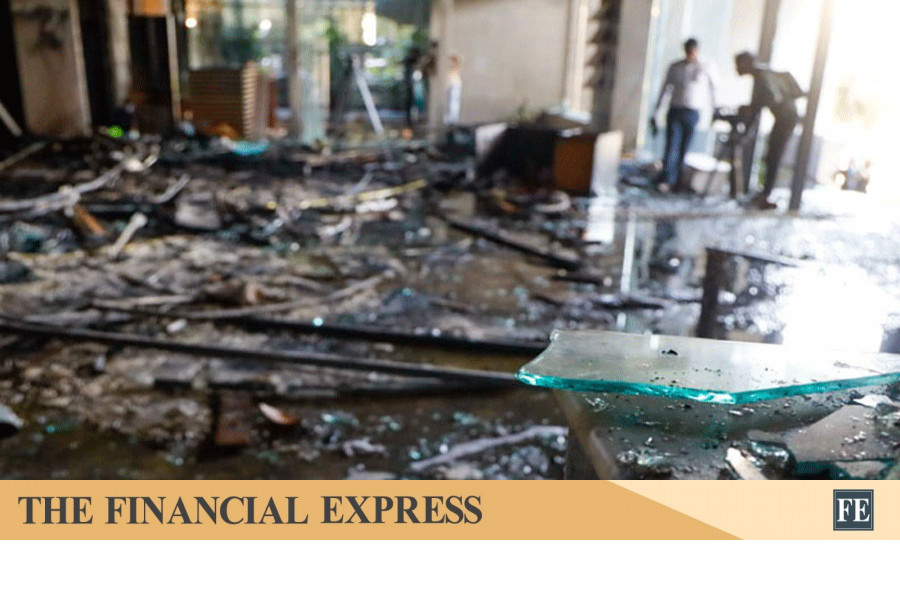
Hadi passed away in Singapore on Dec 18 while undergoing treatment. His death sparked a wave of violence, including vandalism and arson.

It demanded a fair probe into Hadi's murder.

Politics of division along with violence have made all citizens feel even more insecure, the statement said.

The statement also expressed concern over the attacks on the media and Chhayanaut, the assault on New Age Editor Nurul Kabir and attempts to attack the Indian High Commission.

Expressing concern over the violence reported in many areas in Bangladesh after Hadi's death, the statement pointed out that the preparations for the incident took place over a long period, with provocation from social media influencers, who operate from abroad.

“The law-enforcing agencies have failed to take any effective measures to prevent the incident,” it added.

The statement presented a five-point demand, including the resignation of the home advisor.

The other demands include the arrest of the perpetrators of Hadi’s murder and their trial, an investigation into the recent incidents of violence, protection of citizens' lives and property before the general election, and bringing those inciting the violence from home and abroad to justice.​
 

Is security ensured through gun licences?
Kazi Maruful Islam
Updated: 18 Dec 2025, 13: 22

1766279867304.webp


Against the backdrop of the unfortunate attempted assassination of Inqilab Moncho convener Sharif Osman Hadi last week and the overall deterioration of law and order, the interim government has decided to issue firearm licences to important political leaders, potential candidates in the upcoming election, and leaders of the July movement for their personal security.

A related policy guideline was also published on 15 December. At a time when citizens, with the national parliamentary election approaching, are expecting a fearless, violence-free, and festive electoral environment—and when demands are being raised to curb the use of all kinds of weapons, both legal and illegal—what will this decision actually achieve?

As a responsibility of the state, efforts to ensure citizens’ security are undoubtedly important. But the question is: will this decision ensure security, or will it institutionalise the risk of insecurity?

In my view, this decision is not only flawed in principle but may also bring dangerous consequences for society, politics, and the state in the long run.

Electoral politics and the risk of violence

In Bangladesh’s political reality, elections inevitably mean intense competition, tension, and unfortunately, the risk of violence. In such a context, the presence of legal firearms in the hands of political leaders goes far beyond the realm of personal security and increases the potential for violence.

Recent political killings—such as those that occurred during political programmes in Chattogram and inside business establishments in Mirpur—show, through video footage, that the perpetrators planned the attacks in such a way that even if the victims had firearms, they likely would not have had the time or opportunity to use them. A review of past assassination incidents clearly shows that many of those who were killed had personal weapons.

In situations such as political programmes, processions, and counter-demonstrations, the presence of weapons puts not only the individuals concerned but society as a whole at risk. In sociological terms, this is a “spillover”—a side effect of a decision that can spiral beyond control. The argument of personal security may ultimately lead to a deterioration of collective security.

Normalisation of violence and militarisation of society

This decision may foster a deep and dangerous mindset in society—that security equals weapons. In political science and security studies, this is referred to as the militarisation of everyday security. This is not a sign of a healthy society. According to Danish political scientist Barry Buzan and the Copenhagen School of security theory, when a state defines a social or political issue as a “security problem” and legitimises exceptional measures (such as weapons or the use of force) as solutions, violence gradually becomes normal and acceptable.

In this regard, there is much to learn from the experience of the United States. There, the cultural and legal legitimacy of carrying personal firearms has long created a certain tolerance for violence in society.

Research shows that when weapons are easily accessible, disputes, anger, or fear can turn deadly very quickly. Although the US context cannot be directly replicated in Bangladesh, the lesson of how social acceptance of weapons normalises violence cannot be ignored.

Shifting the state’s responsibility onto individuals: A constitutional question
Security lies at the core of the concept of the modern state. According to Thomas Hobbes’s theory of the social contract, people formed states primarily to ensure their own security. German sociologist Max Weber clearly stated that a defining feature of the state is its ‘monopoly of legislative violence.’ In this context, when the state itself declares that carrying weapons is necessary to ensure the security of important citizens, two serious questions arise. First, is the state failing to fulfil its fundamental responsibility? Second, does this not effectively weaken the constitutional promise that the state will ensure the security of citizens’ lives and property?

Pakistan’s experience is relevant here. There, armed personal security for political leaders, businesspeople, and influential groups has gradually become a normal sight. The result has been a loss of trust in the state policing system, the proliferation of illegal weapons, and a cycle of violence that continues to plague the country.

Privatisation of security and expansion of the arms market

Where firearm licences for personal security increase, the arms market—both legal and illegal—inevitably becomes more active. Considering Bangladesh’s weak border security and fragile policing system, it can almost be said with certainty that illegal arms markets will welcome this decision as good news.

In several Latin American countries (particularly Brazil and Mexico), the privatisation of security and the culture of armed guards have, instead of reducing crime and violence, weakened the rule of law—a widely discussed issue in security studies.

Final words

Security is never achieved through weapons alone. Security comes from credible state institutions, a professional policing system, political tolerance, and the rule of law. Putting weapons in the hands of leaders is not proof of state capacity; rather, it is a kind of admission that the state itself is unable to ensure the security of its citizens. In a densely populated and politically sensitive society like Bangladesh, this decision risks normalising violence, militarising society, and undermining the very foundations of the state–citizen relationship.

This policy needs to be reconsidered now—so that security is viewed not as a matter of weapons, but as a question of state responsibility and democratic governance.

● Kazi Maruful Islam is a Professor, Department of Development Studies, University of Dhaka.​
 

Mob violence is a threat to democracy: Rizvi

Published :
Dec 22, 2025 20:55
Updated :
Dec 22, 2025 20:55

1766450288542.webp


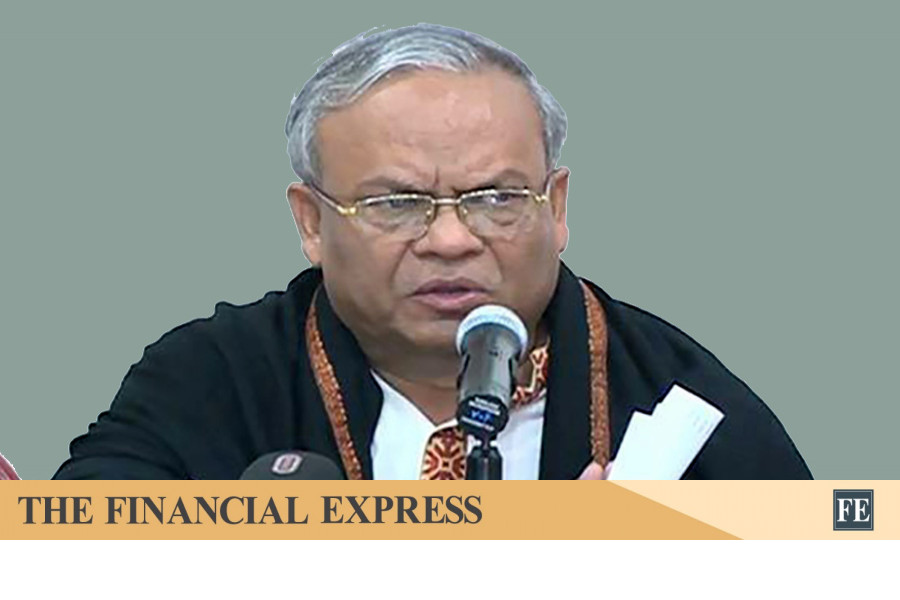
Expressing grave concern over the continued incidents of mob violence across the country, BNP Senior Joint Secretary General Ruhul Kabir Rizvi today said that the attacks being carried out by unruly mobs pose a serious threat to humanity and democratic values.

He made these remarks while talking to journalists after paying tribute at the shrine of the late President Ziaur Rahman in Sher-e-Bangla Nagar this morning, following the announcement of the Central Committee of the Jatiyatabadi Muktijuddher Projonmo, BSS reports.

Rizvi said attacks are occurring one after another across the country under different pretexts. He warned that democracy can never be strengthened in the country if this continues. It will eventually destabilize the society and obstruct the development of democratic culture.

He further added that the people of the country have been deprived of their voting rights for 17 long years. The public is now eager to cast their votes, but a certain syndicate is working systematically to destroy that opportunity. Rizvi appealed that this kind of malicious attempt should not be given an opportunity to grow.

Mob justice is not only a symptom of lawlessness but also a dangerous force that undermines the rule of law and fuels further violence, he added.

Criticizing fascist Sheikh Hasina, the BNP senior leader said that during the Awami League government's tenure, public money was wasted by purchasing electricity from abroad at exorbitant prices under unequal agreements.

He alleged that the hard-earned money of the people was treated as the government’s own, creating opportunities for looting.

During the event, Rizvi praised the leadership of Engineer Ishraque Hossain, the Convener of the newly formed committee, stating that Ishraque has set a brilliant example in the anti-fascist movement. He added that the leaders and activists of this generation are determined to protect the country's independence and sovereignty.​
 

Preventing mob justice imperative for ensuring rule of law

MIR MOSTAFIZUR RAHAMAN
Published :
Dec 22, 2025 22:21
Updated :
Dec 22, 2025 22:21

1766450605790.webp


Mob justice has emerged as one of the gravest threats to Bangladesh's fragile transition, provoking deep anxiety among citizens across political, social and professional divides. Despite repeated assurances from the interim government, vigilante violence continues unabated, exposing a dangerous erosion of state authority and a widening gap between promise and practice. If left unchecked, mob justice will not only undermine the rule of law but also imperil the very prospect of democratic renewal.

At its core, mob justice represents the abdication of lawful governance. It is the moment when the crowd replaces the court, emotion supplants evidence, and coercion displaces accountability. No society committed to justice can tolerate such a reversal without paying a heavy price. In Bangladesh today, that price is being measured in fear, intimidation and the gradual normalisation of lawlessness.

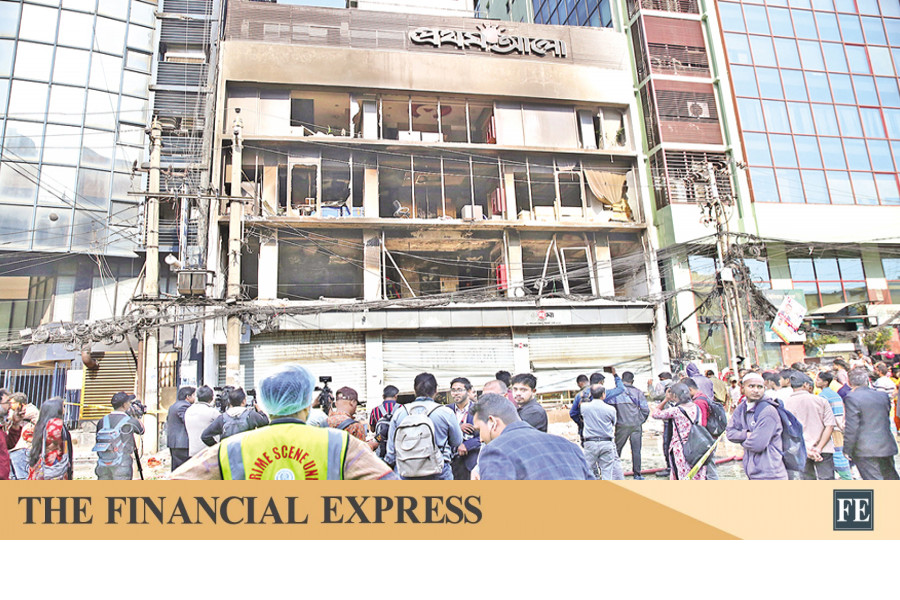
Recent attacks on properties linked to two of the country's most respected daily newspapers -- Prothom Alo and The Daily Star -- illustrate the danger starkly. These were not isolated acts of vandalism, nor spontaneous expressions of anger. They were calculated assaults that targeted institutions central to democratic discourse. When mobs attack media houses with impunity, the message is unmistakable: dissent will be punished, scrutiny will be silenced, and intimidation will prevail.

Even more troubling than the attacks themselves was the failure of law enforcement to prevent them. The absence of timely and effective intervention has raised serious questions about institutional competence, command responsibility and political resolve. In a country where journalists have previously been picked up by law enforcers only to be retrospectively "shown as arrested", the passivity displayed during the vandalisation of media houses is deeply unsettling. It invites an unavoidable question: was this reluctance on the ground, or a reflection of ambiguity -- or worse -- at the top?

Either explanation is deeply problematic. If law enforcers hesitate to act out of fear or confusion, it signals a breakdown of command and confidence. If restraint is politically motivated, it represents a far more dangerous erosion of the state's neutrality. In both cases, the consequence is the same: mobs learn that the cost of violence is negligible.

This sense of impunity is now unmistakable. Those engineering mob violence appear increasingly desperate and emboldened, operating on the assumption that they will face no legal consequences. Such actors thrive in moments of transition, when authority is contested and institutions are recalibrating. History offers a sobering lesson: when the state fails to act decisively at such moments, the vacuum is quickly filled by coercive forces that are hostile to democracy.

The interim government has repeatedly warned against mob justice, as have senior figures in the civil administration and the security forces. These warnings are welcome, but words alone cannot be a substitute for action. The persistence of mob violence suggests that certain quarters no longer take these warnings seriously. That, in itself, should alarm policymakers. When the deterrent effect of the state diminishes, disorder becomes self-perpetuating.

Mob justice is often rationalised as a response to perceived injustice or delayed accountability. But this argument collapses under scrutiny. Vigilantism does not correct injustice; it multiplies it. It does not strengthen accountability; it destroys it. By bypassing due process, mobs erase the distinction between guilt and innocence, replacing justice with collective punishment. The result is not order, but arbitrariness.

For Bangladesh, the stakes could not be higher. The rule of law is not an abstract principle; it is the foundation upon which good governance rests. Without it, institutions lose credibility, citizens lose trust, and democracy becomes illusory. Elections held in an environment where mobs roam unchecked cannot be meaningfully free. A press operating under threat cannot serve as a watchdog. Courts functioning amid fear cannot dispense impartial justice.

Preventing mob justice, therefore, is not merely a law-and-order imperative; it is a democratic necessity. It requires a clear and unequivocal message from the interim leadership that no group -- however loud, organised or politically connected -- will be allowed to operate above the law. That message must be reinforced through visible action: rapid intervention, credible investigations, and prosecution without exception.

Law enforcement agencies must be empowered and instructed to act decisively, not selectively. Their legitimacy depends on consistency. A police force that arrests individuals swiftly in some cases but stands idle in the face of organised vandalism sends a signal of bias and weakness. Restoring confidence will require institutional clarity, operational independence and protection from political interference.

Equally important is accountability within the state apparatus. When mobs succeed because authorities fail to act, responsibility cannot be diffused indefinitely. Identifying lapses, fixing command failures and holding officials accountable are essential steps in reasserting the rule of law. Without internal accountability, public assurances ring hollow.

The role of political leadership is central. Transitional governments often err on the side of caution, fearing that firm action may provoke backlash. But history shows that ambiguity breeds greater instability. The refusal to draw red lines emboldens extremists while demoralising those who rely on the state for protection. Leadership, especially in transition, demands clarity and courage.

Bangladesh stands at a critical juncture. The promise of democratic transition cannot be realised in an environment where mobs dictate outcomes and intimidation is a substitute for debate. Good governance will remain a slogan if anarchic forces are allowed to rule the roost.

The time has come to put a full stop to mob justice. Not tomorrow, not after another warning, but now. Preventing vigilantism is not optional; it is imperative. The rule of law must be enforced uniformly and visibly, or it will cease to exist in practice. If the interim government is serious about steering the country towards a stable and democratic future, it must demonstrate -- through action, not rhetoric -- that the state alone holds the legitimate authority to enforce the law. Anything less risks surrendering that authority to the mob, with consequences that Bangladesh can ill afford.​
 
Привет всем! Стоит заранее разобрать — выбор материала для крыши. По сути экономить на кровле — аукнется потом. Ищешь профессионалов — вот проверенный сервис: установка мембранной кровли. Лично я вижу: мембранная кровля — выгоднее в перспективе. Допустим постоянные ремонты — а мембрана стоит 25-30 лет. Основные этапы: нанять опытную бригаду. Вот и соответственно: это работает для защиты здания.
 
Extrajudicial killings, custodial deaths on rise

38 extrajudicial killings, 107 custodial deaths reported in 2025: ASK
Staff Correspondent 31 December, 2025, 22:41

1767232006626.webp


At least 38 extrajudicial killings and 107 custodial deaths were reported in 2025 and the numbers were 21 and 65, respectively, in 2024, according to the Ain O Salish Kendra yearly human rights report published on Wednesday.

Of the 38 extrajudicial killings in 2025, 26 were killed in reported gunfights, physical torture and in joint forces custody, and 12 others were killed in the custody of law enforcement agencies in different police stations, the ASK report said.

Of the 107 custodial deaths, 69 were under-trial prisoners and 38 others were convicted prisoners.

On September 29, former industries minister of the ousted Awami League government, Nurul Majid Mahmud Humayun, 75, who was in jail custody, died while undergoing treatment at Dhaka Medical College Hospital.

The inspector general of prisons, Brigadier General Syed Md Motaher Hossain, however, claimed that two-thirds of these reported deaths were in hospitals and the jails were providing accommodation to over 82,000 inmates against their capacity of accommodating 43,000 prisoners.

‘A good number of prisoners died of cardiac arrest. We could not address it immediately due to limitations of doctors in jails,’ said the IG prisons.

ASK said that such incidents of using deadly force by avoiding the judicial process against suspects proved the ongoing human rights crisis.

ASK observed that the political changeover did not bring the expected change in improving the human rights situation.

Human rights activists also expressed dissatisfaction over the rights situation due to extrajudicial killings, custodial deaths, mob violence and political violence after the August 5, 2024 political changeover.

Supreme Court lawyer and rights activist Jyotirmoy Barua said that it was unfortunate that law enforcers were involved in extrajudicial killings, avoiding the criminal justice system, which portrays the style of the Sheikh Hasina regime.

‘The interim government has run its 15-month tenure in a shaky way. We expected that the human rights situation would be improved under the interim administration, as many human rights activists are now in the government. It is unfortunate that they could do nothing fruitful,’ he said.

According to ASK investigation, Awami League’s student wing Bangladesh Chhatra League former leader Apel Mahmud, 36, was detained from the Baragara area under Sadar upazila in Netrokona district on October 14, 2025 and was taken in a one-day remand in police custody.

Apel was taken to a police quarter outside the police station and he was beaten for two hours, blindfolded by hanging him.

The police also forced his wife to come to the police station, ASK said, adding that the victim’s wife alleged that the police demanded money and threatened her for her husband’s political identity.

ASK found preliminary truth over the allegations.

Police headquarters’ assistant inspector general of police for media and public relations, AHM Sahadat Hossain, said that Bangladesh police did not support any extrajudicial killing and are looking into all death incidents following laws and regulations.

‘The police carried out impartial investigations and took actions against alleged involvement of any police member,’ he added.

He also said that the police were respectful to human rights and the rule of law and the force’s main aim was to bring all accused under the law.

Human rights activist Nur Khan Liton said that it was unfortunate that the human rights situation did not improve at an expected level after the political changeover.

He, however, said that there was no report of enforced disappearance during the time.

‘We are still witnessing custodial death, extrajudicial killings and political violence,’ he added.

ASK's yearly human rights report also found that at least 102 people were killed and 4,744 were injured in 401 incidents of political violence in 2025.

Bangladesh Nationalist Party’s internal conflict left 39 dead in 192 clashes.

At least 381 journalists faced torture and harassment from January to December in 2025, according to the ASK report.

Besides, at least 42 attacks were launched on the Hindu communities in 2025.

ASK said that 33 houses were damaged, 36 houses were set on fire, four temples were attacked, 64 idols were vandalised, and nine lands were grabbed in the attacks on religious minorities.

The report also showed that 197 people were killed in mob violence in 2025 though the number was 128 in 2024.

ASK found that 293 citizens were victims of mob violence in the past year.​
 

Members Online

Latest Posts

Latest Posts