[🇧🇩] The U.S.A.---A Strategic Partner of Bangladesh

[🇧🇩] The U.S.A.---A Strategic Partner of Bangladesh
180
8K
More threads by Saif

G Bangladesh Defense

62,150 tonnes of US wheat reach Chattogram port under G2G deal

UNB
Published :
Mar 27, 2026 16:18
Updated :
Mar 27, 2026 16:18

1774657378292.webp


A consignment of 62,150 metric tonnes of wheat from the United States reached the outer anchorage of Chattogram Port on Friday under a government-to-government (G2G) agreement.

This is the second shipment under the deal, following an earlier delivery of 58,457 metric tonnes of wheat, according to the Ministry of Food.

Officials said sampling and testing of the wheat onboard have already begun, while steps are underway to ensure swift unloading of the cargo.

Of the total volume, 37,290 metric tonnes will be discharged at Chattogram port while the remaining 24,860 metric tonnes will be unloaded at Mongla port.

Bangladesh has so far imported a total of 467,884 metric tonnes of wheat under previous G2G arrangements, including 237,845 tonnes under G2G-01 and 230,039 tonnes under G2G-02, officials added.

The country’s annual wheat demand is estimated at around 7 million metric tonnes, against a domestic production of about 1 million tonnes, leaving a significant gap to be met through imports by both public and private sectors.​
 

Bangladesh-US trade relations

Muhammad Mahmood
Published :
Mar 29, 2026 00:00
Updated :
Mar 29, 2026 00:01

1774742558904.webp


The United States is Bangladesh's largest export market and a major source of foreign direct investment, with bilateral relations focusing heavily on garment trade, energy, and development. A 2026 trade agreement is reducing U.S. tariffs on Bangladeshi goods to 19 per cent, with special provisions for apparel made with U.S. cotton.

The two countries signed a bilateral investment treaty in 1986. U.S. companies are the largest foreign investors in Bangladesh. Although Bangladesh may not be a major trading partner of the US, the US is an important and major partner to Bangladesh.

Relations between British colonial Bengal and the United States began in 1792, when Benjamin Joy was appointed as the first American envoy to the Bengal Presidency. The British East India Company initially refused to accept the envoy, but eventually a US consulate was established at Fort Williams. The US consulate in Bengal was one of the first U.S. diplomatic posts in Asia, and Chittagong was one of the seven ports under the jurisdiction of the US consulate at Fort Williams.

After the emergence of Bangladesh in December 1971 and the withdrawal of Indian troops in March 1972, the United States formally recognised the newly independent country on April 4, 1972. Now the United States is the single largest export destination for Bangladesh, accounting for about 20 per cent of its total exports, with a heavy concentration on readymade garments (RMG).

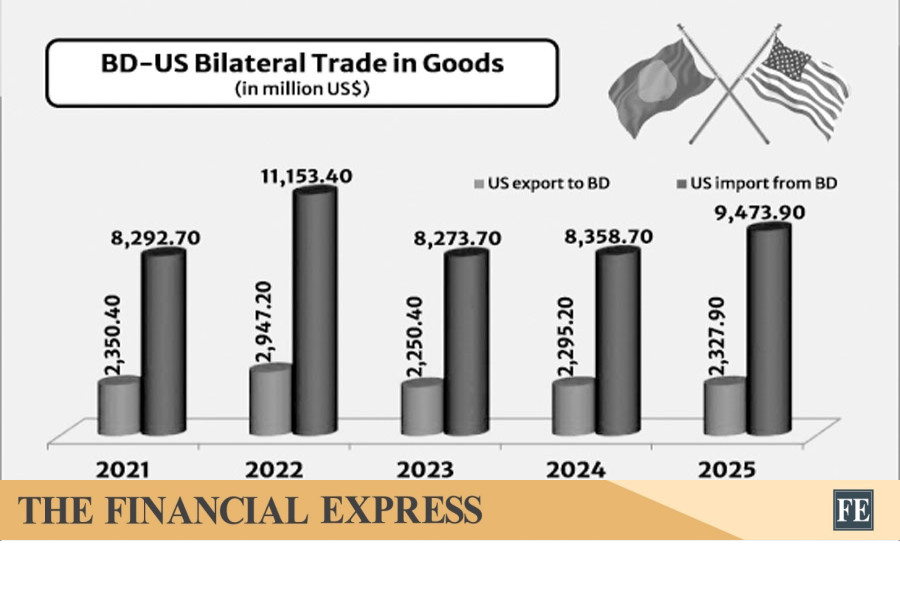
In 2024, US goods exports to Bangladesh were approximately $2.21 billion. Based on the total value of U.S. exports, this amount represents a very small fraction, generally estimated at less than 0.2 per cent of total US global exports, making it a relatively minor, albeit growing, market for US goods compared to top partners like Canada or China.

In the 2024-25 fiscal year, Bangladesh shipped goods worth $8.69 billion to the US, which represented 18 per cent of its total export earnings. The US market absorbs roughly 20 per cent of Bangladesh's total garment exports. Bangladesh holds a 10.53 per cent share of the US apparel market as of early 2026, making it a major supplier alongside China and Vietnam.

Despite recent global trade shifts and new tariff structures, Bangladesh's share of the US apparel market rose to 10.53 per cent in early 2026, up from 9.26 per cent the previous year. Despite challenges, apparel exports to the US grew by over 15 per cent in the Jan-Oct 2025 period. The U.S. goods trade deficit with Bangladesh was $6.1 billion in 2024. The U.S. services trade surplus with Bangladesh was $926 million in 2024.Despite efforts to increase U.S. exports, the trade balance continues to heavily favour Bangladesh due to high garments export.

Bangladesh's imports from the USA primarily consist of agricultural commodities, machinery, and industrial raw materials, with total goods imports reaching approximately $2.3 billion in 2024, showing a 2.0 per cent increase from the previous year. Key import items include raw cotton, wheat, soybeans, aircraft, and LNG.

As of February 2026, a new reciprocal trade agreement commits Bangladesh to lower tariffs on these U.S. goods. Bangladesh will cut tariffs to zero on products such as poultry, seafood, rice, corn and cereal grains when the agreement comes into force. The tariffs on some other US products, such as almonds, will reduce to zero over five to 10 years.

The U.S.-Bangladesh Reciprocal Trade Agreement, signed in February 2026, aims to enhance economic ties by reducing tariffs, cutting non-tariff barriers, and boosting bilateral trade. Key features include a reduction of U.S. tariffs on Bangladeshi goods to 19 per cent, a special zero-tariff mechanism for certain Bangladeshi textiles, and increased access for U.S. agricultural and manufactured products in Bangladesh. The U.S. established a mechanism to provide zero-reciprocal tariff rates for specific Bangladesh-made textile and apparel goods.

The agreement of February 2026 has secured a negotiated 19 per cent tariff rate on certain products with the US, following initial fears of a higher 20-37 per cent tariff. The agreement has been described by many as asymmetrical and bundled with security alignment. According to the Centre for Policy Dialogue (CPD)Bangladesh could lose around Tk. 1,327 crore in customs revenue in the current fiscal year due to the recent trade agreement with the US. However, this revenue loss could be offset by significant consumer welfare benefits.

Bangladesh remains one of the very high tariff countries in the world and the highest in South Asia. The agreement stipulates to phase out tariffs by 2035, with significant tariff reduction at the start of the agreement. Beyond tariff reductions, Bangladesh also has committed to dismantle a wide range of non-tariff barriers. Furthermore, Bangladesh has agreed to recognise US regulatory standards, thus limiting Bangladesh's regulatory autonomy.

But the agreement highlights the contemporary reality of the limits of trade diplomacy in the current Trumpian global economic order. The principal objective of the US trade policy under the Trump administration is to bring down trade deficits. Bangladesh had a trade surplus of about $6 billionin 2025 with the US. One way to reduce the deficit by increasing imports of agricultural commodities, energy products and commercial aircrafts among others from the US.

The US Supreme Court by a 6-3 decision ruled on February 20 that many of Trump's tariffs-those that invoked the International Emergency Economic Powers Act (IEEPA)-were unconstitutional. The statute does not authorise the use of tariffs. Moreover, as the ruling emphasised, the president does not have the authority to tax. The power to tax, including the imposition of tariffs, lies instead with the US Congress, in the unambiguous words of the US Constitution.

The Secretary of the Ministry of Commerce, Bangladesh suggested that the agreement lost its legal basis now due to the ruling and the deal is under review. But the situation is not as simple as that. The decision removes the fastest tool for imposing broad country-level duties, but it does not end the tariff debate. Other statutory authorities remain in play, and businesses and trading partners are left to assess what comes next. Also, Trump in his Social post said, "Any country that wants to 'play games' with the ridiculous supreme court decision, especially those that have ripped off the USA for years, even decades, will be met with a much higher tariff, and worse than that which they just recently agreed to."

It seems that Trump's immediate policy response was dictated by vengeance: a 10 per cent across-the-board tariff increase on all countries, which he extended to 15 per cent a day later. The new worldwide tariffs were enacted under the Trade Act of 1974, which allows the President to impose temporary tariffs up to 150 days to deal with urgent balance-of-payments shortfalls, after which Congress must decide to extend it.

Trump has plenty of other options under the US trade law. Among them are tariffs on certain sectors in the interest of national security, tariffs imposed for unfair trade practices, and tariffs to counter countries that "uniquely discriminate" against the United States. Trump is clearly determined to show that no Supreme Court decision is going to hamstring him in his determination to have absolute control over tariff policy.

With his escalating, ever-changing tariffs on imported goods, the President has roiled the global economy sufficiently to achieve his objective of replacing rules-based free trade with a transactional system that makes access to the U.S. market contingent on his caprice. When he first imposed a roster of high tariffs on what he called "Liberation Day" in April 2025, he claimed that jobs and factories would "come roaring back into our country." But by zapping allies and enemies alike with a burst of tariffs, Trump raised the average tariff on imports from 2.5 per cent in January 2025 to a hefty 16.6 per cent just six months later, the highest since 1932, while not faintly stopping the ongoing loss of jobs in the manufacturing sector. Now the US attack on Iran has added further complications to the global trading system.

The Supreme Court ruling exposes a profound crisis within the US political establishment. One faction-internationally oriented finance capital-acknowledges that Trump's tariff war has been disastrous: it drives up consumer prices, disrupts supply chains, and triggers retaliatory actions that undermine the United States' global dominance, in addition to the consequences of the attack on Iran. The other the tariff power is an instrument of personal rule, a means of rewarding allies and punishing enemies, completely outside the framework of democratic accountability. For countries like Bangladesh with a very heavy reliance on the US market for its exports, it is wise to pursue a very delicate balance in dealing the US under the Trump administration.​
 

US-Bangladesh relations now matters more than ever: Paul Kapur

Diplomatic Correspondent
Dhaka
Updated: 03 Apr 2026, 18: 10

1775263966912.webp


US Assistant Secretary of State for South and Central Asian Affairs Paul Kapur speaks at an eventX/US Department of State’s Bureau of South and Central Asian Affairs

US Assistant Secretary of State for South and Central Asian Affairs Paul Kapur has said that relations between the United States and Bangladesh are now more important than at any previous time.

He made the remarks as the chief guest at a reception organised by the Bangladesh Embassy in Washington, DC, marking the country’s Independence and National Day. The event was held at the embassy on Thursday evening (local time).

On Friday, the US Department of State’s Bureau of South and Central Asian Affairs shared a post on its verified X (formerly Twitter) account regarding Kapur’s participation in the event.

The post included Kapur’s remarks. He said, “I attended the National Day reception at the Embassy of Bangladesh to speak about our bilateral relations.”

1775264014288.webp

Paul Kapur (left) is seen at the reception marking Bangladesh’s Independence Day, organised by the Bangladesh Embassy in Washington, DC on 2 April 2026. Collected

“Today, the U.S.-Bangladesh relationship matters more than ever. Our cooperation in areas including security, trade, and governance, as well as our shared values, makes our countries more prosperous and secure,” he added.

According to sources at the Bangladesh Embassy in Washington, Paul Kapur expressed optimism about the future of bilateral relations and highlighted their importance.

He spoke on issues including business, trade, energy, agricultural products, and security.

Paul Kapur said Bangladesh holds an important strategic position among US partners in terms of security. Developments at sea or along borders have implications not only for the Indo-Pacific region but also for global security.

1775264054197.webp

Former US Ambassador to Dhaka Peter Haas (left) is seen at the reception marking Bangladesh’s Independence Day, organised by the Bangladesh Embassy in Washington, DC on 2 April 2026. Collected

He added that the two countries can work together to ensure Bangladesh can independently make decisions in a complex strategic environment while safeguarding its sovereignty and maritime domain.

Without mentioning China by name, Paul Kapur alluded to geopolitical competition with the country.

He said they do not pressure Bangladesh to choose any specific side. They offer advanced technologies that Bangladesh can use independently and apply to protect its sovereignty​
 

US ambassador calls on PM

BSS
Dhaka
Published: 05 Apr 2026, 17: 00

1775434702012.webp


US Ambassador to Bangladesh Brent T Christensen paid a courtesy call on Prime Minister Tarique Rahman today, Sunday. PMO

The US envoy met the prime minister at his Cabinet Division office in the Bangladesh Secretariat on Sunday afternoon, said Prime Minister's Additional Press Secretary Atikur Rahman Ruman.

During the meeting, the US ambassador handed over two photographs and a replica of the White House to the Prime Minister.

One photograph features Shaheed President Ziaur Rahman and former US President Jimmy Carter, while the other shows former Prime Minister Begum Khaleda Zia and former US President George Bush Sr.

Foreign Minister Dr Khalilur Rahman and Prime Minister's Adviser for Foreign Affairs Humaiun Kobir were present at the meeting.

During the meeting, they discussed various issues of mutual interest.​
 

Khalilur denies ‘secret deal’ with US, clarifies Russian oil waiver issue

Foreign minister says Bangladesh remains free to seek the cheapest energy sources, but US restrictions mean a waiver would be needed for Russian oil

UNB, Dhaka

1775435652986.webp

Foreign Minister Dr Khalilur Rahman. File photo

Foreign Minister Khalilur Rahman today said Bangladesh needs to seek a waiver from the United States to purchase Russian oil, as the US has imposed restrictions on all countries regarding such purchases.

“Restrictions are in place for all countries regarding the purchase of Russian oil. Therefore, you need to seek a waiver from these restrictions,” he told reporters after the first courtesy meeting between Prime Minister Tarique Rahman and US Ambassador to Bangladesh Brent T Christensen.

After the meeting, the US ambassador described his meeting with the prime minister as “very productive”.

“I am looking forward to working together as we pursue common goals that benefit the people of both Bangladesh and the United States,” Christensen said.

The foreign minister said there is no secret deal with the United States.

Responding to a question, Khalilur said claims that Bangladesh must seek US permission because of a trade deal signed with Washington are “completely false.”

US sanctions on Russian oil have pushed buyers to look elsewhere. Last month, Washington temporarily eased those sanctions to allow India to purchase Russian oil currently stranded at sea amid rising tensions in the Middle East.

The foreign minister, however, said Russian oil did not come up during the meeting with the US ambassador.

Khalilur said he discussed a range of issues with US Energy Secretary Chris Wright, but could not disclose details due to confidentiality.

He said that during their meeting in Washington on March 31, the US energy secretary reaffirmed his country’s commitment to supporting Bangladesh through these difficult times and helping ensure its energy security.

Regarding the meeting between Prime Minister Tarique and the US ambassador, the foreign minister said it was the first courtesy meeting, and the two sides discussed cooperation between the two countries.

They discussed cooperation between the two countries in the areas of energy, trade and development, in addition to continued US support for the Rohingyas living in Bangladesh, he added.

On diversifying energy sources, the foreign minister said the government would continue trying to import energy at the lowest possible price, whether from India, the Middle East or the United States.

Foreign Affairs Adviser Humayun Kabir was also present at the meeting.

During the meeting, the US ambassador presented the prime minister with two photographs and a replica of the White House.

One photograph features martyred President Ziaur Rahman with former US President Jimmy Carter, while the other shows former Prime Minister Begum Khaleda Zia with former US President George HW Bush.​
 

Latest Posts

Back