Donate ☕
201 Military Defense Forums
[🇧🇩] - The U.S.A.---A Strategic Partner of Bangladesh | Page 23 | PKDefense
Home Post Alerts Inbox Watch Videos

[🇧🇩] The U.S.A.---A Strategic Partner of Bangladesh

Reply (Scroll)
Press space to scroll through posts
G Bangladesh Defense
[🇧🇩] The U.S.A.---A Strategic Partner of Bangladesh
130
6K
More threads by Saif


Reducing US trade GAP: Dhaka turns to Boeing, wheat imports

1752798887319.webp


The government is set to sign an agreement for the wheat imports on Sunday in Dhaka, according to Bangladesh plans to buy 14 Boeing aircraft and about 3,00,000 tonnes of US wheat, as Dhaka responds to pressure from the Trump administration to narrow a trade gap of more than $6 billion.

"This is the beginning of the trade cooperation between Bangladesh and the US," Rahman told The Daily Star yesterday.

Negotiations with Boeing for the aircraft are at an advanced stage, he confirmed, although a timeline for delivery remains contingent on the US manufacturer's production capacity. The total value of the aircraft and wheat deals has not yet been disclosed.

The push to increase imports from the US comes as Bangladesh is engaged in negotiations with the United States Trade Representative to secure lower tariffs on its exports. President Donald Trump has imposed a 35 percent tariff on goods from Bangladesh, a rate significantly higher than that applied to competitors such as Vietnam (20 percent) and Indonesia (19 percent).

Bangladeshi officials are preparing for a third round of talks in Washington next week, aiming to conclude a reciprocal tariff agreement before new rates take effect on August 1.

"We are trying to reduce the trade gap between Bangladesh and the US by increasing imports from America," said Rahman. He noted that his ministry has been consulting with business leaders from the crucial garment and pharmaceutical sectors, as well as trade experts, ahead of the negotiations.

Rahman declined to provide further details, citing a bilateral non-disclosure agreement.

The government also plans to include private sector representatives in the upcoming talks, a move businesses have recently advocated for. In addition to government-led purchases, private sector importers are being encouraged to source more goods, such as soybeans, from the US.

The effort to rebalance trade follows earlier proposals from Dhaka. In April, Chief Adviser Muhammad Yunus wrote to Trump offering to increase imports of US cotton, wheat, LNG, and soybeans. A similar offer was made by Commerce Adviser Sk Bashir Uddin to USTR Jamieson Greer.

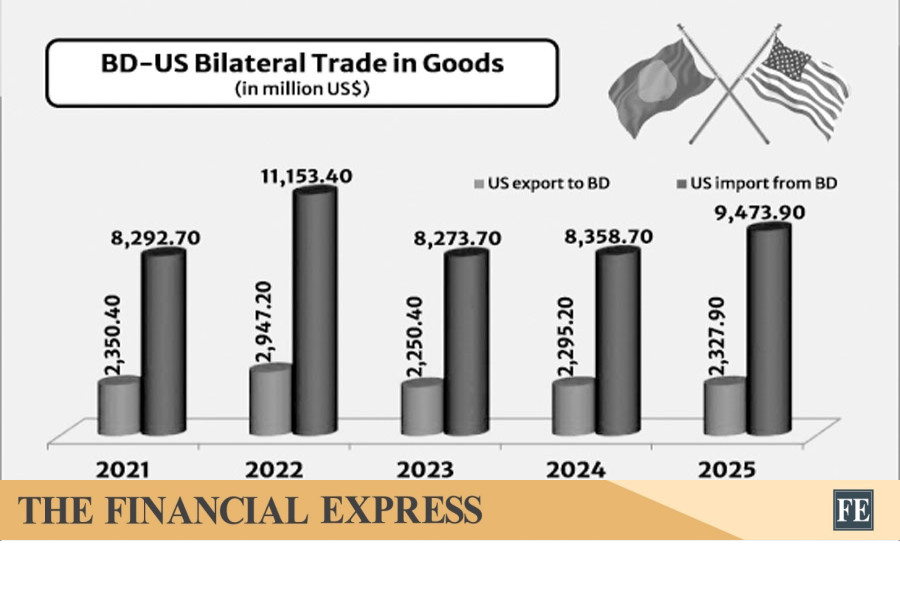
Bangladesh currently exports goods worth more than $8 billion annually to the US, its single largest export market, while it imports goods valued at over $2 billion. The high tariffs have caused significant concern among exporters, particularly in the garment industry, who fear losing competitiveness.

President Trump on Wednesday said he intends to send a single letter telling more than 150 countries what tariff rate they will face, according to a report by Politico.

"It's all going to be the same for everyone, for that group," Trump told reporters during a meeting with the Bahrain Crown Prince Salman bin Hamad Al Khalifa at the White House, as the Politico reported.

"They're not big countries, and they don't do that much business. Not like the ones we've agreed with, like China, like Japan."

Currently, all countries are paying an additional baseline tariff of 10 percent that Trump set in April. Trump has previously indicated the new baseline could be 15 to 20 percent but did not mention a tariff rate.

Trump has already sent out roughly two dozen letters informing individual trading partners like the European Union, Japan and South Korea of the tariff rate they will face effective August 1, the politico said.​
 
Analyze

Analyze Post

Add your ideas here:
Highlight Cite Fact Check Respond

Reducing US trade GAP: Dhaka turns to Boeing, wheat imports

View attachment 20206

The government is set to sign an agreement for the wheat imports on Sunday in Dhaka, according to Bangladesh plans to buy 14 Boeing aircraft and about 3,00,000 tonnes of US wheat, as Dhaka responds to pressure from the Trump administration to narrow a trade gap of more than $6 billion.

"This is the beginning of the trade cooperation between Bangladesh and the US," Rahman told The Daily Star yesterday.

Negotiations with Boeing for the aircraft are at an advanced stage, he confirmed, although a timeline for delivery remains contingent on the US manufacturer's production capacity. The total value of the aircraft and wheat deals has not yet been disclosed.

The push to increase imports from the US comes as Bangladesh is engaged in negotiations with the United States Trade Representative to secure lower tariffs on its exports. President Donald Trump has imposed a 35 percent tariff on goods from Bangladesh, a rate significantly higher than that applied to competitors such as Vietnam (20 percent) and Indonesia (19 percent).

Bangladeshi officials are preparing for a third round of talks in Washington next week, aiming to conclude a reciprocal tariff agreement before new rates take effect on August 1.

"We are trying to reduce the trade gap between Bangladesh and the US by increasing imports from America," said Rahman. He noted that his ministry has been consulting with business leaders from the crucial garment and pharmaceutical sectors, as well as trade experts, ahead of the negotiations.

Rahman declined to provide further details, citing a bilateral non-disclosure agreement.

The government also plans to include private sector representatives in the upcoming talks, a move businesses have recently advocated for. In addition to government-led purchases, private sector importers are being encouraged to source more goods, such as soybeans, from the US.

The effort to rebalance trade follows earlier proposals from Dhaka. In April, Chief Adviser Muhammad Yunus wrote to Trump offering to increase imports of US cotton, wheat, LNG, and soybeans. A similar offer was made by Commerce Adviser Sk Bashir Uddin to USTR Jamieson Greer.

Bangladesh currently exports goods worth more than $8 billion annually to the US, its single largest export market, while it imports goods valued at over $2 billion. The high tariffs have caused significant concern among exporters, particularly in the garment industry, who fear losing competitiveness.

President Trump on Wednesday said he intends to send a single letter telling more than 150 countries what tariff rate they will face, according to a report by Politico.

"It's all going to be the same for everyone, for that group," Trump told reporters during a meeting with the Bahrain Crown Prince Salman bin Hamad Al Khalifa at the White House, as the Politico reported.

"They're not big countries, and they don't do that much business. Not like the ones we've agreed with, like China, like Japan."

Currently, all countries are paying an additional baseline tariff of 10 percent that Trump set in April. Trump has previously indicated the new baseline could be 15 to 20 percent but did not mention a tariff rate.

Trump has already sent out roughly two dozen letters informing individual trading partners like the European Union, Japan and South Korea of the tariff rate they will face effective August 1, the politico said.​

I am hoping - once the wheat and aircraft purchases are agreed to - export tariff to US will be reduced to the level India, Vietnam and Indonesia face. Which is ~20%.

The US has no reason to single out Bangladesh with high rate of punitive tariffs, if we play ball (which we will).
 
Analyze

Analyze Post

Add your ideas here:
Highlight Cite Fact Check Respond
I am hoping - once the wheat and aircraft purchases are agreed to - export tariff to US will be reduced to the level India, Vietnam and Indonesia face. Which is ~20%.

The US has no reason to single out Bangladesh with high rate of punitive tariffs, if we play ball (which we will).
Does our economy permit to buy 14 passenger planes from Boeing?
 
Analyze

Analyze Post

Add your ideas here:
Highlight Cite Fact Check Respond
  • Like (+1)
Reactions: Bilal9
Does our economy permit to buy 14 passenger planes from Boeing?

It is a "promise" to buy (or lease) them over like decades. Not to be bought all at once.

Leasing means you pay as you go, with revenue stream from ticket sales, which is always a sure thing in Bangladesh.

Our Biman 737-800s are already getting rather long-in-the-tooth, they need to be replaced with 737 Max-8s, 9s and 10s. Much quieter than the current fleet (737-800) and to be used for anything regional - ranging from Dhaka - Chittagong to Dhaka - Bangkok (around 3 hour hops). Sturdy little suckers. I ride them quite often on local US flights. Quiet, smooth. Handles turbulence quite well.

The 787's and 777's are also due for replacement in another couple of years. These service the Gulf and EU traffic hops.

Plus US Bangla, Novo Air and Air Astra will need these too - besides Biman.

We need "labor-tana" Hawaii Jahaz and lots of them.
 
Last edited:
Analyze

Analyze Post

Add your ideas here:
Highlight Cite Fact Check Respond
  • Wow (+2)
Reactions: Egyptian

US cotton farmers eye direct partnership with Bangladesh
Staff Correspondent 18 July, 2025, 00:02

US cotton producers on Thursday proposed a direct supply arrangement with Bangladesh’s textile sector to bypass middlemen and recover their declining market share amid stalled tariff talks between Dhaka and Washington.

At a strategic dialogue held at The Westin Dhaka, hosted by US-Bangladeshi firm AmeriBangla Corporation, top garment exporters, US cotton growers, and global trade professionals discussed a farmer-to-factory supply chain model.

The goal was to cut costs, ensure long-term supply security, and improve compliance standards.

Currently, US cotton is 5–6 cents per pound more expensive than imports from West Africa or India. But AmeriBangla CEO Aswar Rahman argued that direct sourcing would offset the price gap due to superior quality and lower waste.

US cotton has less than 2 per cent waste, while others have up to 10 per cent. Every 1 per cent waste means a 1.5 per cent production loss, Aswar said.

US cotton’s share in Bangladesh’s total cotton imports has slipped to just 6 per cent in the first seven months of FY25.

To reverse this, US farmers are ready to supply directly, provided Bangladesh allows bonded warehousing and a simplified ordering system.

In return, these politically influential farmers — spread across 17 southern US states — would lobby Congress to reduce tariffs on Bangladeshi garments.

Garment makers welcomed the initiative but emphasised the need for fixed long-term pricing to avoid future hikes.

To back the effort, AmeriBangla plans to open a dedicated showroom featuring apparel made from US cotton.

Participants included top executives from Hamim, Jamuna, Saad, Divine, True, and RPM groups, alongside representatives from Marubeni, BKMEA, Kuehne+Nagel, and AmeriBangla.​
 
Analyze

Analyze Post

Add your ideas here:
Highlight Cite Fact Check Respond
  • Love (+3)
Reactions: Bilal9

Members Online

⤵︎

Latest Posts

Latest Posts