[🇧🇩] Trump's Victory/Tariff/ Bangladesh

[🇧🇩] Trump's Victory/Tariff/ Bangladesh
207
6K
More threads by Saif

G Bangladesh Defense
Prof Yunus congratulates Trump

1730940667435.png

Muhammad Yunus, left, and Donald Trump

Chief Adviser Prof Muhammad Yunus yesterday congratulated Donald Trump for his historic win in the US presidential election.

"I am delighted to convey, on behalf of the government and the people of Bangladesh, my heartfelt felicitations to you on your victory in the US Presidential Election 2024," he said in a congratulatory message.

"Electing you as the US President for a second term reflects that your leadership and vision have resonated with the people of the United States of America. I am confident that under your stewardship, the United States will thrive and continue to inspire others around the world," the message read.

Yunus said Bangladesh and the US share a long history of friendship and collaboration across numerous areas of mutual interest, reported BSS.

The relationship continued to grow in depth and breadth during Trump's previous term in the office, he said.

The chief adviser said he firmly believes that the possibilities are endless as the two friendly nations work towards exploring newer avenues of partnership.

"... Aligning with our commitment to a peaceful and inclusive society, the government and the peace-loving people of Bangladesh look forward to partner and collaborate in your efforts in addressing the global challenges in the pursuit of peace, harmony, stability, and prosperity for all," Yunus said.

His Press Secretary Shafiqul Alam at a media briefing at the Foreign Service Academy in the evening said, "We welcome this [his win]. We hope Bangladesh-US relations will be deepened and relations will reach a new height."

Responding to a question on Trump's remarks on Bangladesh recently, Shafiqul said he was probably misinformed, reports UNB.​
 
Last edited:
Analyze

Analyze Post

Add your ideas here:
Highlight Cite Fact Check Respond
  • Like (+1)
Reactions: Bilal9

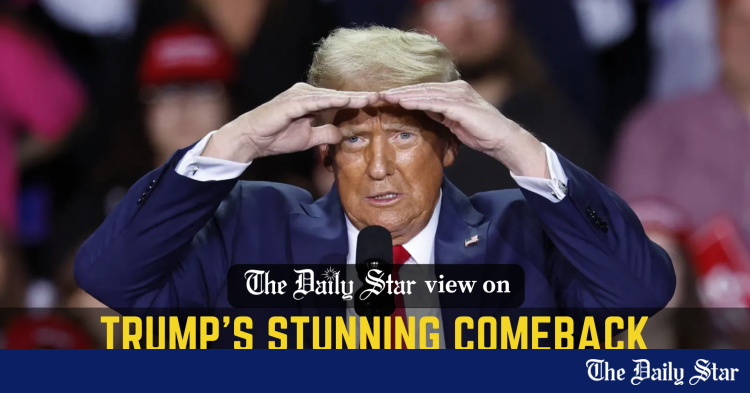
What does a second Trump presidency mean for Bangladesh?
Trump’s victory has implications for wider world, including Bangladesh

1730940836436.webp

VISUAL: STAR

The unbelievable has happened. In a moment of historic consequence for American democracy, Republican Donald Trump has won the 2024 US presidential elections that will see him return to the White House come January 20, 2025. This is indeed a remarkable comeback for the former president—"a phoenix from the ashes," as a Fox News anchor described it—as he overcame a criminal conviction, indictments, apparent assassination attempts, and persistent accusations of authoritarianism on his path to re-election. In so doing, he also avenged his loss to President Joe Biden four years ago.

As per the latest count, Trump has secured 292 electoral votes (against Democratic contender Kamala Harris's 226 votes), thus taking control of the Senate and possibly the House of Representatives, with votes still being counted after early projected wins in key battleground states.

What does a second Trump presidency mean for the world, and indeed Bangladesh? While the world braces for potentially disruptive and far-reaching impacts on global policies, Bangladesh, too, has its share of concerns that it will seek clarity on sooner rather than later. To understand some of the concerns, it is crucial to consider Trump's past policies and recent statements. Experts say a Trump presidency is likely to bring some, if not substantive, changes to the US foreign policy for Bangladesh, with potential ripple effects on issues covering trade, political dynamics, climate change, and Bangladesh's relations with regional powers.

It may be recalled that Trump, before the election, commented on the "barbaric violence" against Hindus, Christians, and other minorities in Bangladesh—a portrayal that is both unfair and unfounded. There is a concern among some that the US may be prompted to view Bangladesh through India's lens, and we hope such concerns will be duly addressed in the coming days.

A Trump presidency may also emphasise more transactional diplomacy, echoing his "America First" stance, which could potentially impact Bangladesh-US trade. The US is our biggest trading partner. But given Trump's history of raising tariffs and protectionist policies, Bangladesh's dependence on exports to the US could, theoretically, face disruptions. His climate policy is another issue of concern. Trump's earlier stance on climate change, marked by US withdrawal from the Paris Agreement and reduced engagement with global climate initiatives, was alarming for vulnerable nations like Bangladesh that depend on climate adaptation financing. His track record with the WHO also shows potential for strained relations with global health bodies, which could potentially impede Bangladesh's access to international health resources.

There are many other areas of mutual interest where Bangladesh and the US will likely cross paths in an increasingly complex and changing reality. It remains to be seen how the relations between our interim government and the upcoming Trump presidency shape up, however. For his part, Chief Adviser Prof Muhammad Yunus has been quick to congratulate the president-elect, expressing optimism for strengthened bilateral ties and future cooperation. Going forward, we hope the government will properly engage with its US counterpart to ensure that our interests are protected.​
 
Analyze

Analyze Post

Add your ideas here:
Highlight Cite Fact Check Respond
  • Like (+1)
Reactions: Bilal9

The US goes red: Another round of Trump presidency

1730941027955.webp

Trump won the presidency through the electoral system and the popular vote, which has not happened in the past two decades. PHOTO: REUTERS

The night started off, as it does, with red states. But unlike 2020, there was no confusion. The percentage of votes counted quickly began to show a clear picture: Donald Trump's victory.

Trump won the presidency through the electoral system and the popular vote, which has not happened in the past two decades. He overperformed in several states, following the trends of the previous two elections that polls underestimated his voters. In three consecutive election cycles, pollsters have not gotten a grip on Trump supporters. The media has engaged in many satirical theories to understand the mass support for Donald Trump in the US. What's clear is that the US media and institutions in general need to figure out what can aptly be described as a shift to the far-right. No comparisons with Hitler, no cases, could stop him.

In 2016, when Hilary Clinton lost, precisely the same way by losing the "Blue Wall"—Michigan, Pennsylvania and Wisconsin—the underlying reasons behind Trump's victory were not addressed. Rather, the analysis focused on the glass ceiling and Clinton's loss. Doing so for this election would be the gravest mistake. While it could be true that Harris's gender has a part to play in her loss, it is well-known that Joe Biden would have lost against Trump as well. When asked in several interviews what Harris would change about the Biden-Harris administration, she reverted to her pride, steering clear of showing how she would drastically differ from her boss.

While a comprehensive major picture of the voter turnout is yet to emerge, the early voter turnout—more than 80 million US citizens cast their votes before November 5—was high. As it happened in 2020, mail-in ballots proved to switch the game for Biden; we waited days as votes were being counted during the pandemic. The high turnout, especially early, when juxtaposed with the sheer number—not just in the Electoral College—of votes for Donald Trump and the fact that he might also win the popular vote, is telling of the national sentiment in the US. While a lot is to be seen in the coming days, it's clear that the US is shifting to the far-right. It's incumbent on all of us to reconcile, as hard as it may be for some, that US politics has moved to a state that an imprudent person is preferred over diplomatic human beings.

Kamala Harris underperformed in commonly Blue counties in the battleground states, where her boss, President Joe Biden, performed better in 2020. For example, in upscale Detroit, Michigan, Harris performed much worse than Biden in 2020. Though the causes of her underperformance will emerge more in the coming days, and data needs to be gathered to understand where Harris went wrong—one fact is clear: Harris's centrist campaign in a polarised US simply did not work. In many ways, it was a clever strategy on paper: reviving the John McCain and Mitt Romney type of Republican. But for now, it can be concluded that centrism is hardly reading the room in a country so polarised. In North Carolina, for example, where Trump won, several counties shifted left while others shifted right, according to The New York Times. Standing in the middle ground, the classic case of trying to please every party undoubtedly played a role in Harris's unexpectedly disappointing performance in the elections.

And whatever strategy the Democrats have deployed in electioneering along with their policies now stands to be proven as outdated. It must be noted that the Republican turnout machine—largely powered by allied conservative groups—focused on getting reliably conservative voters back to the polls for Trump. And it worked.

Republicans took over the Senate, retaking the chamber for the first time in four years. The House is also poised to be Republican. Everything, from the president-elect's policies on taxes to healthcare, will depend on the makeup of the two chambers of Congress. The Senate is solely responsible for confirming a president's cabinet officials and judges—from the federal, district and Supreme Court. Four of the nine justices—other than Trump's appointees—are in their 70s.

A Republican-led Senate would boost Trump's far-right presidency, and it was the only institution that provided the necessary logjams for Trump's loyalist tendencies and his "I can do whatever I want" mindset as the leader of a democratic nation. Though there are moderate voices in the Senate, including Senator Susan Collins of Maine, who was outspoken against Trump, this Senate is more likely to defer to him, who will be all the more recharged with a second term in the White House.

The implications for a Trump victory are far-reaching for the turbulent political atmosphere in the US. Donald Trump is a man who openly favours loyalty over the country, yet he is still favoured by citizens, for whatever reasons. A second Trump term, along with the Republican sweep, means we are possibly looking at a completely new version of US politics. The country is in need of some soul-searching, now more than ever.

Ramisa Rob is in-charge of Geopolitical Insights at The Daily Star.​
 
Analyze

Analyze Post

Add your ideas here:
Highlight Cite Fact Check Respond
  • Like (+1)
Reactions: Bilal9

Trump’s victory will take US-Bangladesh ties to new height: CA office
FE Online Desk
Published :
Nov 06, 2024 19:43
Updated :
Nov 06, 2024 19:43

1730944389261.webp


Donald Trump’s victory in the US presidential elections will jack up the bilateral ties between Bangladesh and the US to new heights, a spokesperson of the Chief Adviser said on Wednesday.

“We have a very good relationship with the US and it will further strengthen after Donald Trump’s victory as both the governments are committed to straightening democracy,” said Shafiqul Alam, press secretary to the CA while addressing a briefing.

Asked about the pre-poll comments of Donald Trump on the minorities in Bangladesh, Mr Alam said that Mr Trump was probably misinformed.

He pointed out that ‘highly exaggerated’ reports on minorities were being spread by certain quarters.

The government is fully committed to ensuring the rights of the minorities and has taken every possible measure for their protection, he mentioned.

During the recently ended Durga Puja festival many apprehended violence but it was celebrated peacefully amid due festivities, he noted.

A special app was created to monitor every puja mandala in the country, he said.

Citing media reports on the death of 9 minority people, he said that after a thorough investigation, it was found that most of the killings resulted from personal reasons.

There was no religious reason behind these killings, he added.

Responding to a question, he said that the government is planning to conduct some reform in the education sector also.​
 
Analyze

Analyze Post

Add your ideas here:
Highlight Cite Fact Check Respond
  • Like (+1)
Reactions: Bilal9

What impact will Trump have on the world economy?

1731027545915.webp

An employee works at a plastic factory in Yiwu, China’s eastern Zhejiang province. Taking into account the probable retaliatory measures from Beijing and Brussels, the impact on the European Union economy will be $533 billion through 2029, $749 billion for the United States and $827 billion for China, according to a study. PHOTO: AFP/FILE

Donald Trump's return to the White House with his protectionist policies poses threats for the global economy, with the prospect of new trade wars, resurgent inflation and slower growth, experts say.

During his first term in office from 2017 to 2021, Trump often resorted to punitive tariffs in disputes with trade partners.

In this 2024 campaign, he pledged to impose an additional 60 percent import tariff on Chinese products and an extra 10 percent tariff on products from the rest of the world.

Taking into account the probable retaliatory measures from Beijing and Brussels, the impact on the European Union economy will be $533 billion through 2029, $749 billion for the United States and $827 billion for China, according to a study by the Roland Berger consulting firm.

A separate study by the London School of Economics estimated that the impact on emerging market nations such as India, Indonesia and Brazil would be much less.

Jamie Thompson, head of macroeconomic forecasting at London-based Oxford Economics, said he sees little short-term economic impact due to the delays in implementing policies, but they could be positive for growth.

"While the outlook for 2025 is essentially unchanged, global growth is likely to be a little stronger in 2026 and 2027 on the back of the election result, as the impact of looser US fiscal policy more than offsets the drag from targeted tariff measures," he told AFP.

But if across-the-board tariffs are imposed it "could leave the global economy around 0.75 percent smaller –- and global trade down some three percent -- by the end of the decade," he added.

The prospects for international cooperation, which can boost trade and growth, will also be dimmer under a second Trump administration, said Tara Varma, a visiting fellow at the Brookings Institution, a US think tank.

"The multilateral world of the 1990-2000s will no longer exist," she said, adding that she anticipates a brutal change in US policies.

Donald Trump's policies could also rekindle inflation, which cooled following a series of interest-rate hikes that the Federal Reserve began to unwind this year.

The Peterson Institute for International Economics, a US think tank, estimated it could add between two and four percentage points to China's inflation rate.

Trump's promised higher import tariffs would "mean higher inflation, at least in the US, and most probably lower growth throughout the world", Bank of France chief Francois Villeroy de Galhau said -- adding that increased uncertainty would also weigh on growth.

The impact of "immigration policy is as important as global trade" on inflation, noted for his part Gilles Moec, chief economist at insurer Axa.

If Trump follows through with talk of a massive expulsion of unauthorised immigrants it could aggravate the labour shortage in the United States.

The Pew Research Center estimated that 8.3 million unauthorised workers could be affected.

The Peterson Institute for International Economics estimated this could add more than two percentage points to the US inflation rate next year, 0.2 percentage points in Europe and 0.6 percentage points in China.

Moec noted the surge in inflation would force central banks to hit the brakes on the cycle of interest rate cuts they began earlier this year as inflation subsided.

Analysts had been looking at lower interest rates to spur consumers to spend and companies to invest and put some more wind into the sails of the global economy.

The trade war that Trump has threatened to wage against China risks sapping global growth.

Asia accounts for 60 percent of global growth, but would be hit hard by a trade war between the United States and China, the International Monetary Fund warned earlier this month.

The United States has also been one of the fastest growing developed economies but Trump's policies risk shaving two percentage points off US GDP per year between 2027 and 2031 from baseline estimates, according to a forecast from the Peterson Institute.​
 
Analyze

Analyze Post

Add your ideas here:
Highlight Cite Fact Check Respond
  • Like (+1)
Reactions: Bilal9

Members Online

Latest Posts

Back
Top
PKDefense
G
O
 
H
O
M
E