Donate ☕
201 Military Defense Forums
[🇧🇩] - Israel and Hamas war in Gaza-----Can Bangladesh be a peace broker? | Page 29 | PKDefense
Home Login Forums Wars Movies Watch Videos
Serious discussion on defense, geopolitics, and global security.

[🇧🇩] Israel and Hamas war in Gaza-----Can Bangladesh be a peace broker?

Reply (Scroll)
Press space to scroll through posts
G Bangladesh Defense
[🇧🇩] Israel and Hamas war in Gaza-----Can Bangladesh be a peace broker?
954
26K
More threads by Saif

Foreign minister calls for greater OIC role to end Gaza atrocities​


1709686509037.webp

Foreign Minister Hasan Mahmud. File photo

Foreign Minister Hasan Mahmud called on the OIC member states to take alternate measures to end the conflict in Gaza and to ensure rights for the Palestinian people.

The foreign minister reiterated Bangladesh's firm support for the Palestinian cause and called for an immediate ceasefire and opening of humanitarian corridors in the besieged territory.

While addressing the 19th Extraordinary CFM of the OIC on Israel's' aggression on the Palestinian People in Jeddah, Saudi Arabia, he also stressed on the importance of the Islamic Financial Safety Net to ensure basic necessities for the Palestinians.

Foreign minister, mentioning the strong statement delivered by Bangladesh at the ICJ in February for the Palestinians, hoped that peace will be established soon in the region.

Noting the current stalemate at the United Nations Security Council, Foreign Minister highlighted the need for its reform so that decision on globally effecting issues could be reached.

He stressed the importance of Muslim Ummah's unity to stop atrocities against Palestinians, ensuring their safe and peaceful living in their homeland.

Earlier yesterday, Dr Hasan Mahmud paid a courtesy call on Saudi Foreign Minister Faisal bin Farhan Al Saud at the OIC Secretariat in Jeddah.

Expressing satisfaction at bilateral ties, Dr Mahmud hoped for deeper cooperation between Bangladesh and Saudi Arabia, anticipating a visit from Saudi Crown Prince Mohammed bin Salman.

Al Saud affirmed Saudi Arabia's commitment to sophisticated economic cooperation.

They discussed increasing sectoral cooperation, trade, and investment opportunities, with Dr. Mahmud seeking cooperation in crude oil purchase, which Al Saud promised to consider, including investments in refinery and petrochemical industries.

Al Saud congratulated Prime Minister Sheikh Hasina on her re-election and praised her leadership in hosting Rohingya refugees, pledging Saudi Arabia's full support.

Hasan Mahmud also met with OIC Secretary General Hissein Brahim Taha.

Taha praised Sheikh Hasina's leadership and reaffirmed OIC's support for Rohingya people.

The foreign minister advocated for greater trade and investment among OIC member states to mitigate economic challenges stemming from the Russia-Ukraine conflict, proposing a dedicated cell at the OIC Secretariat for trade-related information dissemination.​
 
Analyze

Analyze Post

Add your ideas here:
Highlight Cite Fact Check Respond
  • Haha (0)
Reactions: ThunderCat

Dozens killed, wounded as Israeli forces thrust deeper in Gaza

1716075184812.webp

An Israeli solider drives an armored personnel carrier, as military operations continue in the southern Gaza city of Rafah, at an area outside Kerem Shalom, Israel, May 17, 2024. Photo: Reuters

Israeli troops and tanks pushed on Saturday into parts of a congested northern Gaza Strip district that they had previously skirted in the more than seven-month-old war, killing and wounding dozens of Palestinians, medics and residents said.

Israel's forces also took over some ground in Rafah, a southern city next to the Egyptian border that is packed with displaced people and where the launch this month of a long-threatened incursion to crush Hamas hold-outs has alarmed Cairo and Washington.

Israel has conducted renewed military sweeps this month of parts of northern Gaza where it had declared the end of major operations in January. At the time, it also predicted its forces would return to prevent a regrouping by the Palestinian Islamist group that rules Gaza.

One site has been Jabalia, the largest of Gaza Strip's eight historic refugee camps. On Saturday, troops and tanks edged into streets so far spared the ground offensive, residents said. In one strike, medics said 15 Palestinians were killed and dozens wounded.

The Gaza health ministry and the Civil Emergency Service said teams received dozens of calls about possible casualties but were unable to carry out any searches because of the ongoing ground offensive and the aerial bombardment.

"Today is the most difficult in terms of the occupation bombardment, air strikes and tank shelling have going on almost non-stop," said one resident in Jabalia, Ibrahim Khaled, via a chat app.

"We know of dozens of people, martyrs (killed) and wounded, but no ambulance vehicle can get into the area," he told Reuters.

The Israeli military said forces have continued to operate in areas across the Gaza Strip including Jabalia and Rafah, carrying out what it called "precise operations against terrorists and infrastructure".

"The IAF (air force) continues to operate in the Gaza Strip, and struck over 70 terror targets during the past day, including weapons storage facilities, military infrastructure sites, terrorists who posed a threat to IDF troops, and military compounds," the military said in a statement.​

Armed wings of Hamas, the Islamic Jihad, and Fatah said fighters attacked Israeli forces in Jabalia and Rafah with anti-tank rockets, mortar bombs, and explosive devices already planted in some of the roads, killing and wounding many soldiers.

Israel's military said 281 soldiers have been killed in fighting since the first ground incursions in Gaza on Oct 20.

At least 35,386 Palestinians have been killed in Israeli strikes since Oct. 7, according to figures from the enclave's health ministry, while aid agencies have warned repeatedly of widespread hunger and dire shortages of fuel and medical supplies.

In the Hamas attack on Oct. 7, 1,200 people died in Israel and 253 were taken hostage, according to Israeli tallies. About 125 people are still being held in Gaza.

In Rafah, where Israeli tanks thrust into some of the eastern suburbs and clashed with Palestinian fighters there, residents said Israeli bombing from the air and ground persisted all night.

Rafah had been sheltering more than one million displaced Gazans. UNRWA, the main U.N. aid agency for Palestinians, said more than 630,000 people had fled Rafah since the offensive there began on May 6. Israel says it must capture Rafah to destroy Hamas and ensure the country's security.
 
Analyze

Analyze Post

Add your ideas here:
Highlight Cite Fact Check Respond

Israeli leaders split over post-war Gaza governance

1716075305223.webp

This handout picture released by the Israeli army on May 18, 2024 shows Israeli soldiers during military operations in the Gaza Strip, amid the ongoing conflict between Israel and the Palestinian militant group Hamas. Photo: AFP

New divisions have emerged among Israel's leaders over post-war Gaza's governance, with an unexpected Hamas fightback in parts of the Palestinian territory piling pressure on Prime Minister Benjamin Netanyahu.

The Israeli army has been battling Hamas militants across Gaza for more than seven months while also exchanging near-daily fire with Iran-backed Hezbollah forces along the northern border with Lebanon.

But after Hamas fighters regrouped in northern Gaza, where Israel previously said the group had been neutralised, broad splits emerged in the Israeli war cabinet in recent days.

Netanyahu came under personal attack from Defence Minister Yoav Gallant for failing to rule out an Israeli government in Gaza after the war.

The Israeli premier's outright rejection of post-war Palestinian leadership in Gaza has broken a rift among top politicians wide open and frustrated relations with top ally the United States.

Experts say the lack of clarity only serves to benefit Hamas, whose leader has insisted no new authority can be established in the territory without its involvement.

"Without an alternative to fill the vacuum, Hamas will continue to grow," International Crisis Group analyst Mairav Zonszein told AFP.

Emmanuel Navon, a lecturer at Tel Aviv University, echoed this sentiment.

"If only Hamas is left in Gaza, of course they are going to appear here and there and the Israeli army will be forced to chase them around," said Navon.

"Either you establish an Israeli military government or an Arab-led government."

Gallant said in a televised address on Wednesday: "I call on Prime Minister Benjamin Netanyahu to make a decision and declare that Israel will not establish civilian control over the Gaza strip."

The premier's war planning also came under recent attack by army chief Herzi Halevi as well as top Shin Bet security agency officials, according to Israeli media reports.

Netanyahu is also under pressure from Washington to swiftly bring an end to the conflict and avoid being mired in a long counterinsurgency campaign.

Washington has previously called for a "revitalised" form of the Palestinian Authority to govern Gaza after the war.

But Netanyahu has rejected any role for the PA in post-war Gaza, saying Thursday that it "supports terror, educates terror, finances terror".

Instead, Netanyahu has clung to his steadfast aim of "eliminating" Hamas, asserting that "there's no alternative to military victory".

Experts say confidence in Netanyahu is running thin.

"With Gallant's criticism of Netanyahu's failure to plan for the day after in terms of governing Gaza, some real fissures are beginning to emerge in the Israeli war cabinet," Colin P. Clarke, director of policy and research at the Soufan Group think tank, wrote on X, formerly Twitter.

"I'm not sure I know of many people, including the most ardent Israel supporters, who have confidence in Bibi," he said, using Netanyahu's nickname.

Hostage 'impasse'

The Gaza war broke out after Hamas's attack on southern Israel which resulted in the deaths of more than 1,170 people, mostly civilians, according to an AFP tally of Israeli official figures.

The militants also seized about 250 hostages, 125 of whom Israel estimates remain in Gaza, including 37 the military says are dead.

Israel's military retaliation has killed at least 35,386 people, mostly civilians, according to the Hamas-run Gaza's health ministry, and an Israeli siege has brought dire food shortages and the threat of famine.

Many Israelis supported Netanyahu's blunt goals to seek revenge on Hamas in the aftermath of the October 7 attack.

But now, hopes have faded for the return of the hostages and patience in Netanyahu may be running out, experts said.

On Friday, the army announced it had recovered bodies of three hostages who were killed during the October 7 attack.

After Israeli forces entered the far southern city of Rafah, where more than a million displaced Gazans were sheltering, talks mediated by Egypt, the United States and Qatar to release the hostages have ground to a standstill.

"The hostage deal is at a total impasse -- you can no longer provide the appearance of progress," said Zonszein of the International Crisis Group.

"Plus the breakdown with the US and the fact that Egypt has refused to pass aid through Rafah -- all those things are coming to a head."​
 
Analyze

Analyze Post

Add your ideas here:
Highlight Cite Fact Check Respond

800,000 have fled fierce fighting in Rafah: UN
AFPRafah, Palestinian Territories
Published: 19 May 2024, 08: 45

1716101861741.webp

Children stand near a crater caused by Israeli bombardment in a street in Rafah in the southern Gaza Strip on 18 May, 2024AFP

Heavy clashes and bombardment rocked the southern Gaza city of Rafah Saturday, as the United Nations said 800,000 people had been "forced to flee" Israel's assault on Hamas militants there.

Israel's military said air strikes hit more than 70 targets across Gaza while ground troops conducted "targeted raids" in eastern Rafah, killing 50 militants and locating dozens of tunnel shafts.

Philippe Lazzarini of the UN agency for Palestinian refugees said that since Israel's Rafah operation began, there had been a massive movement of people.

"800,000 people are on the road having been forced to flee since the Israeli forces started the military operation in the area on 6 May", the UNRWA chief said on X.

He said people were fleeing to areas without water supplies or adequate sanitation.

It came as political divisions in Israel's war cabinet burst into the open on Saturday night, with minister Benny Gantz saying he would quit unless Prime Minister Benjamin Netanyahu approved a post-war plan for the Gaza Strip.

Gantz called for six goals to be met, including establishing a multinational civilian administration for Gaza.

Netanyahu hit back, calling the threat "washed-up words" that would mean "defeat for Israel".

Meanwhile, Hamas's armed wing, the Ezzedine Al-Qassam Brigades, said it fired a barrage of rockets towards Israel's port of Ashkelon and targeted an Israeli command centre at the Jabalia refugee camp in northern Gaza.

Late Saturday, Israel's military issued new evacuation orders for parts of northern Gaza, saying militants in the area had fired rockets at Israel.

Earlier, an AFP reporter said air strikes and artillery pounded eastern Rafah as warplanes overflew the city on Gaza's border with Egypt.

More than 10 days into what the army called a "limited" Rafah operation that sparked the exodus, fighting has also flared again in northern Gaza.

Israel said in early January it had dismantled Hamas's command structure in the north, but the army said Hamas -- whose 7 October attack sparked the war -- had been "in complete control here in Jabalia until we arrived a few days ago".

Hamas slammed what it called Israel's "escalating crimes of the occupation" and "intensified brutal raids" on Jabalia, saying they had killed dozens of civilians and wounded hundreds.

First aid via pier

Aid groups say Israel's Rafah incursion, launched despite overwhelming international opposition and as mediators were hoping for a breakthrough in stalled truce talks, has worsened an already dire humanitarian crisis.

With key land crossings closed or operating at limited capacity because of the fighting, some aid began entering Gaza via a temporary US-built floating pier.

The Israeli army said 310 pallets began moving ashore in "the first entry of humanitarian aid through the floating pier".

Satellite pictures showed more than a dozen trucks lining up Saturday on its approach road.

In the coming days, around 500 tonnes of aid are expected to be delivered via the pier, according to US Central Command.

But UN agencies and humanitarian aid groups have warned sea or air deliveries cannot replace more efficient truck convoys into Gaza, where the UN has repeatedly warned of looming famine.

The Rafah crossing, a vital conduit for humanitarian aid, has been closed since Israel launched its operation in the city.

The war began after Hamas's unprecedented 7 October attack on Israel, which resulted in the deaths of more than 1,170 people, mostly civilians, according to an AFP tally based on Israeli official figures.

Israel's retaliatory offensive against Hamas has killed at least 35,386 people in Gaza, mostly civilians, according to data provided by the Hamas-run territory's health ministry.

The toll includes at least 83 deaths over the past 24 hours, said a ministry statement on Saturday.

Out of 252 people taken hostage from Israel during the 7 October attack, 124 remain held in Gaza including 37 the army says are dead.

'Advancing and retreating'

The army said Saturday that troops had recovered the body of hostage Ron Benjamin in the same Gaza operation that saw the bodies of three other hostages killed on 7 October retrieved late Thursday.

Israel has vowed to defeat remaining Hamas forces in Rafah, which it says is the Iran-backed group's last bastion.

Palestinian sources in Rafah said Israeli forces were operating in the Al-Salam and Jenina neighbourhoods and on the Philadelphi route along the Egyptian border.

"Troops are advancing and retreating around these areas," a security source said.

Cairo, which has been involved in mediation efforts, says a potential Israeli takeover of Philadelphi could violate the two countries' landmark 1979 peace deal.

Meanwhile, Israel said it killed two senior Islamic Jihad militants in air strikes in the northern West Bank and in Rafah.

In northern Gaza's Beit Lahia, witnesses reported air strikes near Kamal Adwan hospital on Saturday.

Its director Hussam Abu Safiya said Friday the facility had received "large numbers" of casualties from nearby Jabalia and was running low on supplies.

Its fuel supply was "barely enough for a few days", he told AFP.

The World Health Organization has received no medical supplies in Gaza since the Rafah operation began, spokesman Tarik Jasarevic said Friday.

Biden aide visits

On the diplomatic front, US National Security Advisor Jake Sullivan was heading to the region.

Sullivan will meet Saudi Crown Prince Mohammed bin Salman on Saturday and Israeli Prime Minister Benjamin Netanyahu on Sunday, National Security Council spokesman John Kirby said.

Political divisions inside Israel were highlighted Saturday when Gantz said he and his party would quit the government unless Netanyahu approved a post-war plan for Gaza.

In a televised address, Gantz gave a June 8 deadline for "an action plan" for Gaza, including defeating Hamas, returning the hostages and ensuring Israeli security control over Gaza.

Netanyahu dismissed Gantz's comments as "washed-up words whose meaning is clear: the end of the war and a defeat for Israel, the abandoning of most of the hostages, leaving Hamas intact and the establishment of a Palestinian state."​
 
Analyze

Analyze Post

Add your ideas here:
Highlight Cite Fact Check Respond

UN aid chief warns of 'apocalyptic' consequences

1716162300539.webp


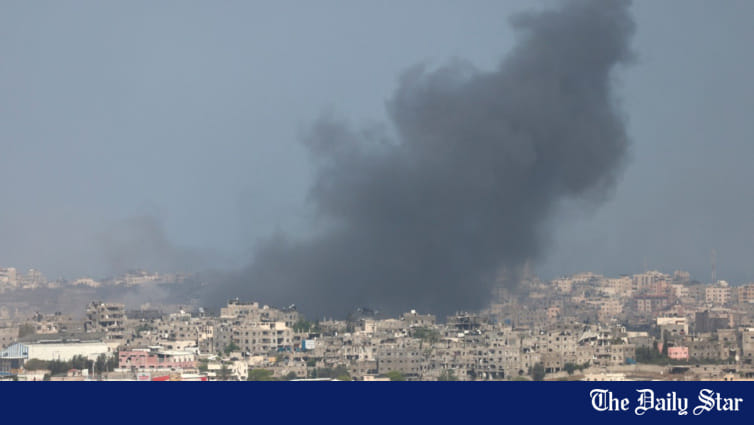
The stranglehold on aid reaching Gaza threatens an "apocalyptic" outcome, the UN's humanitarian chief Martin Griffiths said yesterday as he warned of famine in the besieged territory.

"If fuel runs out, aid doesn't get to the people where they need it, that famine, which we have talked about for so long, and which is looming, will not be looming anymore. It will be present," Griffiths said.

"And I think our worry, as citizens of the international community, is that the consequence is going to be really, really hard. Hard, difficult, and apocalyptic," he told AFP on the sidelines of meetings with Qatari officials in Doha.

An Israeli incursion into the southern Gaza city of Rafah, launched in the face of international outcry, has deepened an already perilous humanitarian crisis in the Gaza Strip.

Griffith, the UN's Under-Secretary-General for Humanitarian Affairs and Emergency Relief Coordinator, said some 50 trucks of aid per day could reach the hardest-hit north of Gaza through the reopened Erez crossing.

But battles near the Rafah and Kerem Shalom crossings in Gaza's south meant the vital routes were "effectively blocked", he explained. "So aid getting in through land routes to the south and for Rafah, and the people dislodged by Rafah is almost nil," Griffiths added.

The UN said that 800,000 people had been "forced to flee" Israel's assault in Rafah. With fuel, food and medicine running out, Griffiths said the military action in Rafah was "exactly what we feared it would be".

"And we all said that very clearly, that a Rafah operation is a disaster in humanitarian terms, a disaster for the people already displaced to Rafah. This is now their fourth or fifth displacement," he said.​
 
Analyze

Analyze Post

Add your ideas here:
Highlight Cite Fact Check Respond
I fail to see how Bangladesh can bring peace to the Palestinian-Israeli conflict.

Two State Solution is the answer to the conflict.
 
Analyze

Analyze Post

Add your ideas here:
Highlight Cite Fact Check Respond

Members Online

No members online now.
⤵︎

Latest Posts