Bangladesh Defense
Saif
Senior Member
- Joined
- Jan 24, 2024
- Messages
- 21,366
- Likes
- 9,715
- Nation

- Residence
- Axis Group

Future of AI-driven digital currency in Bangladesh
The speech by Brett King, futurist and author of the bestselling book Bank 4.0, at Bankers Meet in Dhaka recently, organised by Filps in association with City Bank, Prime Bank, and AB Bank, has deeply inspired me to explore the future of AI-driven financial technology. His insights sparked a partic
Future of AI-driven digital currency in Bangladesh
The speech by Brett King, futurist and author of the bestselling book Bank 4.0, at Bankers Meet in Dhaka recently, organised by Filps in association with City Bank, Prime Bank, and AB Bank, has deeply inspired me to explore the future of AI-driven financial technology. His insights sparked a particular interest in digital currencies, specially Central Bank Digital Currency (CBDC) and Stablecoin, and their potential impact on the future of financial landscape in Bangladesh.
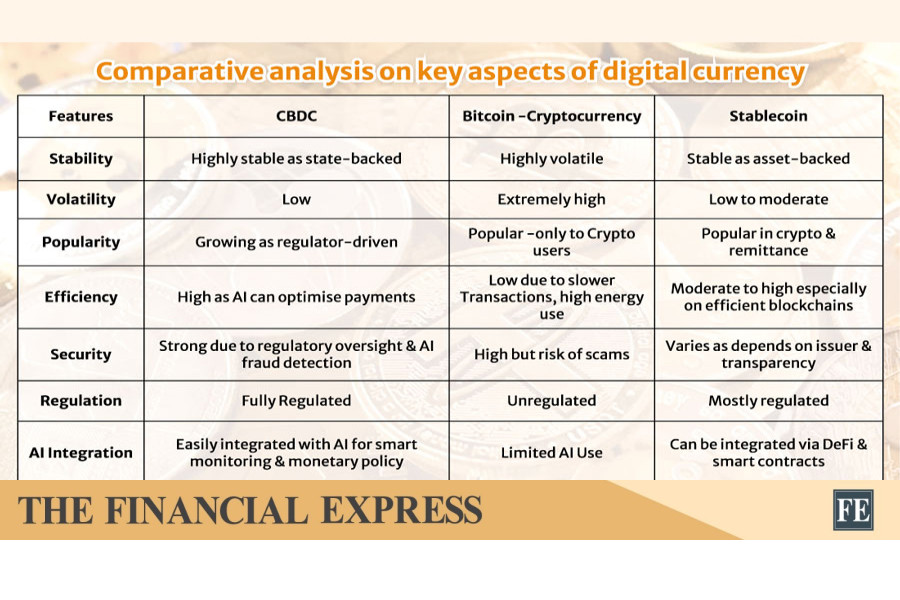
As financial technology evolves at a quicker pace and the integration of artificial intelligence (AI) into currency systems is reshaping how societies/people use & manage money. One of the most significant transformations lies in how money is created, managed, and used. In this context, CBDC, Bitcoin, and Stablecoin will be shaping the future of money each with different features, strengths, and limitations. The race towards cited digital currencies has raised critical questions about stability, volatility, usability, popularity, efficiency, and security.
In Bangladesh, financial inclusion, digital infrastructure, and economic digitalisation adoption are critical. The choice of digital currency especially in an AI-integrated system can redefine the future of financial landscape. The decision on which digital currency model to adopt is really crucial for ensuring long-term economic stability, financial inclusion, and growth.
Understanding the key players in digital currency: Stablecoin. The Hot Topic in the Evolving Digital Economy: Stablecoin is a crypto currency attached with a stable asset like US Dollar or Gold. The most popular example includes USDT (Tether) and USDC. It aims to combine the benefits of digital currency with price stability removing volatility.
CBDC (Central Bank Digital Currency). This is a digital version of country’s national currency issued and regulated by central bank. It retains the full backing and authority of the government. In our country, Bangladesh Bank is currently exploring the feasibility of a Digital Taka.
Crypto currency – Bitcoin. Bitcoin is the pioneer of crypto currency which is decentralised, highly volatile, and operates without a central authority or regulator. It operates on blockchain technology and market dynamics.
The role of AI: AI can easily detect abnormal patterns in CBDC transactions in real time and improves the trust in the system. It is an advantage of CBDC over decentralised crypto currencies. AI-enabled CBDC can also respond to macroeconomic conditions faster than traditional monetary tools. In contrast, Bitcoin operates outside of any policy control. Stablecoins is powered by AI algorithms and can optimize routing of international transfers, offering a faster and cheaper alternative to SWIFT or remittance services like Western Union, Ria, etc.
Choice for Bangladesh: Bangladesh has been digitising economy rapidly, with increasing mobile banking usage (MFS like bKash, Nagad, OK Wallet, MeghnaPay or any other mobile banking app), a large unbanked population, and significant remittance flows from abroad.
From infrastructural context, AI integration in banking is still in its beginning stage in Bangladesh, but rapid progress in fintech adoption will open doors for state-backed AI-integrated CBDC. From regulatory environment perspective, the central bank of Bangladesh has been cautious towards crypto currencies like Bitcoin due to volatility and AML (Anti-Money Laundering) concerns. However, our central bank has shown openness towards exploring CBDC - Digital Taka.
CBDC- Digital Taka is likely to be the most viable and dominant form of digital currency for domestic transactions in Bangladesh due to its regulatory support, stability, and compatibility with national monetary policy.
Stablecoin may become prominent in cross-border transactions, offering lower remittance costs and faster processing; provided regulatory clarity improves or the central bank launches a state-backed stablecoin tied to Taka or USD.
Bitcoin and other crypto currencies will remain restricted due to their volatility, speculative nature, and concerns over AML (Anti-Money Laundering) compliance.
While Bitcoin brought blockchain into the mainstream, its lack of regulatory control and extreme volatility make it unsuitable for broad use in Bangladesh. In contrast, Stablecoin and CBDC powered by AI offer stability, efficiency, security, inclusiveness, governmental control and regulatory ease. This transformation in Bangladesh will be fully based on government decision for the adoption of CBDC and Stablecoin.
Strategic investment in digital infrastructure, regulatory frameworks, pilot programs for Digital Taka, cross-border stablecoin settlements, and AI talent development will be the key factors for banking sector in Bangladesh to get full benefit from this AI-financial revolution. If implemented wisely, an AI-integrated Digital Taka may revolutionise the country’s financial ecosystem, advancing transparency, inclusion, and efficiency across the board.
The writer is SVP & Head of Digital Channels, Prime Bank PLC.
The speech by Brett King, futurist and author of the bestselling book Bank 4.0, at Bankers Meet in Dhaka recently, organised by Filps in association with City Bank, Prime Bank, and AB Bank, has deeply inspired me to explore the future of AI-driven financial technology. His insights sparked a particular interest in digital currencies, specially Central Bank Digital Currency (CBDC) and Stablecoin, and their potential impact on the future of financial landscape in Bangladesh.
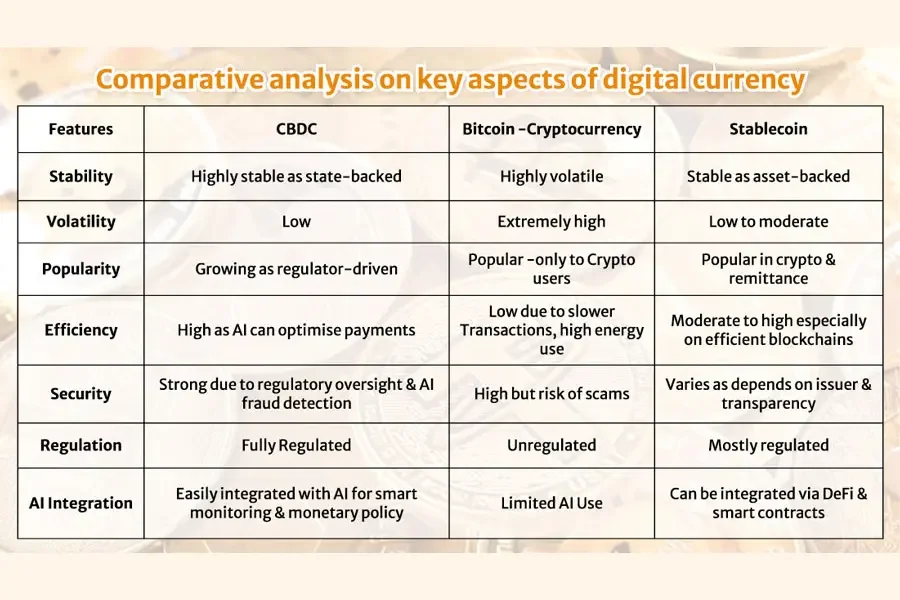
As financial technology evolves at a quicker pace and the integration of artificial intelligence (AI) into currency systems is reshaping how societies/people use & manage money. One of the most significant transformations lies in how money is created, managed, and used. In this context, CBDC, Bitcoin, and Stablecoin will be shaping the future of money each with different features, strengths, and limitations. The race towards cited digital currencies has raised critical questions about stability, volatility, usability, popularity, efficiency, and security.
In Bangladesh, financial inclusion, digital infrastructure, and economic digitalisation adoption are critical. The choice of digital currency especially in an AI-integrated system can redefine the future of financial landscape. The decision on which digital currency model to adopt is really crucial for ensuring long-term economic stability, financial inclusion, and growth.
Understanding the key players in digital currency: Stablecoin. The Hot Topic in the Evolving Digital Economy: Stablecoin is a crypto currency attached with a stable asset like US Dollar or Gold. The most popular example includes USDT (Tether) and USDC. It aims to combine the benefits of digital currency with price stability removing volatility.
CBDC (Central Bank Digital Currency). This is a digital version of country’s national currency issued and regulated by central bank. It retains the full backing and authority of the government. In our country, Bangladesh Bank is currently exploring the feasibility of a Digital Taka.
Crypto currency – Bitcoin. Bitcoin is the pioneer of crypto currency which is decentralised, highly volatile, and operates without a central authority or regulator. It operates on blockchain technology and market dynamics.
The role of AI: AI can easily detect abnormal patterns in CBDC transactions in real time and improves the trust in the system. It is an advantage of CBDC over decentralised crypto currencies. AI-enabled CBDC can also respond to macroeconomic conditions faster than traditional monetary tools. In contrast, Bitcoin operates outside of any policy control. Stablecoins is powered by AI algorithms and can optimize routing of international transfers, offering a faster and cheaper alternative to SWIFT or remittance services like Western Union, Ria, etc.
Choice for Bangladesh: Bangladesh has been digitising economy rapidly, with increasing mobile banking usage (MFS like bKash, Nagad, OK Wallet, MeghnaPay or any other mobile banking app), a large unbanked population, and significant remittance flows from abroad.
From infrastructural context, AI integration in banking is still in its beginning stage in Bangladesh, but rapid progress in fintech adoption will open doors for state-backed AI-integrated CBDC. From regulatory environment perspective, the central bank of Bangladesh has been cautious towards crypto currencies like Bitcoin due to volatility and AML (Anti-Money Laundering) concerns. However, our central bank has shown openness towards exploring CBDC - Digital Taka.
CBDC- Digital Taka is likely to be the most viable and dominant form of digital currency for domestic transactions in Bangladesh due to its regulatory support, stability, and compatibility with national monetary policy.
Stablecoin may become prominent in cross-border transactions, offering lower remittance costs and faster processing; provided regulatory clarity improves or the central bank launches a state-backed stablecoin tied to Taka or USD.
Bitcoin and other crypto currencies will remain restricted due to their volatility, speculative nature, and concerns over AML (Anti-Money Laundering) compliance.
While Bitcoin brought blockchain into the mainstream, its lack of regulatory control and extreme volatility make it unsuitable for broad use in Bangladesh. In contrast, Stablecoin and CBDC powered by AI offer stability, efficiency, security, inclusiveness, governmental control and regulatory ease. This transformation in Bangladesh will be fully based on government decision for the adoption of CBDC and Stablecoin.
Strategic investment in digital infrastructure, regulatory frameworks, pilot programs for Digital Taka, cross-border stablecoin settlements, and AI talent development will be the key factors for banking sector in Bangladesh to get full benefit from this AI-financial revolution. If implemented wisely, an AI-integrated Digital Taka may revolutionise the country’s financial ecosystem, advancing transparency, inclusion, and efficiency across the board.
The writer is SVP & Head of Digital Channels, Prime Bank PLC.