Bangladesh Defense
Saif
Senior Member
- Jan 24, 2024
- 21,680
- 9,794
- Nation

- Residence
- Axis Group

Take stern action to protect our environment
Ineffectiveness of government measures raises concerns
Take stern action to protect our environment
Ineffectiveness of government measures raises concerns

VISUAL: STAR
It is frustrating to see the relentless onslaught on our nature even now. Indiscriminate hill cutting, deforestation, encroachment of water bodies including riverside areas, illegal sand lifting, and rampant tree felling—all are happening as before with the relevant authorities failing to prevent them. Almost every day, we see news of some environmental degradation somewhere in the country. The continuation of this situation even after the fall of the Awami League government and the installation of a pro-environment leadership is alarming.
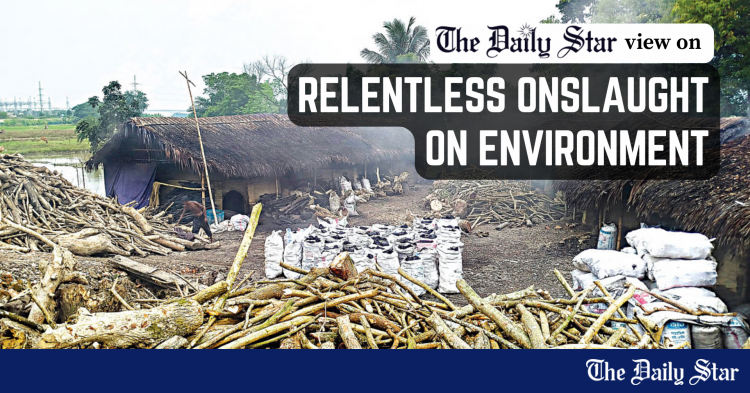
For example, a photo published on the front page of this daily on October 17 revealed one such incident, which showed a hill being cut to make way for housing at Tukerbajar union in Sylhet Sadar. Reportedly, at least six hills have been cut in the area recently. What's more alarming is that, despite locals' complaints, neither the Department of Environment nor the district administration took any action to halt this destruction. The front page of our October 18 issue again published a photo showing how illegally sourced logs were being burnt inside makeshift furnaces in Khulna's Rupsha upazila, leading to environmental pollution. Another report published on October 17 reveals illegal sand extraction at the Raghunandan Hill Reserve Forest in Habiganj. While hill-cutting is directly linked with landslides, sand extraction exacerbates soil erosion and increases landslide risks.
The question is, how can individuals destroy hills, illegally extract sand or fell trees right under the administration's nose? Over the years, this daily has published numerous reports exposing such illegal practices and written countless editorials urging the authorities to take action against those involved. Yet, nothing seems to stir their conscience. Earlier this year, we witnessed local influentials ravaging a hill in Chinipara of Bandarban's Chimbuk area to build a road to transport illegally felled trees. More recently, local influentials cut off the top of Nagin Pahar, a hill in Chattogram, for residential construction. And just the other day, reports emerged about the Water Development Board felling 50,000 trees to collect soil for an embankment in Khulna's Koyra upazila.
Sadly, in all these instances, local administrations either remained silent or were themselves complicit. We know how individuals connected with the previous regime directly engaged in anti-environment acts, but to see this practice persist after regime change questions the sincerity of the present administration. Reportedly, in many cases, AL-affiliated individuals have been replaced by BNP-affiliated ones. We urge our environment adviser to investigate these matters and take stern action against anyone involved in activities detrimental to the environment. We have ample laws for environmental protection; it is time to put them to proper use.
Ineffectiveness of government measures raises concerns
VISUAL: STAR
It is frustrating to see the relentless onslaught on our nature even now. Indiscriminate hill cutting, deforestation, encroachment of water bodies including riverside areas, illegal sand lifting, and rampant tree felling—all are happening as before with the relevant authorities failing to prevent them. Almost every day, we see news of some environmental degradation somewhere in the country. The continuation of this situation even after the fall of the Awami League government and the installation of a pro-environment leadership is alarming.
For example, a photo published on the front page of this daily on October 17 revealed one such incident, which showed a hill being cut to make way for housing at Tukerbajar union in Sylhet Sadar. Reportedly, at least six hills have been cut in the area recently. What's more alarming is that, despite locals' complaints, neither the Department of Environment nor the district administration took any action to halt this destruction. The front page of our October 18 issue again published a photo showing how illegally sourced logs were being burnt inside makeshift furnaces in Khulna's Rupsha upazila, leading to environmental pollution. Another report published on October 17 reveals illegal sand extraction at the Raghunandan Hill Reserve Forest in Habiganj. While hill-cutting is directly linked with landslides, sand extraction exacerbates soil erosion and increases landslide risks.
The question is, how can individuals destroy hills, illegally extract sand or fell trees right under the administration's nose? Over the years, this daily has published numerous reports exposing such illegal practices and written countless editorials urging the authorities to take action against those involved. Yet, nothing seems to stir their conscience. Earlier this year, we witnessed local influentials ravaging a hill in Chinipara of Bandarban's Chimbuk area to build a road to transport illegally felled trees. More recently, local influentials cut off the top of Nagin Pahar, a hill in Chattogram, for residential construction. And just the other day, reports emerged about the Water Development Board felling 50,000 trees to collect soil for an embankment in Khulna's Koyra upazila.
Sadly, in all these instances, local administrations either remained silent or were themselves complicit. We know how individuals connected with the previous regime directly engaged in anti-environment acts, but to see this practice persist after regime change questions the sincerity of the present administration. Reportedly, in many cases, AL-affiliated individuals have been replaced by BNP-affiliated ones. We urge our environment adviser to investigate these matters and take stern action against anyone involved in activities detrimental to the environment. We have ample laws for environmental protection; it is time to put them to proper use.