[🇧🇩] Monitoring Bangladesh's Economy

[🇧🇩] Monitoring Bangladesh's Economy
1K
36K
More threads by Saif

G Bangladesh Defense

Should we keep running after IMF for loans, asks finance minister

Special Correspondent
Dhaka
Published: 21 May 2026, 21: 36

View attachment 26892

Finance Minister Amir Khasru Mahmud Chowdhury speaks as the chief guest at a roundtable discussion organised by Prothom Alo at the Pan Pacific Sonargaon Dhaka on 21 May 2026. Prothom Alo

Finance and Planning Minister Amir Khasru Mahmud Chowdhury has said the country can no longer be run the way it was running in the past, arguing that the financing structure has changed.

“Should we keep running after the International Monetary Fund (IMF) for loans at one to two per cent interest? Or should we create a fund tomorrow morning and channel it into our own market? If I can earn good returns on investment, why should I wait to see who will give me money, when they will give it, and under what conditions? Why do I even need that?” he asked.

The finance minister made the remarks today, Thursday, while speaking as the chief guest at a roundtable discussion titled ‘Budget in Times of Crisis and Public Expectations’, organised by Prothom Alo at the Pan Pacific Sonargaon Dhaka. Prothom Alo Editor Matiur Rahman delivered the welcome speech at the roundtable.

Among others, PPRC Chairperson Hossain Zillur Rahman, Distinguished Fellow of the Centre for Policy Dialogue (CPD) Debapriya Bhattacharya, BRAC Institute of Governance and Development Professorial Fellow Selim Jahan, Transcom Group CEO Simeen Rahman, HSBC Bangladesh CEO Mahbub ur Rahman, Policy Exchange Chairman Masrur Reaz, TK Group Director Mohammad Mustafa Haider, BKMEA President Mohammad Hatem, Moulvibazar Traders’ Association General Secretary Golam Mowla, and Bangladesh Restaurant Owners Association Secretary General Imran Hassan addressed the roundtable, moderated by Prothom Alo Head of Online Shawkat Hossain.

The finance minister said, “We want to move away from the oligarchic economy. So that, every citizen has equal access to opportunities, meaning the economy is participatory and that its benefits reach everyone. Democratisation of the economy is our philosophy.”

He said a large segment of the creative economy remains outside the tax net. Blacksmiths, potters, weavers and many other traditional workers in rural areas have never been brought under the scope of the budget.

“Generation after generation, they have continued working, but their lives have not improved. These people will be brought under financial and technical support programmes. There will be a fund for them in the budget. They survive hand to mouth, but their products are lacking value addition,” he said.

The finance minister also said cultural groups, including theatre organisations, had never been included in the budget. “We will develop theatres in Dhaka and other major cities. We will create theatre districts. We have failed to progress because we did not do these things. We lack soft power, whereas films, music and other cultural products from neighbouring countries are reaching audiences around the world,” he said.

Citing an example, the finance minister said, “A person from the hill tracts came to me for another purpose. He said he also paints. I asked him to bring some of his work one day. He did. The paintings were beautiful. When I asked the price, he said Tk 5,000. I looked at him and said, what are you saying!”

“Later, at Litu bhai’s request, an exhibition of his paintings was arranged. It was found that each painting sold for between Tk 50,000 and 100,000. These are GDP. His expenditure is GDP, what he sells is GDP, when he exports it that is GDP, even foreign exchange earnings. We are bringing such a large group of people into the budget. That is a feature of the budget,” he added.

Speaking on governance versus reform, the finance minister said, “It is a bit like the question of the chicken and the egg. However, we are moving towards comprehensive reform. It will no longer require 13 approvals to open a restaurant. Even if required, they will be issued from a single point within a fixed timeframe.”

“Referring to customs and the port authority, the finance minister said everything must move towards automation. We have seen that costs start rising from Chattogram port. You have to pay here, pay there, this fee, that charge- doing all this pushes prices up by 10 per cent. Our aim is to reduce the cost of doing business,” he said.

He also spoke about interest rates and the capacity of banks. He said banks can provide working capital loans and loans for purchasing vehicles and houses. Yet they are giving project loans worth Tk 20 billion. If one bank cannot manage, even four banks come together to provide it. These are inefficiencies.

His question was, why should the government fund everything? Why should the government bear the cost of purchasing 12 aircraft for Biman Bangladesh Airlines? Biman is an enterprise. It can raise funds from the capital market.

For large-scale financing, the finance minister advised turning to the capital market. He said that instead of taking loans worth Tk 20 billion from banks at high interest rates, the better option would be to raise funds from the capital market. “Has the capital market collapsed, then? We will make this market effective very quickly,” he said.

He added that borrowing from the capital market does not require paying interest until profits are generated. “Once profits are made, dividends are paid. There is also the bond market. Loans can also be taken from the bond market at seven, eight or nine per cent interest. This is how we will reduce the cost of doing business.”

He also referred to bureaucratic costs, saying these would be eliminated. “If everything goes online, costs will fall further. We will introduce ‘one citizen, one card, one wallet’,” he said.

Describing the tobacco sector as a major source of revenue, the finance minister added, “There is massive theft here. The word may sound harsh. Let’s call it evasion. Whether we call it evasion or theft, multinational companies are paying taxes here, but local companies are paying less. Some are not paying at all. A black market has developed here. Stealing here means becoming rich overnight.”

The finance minister said that in the beverage sector, Coca-Cola and Pepsi pay taxes, but there are many others with significant market share. He said instructions have been given to identify who is not paying taxes in this sector like those in the tobacco sector, as those who do pay taxes are facing unfair competition.

“We are catching them one by one,” the finance minister commented, adding, “We are finalising the tax policy. This is a major problem. Everyone is talking about everything, but no one is talking about tax policy. We have to start making a new cake. That is why I did not allow the previous bill to be passed.”

“I want the people of Bangladesh to understand the tax policy, to understand the DNA of Bangladesh. One must understand industry, trade, customs and the global situation. It cannot be a tax policy that simply says take this much from this sector, take this much from that sector,” he continued.

He also said, “We need a tax policy in which people will want to pay taxes, and after paying taxes, they will feel they are taxpayers. I have been talking about a two-year period. Please be patient and wait for this time. Within this period, the economy will recover. This country will become a welfare state.”

“There is no point in focusing only on the history of how much growth has been achieved. What matters is what ordinary people have gained. There will be growth, but if ordinary people’s lives do not change, it is of no use. I know this is a challenge for us,” he added.

Referring to the political goodwill of the prime minister, the finance minister said, “We are able to work because there is political goodwill. Now everyone is working because results are emerging. Even bureaucrats are working seven days a week. They are seeing that something good is happening. There are many obstacles. Some things will be included in this budget. But we will complete the work within six months.”​

Amir Khasru is apparently India agent per Pinaki in multiple mentions in his videos. Don't know for sure.
 
Amir Khasru is apparently India agent per Pinaki in multiple mentions in his videos. Don't know for sure.
Khosru is an Indian stooge and everybody in the political arena of Bangladesh is aware of it. Why has Tareque appointed him as the finance minister is beyond me.
 

Strong loan recoveries drive Bangladesh Finance back to profitability

FE REPORT

Published :
May 25, 2026 09:41
Updated :
May 25, 2026 09:41

1779680650576.webp


Bangladesh Finance made a significant turnaround by securing a profit of Tk 225 million in 2025 from one of the highest losses - Tk 7.83 billion - in the country's non-bank financial institution (NBFI) sector a year earlier.

The achievement was mainly driven by strong recoveries from stressed loans, said Md. Kyser Hamid, managing director and CEO of the company.

The company recovered around Tk 1.77 billion in 2025 from stressed loans, he said, adding that loan rescheduling and lower provisions also contributed to the latest financial performance.

A year ago, Bangladesh Finance set aside money to maintain full provisions against defaulted loans and even stressed loans.

"Usually, provision is kept only for non-performing loans, but we allocated additional interest suspense and provisions against stressed loans in the past two years."

If any client fails to pay loan instalments for more than three consecutive months, their account gets suspended and the pending interest is not shown as income.

Bangladesh Finance kept provisions against investments of Tk 1.66 billion in 2023 and Tk 8.36 billion in 2024.

The CEO said the management had set aside more than what was necessary as interest suspense and kept higher provisions than required in 2023 and 2024, considering that the company might have to bear further financial shocks in the future.

These measures were taken to mitigate unforeseen credit risks, address potential losses early, prevent further deterioration and defaults, ensure adequate reserves, and safeguard overall financial health, he said.

With such precautionary measures already in place, aggressive efforts in 2025 to recover and reschedule defaulted loans enabled the company to reverse a substantial amount of provisions previously maintained.

Echoing Mr Hamid, Md. Sajjadur Rahman Bhuiyan, group chief financial officer, explained that after facing heavy provisioning in FY24, the company strategically focused on recovery in FY25.

"By deploying management to accelerate settlements and rescheduling major corporate loans, we successfully released substantial provisions, ultimately driving the company back to profitability."

Bangladesh Finance booked a provision write-back of Tk 2.13 billion, a dramatic reversal from the Tk 7.85 billion provision recorded in 2024, according to its auditor's opinion published on Sunday.

"The write-back significantly boosted the company's bottom line and marked a major improvement in asset quality management," said the auditor.

Mr Hamid said continued recovery initiatives, disciplined risk management and supportive regulatory policies were expected to further improve the company's financial health and support sustainable long-term growth.

However, the auditor warned that Bangladesh Finance still faces serious financial vulnerabilities.

It pointed out that the company continued to operate with negative consolidated equity of Tk 5.47 billion as of December 2025.

The auditor noted that the financial statements had nevertheless been prepared on a going concern basis after the management provided justification that the company would be able to continue operations in the foreseeable future.

Bangladesh Finance said its management conducted a detailed assessment in line with Bangladesh Bank guidelines and International Accounting Standard (IAS) 1 to evaluate whether the company could continue as a going concern.

The assessment considered financial performance, liquidity conditions, asset quality and capital structure.

According to the company, its board believes the institution has adequate resources and recovery plans in place to continue operations despite the negative capital position.

The company also highlighted a sharp improvement in its provision coverage ratio, which rose to 496.96 per cent at the end of 2025, indicating a strong cushion against potential future credit losses.

Capital adequacy indicators also improved during the year, although they remained below regulatory requirements.

The standalone capital adequacy ratio improved to negative 31.84 per cent from negative 33.81 per cent a year earlier, while the consolidated capital adequacy ratio stood at negative 24.29 per cent.

Meanwhile, net asset value per share also showed signs of recovery. Consolidated NAV per share improved to negative Tk 28.85 in 2025 from negative Tk 30.05 in the previous year.

To restore financial stability, the company has prepared a long-term capital management plan along with a seven-year financial projection and a liquidity management strategy aimed at rebuilding capital strength and improving liquidity conditions, said the auditor.

The management acknowledged that confidence in the financial sector remains weak but said ongoing restructuring initiatives and expected regulatory support would help stabilise the company further.

The auditor also confirmed that subsidiaries - Bangladesh Finance Securities and Bangladesh Finance Capital - received unmodified audit opinions for 2025.

Recovery continues in Q1, 2026

Bangladesh Finance sustained its recovery momentum in the first quarter of 2026, posting a 120 per cent year-on-year increase in consolidated profit to Tk 20.71 million.

The company said the performance in the January-March period resulted from capital gains from investments in securities and further reversal of provisions maintained against loans, leases and investments.

It has sustained its recovery at a time when the sector overall has been under pressure from rising non-performing loans, liquidity stress and weakening depositor confidence over the past several years.​
 

ADB offers $5.0b in dev aid

Also announces 20pc-higher annual funding for Bangladesh

FE Report

Published :
May 25, 2026 23:44
Updated :
May 25, 2026 23:44

1779761215793.webp


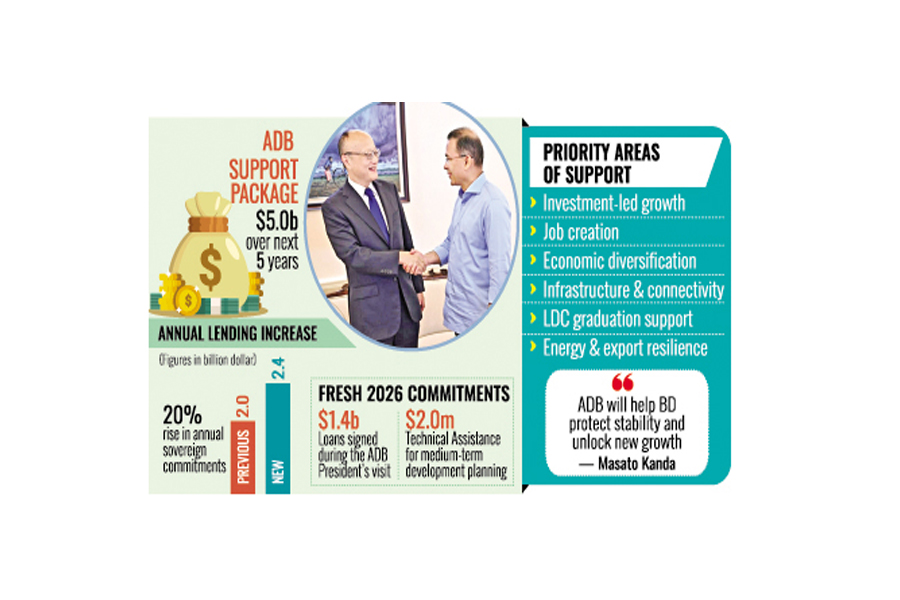
An incremental assistance package announced by the Asian Development Bank (ADB) would fetch Bangladesh US$5.0 billion over next five years and increase the subsequent annual aid by 20 per cent.

The announcement came Monday when ADB President Masato Kanda met Prime Minister Tarique Rahman in Dhaka discussing Bangladesh's development priorities.

Such a bounteous financing commitment comes while the release of remaining sums from an as-much IMF lending package for the country stalls under conditions the new government feels unpalatable in the current context.

The Integrated Growth Network Development Initiative presented by Mr. Kanda during his visit is designed to expand investment, create jobs, improve connectivity, and promote more balanced regional growth.

"The five-year package is expected to amount to about $1.0 billion a year and will be strategically integrated into ADB's enhanced annual sovereign commitment envelope for Bangladesh," the ADB Dhaka office says in a statement.

And the Manila-based development financier plans to increase its annual sovereign commitments for Bangladesh by 20 per cent from about $2.0 billion to about $2.4 billion annually over the medium term.

The higher annual envelope is hoped to support Bangladesh's development priorities, including investment-led growth, job creation, economic diversification, stronger governance, and a smooth transition from least-developed country (LDC) status.

The ADB president says: "Bangladesh is entering a critical new phase. ADB will help the country protect hard-won stability, unlock new sources of growth, and build a more diversified and resilient economy that delivers better jobs and wider opportunity."

Marking Masato Kanda's visit, the ADB signed about $1.4 billion in loans as part of the 2026 annual-commitment programme.

The Asian Bank support is scaled up by $250 million to help in financing gaps linked to the economic impact of the Middle East conflict, which is adding pressure to Bangladesh's economy by way of driving up the cost of fuels, liquefied natural gas, fertilisers, and shipping.

These strains come as inflation remains high and the banking sector remains under stress.

The ADB will work with the government and development partners to track the situation and bring in additional financing and private investment, and help Bangladesh build a more resilient economy through more diverse energy sources and exports, and stronger institutions.

Also will it provide $2.0 million in technical assistance to support the preparation and implementation of Bangladesh's medium-term development framework and align ADB's forthcoming country-partnership strategy with government priorities.

Mr. Kanda also met Finance and Planning Minister Amir Khosru Mahmud Chowdhury, with discussions focused on Bangladesh's reform agenda, macroeconomic pressures, external- financing needs, and ADB's support for government's growth and resilience priorities.

The ADB chief met with key private-sector leaders discussing the opportunities and constraints shaping investment.

Also, the Bank is working with the government to mobilise additional private capital by deepening capital markets, preparing bankable projects, and attracting cofinancing and private investment.

The ADB is a leading multilateral development bank supporting sustainable, inclusive, and resilient growth across Asia and the Pacific.

Working with its members and partners to solve complex challenges together, the Asian Bank harnesses innovative financial tools and strategic partnerships to transform lives, build quality infrastructure, and safeguard the planet.​
 

IMF confirms Bangladesh govt's request for new programme

UNB

Published :
May 27, 2026 17:18
Updated :
May 27, 2026 20:52

1779931973398.webp


The International Monetary Fund (IMF) has said that the Bangladesh government has requested a new IMF-supported programme as discussions continue over the country’s reform agenda and policy priorities.

In a statement, IMF Mission Chief for Bangladesh Ivo Krznar said the IMF staff are currently engaged in talks with the Bangladeshi authorities regarding the proposed programme.

“The Bangladeshi authorities have requested a new IMF-supported programme. IMF staff are in discussions with the authorities on their reform agenda and policy priorities,” he said.

Krznar said the IMF remains committed to supporting Bangladesh in maintaining macroeconomic and financial stability amid ongoing economic challenges.

“The IMF remains a committed partner to Bangladesh in its efforts to secure lasting macroeconomic and financial stability, strengthen resilience, and support strong, inclusive growth,” he added.

The development comes as Bangladesh continues efforts to stabilise its economy through fiscal, monetary and structural reforms while addressing pressure on foreign exchange reserves, inflation and the financial sector.

Bangladesh has been implementing various reform measures under its existing IMF loan programme approved in 2023.​
 

Govt eyes $51b reserves in FY27

Experts urge balancing job creation, investments, reserve build-up

Rejaul Karim Byron

1780186663151.webp


The government expects the country’s gross foreign currency reserves to hit a record $51.4 billion by the end of next fiscal year, provided that remittance inflow is strong and interest rates high.

On September 1, 2021, strong remittance inflows and lower imports sent the country’s gross foreign reserves to $48.09 billion, which remains a record.

However, the figures are not as per the IMF’s balance of payments and investment position manual (BPM6), which is followed faithfully by central banks around the world.

Gross reserves are reserve assets, which consist of gold, cash dollar, bonds, and treasury bills, reserve position in the IMF, special drawing rights holdings -- which is a form of international money created by the IMF and defined as a weighted average of various convertible currencies.

The Bangladesh Bank’s gross reserves computation factors in other components such as the Export Development Fund, sovereign guarantees for flag carrier Biman Bangladesh Airlines, the below-investment-grade securities. Subsequently, the number ends up being markedly higher.

Even with that methodology, crossing the $51 billion-mark would be a tall order given the current economic situation, according to economists.

“For reserves to reach $51 billion, remittance inflows must remain strong and ongoing discussions with development partners on budget support must progress positively. The loans need to be secured,” said Mustafizur Rahman, distinguished fellow at the Centre for Policy Dialogue.

The key issue lies in whether the government prioritises propping up foreign currency reserves or encouraging investment and job creation. If it is the latter, imports will ramp up, and it would be difficult to top up reserves.

If the finance ministry projections assume investment will rebound, imports will rise and capital machinery imports will increase, then achieving such a sharp rise in reserves will be difficult, Mustafizur said.

In the first nine months of the fiscal year, imports grew 4.55 percent, while exports fell 4.38 percent. Remittance grew 19.5 percent in the first 10 months of the fiscal year.

“Even if reserves grow, without investment and job creation, the benefit to the economy remains questionable. Thus, reserves must be satisfactory, but investment must also grow. The strategy should be balanced.”

The government must take specific steps to boost investment, he added.

At the end of June last year, reserves stood at $31.77 billion. In the original budget for this fiscal year, the target was to raise reserves to $38.9 billion, but in the revised budget, this was lowered to $32.8 billion.

Gross reserves as per the BB methodology are higher than the revised budget target due to strong remittance growth, low import growth, and despite a stagnation in export receipts.

As of May 23, which is the latest available data, gross foreign reserves stood at $34.57 billion, but it is $29.91 billion as per the BPM6 methodology.

“Due to recent export growth, continuous increase in remittance inflows, exchange rate stability, and prevailing high interest rates, foreign currency reserves may gradually increase in the future,” said a budget projection report of the finance ministry.

However, risks remain.

If the ongoing Middle East crisis prolongs, the resulting energy security crisis could increase import costs, putting pressure on reserves, the report said.

The import growth target for fiscal 2026-27 has been set at 8.8 percent, export at 8 percent and remittance growth at 15 percent.

In the first nine months of the fiscal year, an average of 89,870 workers went abroad each month, compared to 85,340 workers a year earlier.

However, in February and March, overseas worker migration slowed somewhat. War-related situations may also pose challenges for remittance inflows.

The current encouraging remittance growth, improvements in the balance of payments, exchange rate stability, positive discussions with development partners, and continued budget support will boost reserves, said a finance ministry official on the condition of anonymity.

The latest discussions with the IMF are progressing positively.

The government and IMF have agreed to exit the old $5.5 billion programme and adopt a new programme worth $5-6 billion.

“This positive progress means that in the next fiscal year, Bangladesh could receive more than $1 billion in budget support from the IMF. Additionally, the World Bank, the Asian Development Bank, and other development partners may provide $2-3 billion in budget support,” the official said.

Although this will increase interest payment expenses and future debt burdens, it will directly contribute to reserve growth, he added.​
 

Govt gunning for 6.5pc growth next year

Rejaul Karim Byron


1780186812647.webp


The government is setting a high growth target for the next fiscal year, banking on the possibility of stability returning to the Middle East by June next year and the expansionary fiscal and monetary policies being pursued.

Even though GDP growth has been declining for three consecutive years, the government is targeting 6.5 percent growth for the next fiscal year, The Daily Star has learned from finance ministry officials involved with the proceedings.

This is much higher than the economic outlooks from the World Bank, the International Monetary Fund, and the Asian Development Bank, which projected Bangladesh’s GDP growth between 4 and 5 percent.

“The government always sets a high growth target, while development partners provide more conservative projections,” said a finance ministry official, adding that the BNP-led government has begun taking several measures after assuming office to boost growth.

To boost public investment to deliver the high GDP growth, the annual development programme for the next fiscal year will be increased by 50 percent to Tk 3 lakh crore.

On the other hand, to encourage private investment, policy interest rates will be reduced from July. Besides, the Bangladesh Bank has already announced a stimulus package of Tk 60,000 crore.

“The current economic situation in Bangladesh is stagflationary -- and under the current global conditions and with this pace of reform, 6.5 percent is pie in the sky, I would say,” said Zahid Hussain, a former lead economist of the World Bank’s Dhaka office.

Growth projections depend on improvements in key “choke points” in the economy: banks, ports, the National Board of Revenue, roads and markets.

“Whether ports function properly, whether extortion occurs in roads and markets -- all these things matter.”

Without reforms in policies and institutions, these choke points will not open.

“The knots must be untied first,” he said, adding that the solution is not more government spending or investment, but making institutions and policies investment-friendly.

For instance, as many as 35,000 factories are idle simply because there is no gas.

In such cases, higher spending cannot increase production.

“Therefore, instead of chasing targets, the question is whether we can do better than this year.”

Reforms are needed in areas like port functioning, banking and energy.

“Everything cannot be changed overnight. But there must be a roadmap -- what is being done, what will be done -- a clear plan. The journey is long, but progress must be visible. Without these, turning growth around -- even to 5 percent, let alone 6 percent -- will be difficult in the current context.”

If the Strait of Hormuz remains closed, the economy will be hit until the situation is resolved, he said.

Globally, commodity prices are rising due to supply constraints, while fiscal and monetary expansion will create demand.

“So how will inflation fall?”

Therefore, to meet the 7.5 percent target for the next fiscal year, productivity must increase significantly while maintaining the current policy stance.

“The current fiscal year’s inflation target of 7 percent is impossible to achieve. As of April, inflation was above 9 percent. How will it fall below 8 percent by June?”

Electricity price adjustments will add about 1 percentage point to inflation directly and indirectly in the next fiscal year.

“However, this does not mean the adjustment is wrong -- prices had to be raised. Directionally, inflation is expected to rise compared to the current fiscal year. If it falls by chance, that would be different.”

Inflation can only be brought down by maintaining a tight monetary policy stance -- that is, by not lowering policy rates -- and by fiscal consolidation, following a revenue-based expenditure policy, Hussain added.

On inflation control measures, the finance ministry said that due to Middle East instability, the current policy interest rate will be maintained until June.

However, from July, rates will gradually be reduced to encourage investment while controlling inflation.

Government spending will prioritise social and economic sector projects. During the cost-of-living crisis, targeted subsidies will be provided, along with ensuring a low-cost goods supply.

The Family and Farmers’ card programmes will be expanded, market monitoring and price control strengthened, and import duties on essential goods reduced.

These measures will bring inflation down to less than 8 percent for the first time in four years in fiscal 2026-27 and 6.5 percent in the following year.

The finance ministry maintains that moderate growth is achievable even this fiscal year due to the government’s business- and investment-friendly policies and regulatory measures led by its aim to build a trillion-dollar economy by 2034.

The government expects to surpass the $600 billion-mark in its third year. The current size of the economy is less than $500 billion.

Economic liberalisation, improvements in the ease of doing business, establishing discipline and good governance in the financial sector, increased food grain production, industrial growth, higher remittances and expanded import-export activities will power growth.

“It is expected that investor interest will increase under an elected government,” the finance ministry official said.​
 

Latest Posts

Back