[🇧🇩] BRICS---Can Developing Countries Including Bangladesh Benefit From It?

[🇧🇩] BRICS---Can Developing Countries Including Bangladesh Benefit From It?
38
3K
More threads by Saif

G Bangladesh Defense

RBI proposes linking BRICS digital currencies

FE ONLINE DESK
Published :
Jan 19, 2026 13:00
Updated :
Jan 19, 2026 13:00

1769301465680.webp


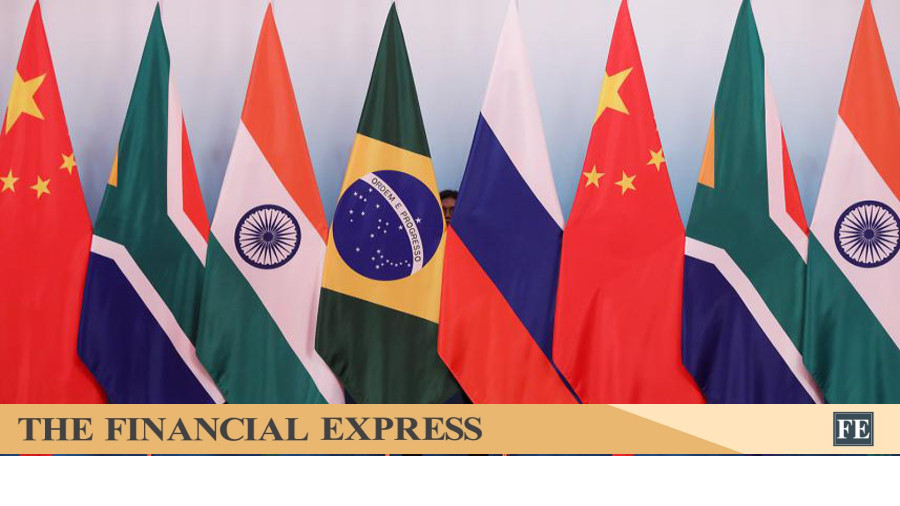
India's central bank has proposed that BRICS countries link their official digital currencies to make cross-border trade and tourism payments easier, two sources said, which could reduce reliance on the US dollar as geopolitical tensions rise.

The Reserve Bank of India (RBI) has recommended to the government that a proposal connecting the central bank digital currencies (CBDCs) be included on the agenda for the 2026 BRICS summit, the sources said. They requested anonymity because they were not authorised to speak publicly.

India will host the summit, which will be held later this year. If the recommendation is accepted, a proposal to link the digital currencies of BRICS members would be put forward for the first time. The BRICS organisation includes Brazil, Russia, India, China and South Africa, among others.

The initiative could irritate the US, which has warned against any moves to bypass the dollar, reports Reuters.

US President Donald Trump has previously said the BRICS alliance is "anti-American" and he threatened to impose tariffs on its members.

The RBI, India's central government and the central banks of China, Brazil, and Russia did not respond to emails seeking comment. The South African central bank declined to comment.

The RBI's proposal to link BRICS' CBDCs for cross-border trade finance and tourism has not been previously reported.

BUILDING BRIDGES

The RBI's proposal builds on a 2025 declaration at a BRICS summit in Rio de Janeiro, which pushed for interoperability between members' payment systems to make cross-border transactions more efficient.

The RBI has publicly expressed interest in linking India's digital rupee with other nations' CBDCs to expedite cross-border transactions and bolster its currency's global usage. It has, however, said its efforts to promote the rupee's global use are not aimed at promoting de-dollarisation.

While none of the BRICS members have fully launched their digital currencies, all five main members have been running pilot projects.

India's digital currency - called the e-rupee - has attracted a total of 7 million retail users since its launch in December 2022, while China has pledged to boost the international use of the digital yuan.

The RBI has encouraged the adoption of the e-rupee by enabling offline payments, providing programmability for government subsidy transfers and by allowing fintech firms to offer digital currency wallets.

For the BRICS digital currency linkages to be successful, elements like interoperable technology, governance rules and ways to settle imbalanced trade volumes would be among the discussion topics, one of the sources said.

The source cautioned that hesitation among members to adopt technological platforms from other countries could delay work on the proposal and concrete progress would require consensus on tech and regulation.

One idea that is being explored to manage potential trade imbalances is the use of bilateral foreign exchange swap arrangements between central banks, both the sources said.

Previous attempts by Russia and India to conduct more trade in their local currencies hit roadblocks. Russia accumulated large balances of the Indian rupee for which it found limited use, prompting India's central bank to permit the investment of such balances in local bonds.

Weekly or monthly settlements for transactions are being proposed to be made via the swaps, the second source said.

LONG ROAD

Founded in 2009 by Brazil, Russia, India and China, BRICS later expanded to include South Africa and has since broadened further, adding newer members like the United Arab Emirates, Iran and Indonesia.

The bloc has returned to the limelight thanks to Trump’s revived trade-war rhetoric and tariff threats, including warnings aimed at countries aligning with BRICS. At the same time, India has edged closer to Russia and China as it faced trade friction with the US

Past efforts to turn BRICS into a major economic counterweight have run into hurdles, including an ambition to create a common BRICS currency, an idea that was floated by Brazil but was subsequently nixed.

While interest in CBDCs has been dampened globally by rising stablecoin adoption, India continues to position its e-rupee as a safer, more regulated alternative.

CBDCs "do not pose many of the risks associated with stablecoins," RBI Deputy Governor T Rabi Sankar said last month.

"Beyond the facilitation of illicit payments and circumvention of control measures, stablecoins raise significant concerns for monetary stability, fiscal policy, banking intermediation and systemic resilience," Sankar said.

India fears widespread stablecoin use could fragment national payments and weaken its digital payments ecosystem, Reuters reported in September.​
 

Is BRICS losing glamour?

Mir Mostafizur Rahaman

Published :
May 19, 2026 02:13
Updated :
May 19, 2026 02:13

1779157652604.webp


The rise of BRICS (Brazil, Russia, India, China and South Africa) was once portrayed as the beginning of a post-western age. For much of the past two decades, the bloc symbolised the ambitions of emerging powers determined to reshape a global order long dominated by the United States and its allies. Economists predicted its collective rise with excitement.

Diplomats from the global south viewed it as an alternative centre of influence. Politicians spoke grandly about a multipolar world.

Today, however, the mood surrounding BRICS is markedly different.

The recent foreign ministers' meeting in New Delhi, which ended without a joint statement because of disagreements over the Iran-Israel conflict, has reinforced perceptions that the bloc is losing coherence and strategic direction. A grouping that once promised to challenge western dominance now appears divided even on issues directly affecting one of its own members.

To understand why BRICS now appears to be losing weight, it is necessary to revisit how the platform emerged -- and why so many once believed it could transform global politics.

The story of BRICS began not in diplomacy but in finance.

In 2001, economist Jim O'Neill of Goldman Sachs coined the term "BRIC" to describe four rapidly growing economies -- Brazil, Russia, India and China. His argument was straightforward: these countries possessed the demographic scale, economic potential and geopolitical importance to reshape the world economy during the 21st century.

The concept soon evolved from an economic label into a political platform.

In 2006, foreign ministers from the four countries held their first meeting on the sidelines of the United Nations General Assembly. By 2009, amid the global financial crisis that badly damaged confidence in western financial institutions, the first formal BRIC summit took place in Yekaterinburg, Russia.

The timing mattered. While the western financial system was shaken by crisis, many emerging economies appeared comparatively resilient. BRIC's message resonated across the developing world: global governance institutions no longer reflected contemporary realities and emerging powers deserved greater influence.

In 2010, South Africa joined the grouping, transforming BRIC into BRICS and giving the bloc representation from Africa as well. The inclusion carried symbolic importance. BRICS increasingly presented itself as a political voice for the global south.

Its ambitions expanded steadily.

The bloc demanded reforms to institutions such as the International Monetary Fund and the World Bank, arguing that voting structures unfairly favoured western powers. It criticised unilateral sanctions and western military interventions. It promoted the idea of a multipolar international order.

Then came perhaps its most concrete institutional achievement: the creation of the New Development Bank in 2014. Headquartered in Shanghai, the bank was designed as an alternative source of development financing for emerging economies.

At the same time, discussions intensified about reducing dependence on the US dollar. Some BRICS leaders floated proposals ranging from local currency trade settlements to a common reserve currency. Countries such as Bangladesh expressed interest in joining or engaging more closely with the bloc, believing BRICS represented the future centre of economic and political gravity.

For a while, the momentum appeared real.

The combined population of BRICS countries accounted for more than 40 per cent of humanity. China became the world's manufacturing hub. India emerged as a major technological power. Russia remained a formidable military actor. Brazil and South Africa projected regional influence.

Many analysts predicted that BRICS would gradually erode American dominance over global finance and diplomacy.

Yet beneath the rhetoric of unity, contradictions always existed.

BRICS was never a military alliance or an ideologically coherent bloc. Its members possessed vastly different political systems, strategic priorities and regional interests. China and India remained geopolitical rivals despite participating in the same platform. Russia's foreign policy increasingly revolved around confrontation with the west, while India simultaneously deepened security cooperation with Washington through the Quad. Brazil's priorities fluctuated with changes in domestic leadership.

These contradictions were manageable as long as BRICS functioned mainly as a platform for expressing dissatisfaction with western dominance. But global crises gradually exposed the limits of the grouping's unity.

The first major rupture came with the Ukraine war.

When Russia invaded Ukraine in 2022, Moscow expected diplomatic solidarity from fellow BRICS members. Instead, responses varied considerably. China offered strategic backing but avoided direct military alignment. India maintained close ties with Russia while strengthening relations with the United States and Europe. Brazil and South Africa attempted neutrality.

The bloc survived, but its internal divisions became increasingly visible.

Now the Iran-Israel conflict has deepened those fractures further.

The latest BRICS foreign ministers' meeting in New Delhi ended without consensus because of disagreements surrounding the Middle East crisis. Iran, one of the bloc's newer members, urged a united condemnation of the United States and Israel. Yet several members resisted adopting language that could damage their own strategic interests.

This was politically significant. A grouping that claims to represent solidarity among emerging powers could not formulate a collective position regarding military actions involving one of its own members.

The absence of Chinese Foreign Minister Wang Yi from the summit further fuelled perceptions of drift. Officially, he remained in Beijing because of the visit of Donald Trump. Symbolically, however, it reinforced the impression that BRICS no longer commands the same strategic urgency it once did.

Expansion may also have complicated the bloc's cohesion.

The admission of countries such as Iran, Egypt, Ethiopia and the United Arab Emirates broadened BRICS geographically and politically. Yet it also imported regional rivalries directly into the organisation. Iran and Gulf states possess sharply different security perspectives. India's priorities differ from China's. Russia's confrontation with the west is not universally shared.

As membership expands, consensus becomes harder.

Unlike the European Union or NATO, BRICS lacks strong institutional mechanisms capable of enforcing collective positions. It has no common security architecture, no binding treaty system and no unified strategic doctrine.

It is ultimately a coalition of convenience.

Yet declaring BRICS irrelevant would also be premature.

The dissatisfaction that fuelled its rise still exists across much of the global south. Many developing countries continue to view western-led institutions as unequal and unrepresentative. The wars in Ukraine and the Middle East have intensified accusations of double standards regarding international law and humanitarian principles.

BRICS still offers emerging powers diplomatic leverage and symbolic autonomy. It still reflects the broader transition from a unipolar to a more fragmented world order.

But the romantic vision of BRICS as a disciplined anti-western alliance now appears detached from reality.

The bloc's core problem is simple: opposing western dominance is easier than constructing a coherent alternative. Shared grievances do not automatically produce shared strategy.

The New Delhi meeting exposed that truth with unusual clarity. National interests prevailed over bloc solidarity. Strategic calculations trumped rhetoric about southern unity.

BRICS is unlikely to disappear. It will continue holding summits, expanding partnerships and demanding reforms to global governance. But unless it can reconcile the competing ambitions of its members and articulate a coherent collective agenda, its influence may gradually diminish.

The irony is striking. BRICS emerged during a moment of western uncertainty and rising optimism about emerging powers. Two decades later, the world is undeniably more multipolar - but also more fragmented and transactional.

In that harsher geopolitical environment, BRICS is discovering that symbolism alone cannot sustain strategic weight.

For now, the bloc remains influential enough to matter, but too divided to lead. And that is why the question echoing through global diplomacy today is no longer whether BRICS will reshape the world order.

It remains to be seen whether the world's most ambitious non-western coalition can avoid becoming merely another talking shop in an increasingly unstable world.​
 

Modi invites PM Tarique to attend BRICS Summit

Diplomatic Correspondent
Dhaka

1784849254198.webp

A collage photo shows Prime Minister Tarique Rahman and Indian Prime Minister Narendra Modi. BSS

Indian Prime Minister Narendra Modi has invited Prime Minister Tarique Rahman to attend the BRICS Summit, scheduled to be held in New Delhi on 12–13 September.

Speaking to journalists at her office on Thursday afternoon, State Minister for Foreign Affairs Shama Obaed Islam confirmed the development.

She said the invitation for the prime minister's visit to New Delhi had been received by the Ministry of Foreign Affairs from the Indian side. The invitation letter has already been forwarded to the Prime Minister's Office.

1784849290579.webp

State Minister for Foreign Affairs Shama Obaed Islam Ministry of Foreign Affairs

The 18th BRICS Summit will be held on 12 and 13 September. Although Bangladesh is not a member of the 11-member bloc, India has invited Bangladesh as a special guest.

The current BRICS members are Brazil, China, Egypt, Ethiopia, India, Indonesia, Iran, Russia, Saudi Arabia, South Africa and the United Arab Emirates.

Asked whether Bangladesh was concerned about the ongoing student movement in India, where many Bangladeshi nationals are currently residing, Shama Obaed said: "As a democratic state and a democratic government, Bangladesh wants peace and stability to be maintained in our region. As a democratic government and state, we hope that India, as the world's largest democracy, will pay attention to the concerns of its people and move quickly toward resolving the situation."​
 

BRICS leaders gather in New Delhi as wars and rivalries strain expanded bloc


1789106831800.webp

A worker installs a CCTV camera beside a BRICS summit banner bearing an image of Indian Prime Minister Narendra Modi in front of Bharat Mandapam, the venue for the summit, in New Delhi, India, Thursday, Sept. 10, 2026. Photo: AP

Leaders of the BRICS nations will meet in New Delhi this weekend as wars in Ukraine and the Middle East and U.S.-China tensions test the group’s ability to act together.

Host India will seek to balance its ties with China and Russia against its growing partnerships with the United States and other Western powers.

Russian President Vladimir Putin, Chinese President Xi Jinping and Iranian President Masoud Pezeshkian are among the leaders expected to attend.

BRICS is a grouping of major emerging markets and developing countries, named after an acronym for Brazil, Russia, India, China and South Africa. It has expanded from its original membership to include 11 countries that together represent about half the world’s population and a large share of its energy, resources and economic output. Experts say its growing size has also exposed divisions as its members want greater influence in the global order but often have competing political, economic and foreign-policy interests.

BRICS faces divisions over Iran and Ukraine

The conflicts in Iran and Ukraine are likely to highlight those divisions. Iran is a member of the expanded BRICS, while Russia remains one of its most influential members. China has close ties with both countries, while India maintains relations with Russia, Iran, the United States and Europe.

That diversity makes it difficult for BRICS to take a strong common position on major conflicts. The grouping includes countries with competing regional ambitions, including India and China, Iran and Saudi Arabia, and Egypt and Ethiopia, as well as other nations from the Global South.

“The Global South is not a homogeneous entity,” said Praveen Donthi, senior analyst with the International Crisis Group. “Hence, the grouping will find it hard to manage and mediate in these conflicts.”

Russia’s war in Ukraine has already exposed the limits of India’s ability to balance competing interests. New Delhi has maintained close ties with Moscow, including through energy and defense pacts, while also deepening its strategic relationship with Washington.

The South Asian nation has consistently called for dialogue and diplomacy rather than taking sides.

The Iran-U.S. conflict poses a similar challenge. BRICS members have differing ties with Washington and interests in the Middle East, making a unified response difficult. China and Russia have backed Iran in international forums, while India has taken a cautious approach. Saudi Arabia and the UAE have their own tensions with Tehran.

India sees BRICS as a way to engage China

For India, the summit is an opportunity to manage its relationship with China. Ties have improved since border tensions escalated in 2020, but China remains India’s largest strategic rival.

Chinese President Xi Jinping’s visit to New Delhi, his first in seven years, could help consolidate the recent diplomatic thaw but there are few signs of a recovery in trade and business ties.

“The upcoming summit offers India an opportunity to engage with China, make progress on outstanding bilateral issues,” Donthi said.

India also has an interest in preventing BRICS from becoming an explicitly anti-Western bloc.

New Delhi has strengthened ties with the United States, Israel, Japan, Australia and Europe while maintaining its longstanding relationship with Russia.

“India will project its strategic autonomy by being part of a non-West grouping but also finds it useful to engage with China, its primary strategic rival,” Donthi said.

The grouping wants less reliance on the dollar

Reducing dependence on the U.S. dollar is a major issue for BRICS. Members have discussed increasing trade in their own currencies and creating payment systems that would reduce their reliance on Western financial institutions.

The idea has gained momentum as countries such as Russia face sweeping Western sanctions. But replacing the dollar will be difficult, as it is deeply embedded in global trade and finance, while BRICS members have different currencies, financial systems and economic priorities.

Mahesh Sachdev, a retired Indian diplomat, said the goal should not be a direct confrontation with the dollar. Instead, he said, countries want to reduce their exposure to the current financial system that can be used for political pressure.

“It’s a challenge, but we’re not talking about frontal confrontations. It’s not a binary situation,” he said.

Its influence will depend on what it can deliver

BRICS’ growing membership also gives it considerable weight, but its influence will ultimately depend on whether the members can agree on practical steps.

The group has called for changes to global financial institutions, greater representation for developing countries and alternatives to Western-dominated systems. Yet its members often disagree on how to achieve those goals.

Sachdev BRICS needs “more cohesive attitude and better harmony” among its members.

“If it remains just a periodic talking shop and photo ops,” he said, “then its relevance erodes.”

Donthi said BRICS’ success could be measured in smaller steps. These include keeping the expanded group together, improving ties with China, and deepening trade and financial cooperation. The grouping could also show that it can give developing countries a platform without forcing them to choose between Western and non-Western blocs, he said.

“BRICS allows for incremental geopolitical gains, if not outright wins,” Donthi said.​
 

Can the BRICS bloc challenge Western dominance?


1789192351797.webp


After the US and Israel attacked BRICS member country Iran, it retaliated with attacks on another member of the alliance, the United Arab Emirates.

Now leaders from both countries are set to meet on Saturday.

This is the third time the bloc - originally composed of Brazil, Russia, India, China, and South Africa - will try to reach a consensus on a war that has sent international politics and the global economy into turmoil this year.

Al Jazeera's analysis says the ongoing war between the US and Iran has exposed divisions among BRICS nations. But India, the hosts of the conference, are attempting to bring the alliance to a new level.

Meanwhile, Tehran and Abu Dhabi find themselves on opposite sides of a war that has escalated in the past week.

The conference in New Delhi is to be held more than six months after the US and Israel launched attacks on Iran.

Iran and the UAE became members of the BRICS in 2024. The other members are Brazil, Russia, India, China, South Africa, Saudi Arabia, Egypt, Ethiopia and Indonesia.

This alliance of emerging countries was formed primarily to challenge the Western-led global order.

However, analysts say the alliance, which formed 20 years ago,, it is still struggling to set up a strong alternative to the Western powers.

BRICS has created a platform outside the Western-led institutions, which has given the countries of the Global South greater power and economic bargaining options.

Still, experts point to the monopoly of the dollar remaining in place and the difficulties posed by the differing stances of its members, which restrict its capacity on foreign policy and security.

But others say BRICS’s success should not be measured by whether it can stand as an alternative to the West, but whether it can make Western dominance more difficult.

“We tend to undermine any BRICS-led initiative as it is not the revolution we have expected,” Brazilian researchers Octavio Oliveira and Enzo Godinho at the University of Sao Paulo told Al Jazeera.

“Yes, it does not have the institutionality or the capacity of the UN to tackle specific geopolitical issues, but its mere existence is a much more important platform for Global South countries to express their voices and bypass the West in cooperation.”

Some analysts argue BRICS was not born to replace the Western world order, but to challenge the US-led power structure.

The emergence of BRICS was largely due to the 2008 financial crisis and the failure of the Doha round of the World Trade Organization (WTO) talks.

The Doha Round was a trade negotiation aimed at reforming the international trading system in the interests of the South.

Countries that were looked to become the next “developed countries” understood they would get a stronger voice if they could come together under a platform,” Oliveira and Godinho said.

These emerging powers wanted to exert more influence in Western institutions.

As such, unity among the bloc’s members is the most important thing, Sean Burgess, an associate professor of international relations at Carleton University in Canada, told Al Jazeera.

He says two things encourage BRICS nations to stay united – money through international trade and the ability to stop listening to “Western narratives” on their failures on rights and democracy.

Overthrowing the liberal world order is less important to BRICS nations than reforms and greater autonomy, analysts say.

“Why would the BRICS want to take on the global governance responsibilities of the G7 members?” Burgess asks.

The academic says that BRICS has provided its member countries with alternative trade and investment channels that serve their interests, particularly on national development and poverty alleviation.

“Chinese concentration on development assistance without conditionality and Brazilian discussions of direct central bank currency swaps are two of the most obvious examples.”

This has led to economic transactions increasing not only among BRICS members but also among countries in the Global South as a whole.

Guy Burton, a geopolitical and policy analyst says the concepts of BRICS and the West have changed dramatically since the group first formed. The bloc is now operating in a new global paradigm.

The idea of Westen unity “breaking down now, with the transatlantic relationship between the US and Europe fracturing – so it’s unclear what BRICS would even be challenging, or whom, America or Europe,” he told Al Jazeera.

Economic Strength, Collective Action Vulnerability

Analysts told Al Jazeera that while the bloc had great economic power, it had limited ability to use it collectively.

Strategist Imran Khalid, an analyst and senior fellow at Foreign Policy in Focus, said that BRICS countries account for about half of the world's population, 40 percent of global output in purchasing power parity terms, 44 percent of global oil production, and about a quarter of world trade.

Citing IMF data, he said that the economy of the 11-member alliance is growing at about 3.7 percent this year, compared to 1 percent for the G-7.

Despite the size of BRICS, the bloc’s influence is weak, he adds.

Analysts believe that the biggest limitation to the its ability to challenge Western economic powers is perhaps their structural dependence on the US dollar.

Oliveira and Godinho said, “Despite extensive rhetoric about de-dollarisation initiatives, the vast majority of BRICS trade is still denominated in US dollars, while most BRICS nations maintain significant dollar reserves, reflecting the dollar’s continued status as the world’s primary reserve currency and creating a structural dependency that limits the bloc’s policy independence.”

“The bloc as a whole is not moving off the dollar; individual members are reducing their own exposure, one relationship at a time,” said Khalid.

“That is slower, and it is also harder to reverse.”

Interests Divided

The ability to represent a large portion of the world is the greatest strength of BRICS. But this can also be the greatest weakness of the alliance as there are many differences of interest among the member states.

In May, the BRICS foreign ministers met in India. There, too, the alliance members could not reach any consensus on the US-Israeli war against Iran.

Khalid said, ““May’s foreign ministers’ meeting ended without a statement because Iran wanted American and Israeli actions named and the UAE would not agree to it.”

And yet, all the ceasefire initiatives in the conflict have come from the Global South instead of Washington, he noted.

Burton noted Iran’s uncomfortable position in the bloc, stating that while it had membership, the other members did not align itself with the country.

“There’s no ‘one for all, all for one’ logic in BRICS – members deliberately preserve their freedom to act independently, which is the opposite of a coordinated bloc.”

Burgess agrees, saying: “All of the members want a greater say, but they absolutely do not agree on the message.”

Can BRICS Challenge the Order?

Khalid told Al Jazeera that BRICS was more a platform for autonomy rather than a rival to the Western order.

Without a common currency, tariffs, or defence commitments, the bloc is not a strong geopolitical alliance in the conventional sense.

But it has set up an alternative to Western institutional funding and trade.

He says the alliance has also created an opportunity for the countries of the South to take a position according to their own interests in relation to Washington and Beijing.

The most important thing was the bloc could challenge “how cheaply the West can apply pressure to individual countries”, he said.​
 

The evolution of BRICS and its challenges today

Reuters, New Delhi

1789193674617.webp

Traffic passes in front of a floral arrangement with the BRICS Summit logo, ahead of the 18th BRICS Summit in New Delhi, India, September 11, 2026. Photo: Reuters

Leaders of the BRICS group of nations will meet on Saturday in the Indian capital of New Delhi for their annual summit, amid mounting geopolitical tension, disruptions in energy markets, shipping, and global trade.

Here is a look at the bloc's history, and the challenges it faces today.

WHAT IS BRICS?

The acronym BRIC was coined by Goldman Sachs ‌Chief Economist Jim O'Neill in 2001, in a research paper highlighting the growth potential of Brazil, Russia, India, and China, but it was not until 2009 that the countries came together as a bloc.

South Africa joined them in 2011, creating BRICS as it is known today.

The grouping expanded in 2024, when Egypt, Ethiopia, Iran and UAE became members, and in 2025, when Indonesia joined.

Saudi Arabia has also been invited to be part of the bloc but has not formally accepted the invitation.

WHY WAS IT FORMED?

BRICS ⁠was set up to challenge a world order dominated by the United States and its Western allies.

Together, its members account for more than 40% of the world's population and almost a quarter of the global economy.

The grouping today focuses on political and security cooperation, economic and financial cooperation, and people-to-people exchanges, according to the BRICS website set up by India during its presidency this year.

Members meet annually, with the chairmanship rotating among them.

WHAT HAS IT ACHIEVED?

BRICS' biggest achievement is the multilateral New Development Bank, established in 2015 to finance infrastructure and sustainable development projects in emerging markets.

The bank has approved 139 projects worth nearly $43 billion, according to its website, but suspended new transactions in Russia in the face of sanctions.

In addition, a BRICS Pay System is being set up, with the aim of linking members' fast ‌payment ⁠systems to enable cross-border settlements without relying on dollar-based banks.

Members are also exploring linking their central bank digital currencies and are increasingly settling trade in national currencies as they pursue alternatives to dollar-based payment systems.

WHAT ARE THE CHALLENGES?

From disagreements on core purpose to divergent interests, BRICS is grappling with many challenges today.

While Russia and China consider the bloc a counterweight to the West, India and Brazil see it as more focused on economics and reform.

The 2024 expansion has also ⁠complicated its consensus-oriented approach, with divergent foreign policy interests hindering agreement.

This hurdle will come into sharp focus this week, as India seeks to strike a joint statement by bridging differences between Tehran and Washington-ally Abu Dhabi, which are on opposing sides of the U.S.-Iran war.

Their differences prevented a joint statement during ⁠the BRICS foreign ministers' meeting in New Delhi in May.

HOW DOES THE WEST VIEW BRICS?

Most Western nations are cautious about the grouping, recognising it as a platform that can slowly shift the balance of geopolitical power, but the bloc has repeatedly clashed with US ⁠President Donald Trump, who has termed it "anti-American".

He has also threatened to slap tariffs on its members if they try to set up a new BRICS currency, or back any currency to replace the U.S. dollar.

Brazil floated the idea of a common BRICS currency during its chairmanship last year but the idea was later scrapped.​
 

BRICS leaders meet in India focusing on trade, investment, global conflicts
United News of Bangladesh / AP . New Delhi 12 September, 2026, 10:51

1789194804587.webp

Iranian president Masoud Pezeshkian, center right, arrives for the BRICS summit in New Delhi, India, on Friday, September 11, 2026. | UNB photo

Leaders of the BRICS nations were meeting in New Delhi on Saturday for a summit focused on trade, investment and global conflicts, as the bloc seeks a bigger role in shaping the global agenda for emerging and developing countries.

Indian prime minister Narendra Modi is hosting Russian president Vladimir Putin, Chinese president Xi Jinping, Iranian president Masoud Pezeshkian and counterparts from the other eight BRICS members. The summit comes as wars in Ukraine and the Middle East, along with rising US-China tensions, test the bloc’s ability to find common ground among countries with competing geopolitical interests.

Thousands of police and paramilitary personnel were deployed around the summit venue and other parts of New Delhi, with traffic restrictions and diversions in place.

BRICS was founded in 2006 by Brazil, Russia, India and China, with South Africa joining in 2010. It has since expanded to 11 members, representing about half the world’s population and a significant share of global economic output. The group has increasingly called for greater representation for developing countries in global institutions.

The leaders are expected to discuss economic cooperation, energy, food security, technology, supply chains and reforms to global institutions. Reducing reliance on the US dollar will also be a priority, with members promoting greater use of their own currencies in trade and payments as well as pushing for alternatives to Western-dominated financial institutions.

For India, the summit highlights its effort to maintain strategic ties with Russia and Iran while deepening relations with the US and Europe. New Delhi has sought to balance its longstanding partnerships with Moscow and Tehran with efforts to expand economic, defense and technology ties with Washington and other Western nations.

India has maintained close ties with both Moscow and Tehran despite the war in Ukraine and tensions between Iran and the US, while calling for dialogue and diplomacy to resolve conflicts. Modi met with Putin and Pezeshkian separately in New Delhi on Friday ahead of the summit.

The summit comes as Iran, a member of the expanded BRICS group, is directly involved in the war in the Middle East, putting the bloc’s unity under pressure as its members navigate differing positions on the conflict and relations with the US.

A key test for India will be whether it can secure a joint statement from leaders at the summit. Those divisions were evident in May, when BRICS foreign ministers failed to agree on a joint statement over the Iran war, forcing India to issue a chair’s summary instead.​
 

Latest Posts

Back