Ukraine's economy is enduring its toughest period since the early months of Russia's invasion after sustained air strikes left its power system in tatters as the war enters a fifth year, forcing firms to cut output and shrinking state revenues. From steel mills to miners, cement makers and food pr
thefinancialexpress.com.bd
Power drought tips Ukraine's economy into worst crisis since war's first year
REUTERS
Published :
Feb 23, 2026 22:52
Updated :
Feb 23, 2026 22:52
Workers repair a power substation damaged by a recent Russian drone and missile strike, amid Russia's attack on Ukraine, in Kharkiv, Ukraine Feb 20, 2026. Photo : REUTERS/Vyacheslav Madiyevskyy
Ukraine's economy is enduring its toughest period since the early months of Russia's invasion after sustained air strikes left its power system in tatters as the war enters a fifth year, forcing firms to cut output and shrinking state revenues.
From steel mills to miners, cement makers and food producers, Ukrainian industry is being forced to cut output and absorb rising costs as it struggles to shift work schedules and save equipment from emergency shutdowns, executives at eight companies said.
Sergii Pylypenko, CEO of Kovalska Group, Ukraine's largest producer of concrete and building materials, said the diesel generators it had bought could not power the entire output of its large factories:
"For more than two months now, we have been working under emergency power cuts without any predictable schedule.
"In certain periods, the lack of a stable power supply can reduce production volumes by up to 50 percent."
UKRAINE'S ECONOMY SHRANK 30 percent IN FIRST YEAR OF WAR
Ukraine’s economy shrank by nearly a third in the first year of the war and, despite modest growth during subsequent years, it remains far smaller than before the invasion and heavily reliant on government spending. Nearly 6 million people have left Ukraine and more than 3 million are displaced within its borders, accounting for over a fifth of the pre-war population.
In February, the monthly business activity recovery index of the Institute for Economic Research in Kyiv – which compares the number of companies reporting that business is worse or better than last year - turned negative for the first time since 2023.
Ukraine's economy is vital not only to provide tax revenues to finance the war and fund debt, and to produce armaments, but also to provide jobs and economic prospects for soldiers and returning refugees when peace finally returns.
Oleksandr Myronenko, chief operating officer at Metinvest, a mining and metals group with annual revenues of around $7 billion, said the long power outages made it difficult to restart production after Russian strikes.
Metinvest - controlled by Rinat Akhmetov, one of Ukraine’s richest men - has been a major generator of tax revenues and steel for the war effort.
It has forecast growth this year in Ukraine, but failed to achieve that in the first two months owing to the impact of Russian bombardment, Myronenko said.
"This included damage to generating capacities and also to the transport infrastructure, which affects not only steel makers but all producers in Ukraine: they have to decrease volumes," he said.
BLACKOUTS DAMPEN UKRAINIAN CONSUMER DEMAND
Nataliia Kolesnichenko, economist at the Centre for Economic Studies in Kyiv, estimated energy demand had exceeded supply by 30 percent in January and February. "The energy situation has deteriorated dramatically in recent months," she said.
Energy Minister Denys Shmyhal said on February 12 that, even though temperatures were warming, peak demand stood at 16.4 gigawatts, still well above the 12.3 gigawatts Ukraine was able to produce, and that it was importing almost 2 gigawatts at peak times.
Businesses are having to contend with lower output, rising costs, disruption of supply chains and longer delivery times. These all affect competitiveness and will increase inflation, already running at around 7 percent, three economists said.
The power crisis has already prompted Ukraine’s central bank to cut its forecast for economic growth this year to 1.8 percent from 2 percent – in line with the 1.8 percent growth expected to be announced for last year.
Independent economists are more cautious. Dragon Capital, an investment house, forecasts growth of 1 percent this year due to the electricity deficit, while ICU – a Kyiv-based asset manager and investment bank - has downgraded its growth forecast to 0.8 percent from 1.2 percent.
ICU said about 20-25 percent of economic output is reliant on steady electricity supplies.
Many small businesses have struggled to stay afloat during the coldest, darkest winter of the war, contending also with the chilling effect of long blackouts on consumer demand.
Prime Minister Yulia Svyrydenko said the energy crisis had cost the state budget about 12 billion hryvnias ($280 million) in customs and tax revenues in January alone.
A jump in the level of Ukraine’s debt to almost 100 percent of gross domestic product – despite two restructurings - has unsettled some investors. Last week, when peace talks in Geneva appeared to stall, the price of Ukraine’s bonds slid.
KYIV FACES HUNGARIAN RESISTANCE IN GETTING EU FUNDS
But Ukraine looks close to clinching a deal with the International Monetary Fund for a new $8.1 billion lending programme after the IMF agreed to ease some conditions, including sensitive tax increases, Svyrydenko has said.
IMF approval should help to pave the way for assistance from the European Union worth around 90 billion euros ($105 billion) over two years, if Hungarian resistance can be overcome – a lifeline after President Donald Trump's US administration stopped direct budget aid.
Hungary last week threatened to block the assistance unless Kyiv restores supplies of Russian oil through the Druzhba pipeline.
But more immediately, Hungary and Slovakia last week threatened to halt their power exports to Ukraine if oil flows did not resume. Kyiv blamed damage to the pipeline on a Russian strike and by Monday had given no timeframe for repairs.
Hungary and Slovakia accounted for 68 percent of Ukraine's imported power this month, according to the consultancy ExPro in Kyiv.
Although businesses have invested millions of hryvnias in back-up power supplies, ranging from generators to batteries, solar panels and gas, a recent survey by Ukraine's European Business Association showed that outages had made life difficult for four in five. Half had reduced output, while 61 percent complained about rising costs.
Global steelmaker ArcelorMittal lost around 10 percent of its hot metal production and more than 25 percent of finished rolled products to electricity shortages in January, it said.
ArcelorMittal suspended one of its continuous casting machines to avoid emergency shutdowns and prevent equipment damage, losing more than 70 percent of its planned hot-rolled billet output.
Russia's foreign ministry spokeswoman Maria Zakharova said on Thursday that any deployment of British troops in Ukraine would prolong the war, not end it. France and Britain have said they intend to send troops to Ukraine once a ceasefire in the war with Russia is reached. British Defence Ministe
thefinancialexpress.com.bd
Russia says sending British troops to Ukraine would prolong war, not end it
REUTERS
Published :
Feb 26, 2026 22:52
Updated :
Feb 26, 2026 22:52
British Prime Minister Keir Starmer greets Ukrainian President Volodymyr Zelensky at 10 Downing Street, as E3 partners France, Germany and Britain meet in London, Britain, Dec 8, 2025. Photo : REUTERS/Isabel Infantes/Files
Russia's foreign ministry spokeswoman Maria Zakharova said on Thursday that any deployment of British troops in Ukraine would prolong the war, not end it.
France and Britain have said they intend to send troops to Ukraine once a ceasefire in the war with Russia is reached.
British Defence Minister John Healey wrote in a weekend newspaper article: "I want to be the defence secretary who deploys British troops to Ukraine – because this will mean that this war is finally over."
Zakharova told reporters: "Contrary to Healey's misconception, the deployment of British troops to Ukraine will not mean the end of the war, but rather a prolongation of the conflict and an increase in the risk of a large-scale military confrontation involving many more states."
She repeated a warning by Russia that it would see any foreign troops in Ukraine as legitimate targets.
US opposes IAEA board resolution condemning attacks on Ukraine's power grid
REUTERS
Published :
Mar 05, 2026 22:53
Updated :
Mar 05, 2026 22:53
The logo of the International Atomic Energy Agency (IAEA) is seen at the IAEA headquarters, amid the coronavirus disease (COVID-19) pandemic, in Vienna, Austria May 24, 2021. Photo : REUTERS
The United States joined Russia, China, and Niger on Thursday in opposing a resolution adopted by the UN nuclear watchdog's board denouncing attacks on Ukraine's energy infrastructure as a threat to nuclear safety, diplomats said.
The resolution, passed by the International Atomic Energy Agency's 35-nation Board of Governors, is the seventh on Ukraine since Russia invaded its neighbour four years ago.
This is the first time the United States has opposed one.
"While we continue supporting the IAEA's work in-country, we do not support the Board's current consideration of an unnecessary resolution that does not help achieve peace between Ukraine and Russia," the United States said in its statement to the board before the vote.
US President Donald Trump has in the past year pressured Ukraine for a quick peace deal that could involve ceding land to Russia. Ukraine has ruled out giving up territory.
The IAEA board passed the resolution with 20 votes in favour, including France, Britain, Australia, Canada, South Africa and Argentina, 10 abstentions and the four votes against, diplomats at the closed-door meeting said. Brazil, Egypt, Morocco and Saudi Arabia were among the abstentions.
The resolution's wording was not as strong as previous ones.
The text seen by Reuters said the board "reemphasises that attacks targeting Ukraine's energy infrastructure for the off-site power supply of nuclear power plants, including at the ZNPP (Zaporizhzhia Nuclear Power Plant), represent a direct threat to nuclear safety and security".
The move follows the United States' abstention at the UN General Assembly on the anniversary of the invasion in February when it passed a resolution supporting Ukraine, backing its international borders and voicing concern over intensifying Russian attacks on civilians and critical energy infrastructure.
That resolution passed with 107 countries voting in favour, 12 against, and 51 abstentions.
The United States said at the time that the General Assembly resolution included language likely to distract from ongoing negotiations aimed at ending the conflict.
Ukraine struck an oil pumping station in Russia's Krasnodar region, an official from Ukraine's SBU security service said on Thursday, the latest target of a campaign by Kyiv to attack Russian strategic infrastructure. The Tikhoretsk hub is one of the largest oil points in southern Russia and is th
thefinancialexpress.com.bd
Ukrainian drones hit oil hub in Russia's Krasnodar region
REUTERS
Published :
Mar 12, 2026 19:32
Updated :
Mar 12, 2026 19:32
A employee of SkyFall company operates a P1-Sun FPV interceptor drone during a test fly at a training ground, amid Russia's attack on Ukraine, in an undisclosed location, Ukraine Mar 6, 2026. Photo : REUTERS/Valentyn Ogirenko
Ukraine struck an oil pumping station in Russia's Krasnodar region, an official from Ukraine's SBU security service said on Thursday, the latest target of a campaign by Kyiv to attack Russian strategic infrastructure.
The Tikhoretsk hub is one of the largest oil points in southern Russia and is the only supply route for petroleum products to the key port of Novorossiysk, the official said.
The Sheskharis oil terminal in Novorossiysk was attacked by Ukrainian drones earlier this month, leading to the temporary suspension of oil loadings.
The SBU official added that a large-scale fire broke out after the drone strike on Tikhoretsk, which houses a large oil depot and terminal.
Kyiv has conducted regular long-range strikes on Russia, aiming to knock out oil refineries, depots and pipelines to cripple Moscow's main source of funding for its war in Ukraine. Russia has repeatedly struck energy infrastructure in Ukraine since it invaded its neighbour in February 2022.
Andriy Kovalenko, head of Ukraine's state-run Centre for Countering Disinformation, said Ukrainian forces have in the past month alone attacked several chemicals plants in Russia producing explosives.
Those included two strikes on Metafrax Chemicals, as well as attacks on Dorogobuzh, UralKhim, Akron and KuibyshevAzot, he added.
"Ukraine is gradually destroying Russia's military-industrial complex and its cycles," Kovalenko said on the Telegram messaging app.
On Tuesday, Ukraine struck the key Kremniy El factory producing missile components in the Russian border region of Bryansk.
Russian drone and missile strikes near Ukraine’s capital and several other regions killed four people and wounded 15, the authorities said Saturday.
Mykola Kalashnyk, the head of the Kyiv regional military administration, said four of the 15 injured were in critical condition and four people had died in attacks that ‘targeted ordinary settlements in the region: residential buildings, educational institutions, businesses, and critical infrastructure’. He said he had ‘information about 30 damaged sites’. Ukrainian president Volodymyr Zelensky said rescue and clearing up operations were underway ‘in the Kyiv, Sumy, Kharkiv, Dnipro, and Mykolaiv regions’.
‘The main target for the Russians was the energy infrastructure of the Kyiv region, but unfortunately, there were also direct hits on and damage to ordinary residential buildings, schools, and civilian businesses,’ he said.
The air force said Russia had launched 430 drones and 68 missiles, adding that air defence had intercepted 402 and 68 of them respectively.
Peace talks spearheaded by the United States aiming to halt more than four years of fighting have been derailed by the US-Israeli war with Iran.
Zelensky on Friday also expressed concern that the temporary easing of US sanctions on Russian oil would bring Moscow new revenue to finance its war effort.
Russia’s invasion sparked the bloodiest war in Europe since World War II, forcing the displacement of millions and killing hundreds of thousands of soldiers and civilians on both sides.
Volodymyr Zelensky has said Ukraine will face a deficit of missiles it is using to fight Russia due to the war in the Middle East, reports BBConline...
www.newagebd.net
Ukraine faces missile shortage due to war on Iran: Zelensky
New Age Desk 19 March, 2026, 02:05
An image taken from an undated video released on social media by the Iranian Red Crescent Society on Wednesday, and filmed at an undisclosed location, shows rescuers carrying a victim on a stretcher at a site the organisation says was hit by US-Israeli strikes. | AFP photo
Volodymyr Zelensky has said Ukraine will face a deficit of missiles it is using to fight Russia due to the war in the Middle East, reports BBConline.
In an exclusive interview with the BBC, the Ukrainian president said Russia’s Vladimir Putin wanted a ‘long war’ between the US, Israel and Iran because it would weaken Kyiv, with US resources being directed elsewhere.
Zelensky also claimed that US president Donald Trump was not on ‘any side’ in the war between Russia and Ukraine and did not want to ‘irritate’ Putin.
He urged Trump and Keir Starmer to meet and find common ground, after the US president’s repeated criticism of the UK prime minister.
Now in its third week, the conflict in the Middle East has spread across the Gulf with Iran lashing out at neighbouring states in retaliation to the US and Israel’s strikes.
Zelensky said he had a ‘very bad feeling’ about the impact of the conflict on the war in Ukraine, saying negotiations towards peace are being ‘constantly postponed. There is one reason — war in Iran’.
He also said the situation was benefiting Putin because it increased energy prices, which was a problem for Ukraine, and meant there could be a ‘deficit’ of missiles.
‘For Putin, a long war in Iran is a plus,’ he said. ‘In addition to energy prices, it means the depletion of US reserves, and the depletion of air defence manufacturers. So we Ukraine have a depletion of resources.’
Zelensky said there would ‘definitely’ be a deficit of Patriot missiles which would be ‘a challenge’, saying the question now was ‘when will all the stockpiles in the Middle East be exhausted’.
‘America produces 60-65 missiles per month. Imagine, 65 missiles per month is about 700-800 missiles per year, produced each year,’ he said. ‘And on the first day in the Middle East war, 803 missiles were used.’
Zelensky also spoke about his US counterpart’s position on the Ukraine war, saying that Trump wanted to be a negotiator rather than take any side in Ukraine’s war against Russia’s illegal invasion.
The Ukrainian president said he thought Trump ‘wants to finish this war’ but added that the US president and his advisers had chosen a strategy of close dialogue with Putin, and ‘not to irritate him because Europe irritated him and Putin does not want to talk to Europe’.
The war ignited by US and Israeli strikes on Iran has spilled into a diplomatic row after Trump’s reprimanding of the Nato allies and Sir Keir’s supposed lack of military action. Zelensky warned against division among western leaders.
Speaking to the BBC after talks with Sir Keir, the Ukrainian president said that while he would not tell Trump what to do, the pair should meet to ‘re-load the relationship’.
‘I would really like president Trump to meet with Starmer... so that they have a common position,’ he said.
In his latest attack on Tuesday, Trump branded Starmer ‘no Winston Churchill’ and said that while he thinks the UK prime minister is a ‘nice man’ he is ‘disappointed’.
Starmer’s response held firm, insisting the UK will not be drawn into a wider war, with Downing Street reiterating an ‘enduring’ US-UK relationship.
Starmer welcomed Zelensky to Downing Street on Tuesday — the latest stop on the Ukrainian leader’s tour of European capital cities.
Zelensky visited Paris last week and travels to Madrid on Wednesday. The visits come as the Middle East conflict overshadows Ukraine’s four-year fight against Russia’s full-scale invasion.
‘I think it’s really important that we are clear that the focus must remain on Ukraine,’ said Sir Keir.
As part of Zelensky’s visit to London, the Ukrainian leader addressed MPs in parliament.
‘The regimes in Russia and Iran are brothers in hatred and that is why they are brothers in weapons,’ Zelensky said. ‘And we want regimes built on hatred, to never, never win in anything. And we want no such regime to threaten Europe or our partners.’
Among those in the audience in a packed Westminster committee room were Starmer, Nato secretary-general Mark Rutte, defence secretary John Healey and leaders of opposition parties.
Russia launched over 400 drones at Ukraine on Tuesday in a rare daytime attack, air force spokesman Yuriy Ihnat told Reuters. Local authorities had previously said air defence was engaging targets near the capital, Kyiv, and the western city of Lviv, which is several dozen
thefinancialexpress.com.bd
Russia launches over 400 drones at Ukraine in rare daytime attack, air force says
REUTERS
Published :
Mar 24, 2026 20:42
Updated :
Mar 24, 2026 20:42
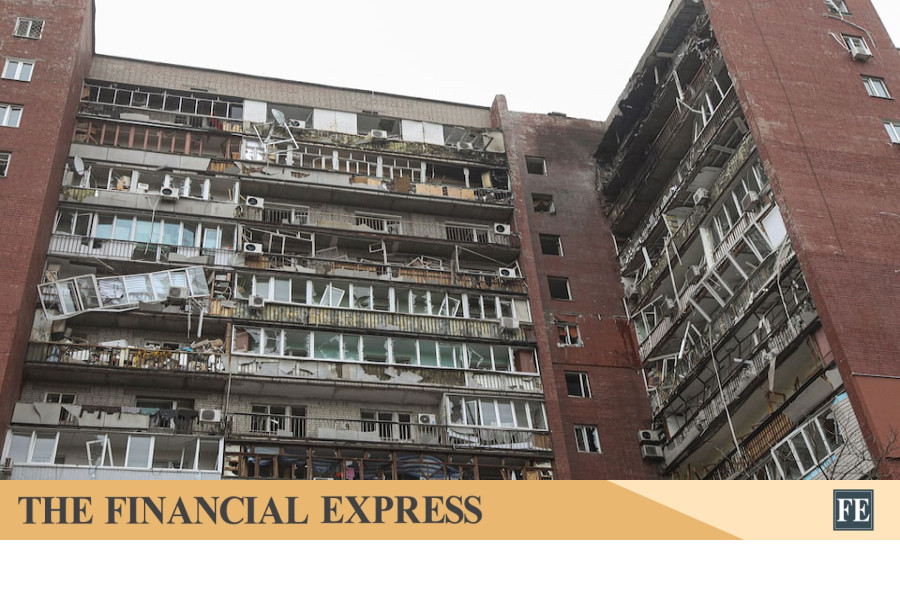
An apartment building which was hit by a Russian drone strike, amid Russia's attack on Ukraine, in Dnipro, Ukraine March 24, 2026. Photo : REUTERS/Stringer
Russia launched over 400 drones at Ukraine on Tuesday in a rare daytime attack, air force spokesman Yuriy Ihnat told Reuters.
Local authorities had previously said air defence was engaging targets near the capital, Kyiv, and the western city of Lviv, which is several dozen kilometres (miles) from the Polish border.

 War Archive