Wars 2026 02/28 Israel-Iran War 3.0

Wars 2026 02/28 Israel-Iran War 3.0
183
2K
More threads by RayKalm

G War Archive

Trump warns Iran 'will be laughing no longer' amid negotiations

He also accused Tehran of "laughing at our now GREAT AGAIN Country"

AFP
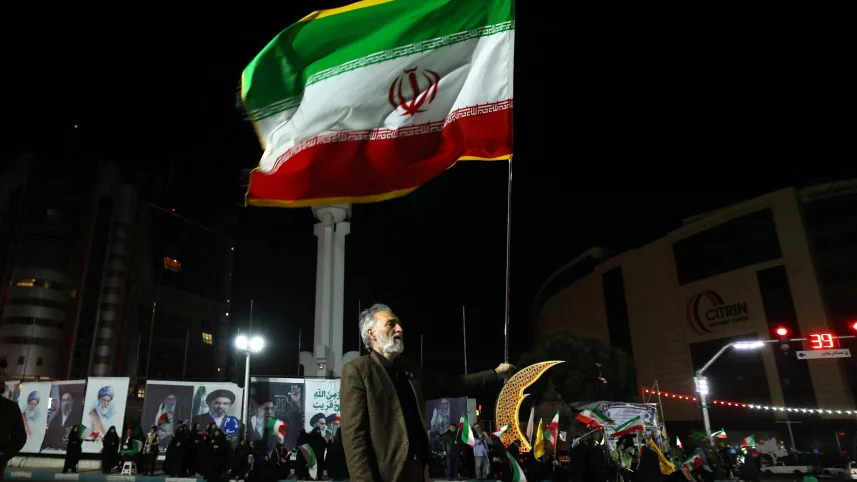
1778467629460.webp

A man holds an Iranian flag during a rally in support of Iran's supreme leader Ayatollah Mojtaba Khamenei at Sadeghyeh Square in Tehran on April 27, 2026. Photo: AFP

US President Donald Trump on Sunday accused Iran of "playing games" and laughing at America for decades, but said it soon would be made to stop -- without commenting directly on reports of Tehran's response to Washington's latest peace proposal.

"Iran has been playing games with the United States, and the rest of the World, for 47 years (DELAY, DELAY, DELAY!)," Trump said on his Truth Social platform.

He also accused Tehran of "laughing at our now GREAT AGAIN Country" but added: "They will be laughing no longer!"​
 

Trump rejects Iran peace terms, Tehran warns of new attacks

AFP
Washington, United States
Published: 11 May 2026, 09: 33

1778546424563.webp

US President Donald Trump Reuters file photo

US President Donald Trump on Sunday branded Iran's terms for ending the Middle East war "totally unacceptable," raising the likelihood of renewed conflict after weeks of negotiations.

Iran had responded to Washington's latest peace proposal earlier in the day, while warning it would not hold back from retaliating against any new US strikes or permit more foreign warships in the Strait of Hormuz.

Trump himself provided no details on Tehran's counterproposal, but in a brief post on his Truth Social platform made clear he was rejecting it.

"I have just read the response from Iran's so-called 'Representatives.' I don't like it -- TOTALLY UNACCEPTABLE!" Trump said.

The back and forth came as Israeli Prime Minister Benjamin Netanyahu -- whose forces launched the war on Iran along with the US military on 28 February -- insisted the conflict was not over until Iran's enriched uranium was removed and its nuclear facilities dismantled.

Tehran publicly maintained its defiant line, despite behind-the-scenes diplomacy.

"We will never bow down to the enemy, and if there is talk of dialogue or negotiation, it does not mean surrender or retreat," Iranian President Masoud Pezeshkian said Sunday on X.

According to state broadcaster IRIB, Tehran's response to the US plan, passed to Pakistani mediators, focuses on ending the war "on all fronts, especially Lebanon" -- where Israel has kept up its fight with Iran-backed Hezbollah -- as well as on "ensuring shipping security."

It offered little detail, though the US proposal had reportedly focused on extending the truce in the Gulf to allow for talks on a final settlement of the conflict and on Iran's contested nuclear programme.

Netanyahu said in an interview to be aired in full later Sunday that Iran's stockpile of enriched uranium must be removed before the war can end.

"It's not over, because there's still nuclear material -- enriched uranium -- that has to be taken out of Iran. There's still enrichment sites that have to be dismantled," Netanyahu told CBS's "60 Minutes."

He added that Trump was on the same page regarding the need to take away the uranium, though the president said in a recent interview that the US could remove it "whenever we want," and that it was "very well surveilled" where it is now.

Trump is expected to press President Xi Jinping of China -- a major buyer of Iranian oil -- on Iran when he visits Beijing this coming week, a senior US administration official said.

No Hormuz 'interference'

Meanwhile The Wall Street Journal, citing people familiar with the matter, said Iran laid out its own demands to Washington and proposed to have some of its highly enriched uranium diluted, and the rest transferred to a third country.

In its response, delivered through mediator Pakistan, Iran sought guarantees that the transferred uranium will be returned if negotiations fail or Washington quits the agreement later, sources told the Journal.

Trump made no mention of such details in rejecting Iran's response.

Iran imposed a blockade on the vital Strait of Hormuz early in the war, sending global oil prices soaring and rattling financial markets.

It has since set up a payment mechanism to extract tolls from ships crossing the strait, but US officials have stressed it would be "unacceptable" for Tehran to control an international waterway and the route for a fifth of the world's oil and other vital materials.

The US Navy, meanwhile, is blockading Iran's ports, at times disabling or diverting ships heading to and from them.

Britain and France are leading efforts to create an international coalition to secure the strait after a peace deal is reached, with both countries sending vessels to the region in advance.

But Iran warned Sunday that the two nations would meet "a decisive and immediate response" should they deploy their ships to the strait.

"Only the Islamic Republic of Iran can establish security in this strait and it will not allow any country to interfere in such matters," Deputy Foreign Minister Kazem Gharibabadi posted on X.

French President Emmanuel Macron later insisted his country had "never envisaged" a naval deployment in Hormuz, but rather a security mission "coordinated with Iran."

'Restraint over'

Fresh drone attacks Sunday in the Gulf were the latest to rattle the ceasefire after multiple recent flare-ups.

The United Arab Emirates said its "air defence systems successfully engaged two UAVs launched from Iran."

Kuwait reported an attempted attack as well, saying its armed forces dealt with "a number of hostile drones in Kuwaiti airspace."

And Qatar's defense ministry said a freighter arriving in its waters from Abu Dhabi was hit by a drone.

There was no immediate claim of responsibility, but Iran's Fars news agency reported that "the bulk carrier that was struck near the coast of Qatar was sailing under a US flag."

In a social media post on Sunday, the spokesman for the Iranian parliament's national security commission warned Washington: "Our restraint is over as of today."

"Any attack on our vessels will trigger a strong and decisive Iranian response against American ships and bases," Ebrahim Rezaei said.

According to Iranian state television, Tehran's military chief Ali Abdollahi met the country's supreme leader Mojtaba Khamenei and received "new directives and guidance for the continuation of operations to confront the enemy."​
 

Iran now defines Strait of Hormuz as far larger zone, IRGC officer says

REUTERS

Published :
May 12, 2026 16:44
Updated :
May 12, 2026 16:44

1778630418975.webp


Iran has expanded its definition of the Strait of Hormuz into a “vast operational area” far wider than before the Iran war, according to a senior officer in the Islamic Revolutionary Guard Corps (IRGC) Navy.

The strait is no longer viewed as a narrow stretch around a handful of islands but instead has been greatly enlarged in scope and military significance, said Mohammad Akbarzadeh, deputy political director of the IRGC Navy, the state-affiliated Fars News Agency reported on Tuesday.

“In the past, the Strait of Hormuz was defined as a limited area around islands such as Hormuz and Hengam, but today this view has changed,” Akbarzadeh said.

Iranian authorities did not reply to a Reuters request for immediate comment.

About a fifth of the world’s oil and liquefied natural gas supply normally passes through the strait, which is the gateway to the Gulf and main export route for countries such as Saudi Arabia, Iraq and Qatar.

Akbarzadeh said the strait is now defined as a strategic zone stretching from the city of Jask in the east to Siri Island in the west, describing it as “a vast operational area”.

The reported expansion is the second announced by Iran since the start of its conflict with the US and Israel.

On May 4, the IRGC Navy published a map showing a new zone of control extending along significant a stretch of the UAE’s Gulf of Oman coastline.

That stretched from Iran’s Mount Mobarak and the UAE’s emirate of Fujairah in the east to Iran’s Qeshm Island and the UAE emirate of Umm ⁠al Quwain in the west.

Tuesday’s announcement appears to represent a widening of that area.

Fars and Tasnim, another Iranian news agency, reported on Tuesday that the strait’s width, which they said was previously estimated at 20 to 30 miles, had now increased to between 200 and 300 miles.

The expanded zone forms a “complete crescent”, Tasnim said.​
 

US must accept peace plan: Iran
Agence France-Presse . Tehran, Iran 13 May, 2026, 00:27

1778633330118.webp


Iran’s chief negotiator said Tuesday that Washington must accept Tehran’s latest peace plan or face failure, after US president Donald Trump warned the truce in the Middle East war was on the brink of collapse.

The war, which erupted more than two months ago with US-Israeli strikes on Iran, has spread throughout the Middle East and roiled the global economy despite the ceasefire, impacting hundreds of millions worldwide.

Both sides have refused to make concessions and repeatedly threatened to resume fighting, but neither appears willing to return to all-out war.

‘There is no alternative but to accept the rights of the Iranian people as laid out in the 14-point proposal. Any other approach will be completely inconclusive; nothing but one failure after another,’ Mohammad Bagher Ghalibaf said in a post on X.

‘The longer they drag their feet, the more American taxpayers will pay for it.’

Iran sent its proposal in response to an earlier US plan, details of which remain limited. Media reports have said the American plan involved a one-page memorandum of understanding aimed at ending the fighting and establishing a framework for negotiations on Iran’s nuclear programme.

Iran’s foreign ministry said its response called for ending the war on all fronts, including Lebanon, halting the US naval blockade on Iranian ports and securing the release of Iranian assets frozen abroad under longstanding sanctions.

But Trump slammed Tehran’s reply as ‘TOTALLY UNACCEPTABLE’, saying the US would enjoy a ‘complete victory’ over Iran and that the truce that has halted fighting for over a month was on its last legs.

In a show of defiance, Iran’s Revolutionary Guards said they carried out drills in Tehran aimed at ‘enhancing combat capability to confront any movement of the American-Zionist enemy’, state media reported Tuesday.

The drills involved the Islamic Revolutionary Guard Corps or IRGC, the ideological arm of Iran’s military, as well as the Basij, a paramilitary force affiliated with the Guards, according to state TV.

‘Enhancing combat capability to confront any movement of the American-Zionist enemy was one of the goals and scenarios implemented in this drill, which was successfully carried out,’ Brigadier General Hassan Hassanzadeh, commander of the Tehran Revolutionary Guards, was quoted as saying by state TV.

The war of words has unnerved people in Iran who do not know what the coming months will bring.

‘We are just trying to dig our nails into anything that could help us survive. The future is so uncertain and we are just living day to day,’ Maryam, a 43-year-old painter from the capital Tehran, told Paris-based journalists.

‘We are trying to find a way to continue. Keeping hope is very difficult right now.’

Trump’s angry reaction to Iran’s counteroffer sparked a spike in oil prices and dashed hopes that a deal could be quickly negotiated to reopen the Strait of Hormuz to commercial shipping.

Iran is restricting maritime traffic in the waterway and has been setting up a payment mechanism to charge tolls for crossing ships, sparking a global energy crisis.

‘The energy supply shock that began in the first quarter is the largest the world has ever experienced,’ the CEO and president of Saudi oil giant Aramco, Amin Nasser, told investors.

US officials have stressed it would be ‘unacceptable’ for Tehran to control the strait, which usually carries about a fifth of the world’s oil and natural gas.

‘Iran should not use this strait as a weapon to pressure or to blackmail the Gulf countries,’ Qatari foreign minister Sheikh Mohammed bin Abdulrahman Al Thani told reporters in Doha on Tuesday.

Trump told Fox News that he was considering reviving a short-lived US operation to guide oil tankers and commercial ships through Hormuz, but that he had not yet taken a final decision.

The maritime standoff has also left the world facing a shortage of fertiliser — much of which comes from Gulf ports — and risks food supplies for tens of millions of people.

Jorge Moreira da Silva, executive director of the United Nations Office for Project Services, said there were just a few weeks left to avert a potentially ‘massive humanitarian crisis’ that could force 45 million more people into hunger.

Meanwhile, the US ambassador to Israel Mike Huckabee told a conference Tuesday that Israel sent Iron Dome air defence batteries and personnel to operate them in the United Arab Emirates during the war, after it was targeted more than any country by Iran.

And elsewhere in the Gulf, Kuwait said that four people arrested earlier this month as they attempted to enter the country by sea had confessed to belonging to Iran’s Revolutionary Guards.

On the war’s Lebanon front, Israeli strikes on a town in the south killed six people and wounded seven others, state media said Tuesday, as fighting continued despite a ceasefire agreement.

Israel has intensified its attacks in south Lebanon as it trades fire with Iran-backed Hezbollah even after the April 17 truce took effect.

More than 2,800 people have been killed in Lebanon since the country was dragged into the wider war on March 2, according to health authorities.

Hezbollah chief Naim Qassem said Tuesday his group’s weapons were not part of a third round of upcoming negotiations between Lebanon and Israel this week, vowing not to surrender ‘however great the sacrifices’.

‘We will not abandon the battlefield and we will turn it into hell for Israel,’ he said in a statement.​
 

Iran retains substantial missile capabilities, reports NYT

Iran says control over Hormuz to bring significant economic revenues

New Age Desk 13 May, 2026, 23:39

The Trump administration’s public portrayal of a shattered Iranian military is sharply at odds with what US intelligence agencies are telling policymakers behind closed doors, according to classified assessments from early this month that show Iran has regained access to most of its missile sites, launchers and underground facilities, the New York Times reports.Health & Wellness

Most alarming to some senior officials is evidence that Iran has restored operational access to 30 of the 33 missile sites it maintains along the Strait of Hormuz, which could threaten American warships and oil tankers transiting the narrow waterway, the publication said, DAWN reported.

People with knowledge of the assessments said they show — to varying degrees, depending on the level of damage incurred at the different sites — that the Iranians can use mobile launchers that are inside the sites to move missiles to other locations. In some cases they can launch missiles directly from launchpads that are part of the facilities.

Only three of the missile sites along the strait remain totally inaccessible, according to the assessments, the report said.

Meanwhile, Iran’s military spokesman said on Wednesday that Tehran’s control over the Strait of Hormuz could generate ‘significant’ economic revenue and strengthen the country’s international position, Agence France-Presse.

Iran has largely blocked shipping through the strait since the outbreak of war with the United States and Israel on February 28.

In peacetime, the route accounts for roughly a fifth of global oil and liquefied natural gas shipments, along with other key commodities.

Iran’s grip over the waterway has rattled global markets and given Tehran significant leverage, while the United States has imposed its own naval blockade on Iranian ports despite a fragile ceasefire in place since April 8.

‘Our oversight of the Strait of Hormuz will generate significant economic revenues for our country — potentially even doubling our oil income — and will strengthen our influence on the international stage,’ military spokesman Mohammad Akraminia said, according to ISNA news agency.

He added that the western part of the strait was controlled by the naval forces of the Revolutionary Guards, while the eastern section was overseen by the Iranian navy.

Iran’s control over the strait remains one of the key sticking points in negotiations with the United States, which have so far failed to produce a breakthrough.

On Wednesday, Ebrahim Azizi, head of the Iranian parliament’s national security commission, said his committee had finalised a plan to manage the waterway.

‘The Islamic Republic of Iran intends to use this strategic position as a lever of power through strategic management of the Strait of Hormuz,’ he said, according to state television.

Last month, Iranian deputy speaker of parliament Hamidreza Hajibabaei said Tehran had received its first revenues from tolls imposed on vessels crossing the strait.

China’s top diplomat urged Pakistan to step up mediation efforts between Iran and the United States, and to help ‘properly’ address the reopening of the Hormuz strait, Chinese state media said on Wednesday.

Foreign minister Wang Yi spoke to his Pakistani counterpart Ishaq Dar in a call on Tuesday, state news agency Xinhua reported.

Wang called on Pakistan to ‘step up mediation efforts, and contribute to properly addressing issues related to opening the Strait of Hormuz’, state news agency Xinhua said.

‘China will continue to support Pakistan’s mediation efforts and make its own contribution toward this end,’ Wang said, according to Xinhua.

Pakistan has emerged as the key mediator between the United States and Iran, who are in the process of negotiating a peace agreement after the conflict.

The Iranian government rejected on Tuesday the idea of amending its proposals, which Trump has deemed ‘garbage’.​
 

UAE ‘active partner’ in US-Israeli war: Iran

Iran allows Chinese ships to pass Hormuz

Agence France-Presse . Tehran, Iran 14 May, 2026, 23:52

1778806524663.webp

Iran’s foreign minister Abbas Araghchi. | File photo

Iran’s foreign minister Abbas Araghchi on Thursday accused the United Arab Emirates of playing an active role in the US-Israeli war against his country.

‘The UAE is an active partner in this aggression, and there is no doubt about it,’ Araghchi said in a Telegram post while attending a BRICS summit in India.

Araghchi also referred to what Israel has described as a ‘secret’ meeting in the UAE during the war between prime minister Benjamin Netanyahu and UAE president Mohammed bin Zayed Al Nahyan — a visit Abu Dhabi has denied took place.

‘I must say that the UAE was directly involved in the act of aggression against my country. When this aggression began, they even refused to condemn it,’ Araghchi said.

‘It also became clear that they participated in these attacks and may have even acted directly against us,’ he added.

Meanwhile, Iranian media reported Thursday that naval forces had allowed a group of Chinese ships to pass through the strategic Strait of Hormuz since the night before.

Iran has largely blocked shipping through the strait since the outbreak of war with the United States and Israel on February 28.

In peacetime, the route accounts for roughly a fifth of global oil and liquefied natural gas shipments, along with other key commodities. ‘Following a decision by the Islamic republic, a number of Chinese vessels have been allowed to pass through the Strait of Hormuz under Iranian-managed transit protocols,’ the Tasnim news agency said.

It added that the passage, which was requested by Beijing, began on Wednesday evening after ‘an understanding on Iranian management protocols’.

Fars news agency also carried a similar report, while Iranian state television said ‘more than 30 ships’ had been allowed to pass, although it was not clear if they were all Chinese.​
 

Iran FM says US willing to continue talks, open to China's help

Araghchi spoke a day after US President Donald Trump said Xi Jinping had offered China's help to reopen the Strait of Hormuz

AFP, India

1778891312949.webp

File photo: AFP

Iran's Foreign Minister Abbas Araghchi said on Friday he had "received messages" from the United States saying it is willing to continue talks, and that he was open to any support, including from China.

"We received messages again from the Americans saying that they are willing to continue the talks and continue the interaction," Araghchi told reporters in the Indian capital.

Araghchi spoke a day after US President Donald Trump said Xi Jinping had offered China's help to reopen the Strait of Hormuz, and that the Chinese leader had also pledged not to send military equipment to aid Iran in its war against the United States and Israel.

"We appreciate any country who has the ability to help, particularly China," Araghchi said, speaking after he attended a meeting of the BRICS bloc of nations in New Delhi.

"We have very good relations with China, we are strategic partners to each other, and we know that (the) Chinese have a good intention, so anything that can be done by them to help diplomacy would be welcomed by the Islamic republic," he added.

China said it had been working to help end the conflict since it began with US and Israeli strikes on Iran on February 28.

"There is no point in continuing this conflict, which should not have happened in the first place," China's foreign ministry told AFP.

"To find an early way to resolve the situation is in the interest of not only the US and Iran, but also regional countries and the rest of the world."

Pakistan has been the key mediator so far between the United States and Iran, but a first round of talks in Islamabad in April failed to reach any agreements.

"The mediation process by Pakistan has not failed yet, but it is in a very difficult course, mostly because of the Americans' behaviour and the mistrust which exists between us," Araghchi said.​
 

Trump says US and China are aligned on Iran, Tehran must make a deal soon

Trump considers lifting sanctions on Chinese oil firms buying Iranian crude

Reuters, Dubai

1778891726262.webp

China's President Xi Jinping and US President Donald Trump visit the Temple of Heaven in Beijing on May 14, 2026. BRENDAN SMIALOWSKI/Pool via REUTERS/File Photo

US President Donald Trump said his patience with Iran was running out and that Chinese President Xi Jinping had agreed during their talks in Beijing that Tehran must reopen the Strait of Hormuz.

Trump said later he was considering whether to lift sanctions on Chinese oil companies buying Iranian oil imposed by Washington ahead of his trip to Beijing. China is the biggest buyer of Iranian oil.

However, his comments gave little indication of whether Beijing might use its influence with Tehran to end a conflict it said should never have started.

"I'm not asking for any favors because, when you ask for favors, you have to do favors in return," Trump said, when asked by a reporter on his plane home whether Xi had made any firm commitment to put pressure on the Iranians to reopen the strait.

"We've wiped out their (Iran's) armed forces, essentially. We may have to do a little cleanup work."

Xi did not comment on his discussions with Trump about Iran, although China's foreign ministry issued a blunt statement outlining Beijing's frustration with the Iran war.

"This conflict, which should never have happened, has no reason to continue," the ministry said.

Iran effectively shut the Strait to most shipping traffic in response to US-Israeli attacks, which began on February 28, causing an unprecedented disruption to global energy supplies.

'WE WANT THE STRAITS OPEN'

The US paused its attacks on Iran last month but began a blockade of the country's ports. Tehran said it would not unblock the strait until the US ended its blockade. Trump has threatened to attack Iran again if it does not agree to a deal.

"We don't want them to have a nuclear weapon, we want the straits open," Trump said in Beijing, sitting alongside Xi.

Iranian Foreign Minister Abbas Aragchi said Tehran had received messages from the US indicating Washington was willing to continue talks.

"We hope that, with the advancement of negotiations, we will reach a good conclusion so that the Strait of Hormuz can be completely secured and we can expedite the normalisation of traffic through the strait," he told reporters in New Delhi.

Iran, which denies it intends to build a nuclear weapon, has refused to end its nuclear program or relinquish its hidden stockpile of enriched uranium, to Trump's frustration.

"I am not going to be much more patient. They should make a deal," Trump said in an interview aired on Thursday night on Fox News' "Hannity" program, suggesting the enriched uranium only needed to be secured by the US for public relations purposes.

Oil prices rose around 3% to near $109 a barrel on concerns over a lack of progress in resolving the conflict.

After talks between Trump and Xi yesterday, the White House said Xi had made clear China's opposition to any Iranian effort to charge a toll for use of the strait.

Trump said Xi also promised not to send Iran military equipment. "That’s a big statement," Trump said on "Hannity".

Asked about US sanctions on Chinese oil refineries buying Iranian oil, he told reporters on his plane: "We talked about that, and I'm going to make a decision over the next few days."

IRAN SAYS IT DOES NOT TRUST THE AMERICANS

The war has become a liability for Trump ahead of key US midterm elections in November.

China has dismissed reports it had plans to supply weapons to Iran as "groundless smears", but analysts doubt Xi will want to push Iran hard or end support for its military, given its value as a strategic counterweight to the US.

Talks on ending the war, mediated by Pakistan, have been on hold since last week when Iran and the US each rejected the other's most recent proposals.

Iran would welcome any Chinese input, Foreign Minister Aragchi said today, adding that Tehran was trying to give diplomacy a chance but did not trust the US

Iran is prepared for a resumption of fighting as well as for diplomatic solutions, Aragchi said, reiterating that vessels not linked to states attacking his country could traverse the Strait of Hormuz.

Before the war, about a fifth of global oil and liquefied natural gas as well as fertilizer and other vital supplies, passed through the waterway. Attacks on shipping have prevented almost all traffic, although a huge Chinese tanker and another linked to Japan crossed the strait on Wednesday.

The UAE said it would speed up building a new pipeline to its Fujairah port just outside the strait, after a vessel heading to it was sunk this week and another was boarded and redirected to Iran.

LEBANON TALKS AIM TO EXTEND CEASEFIRE

Thousands of Iranians were killed during the US and Israeli air strikes, and thousands have been killed in renewed fighting in Lebanon between Israel and the Iran-backed group Hezbollah.

With a fragile ceasefire in Lebanon due to expire on Sunday, discussions between Lebanese and Israeli officials were set to resume on Friday. Hezbollah opposes the talks, in which Israel is insisting on the group's disarmament.

Trump says his aims in starting the war are to destroy Iran's nuclear program, end its ability to attack neighbors, and make it easier for Iranians to overthrow their government.

Iran is seeking the lifting of sanctions, reparations for war damage, and acknowledgment of its control over the strait.​
 

Latest Posts

Back