Home Watch Videos Wars Movies Login

[🇧🇩] Agriculture in Bangladesh

Latest Posts Countries Wars Q&A

[🇧🇩] Agriculture in Bangladesh
242
10K
More threads by Saif

G Bangladesh Defense

Distributing farm credit efficiently

FE
Published :
Aug 13, 2025 22:40
Updated :
Aug 13, 2025 22:40

1755134260557.webp


Though the agriculture sector contributes around 12 per cent of the country's gross domestic product (GDP), it is a misleading indicator to assess the importance of the sector. For instance, around 45 per cent of the nation's workforce is directly involved in the sector, which underscores the impact of agriculture on the job market and the economy. Again, ensuring food security remains highly dependent on substantial farm output. Against the backdrop, the latest push by the central bank to enhance disbursement of farm credit from commercial banks is a move in the right direction.

On Tuesday, Bangladesh Bank formally unveiled the Agricultural and Rural Credit Policies and Programmes for the current fiscal year (FY26), setting a target of Tk 390 billion for agricultural and rural credit distribution. The new target is 2.63 per cent more than last fiscal year's (FY25) target of Tk 380 billion, when the actual amount of disbursed loans stood at 373.26 billion. Central bank statistics also showed that the farm loan disbursement fell below the target after three years of overshooting the annual targets. So, it is a matter of concern, especially when the agro-based rural economy needs sufficient support to help boost economic activities. The latest farm credit policy emphasised easing the loan application procedures, disbursing credit through agent banking activities, and using the MFI/NGO linkage by banks that do not have adequate number of branches or sub-branches in rural areas.

The central bank governor has rightly pointed out that farm and rural credit is still a low priority area for the commercial banks in the country, as less than 3 per cent of total bank financing goes to agriculture. In this connection, two specialised banks (BKB and RAKUB) and six state-owned commercial banks (SCBs) play a critical role in disbursing farm credit. These eight banks disburse around 36 per cent of the total credit, whereas the share of 42 private commercial banks (PCBs) is 62 per cent. So, there is a scope to increase the share of PCBs to boost farm credit.

At present, 60 per cent of the total farm credit goes to the crop sub-sector, followed by 15 per cent to livestock and 13 per cent to fisheries. To meet the growing demand for staple food, such as rice, along with vegetables and fruits for nutrition, and cattle and fish for animal proteins, efficient farm production is necessary. Without having climate-resilient seeds and advanced technologies, it is challenging to enhance the farm output, especially when farm land is slowly vanishing in the country and putting food security under threat. Though import from the international market is a key source to meet the country's food demand, there is no alternative to enhance the local output. Moreover, the agriculture sector is now more diversified than before, and many young entrepreneurs in agriculture sector are emerging with small-scale operations. They need bank financing to move ahead with their farm projects. Farm-centric cottage, small and medium enterprises (CSMEs) are also growing in different parts of the country, reflecting the diversification. All these require easy and efficient financing, and PCBs can also tap into these opportunities.

Finally, as also mentioned by the governor, refinancing for farm credit is not the responsibility of the central bank alone, and the government should also to come up with the budget support. This will help increase the volume of farm credit.​
 
Analyze

Analyze Post

Add your ideas here:
Highlight Cite Respond

How biochar can boost fertiliser efficiency

Atiqul Kabir Tuhin
Published :
Aug 17, 2025 00:33
Updated :
Aug 17, 2025 00:33

1755560624700.webp


As Bangladesh's population grows and the demand for food rises, efficient fertiliser use has become more critical than ever to safeguard food security. Farmers in the country rely heavily on chemical fertilisers and pesticides, a long-standing practice that has caused soil degradation, biodiversity loss, water pollution and contamination of the food chain. Researchers warn that overuse of fertiliser has become a pressing concern, reducing fertiliser efficiency, lowering farm profitability, and contributing to environmental damage, including greenhouse gas emissions.

Professor Shahla Hosseini-Bai of Griffith University, Australia, in collaboration with researchers in Bangladesh, is leading a project to understand farming practices in rice systems and identify sustainable strategies to improve fertiliser efficiency and increase yields. Sharing the research team's recent findings, she said many farmers apply extra fertiliser, believing it will boost yields. However, the study revealed that over-fertilisation not only failed to increase yields but also led to unnecessary expenses and environmental harm. Under-fertilisation, though less common, was also observed due to farmers' financial constraints.

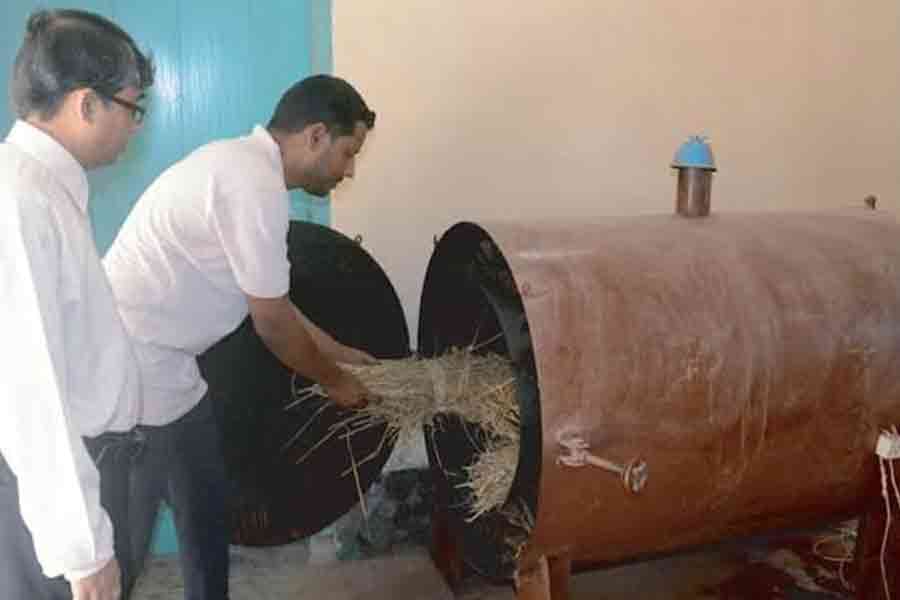
To address these challenges, researchers are exploring innovative technologies to improve fertiliser efficiency. One promising approach, according to Professor Hosseini-Bai, is the use of biochar - a charcoal-like substance produced from agricultural residues and waste through pyrolysis, a process that involves heating in the absence of oxygen. Often referred to as "black gold" for soil, biochar offers a multitude of benefits, including enhancing soil health and fertility, promoting sustainable waste management and mitigating climate change.

Explaining its effects, Professor Hosseini-Bai said, "Biochar enhances soil's ability to retain nutrients and water, reducing the need for excessive fertiliser and irrigation. Its water-retention capacity is particularly valuable during drought. Because it is highly stable, biochar can remain in the soil for centuries, significantly increasing carbon storage."

Biochar also acts as a carbon sink by locking CO2 underground for hundreds of years. Its porous structure functions like a sponge, retaining moisture, micro-organisms, and essential nutrients such as nitrogen and phosphorus, as well as gases like carbon dioxide and nitrous oxide. Considering these benefits, the Intergovernmental Panel on Climate Change (IPCC) recognised biochar as a potential tool for climate change mitigation.

Despite its potential, biochar adoption remains limited by cost and accessibility. Professor Hosseini-Bai has developed both liquid and solid biochar-based fertilisers that are nutrient-efficient, reduce dependence on conventional inputs, and are effective across a wide range of crops. She notes that wider adoption is hampered by limited commercial production - an obstacle that could be addressed by introducing low-cost kilns into formal markets.

Her research also shows that combining biochar or other organic matter with fertilisers can substantially improve yields. Biochar's properties vary according to the feedstock and production method, allowing it to be tailored to specific soil conditions. Smallholder farmers can design their own kilns and produce biochar on-site. Farmers can also compost or mulch organic farm and household waste such as rice husks, straw, fruit scraps, or manure, and apply it alongside fertilisers for similar benefits. Even simple techniques, such as burying organic matter, igniting it, and covering it to limit oxygen, can make biochar production feasible in resource-scarce settings. However, organic matters like manure and straw are often used as fuel or livestock feed, which may limit their availability for soil improvement.

Unlocking biochar's full potential will require concerted action by government, researchers, and farmers. Public investment in production facilities, training programmes, and farmer support can accelerate adoption. At the same time, academic and research institutions can play a pivotal role in this regard by sharing knowledge, making research findings widely available, and establishing demonstration sites to showcase biochar's effectiveness in real farming conditions.​
 
Analyze

Analyze Post

Add your ideas here:
Highlight Cite Respond

Potato output hits historic high, raises concerns of surplus

1755650634585.webp


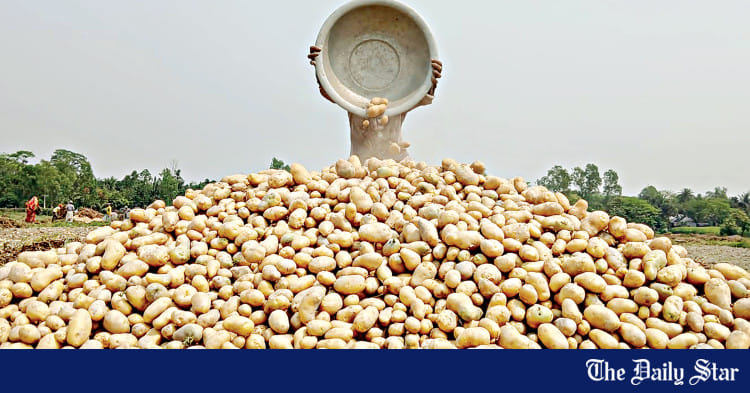
Bangladesh produced 1.15 crore tonnes of potatoes, the highest in history, in the last harvesting season, raising fears that a good portion of the tuber is likely to remain surplus this year as demand is far below the output, according to estimates by the Bangladesh Bureau of Statistics (BBS).

An expansion of cultivation area and a higher yields owing to favourable weather boosted the overall production of the popular vegetable this year, said the BBS, releasing its estimate early this month.

Farmers grew the tuber on land of 4.92 lakh hectares in the fiscal year 2024-25, up 8 percent year-on-year. Overall production increased 9 percent year on year from 1.06 crore tonnes the previous year, it added.

"We are going to see a surplus this year," said Matiar Rahman, director of Tuber Crop Research Centre (TRC) .

Including around 10 lakh tonnes of potatoes used for seeds, the country requires just over 90 lakh tonnes of potatoes for domestic consumption, according to estimates by the TRC and the Bangladesh Cold Storage Association (BCSA).

With roughly 80 lakh tonnes being consumed, a portion of the vegetable is used by processors to make chips and crackers. Apart from this, just over 62,000 tonnes of potatoes were exported in the fiscal year 2024-25.

"It appears that many people will not show interest in buying potatoes at the end of the year, causing losses for farmers," he said.

Transplanted from mid-September to November, the main harvesting season starts in mid-January and continues until March every year. However, early varieties of the vegetable start coming to the market from December, and demand for old potatoes declines amid an increased arrival of winter vegetables.

Stakeholders said potatoes harvested in the January-March period will be consumed in the three and a half months of this year.

Mostofa Azad Chowdhury Babu, president of the BCSA, said cold storages have 29 lakh tonnes of potatoes now as only 4 lakh tonnes have been released so far.

"Now, there are no potatoes at the farmers' end," he said.

"As we have only three and a half months of the season, a good amount is likely to remain surplus," he said, adding that the price of the vegetable remains much lower than the overall cost.

Potatoes are selling at Tk 14 - Tk 15 per kilogramme (kg) whereas production and other costs are Tk 25 - Tk 27, he added.

At retail, the vegetable is selling at Tk 25 - Tk 30 per kg in Dhaka, which is 48 percent lower than the same period a year ago, according to the Trading Corporation of Bangladesh.

"The amount of export is not significant," he said.

To increase consumption, the BCSA earlier urged the government to include 10 kilogrammes of potatoes per household in the social safety net schemes, including the Food-Friendly Programme.

He said mostly farmers' stored potatoes in the cold storages and if the government takes the initiative to distribute potatoes under social safety net programmes, farmers will be saved from losses.

"We have not seen any decision from the government," he said.​
 
Analyze

Analyze Post

Add your ideas here:
Highlight Cite Respond

Managing farm productivity risks

Published :
Dec 05, 2025 23:44
Updated :
Dec 06, 2025 00:23

1764982337686.webp


With close to 9.0 million hectares of available cultivable land, which too is shrinking by around 2,500 hectares annually, thanks mainly to urbanisation, feeding some 175 million mouths is a challenge of miraculous proportions. But the farming community of the country has been successfully meeting the challenge so far. Obviously, extensive application of modern farm practices had helped achieve that feat. But, of late, new challenges emerging from climate change, rising input costs and other issues are coming in the way of the farming communality's ability to maintain the robust productivity they achieved so far. Despite their best efforts, the proportion of output in comparison to the inputs, is not increasing but falling. In other words, the returns are diminishing. According to a new study, styled, 'Perspectives on the Agrifood System in Bangladesh', carried out by a state research body and policy think tank, Bangladesh Institute of Development Studies (BIDS), the country's agrifood system growth, has begun to slow down with the 'total factor productivity (TFP)' levelling out. TFP is the output that a given sum of inputs including labour and capital can generate.

That means the country's agriculture sector which employs around 40 per cent of the country's workforce and shares an estimated 12 per cent of the GDP, has lost its growth momentum despite the fact that this sector, since 2000, has been able to achieve rapid labour and proactivity gains. The villain, as is well- known to everybody by now, is the climate variability with its increasing level of temperatures and erratic rainfalls resulting in crop failures and ever-declining yields of rice, wheat, pulses, vegetables and oilseeds. As reported, researchers, through their long-term modelling have projected that such decline in the yields of these vital crops will continue until 2050. It is no doubt a piece of bad news for the farming sector in particular and the nation in general. Actually, what experts have found out through their researches is identical to the experience being gained by the workers in the field by way of their daily struggles. As the extreme heat is forcing labourers to work for fewer hours, their daily earnings, as expected, have been falling in direct proportions. Unsurprisingly, the research findings also say that agricultural labour productivity, in the face of extreme heat, has dropped by an estimated 11 per cent. In some areas of the country that have been experiencing very extreme heat waves, the workers' earnings have dropped further by about 20 per cent, say reports.

As suggested by experts, an obvious way out of this low productivity trap is crop diversification on a wider scale, adoption of modern cultivation practices with the application of advanced technology and better risk management. But so far as crop diversification is concerned, there are certain constraints. For example, rice occupies about 80 per cent of the gross cropped area of agricultural land. Add to that the country's continued dependence on the imports of food items including some basic items including wheat, pulses, edible oil, dairy, etc. it implies that the nation's food system is exposed to global market volatility. The domestic food market, on the other hand, is also held hostage to the oligopoly of millers and big corporate interests.

Overall, it implies a constant challenge to ensuring the nation's food security. All these issues call for enhancing the country's agro-productivity through a right mix of modern farming practice and economical use of resources. Hopefully, through helping farmers and entrepreneurs to efficiently manage farm production and adopting a proper food policy, the government should be able to meet the rising challenge to the nation's food security.​
 
Analyze

Analyze Post

Add your ideas here:
Highlight Cite Respond

How agricultural innovations can feed a nation and keep emissions low

1765071025818.webp

Smart irrigation and nutrient management can halve the climate penalty on rice yields. File Photo: Mostafa Sabuj

For five decades, Bangladesh's agriculture has powered food security and rural livelihoods, yet climate change now threatens that success. Average temperatures have risen by 0.24 degrees Celsius per decade since 1981 and could climb another 1.5-2 degrees Celsius by mid-century according to the Bangladesh Meteorological Department (BMD) and IPCC's Sixth Assessment Report (AR6). Rainfall is erratic, groundwater is declining, and salinity, drought, and flash floods increasingly converge. My own analyses across Bangladesh Rice Research Institute (BRRI) research stations show rice yields could fall by 15-20 percent unless irrigation, fertiliser, and varietal strategies are re-engineered for resilience.

The data are sobering, but they also reveal how transformation is possible. Over the past decade, field trials in Gazipur, Rajshahi, and Satkhira prove that a portfolio of low-carbon agronomic practices—Alternate Wetting and Drying (AWD), Direct Seeded Rice (DSR), short-duration stress-tolerant varieties, and the locally fabricated Prilled Urea Applicator (PUA)—can simultaneously raise yields, conserve resources, and cut greenhouse-gas emissions. As documented in an article in Rice Today, these innovations show that Bangladesh can pioneer climate-smart intensification: producing more rice with less water, energy, and carbon.

Precision water, smarter nitrogen

The irrigation method AWD is one of the most promising interventions for rice cultivation. In Bangladesh, multi-location experiments during 2018-19 found that AWD reduced cumulative methane (CH₄) emissions by approximately 37 percent compared to continuous flooding, while grain yields were unaffected. Meanwhile, global meta-analysis indicates AWD reduces CH₄ emissions by approximately 51.6 percent and global-warming-potential (GWP) by almost 46.9 percent, though nitrous oxide emissions increases by 44 percent. The broader water-saving potential of AWD is supported in Bangladesh: pilot work reports water savings of approximately 25-30 percent in regions where farmers pay volumetrically for irrigation. However, widescale adoption remains constrained by three critical enablers: reliable electricity for pumps, disciplined scheduling of dry-rewet cycles, and transition to volumetric water billing instead of flat per-area charges. Without these enablers, AWD's full potential will remain restricted to demonstration plots rather than scaling across the national rice landscape.

The second innovation DSR replaces labour- and fuel-intensive puddled transplanting and has been shown to reduce methane emissions by up to 47 percent and save both diesel and groundwater. Yet its national adoption rate remains below 10 percent. At pilot sites in Rajshahi and Bogura, DSR plots reduced irrigation cycles from 10 to six, but weed management and lack of mechanised seeding remain major constraints. Without affordable seed drills and technical guidance, most farmers are reluctant to risk an entire season's harvest.

A third frontier in rice‐sector innovation is genetic adaptation. Short-duration and stress-tolerant varieties, for example, BRRI dhan74, BRRI dhan81, and BRRI dhan84 (maturing in about 120–135 days), allow farmers to escape late-season heat or flood damage. Coastal strains such as BRRI dhan97 and BRRI dhan99 have been developed for high-salinity environments. Meanwhile, submergence-tolerant varieties such as BRRI dhan51 and BRRI dhan52 have demonstrated survival for up to two weeks under water. When these genetic tools are integrated with irrigation practices like AWD or DSR, there is a dual benefit—mitigation (via reduced flooding duration) and adaptation (via risk avoidance).

Finally, the PUA exemplifies Bangladesh's capacity for frugal, high-impact innovation. Developed by BRRI engineers and refined through field trials I have supervised since 2016; this lightweight device delivers prilled urea precisely to the crop's root zone. It enhances nitrogen-use efficiency by around 30 percent, cuts nitrous-oxide emissions by 10-20 percent, and typically boosts rice yield by about 10 percent. Considering that rice cultivation uses roughly 25 lakh tonnes of urea annually in Bangladesh, nationwide deployment of the PUA could reduce fertilser demand by nearly 7.5 lakh tonnes each year—saving over $300 million while simultaneously lowering import costs and agricultural greenhouse-gas emissions.

From relief to resilience finance

Technology is not the main barrier in adopting these practices, finance and governance are. Farmers rarely profit from saving water, face frequent power outages, and lack credit for mechanisation. Although agricultural lending has grown (with a target of Tk 380 billion in FY 2024-25), climate related allocation to 25 ministries in FY2026 was lower than the previous fiscal year.

What we need is National Risk Mitigation Facility—a blended fund pooling government, banking, and donor capital to underwrite climate-smart loans and weather-index insurance. A linked digital finance dashboard between the Ministry of Agriculture and Bangladesh Bank could track every climate-smart agricultural (CSA) loan against hazard maps and gender inclusion metrics. Such integration would turn resilience data into bankable collateral.

Lightweight mechanisation reduces women's labour burden, while youth-run service hubs are emerging as viable enterprises. Female farmers using the PUA reported saving roughly one-third of fertiliser labour hours. Digital advisory tools—Khamari App, Krishoker App, and e-Krishi—further improve decision-making and credit access. Embedding gender and youth indicators in national monitoring systems will ensure that participation is measurable and rewarded. For instance, the Khamari App's recommendations led to about 18 percent reduction in fertiliser cost and about six percent yield increase in Boro trials.

Evidence from the climate frontline

Crop-modelling simulations project that Boro yield can decline by about five percent by 2030s and 20 percent by 2050, with smaller but significant losses for Aman and Aus. Combining AWD, stress-tolerant varieties, improved drainage, and staggered transplanting can recover 10-15 percent of these losses. In short, smart irrigation and nutrient management can halve the climate penalty on yields.

But Bangladesh is not uniform. The Barind uplands face heat and drought; the haor basin suffers flash floods; coastal deltas battle salinity and cyclones; and southeastern hills erode under heavy rain. Each landscape requires a tailored CSA "menu": heat-tolerant rice with micro-insurance in the Barind, drainage and submergence-tolerant cultivars in the haor, salt-tolerant varieties with solar drainage in the coast, and agroforestry in the hills. One policy cannot fit all.

Five strategic measures can help tackle the challenge. First, ensure that climate and satellite datasets from the BMD and Bangladesh Space Research and Remote Sensing Organization are publicly available. Open data will empower financial institutions, insurers, and researchers to quantify risk, design climate-linked credit, and verify carbon-saving outcomes across agriculture. Second, integrate verified efficiency and mitigation indicators—such as AWD, DSR and PUA—into the agricultural credit scoring framework of the Bangladesh Bank. Linking finance to verified resource efficiency will reward innovation and accelerate low-emission farming. Third, introduce performance-based incentives that pay farmers per tonne for carbon-dioxide-equivalent reduction through climate-smart practices such as AWD, DSR, or mechanised fertiliser deep placement. A digital finance dashboard jointly managed by the Ministry of Agriculture and Bangladesh Bank could automate these payments and ensure transparent tracking. Fourth, expand concessional credit and capacity-building programmes for women mechanisation entrepreneurs and youth-led agritech ventures. Digital tools like e-Krishi, the Khamari App, and Krishoker Janala demonstrate scalable pathways to enhance financial inclusion and technology access and lastly, build a unified monitoring, reporting and verification (MRV) framework that links agronomic data from the Department of Agricultural Extension (DAE) with financial data from the Bangladesh Bank. This system will align agricultural performance measurement with national adaptation and mitigation priorities outlined in the National Adaptation Plan 2023-2050 and the Bangladesh Delta Plan 2100.

Also, traditional metrics—tonnes per hectare—must give way to emissions per tonne and resilience per taka invested. When every subsidy or credit line carries a climate-performance tag, Bangladesh can shift from counting inputs to accounting for impact. That transparency will unlock green finance and link local adaptation to global mitigation.

Bangladesh has policy blueprints, but integration is slow. What's missing is a unified delivery system connecting climate data, finance, and field adoption. Success will hinge on institutional coordination and the courage to move from demonstration to delivery. If that resolve is found, Bangladesh's rice fields could become a global example, proving that innovation, inclusion, and investment can align to feed a nation, while keeping carbon emission minimal.

Mohammad Kamruzzaman Milon is senior scientist and agro-climate change expert at the Bangladesh Rice Research Institute (BRRI).​
 
Analyze

Analyze Post

Add your ideas here:
Highlight Cite Respond
  • Like (+1)
Reactions: Krishna with Flute

Time for urgent, climate-smart reforms in agriculture
Home-grown science offers a roadmap to avert a future food crisis

1765156608665.webp


One of the biggest challenges Bangladesh is facing now—and one that is likely to intensify in the coming years due to climate change—is its food production capacity. Rising salinity in coastal areas, the depletion of groundwater, and increasing temperatures are likely to pose some of the most serious threats to our agriculture in general, and rice production in particular. We must, therefore, urgently address this issue if we are to avert a future food crisis.

In Bangladesh, the average temperature has risen by 0.24 degrees Celsius per decade since 1981, and is estimated to climb another 1.5-2 degrees by 2050, according to the Bangladesh Meteorological Department and the IPCC's Sixth Assessment Report. Agro-scientist Mohammad Kamruzzaman Milon, in a recent article published by this daily, predicts that rice yields may dip by 15-20 percent "unless irrigation, fertiliser, and varietal strategies are re-engineered" for future resilience. The author also pointed out some significant innovations already achieved by our scientists, the timely implementation of which could help significantly mitigate those critical problems.

Through field research in Gazipur, Rajshahi, and Satkhira, a set of low-carbon agronomic practices has been developed that can simultaneously raise yields, conserve resources, and cut greenhouse gas emissions. The findings suggest that Bangladesh can pioneer climate-smart measures that produce more rice with less water, less energy, and a lower carbon footprint. The author identified several innovations that are already in place and can contribute significantly to combating the impact of climate change on our food production system. These are scientifically proven and have been recognised internationally as acceptable options.

What we urgently need now is the required funding as well as changes in our policy direction. The author makes five suggestions that we find worthy of consideration: making all climate and satellite datasets publicly available to enable research by universities and other competent bodies, including those interested in funding such initiatives; integrating verified efficiency and mitigation indicators into the agricultural credit scoring framework of Bangladesh Bank; introducing performance-based incentives that reward farmers for reducing carbon emissions; expanding concessional credit and capacity-building programmes for women- and youth-led agritech ventures; and building a unified monitoring, reporting and verification framework that links agronomic data with financial data.

We seldom write editorials on views expressed in our op-ed columns. However, we find the suggestions made by Mohammad Kamruzzaman to be of sufficient merit and practical value to urge the government and relevant authorities to take immediate note and attach the highest priority to their implementation. We often desperately search for solutions to the myriad problems we face. But this is a case where solutions may already be in our hands. All we need to do is focus on them, coordinate the various bodies that need to be engaged, provide the necessary funding, and expedite implementation. After all, climate challenges must be addressed urgently. We urge immediate action in this area.​
 
Analyze

Analyze Post

Add your ideas here:
Highlight Cite Respond
  • Like (+1)
Reactions: Krishna with Flute
BD should focus more on Agroforestry. In India, methods like Subhash Palekar Kheti etc has changed the destiny of farmer. Zero Budget agriculture with minimum 5 lakh income per acre post second year. BD can adopt that and their farmers will become rich. I have prepared some report on same for my brother's farmhouse. I can share if some one is interested. A combination of Permaculture and organic farming.
 
Analyze

Analyze Post

Add your ideas here:
Highlight Cite Respond
  • Like (+1)
Reactions: Saif

61% women in agro-industries face abuse
BIDS study finds supervisors behind majority of the cases

1765243203730.webp

Photo: Habibur Rahman

Nearly three in five women working in factories that make food and non-food items from farm, fisheries and forestry products face verbal or emotional abuse, according to a new study.

Besides, one in nine reported physical or sexual harassment, according to the study by the Bangladesh Institute of Development Studies (BIDS).

The survey covered 510 women in Mymensingh, Narayanganj, Gazipur, Dhaka, Cumilla and Chattogram districts.

Most respondents said their supervisors were responsible for the abuse, pointing to a serious misuse of authority at work.

The study was unveiled yesterday at a session titled "Labour Market, Agriculture and Energy" in Dhaka on the second day of the BIDS Conference on Development 2025.

It found that 61.37 percent of women employed in agro-based enterprises had faced verbal and emotional abuse. Of this group, 10.98 percent reported sexual or physical harassment, and 2.55 percent mentioned cyber harassment. Supervisors accounted for 64.4 percent of all reported incidents.

Researchers also highlighted punishing work hours with little reward. Women work an average of 51.6 hours a week. Nine in ten said overtime is compulsory, yet only 6.3 percent receive the legally required double overtime pay.

The session featured four studies that highlighted systemic inequalities across cities, farms, factories and households. The study on the working conditions and economic empowerment of women in agro-based industries was presented by Kashfi Rayan, research associate at BIDS.

It also found that essential facilities remain rare. Only 21 percent of enterprises provide childcare rooms, and just 31 percent offer full paid maternity leave.

Despite the rising participation of women in agro-industries, the study said empowerment remains limited due to restrictive household decision-making, weak representation at work and low awareness of labour rights.

Rayan called for tighter enforcement of labour laws, gender-responsive facilities and stronger grievance and reporting systems to ensure safety and dignity at work.

In the same session, Badrun Nessa Ahmed, senior research fellow at BIDS, presented findings on wage disparities between cities and rural areas in her paper titled "One size does not fit all: urban heterogeneity and labour market inequalities in Bangladesh".

Drawing on Labour Force Survey data, she said workers in metropolitan areas earn 2.6 times more than those in rural areas. Between 2013 and 2022, rural wages grew by only 4.2 percent, compared with 10.7 percent in big cities.

An instrumental variable analysis showed a 21.6 percent wage premium in metropolitan areas, while smaller towns offered only 5.2 percent.

"Urban Bangladesh is not homogeneous. The advantages are heavily concentrated in big cities," Ahmed said, pointing to factors such as agglomeration, productivity clustering and better job matching.

She recommended strengthening secondary cities, improving urban services and formalising labour markets to reduce widening spatial inequality.

Another study, presented by senior research fellow Mohammad Golam Nabi Mozumder, warned of ecological pressures linked to rapid mechanisation in agriculture.

Titled "The irresistible shift from agriculture to agri-venture: technology, habitus, and the looming threat of ecocide", the study examined how rising wages and persistent labour shortages are turning farming from a livelihood into a profit-driven agri-venture that risks upsetting ecological balance.

Based on interviews in 14 districts, the study recorded heavy use of hybrid seeds, synthetic fertilisers and pesticides, along with inefficiencies when machines are used on small, fragmented plots.

It also found irregularities in the subsidised machinery market, ranging from counterfeit equipment to dual-branded machines and contract terms that vary widely.

Mozumder warned of a "pesticide treadmill" that is degrading soil and threatening aquatic life, calling it a looming "spectre of ecocide". He urged policymakers to regulate machinery distribution, set quality standards and promote agro-ecological models to protect the environment.

SM Zulfiqer Ali, research director at BIDS, moderated the session.​
 
Analyze

Analyze Post

Add your ideas here:
Highlight Cite Respond

Members Online

No members online now.

Latest Posts

Back
 
G
O
 
H
O
M
E