Home Watch Videos Wars Movies Login

[🇧🇩] Agriculture in Bangladesh

Latest Posts Countries Wars Q&A

[🇧🇩] Agriculture in Bangladesh
242
10K
More threads by Saif

G Bangladesh Defense
Potato Paradox: Just another curry on the rice plate? This will not solve the price problem

1766884166028.webp


Punishing retail prices during low output and throwaway rates during bumper harvests have become a familiar cycle for potato farmers. The swings are recurring and costly, leaving as many as half a crore growers exposed to debt in good years and public anger in bad ones.

Yet agri experts and supply chain players say the problem has little to do with farmers, or even with production. Instead, it reflects how potatoes are treated in policy and planning.

Unlike many other countries, Bangladesh largely views the crop as just another vegetable eaten with rice, not as a basic industrial raw material.

That distinction matters. When production overshoots domestic demand, prices collapse. Farmers absorb the losses, while the economy misses out on value addition that could stabilise incomes and absorb surplus output.

Bangladesh is the world's seventh-largest potato producer. Still, it remains far behind global peers in industrial use of the tuber.

In China, about 15 percent of potato output goes into industrial processing. In the Netherlands, Germany, France and the United States, the share ranges from 60 percent to 65 percent. Russia and Ukraine process 20 percent to 30 percent, while neighbouring India, with similar food habits, uses 5 percent to 7 percent.

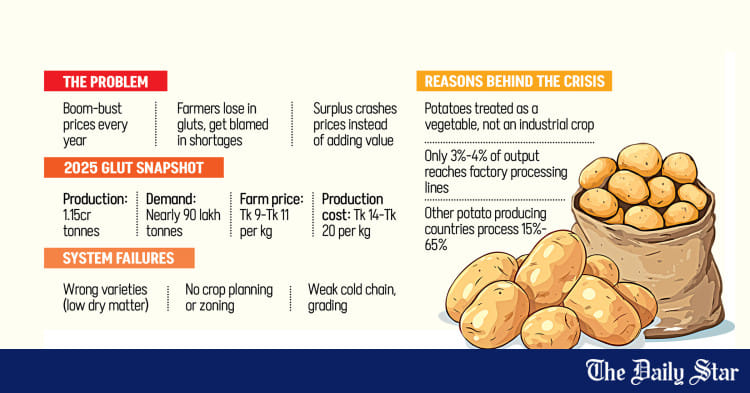
Bangladesh, by contrast, processes only 3 percent to 4 percent of its total output, according to industry insiders.

The difference is decisive. In countries where potatoes feed factories, surplus strengthens supply chains. In Bangladesh, surplus simply crashes prices.

After rice, potatoes are the second most produced crop in Bangladesh and a pillar of food security. Yet more than a quarter of output is lost after harvest, according to the Food and Agriculture Organization, which points to weak storage, handling and processing capacity.

WRONG VARIETIES, WEAK PLANNING

Kamruzzaman Kamal, marketing director of Pran-RFL Group, the parent of the local agro processing giant Pran, said industrial processing is limited because most locally grown potatoes are table varieties, not processing-grade crops.

"These potatoes have high moisture and sugar content, which makes them unsuitable for products like French fries. They lose colour and become soft after frying," said Kamal.

Globally, potatoes used for fries, chips and flakes require dry matter of around 22.5 percent. But locally grown potatoes usually contain only 16 percent to 19 percent dry matter, according to scientists.

While potatoes are locally used at home to make chips, and in factories to produce crackers, biscuits and chanachur, the backward linkage industry for flakes and starch is still underdeveloped. Only one or two such factories are currently in production.

Kamal said farmers are not encouraged to grow processing varieties because crop planning is mostly individual-driven rather than coordinated. Many existing varieties are disease-prone, poorly adapted to climate stress and quick to spoil.

Inadequate storage, no grading and sorting at farm level, insufficient cold-chain infrastructure and limited warehousing have further constrained both industrial use and exports, added the Pran-RFL marketing director.

Khurshid Ahmad Farhad, general manager for international business and corporate affairs at Bombay Sweets and Company Limited, a popular food processing brand, said the absence of integrated crop planning and unpredictable weather has kept industrial processing from reaching scale.

Factories producing flakes, slices, chips and biscuits need potatoes of specific size and quality. Bangladesh does not produce enough of these at consistent volumes, he said. Even when quality potatoes are available, production costs are often far higher than international benchmarks, making local products uncompetitive.

"In recent times, costs have risen so sharply that a Dubai-based trader told me they could supply potato flakes at a lower price than we can," Farhad said.

Globally, the largest potato-based industrial products include mashed potatoes and French fries. In Bangladesh, suitable varieties have yet to be developed at a commercial scale, leaving much of the segment untapped.

Although government agencies hold relevant crop data, it is neither centrally coordinated nor used for forecasting, Farhad said. As a result, annual output swings widely between about 80 lakh tonnes and nearly 90 lakh tonnes, with no early warning for the industry.

"This uncertainty is the biggest obstacle. Planning depends on assured availability and consistent quality of raw materials," he said.

THE GLUT, THEN THE CRASH


Strong prices in the 2024 season encouraged farmers to expand potato acreage massively this year in the hope of better returns. Instead, excessive output triggered a severe glut and eventual price fall.

According to the Bangladesh Bureau of Statistics, potato production reached a record 1.15 crore tonnes last season, far above annual domestic demand of around 90 lakh tonnes.

Cultivated area rose 8 percent year-on-year to 4.92 lakh hectares in fiscal year 2024-25, while output increased 9 percent from 1.06 crore tonnes the previous year.

The oversupply sent field-level prices tumbling to Tk 9 to Tk 11 per kg, well below the estimated average production cost of Tk 14. In northern regions, costs were higher, at around Tk 20 per kg, according to the Department of Agricultural Extension (DAE).

For farmers, the result was debt rather than profit. For the economy, it was another missed chance to channel surplus into value-added uses.

'TYPICAL COLD STORAGE ONLY DELAYS LOSSES'

Bangladesh has expanded cold storage capacity to about 35-40 lakh tonnes. Processing capacity, however, is remarkably low.

Md Mohsin Ali, head of supply chain at Quasem Industries Limited, which produces Sun Chips, said processing capacity stands at just 70,000-80,000 tonnes.

The shortage of modern cold storage designed for processing-grade potatoes is one of the sector's biggest constraints, he said. "Therefore, typical cold storage facilities currently delay losses. It does not create value," he said. "Without factories that can absorb surplus, price crashes will continue."

In many countries, he said, potatoes are a staple food and a major industrial input. In Bangladesh, those consumption patterns and industrial linkages have yet to emerge.

According to Ali, weak policy support, lack of dedicated processing policies and limited investment in research and development are major barriers.

DEMAND EXISTS, QUALITY DOES NOT

Apart from the unavailability of commercial-grade potatoes, the shortage of premium-grade crops is visible even in high-end kitchens.

Md Ershad Ali, assistant sous chef at Pan Pacific Sonargaon Dhaka, a five-star hotel, said they serve potatoes to their guests at every meal, with each buffet offering at least one potato dish.

Some international recipes, however, cannot be prepared with local potatoes due to inconsistent size and grading. Overseas, potatoes arrive uniformly graded and ready for consistent cuts and presentation. Local supplies vary widely.

The hotel uses about 500 kg of potatoes each week. That could rise to 800 kg if uniformly graded, high-quality potatoes were available, he said.

A POLICY BLIND SPOT

FH Ansary, managing director of ACI Agribusiness, said potatoes need to be viewed through four lenses: food, industry, environment and health.

"We treat potatoes as just a vegetable. Elsewhere, they are protein sources, pharmaceutical inputs, packaging material and industrial feedstock," he said.

Ansary said farmers focus on table potatoes because the market is guaranteed. Seeds of processing varieties are scarce, quality-based cultivation is limited, and there is no price assurance or buy-back mechanism.

"The bridge between farmers and industry is broken," he said. "Without it, neither industrial use nor price stability will be achieved."

M Masrur Reaz, chairman of local think tank Policy Exchange Bangladesh, said processed potatoes generate far higher value than fresh ones. Globally, fresh potatoes account for about half of export volume but only 20 percent of value. Processed potatoes make up a third of the volume yet generate more than half of the trade value.

In Bangladesh, processing is limited to 3 percent to 4 percent of output, while exports stand at just 62,000 tonnes, said the economist. "Without value addition, price crashes during bumper harvests will keep hurting farmers."

Agriculture contributes about 12 percent to the gross domestic product of Bangladesh. The processed food sector accounts for only 1.7 percent.

Mohammad Khurshid Alam, chief scientific officer at the Bangladesh Agricultural Research Institute (Bari), said the short winter season limits dry matter accumulation in potatoes. Excessive use of urea further delays maturity and raises moisture content. He said contract farming and area-based zoning are important, with specific regions designated for processing and export varieties.

Other solutions, the scientist said, include developing high dry-matter varieties through public-private partnerships, expanding good agricultural practice certification, improving post-harvest management and rebuilding links between farmers and industry.​
 
Analyze

Analyze Post

Add your ideas here:
Highlight Cite Respond
Issues for govt to fix to deal with surplus agricultural output

A RECORD record potato harvest this season for farmers in the north has become a stark illustration of how abundance can paradoxically breed disaster. What should have been a period of relative prosperity has instead turned into a likely financial crisis as prices have plummeted to levels far below production costs. Early potatoes, expected to bring a premium before the main harvest, are now sold for Tk 10–12 a kilogram, barely a half of what it cost to produce them. The situation is compounded by the lingering stock of the past season’s crop in cold storage, creating an unprecedented ‘double blow’ for growers who hoped for stable returns. Government efforts to safeguard the sector, including a minimum price announcement and plans for procurement, have largely remained unimplemented, leaving farmers to navigate the collapse unaided. Rising input costs, from fertiliser and fuel to labour, have exacerbated the imbalance between cost and revenue while weak market forecasting and ineffective regulation have allowed surplus supply to overwhelm demand. Beyond the immediate losses, the crisis exposes structural vulnerabilities in agricultural markets.

The crisis at hand underscores the urgent need for a cold storage system that is both accessible and efficiently managed. While the government has established 384 commercial cold storage units with a combined capacity of around 3.27 million tonnes and more than 650 low-cost attic-style facilities in village, the measures fall far short of the nation’s annual potato output of 11.5 million tonnes. Even where space exists, high storage rents, sometimes exceeding the market value of the potatoes, leave many farmers reluctant to store their crops while poorly maintained units risk spoilage. Expanding storage capacity, reducing costs and ensuring proper upkeep are essential first steps, but they should also be paired with investment in agricultural processing industry and value addition. Limited processing facilities, weak export channels and the absence of a coordinated cold-chain logistics network prevent surplus potatoes from reaching alternative markets. Without reforms to market regulation, price stabilisation mechanisms and a strategic push into processing and export infrastructure, any expansion in storage will merely postpone the inevitable price collapse. A comprehensive approach is needed, one that combines storage improvements, market management and processing initiatives to protect farmers and stabilise the sector against both seasonal and structural vulnerabilities.

The authorities should act decisively to prevent repeated losses. Expanding and properly managing cold storage, investing in processing and export infrastructure and enforcing market regulation are essential. Without these measures, farmers will continue to bear the brunt of surplus and price collapse, rural livelihood will be jeopardised and seasonal gluts will remain a persistent threat to both food security and agricultural stability.​
 
Analyze

Analyze Post

Add your ideas here:
Highlight Cite Respond
Chilly spell raises disease risk for winter crops

1767316849374.webp

Farmers shield Boro seedlings with polythene as the cold wave threatens crops like potatoes, tomatoes, and onions, risking disease and stunted growth while some crops may thrive. The photo was taken in Manda upazila of Naogaon on December 31. Photo: Azahar Uddin

As a cold wave continues to grip the country, agricultural experts are warning that certain crops could face serious risks from the unusual weather, while others may benefit and thrive under these conditions.


According to a press release issued today by the Bangladesh Agro-Meteorological Information Service under the Department of Agricultural Extension, the cold weather is expected to affect multiple crops.


Potatoes are particularly vulnerable to late blight, while rice seedlings in seedbeds may be affected by scorch disease. Onions and garlic face tipburn, and onions can also develop purple blotch. Pulses are at risk of leaf spot, rust, and Stemphylium diseases. Mustard crops may develop white mould and leaf spot before flowering.

Limu Akter, senior scientific officer of the vegetable division at the Horticultural Research Center of the Bangladesh Agricultural Research Institute, said, "The current cold and damp weather is highly unfavourable for some winter vegetables, as it encourages the spread of serious diseases such as late blight and powdery mildew.


"Crops like potatoes, tomatoes, capsicum, and eggplant are particularly vulnerable, while cucurbit crops face an increased risk from powdery mildew. Prolonged adverse weather can stunt plant growth and greatly increase disease risks," she added.

Mahbuba Begum, principal scientific officer of the Tuber Crop Research Center in Gazipur, said, "The prevailing weather conditions are ideal for the initiation and rapid spread of late blight in potatoes.

"High humidity and cool conditions significantly increase the risk of infection, making potatoes the most vulnerable crop at this time. Other crops, such as sweet potatoes and mustard, are not facing major threats under the current conditions."


Begum advised, "To effectively control late blight, farmers should follow recommended management practices, including the regular application of fungicides at seven-day intervals.

"Timely preventive action is essential, as the disease can spread quickly once established, while most other crops remain largely unaffected by the current weather pattern."

Mohammad Khalequzzaman, director general of the Bangladesh Rice Research Institute, said that rice cultivation is extremely sensitive to temperature and sunlight, and growth can completely halt when temperatures fall below 10–13°C.

He added, "During the recent cold wave, a combination of low temperatures and lack of sunlight caused physiological growth stoppage, which can lead to cold injury, disease, and rotting if such conditions persist.

"However, the impact on rice at the seedling or seedbed stage was minimal, as growth is naturally paused during this period, allowing the plants to withstand short-term cold stress and recover once sunlight returns, and temperatures rise."

Khalequzzaman stressed, "Nighttime temperatures are the most critical factor for assessing potential damage. While prolonged cold spells can delay crop maturity and reduce yields, the recent seven-day cold wave was not severe enough to cause measurable losses.

"The situation would have been far more damaging if the rice had already been transplanted into open fields. At present, only Boro rice in seedbeds is being managed."

COLD WAVE CONTINUES

According to the Bangladesh Meteorological Department (BMD), a cold wave is currently affecting 17 districts, with moderate to dense fog possible in some areas.

Earlier on December 26, the Met Office reported that a mild cold wave had hit Jashore, Chuadanga, Gopalganj, Rajshahi, Pabna, Sirajganj, and Nilphamari.

Shahnaz Sultana, a meteorologist at BMD, said, "The unusually cold conditions in the country began on December 25. There was a brief period of sunlight on December 27, but persistent fog and overcast skies on December 28 and 29 prevented daytime warming.

"During this period, maximum daytime temperatures dropped significantly, while nighttime temperatures remained largely unchanged. The lack of sunlight made the days feel much colder, intensifying the impact of the cold spell."

The Bangladesh Agro-Meteorological Information Service also provided guidelines to help farmers prevent potential crop damage.

Experts warn that if the cold wave continues for several more days, crop production could be disrupted, yields may be lowered, and market prices could rise.​
 
Analyze

Analyze Post

Add your ideas here:
Highlight Cite Respond
BADC initiative transforms rice harvesting in Sunamganj
United News of Bangladesh . Sunamganj 03 January, 2026, 01:24

1767404613740.webp

The Bangladesh Agricultural Development Corporation launches a comprehensive initiative to construct causeways, threshing floors and sunning platforms aimed at easing the harvesting, processing and transport of boro rice, in Sunamganj. | UNB photo

In a transformative move for agriculture in Bangladesh’s haor regions, the Bangladesh Agricultural Development Corporation has launched a comprehensive initiative to construct causeways, threshing floors, and sunning platforms, aimed at easing the harvesting, processing and transport of boro rice.

Causeways—earthen or paved routes connecting remote haor fields to main transport channels—are often the only lifelines for farmers during the crucial boro season. Yet, flooding and sudden hill torrents frequently stall transport, causing significant crop losses.


Responding to long-standing demands from farmers and local organisations, BADC’s initiative seeks to construct permanent causeways across approximately 10 kilometres of haor areas.

Complementing this, threshing and sunning floors will be built to reduce post-harvest losses, allowing rice to be quickly milled and dried even in the face of early floods or hill torrents.

Work on these facilities will commence in the current fiscal year in selected important haors, with plans to extend the project to other regions in phases.

The initiative falls under the Sylhet Division Project on Surface Water Management and Agricultural Productivity Enhancement, which has already begun in Sunamganj and surrounding districts, with a budget of nearly Tk 500 crore.

Scheduled for completion by 2029, the project encompasses causeway construction, fallow land rehabilitation, canal and hill stream excavation, farmer training, and other measures designed to boost agricultural productivity.

Once implemented, it is expected to provide irrigation benefits to 17,019 hectares of previously fallow land across Sunamganj, Sylhet, Moulvibazar and Habiganj districts, producing an additional 51,058 tonnes of food.

In remote haor areas, five threshing floors and five sunning floors will be constructed to enable farmers to swiftly process and dry harvested rice.

Officials say that this dual infrastructure will not only reduce post-harvest losses but also facilitate faster transport, saving farmers time and money.

During the first year, around four kilometres of causeways will be paved in Sunamganj, accompanied by two threshing floors and two sunning floors.

The causeways will be eight feet wide and constructed with reinforced cement concrete, with design work for these facilities near completion.

Welcoming the project, retired professor Chittaranjan Talukdar said, ‘For the first time, the government has taken up the development of causeways under a formal project. This initiative will allow both road and boat transport, reduce crop losses, and save farmers’ costs and time.’

He emphasised that causeways should eventually be constructed across all major haors in phased programmes.

Mizanur Rahman, president of the Haor, River and Environment Protection Movement, described the project as ‘timely and crucial’, stressing the importance of climate-resilient and sustainable implementation, with input from experienced local farmers.

Project director Pronojit Kumar Dev said, ‘This five-year BADC project is extremely important and will bring revolutionary changes to haor agriculture. Construction of causeways, threshing, and sunning floors will significantly benefit the transport, drying, and milling of harvested crops, particularly during emergencies.’

With these measures, the long-standing challenges of transporting and processing rice in haor regions may finally begin to ease, promising a more secure and productive future for farmers across Sunamganj and the greater Sylhet division.​
 
Analyze

Analyze Post

Add your ideas here:
Highlight Cite Respond
Meeting fertiliser needs of Boro farmers

Published :
Jan 10, 2026 00:59
Updated :
Jan 10, 2026 00:59

1768005612162.webp

Chronic shortage of natural gas has been hampering fertiliser production especially at the five urea fertiliser-producing plants operated by the state-owned Bangladesh Chemical Industries Corporation (BCIC). But Boro being the country's major dry season rice crop (January-February its peak planting season), its demand for fertilisers needs to be urgently met. Reports have it that the fertiliser factories remain out of production for most the time of the year (from April to November) for want of gas supply. So, to meet the Boro season's requirement, the BCIC in a recent letter reportedly requested the authorities concerned including the energy and the finance ministries as well as Petrobangla to ensure supply of at least 197 MMCFD (million cubic feet per day) of gas for keeping at least four of its fertiliser plants operational for 11 months in a row. The BCIC is learnt to have sent a proposal to the Ministry of Industry (MoI) recently, urging necessary steps in line with the recommendations made by a committee formed by the Energy and Mineral Resources Division. It has also requested the authorities concerned for amendment to the order issued by the Bangladesh Energy Regulatory Commission (BERC) for raising the supply of gas to197 MMCFD in order to maintain uninterrupted gas supply.

With the present level of gas supply, only two fertiliser plants could be run, producing between 0.9 and 1.1 million metric tonnes of fertiliser. But that is much less than the target of 1.8 million metric tonnes. It is worthwhile to note that urea constitutes about 80 per cent of BCIC's total fertiliser output. But the factories cannot run in full installed capacity of 3.1 million tonnes per year. In fact, all the fertiliser plants of the country together can produce only a fraction of the actual demand of different kinds of fertilisers used for the country's agriculture. According to a projection of Agricultural Ministry, the demand is for about 6.0 million metric tonnes for the fiscal year 2025-26. Notably, natural gas is the backbone of urea fertiliser production as it is the source of both the raw material and the fuel to run the plants. But it is not only the supply shortage of gas, its price is also an issue, which has seen a sharp rise.

As a result, the BCIC's current outstanding (unpaid) gas bills, as reported, stand at Tk20 billion. Also, the price the government has fixed for the locally produced fertiliser is far less than its production cost. In consequence, the BCIC plants have been constantly facing losses. But unlike in the case of imported fertilisers, the BCIC-produced fetiliser does not get any subsidy. To get around the gas scarcity and the related issues, the government had formed a high-powered panel, which reviewed the prospect of operating fertiliser plants with imported LNG (liquefied natural gas). However, the committee recommended that the four of the five urea plants be rather operated for 330 days at a stretch annually to produce at least 1.8 million metric tonnes of fertiliser. An average supply of 180.81MMCFD would be required for the purpose.

To make that possible, as the committee report further informed, domestic gas production has to be increased, which would save foreign currency as well as create jobs and so on. Undoubtedly, there cannot be a better idea than meeting natural gas requirement of the fertiliser plants from the domestic sources. Understandably, that would require devising a long-term strategy. But for the short-run, especially for the ongoing Boro planting season, the government must take urgent measures to ensure that the farmers get the required supply of fertilisers.​
 
Analyze

Analyze Post

Add your ideas here:
Highlight Cite Respond
Potato Paradox: Just another curry on the rice plate? This will not solve the price problem

27 December 2025, 18:00 PM
By Sukanta Halder

1768525633117.webp


Punishing retail prices during low output and throwaway rates during bumper harvests have become a familiar cycle for potato farmers. The swings are recurring and costly, leaving as many as half a crore growers exposed to debt in good years and public anger in bad ones.


Yet agri experts and supply chain players say the problem has little to do with farmers, or even with production. Instead, it reflects how potatoes are treated in policy and planning.

Unlike many other countries, Bangladesh largely views the crop as just another vegetable eaten with rice, not as a basic industrial raw material.

That distinction matters. When production overshoots domestic demand, prices collapse. Farmers absorb the losses, while the economy misses out on value addition that could stabilise incomes and absorb surplus output.


Bangladesh is the world's seventh-largest potato producer. Still, it remains far behind global peers in industrial use of the tuber.

In China, about 15 percent of potato output goes into industrial processing. In the Netherlands, Germany, France and the United States, the share ranges from 60 percent to 65 percent. Russia and Ukraine process 20 percent to 30 percent, while neighbouring India, with similar food habits, uses 5 percent to 7 percent.

Bangladesh, by contrast, processes only 3 percent to 4 percent of its total output, according to industry insiders.


The difference is decisive. In countries where potatoes feed factories, surplus strengthens supply chains. In Bangladesh, surplus simply crashes prices.

After rice, potatoes are the second most produced crop in Bangladesh and a pillar of food security. Yet more than a quarter of output is lost after harvest, according to the Food and Agriculture Organization, which points to weak storage, handling and processing capacity.


WRONG VARIETIES, WEAK PLANNING


Kamruzzaman Kamal, marketing director of Pran-RFL Group, the parent of the local agro processing giant Pran, said industrial processing is limited because most locally grown potatoes are table varieties, not processing-grade crops.

"These potatoes have high moisture and sugar content, which makes them unsuitable for products like French fries. They lose colour and become soft after frying," said Kamal.

Globally, potatoes used for fries, chips and flakes require dry matter of around 22.5 percent. But locally grown potatoes usually contain only 16 percent to 19 percent dry matter, according to scientists.

While potatoes are locally used at home to make chips, and in factories to produce crackers, biscuits and chanachur, the backward linkage industry for flakes and starch is still underdeveloped. Only one or two such factories are currently in production.

Kamal said farmers are not encouraged to grow processing varieties because crop planning is mostly individual-driven rather than coordinated. Many existing varieties are disease-prone, poorly adapted to climate stress and quick to spoil.

Inadequate storage, no grading and sorting at farm level, insufficient cold-chain infrastructure and limited warehousing have further constrained both industrial use and exports, added the Pran-RFL marketing director.

Khurshid Ahmad Farhad, general manager for international business and corporate affairs at Bombay Sweets and Company Limited, a popular food processing brand, said the absence of integrated crop planning and unpredictable weather has kept industrial processing from reaching scale.

Factories producing flakes, slices, chips and biscuits need potatoes of specific size and quality. Bangladesh does not produce enough of these at consistent volumes, he said. Even when quality potatoes are available, production costs are often far higher than international benchmarks, making local products uncompetitive.

"In recent times, costs have risen so sharply that a Dubai-based trader told me they could supply potato flakes at a lower price than we can," Farhad said.

Globally, the largest potato-based industrial products include mashed potatoes and French fries. In Bangladesh, suitable varieties have yet to be developed at a commercial scale, leaving much of the segment untapped.

Although government agencies hold relevant crop data, it is neither centrally coordinated nor used for forecasting, Farhad said. As a result, annual output swings widely between about 80 lakh tonnes and nearly 90 lakh tonnes, with no early warning for the industry.

"This uncertainty is the biggest obstacle. Planning depends on assured availability and consistent quality of raw materials," he said.

THE GLUT, THEN THE CRASH

Strong prices in the 2024 season encouraged farmers to expand potato acreage massively this year in the hope of better returns. Instead, excessive output triggered a severe glut and eventual price fall.

According to the Bangladesh Bureau of Statistics, potato production reached a record 1.15 crore tonnes last season, far above annual domestic demand of around 90 lakh tonnes.

Cultivated area rose 8 percent year-on-year to 4.92 lakh hectares in fiscal year 2024-25, while output increased 9 percent from 1.06 crore tonnes the previous year.

The oversupply sent field-level prices tumbling to Tk 9 to Tk 11 per kg, well below the estimated average production cost of Tk 14. In northern regions, costs were higher, at around Tk 20 per kg, according to the Department of Agricultural Extension (DAE).

For farmers, the result was debt rather than profit. For the economy, it was another missed chance to channel surplus into value-added uses.

'TYPICAL COLD STORAGE ONLY DELAYS LOSSES'

Bangladesh has expanded cold storage capacity to about 35-40 lakh tonnes. Processing capacity, however, is remarkably low.

Md Mohsin Ali, head of supply chain at Quasem Industries Limited, which produces Sun Chips, said processing capacity stands at just 70,000-80,000 tonnes.

The shortage of modern cold storage designed for processing-grade potatoes is one of the sector's biggest constraints, he said. "Therefore, typical cold storage facilities currently delay losses. It does not create value," he said. "Without factories that can absorb surplus, price crashes will continue."

In many countries, he said, potatoes are a staple food and a major industrial input. In Bangladesh, those consumption patterns and industrial linkages have yet to emerge.

According to Ali, weak policy support, lack of dedicated processing policies and limited investment in research and development are major barriers.

DEMAND EXISTS, QUALITY DOES NOT

Apart from the unavailability of commercial-grade potatoes, the shortage of premium-grade crops is visible even in high-end kitchens.

Md Ershad Ali, assistant sous chef at Pan Pacific Sonargaon Dhaka, a five-star hotel, said they serve potatoes to their guests at every meal, with each buffet offering at least one potato dish.

Some international recipes, however, cannot be prepared with local potatoes due to inconsistent size and grading. Overseas, potatoes arrive uniformly graded and ready for consistent cuts and presentation. Local supplies vary widely.

The hotel uses about 500 kg of potatoes each week. That could rise to 800 kg if uniformly graded, high-quality potatoes were available, he said.

A POLICY BLIND SPOT

FH Ansary, managing director of ACI Agribusiness, said potatoes need to be viewed through four lenses: food, industry, environment and health.

"We treat potatoes as just a vegetable. Elsewhere, they are protein sources, pharmaceutical inputs, packaging material and industrial feedstock," he said.

Ansary said farmers focus on table potatoes because the market is guaranteed. Seeds of processing varieties are scarce, quality-based cultivation is limited, and there is no price assurance or buy-back mechanism.

"The bridge between farmers and industry is broken," he said. "Without it, neither industrial use nor price stability will be achieved."

M Masrur Reaz, chairman of local think tank Policy Exchange Bangladesh, said processed potatoes generate far higher value than fresh ones. Globally, fresh potatoes account for about half of export volume but only 20 percent of value. Processed potatoes make up a third of the volume yet generate more than half of the trade value.

In Bangladesh, processing is limited to 3 percent to 4 percent of output, while exports stand at just 62,000 tonnes, said the economist. "Without value addition, price crashes during bumper harvests will keep hurting farmers."

Agriculture contributes about 12 percent to the gross domestic product of Bangladesh. The processed food sector accounts for only 1.7 percent.

Mohammad Khurshid Alam, chief scientific officer at the Bangladesh Agricultural Research Institute (Bari), said the short winter season limits dry matter accumulation in potatoes. Excessive use of urea further delays maturity and raises moisture content. He said contract farming and area-based zoning are important, with specific regions designated for processing and export varieties.

Other solutions, the scientist said, include developing high dry-matter varieties through public-private partnerships, expanding good agricultural practice certification, improving post-harvest management and rebuilding links between farmers and industry.​
 
Analyze

Analyze Post

Add your ideas here:
Highlight Cite Respond

Tomato cultivation emerges as economic force in Rajshahi
Bangladesh Sangbad Sangstha . Rajshahi 17 January, 2026, 00:13

1768613043681.webp


Tomato cultivation has emerged as a significant economic force in Rajshahi, contributing an estimated Tk 100 crore in yearly trade. | BSS Photo

Many of the farmers of Godagari, Tanore and Paba upazilas are spending a busy time harvesting tomatoes from their fields.


During the current winter season, tomatoes are being grown on around 3,500 hectares of land across the district.

Wholesale prices are presently hovering between Tk 1,800 and Tk 2,000 per maund, while early-harvest tomatoes have secured even higher prices.

At the beginning of the season, many traders purchase produce directly from farmers’ fields, providing growers with immediate and consistent cash returns.

Officials from the Department of Agricultural Extension said that tomatoes produced in Rajshahi were largely free from chemical ripening agents, which had strengthened consumer trust and increased demand in major urban markets.

After mango, tomatoes have now become the district’s second most important cash crop, directly engaging more than one lakh families in farming and trading.

In addition, thousands of others earn livelihoods through transportation, storage, and marketing linked to the tomato supply chain.

Farmers said tomato is more profitable than most other field crops, with production ranging from 60 to 70 maunds per bigha.

Ijarul Haque, a farmer of Premtali village in Godagari, said that he cultivated tomatoes on five bighas of land. He harvested 10 maunds in the first phase and sold them at Tk 2,300 per maund, adding that production will increase further in the coming days.

Another farmer, Amzad Hossain, said that good prices were available at the beginning of the season and traders often purchased tomatoes from entire fields in advance.

He said that traders from outside districts regularly visited the area to buy tomatoes while local traders also participate.

Tozammel Haque of Sultanganj village said that he cultivated two hybrid varieties on one and a half bighas of land, spending Tk 1.25 lakh. Over the last two weeks, he sold tomatoes worth Tk 30,000 at rates of Tk 70-75 per kilogram.

‘Platform-cultivated tomatoes have high demand as they ripen naturally on the plants without the need for chemicals,’ he added.

Saiful Islam, 47, of Pirijpur village said that he cultivated high-yielding varieties that were fetching good prices in the markets. He said that tomatoes were currently selling at Tk 1,800 to Tk 2,000 per maund on wholesale markets.

Ekramul Haque of Bijoynagar village said that many farmers in the region had already changed their fortunes through tomato cultivation, earning between Tk 25,000 and Tk 35,000 per bigha in a season.

‘Tomato farming is gaining popularity in the region, especially in the vast Barind tract, as it is highly profitable here,’ said Dr Azizur Rahman, additional director of Department of Agricultural Extension.

He said that tomatoes, now considered the second major cash crop of the region, played an important role in the local economy.

More than one lakh families are directly benefiting from tomato cultivation and trading, while a large number of employment opportunities are generated every year.

Retired chief scientific officer of the Fruit Research Station, Dr Alim Uddin, said that the soil and climatic conditions of Rajshahi, Natore, Naogaon and Chapainawabganj districts were highly suitable for tomato cultivation.

Although tomato is cultivated more or less in all upazilas of Rajshahi, Godagari upazila produces two third of all tomatoes produced in the country.

During early winter and winter season, Godagari upazila produces tomatoes worth several Tk 100 crore.​
 
Analyze

Analyze Post

Add your ideas here:
Highlight Cite Respond

It is time to ingrain farm-to-table concept

Published :
Jan 19, 2026 00:39
Updated :
Jan 19, 2026 00:39

1768783056091.webp


Dhaka's kitchen markets are now a visual feast, overflowing with vibrant greens and colourful produce of a winter harvest. To the casual observer, the sheer volume of supply would suggest a season of relief for the city's beleaguered consumers. However, the reality on the ground is starkly different. The seasonal abundance is proving to be of no benefit to the average buyers as the prices of winter vegetables have reportedly gone up compared to the past few weeks. For instance, a kilogram of good-quality brinjal that previously sold for Tk60-70 is now priced at Tk80-100, while beans have climbed to Tk70-80 per kg from Tk50-70. Similarly, prices of almost all winter vegetables are on the upward trajectory.

Even more distressing is the widening gap between what growers receive and what consumers are forced to pay in the markets. For example, while a kilo of brinjal sells for Tk80-100 in city markets, growers reportedly receive barely Tk20 per kg. A recent report by The Financial Express lays bare how a convoluted supply chain facilitates this blatant price gouging. As the report informs, a typical agricultural produce changes hands five to six times before reaching the consumer's table. It involves farias (small brokers), aratdars (hoarders), beparis (transporters), urban wholesellers and finally retailers. Intermediaries at each stage of the supply chain drive up prices, while farmers struggle to get a fair return and consumers are forced to pay exorbitant rates.

It is, therefore, evident that the main crisis in the country's agricultural economy is not production, but market management. It is worth mentioning that the intermediaries who dominate the supply chain add little or no value to agricultural produce. They merely hoard or transport them from one place to another and, in the process, make undue profits-often through manipulation and syndication. Reducing the number of unnecessary intermediaries has long been discussed, but the authorities have so far failed to implement a lasting solution to this chronic problem.

Against this backdrop, the "farm-to-table" or direct marketing model deserves consideration. Under such a system, farmers sell directly to consumers through farmers' markets, cooperatives, contract arrangements or digital platforms. Estimates suggest that by implementing direct marketing model farmers' incomes can be increased by 30-40 per cent, while it will also cut consumer costs by 15-20 per cent. To this end, dedicated farmers' markets can be introduced in divisional cities at fixed locations and on designated days, reserved exclusively for small and marginal farmers. A few farmers market already exist in parts of Dhaka such as Meradia, Purbachal and the Beribandh areas, where farmers from the city's outskirts sell produce directly. These initiatives, however, remain scattered and informal. They need to be expanded under clear policy frameworks. The role of the government is paramount here. Direct marketing cannot develop through market forces alone as farmers are at the weakest end of the supply chain. It demands policy support and infrastructure development. The authorities can popularise farmers' markets by earmarking specific urban spaces for growers, subsidising transport and storage facilities. It would go a long way towards curbing the dominance of middlemen and easing inflationary pressures.​
 
Analyze

Analyze Post

Add your ideas here:
Highlight Cite Respond

Members Online

No members online now.

Latest Posts

Back
 
G
O
 
H
O
M
E