
 Bangladesh Defense
Saif
Senior Member
- Jan 24, 2024
- 21,494
- 9,744
- Nation

- Residence
- Axis Group


BSF’S PUSH-IN BIDS: Families spend days in sun, rain without food
Scenes of people passing days in no-man’s-land of the Bangladesh-Indian border over the past few days reveal a looming humanitarian crisis fuelled by relentless push-in attempts by the Indian Border Security Force.
 www.newagebd.net
BSF’S PUSH-IN BIDS: Families spend days in sun, rain without food
BGB signs MoU with Ansar and VDP to patrol borders
Staff Correspondent 09 June, 2026, 00:22
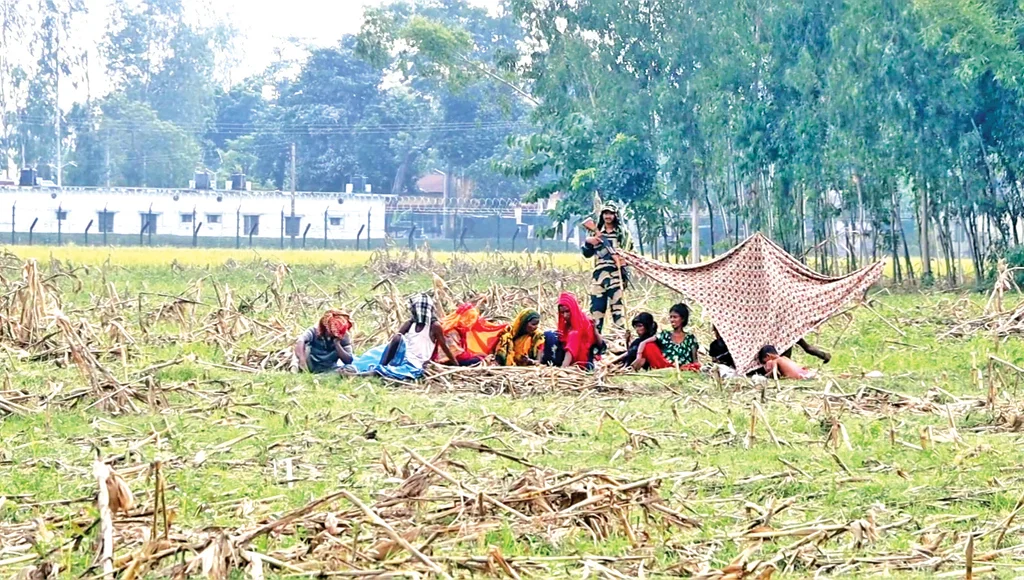
People are left stranded in no-man’s-land as Indian Border Security Force attempts to push people into Bangladesh along the Bangladesh-India border at Haripur in Thakurgaon on Monday. | New Age photo
Scenes of people passing days in no-man’s-land of the Bangladesh-Indian border over the past few days reveal a looming humanitarian crisis fuelled by relentless push-in attempts by the Indian Border Security Force.
In the early hours of Monday, the BSF took back 10 individuals from the zero line near Panchagarh along India after leaving them there for about 70 hours, without any food and shelter.
New Age Correspondent in Panchagrah reported that the group had to take shelter in croplands along border since Friday morning under the open sky amid scorching heat, rain and rough weather as the BGB halted the illegal push-in.
‘BSF took them back at about 2:30am on Monday after consultation with us,’ BGB-56 Battalion commanding officer Lieutenant Colonel Md Sirajul Islam said.
Similar incidents repeated across the border, stretching from Bangladesh’s north to southwest, as the BSF looked for a chance to push the people into Bangladesh.
‘It is really inhuman and sad that people had to stay in such a situation for two or three days under open sky without food and defying rough weather. India should follow diplomatic channel as a responsible country, if any Bangladeshi is staying illegally,’ Dhaka University’s Peace and Conflict Studies department associate professor Muhammad Sazzad Hossain Siddiqui told New Age.
The BSF arbitrarily identified them as Bangladeshi citizens, without the support of any documents and bypassed the law of their own country that requires verification of identities of individuals before deportation.
Different media reports and international human rights bodies said that Indian Muslims were being deported to Bangladesh through push-ins illegally.
BGB officials said that it identified India pushed 126 Indian people into Bangladesh since May 7, 2025 and the BGB pushed them back to India.
Women and children are among the individuals who spent hours under the scorching summer sun and then got drenched in intermittent rains brought by the arrival of the monsoon.
On Monday morning, the Indian BSF took back 11 people, including four women and four children, who were staying at the zero line along the Moshalgaon border under Haripur upazila in Thakurgaon district about 48 hours after push-in attempt, said BGB-42 Battalion in Dinajpur commanding officer Lieutenant Colonel Abdullah Al Moin Hasan.
The border guards of the two neighbouring countries faced off at many points, with BGB resisting BSF’s attempts to push people into Bangladesh – a recurrent phenomenon after India’s ruling Bharatiya Janata Party’s landslide election victory in the West Bengal in early May.
Bangladesh had taken clear stance that it would not allow anyone to push into Bangladesh and India had to follow the legal channel with national identity verification.
A memorandum of understanding was signed between the BGB and the Bangladesh Ansar and Village Defense Party under which Ansar members were deployed in 11 bordering districts to ensure border security, combating cross-border crimes and protecting sovereignty.
The districts are Chapainawabganj, Naogaon, Jaipurhat, Jashore, Jhenaidah, Satkhira, Thakurgaon, Dinajpur, Sylhet, Jamalpur and Khagrachhari, said an Ansar press release issued on Monday evening.
On June 1, BSF attempted to push 100 people into Bangladesh near Benapole Land Port along India and the attempt failed due to BGB obstruction and 10 people, including women and children were stranded in the no-man’s-land for over 48 hours before they were took back on June 3.
BGB headquarters deputy director general (Media) Colonel Abul Hasnat Mohamamd Mahmud Azam said that leaving people, including women and children, for days in the no-man’s-land under the open sky was an inhuman act by the Indian authorities or nothing else.
‘People are staying without having food and sanitation. It cannot be accepted from a responsible force like BSF,’ he added.
The attempts of the Indian BSF to push people into Bangladesh continued as the BGB and local people foiled two more push-in attempts in Lalmonirhat and Noagaon districts between Sunday night and early Monday.
Members of BGB and Bangladesh Ansar and Village Defence Party and villagers thwarted an alleged attempt by India’s BSF to push 15–20 people into Bangladesh through the Porsha border in Naogaon district, New Age Staff Correspondent in Rajshahi reported.
According to BGB and local villagers, BSF personnel allegedly attempted to push a group of 15 to 20 people into Bangladesh at around 11pm on Sunday night through to the Nitpur border outpost at around 11pm.
Lieutenant Colonel Mohammad Ariful Islam, commanding officer of BGB-16 Battalion, said that BSF personnel had tried to push some people into Bangladesh on Sunday night.
‘The attempt was foiled because of the firm position taken by BGB, Ansar members and local residents. No one will be allowed to enter Bangladesh illegally,’ he said.
New Age Correspondent in Lalmonirhat quoting the BGB-15 Battalion in Lalmonirhat commanding officer Lieutenant Colonel Mehedi Imam said that Indian BSF tried to push 70-80 illegally through Aditmari, Durgapur and Patgram in Lalmonirhat early Monday by turning off the lights of the barbed wire fence.
BGB and villagers resistance foiled the BSF’s attempt and they were now stranded in the no-man’s-land but the BGB and villagers took strong position to prevent push-ins, according to the BGB.
BGB, local people and the members of the Bangladesh Ansar and Village Defense Party had foiled over the past few days.
West Bengal, India chief minister Suvendu Adhikari, speaking in the capital Kolkata on Sunday, said nearly 5,000 Bangladeshi citizens had been deported across the border in the past one month, according to an Agence-Franse-Press report.
According to New Age statistics, 2,463 people have been pushed into Bangladesh by Indian authorities, mostly the BSF, from May 7, 2025 to May 8, 2026.
Of them, at least 223 were Rohingyas, including 50 registered with the United Nations High Commissioner for Refugees in India.
But BGB headquarters data reveal that India pushed 2,344 people, including 126 Indian nationals, into Bangladesh between May 7, 2025 and January 26, 2026.
Meanwhile, 45 people -- 17 at a border point in Naogaon early Friday and 28 at another in Chapainawabganj early Thursday -- were left stranded in the no-man’s-land after the BGB sent them back to India immediately following their entry into Bangladesh territory.
They were then taken to the Indian side on Saturday.
According to Bangladesh authorities, Bangladesh shares 4,156-kilometre-long border with India, of which some 180 kilometres fall on different water bodies and 79 kilometres on the Sundarban.
Bangladesh government officials said that pushing people into Bangladesh illegally was an Indian BJP government’s political stance but Dhaka urged New Delhi to follow legal procedure.
BGB signs MoU with Ansar and VDP to patrol borders
Staff Correspondent 09 June, 2026, 00:22
People are left stranded in no-man’s-land as Indian Border Security Force attempts to push people into Bangladesh along the Bangladesh-India border at Haripur in Thakurgaon on Monday. | New Age photo
Scenes of people passing days in no-man’s-land of the Bangladesh-Indian border over the past few days reveal a looming humanitarian crisis fuelled by relentless push-in attempts by the Indian Border Security Force.
In the early hours of Monday, the BSF took back 10 individuals from the zero line near Panchagarh along India after leaving them there for about 70 hours, without any food and shelter.
New Age Correspondent in Panchagrah reported that the group had to take shelter in croplands along border since Friday morning under the open sky amid scorching heat, rain and rough weather as the BGB halted the illegal push-in.
‘BSF took them back at about 2:30am on Monday after consultation with us,’ BGB-56 Battalion commanding officer Lieutenant Colonel Md Sirajul Islam said.
Similar incidents repeated across the border, stretching from Bangladesh’s north to southwest, as the BSF looked for a chance to push the people into Bangladesh.
‘It is really inhuman and sad that people had to stay in such a situation for two or three days under open sky without food and defying rough weather. India should follow diplomatic channel as a responsible country, if any Bangladeshi is staying illegally,’ Dhaka University’s Peace and Conflict Studies department associate professor Muhammad Sazzad Hossain Siddiqui told New Age.
The BSF arbitrarily identified them as Bangladeshi citizens, without the support of any documents and bypassed the law of their own country that requires verification of identities of individuals before deportation.
Different media reports and international human rights bodies said that Indian Muslims were being deported to Bangladesh through push-ins illegally.
BGB officials said that it identified India pushed 126 Indian people into Bangladesh since May 7, 2025 and the BGB pushed them back to India.
Women and children are among the individuals who spent hours under the scorching summer sun and then got drenched in intermittent rains brought by the arrival of the monsoon.
On Monday morning, the Indian BSF took back 11 people, including four women and four children, who were staying at the zero line along the Moshalgaon border under Haripur upazila in Thakurgaon district about 48 hours after push-in attempt, said BGB-42 Battalion in Dinajpur commanding officer Lieutenant Colonel Abdullah Al Moin Hasan.
The border guards of the two neighbouring countries faced off at many points, with BGB resisting BSF’s attempts to push people into Bangladesh – a recurrent phenomenon after India’s ruling Bharatiya Janata Party’s landslide election victory in the West Bengal in early May.
Bangladesh had taken clear stance that it would not allow anyone to push into Bangladesh and India had to follow the legal channel with national identity verification.
A memorandum of understanding was signed between the BGB and the Bangladesh Ansar and Village Defense Party under which Ansar members were deployed in 11 bordering districts to ensure border security, combating cross-border crimes and protecting sovereignty.
The districts are Chapainawabganj, Naogaon, Jaipurhat, Jashore, Jhenaidah, Satkhira, Thakurgaon, Dinajpur, Sylhet, Jamalpur and Khagrachhari, said an Ansar press release issued on Monday evening.
On June 1, BSF attempted to push 100 people into Bangladesh near Benapole Land Port along India and the attempt failed due to BGB obstruction and 10 people, including women and children were stranded in the no-man’s-land for over 48 hours before they were took back on June 3.
BGB headquarters deputy director general (Media) Colonel Abul Hasnat Mohamamd Mahmud Azam said that leaving people, including women and children, for days in the no-man’s-land under the open sky was an inhuman act by the Indian authorities or nothing else.
‘People are staying without having food and sanitation. It cannot be accepted from a responsible force like BSF,’ he added.
The attempts of the Indian BSF to push people into Bangladesh continued as the BGB and local people foiled two more push-in attempts in Lalmonirhat and Noagaon districts between Sunday night and early Monday.
Members of BGB and Bangladesh Ansar and Village Defence Party and villagers thwarted an alleged attempt by India’s BSF to push 15–20 people into Bangladesh through the Porsha border in Naogaon district, New Age Staff Correspondent in Rajshahi reported.
According to BGB and local villagers, BSF personnel allegedly attempted to push a group of 15 to 20 people into Bangladesh at around 11pm on Sunday night through to the Nitpur border outpost at around 11pm.
Lieutenant Colonel Mohammad Ariful Islam, commanding officer of BGB-16 Battalion, said that BSF personnel had tried to push some people into Bangladesh on Sunday night.
‘The attempt was foiled because of the firm position taken by BGB, Ansar members and local residents. No one will be allowed to enter Bangladesh illegally,’ he said.
New Age Correspondent in Lalmonirhat quoting the BGB-15 Battalion in Lalmonirhat commanding officer Lieutenant Colonel Mehedi Imam said that Indian BSF tried to push 70-80 illegally through Aditmari, Durgapur and Patgram in Lalmonirhat early Monday by turning off the lights of the barbed wire fence.
BGB and villagers resistance foiled the BSF’s attempt and they were now stranded in the no-man’s-land but the BGB and villagers took strong position to prevent push-ins, according to the BGB.
BGB, local people and the members of the Bangladesh Ansar and Village Defense Party had foiled over the past few days.
West Bengal, India chief minister Suvendu Adhikari, speaking in the capital Kolkata on Sunday, said nearly 5,000 Bangladeshi citizens had been deported across the border in the past one month, according to an Agence-Franse-Press report.
According to New Age statistics, 2,463 people have been pushed into Bangladesh by Indian authorities, mostly the BSF, from May 7, 2025 to May 8, 2026.
Of them, at least 223 were Rohingyas, including 50 registered with the United Nations High Commissioner for Refugees in India.
But BGB headquarters data reveal that India pushed 2,344 people, including 126 Indian nationals, into Bangladesh between May 7, 2025 and January 26, 2026.
Meanwhile, 45 people -- 17 at a border point in Naogaon early Friday and 28 at another in Chapainawabganj early Thursday -- were left stranded in the no-man’s-land after the BGB sent them back to India immediately following their entry into Bangladesh territory.
They were then taken to the Indian side on Saturday.
According to Bangladesh authorities, Bangladesh shares 4,156-kilometre-long border with India, of which some 180 kilometres fall on different water bodies and 79 kilometres on the Sundarban.
Bangladesh government officials said that pushing people into Bangladesh illegally was an Indian BJP government’s political stance but Dhaka urged New Delhi to follow legal procedure.


