[🇧🇩] Agriculture in Bangladesh

[🇧🇩] Agriculture in Bangladesh
260
12K
More threads by Saif

G Bangladesh Defense

Paddy prices slide ahead of Boro harvest

Early harvesting, policy uncertainty deepen fears of farmer losses

Yasir Wardad

Published :
Apr 17, 2026 08:40
Updated :
Apr 17, 2026 08:40
1776471734614.webp


A sharp fall in paddy prices ahead of the peak Boro harvest has triggered fresh concern among farmers, who fear mounting losses unless the government intervenes swiftly.

The decline, driven by early harvesting and rising supply, has already eroded returns from older stocks, according to market insiders.

With harvesting gathering pace in low-lying areas and no procurement announcement yet, market uncertainty is growing. Farmers and traders alike are now looking to the government for a stabilising signal before the main harvest begins next month (May).

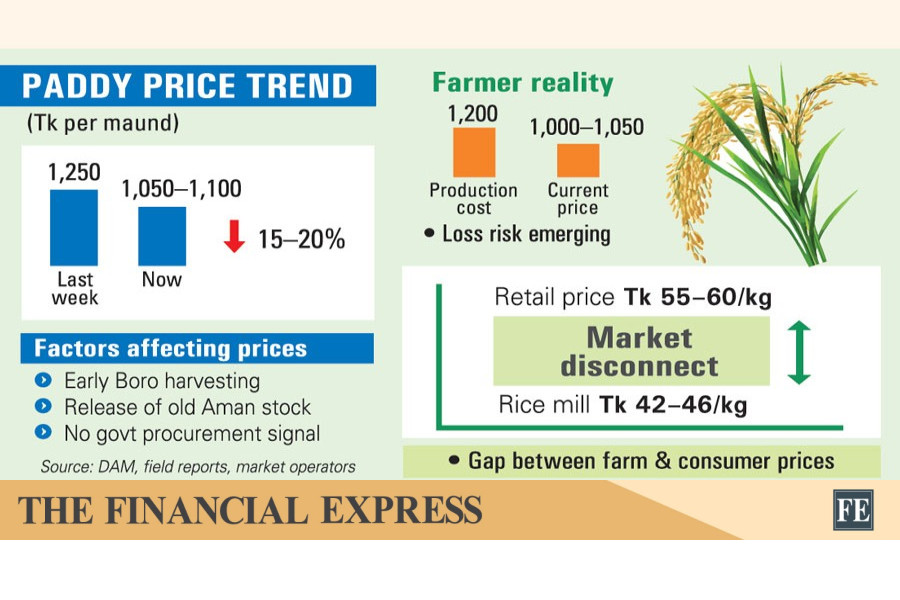
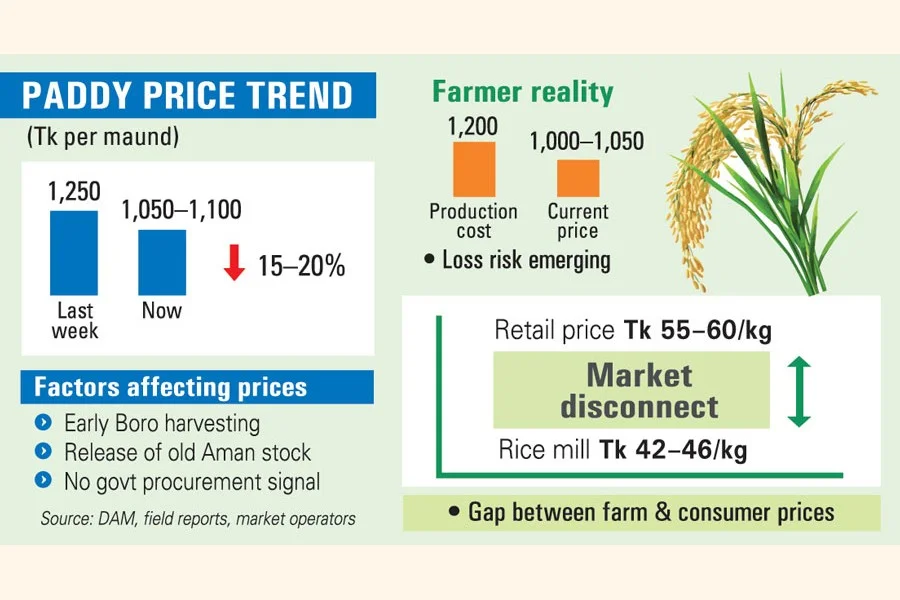
Paddy prices have dropped by 15-20 per cent within a week with the early start of Boro harvesting, raising fears of a deeper fall as peak harvest begins in May.

Paddy from the Aman season, which was selling above Tk 1,250 per maund just a week ago, is now being traded at Tk 1,050-1,100 in Rangpur, Dinajpur, Bogura, Joypurhat and other regions, according to the Department of Agricultural Marketing (DAM).

The sudden drop in older stock has come as a blow for farmers preparing to harvest Boro. As fields turn golden across the country, farmers are now anxiously watching the market and hoping for a timely government signal to avoid losses, insiders said.

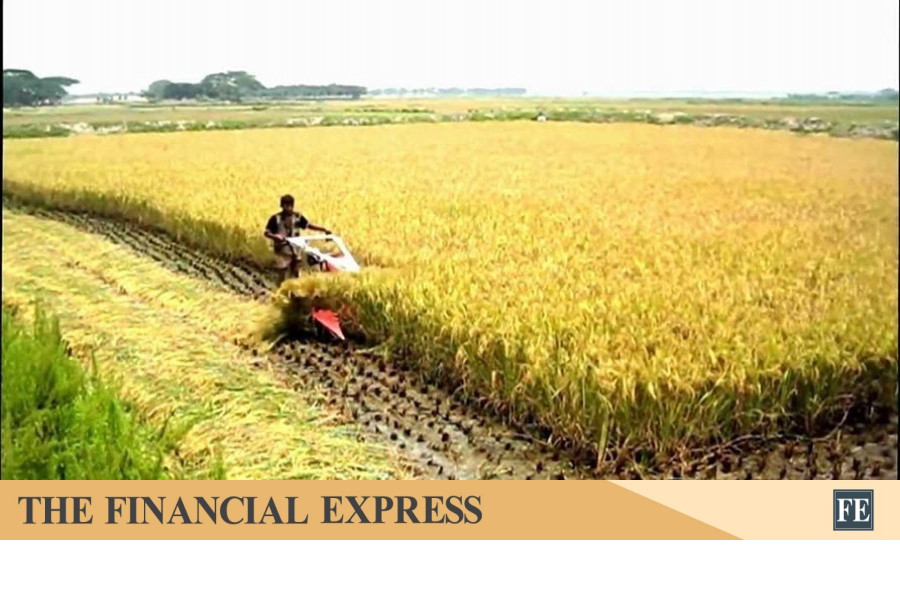
Harvesting has already started in haor, baor, beel and other low-lying areas, adding new supply to the market.

Prices have started falling even before full-scale Boro harvesting, indicating rising supply pressure and weak market confidence.

In contrast, the price of husked rice (coarse variety) has remained stable. It is selling at Tk 42-46 per kg in major milling areas, while retail prices stand at Tk 55-60 per kg in Dhaka, Narayanganj and Gazipur, showing a widening gap between producers and consumers.

"We are in panic," said Rahman Ali, a farmer from Mithamoin in the Kishoreganj haor belt.

"I have already harvested three bighas of land, and another 12 bighas are ready. But the price is only Tk 1,000-1,050 per maund, while production costs exceed Tk 1,200 in my area," he said.

A farmer in Mohanganj of Netrakona expressed similar concern, saying rising costs have worsened the situation.

"Fertiliser, diesel, irrigation and harvesting by combine harvesters - all costs have increased," he said, adding that farmers may face losses if prices fall further.

Omar Faruq, a trader in Nilphamari, said the decline is mainly due to early harvesting and the absence of a government procurement announcement, which usually helps stabilise prices.

Md Shahidul Islam, a rice trader in Dinajpur, said some traders had stocked paddy expecting higher profits but are now releasing it due to falling prices.

"The arrival of new Boro from haor areas and the release of old stock have pushed prices down," he said.

He said that a government procurement announcement usually brings stability. "When the government declares procurement prices, it gives confidence to both farmers and traders. Now everyone is waiting for that announcement," he added.

Agricultural economist Prof Golam Hafeez Kennedy warned that the current trend could have serious consequences if not addressed quickly.

He said farmers growing onion and potato have already suffered heavy losses this year due to sharp price drops, and Boro farmers now face a similar risk.

"If prices fall further during peak Boro harvest, farmers may not recover their costs. This could discourage cultivation in the next season," he said.

He urged the government to announce the procurement price immediately and increase procurement volume to support farmers, especially amid the ongoing global fuel crisis linked to tensions in the Middle East.

Bangladesh produced around 20 million tonnes of rice in the Boro season last year, which accounts for about 55 per cent of total annual production. The government has set a higher production target of 20.6 million tonnes for the current season.​
 

Govt working to make agri sector self-reliant, says minister
Bangladesh Sangbad Sangstha . Cumilla 17 April, 2026, 22:47

1776475687431.webp

Fisheries, livestock and agriculture minister Mohammed Aminur Rashid. | PID photo

Fisheries, livestock and agriculture minister Mohammed Aminur Rashid on Friday said that the government was working to make the country’s agriculture sector self-reliant.

He said that around 70 per cent of the population depended directly or indirectly on agriculture, adding that a strong agricultural sector was essential for a strong national economy.

The minister made the remarks while speaking as chief guest at a ‘Farmer Card’ distribution programme, at the Bibir Bazar High School and College ground in Cumilla Sadar Adarsha Upazila.

He said that the introduction of ‘Farmer Card’ would help eliminate the role of middlemen in agricultural marketing, ensuring fair prices for farmers.

Under the initiative, small, marginal and landless farmers will receive Tk 2,500 in incentives, which they can use to purchase fertiliser, seeds, pesticides and other agricultural inputs.

On agricultural modernisation, the minister said that the government was providing machinery to farmers at 50-70 per cent subsidy, which would also be facilitated through the farmer card system.

He added that agricultural loans and insurance facilities would also be made available through the card.

The minister further said that the government had a plan to expand solar-powered irrigation pumps across the country. Farmers with ‘Farmer Card’ will receive these facilities through cooperatives, he added, saying that the integrated initiatives would help make agriculture self-reliant.

After the programme, the minister inaugurated an agricultural fair set up adjacent to the venue and visited stalls of various departments and agencies under the Ministry of Agriculture.

Cumilla district commissioner Md Reza Hasan presided over the event.

Haji Jasim Uddin MP, Atikul Alam Shawon MP, Cumilla City Corporation administrator Yusuf Molla Tipu, District Council administrator Mostak Mia, agriculture secretary Rafiqul E Mohame and fisheries and livestock secretary Md Delwar Hossain, among others, attended the event.​
 

FROM REMITTANCES TO INVESTMENT

Exporting agri-entrepreneurship

1776819564156.webp

There is a huge potential for Bangladeshi agri-entrepreneurs in Africa, home to nearly 60 per cent of the world’s uncultivated arable land. | The Habari Network

BANGLADESH has successfully ‘exported’ agricultural labour for decades to Qatar and Malaysia, where our farmers have evolved from labourers into entrepreneurs. This article proposes a formal policy shift — from unorganised labour migration to state-backed agricultural investment in English-speaking African nations such as Nigeria, Ghana, Kenya and Zambia. By adopting a structured and strategic approach, Bangladesh can secure external food sources, diversify export earnings and elevate the status of its farmers — from wage earners to global farm managers and investors. Our farmers have already demonstrated remarkable adaptability across diverse climates and regulatory environments, making this transition not only feasible but strategically compelling.

The Qatar experience

IN RESPONSE to food security initiatives, Bangladeshi migrants in Qatar moved beyond manual labour to leasing land in Al Khor and Al Shamal. They now manage over 1,100 farms, contributing to approximately 46 per cent vegetable self-sufficiency. Their production includes eggplants, gourds and herbs — demonstrating both technical competence and entrepreneurial initiative. Many have since diversified into livestock, honey production and experimental fish farming, signalling a transition from subsistence labour to commercial agriculture.

The Malaysia experience

IN THE Cameron Highlands and across palm oil plantations, Bangladeshi workers are widely regarded as ‘indispensable.’ They constitute a significant share of the plantation workforce and often handle complex harvesting and field operations that local labour avoids. Their role has gradually expanded from manual execution to operational management within large-scale agro-industrial systems.

Labour export to agri-entrepreneurship

ACROSS both regions, a clear trajectory is visible: from labourer to entrepreneur. This accumulated experience — managing commercial agriculture under foreign regulatory systems — represents a pre-trained global asset. It is this transformation — from labour export to capability export — that now opens the door to capital-backed agricultural expansion abroad.

Market analysis: selected African countries

FOR an effective pilot phase, focus should be placed on English-speaking countries with abundant arable land, growing food demand and relatively stable policy environments.

Nigeria offers large-scale opportunities in rice and vegetable production, supported by strong domestic demand and linguistic compatibility.

Ghana presents a stable political environment suitable for long-term land leasing, particularly in roots, tubers and horticulture.

Kenya provides entry into high-value sectors such as floriculture and legumes, supported by an established commodity exchange infrastructure.

Zambia stands out for its vast uncultivated arable land and investor-friendly climate, particularly for cereal grains and livestock.

These countries are not merely destinations — they are platforms for outward agricultural expansion, where Bangladeshi farmers can transition from workers to investors within scalable production systems.

Product roadmap: short-term vs long-term strategy

INITIAL efforts should concentrate on crops where Bangladeshi farmers already possess immediate efficiency and short production cycles. Vegetables such as bitter gourd, pointed gourd (patol) and snake gourd offer high yields and strong demand in both diaspora and urban markets.

Horticultural expansion into quick-growing fruits like dragon fruit and malta builds on recent domestic success. Herbs such as mint, parsley and coriander provide high turnover with minimal land requirements. These are not experimental crops — they are proven competencies ready for export replication.


The long-term vision must move beyond cultivation into integrated value creation.

Agro-processing facilities — producing jams, pickles and fruit pulps — can reduce post-harvest losses and increase value retention. Commercial plantations can draw directly on Malaysian experience in palm oil and rubber, as well as East African models for tea and coffee.

Livestock and fisheries, including poultry and aquaculture, can replicate the entrepreneurial diversification already observed in Qatar. The objective is clear: transition from production to value-chain control, where Bangladesh captures not only output but also processing, branding and distribution margins.

Policy recommendations for adoption

GOVERNMENT-TO-GOVERNMENT (G2G) agreements should establish ‘Agri-Technical Visas’ for trained Bangladeshi farmers. The Export Promotion Bureau should create a dedicated agri-export desk to provide real-time intelligence on phytosanitary standards, trade barriers and market access conditions. A pilot program should deploy approximately 500 experienced farmers from Qatar and Malaysia as ‘farmer-contractors’ to initiate operations in Nigeria or Ghana.

For long-term policy, the Planning Commission should establish a migrant agri-investor fund, enabling farmers to access low-interest financing for overseas land leasing, using remittance flows as collateral.

Traceability systems and Good Agricultural Practices (GAP) certification must be implemented to ensure global export compliance.

Vocational accreditation should formalise the status of migrant farmers as technical managers, replacing the outdated classification of ‘unskilled labour.’

To operationalize this structural shift into a fully executable economic program, the policy framework must be anchored in financial, legal and institutional precision. The proposal must integrate a rigorous capital expenditure framework for the initial pilot program, underpinned by specific return on investment projections that quantify the expected impact on national foreign currency reserves through expanded export earnings, while simultaneously establishing bilateral legal protocols to safeguard land-tenure rights and formalise dispute-resolution mechanisms within the regulatory environments of host nations such as Nigeria or Zambia.

By incorporating a public-private partnership module — which links independent farmer-entrepreneurs with established agro-processing firms to produce value-added goods such as fruit pulps and jams — the policy creates a concrete pathway for capturing high-margin branding and global distribution channels. Taken together, these elements transform the proposal from a persuasive conceptual case into an actionable engine for economic sovereignty, ready for immediate adoption by the Planning Commission.

Institutional framework

TO MOVE beyond the limitations of unorganised labour migration, this strategy requires a dedicated institutional anchor. The state should, therefore, establish a foreign direct investment entity — the Bangladesh Global Agri-Investment Corporation — under a public-private partnership model. Rather than farmers seeking fragmented individual leases, this state-backed special purpose vehicle would negotiate sovereign-level land concessions in countries such as Zambia or Nigeria, providing a unified legal umbrella for land-tenure security and dispute resolution.

The corporation would operationalize the migrant agri-investor fund by financing centralised ‘agri-hubs’ equipped with cold-chain logistics, storage and processing facilities. In doing so, it would fundamentally alter the risk structure of overseas farming: Bangladeshi farmers would no longer operate as vulnerable independent migrants, but as equity-holding technical managers within a secure, state-insured value chain.

This institutional architecture makes the policy implementable in concrete terms. Legal risks are transferred from individual farmers to a sovereign-backed entity capable of negotiating and enforcing bilateral agreements. Infrastructure constraints — such as electricity, storage and processing — are resolved through shared agri-hubs that no individual farmer could finance alone. Financial viability improves dramatically, as banks are far more willing to lend to a state-backed corporation than to migrants relying on remittance-based collateral. Most importantly, scale is achieved: a pilot group of 500 farmers can function not as dispersed actors, but as a coordinated ‘mega-farm,’ enhancing bargaining power in global markets and enabling integration into high-value distribution networks.

Conclusion

THE Export Promotion Bureau must move beyond identifying products to identifying capabilities. Our farmers are not merely labour exports — they are mobile repositories of agricultural knowledge, adaptability and entrepreneurial potential. What has already occurred organically in Qatar and Malaysia now calls for deliberate policy design. Transforming them from migrant labourers into global farm owners and managers is not only feasible — it is a data-backed strategic pathway towards Bangladesh’s long-term economic resilience. It marks a decisive shift from exporting labour to exporting capability, and ultimately to embedding Bangladeshi capital and expertise within global agricultural systems.

Dr Abdullah A Dewan, formerly a physicist and nuclear engineer at BAEC, is an emeritus professor of economics at Eastern Michigan University, USA. Humayun Kabir is a former senior official of the United Nations in New York.​
 

Higher exports bring no relief to potato farmers

Retail price in Dhaka remains the same as last year, as per TCB

Mostafa Shabuj

1777509696508.webp

Farmers wash freshly harvested potatoes beside a pond in Gobindaganj upazila of Gaibandha, as growers struggle to sell amid a supply glut that has outpaced demand this year. Photo: Mostafa Shabuj

Potato exports this year so far surpass last year's figures by 10.7 percent, yet that is not enough to cover a surplus in production and bring relief to farmers.

As per provisional data from the Department of Agricultural Extension (DAE), so far, approximately 1.17 crore tonnes of potatoes have been produced this year, compared to about 1.15 crore tonnes last year. This indicates a possible increase of over 200,000 tonnes year-on-year.

The official Bangladesh Bureau of Statistics (BBS) data on potato production is yet to be published, however.

On the other hand, according to the DAE, the Bangladesh Cold Storage Association (BCSA), and the Bangladesh Potato Exporters Association, the annual demand for potatoes in Bangladesh is 85 to 90 lakh tonnes.

BCSA said 36 lakh tonnes of potatoes are currently stored in cold storage, which is 1 lakh tonnes more than last year.

Meanwhile, the Plant Quarantine Wing of the DAE shared that potato exports in FY26 so far (as of April 29) were 52,293 tonnes. Exports in FY25 as of April 30 stood at 47,225 tonnes. The increase stands at a little over 5,000 tonnes, not nearly enough to cover the excess production this year.

Experts in this sector have blamed several factors for the meagre exports, namely, low cultivation of export-quality potatoes and higher production costs than neighbouring nations.

Gap between production and export

AKM Mafidul Islam, deputy director (export) of the Plant Quarantine Wing, said the export momentum is better this year compared to previous years.

“Furthermore, the Vietnamese market has recently opened up for Bangladeshi potato exporters.”

He remained hopeful that potato exports would rise this year.

Ferdousi Begum, chairman of the Bangladesh Potato Exporters Association, said, “The demand for potatoes in Bangladesh is only 85 lakh tonnes, but we have had a surplus since 2007.”

“There is not much demand for Bangladeshi potatoes anywhere except Malaysia.”

Some go to Nepal, but the potatoes get damp from rain in July during the loading and unloading process, and it lowers the quality, she said.

Mostofa Azad Chowdhury Babu, president of the BCSA, said, “The main problem with exporting potatoes from Bangladesh is that the production cost is higher than in neighbouring countries.”

“This year, the cost of producing one kilogramme of potatoes in the Northern districts was Tk 15 and Tk 19 in Munshiganj. In contrast, the production cost in India is around Tk 10. Due to this, Nepal is buying from India instead of Bangladesh this year, Babu said.

“Furthermore, the cultivation of export-quality potatoes in Bangladesh is still significantly low.”

Growing frustration for potato growers

Farmers have complained of low prices despite a record harvest.

Rafiqul Islam, a farmer from Chhatianpara village in Bogura's Shibganj upazila, said his potato crop on 9 bighas of land was damaged by rain. Despite the government's assurances, he has yet to receive any assistance.

Abdul Motin, a farmer at Shibganj’s Kichak bazar, a major hub for potato wholesalers, said that the price of local variety ‘Pakri’ potatoes has dropped by half compared to the start of the season. The surplus supplies have kept prices low, he told this correspondent, while farmers are struggling to sell off the excess.

Discouraged by the lack of profit, Sakiul Islam, a farmer from Rajahar village in Gaibandha’s Gobindaganj upazila, said he plans to only grow enough potatoes for personal consumption in the future.

Nayeem Islam, a farmer from Biala village in Joypurhat’s Kalai upazila, said he plans to drop potato cultivation entirely from next year.

Meanwhile, retail prices for potatoes in Dhaka have remained between Tk 20 and Tk 25 per kg, as per the Trading Corporation of Bangladesh (TCB). The prices were the same this time last year.

Likely measures to contain the crisis

Farmers are currently producing more potatoes than needed, said Abdur Rahim, director general of the DAE.

"For this reason, the government is working to increase potato usage by processing them alongside exports."

He said the government plans to create a database in the future using farmer cards.

“We will then be able to determine exactly how much land should be used for potato cultivation based on national demand,” the DG added.

Talking to The Daily Star, prominent agricultural economist Jahangir Alam Khan listed several measures the government could take to mitigate this crisis.

"This year, the government could set a minimum procurement price for potatoes.”

He suggested the government buy and store at least 10 percent of the total production at this fixed price to stabilise the market, releasing the potatoes later when prices rise.​
 

Bailing out rain-hit haor area's Boro farmers

SYED FATTAHUL ALIM

Published :
May 04, 2026 00:23
Updated :
May 04, 2026 00:23

1777851982635.webp


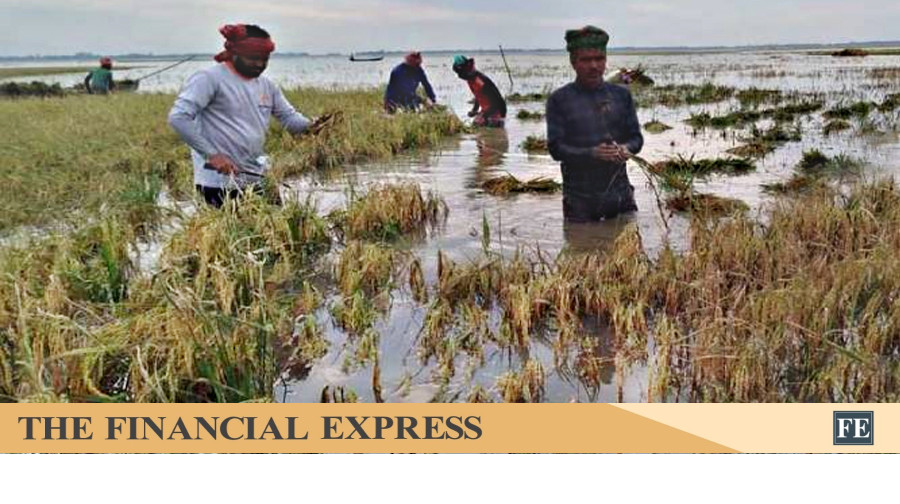
Boro, with its annual share of the country's total rice output ranging approximately from 55 per cent to 60 per cent, is actually the largest contributor to Bangladesh's total rice production. As an irrigated crop of dry season, it outperforms the monsoon-dependent Aman (roughly 35-39 per cent ) and Aus (roughly 7-10 per cent), making it critical for national food security. And of this total share, the seven haor districts, namely, Sylhet, Sunamganj, Moulvibazar, Habiganj, Netrokona, Kishoreganj and Brahmanbaria, together contribute approximately18 to 20 per cent to the total national Boro output. But the haor areas at present are facing serious climate-induced hazards originating from heavy pre-monsoon rain. As a result, the Boro crop of haor districts which is harvested between April and June have gone under water. Notably, in some districts such as Netrokona, most of the haor areas grow a single crop, which is usually Boro paddy. So, this crop is the only source of sustenance for the farmers of the haor areas of the districts all the year round. But due to the heavy rain and flash floods from the upstream region during the harvest time, farmers are facing an uncertain future. There is labour shortage and the harvesting machines, too, cannot work in deep water. Now with their rice under water, the predicament before farmers is not one of just counting losses, but also of their very survival. The indebted farmers, who loaned from banks, credit-giving NGOs or local money lenders, are in dire straits. Meanwhile, the production cost of rice has also increased due to rise in labour and other input costs. Especially, due to the rise in diesel price, the irrigation cost, too, has gone up. According to an estimate, last year a farmer would invest about Tk33 to produce a kg of rice.
FE

Considering the increased cost of labour and irrigation, thanks to diesel price hike, production cost of rice has increased by Tk 2.0 per kg. The rice which has already been harvested is rotting as drying is problematic without chatals (raised platforms for drying foodgrains) and enough sunshine. Obviously, the middlemen are taking advantage of the situation and buying the harvested rice at very low prices from farmers. In some rain-hit haor districts, to avoid their harvested wet rice getting further damaged, farmers are compelled to sell their rice at prices as low as Tk 500 to Tk600 per maund (1 maund is approximately 37.32 kg). District administrations of the haor areas are advising farmers to store rice and wait until the government procurement begins when they might get a fair price for their crop. But it all depends on the weather condition. If rain stops, the water recedes and sunshine returns, they will be able to dry and store their rice and expect better price for their rice from the government. In that case, the government officials in charge of procurement have to be instructed not to harass farmers as they usually do under various pretexts. But poor farmers cannot depend on just assurances of a future which is uncertain. They actually need government's financial support for survival. According to an estimate, this year, boro paddy was cultivated on 6.3 lakh hectares of land in the seven haor districts. It is feared that about 77,000 hectares of boro crop in the haor basin might have gone under floodwater. Going by the record of Boro yield of the previous year at four metric tons per hectare, around three hundred thousand metric tons of Boro crop in the haor basin are at risk of being damaged by floods. According to the Department of Agricultural Extension (DAE), that is a significant portion of the total Boro output at 21.30 million metric tons (last year's yield). However, it is not for the first time that haor basin farmers have been facing livelihood-destroying crop losses owing to vagaries of nature.

In fact, the pre-monsoon rainfalls, flash floods from the upstream regions from across the border, breach in the embankments and other kinds of unpredictability are not quite a new experience in the haor areas. In other words, this boro harvesting season's downpours or flashfloods are not something out of the ordinary. In fact, to haor farmers, such experience is common at least for a decade. So, one wonders, why were no appropriate measures taken in advance to protect haor farmers from the predictable natural calamities? In most cases, the makeshift embankments built by farmers cannot stand the pressure of flashfloods whether caused by untimely downpours or rush of water from the upstream. So, this season's damage to boro rice due to the inundation caused by rain could well be averted through early intervention by the government. The farmers of the inundated haor areas complain that there is no channel to drain out the accumulated rain or floodwater. If there was arrangement to empty the water from the flooded boro fields, they could harvest the crops to prevent those from rotting under water. So, purely blaming the untimely rain won't do. Some experts hold the view that as part of helping the rain-hit boro farmers, the government can buy the wet boro rice from farmers and get those dried from the chatals in other areas not affected by rain.

The chatal owners would help dry the wet paddy and even husk it into rice upon payment of the required charges. The cost of drying and husking the wet rice could well be adjusted from the higher price (Tk1400 per maund) at which the government is going to purchase unhusked rice from farmers this year. In fact, there are many ways to stand beside Boro farmers of the haor areas in need. The good news is that the government is learnt to have brought forward the date of purchasing the husked rice from farmers of six haor districts from 15th May to 3rd May when both husked rice and boro paddy would be bought from farmers. That would definitely be of help for farmers at a loss with rain-damaged Boro rice. While haor area Boro yield is part of ensuring the nation's food security, the upcoming Aman season would also play a significant role in that respect. So, procuring the required amount of fertilizers for the purpose will now be the main task before the government. There are 0.34 million tons of urea reportedly in government stock, where 0.4 million tons is considered safe level. The government has been trying to buy 0.2 million tons of urea from private sources through inviting tenders but with no success so far. So, ensuring an adequate stock of fertilizers for the next cropping seasons remains a challenge before the government.​
 

Latest Posts

Back
Top Bottom