Bangladesh Defense
Saif
Senior Member
- Jan 24, 2024
- 21,040
- 9,686
- Nation

- Residence
- Axis Group


35 years of the 1991 cyclone: a call for building coastal resilience
As a country there is no way we can prevent natural hazards like cyclones, flooding and sea level rise but we can reduce disaster risks by building our own resilience through adaptation measures, applying nature-based solutions and building buffer zones, effective community engagement, early...
 en.prothomalo.com
35 years of the 1991 cyclone: a call for building coastal resilience
As a country there is no way we can prevent natural hazards like cyclones, flooding and sea level rise but we can reduce disaster risks by building our own resilience through adaptation measures, applying nature-based solutions and building buffer zones, effective community engagement, early warning systems, and necessary infrastructural development
Parvez Uddin Chowdhury
Published: 29 Apr 2026, 08: 10
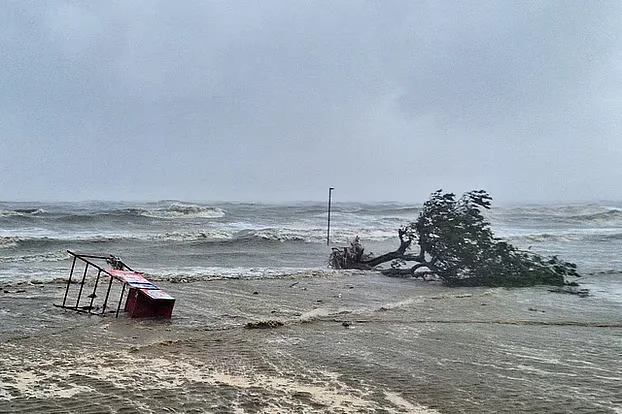
Cyclone causes large swaths of land in the coastal areas to go under water AFP
After long dry season, April is traditionally seen as a time of renewal of nature. Nature stirs back to life with the first rain. It is a new beginning that brings joy and hope to people and to every other creature in nature. But for the coastal people of southern Chattogram, April is not only a month of hope and celebration but also of fear – fear of devastating cyclones, violent storm surges and flooding.
TS Eliot called April ‘the cruelest month’ in his poem The Wasteland. His description deeply resonates with the people who survived the catastrophic 1991 cyclone that struck the southeastern coastal belt of Bangladesh.
Today marks the 35th anniversary of the 1991 cyclone. It was one of the most powerful cyclones ever recorded in history that killed over 140,000 people including more than 40,000 from Banshkhali alone. Though all the coastal areas were affected, the majority of the fatalities occurred in the southeastern coastal belt that includes Banshkhali, Anowara, Chakaria, Pekua, Kutubdia and Moheskhali. In addition to the immense human toll, the cyclone left over 10 million people homeless across the belt. Overall property and infrastructure damage was in billions of dollars.
People living along the coast are often considered to be naturally brave and resilient as they survive facing the harsh behavior of the sea. For them, cyclones and flooding are not rare incidents. Yet for those who endured the 1991 cyclone, resilience does not mean fearlessness. The trauma of that night is still alive, and many who survived say they would not wish to confront such a calamity again. Coastal people in southern Chattogram still continue to bear the haunting memories of that disastrous cyclone. Decades later, the disaster remains a powerful collective memory for the people of the entire coastal belt.
I was born in a seaside village in Banshkhali, Chattogram. We suffered the loss of many family members, and all our properties were lost during the cyclone. My father often recalls the haunting memories of that powerful cyclone. It made landfall at night with storm surges as tall as a two-storey building that flooded the entire coastal villages within seconds. The whole night was horrific with salty rain and violent wind. There were no cyclone shelters at that time and also no effective early warning system. Like many others, my father survived holding the floating roof of our thatched house and my mother survived clinging to a tree.
Every year thousands of people are being displaced, losing livelihoods in the coastal areas due to various climate effects. Reports are often seen that mangroves along the coastline are being erased for shrimp projects and salt-producing fields leaving people without adequate natural protection.
My father says the aftermath was even more catastrophic. Much of the water had receded by the morning. Everything was swept away; the entire coastline became unfamiliar. Those who survived started looking for the missing family members. Searching was difficult as there was no visible road, on top of that, people were hungry, had nothing to eat. There were dead bodies floating everywhere face lying down. After few days, army personnel arrived and started burying dead bodies and people got some dry food being dropped from helicopters.
My parents live in the village. They still get terrified when a cyclone alert is issued in April and May. My mother repeatedly calls me to ask how far my home is from the sea and urges me to seek shelter on high ground. Her concern may sound excessive or even awkward to me, but she speaks from lived experience—and she means it with absolute seriousness.
Building coastal resilience
Powerful cyclones hitting the coastal belts along the Bay of Bengal is not new. Due to various geographical factors, the Bay of Bengal is often called a hotbed for powerful tropical cyclones. Majority of the deadliest tropical cyclones in world history occurred here. According to a report by Weather Underground, 26 of the 35 deadliest tropical cyclones in recorded history have occurred in the Bay.
Because of global warming and sea level rise, scientists say intensity of cyclones is increasing. Every year there are a lot of research, reports and newspaper articles consistently being published highlighting the diverse climate related challenges being faced by the coastal people and calling for urgent action.
It is not unknown to us that sea level in the Bay of Bengal is rising faster than global average. And on top of that, recent reports reveal that sea level in the eastern coast is rising faster than the western coast. So, coastal lowlands in Chattogram and people living along the belt are at greater risk of being affected.
Every year thousands of people are being displaced, losing livelihoods in the coastal areas due to various climate effects. Reports are often seen that mangroves along the coastline are being erased for shrimp projects and salt-producing fields leaving people without adequate natural protection.
Along Banshkhali coastal belt, since 2005, we have seen dramatic changes including powerful tidal flooding, breaking of embankments, uprooting of trees, erosion of coastal land, displacement of people, high salinity in the rice fields and so on. Many elderly people say they have not witnessed such turbulence in the bay''s waters in the last 100 years.
Banshkhali being an outlying upazila has often been overlooked and remained out of focus, particularly its western coastal villages. There are places with broken and poor embankments. Monsoon is approaching bringing with it worry and anxiety.
Every year, climate effects along the coastal belt are increasing and reminding us of the need to build more coastal resilience. Traditional hard solutions such as concrete seawalls, embankments reinforced with concrete blocks, or geo-bags, on their own, are insufficient to provide long-term protection. These measures need to be complemented by nature-based measures, including the restoration of mangroves, saltmarshes, and other coastal ecosystems that work as buffer zones. In some parts of Banshkhali shoreline, mangroves and saltmarshes are making significant changes in restoring coastal ecosystems which can be studied and applied in other places.
We have to remember that our coastlines are inherently very dynamic and diverse. One can visit Banshkhali shoreline to observe that clearly. Because of this variability, coastal interventions must be grounded in location-specific research. Blanket policies have already proven ineffective.
As a country there is no way we can prevent natural hazards like cyclones, flooding and sea level rise but we can reduce disaster risks by building our own resilience through adaptation measures, applying nature-based solutions and building buffer zones, effective community engagement, early warning systems, and necessary infrastructural development.
* Parvez Uddin Chowdhury is a development worker and climate enthusiast.
As a country there is no way we can prevent natural hazards like cyclones, flooding and sea level rise but we can reduce disaster risks by building our own resilience through adaptation measures, applying nature-based solutions and building buffer zones, effective community engagement, early warning systems, and necessary infrastructural development
Parvez Uddin Chowdhury
Published: 29 Apr 2026, 08: 10
Cyclone causes large swaths of land in the coastal areas to go under water AFP
After long dry season, April is traditionally seen as a time of renewal of nature. Nature stirs back to life with the first rain. It is a new beginning that brings joy and hope to people and to every other creature in nature. But for the coastal people of southern Chattogram, April is not only a month of hope and celebration but also of fear – fear of devastating cyclones, violent storm surges and flooding.
TS Eliot called April ‘the cruelest month’ in his poem The Wasteland. His description deeply resonates with the people who survived the catastrophic 1991 cyclone that struck the southeastern coastal belt of Bangladesh.
Today marks the 35th anniversary of the 1991 cyclone. It was one of the most powerful cyclones ever recorded in history that killed over 140,000 people including more than 40,000 from Banshkhali alone. Though all the coastal areas were affected, the majority of the fatalities occurred in the southeastern coastal belt that includes Banshkhali, Anowara, Chakaria, Pekua, Kutubdia and Moheskhali. In addition to the immense human toll, the cyclone left over 10 million people homeless across the belt. Overall property and infrastructure damage was in billions of dollars.
People living along the coast are often considered to be naturally brave and resilient as they survive facing the harsh behavior of the sea. For them, cyclones and flooding are not rare incidents. Yet for those who endured the 1991 cyclone, resilience does not mean fearlessness. The trauma of that night is still alive, and many who survived say they would not wish to confront such a calamity again. Coastal people in southern Chattogram still continue to bear the haunting memories of that disastrous cyclone. Decades later, the disaster remains a powerful collective memory for the people of the entire coastal belt.
I was born in a seaside village in Banshkhali, Chattogram. We suffered the loss of many family members, and all our properties were lost during the cyclone. My father often recalls the haunting memories of that powerful cyclone. It made landfall at night with storm surges as tall as a two-storey building that flooded the entire coastal villages within seconds. The whole night was horrific with salty rain and violent wind. There were no cyclone shelters at that time and also no effective early warning system. Like many others, my father survived holding the floating roof of our thatched house and my mother survived clinging to a tree.
Every year thousands of people are being displaced, losing livelihoods in the coastal areas due to various climate effects. Reports are often seen that mangroves along the coastline are being erased for shrimp projects and salt-producing fields leaving people without adequate natural protection.
My father says the aftermath was even more catastrophic. Much of the water had receded by the morning. Everything was swept away; the entire coastline became unfamiliar. Those who survived started looking for the missing family members. Searching was difficult as there was no visible road, on top of that, people were hungry, had nothing to eat. There were dead bodies floating everywhere face lying down. After few days, army personnel arrived and started burying dead bodies and people got some dry food being dropped from helicopters.
My parents live in the village. They still get terrified when a cyclone alert is issued in April and May. My mother repeatedly calls me to ask how far my home is from the sea and urges me to seek shelter on high ground. Her concern may sound excessive or even awkward to me, but she speaks from lived experience—and she means it with absolute seriousness.
Building coastal resilience
Powerful cyclones hitting the coastal belts along the Bay of Bengal is not new. Due to various geographical factors, the Bay of Bengal is often called a hotbed for powerful tropical cyclones. Majority of the deadliest tropical cyclones in world history occurred here. According to a report by Weather Underground, 26 of the 35 deadliest tropical cyclones in recorded history have occurred in the Bay.
Because of global warming and sea level rise, scientists say intensity of cyclones is increasing. Every year there are a lot of research, reports and newspaper articles consistently being published highlighting the diverse climate related challenges being faced by the coastal people and calling for urgent action.
It is not unknown to us that sea level in the Bay of Bengal is rising faster than global average. And on top of that, recent reports reveal that sea level in the eastern coast is rising faster than the western coast. So, coastal lowlands in Chattogram and people living along the belt are at greater risk of being affected.
Every year thousands of people are being displaced, losing livelihoods in the coastal areas due to various climate effects. Reports are often seen that mangroves along the coastline are being erased for shrimp projects and salt-producing fields leaving people without adequate natural protection.
Along Banshkhali coastal belt, since 2005, we have seen dramatic changes including powerful tidal flooding, breaking of embankments, uprooting of trees, erosion of coastal land, displacement of people, high salinity in the rice fields and so on. Many elderly people say they have not witnessed such turbulence in the bay''s waters in the last 100 years.
Banshkhali being an outlying upazila has often been overlooked and remained out of focus, particularly its western coastal villages. There are places with broken and poor embankments. Monsoon is approaching bringing with it worry and anxiety.
Every year, climate effects along the coastal belt are increasing and reminding us of the need to build more coastal resilience. Traditional hard solutions such as concrete seawalls, embankments reinforced with concrete blocks, or geo-bags, on their own, are insufficient to provide long-term protection. These measures need to be complemented by nature-based measures, including the restoration of mangroves, saltmarshes, and other coastal ecosystems that work as buffer zones. In some parts of Banshkhali shoreline, mangroves and saltmarshes are making significant changes in restoring coastal ecosystems which can be studied and applied in other places.
We have to remember that our coastlines are inherently very dynamic and diverse. One can visit Banshkhali shoreline to observe that clearly. Because of this variability, coastal interventions must be grounded in location-specific research. Blanket policies have already proven ineffective.
As a country there is no way we can prevent natural hazards like cyclones, flooding and sea level rise but we can reduce disaster risks by building our own resilience through adaptation measures, applying nature-based solutions and building buffer zones, effective community engagement, early warning systems, and necessary infrastructural development.
* Parvez Uddin Chowdhury is a development worker and climate enthusiast.