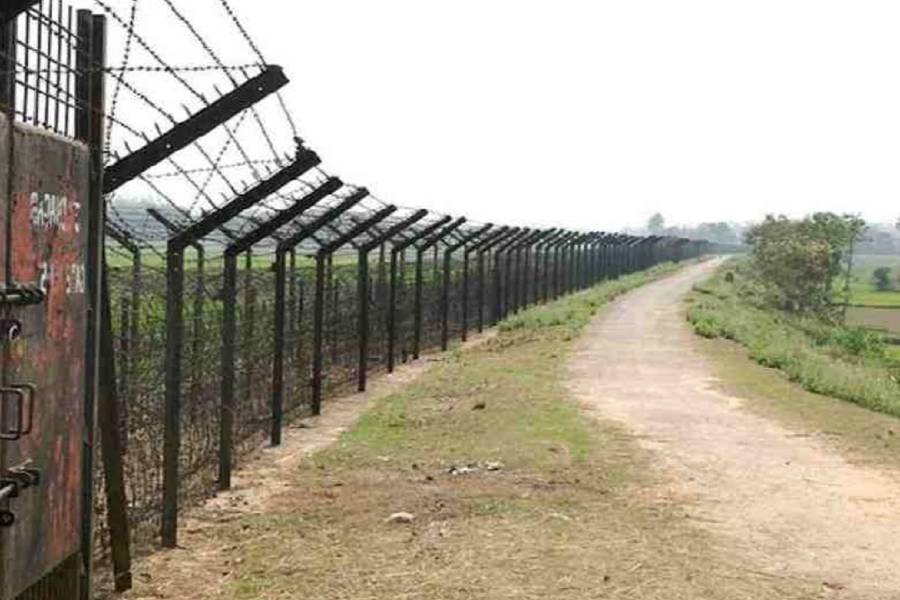
[🇧🇩] Atrocities of BSF/How BGB responds

[🇧🇩] Atrocities of BSF/How BGB responds
245
11K
More threads by Saif

G Bangladesh Defense

BSF returns body of Bangladeshi after flag meet

Published :
Jul 06, 2025 18:44
Updated :
Jul 06, 2025 18:44

1751843359211.webp


Indian Border Security Force (BSF) returned the half-decomposed body of a Bangladeshi on Saturday night, three days after he was allegedly shot dead along Nitpur border in Porsha upazila of Naogaon district.

The deceased was identified as Ibrahim Hossain, 40, a resident of Rodgram village under Nitpur union of the upazila, reports UNB.

According to locals, Ibrahim took his cattle to graze near the border on Thursday morning when the BSF members from India's Agrabad Camp reportedly opened fire on him, killing him on the spot.

Later, the BSF took the body to India.

Though the BSF initially denied the killing, later they admitted and returned the body through the Nitpur border around 10pm on Saturday, Bangladesh sources said.

Mahfuzur Rahman, company commandant of the BGB-16 Battalion in Nitpur Camp, said they, accompanied by police, received the body from the BSF and subsequently handed it to the family.

Earlier a flag meeting was held between the BGB and BSF in this regard, he said.​
 

Days of India’s intimidation at the border are over: Nahid Islam
Staff Correspondent Chapainawabganj
Published: 06 Jul 2025, 22: 49

1751846415947.webp

National Citizen Party convener Nahid Islam takes part in a procession in Chapainawabganj on 6 July 2025 Prothom Alo

National Citizen Party (NCP) convener Nahid Islam on Sunday said Indian Border Security Force (BSF) violates international law by launching grenades and detonating explosives along the border. Such aggression will no longer be tolerated.

He made those remarks during a roadside rally organised by the NCP in Chapainawabganj today.

Earlier, the NCP’s July March began at 2:00 pm from Shantir Mor in Chapainawabganj town and paraded through Baten Khan Mor, Nimtola Mor, Boroindara Mor, and Gabtola Mor, concluding in front of Nawabganj Government College. Later, a roadside rally was organised there.

In his address, Nahid Islam said, “The days of our Indian neighbours’ intimidation at the border are over. If any more provocations occur at the border, if aggression is carried out, or if there are attempts to kill our brothers at the border, we will declare a long march. We will protect our borders ourselves.”

The NCP convener further said, “Following the mass uprising, we have envisioned a new Bangladesh. We seek fundamental reforms of the state; we demand justice for the perpetrators of mass-killing; we have called for the July Declaration and the July Charter. We know these are the demands of the people. We have come here bearing the message of the July mass uprising, a message that envisions a just state, a dream of an nondiscriminatory Bangladesh. That is the Bangladesh we dream of.”

Addressing the people of Chapainawabganj, Nahid Islam said, “Chapainawabganj is the symbol of our border resistance. It represents the farmer sitting with a sickle on the border. We are the children of those farmers, who fought against fascism, took bullets to their chests.”

“Chapainawabganj is the mango capital. But unfortunately, despite being such a historically significant district, no government has taken steps to elevate the mango industry, to promote it globally, or to support its export,” he continued.

He further said, “We also know that Chapainawabganj was once famous for its silk industry. But it is fading away day by day. No initiatives have been taken to preserve such traditional industries. We want all of Bangladesh’s national and cottage industries to be protected properly.”

The rally began with the national anthem.

Among others, the event featured speeches by party member secretary Akhtar Hosen, member Asif Mostafa Jamal, and Chapainawabganj’s chief coordinator Alaul Haque, who gave the opening address.

The event was moderated by NCP’s chief organiser (north zone) Sarjis Alam and central member Tajnuva Jabeen.

Also present were chief organiser (south zone) Hasnat Abdullah, chief coordinator Nasiruddin Patwari, senior joint convenor Samantha Sharmin, and senior joint member secretary Tasnim Zara.​
 

BSF hands over body of Bangladeshi farmer shot dead at Chuadanga Border

Published :
Jul 09, 2025 00:04
Updated :
Jul 09, 2025 00:04

1752016619838.webp


The body of a Bangladeshi farmer, who was shot dead by the Indian Border Security Force (BSF) near the Jhajhadanga border in Damurhuda upazila of Chuadanga, was handed over to Border Guard Bangladesh (BGB) on Tuesday, almost a week after the incident.

The deceased was identified as Ibrahim Babu, 28, son of Md Nur Islam of Jhajhadanga village, UNB reports.

The body was handed over around 8:45pm through a flag meeting between the two border forces at the Darshana border, said Major Asif, deputy commander of BGB’s 6th Battalion.

Company commanders from the 6th BGB Battalion’s Darshana unit and the 32nd BSF Battalion’s Gede unit were present during the flag meeting.

Police from Krishnanagar Police Station in India’s Nadia district handed over the body to Darshana Police Station, said its officer-in-charge (OC) Md Shahid Titumir.

“After completing legal formalities, the body was handed over to the victim’s family,” the OC added.

On July 3, Ibrahim Babu had gone near border pillar no 79 in Jhajhadanga to collect grass for his cattle when BSF personnel opened fire on him. Eyewitnesses said he died on the spot.​
 

Death toll from BSF firing along Feni border climbs to 2 as an injured dies

UNB
Published :
Jul 25, 2025 17:48
Updated :
Jul 25, 2025 17:48

1753487456031.webp


The number of Bangladeshis killed in alleged Indian Border Security Force (BSF) firing along Parshuram border of Feni district early Friday rose to two following the death of the injured youth.

The latest deceased Md Liton, 32, was son of Gachhi Mia of Bashpaduya village under Parshuram upazila. Earlier 21-year-old Millat Hossain, son of Yusuf Miah of the same village died.

Moreover, another Bangladeshi named Md Afsar, 31, son of Ayer Ahmed from the same area, sustained bullet injuries in the incident.

According to locals and the Border Guard Bangladesh (BGB), the trio allegedly crossed the border near the Gathuma Border Outpost (BOP) area around 1am when BSF members opened fire, injuring them.

Locals could rescue Millat and Afsar and took to Parshuram Upazila Health Complex and later shifted to Feni General Hospital, they said.

Millat died on the way while Afsar is undergoing treatment, according to them.

Lt Col Mohammad Mosharraf Hossain, commandant of BGB-4 Feni Battalion, said injured Liton was found lying in India territory and he was taken to a local hospital where he died.

A process was underway to bring back his body from India, the BGB commandant said.

A protest note will be sent to the Indian authorities as firing along the border is ‘unacceptable under any circumstances,’ he said.

He also said that they were trying to find out why the Bangladeshis crossed the zero line at that hour.

Millat’s body was kept at the Feni General Hospital morgue for autopsy, added the BGB official.​
 

BSF kills 34 Bangladesh nationals in 11 months of interim govt
Tanzil Rahaman with Nazmul Haque Shamim in Feni 26 July, 2025, 00:48

1753493286697.webp


At least 34 people were killed by the Indian Border Security Force by either being shot or being tortured during the first 11 months of the interim government’s tenure, while the figure was 30 in 2024 and 31 in 2023, according to rights group Ain O Salish Kendra data.

Border killings are on the rise despite repeated promises made by the Indian government and the BSF to bring it down to zero.

At least two more Bangladeshi youths were killed and another was injured in BSF firing on the Indian side opposite to Bashpaudia border point under Parshuram upazila in Feni district early Friday.

The deceased are Md Millat Hossain, 21, and Md Liton, 32 and injured Md Afsar, 31. All of them hailed from Bashpadua village, according to local people and Border Guard Bangladesh officials.

In a four-day-long director general-level conference of Bangladeshi and Indian border forces in February 17–20 in New Delhi, BGB DG Mohammad Ashrafuzzaman Siddiqui once again urged his Indian counterpart Daljit Singh Chawdhary to bring down the border killings to zero.

Bangladesh Institute of Peace and Security Studies president retired Major General ANM Muniruzzaman said that the killings could not be controlled because of not getting expected help from the Indian side and failure of the Bangladesh government in pressing India.

‘I can say that the Bangladesh government could not press the issue at such level in India where it would be effective,’ he explained.

He said that India did not pay any heed to Bangladesh for its weak policy of the foreign ministry, including mismanagement and static status.

About the Friday’s border killings in Feni, BGB officials quoting local people said that they had entered India crossing the zero line with barbed wire fencing and three people were injured in BSF firing at about 1:00am on Friday.

They said that Millat and Afsar managed to return to Bangladesh territory while local people got them admitted to Feni 250 General Hospital, where Millat died in the morning.

BGB officials also said that BSF personnel took injured Liton to Bilonia Hospital in India where he died in the morning.

Commanding officer of BGB-4 Battalion in Feni Lieutenant Colonel Mohammad Mosharraf Hossain said that two Bangladeshi youths were killed and one was injured in BSF firing at about 1:00am.

‘BGB members went to the spot after hearing the news from local people. Three youths had entered Indian territory to fetch smuggled goods. We have contacted the BSF to bring the Liton’s body back from India,’ said Mosharraf.

He also said that they would convey protest to the BSF over the incident.

Dhaka University’s Peace and Conflict Studies department associate professor Muhammad Sazzad Hossain Siddiqui said that if the interim government could give attention to the regional strategic politics, the border killings would have come down to more than half.

He said that the number of border killings was almost the same during the adversarial relations between India and Bangladesh compared with the so-called friendly relations during the previous Awami League government.

‘The interim government has been failing to hold a strong position in this regard,’ he added.

Although Bangladesh authorities have taken various security measures, India has pushed about 2,000 people into Bangladesh, including Indian nationals and Rohingyas, since May 7 without following legal procedures while there have also been incidents of crude bomb explosions, firing sound grenades, flying drones, and opening fire along bordering areas in Bangladesh and inside India, according to BGB officials.

Border killings by the Indian BSF happened every month excepting November in 2024 since the ouster of Sheikh Hasina on August 5 amid a student-led mass uprising in the year, when she fled to India, the statistics show.

ASK data show that at least 15 Bangladeshis were killed and 29 others injured in BSF firing and beating from January to June this year.

Of the dead in the six months, two were killed in January, one in February, three in March, five in April, two in May, and two in June.

In 2024, two were killed in August, two in September, three in October, none in November and six in December.

According to Bangladesh authorities, Bangladesh has 4,156 kilometres of border with India, of which some 180 kilometres fall on different water bodies and 79 kilometres on the Sundarbans.​
 

Border killing on as Dhaka remains weak, Delhi unwilling
27 July, 2025, 00:00

THE death of Bangladeshis continues at the hands of India’s Border Security Force, with at least 34 having died, after being shot or tortured by the Indian guards, during one year of the interim government. Rights group Ain O Salish Kendra says that 15 died in firing and from torture by the Indian guards in January–June. Two were killed in January, one in February, three in March, five in April, two in May and two in June. In 2024, as the rights group report says, two were killed in August, two in September, three in October and six in December. With the six having been killed in July, the figure stands at 34. In the latest event, the Indian guards killed two Bangladeshis in the Parashuram border in Feni early July 25. One of the wounded died in a hospital in Bangladesh and the other wounded, who Bangladesh Border Guard says Indian guards had taken away, died in a hospital in India, both in the morning. Yet another who was wounded in the firing managed to get into the Bangladeshi territory.

Bangladesh border guards are reported to have been planning to lodge protests with the Indian guards in connection with the incident. But such ritualistic protests have hardly been able to end the killing of Bangladeshis in the frontiers. Experts also say that the interim government has failed to boldly stand its ground on the issue with New Delhi. Ain O Salish Kendra lists 30 death at the hands of the Indian guards in 2024 and 31 in 2023. This shows that the situation has changed little. The Bangladesh Border Guard director general at the meeting in New Delhi in February 17–20 urged his Indian counterpart to end killing in the frontiers. And, any sign is still forthcoming that the request has held water. The Indian authorities on many such occasions have said that they would end such border killing and use non-lethal weapons in border control. All the promises have fallen flat. Experts observe that New Delhi remains unwilling and Dhaka remains weak when it takes up the issue with India. This warrants that Dhaka should show enough boldness when it takes up the issue with New Delhi if it wants to end border death.

In such a situation, Dhaka should, therefore, show the required boldness in taking up the issue with New Delhi and take up the issue with regional and international forums effectively. Conscientious sections of Indian society should also rally against their government for an end to border death at the hands of Indian guards.​
 
BSF’s border killings must be challenged
Time for Dhaka to draw a line on such provocative actions


1753928826653.webp


We condemn the killing of at least 34 Bangladeshis by India's Border Security Force (BSF) during the first 11 months of the interim government's tenure. Data from Ain o Salish Kendra (ASK) shows that the figure stood at 30 in 2024 and 31 in 2023. This suggests that, despite India's repeated promises to ensure zero border killings, it has done virtually nothing differently over the years. In fact, according to an earlier estimate by the Human Rights Support Society (HRSS), over the past 10 years, at least 305 Bangladeshis have been killed and 282 others injured along the Bangladesh-India border. This further illustrates how deadly the border has become, largely due to the repeated use of lethal force by BSF.

Most recently, on July 25, two Bangladeshi youths were killed and another injured by BSF firing on the Indian side opposite the Bashpaudia border point in Parshuram, Feni. Reportedly, the three victims had entered India, crossing the zero line marked by barbed wire fencing, and were shot by BSF personnel. Two of them managed to return to Bangladeshi territory, and local residents took them to the Feni General Hospital where one died in the morning. The other was taken by BSF personnel to Bilonia Hospital in India, where he also died.

While we do not condone any illegal crossing of the border, there is absolutely no justification for BSF's consistent use of lethal force at every possible opportunity. Looking at the data, since Hasina's ouster on August 5 last year, the BSF has killed at least one Bangladeshi every month, with the exception of November.

India has recently added to these hostile border actions by pushing around 2,000 people into Bangladesh—including even Indian nationals and Rohingyas—since May 7. And it has done so by bypassing all established legal channels and international obligations. Unfortunately, despite repeated protests by our government, India has continued its illegal push-in campaign. Experts have described these push-ins as orchestrated human rights violations, flagrantly breaching bilateral protocols such as the 1975 Joint Guidelines and the 2011 Coordinated Border Management Plan.

Much like the Hasina government, the interim government has also failed to take a strong stance in the face of such provocative actions by India. It is, therefore, high time for our authorities to demonstrate greater boldness in raising these issues with New Delhi and to consider actively taking them up at regional and international forums.​
 

BGB-BSF confce begins in Dhaka on Aug 25
Border killing, push-in likely to be high on agenda

Staff Correspondent 10 August, 2025, 18:11

1754875277948.webp


The 56th director general-level conference between the Border Guard Bangladesh and the Indian Border Security Force will be held from August 25 to August 28 at the BGB headquarters in Dhaka.

The incidents of border killings and push-ins by the Indian security forces are expected to be high on the agenda.

A high-level BSF delegation led by its director general is expected to take part in the conference, said a BGB press release on Sunday.

In the four-day conference, different cross-border crime issues, including border killings, push-ins, and illegal intrusion, smuggling drugs, arms and ammunitions and others from India are likely to be discussed.

The other issues would include implementing development activities inside the 150 yards adjacent to the international border, water sharing, and the protection of embankments on trans-boundary rivers.

Besides, joint initiatives to implement a coordinated border management plan, reduce border tensions over recent anti-Bangladesh propaganda by the Indian media outlets, and bilateral issues, among, others, would also feature in the discussion.

Expressing concern over the killing of Bangladeshis along Indian border in the 55th DG-level conference of the two border forces in February 17–20 in New Delhi, BGB DG Mohammad Ashrafuzzaman Siddiqui urged his counterpart Daljit Singh Chawdhary to bring the border killing to zero, according to the BGB-BSF joint press statement.

Contrarily, border killings have been on the rise despite repeated promises by the Indian government and the BSF to bring the number down to zeroAt least 34 Bangladeshis were killed by the BSF by either being shot or being tortured in the first year of the interim government’s tenure, while the figure was 30 in 2024 and 31 in 2023, according to rights group Ain O Salish Kendra data.

Border killings by the BSF happened every month except November in 2024 since the ouster of Sheikh Hasina on August 5 amid a student-led mass uprising in the year, when she fled to India, statistics show.

Meanwhile, the BSF and the Indian Navy have pushed 2,055 people, including 173 Rohingyas and Indian nationals, into Bangladesh since May 7.

Among the Rohingyas pushed by the Indian BSF, 50 are registered with the United Nations High Commissioner for Refugees in India.

Apart from border killings and push-ins, there have also been incidents of crude bomb explosions, firing sound grenades, flying drones, and opening fire along border areas in Bangladesh and India following the past year’s August 5 political changeover, according to BGB officials.

According to Bangladesh authorities, Bangladesh has 4,156 kilometres of border with India, of which some 180 kilometres fall on different water bodies and 79 kilometres on the Sundarban.​
 

Latest Posts

Back