New Tweets

[🇧🇩] Bangladesh-Pakistan Relation---Can we look beyond 1971?

G Bangladesh Defense
[🇧🇩] Bangladesh-Pakistan Relation---Can we look beyond 1971?
153
6K
More threads by Saif


Dhaka, Islamabad to hold FS-level talks Thursday after 15 years
Published :
Apr 15, 2025 21:30
Updated :
Apr 15, 2025 21:36

1744759199260.webp


Bangladesh and Pakistan will hold Foreign Office Consultations (FOC) in Dhaka on Thursday, marking the first such meeting since 2010.

Foreign Secretary Md Jashim Uddin and Pakistan’s Foreign Secretary Amna Baloch will lead the Bangladesh and Pakistan sides respectively at the FOC to be held at state guest house Padma, reports UNB.

Pakistan’s Foreign Secretary Baloch, who assumed the charge as the 33rd Foreign Secretary of Pakistan on September 11 last year, is scheduled to arrive in Dhaka on Wednesday to join the talks with her Bangladesh counterpart, a senior official at the Ministry of Foreign Affairs told UNB.

Pakistan wanted to hold the consultations with Bangladesh as part of Islamabad’s efforts to strengthen the ties with Dhaka.

Pakistan’s Deputy Prime Minister and Foreign Minister Ishaq Dar is also scheduled to pay an official visit to Bangladesh later this month.

Chief Adviser’s Press Secretary Shafiqul Alam on Tuesday said there will be discussions on all issues of mutual interest as the Deputy Prime Minister of Pakistan is coming.

Ishaq Dar’s upcoming trip to Dhaka will mark the first visit by a Pakistani Foreign Minister since 2012.

Both sides, in their recent interactions, expressed satisfaction over recent visits of several trade delegations from Pakistan to Bangladesh and emphasised the importance of visits by the product specific trade delegations from Bangladesh to Pakistan.

Cooperation in the sectors of tourism, people-to-people contacts, cultural exchanges, the issue of forcibly displaced Rohingyas and cooperation in the international forum were also discussed.

Both sides recalled the substantive discussion between Bangladesh’s chief adviser and the prime minister of Pakistan during their meetings in Cairo on the sidelines of D-8 Summit in December 2024 and in New York in September 2024 on the sidelines of the 79th UNGA.

They also recalled the meeting between the foreign adviser and deputy prime minister and foreign minister of Pakistan on the sidelines of the Commonwealth Heads of Governments Meeting in Apia, Samoa in October 2024.​
 
Analyze

Analyze Post

Add your ideas here:
Highlight Cite Respond
  • Love (+3)
Reactions: Bilal9

Pakistan foreign secretary Amna Balooch arrives in Dhaka
Diplomatic CorrespondentDhaka
Published: 16 Apr 2025, 16: 03

1744853234058.webp

Pakistan foreign secretary Amna Balooch was received at Hazrat Shahjalal International Airport by Ishrat Jahan, director general of South Asia wing at the foreign ministry on 16 April Collected

Pakistan foreign secretary Amna Balooch arrived in Dhaka Wednesday.

She was received at Hazrat Shahjalal International Airport by Ishrat Jahan, director general of South Asia wing at the foreign ministry.

Amna Balooch arrived in Dhaka to join a foreign secretary level talks between the two South Asian countries.

The talks, the first such meeting in 15 years, will take place at state guest house Padma on Thursday, with foreign secretary of Bangladesh Md Jasim Uddin leading the host delegation and Amna Baloch leading the Pakistani side.

According to the draft itinerary, Baloch will attend the high-level talks scheduled for Thursday morning.

Later, she will pay courtesy calls on foreign affairs adviser Md Touhid Hossain and chief adviser to the interim government Professor Muhammad Yunus.

Speaking to Prothom Alo, foreign secretary Md Jasim Uddin said the foreign secretary-level meeting is going to take place in Dhaka on 17 April. Both sides will discuss a wide range of bilateral issues, including unresolved historical matters between the two nations.​
 
Analyze

Analyze Post

Add your ideas here:
Highlight Cite Respond
  • Love (+3)
Reactions: Bilal9

Ways needed to overcome hurdles for stronger ties with Pakistan: CA
UNB
Published :
Apr 17, 2025 19:42
Updated :
Apr 17, 2025 19:42

1744934224897.webp


Chief Adviser Professor Muhammad Yunus on Thursday laid emphasis on strengthening ties with Pakistan to boost mutual cooperation and explore trade and business potential by overcoming certain hurdles.

"There are certain hurdles. We have to find ways to overcome those and move forward," he said when Pakistani Foreign Secretary Amna Baloch met him at the State Guest Jamuna.

Acknowledging past issues, Baloch, the first Pakistani foreign secretary to visit Bangladesh in 15 years, said Bangladesh and Pakistan must find ways to "harness the potential between the two countries".

"We have huge intra-market potential on our own rights, and we should use it. We can't miss the bus every time," Baloch said.

She said that there is a need for a regular B2B interaction between the private sectors of two countries and exchange visits at all levels.

In January 2025, a delegation of the FPCCI visited Bangladesh and signed an MoU with the FBCCI, said the Chief Adviser's press wing.

The Pakistan foreign secretary hoped that the upcoming visit of the country's Deputy Prime Minister Ishaq Dar at the end of April would further boost relations between the two countries.

The Chief Adviser said he always preferred closer ties with neighbouring countries, including Pakistan, in the framework of SAARC.

He said Bangladesh and Pakistan should exchange more youth and cultural programmes between the two countries to increase the people-to-people bonding. "We kept missing each other for a long time as our relationship was frozen. We have to overcome the barriers," he said.

The Chief Adviser recalled his meeting with Pakistan Prime Minister Shehbaz Sharif in New York on the sidelines of the 79th UNGA in September 2024 and in Cairo on the sidelines of the D-8 Summit in December 2024, saying that they were the key to making progress in bilateral relations.

He said Bangladesh and Pakistan will continue to work closely at multilateral and regional forums like SAARC, OIC and D-8.

Senior Secretary on SDGs Affairs Lamiya Morshed and Pakistan High Commissioner to Bangladesh Syed Ahmed Maroof were, among others, present.​
 
Analyze

Analyze Post

Add your ideas here:
Highlight Cite Respond
  • Love (+3)
Reactions: Bilal9

Pakistan raises Kashmir issue during bilateral consultations with Bangladesh
FE Online Report
Published :
Apr 18, 2025 20:02
Updated :
Apr 18, 2025 20:13

1745019430642.webp


In the sixth round of the Foreign Secretary-Level Bilateral Consultations in Dhaka, the Foreign Secretary of Pakistan briefed the Bangladeshi side on the situation in India’s illegally occupied Jammu and Kashmir (IIOJK), emphasising the need for an early resolution of the dispute in accordance with UN Security Council resolutions and the aspirations of the Kashmiri people, said a statement from the Pakistan Foreign Ministry on Friday.

Pakistan and Bangladesh convened the sixth round of the Foreign Secretary-Level Bilateral Consultations in Dhaka on 17 April 2025, following a hiatus of 15 years.

The talks, led by Foreign Secretary of Pakistan Amna Baloch and Foreign Secretary of Bangladesh Md Jashim Uddin (Bangladesh), were held in a cordial atmosphere and reflected a shared resolve to revitalise bilateral engagement, the statement said.

The two sides held a comprehensive exchange on political, economic, cultural, educational, and strategic cooperation, underpinned by shared history, cultural affinities, and the common aspirations of their peoples. Satisfaction was expressed at recent high-level contacts in New York, Cairo, Samoa, and Jeddah, which have helped re-energise the bilateral relationship.

Both sides emphasised the importance of maintaining momentum through regular institutional dialogue, early finalisation of pending agreements, and enhanced cooperation in trade, agriculture, education, and connectivity.

Pakistan offered academic opportunities in its agricultural universities, while Bangladesh offered technical training in fisheries and maritime studies. The Bangladeshi side also acknowledged scholarship offers from private universities in Pakistan and underscored the need for deeper cooperation in the education sector.

On multilateral issues, both sides reaffirmed the need to revitalise SAARC in line with its founding principles. The Foreign Secretary appreciated the vision of the Bangladeshi leadership and expressed hope that the SAARC process would remain insulated from bilateral political considerations.

While reviewing the Middle East situation, the two sides strongly condemned the ongoing Israeli aggression and grave human rights violations in the Occupied Palestinian Territories, particularly in Gaza.

According to the statement, the Bangladeshi side appreciated recent performances by renowned Pakistani artists in Dhaka, while the Pakistani side encouraged reciprocal cultural exchanges. Prospects for broader cooperation in sports, media, and cultural institutions were discussed, including the finalisation of various MoUs in these areas.

The Pakistan Foreign Secretary held separate meetings with Bangladesh Chief Adviser Professor Muhammad Yunus and Foreign Adviser Md Touhid Hossain.

Discussions focused on regional integration, economic linkages, and the importance of insulating bilateral ties from external pressures. A shared commitment to a forward-looking partnership emerged. The Foreign Adviser looked forward to the forthcoming visit of Senator Muhammad Ishaq Dar, Deputy Prime Minister and Foreign Minister of Pakistan, the statement added.

While thanking the Chief Adviser for the warm hospitality, Foreign Secretary Amna Baloch conveyed best wishes to him from Pakistan's leadership.

The next round of Consultations will be held in Islamabad in 2026.​
 
Analyze

Analyze Post

Add your ideas here:
Highlight Cite Respond
  • Love (+3)
Reactions: Bilal9

There are examples of turning ex-enemies into allies: Azad Majumder
BSS Dhaka
Updated: 18 Apr 2025, 18: 25

1745021965354.webp


Chief adviser’s deputy press secretary, Abul Kalam Azad Majumder, speaks at a press briefing at the Foreign Service Academy. BSS file photo

Claiming that the interim government has taken a pro-Bangladesh foreign policy, Chief Adviser's Deputy Press Secretary Abul Kalam Azad Majumder has said there are examples of turning former enemies into allies in the world.

"There are many instances of former enemies turning into allies," he wrote in a post on his verified Facebook account.

Citing examples, he mentioned that France and England fought countless wars for centuries, but joined hands in the Second World War.

The US bombed Japan in the same war, but later turned the country into an ally, Azad said.

He added: "The other day, we faced a question about whether Bangladesh is shifting its foreign policy to be pro-Pakistan. It did not surprise us at all."

There will always be some people who will rarely believe in Bangladesh’s independent identity, he said.

"Our response was obvious. Irrespective of whatever happened in the past with regard to the country’s foreign policy, it will be a pro-Bangladesh policy from now on, driven by our own interest," the deputy press secretary said.

Distancing from one neighbour to keep another happy cannot be the foreign policy of an independent nation, he added.

He said it took the interim government less than 24 hours to translate its words into action by reminding Amna Baloch, the visiting foreign secretary of Pakistan, the outstanding issues between the two countries, while at the same time agreeing to work together for mutual benefits.

One of the emotive issues, of course hindering Bangladesh-Pakistan relations, is Bangladesh’s demand for an apology from Pakistan for the genocide and atrocities committed by its armed forces in 1971, Azad said.

He said even many in Pakistan’s civil society, media, and intelligentsia believed that an apology would be an act of goodwill and grace, but the Pakistan’s Foreign Office and military bureaucracy were always opposed to such an idea, and thus a formal apology never came.

Bangladesh also pressed for the issue of division of assets, which was a forgotten matter for the past regimes, who preferred disengagement to talks, the deputy press secretary said.

According to an estimate, he said, Bangladesh has a claim of at least US$ 4.32 billion as of 1974.

The estimate was based on assumptions with respect to internal capital creation, external debt settlement, and retention of external financial assets, he mentioned.

He said Bangladesh has an additional claim of about US$ 200 million, which was donated by foreign countries/agencies for the cyclone victims of the then East Pakistan in November 1970.

“The money was lying in the office of the State Bank of Pakistan in Dhaka before it was transferred to the Lahore Branch of the State Bank of Pakistan during our war of liberation in 1971,” Azad said.

He said the repatriation of stranded Pakistanis was another issue that hindered the relationship between the two countries.

In the past, he said, Pakistan only took back around 125,000 of its people, but some 325,000 are housed in 79 camps in 14 districts of Bangladesh.

Azad said these are the issues that continued to remain as barriers in order to move towards a healthy and forward-looking bilateral relationship between the two countries.

"And the best option to resolve the issues is obviously talks, and this is exactly what the interim government is trying to do.

"It has brought Pakistan to talks after long years and duly raised the issues while at the same time looking to explore trade and commerce potential for mutual benefits," he wrote in his post.

The deputy press secretary reminded that Chief Adviser Professor Muhammad Yunus, during his meeting with his counterpart Shehbaz Sharif in Egypt earlier this year, spoke about the need for resolving the outstanding issues, and on Thursday, while holding a meeting with Baloch at the State Guest House Jamuna, he reiterated his call.

But, in the same meeting, Prof Yunus insisted on a sound relationship with neighbouring countries, including Pakistan, to tap the huge economic potential of the region, he said.

"It is perhaps time for Bangladesh and Pakistan to move on and work together to resolve the past issues for future benefits," Azad said.​
 
Analyze

Analyze Post

Add your ideas here:
Highlight Cite Respond
  • Love (+3)
Reactions: Bilal9

Talks with Bangladesh reflected a shared resolve to revitalise bilateral engagement: Pakistan
Prothom Alo English Desk
Published: 18 Apr 2025, 17: 26

1745022226812.webp

Bangladesh Foreign Secretary Md Jashim Uddin and Pakistan’s Foreign Secretary Amna Baloch led their respective sides during the FOC held at the State Guest House Padma in Dhaka on 17 April 2025 File photo

The sixth round of Foreign Secretary-level bilateral consultations between Bangladesh and Pakistan reflected a shared resolve to revitalise bilateral engagement, Pakistan foreign ministry said in a statement on Friday.

The statement, published in the website of Pakistan foreign ministry, said, “Pakistan and Bangladesh convened the Sixth Round of Foreign Secretary-Level Bilateral Consultations in Dhaka on 17 April 2025, following a hiatus of 15 years. The talks, led by Foreign Secretary Amna Baloch (Pakistan) and Foreign Secretary Md. Jashim Uddin (Bangladesh), were held in a cordial atmosphere and reflected a shared resolve to revitalise bilateral engagement.”

It further said the two sides held a comprehensive exchange on political, economic, cultural, educational, and strategic cooperation, underpinned by shared history, cultural affinities, and the common aspirations of their peoples.

“Satisfaction was expressed at recent high-level contacts in New York, Cairo, Samoa, and Jeddah, which have helped reenergise the bilateral relationship.”

According to the statement, both sides emphasised the importance of maintaining momentum through regular institutional dialogue, early finalisation of pending agreements, and enhanced cooperation in trade, agriculture, education, and connectivity. “Pakistan offered academic opportunities in its agricultural universities, while Bangladesh offered technical training in fisheries and maritime studies. The Bangladeshi side also acknowledged scholarship offers from private universities in Pakistan and underscored the need for deeper cooperation in the education sector.”

The Pakistan foreign ministry statement further said that recognising connectivity as a priority, the two sides welcomed the launch of direct shipping between Karachi and Chittagong and emphasised the importance of resuming direct air links. They also expressed satisfaction over the progress made in easing travel and visa facilitation.

“The Bangladeshi side appreciated recent performances by renowned Pakistani artists in Dhaka, while the Pakistani side encouraged reciprocal cultural exchanges. Prospects for broader cooperation in sports, media, and cultural institutions were discussed, including the finalisation of various MoUs in these areas.”

“On multilateral issues, both sides reaffirmed the need to revitalise SAARC in line with its founding principles. The Foreign Secretary appreciated the vision of the Bangladeshi leadership and expressed hope that the SAARC process would remain insulated from bilateral political considerations,” the statement read.

The Kashmir issue was also raised in the meeting. According to the statement, Pakistan emphasised the need for an early resolution of the dispute regarding Kashmir in accordance with UN Security Council resolutions. The two sides in the meeting strongly condemned the ongoing Israeli aggression and grave human rights violations in the Palestinian territories, particularly in Gaza.

The Pakistan Foreign Secretary called on Chief Adviser Professor Muhammad Yunus and Foreign Adviser Md. Touhid Hossain separately. Their discussions focused on regional integration, economic linkages, and the importance of insulating bilateral ties from external pressures.

The Foreign Adviser looked forward to the forthcoming visit of Senator Muhammad Ishaq Dar, Deputy Prime Minister and Foreign Minister of Pakistan, to Bangladesh.

The next round of Consultations will be held in Islamabad in 2026, the statement added.​
 
Analyze

Analyze Post

Add your ideas here:
Highlight Cite Respond
  • Love (+3)
Reactions: Bilal9

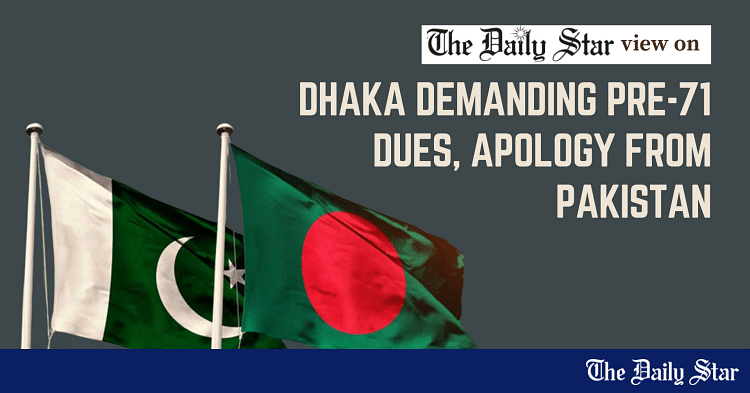
Thaw in Bangladesh-Pakistan ties a welcome development
Pakistan should apologise for its 1971 role to smoothen transition


1745024218633.webp

VISUAL: STAR

It is encouraging to see constructive discussions at the first foreign-secretary-level talks held between Bangladesh and Pakistan in 15 years. Given the complex and often strained history between the two countries, the meeting marked a gradual thaw in relations as both sides sought to build on earlier interactions between the two heads of state in September and December. At the meeting, among other topics, Dhaka notably raised two historically unresolved issues: it demanded $4.52 billion as Bangladesh's share of pre-1971 assets and dues as well as a formal apology for the genocide committed during the Liberation War. It also requested the repatriation of stranded Pakistanis from Bangladesh. In response, the Pakistani delegation expressed a willingness to continue discussions.

We must say that while economic imperatives likely, and rightly, drive ongoing efforts, addressing these issues is vital to a solid foundation for bilateral relations. Pakistan's pre-1971 role remains a deep wound for Bangladeshis and a stumbling block to building a truly fruitful partnership. There may be debates about the number of civilians killed by Pakistani forces, but the repressions and brutalities we suffered during our independence struggle are a matter of historical record. For us, asking for a formal apology or reparations is not about seeking revenge; it's about the need for admission of a historic tragedy and fostering genuine reconciliation. That said, we need to be prudent given the complexities involved.

While economic imperatives likely, and rightly, drive ongoing efforts, addressing historic issues is vital to a solid foundation for bilateral relations. Pakistan's pre-1971 role remains a deep wound for Bangladeshis and a stumbling block to building a truly fruitful partnership. There may be debates about the number of civilians killed by Pakistani forces, but the repressions and brutalities we suffered during our independence struggle are a matter of historical record. For us, asking for a formal apology or reparations is not about seeking revenge; it's about the need for admission of a historic tragedy and fostering genuine reconciliation.

For context, apologies issued by Japan for wartime atrocities in South Korea and China were often seen as insufficient as they were deemed vague, lacking legal reparations, or undermined by subsequent statements and actions of politicians. This highlights the difficulty of securing apologies that are both meaningful and enduring. Nevertheless, sustained diplomatic pressure has, at times, prompted renewed gestures of atonement from Japan. We must learn from such examples and engage with Pakistan accordingly. On Pakistan's side, a formal apology would also help its own collective reckoning as much as it would mend ties with us. The economic aspect of Bangladesh's demands could prove to be more challenging, however. As of April 4, Pakistan's foreign exchange reserves stood at $15.75 billion. Meeting the demand for $4.52 billion would mean parting with more than a quarter of those reserves—an unfeasible prospect at the moment. We, therefore, need to approach the issue with patience and strategic foresight.

It's important to remember that both sides have much to gain from an improved relationship, not just economically but also in other areas of shared interest. Bangladesh's exports to Pakistan stood at $61.98 million in FY2024, while imports from Pakistan were $627.8 million—a gap that greater cooperation can help address. However, these imports are still considerably lower than those from China and India. Enhanced trade ties with Pakistan could diversify our sourcing markets and offer competitive advantages. Already, direct shipping has begun between Bangladesh and Pakistan, while trade and visa procedures are getting easier, with direct flights on the cards.

Of course, sensitivities rooted in something as crucial as 1971 will not vanish overnight. But a future-oriented approach—combining constructive dialogue, historical reckoning, and acknowledgement of mutual benefits—can go a long way. The first steps in that direction have already been taken. We hope that the scheduled visit of Pakistan's Deputy Prime Minister and Foreign Minister Ishaq Dar later in the month would further normalise Bangladesh-Pakistan relations.​
 
Analyze

Analyze Post

Add your ideas here:
Highlight Cite Respond
  • Like (+1)
Reactions: Bilal9

Resetting BD-Pak relations: Wishes and realities
MIR MOSTAFIZUR RAHAMAN
Published :
Apr 21, 2025 23:00
Updated :
Apr 21, 2025 23:00

1745367288930.webp


Over the past year, there has been a cautious but notable thaw in the once-frozen diplomatic ties between Bangladesh and Pakistan. The change came in the wake of political transition in Bangladesh following the fall of the Awami League government on August 5 last year and installation of an interim government. Keen to pursue a pragmatic foreign policy, the new administration initiated moves to re-engage with Islamabad. This shift marked a significant departure from more than 15 years of virtual diplomatic stagnation between the two nations.

In that context, Bangladesh took some important steps -- restoring a direct shipping link and granting permission for a Pakistani airline to operate direct flights to Dhaka. Diplomatic overtures were reinforced when Bangladesh's Chief Adviser met Pakistan's Prime Minister Shahbaz Sharif on the sidelines of the UN General Assembly in September. The leaders agreed to revitalise the bilateral relationship and explore new avenues of cooperation.

The latest in this string of initiatives was the 6th round of Foreign Office Consultations (FoC), held in Dhaka last week. It drew considerable attention from diplomatic circles in South Asia, as it signalled a potential new chapter in the Bangladesh-Pakistan relationship. The discussions covered a wide range of issues -- economic, educational, agricultural, and cultural -- tapping into shared history and the aspirations of both peoples. At face value, the talks were cordial and comprehensive, with expressions of satisfaction on both sides regarding recent high-level engagements in global forums such as New York, Cairo, Samoa, and Jeddah.

Yet beneath this seemingly smooth surface lies a stubborn historical fracture -- one that remains unhealed, unresolved, and overlooked: the unresolved legacy of the 1971 Liberation War.

Despite the optimistic tone, the talks revealed a familiar impasse. Bangladesh reiterated three long-standing demands, all of which remain unmet since its emergence as an independent nation over five decades ago. These are; a formal apology from Pakistan for the genocide committed during the 1971 Liberation War; Bangladesh's rightful share of pre-independence financial assets held in Pakistan's central treasury; and repatriation of stranded Pakistanis still living in refugee camps across Bangladesh.

Sadly, Pakistan remained non-committal on all three counts. Although both sides publicly claimed the meeting was "fruitful" and that they would "remain engaged" on the outstanding issues, Islamabad's own statement tellingly omitted any mention of the three core demands. This silence has not gone unnoticed in Dhaka, sparking widespread scepticism about Pakistan's sincerity. Can these long-standing wounds simply be glossed over in the name of moving forward?

The short answer is no.

There can be no genuine reset in relations between Bangladesh and Pakistan without a full and formal acknowledgement of the atrocities committed by the Pakistan Army during the 1971 Liberation War. That war was not merely a political separation -- it was a brutal, bloody genocide. Over three million Bangladeshis were killed. Tens of thousands of women were subjected to rape and systematic sexual violence. Homes, schools, and places of worship were destroyed. Entire villages were burnt to the ground. These crimes are not mere footnotes in history -- they are etched into the collective consciousness of Bangladesh, shaping its national identity and moral memory.

A meaningful reconciliation cannot be built on denial, silence, or diplomatic evasion. It requires truth, justice, and accountability. The most fundamental starting point for that is an unambiguous, unconditional apology from Pakistan to the people of Bangladesh. Without such a gesture, talk of cooperation in trade, education, and connectivity will remain hollow-lacking the moral foundation necessary for any long-term partnership.

Many observers in Bangladesh and beyond have pointed to examples around the world where nations have sought to right historical wrongs through apology and reparation. From Germany's post-Holocaust stance to South Africa's Truth and Reconciliation Commission, the international precedent is clear: true healing begins with acknowledgement.

Pakistan has, over the years, expressed "regret" or "sorrow" in vague diplomatic language -- but that is not enough. Regret is not accountability. Sorrow is not justice. Bangladesh is not seeking vengeance; it is seeking closure. That closure must be delivered with the courage to say, in no uncertain terms: "We are sorry for the crimes committed in 1971."

In addition to the apology, the other two demands -- fair distribution of financial assets and the humane resolution of the status of stranded Pakistanis -- are also essential for repairing trust. These are not new or unreasonable demands; they are rooted in international principles of equity and responsibility. It is worth remembering that Bangladesh has, for decades, housed tens of thousands of "Bihari" Pakistanis in makeshift camps, offering humanitarian support while awaiting a lasting solution from Islamabad. This burden cannot be borne indefinitely, especially without Pakistan's direct participation in the repatriation process.

The economic and academic cooperation discussed during the FoC -- including scholarships, agricultural training, and maritime studies -- are certainly welcome. But they are not a substitute for justice. Similarly, shared concerns on multilateral platforms, such as the condemnation of Israeli aggression in Gaza or the call to revitalise SAARC, reflect some alignment in international views. However, these areas of consensus should not be used to deflect attention from the historic wrongs that still demand redress.

In this context, the path forward for Pakistan is clear.

If it genuinely wants to restore normalcy and rebuild trust with Bangladesh, it must exhibit the moral courage to confront its past. That includes offering a public, official apology-one that does not hide behind euphemisms or deflect responsibility. This should not be seen as an act of weakness, but rather a bold step toward moral leadership and reconciliation. Only then can the two nations, linked by history and geography, begin to forge a future free from the shadows of 1971.

Furthermore, Bangladesh must also remain firm in its principles during this diplomatic outreach. Resetting ties should not come at the cost of forgetting history. Economic cooperation, people-to-people contacts, and regional integration are all valuable, but not at the expense of justice. The wounds of 1971 are too deep to be buried under trade deals and cultural exchanges alone.

The recent meetings between Bangladesh and Pakistan have opened a diplomatic window, but it is one that must be used wisely. Symbolic gestures must now give way to substantive action. Until Pakistan formally acknowledges and apologises for its war crimes, any effort to "revamp" bilateral ties will remain, at best, superficial.

Healing begins with truth. Reconciliation begins with justice. And in this case, justice begins with a clear, loud, and unequivocal apology from Pakistan. Nothing less will suffice.​
 
Analyze

Analyze Post

Add your ideas here:
Highlight Cite Respond
  • Like (+1)
Reactions: Bilal9

Latest Posts

Back
PKDefense - Recommended Toggle