Donate ☕
[🇧🇩] - Bangladesh-Pakistan Relation---Can we look beyond 1971? | Page 10 | PKDefense

[🇧🇩] Bangladesh-Pakistan Relation---Can we look beyond 1971?

⤵︎
Reply (Scroll)
Press space to scroll through posts
G Bangladesh Defense
[🇧🇩] Bangladesh-Pakistan Relation---Can we look beyond 1971?
149
5K
More threads by Saif


Resetting BD-Pak relations: Wishes and realities
MIR MOSTAFIZUR RAHAMAN
Published :
Apr 21, 2025 23:00
Updated :
Apr 21, 2025 23:00

1745367288930.webp


Over the past year, there has been a cautious but notable thaw in the once-frozen diplomatic ties between Bangladesh and Pakistan. The change came in the wake of political transition in Bangladesh following the fall of the Awami League government on August 5 last year and installation of an interim government. Keen to pursue a pragmatic foreign policy, the new administration initiated moves to re-engage with Islamabad. This shift marked a significant departure from more than 15 years of virtual diplomatic stagnation between the two nations.

In that context, Bangladesh took some important steps -- restoring a direct shipping link and granting permission for a Pakistani airline to operate direct flights to Dhaka. Diplomatic overtures were reinforced when Bangladesh's Chief Adviser met Pakistan's Prime Minister Shahbaz Sharif on the sidelines of the UN General Assembly in September. The leaders agreed to revitalise the bilateral relationship and explore new avenues of cooperation.

The latest in this string of initiatives was the 6th round of Foreign Office Consultations (FoC), held in Dhaka last week. It drew considerable attention from diplomatic circles in South Asia, as it signalled a potential new chapter in the Bangladesh-Pakistan relationship. The discussions covered a wide range of issues -- economic, educational, agricultural, and cultural -- tapping into shared history and the aspirations of both peoples. At face value, the talks were cordial and comprehensive, with expressions of satisfaction on both sides regarding recent high-level engagements in global forums such as New York, Cairo, Samoa, and Jeddah.

Yet beneath this seemingly smooth surface lies a stubborn historical fracture -- one that remains unhealed, unresolved, and overlooked: the unresolved legacy of the 1971 Liberation War.

Despite the optimistic tone, the talks revealed a familiar impasse. Bangladesh reiterated three long-standing demands, all of which remain unmet since its emergence as an independent nation over five decades ago. These are; a formal apology from Pakistan for the genocide committed during the 1971 Liberation War; Bangladesh's rightful share of pre-independence financial assets held in Pakistan's central treasury; and repatriation of stranded Pakistanis still living in refugee camps across Bangladesh.

Sadly, Pakistan remained non-committal on all three counts. Although both sides publicly claimed the meeting was "fruitful" and that they would "remain engaged" on the outstanding issues, Islamabad's own statement tellingly omitted any mention of the three core demands. This silence has not gone unnoticed in Dhaka, sparking widespread scepticism about Pakistan's sincerity. Can these long-standing wounds simply be glossed over in the name of moving forward?

The short answer is no.

There can be no genuine reset in relations between Bangladesh and Pakistan without a full and formal acknowledgement of the atrocities committed by the Pakistan Army during the 1971 Liberation War. That war was not merely a political separation -- it was a brutal, bloody genocide. Over three million Bangladeshis were killed. Tens of thousands of women were subjected to rape and systematic sexual violence. Homes, schools, and places of worship were destroyed. Entire villages were burnt to the ground. These crimes are not mere footnotes in history -- they are etched into the collective consciousness of Bangladesh, shaping its national identity and moral memory.

A meaningful reconciliation cannot be built on denial, silence, or diplomatic evasion. It requires truth, justice, and accountability. The most fundamental starting point for that is an unambiguous, unconditional apology from Pakistan to the people of Bangladesh. Without such a gesture, talk of cooperation in trade, education, and connectivity will remain hollow-lacking the moral foundation necessary for any long-term partnership.

Many observers in Bangladesh and beyond have pointed to examples around the world where nations have sought to right historical wrongs through apology and reparation. From Germany's post-Holocaust stance to South Africa's Truth and Reconciliation Commission, the international precedent is clear: true healing begins with acknowledgement.

Pakistan has, over the years, expressed "regret" or "sorrow" in vague diplomatic language -- but that is not enough. Regret is not accountability. Sorrow is not justice. Bangladesh is not seeking vengeance; it is seeking closure. That closure must be delivered with the courage to say, in no uncertain terms: "We are sorry for the crimes committed in 1971."

In addition to the apology, the other two demands -- fair distribution of financial assets and the humane resolution of the status of stranded Pakistanis -- are also essential for repairing trust. These are not new or unreasonable demands; they are rooted in international principles of equity and responsibility. It is worth remembering that Bangladesh has, for decades, housed tens of thousands of "Bihari" Pakistanis in makeshift camps, offering humanitarian support while awaiting a lasting solution from Islamabad. This burden cannot be borne indefinitely, especially without Pakistan's direct participation in the repatriation process.

The economic and academic cooperation discussed during the FoC -- including scholarships, agricultural training, and maritime studies -- are certainly welcome. But they are not a substitute for justice. Similarly, shared concerns on multilateral platforms, such as the condemnation of Israeli aggression in Gaza or the call to revitalise SAARC, reflect some alignment in international views. However, these areas of consensus should not be used to deflect attention from the historic wrongs that still demand redress.

In this context, the path forward for Pakistan is clear.

If it genuinely wants to restore normalcy and rebuild trust with Bangladesh, it must exhibit the moral courage to confront its past. That includes offering a public, official apology-one that does not hide behind euphemisms or deflect responsibility. This should not be seen as an act of weakness, but rather a bold step toward moral leadership and reconciliation. Only then can the two nations, linked by history and geography, begin to forge a future free from the shadows of 1971.

Furthermore, Bangladesh must also remain firm in its principles during this diplomatic outreach. Resetting ties should not come at the cost of forgetting history. Economic cooperation, people-to-people contacts, and regional integration are all valuable, but not at the expense of justice. The wounds of 1971 are too deep to be buried under trade deals and cultural exchanges alone.

The recent meetings between Bangladesh and Pakistan have opened a diplomatic window, but it is one that must be used wisely. Symbolic gestures must now give way to substantive action. Until Pakistan formally acknowledges and apologises for its war crimes, any effort to "revamp" bilateral ties will remain, at best, superficial.

Healing begins with truth. Reconciliation begins with justice. And in this case, justice begins with a clear, loud, and unequivocal apology from Pakistan. Nothing less will suffice.​
 
Analyze

Analyze Post

Add your ideas here:
Highlight Cite Fact Check Respond

Pakistan FM Ishak Dar’s Bangladesh tour postponed
Diplomatic Correspondent Dhaka
Published: 24 Apr 2025, 21: 27

1745543757001.webp

Pakistan foreign minister Ishak Dar Courtesy: Pakistan foreign ministry

Pakistan’s deputy prime minister and foreign minister Ishak Dar’s 2-day visit to Bangladesh has been postponed.

The foreign ministry of Pakistan disclosed this on Thursday. He was supposed to reach Dhaka on 27 April.

The Pakistan Ministry of Foreign Affairs said in a message that in the wake of the unwarranted situation the deputy prime minister and foreign minister of Pakistan will not be able to visit Bangladesh on 27 and 28 April. The new date for the visit will be fixed on the basis of discussions between the two sides.

The announcement came, following the deadly terrorist attack that killed at least 26 tourists, the deadliest terrorist attack since 2019.

Following the incident, India took five steps against Pakistan in the wake of the attack on tourists in Pahalgam, Kashmir. The decisions were taken at a meeting of the union cabinet committee on security of India on Wednesday.

Pakistan's National Security Committee (NSC) meeting today, Thursday took several countermeasures in response to India's actions. The meeting was chaired by Pakistani prime minister Shahbaz Sharif. The decisions were announced in a statement sent by the Prime Minister's Office after the meeting.

Earlier, Pakistan foreign secretary Amna Baloch paid a visit to Dhaka. During that tour, the date for Ishak Dar’s visit to Bangladesh was announced.​
 
Analyze

Analyze Post

Add your ideas here:
Highlight Cite Fact Check Respond

Bangladesh agrees in principle to aid corridor for Rakhine: Touhid
United News of Bangladesh. Dhaka 28 April, 2025, 06:11

Foreign Affairs Adviser Md Touhid Hossain on Sunday said Bangladesh agreed in principle to provide a humanitarian corridor to Rakhine in line with a UN proposal.

The United Nations wants to create a humanitarian channel through Bangladesh to send humanitarian aid to Rakhine, and the interim government has agreed in principle to this subject to meeting some conditions.

‘Bangladesh has agreed in principle to provide a humanitarian channel to Rakhine as per the UN proposal. It will be a humanitarian passage. But we have some conditions. I will not go into details. If the conditions are met, we will definitely help,’ said Hossain.

Asked about the government’s position regarding contact with the Arakan Army, he said establishing contact with the Arakan Army becomes inevitable.

Though they are non-state actor, they have to contact them due to reality, and as they cannot contact them formally, informal contact was made, Hossain explained.​
 
Analyze

Analyze Post

Add your ideas here:
Highlight Cite Fact Check Respond

Water wars are no answer
28 April, 2025, 00:00

The Indus does not belong to politicians or generals. It belongs to the farmers in Punjab, the families in Sindh, the fishermen near Karachi, and the communities in Kashmir who have lived along its banks for centuries, writes MA Hossain

HISTORY is a tireless teacher. It reminds us that wars between India and Pakistan have only hardened enmities, deepened poverty, and imperilled the broader region’s stability. Today, as tensions mount once again over the Indus Waters Treaty, a sobering truth confronts both New Delhi and Islamabad: peace is not an idealistic luxury — it is a survival imperative.

The immediate spark was a brutal and condemnable act: the killing of 26 Indian tourists in Kashmir on April 22, a grim reminder of the unresolved tensions in the region. India, furious and under intense domestic pressure, suspended its participation in the 1960 Indus Waters Treaty — a pact once hailed as a rare diplomatic triumph between two nuclear-armed rivals. Pakistan, equally predictably, warned that any attempt to obstruct the flow of water would constitute an ‘act of war’ meriting a full-force response.

The temptation to escalate is understandable, particularly in democracies where leaders are acutely sensitive to public anger. Yet history, geography, and basic prudence all demand a different course. In the cold calculus of realpolitik, neither side can afford to weaponise water. If anything, the perilous road they are now tempted to tread will lead not to victory, but to mutual impoverishment.

Fragile lifeline of Indus

THE Indus Waters Treaty has survived wars, political upheavals, and decades of bitter recriminations. Brokered by the World Bank in 1960 after years of arduous negotiations, the treaty divided the six rivers of the Indus Basin between the two countries. India was given control of the eastern tributaries — the Ravi, Beas, and Sutlej — while Pakistan retained rights to the western rivers — the Indus, Jhelum, and Chenab. Importantly, while India could use the western rivers for limited purposes like hydroelectric projects, it was prohibited from any consumptive use that would significantly diminish Pakistan’s flows.

That the treaty has endured for 65 years is not an accident. It is a testament to the fact that neither India nor Pakistan can afford the catastrophic consequences of disrupting the river system that sustains hundreds of millions of lives. Pakistan, in particular, relies on these waters for 80 per cent of its irrigated agriculture. To tamper with that supply would be to invite famine, mass displacement, and potentially, the collapse of a fragile state. For India, the risks are scarcely smaller: regional instability, international condemnation, and the not-so-distant prospect of full-scale war with a nuclear adversary.

Sabre-rattling and its limits

TECHNICALLY, as experts on both sides acknowledge, India does not currently possess the infrastructure necessary to significantly choke off the flow of the western rivers. Diverting or storing the massive volumes of the Indus and its tributaries would require the construction of enormous dams and canals across some of the most difficult terrain on Earth — a process that would take years, not weeks. Even if undertaken, such efforts would be politically costly and economically ruinous.

Yet the dangers lie less in immediate engineering feats than in the corrosive effects of escalation. India’s decision to suspend the treaty, although largely symbolic in the short term, undermines the spirit of a rules-based order that has kept the worst impulses of nationalism in check. It also sets a dangerous precedent that could rebound on India itself. After all, China holds the headwaters of the Brahmaputra River, vital to India’s northeast. If India chooses to treat international river agreements as disposable under pressure, why should it expect better from others?

Pakistan’s reaction, too, demands scrutiny. Its leaders have declared that any obstruction of the Indus waters would amount to an act of war, vowing to respond with ‘full force.’ This is a dangerous and reckless posture. By framing water flows as an existential trigger, Islamabad risks locking itself into a position where diplomacy becomes impossible and escalation inevitable. More measured voices should prevail, recognising that mutual interdependence on shared rivers is not a vulnerability — it is a lifeline.

Strengthening the treaty

THERE are, of course, longer-term challenges to the treaty that cannot be ignored. Climate change is rapidly altering weather patterns across the Himalayan region. Glaciers are melting at alarming rates, monsoon seasons are becoming more erratic, and the demands of swelling populations are placing unprecedented strains on water resources. Both India and Pakistan must adapt to a future where the current water-sharing arrangements will be under increasing pressure. But adaptation requires cooperation, not confrontation.

The immediate crisis offers both countries an opportunity to reframe their relationship around pragmatic coexistence rather than perpetual hostility. Instead of tearing down a 65-year-old framework, India and Pakistan should work to strengthen it—modernizing the dispute resolution mechanisms, enhancing information sharing, and establishing joint protocols for dealing with emergencies like floods or droughts. Such initiatives would not only reduce the risk of miscalculation but also demonstrate to their own populations and the world that both nations are capable of responsible leadership.

Narendra Modi, India’s prime minister, has famously declared, ‘Blood and water cannot flow together.’ It is a potent line, but one that must be applied with wisdom. Blood has already been spilled; adding the weaponisation of water would not redeem those deaths but compound the tragedy. The true tribute to the victims would be an unyielding commitment to peace, however difficult or imperfect it may be.

For Pakistan, too, there is a choice. Instead of viewing every Indian infrastructure project as an existential threat, it should invest in better water management, technological upgrades in agriculture, and diplomatic engagement that addresses legitimate concerns without turning every dispute into a casus belli.

True ownership of Indus

ULTIMATELY, the Indus does not belong to politicians or generals. It belongs to the farmers in Punjab, the families in Sindh, the fishermen near Karachi, and the communities in Kashmir who have lived along its banks for centuries. Their future should not be held hostage to the dangerous fantasies of those who mistake conflict for courage.

In a world increasingly defined by scarcity and competition, sharing water must be seen not as a concession but as an act of collective survival. There is no glory in turning rivers into weapons. There is only ruin.

MA Hossain, political and defence analyst based in Bangladesh.​
 
Analyze

Analyze Post

Add your ideas here:
Highlight Cite Fact Check Respond

Bangladesh-Pakistan Business Forum launched
UNB
Published :
Apr 28, 2025 22:07
Updated :
Apr 28, 2025 22:07

1745890537866.webp


Commerce Adviser Sheikh Bashir Uddin on Monday urged business leaders from Bangladesh and Pakistan to come forward to achieve the desired trade goals relating to trade and investment between the two countries.

"The Bangladesh-Pakistan Business Forum will play a crucial role in strengthening bilateral trade relations and enhancing economic cooperation. This forum will serve as a platform for connecting business institutions and trade organisations from both countries, promoting trade, and exploring investment opportunities," he said.

The commerce adviser made the call while speaking at the inauguration of the Bangladesh-Pakistan Business Forum, held at the Intercontinental Hotel in Dhaka, as chief guest.

He also stressed the importance of increasing connectivity between the peoples of both countries.

The tariff and non-tariff barriers between Bangladesh and Pakistan should be discussed, and how to rationalise it must be found out," said the adviser.

Meanwhile, a Memorandum of Understanding (MoU) was signed between the Bangladesh Garment Manufacturers and Exporters Association (BGMEA) and the Pakistan Ready-Made Garment Manufacturers and Exporters Association (PRGMEA) in a bid to strengthen bilateral trade between the two countries.

Administrator and Vice Chairman of the Bangladesh Export Promotion Bureau (EPB), Md. Anwar Hossain and Vice Chairman of PRGMEA, Amir Reyaz Chottani, signed the MoU on behalf of their respective sides.​
 
Analyze

Analyze Post

Add your ideas here:
Highlight Cite Fact Check Respond

Pakistan’s President Zardari hosts Tigers, says 'need to mend hearts' over 1971

FE ONLINE DESK
Published :
Jun 01, 2025 21:16
Updated :
Jun 01, 2025 21:21

1748822972062.webp


President Asif Ali Zardari has said that Pakistan intends to forge strong bilateral relations with Bangladesh in all areas including commerce, trade, sports, culture, and people-to-people ties, Pakistan’s The Nation reported on Sunday.

Speaking at a reception hosted for the Bangladesh and Pakistan men’s cricket teams at the Governor’s House in Punjab on Sunday, he said the Pakistan government is trying to work together to build a stronger relationship, adding that it cannot happen overnight but “we need to keep investing in people and come up with solutions to take our relations to new heights,” according to report.

The Bangladesh cricket team is in Pakistan to play a three-match T20I series and is due to play the third and last T20I on Sunday night, The Nation mentioned in its report.

Punjab Governor Sardar Saleem Haider Khan, Chairman PCB Mohsin Naqvi, High Commissioner of Bangladesh to Pakistan Muhammad Iqbal Hussain, BCB Cricket Operations Head Nazmul Abedeen Fahim, Advisor to Chairman PCB Amir Mir, team officials, and members of the Pakistan and Bangladesh cricket teams were present, according to The Nation.

President Asif Ali Zardari said Pakistani businessmen wish to collaborate with Bangladeshi businesses, adding that the Pakistani government is also interested in working with the Bangladeshi government in the long run. “We have a bright future as two nations,” the President remarked, the newspaper wrote.

President Zardari eulogized the rich history of Bangladesh and its people, adding that the Bengali nation is one of the oldest and richest nations in the region and has a proud history, according to The Nation.

He also recognized the progress made by Bangladesh over the past 50 years, adding Bangladesh is a success story in the world both financially as well as in human resource capital. “Allah has given you strength financially and in the form of manpower,” he added, the report noted.

President Zardari said Bangladesh was destined to progress and prosper vis-à-vis the export business and Pakistan will contribute as much as it can, as stated in the Pakistan newspaper.

Reminiscing on the shared history and pangs of separation as brothers when the two countries parted ways in 1971, President Zardari said the younger generation was not aware of the pain the older generation had gone through, adding that “we had broken each other’s hearts in the past and there was a need to mend the hearts today,” emphasizing reconciliation and mutual understanding—a message that resonated deeply in his address, The Nation observed.

Recognizing the transformative power of cricket as a sport which helps in uniting people throughout the world, he said, “I am happy to host you all in Pakistan, in Lahore. And I hope that there will be many such trips,” the paper reported.

President Zardari also expressed the desire to visit Bangladesh, adding that he had not been to Dhaka for a long time. He fondly recalled his student days at the Pitaro Cadet College and the lasting friendships he made during those days, adding that he was in close contact with Bangladeshi college friends even today, The Nation highlighted.

President Zardari reassured the Bangladesh envoy to Pakistan of his full support in furthering bilateral relations between the two brotherly countries, the report added.

The President hailed the Bangladesh Tigers for their immense talent and wished them a great future, The Nation stated.

He also praised the young Pakistan team and expressed hope it will do well on the international front. “The world is young, you are young and it’s your time. We’ve seen our time, this is your time. All of you are going to see the future and I bless you and I hope that you’ll have an eventful, good future,” President Zardari maintained, as quoted by The Nation.

President Asif Zardari also had group photos with both teams while he gave away mementos to the officials of the visiting Bangladesh team, the newspaper said.​
 
Analyze

Analyze Post

Add your ideas here:
Highlight Cite Fact Check Respond

Bangladesh, Pakistan businesses hold meeting

Bangladesh Sangbad Sangstha . Dhaka 03 July, 2025, 22:18

Businessmen and entrepreneurs from both Bangladesh and Pakistan see huge trade potential in sectors such as pharmaceuticals, surgical products, equipment, electronics, and intermediary industrial goods.

In this regard, both sides also expressed optimism that joint ventures and joint trade initiatives could bring substantial benefits for them.

These observations came at a networking meeting held on Thursday between local business leaders and a visiting business delegation of Pakistani entrepreneurs at Motijheel in the capital.

The meeting was organised by the Federation of Bangladesh Chambers of Commerce and Industry (FBCCI), said a press release.

The meeting was chaired by FBCCI administrator Md Hafizur Rahman. Mohammad Wasif, acting high commissioner of Pakistan to Bangladesh was also present.

Highlighting the importance of diversifying trade between Bangladesh and Pakistan, FBCCI administrator M Hafizur Rahman stated that sectors such as motor and electronic goods, and intermediary industrial products, are vital for both countries.

He also stressed the need for tapping potentials in pharmaceuticals, surgical products, equipment, and textiles.

Hafizur further mentioned that the FBCCI and the Federation of Pakistan Chambers of Commerce and Industry would work jointly to strengthen trade ties between the two countries.

Noting that there is ample scope for expanding trade and investment between Bangladesh and Pakistan, Acting High Commissioner of Pakistan in Dhaka Mohammad Wasif hoped that the ongoing networking programs between entrepreneurs from both nations would continue to explore newer business avenues.

During the meeting, business representatives from both tcountries expressed their interest in expanding trade and pursuing joint ventures in pharmaceuticals, surgical products and equipment, textiles, electronics, and intermediary industrial goods.

Former FBCCI director Nasrin Fatema Awal, FBCCI secretary general Md Alamgir, head of FBCCI International Affairs Wing Md Zafar Iqbal, business leaders and other distinguished guests were present, among others.​
 
Analyze

Analyze Post

Add your ideas here:
Highlight Cite Fact Check Respond

Diplomatic relations
Pakistan foreign minister to visit Dhaka, focus on close political ties

Raheed Ejaz Dhaka
Updated: 04 Aug 2025, 19: 46

1754356185068.webp

Pakistan deputy Prime Minister and Foreign Minister Ishaq Dar Facebook

Pakistan Deputy Prime Minister and Foreign Minister Ishaq Dar will arrive in Dhaka on 23 August on a two-day visit in a first bilateral visit of any Pakistani foreign minister in the past three decades.

Ishaq Dar will hold a bilateral meeting with Bangladesh’s Foreign Adviser Md Touhid Hossain on the second day of his visit.

Officials at the foreign ministry told this correspondent that Ishaq Dar may have an opportunity to pay a courtesy call on the Chief Adviser to the Interim Government Professor Muhammad Yunus on the second day of his visit.

Diplomatic sources said Pakistan foreign secretary Amna Baloch visited Dhaka last April to revitalise the two-decade long cold relations between Dhaka and Islamabad.

As part of this, Ishaq Dar may discuss issues related to rejuvenating the relation and increasing ties in political domain.

Diplomatic sources also hinted that Ishaq Dar may hold discussion with political leaders in Bangladesh during his Dhaka visit.

When asked, Foreign Adviser Touhid Hossain told Prothom Alo on 2 August that Pakistan Foreign Minister Ishaq Dar will arrive in Dhaka on 23 August on a bilateral visit, and the bilateral meeting may be held on 24 August.

Regarding the priority issues of the upcoming Dhaka-Islamabad foreign ministry level meeting, Touhid Hossain said, “The meeting agenda has not yet been fixed. We hope it will be finalised at the beginning of August.”

Since the political changeover in Bangladesh following the student-people's mass uprising on 5 August 2024, Pakistan has been emphasising the activation of bilateral engagements at various levels.

As part of this approach, Pakistan’s Foreign Secretary Amna Baloch visited Dhaka in April for foreign secretary-level talks.

Following Ishaq Dar’s scheduled visit to Dhaka, Pakistan has expressed interest in organising a meeting of the Joint Economic Commission (JEC) in Islamabad. The last (eighth) JEC meeting between the two countries was held in Dhaka in September 2005.

Ishaq Dar was originally scheduled to visit Dhaka on 27–28 April. However, the foreign ministries of both Pakistan and Bangladesh announced on 24 April that the visit had been postponed due to ‘unexpected circumstances,’ Bangladesh’s foreign ministry had said at the time that a new date for the visit would be finalised in consultation with both parties.

According to diplomatic sources, 26 tourists were killed in a shooting by gunmen in Pahalgam, a region in Indian-administered Kashmir, on 22 April, escalating a conflict between India and Pakistan. As a result of the emerging situation, Ishaq Dar’s visit to Dhaka was postponed.

After nearly a 15-year hiatus, the foreign secretaries of Bangladesh and Pakistan met in Dhaka on 17 April. During the meeting, both countries emphasised the importance of maintaining regular dialogue to advance bilateral relations.

As a result, the meeting was seen as the first step in reviving relations that had been dormant for over a decade and a half.

Officials at the foreign ministry stated that the discussions stressed mutual respect, understanding, and shared interests as key to moving forward.

Bangladesh conveyed that urgent resolution of unresolved issues was essential to build upon recent high-level communications.

In this regard, Bangladesh highlighted three historic issues: a formal apology from Pakistan for the 1971 genocide, the repatriation of stranded Pakistanis, and Bangladesh’s rightful share of undivided assets. Pakistan agreed to continue discussions on these matters.

However, Pakistan's Ministry of Foreign Affairs omitted any mention of these key issues in its post-meeting press release. When asked about this, several high-level government sources in Bangladesh said that while Bangladesh seeks cordial ties with Pakistan, such relations cannot be built while ignoring the unresolved historical matters.

At the D-8 Summit in Cairo last December, Chief Adviser Muhammad Yunus raised these concerns with Pakistan’s Prime Minister Shehbaz Sharif, saying, “These matters keep resurfacing. Let us resolve them so we can move forward.” He emphasised the importance of settling these issues permanently for the sake of future generations.

Government sources said that since the Chief Adviser himself is advocating for resolving these historical issues, there is no scope for progressing relations while disregarding them. Nevertheless, Bangladesh is not unwilling to participate in various meetings, including the Joint Economic Commission (JEC). However, it prefers a cautious and slow approach.

The last foreign secretary-level talks between the two countries took place in Islamabad on 1 November 2010. Even then, Pakistan’s press release avoided mentioning the three unresolved issues, including an apology for the 1971 genocide.

In contrast, Bangladesh's press release included references to them. At that time, Pakistan also promised to continue discussions on the unsettled matters.

Emphasis on trade and commerce

Bangladesh and Pakistan are eager to enhance trade and commerce as part of strengthening their bilateral ties. Some top Pakistani business leaders are expected to accompany Ishaq Dar during the latter’s upcoming visit to Bangladesh.

As part of the effort to boost trade, business representatives from both countries signed a Memorandum of Understanding (MoU) on 14 January to establish a Joint Business Council.

Later, the ‘Pakistan-Bangladesh Business Forum’ was held in Dhaka on 28 April. To enhance cooperation in the apparel sector, the Bangladesh Garment Manufacturers and Exporters Association (BGMEA) signed an MoU with Pakistan’s Pakistan Readymade Garments Manufacturers and Exporters Association (PRGMEA) during the forum.

An analysis of government statistics shows that trade between the two countries increased by 5 per cent in the 2022–23 fiscal year, compared to the previous year. The trade volume in 2021–22 was $919 million, which rose to $956 million in 2022–23. Trade volume declined again in the 2023–24 fiscal year due to economic downturns.

Bangladesh imports raw materials for garments from Pakistan, as well as food grains when there are supply shortages. Pakistan also imports raw jute, tea, raw and semi-processed leather, and hydrogen peroxide from Bangladesh.

Several former Bangladeshi diplomats told Prothom Alo on condition of anonymity that Pakistan has become more proactive in strengthening ties with Bangladesh following the 5 August political changeover. This is evident from recent activities by Pakistan.

Direct cargo shipping between the two countries has commenced. Visa restrictions are beginning to ease. Pakistan based airline Fly Jinnah has been granted approval to operate flights to Bangladesh, followed by AirSial, another Pakistani low-cost carrier, receiving permission to fly directly to Bangladesh.

Several foreign policy observers commented that the 15-year stagnation in Dhaka-Islamabad relations should come to an end. Bilateral cooperation in trade, people-to-people movement, and other sectors is possible.

However, Bangladesh must not lose sight of resolving the three historical and unresolved issues despite the complexities involved.​
 
Analyze

Analyze Post

Add your ideas here:
Highlight Cite Fact Check Respond

Two ministers from Pakistan to visit Dhaka within two days of each other
Raheed Ejaz Dhaka
Updated: 14 Aug 2025, 15: 36

1755221199837.webp

Pakistan foreign minister Ishaq Dar (L) and commerce minister Kamal Khan Pakistan government website

Two Pakistani ministers are coming to Dhaka within just two days of each other. Pakistan’s Commerce Minister Jam Kamal Khan will arrive in Dhaka on 21 August for a four-day visit, while the country’s Deputy Prime Minister and Foreign Minister Ishaq Dar will come on 23 August for a two-day trip. Diplomatic sources in Dhaka confirmed this information to Prothom Alo today, Thursday.

Ishaq Dar’s two-day visit to Dhaka, starting on 23 August, had already been scheduled earlier. Yesterday, Wednesday, Pakistan informed Bangladesh that its Commerce Minister Jam Kamal Khan would visit Dhaka from 21 to 24 August.

Diplomatic sources say that after the political change in Bangladesh brought about by the student-people's uprising of 5 August 2024, Pakistan took the initiative to activate discussions between the two countries at various levels.

In April this year, Pakistan’s Foreign Secretary Aamna Baloch visited Dhaka with the aim of reviving the two countries’ one-and-a-half-decade frosty relations. In continuation of that effort, Ishaq Dar is coming to Dhaka. During his visit, in addition to reviving ties, he may discuss ways to enhance political-level engagement.

According to diplomatic sources, after Jam Kamal Khan and Ishaq Dar, Pakistan’s Finance Minister Muhammad Aurangzeb may also visit Dhaka.

Muhammad Aurangzeb is expected to come to Dhaka in September or October to attend a meeting of the two countries’ Joint Economic Commission (JEC). Economic Adviser Salehuddin Ahmed will head the Bangladesh side at this meeting by. The last JEC meeting between the two countries was held in 2005.

Possible outcome of the visits

Diplomatic sources said that following the foreign secretary–level meeting between the two countries, Ishaq Dar’s visit will carry a political message regarding the revival of bilateral relations.

The formal meeting between Bangladesh’s Foreign Advisor Md. Touhid Hossain and Pakistan’s Deputy Prime Minister and Foreign Minister Ishaq Dar will be held on 24 August.

A review of government documents and discussions with several former and current Bangladeshi diplomats reveal that there is no precedent for a bilateral visit or meeting at the foreign minister level between the two countries.

In the upcoming meeting, the foreign ministers of both countries are expected to discuss various issues related to relations and cooperation. Officials from the Ministry of Foreign Affairs have said that final preparations are underway regarding the agenda of the meeting.

told Prothom Alo, “We are not doing anything out of the way in our relations with Pakistan. Like with many other countries, we are trying to establish a normal relationship with Pakistan, focusing on facilitating trade, investment, and the movement of people-----Touhid Hossain, Advisor. Minister for Foreign Affairs.

According to ministry sources, following the formal meeting between Touhid Hossain and Ishaq Dar, several memoranda of understanding (MoUs) have been finalized for signing. The list of agreements to be signed includes cooperation between the foreign service academies of the two countries and cultural exchange.

Last month, Pakistan’s Interior Minister Syed Mohsin Raza Naqvi visited Dhaka. According to sources at the Ministry of Home Affairs, following this visit, progress has been made on signing a visa exemption agreement for diplomatic and official passport holders of the two countries. The two countries have exchanged drafts of the agreement. If political-level approval is granted next week, there is a possibility that the agreement will be signed during Ishaq Dar’s visit.

Meanwhile, during Pakistan Commerce Minister Jam Kamal Khan’s visit, emphasis will be placed on how trade and business between the two countries can be strengthened. According to sources at the Ministry of Commerce, a memorandum of understanding (MoU) for the formation of a Joint Working Group on trade has been finalized. If all goes smoothly, this MoU may be signed during Jam Kamal Khan’s visit to Dhaka. The working group on trade will be led by the additional secretaries of the commorce ministries of both countries.

Foreign Adviser Touhid Hossain told Prothom Alo, “We are not doing anything out of the way in our relations with Pakistan. Like with many other countries, we are trying to establish a normal relationship with Pakistan, focusing on facilitating trade, investment, and the movement of people. There is no need for economically or politically hostile relations with Pakistan. In the past, a hostile environment with Pakistan was created unnecessarily, and we have moved beyond that. While normalising relations with Pakistan, three unresolved issues remain on the discussion table.”​
 
Analyze

Analyze Post

Add your ideas here:
Highlight Cite Fact Check Respond

Pakistan High Commissioner presents credential to President

UNB
Published :
Aug 19, 2025 21:05
Updated :
Aug 19, 2025 21:05

1755645782302.webp


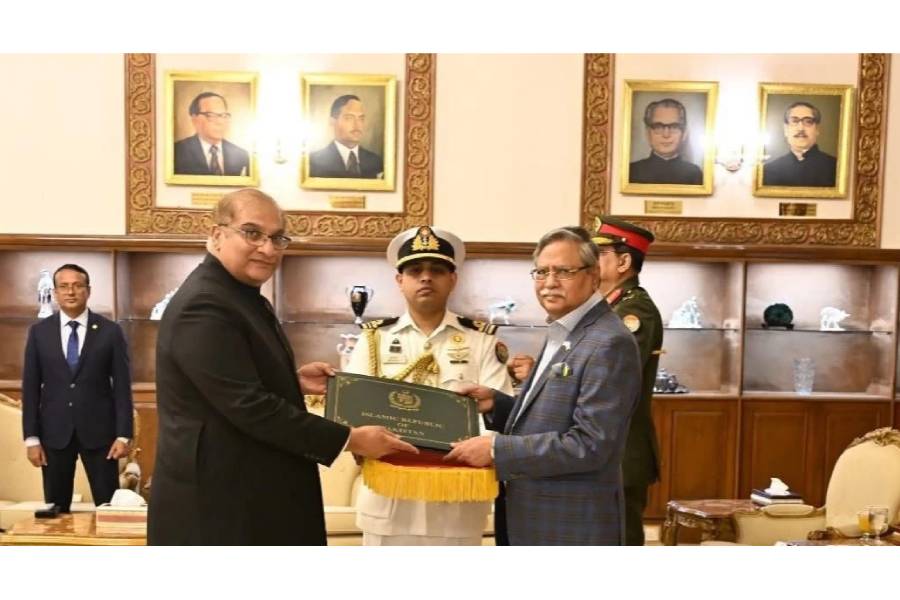
Pakistan High Commissioner to Bangladesh, Imran Haider presented his credentials to the President of Bangladesh, Mohammed Shahabuddin at Bangabhaban on Tuesday.

During the meeting, the high commissioner conveyed greetings and best wishes from the leadership and people of Pakistan to the president and the brotherly people of Bangladesh, according to Pakistan High Commission in Dhaka.

He noted that relations between Pakistan and Bangladesh are deeply rooted in shared history, common faith and cultural affinities and emphasised that Pakistan looks forward to further strengthening the bonds of friendship and cooperation in areas of mutual interest.

Welcoming the high commissioner, the president felicitated him on his appointment and assured full support in the discharge of his diplomatic responsibilities.

He also expressed his best wishes for the high commissioner’s successful tenure in Bangladesh.​
 
Analyze

Analyze Post

Add your ideas here:
Highlight Cite Fact Check Respond

Mahfuj Alam urges Pakistan to assist Bangladeshi research on East Pakistan era

Information adviser made the request during a meeting with Pakistan high commissioner

1763601251133.webp

Photo: PID

Mahfuj Alam, adviser to the Ministry of Information and Broadcasting, has urged Pakistan to assist Bangladeshi researchers interested in studying 24 years of events (from 1947 to 1971) during the East Pakistan era.

The adviser made the request during a meeting at his office with Pakistan's High Commissioner Imran Haider today, said a press release issued by the ministry.

Mahfuj Alam said, "Many researchers in Bangladesh want to study the daily socio-economic events of former East Pakistan from 1947 to 1971. For this research, it is necessary to collect related documents preserved in Pakistan's archives."

The adviser urged Pakistan's high commissioner to provide the necessary cooperation in this regard.

At the same time, both the adviser and the high commissioner expressed interest in strengthening cooperative relations for the development of media in the two countries.

Various socio-economic issues of both countries were also discussed during the meeting, the press release added.​
 
Analyze

Analyze Post

Add your ideas here:
Highlight Cite Fact Check Respond

'Ties with Pakistan kept poor intentionally by past regime'

FE Online Report
Published :
Nov 30, 2025 22:06
Updated :
Nov 30, 2025 22:08

1764551996988.webp


Foreign Adviser Touhid Hossain on Sunday said, Bangladesh’s relations with Pakistan had been intentionally kept poor for many years.

“Certain decisions caused relations with Pakistan to deteriorate compared to before” he said while addressing a meeting organised by the DCAB in the city.

“The issues that existed before 2009 remained unchanged for the next 15 years. Pakistan did not apologise earlier, nor did they later; the issue of asset division was unresolved before, and still unresolved. But during that time, some deliberate decisions were taken that worsened relations”.

“Our decision now is to establish a normal relationship with Pakistan — nothing beyond that” he added.​
 
Analyze

Analyze Post

Add your ideas here:
Highlight Cite Fact Check Respond
CA for enhanced trade with Pakistan

FE ONLINE REPORT
Published :
Dec 28, 2025 19:42
Updated :
Dec 28, 2025 19:42

1766969674323.webp


Chief Adviser Professor Muhammad Yunus stressed the need for boosting bilateral trade between Bangladesh and Pakistan when Pakistan High Commissioner, Imran Haider, paid a courtesy call on him at the State Guest House in Dhaka.

During the meeting, both sides discussed ways to expand cooperation in trade, investment, and aviation, as well as scaling up cultural, educational, and medical exchanges to further strengthen bilateral relations between the two South Asian nations, said a spokesman of the CA Office.

Professor Yunus underscored the need to further boost Bangladesh–Pakistan trade and expressed hope that during Mr. Haider’s tenure, both countries would explore new avenues for investment and joint venture businesses.

Chief Adviser Professor Muhammad Yunus welcomed the growing interactions between the two countries and emphasised the importance of increased visits, as well as cultural, educational, and people-to-people exchanges among SAARC member states.

The Pakistani High Commissioner noted that bilateral trade has recorded a 20 percent growth compared to last year, with business communities from both countries actively exploring new investment opportunities.

He also highlighted a significant increase in cultural exchanges, adding that Bangladeshi students have shown strong interest in higher education opportunities in Pakistan, particularly in medical sciences, nanotechnology, and artificial intelligence.

Mr. Haider further said that Pakistan has witnessed a rise in patients traveling to its leading hospitals for liver and kidney transplants, and noted that Pakistan is ready to offer training and academic opportunities in transplantation-related medical fields.

Pakistan High Commissioner said that Dhaka-Karachi direct flights are expected to start in January.

SDG Coordinator and Senior Secretary Lamiya Morshed was also present at the meeting.​
 
Analyze

Analyze Post

Add your ideas here:
Highlight Cite Fact Check Respond
  • Wow (+2)
Reactions: Afhan
Pakistan’s National Assembly speaker calls on chief adviser
Sardar Ayaz Sadiq attended Khaleda Zia’s funeral

1767317388664.webp


Photo: Cheif adviser's Facebook page

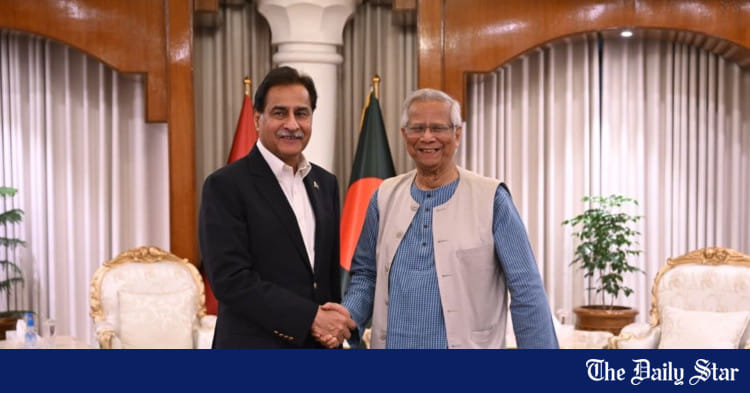
Sardar Ayaz Sadiq, speaker of the National Assembly of Pakistan, paid a courtesy call on Chief Adviser Prof Muhammad Yunus at the State Guest House Jamuna in Dhaka today.


The information was shared on the official Facebook page of the chief adviser.

Sadiq arrived in Dhaka to attend the funeral of former prime minister and BNP Chairperson Khaleda Zia.

He was received at Hazrat Shahjalal International Airport by the Pakistan High Commissioner to Bangladesh Imran Haider and senior officials of the foreign ministry, reports BSS.


The flight carrying Sadiq landed at the Dhaka airport at around 11:50am, the airport's spokesperson Flight Lieutenant Masud said.​
 
Analyze

Analyze Post

Add your ideas here:
Highlight Cite Fact Check Respond
Tarique discusses party vision, trade, economy, global ties with diplomats

Staff Correspondent 09 January, 2026, 19:41

1768008973402.webp

Pakistan high commissioner to Bangladesh Imran Haider on Friday paid a courtesy call on BNP acting chairman Tarique Rahman at the BNP chairperson's office in Gulshan. | BSS photo

Bangladesh Nationalist Party acting chairman Tarique Rahman on Friday held separate meetings with diplomats of Australia, Germany and Pakistan, focusing on the party’s vision for governance and the country’s future.

The discussions, held at the BNP chairperson’s office at Gulshan in the capital Dhaka, covered a range of issues, including bilateral relations, economic policy, trade cooperation and the forthcoming national elections scheduled for February 12.


Those who met Tarique included Australian high commissioner Susan Ryle, German ambassador Rüdiger Lotz and Pakistan high commissioner Imran Haider.

After the meeting, BNP joint secretary general Humayun Kabir told reporters that the central area of the discussions was strengthening bilateral ties and if voted to power, how a future BNP government would manage relations with the respective countries.

He said that the party’s broader foreign policy orientation and strategic priorities were also discussed.

According to Humayun, Tarique discussed the future economic recovery and development in detail during the meetings, with particular emphasis on the BNP’s 31-point proposal and its policy priorities.

The diplomats and the BNP leader also explored ways to expand trade, investment and people-to-people contacts between Bangladesh and the countries concerned, he said.

Humayun said that regarding the forthcoming elections, the foreign envoys expressed keen interest in the process.

He said that the diplomats were keen to engage in strategic exchanges, viewing Tarique as a major political leader of significance beyond Bangladesh in the broader Asia-Pacific context.

The diplomats offered condolences over the death of the party’s chairperson Khaleda Zia.​
 
Analyze

Analyze Post

Add your ideas here:
Highlight Cite Fact Check Respond

Members Online

Latest Posts

Latest Posts

Post