Home Watch Videos Wars Movies Login

[🇧🇩] Bangladesh Police and Rapid Action Battalion

Latest Posts Countries Wars Q&A

[🇧🇩] Bangladesh Police and Rapid Action Battalion
147
5K
More threads by Saif

G Bangladesh Defense

We do need a separate police commission
Home ministry’s refusal to acknowledge this is baffling

1741046632207.webp

VISUAL: STAR

We are baffled by the position taken by the Ministry of Home Affairs regarding the formation of an independent commission to ensure transparency and accountability in police conduct. According to a report by this daily, the ministry claimed there was no need for such a commission as it already performs this role. Given the police's track records over the past years—especially during Awami League's 15-plus-year rule, and particularly during the July mass uprising—we fail to understand what made the ministry so confident about its own oversight role or capacity.

The proposal to establish this independent body was put forth in January by the Police Reform Commission—one of many extensive measures proposed to the interim government to overhaul the police force. These measures also include regulating police use of force against civilians in line with UN peacekeepers' rules of engagement, combating custodial torture, extortion, legal harassment, arbitrary arrests, and enforced disappearances through modern and technologically advanced means, and amending existing police laws. The goal is to make the force pro-people, accountable, and neutral—not to mention freeing it from the undue influence wielded by the government of the day. Such influence never bodes well, as we know from our experience under the previous regime, when the force was blatantly misused to serve its political interests.

Why, then, is the ministry opposed to independent oversight when one of the interim administration's core goals is to introduce reforms that eliminate past failures in governance, law enforcement, and justice? Why—when the government claims to be establishing a just, modern system—does the ministry insist on retaining the Police Act, formulated in 1861, or the Code of Criminal Procedure, enacted in 1898? Why is it refusing to acknowledge that drastic—rather than cosmetic—measures are necessary to restore police image and credibility?

We fail to see the logic behind the home ministry's position. Most of the reform measures, including the establishment of an independent police commission, were suggested not just by the Police Reform Commission, but also by experts over time and even by the UN. More importantly, the people demand a complete overhaul of the force. So we urge the home ministry to reassess its position and make decisions that align with public interests, which, in this instance, lie in the formation of an independent police commission.​
 
Analyze

Analyze Post

Add your ideas here:
Highlight Cite Respond

Police alone cannot take on violent mobs
Leaders and influencers too have a responsibility to restore rule of law

1741392793921.webp

VISUAL: STAR

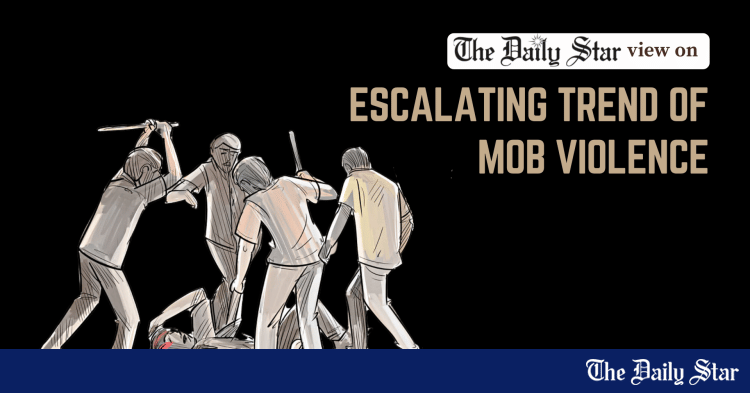
For any crime or breakdown in law and order, law enforcement is naturally the first to be held accountable. It falls upon police and other security forces now active on the ground to prevent and bring to book those involved in mugging, robbery, rape, extortion, etc. Curbing mob violence is also their responsibility. That such violence has reached an alarming level of late—with at least 119 people killed and 74 injured in 114 mob incidents since August, according to the Human Rights Support Society—is largely due to weak policing. However, placing sole focus or responsibility on security forces risks overlooking the role played by other influential actors in the surge of crimes.

Those getting involved in mob violence, often fuelled by righteous indignation, are partly enabled by the support they receive from a section of social media influencers, the relative silence of political, social, and religious leaders, and the general instability in the country. If we analyse the pattern of some recent incidents—such as the hostile mobilisation at the Shahbagh police station demanding the release of an alleged sexual harasser, or the fallout of alleged public smoking by two women at Lalmatia—the prevailing mentality seems to support, strange as it may seem, both rule of law and frequent exceptions to it, provided they align with the notion of justice held by a certain majoritarian group in society. That the home adviser has survived the metaphorical guillotine (calls for his resignation) after his controversial remark on the Lalmatia incident is likely due to the right-wing support behind such incidents. This situation is further exacerbated by the lack of legal consequences for those taking the law into their own hands.

Of course, righteous indignation or frustration with inadequate judicial mechanisms is not the only motivation behind the formation of mobs. While previously the key reasons included suspicions of theft, robbery, or mugging, after the political changeover on August 5, there have been reports of many opportunistic or politically vengeful mobilisations as well. Think of the mob that stormed a Gulshan flat allegedly linked to Awami League leader HT Imam over a rumour of a secret stash inside, or the two Iranians allegedly robbed of cash and mobile phones in Bashundhara Residential Area. More often than not, such mobilisations led to tragic consequences. Along with deaths in the most brutal fashion, mob beatings have often made for horrifying headlines—the eyes of a victim being gouged out in Bhola, two individuals being beaten and hung upside down in Dhaka's Uttara. The list goes on.

While the government insists that there is no room for mob justice or moral policing in the country, the fact is, its relative inaction has only served to embolden such acts. The effect has transcended mob violence—with clashes, political repression, harassment of women and children, suppression of freedom of expression, and all sorts of crimes being reported across the country. Under these charged circumstances, we urge all stakeholders in post-uprising Bangladesh to help restore the rule of law. That means everyone doing their part as they should—police taking prompt and stern action, political parties disciplining their unruly members, community/religious leaders preventing mob formations, and social media influencers promoting unity rather than division. Leaders and influencers, in particular, must refrain from bellicose rhetoric that only destabilises our society.​
 
Analyze

Analyze Post

Add your ideas here:
Highlight Cite Respond

DMP ramps up security measures
667 patrol teams deployed, 71 checkpoints set up in city

1741480535502.webp


Dhaka Metropolitan Police (DMP) has significantly boosted security measures and operations in the capital in the last 24 hours to improve law and order.

According to a press release issued by DMP's media wing, 667 patrol teams were deployed and 71 checkpoints were set up in the city to tackle crimes.

During the intensified drive, law enforcers also arrested 239 individuals for various crimes, including robbery, extortion, drug dealing, and theft, it reads.

According to the DMP's Crime Command and Control Centre, the patrol teams operated in two shifts, with 340 teams active at night and 327 during the day. These included 479 mobile patrol teams, 73 foot patrol teams, and 115 motorcycle patrol teams. Additionally, 71 strategic checkpoints were set up at key locations.

Different law enforcement units, including the Counter Terrorism and Transnational Crime (CTTC) unit, the Anti-Terrorism Unit (ATU), and the Rapid Action Battalion (Rab), were also deployed alongside regular police forces. The Armed Police Battalion (APBn) operated 20 additional checkpoints to bolster security measures.

During the special operation, law enforcers recovered various weapons, including two metal rods, a hammer, a machete, a cleaver, five knives, ten switchblades, a metal knuckle duster, and two crude bombs.

Additionally, a significant amount of illegal drugs was seized, including 41.65 kg of cannabis, 307 yaba pills, 36 grams of heroin, and 33 bottles of locally brewed liquor.

Among those arrested, seven were identified as robbers, 20 as professional muggers, four as extortionists, 10 as thieves, and 17 as known drug dealers. Twenty-three individuals with warrants issued against their names were also apprehended.

DMP filed 73 cases in connection with the arrests and assured that legal action was being taken against the arrestees.

"The safety and security of Dhaka's residents remain our top priority. We will continue our operations to ensure a crime-free city," said Deputy Police Commissioner Muhammad Talebur Rahman PPM, from DMP's Media and Public Relations Division.

DMP has urged citizens to remain vigilant and cooperate with law enforcement to maintain peace and order in the capital.​
 
Analyze

Analyze Post

Add your ideas here:
Highlight Cite Respond

Auxiliary police force: DMP appoints 500 security guards
Experts emphasise supervision

The Dhaka Metropolitan Police (DMP) has appointed around 500 security personnel working in various residential areas, markets, and shopping centres across the capital as members of the "Auxiliary Police Force".

The appointments were given under Section 10 of the Dhaka Metropolitan Police Ordinance, 1976, by DMP Commissioner SM Sazzat Ali.

The ordinance, under its "Constitution and Organisation of the Dhaka Metropolitan Police" section, empowers the police commissioner to appoint auxiliary officers to assist law enforcement when additional support is required.

Subsection (2)(b) of Section 10 further stipulates that auxiliary officers, upon appointment, shall have the same powers, immunities, duties, and authority as regular police officers.

The designated auxiliary members will be legally protected, similar to regular police officers.

"If anyone obstructs an auxiliary member from performing their duties or attacks them, legal action will be taken against the offender," SN Nazrul Islam, additional commissioner (crime and operations) of DMP, told The Daily Star.

The auxiliary members will be able to make arrests: they will hand over detainees to the designated police patrol team or the nearest police station, and the police will then investigate the complaint, and after a preliminary inquiry, lawful action will be taken based on the findings.

Asked about the selection process, Nazrul said the DMP has identified malls and markets that already have private security guards.

"We appointed the team leaders of these security guards as auxiliary force members," he said.

In residential areas, the DMP focused on localities and alleys where security guards lock the gates after a specific time. "We have chosen these guards as members of the auxiliary police force."

When asked whether the auxiliary officers would receive training, Nazrul said the initiative is temporary.

"We will not provide any training. They will only wear a band labelled 'Auxiliary Police Force' on their arms."

Addressing concerns of misuse of power, Nazrul assured that strict monitoring mechanisms are in place.

"Our patrol teams and local police stations will supervise the activities of auxiliary members round the clock. If any member is found abusing their authority, their appointment will be terminated immediately."

Nazrul said the move aims to bring a large number of security guards working in malls and residential areas under greater accountability.

"We want to boost their confidence as they act as associates of the police in ensuring security. Once their work receives legal protection, petty crimes in alleys and marketplaces are expected to decrease, enhancing overall security," he said.

Earlier on Saturday, DMP Commissioner SM Sazzat Ali said that the initiative was introduced to enhance security during Ramadan and Eid shopping, as many shopping centres will remain open late into the night.

Experts have welcomed the move but emphasised the importance of supervision, background verification, and training to ensure its effectiveness.

Many private security organisations employ retired armed forces personnel and former police officers, according to Nurul Huda, a former inspector general of police.

"A significant number of these individuals have experience in firearm handling and minor investigations. This makes them a ready force, whereas recruiting and training new personnel properly would take at least six to nine months."

Supervision is essential to ensure that those appointed are properly vetted, Huda said.

Verification must be done to confirm their background, and if there are any training gaps, they can be addressed in seven to ten days.

He acknowledged that there is added pressure due to Ramadan as security duties increase during this time.

"Shopping malls remain open late and ensuring security with standard eight-hour shifts requires three shifts per day to meet international standards."

Besides, many key police positions in the DMP are now occupied by newly appointed officers.

"Handling law enforcement in a metropolitan city like Dhaka requires extensive local knowledge and a well-established information network, which some new officials may still be developing," he said.

He remains optimistic about this initiative.

"Rather than dismissing this as a failure, it should be seen as an experiment. If it proves effective, it could be a model for future security arrangements."​
 
Analyze

Analyze Post

Add your ideas here:
Highlight Cite Respond

A questionable move by DMP
Giving security guards police power raises concerns

1741654799002.webp

VISUAL: STAR

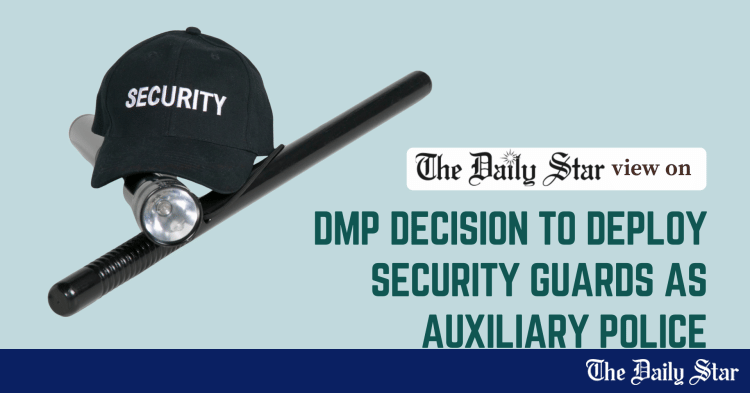
The Dhaka Metropolitan Police's (DMP) decision to empower private security personnel with the power to detain individuals suspected of crimes has raised concerns. While its objective—to bolster security during Ramadan and Eid—seems reasonable, the delegation of such powers to untrained private guards risks creating more problems than it solves. Under this initiative, as revealed by the DMP commissioner recently, guards deployed in shopping malls, residential areas, and markets—potential crime hotspots during festival/holiday seasons—will serve as members of an "Auxiliary Police Force," wearing official bands and having the power to make arrests if necessary. Already, the appointment of around 500 such police assistants has been confirmed.

The move blurs the line between trained law enforcement officers and private security guards, whose primary role is to monitor and report incidents, not to enforce the law. Unlike police officers, private guards do not undergo the same rigorous training, ethical scrutiny or legal oversight. Granting them the authority to arrest people without proper training invites the possibility of abuse. The question is: how will the DMP prevent this scenario, especially when those will be unaccompanied by police?

The question here is not about the legality of the move—which is being taken under the DMP Ordinance, 1976—but rather its security and accountability risks. First of all, the move blurs the line between trained law enforcement officers and private security guards, whose primary role is to monitor and report incidents, not to enforce the law. Unlike police officers, private guards do not undergo the same rigorous training, ethical scrutiny or legal oversight. Granting them the authority to arrest people without proper training invites the possibility of abuse. The question is: how will the DMP prevent this scenario, especially when those will be unaccompanied by police?

The DMP commissioner has stated that auxiliary officers will be "legally protected" like police officers, but does that mean they will also be held to the same accountability standards? If an auxiliary officer makes an unjust arrest or uses excessive force, will they face the same consequences as a regular officer? There's a potential legal grey area that could lead to chaos and further insecurity. We must say that this decision reflects poorly on the DMP's capacity to do its job. The commissioner has cited the limited number of police personnel and the need to grant officers leave for Eid as justifications for the move. While we acknowledge the resource constraints amid increasing street crimes, the answer is not to outsource policing, however temporarily, to private security personnel.

The DMP should be credited for boosting security measures in the capital in recent days. According to its media wing, 667 patrol teams have been deployed and 71 checkpoints have been set up to tackle crimes. While this and other factors have likely stretched the force thin, the decision to delegate police powers to private guards is almost as troubling as the Awami League government's move to grant similar powers to Ansar shortly before the 2024 election. Similar misuse concerns also arose after the interim government granted magistracy powers to commissioned army officers in September. So, instead of hastily delegating such powers, what the DMP should do is focus on strengthening its own capacity.​
 
Analyze

Analyze Post

Add your ideas here:
Highlight Cite Respond
  • Like (+1)
Reactions: Bilal9

Hotline launched at Police HQ to prevent violence against women
UNB
Dhaka
Published: 10 Mar 2025, 18: 42

1741655833642.webp

Bangladesh Police logo

A hotline service has been launched at Police Headquarters to take swift action against women repression, aggressive gestures towards women, slander, eve teasing and sexual harassment.

If such an incidents happen anywhere in the country, complaints can be made to the hotline numbers which will be available round the clock, said a media release issued on Monday.

The hotline numbers are—01320002001, 01320002002 and 01320002222.

Besides, the Police Cyber Support for Women Facebook page is still operational to provide legal services and protection to the victims of cybercrimes.

Bangladesh Police follows a zero-tolerance policy to maintain law and order and prevent crime as well as prevent repression on women and children.

It also is committed to taking appropriate legal actions against the repressors of women and children, said the release.​
 
Analyze

Analyze Post

Add your ideas here:
Highlight Cite Respond
  • Like (+1)
Reactions: Bilal9

No alternative to democratic reforms of police force
13 March, 2025, 00:00

THE way the police have relied on violence to disperse an anti-rape march towards the residence of the chief adviser demanding a more decisive role in ending violence against women is a shocking reminder of the role that the police played during the July uprising. The anti-rape march was one of many protests taking place over the rape of a child in Magura, fighting for life in a hospital in Dhaka. On March 11, as the protesters reached the crossing beside the InterContinental Hotel, the police charged with truncheons, leaving at least 21 people, including a few police personnel, injured. The protesters pressed home their nine-point demand, including the removal of the home adviser for his failure to ensure women’s safety, the establishment of a speedy tribunal for rape cases and logical reforms in rape and sexual harassment laws. Protesters allege that the police not only attacked but also grabbed women by the hair and kicked and punched them in the face. Some photographs of police violence substantiate the claims. The police may need to disperse marches for law and order and there may be hostile elements within the protests, but that does not justify the police action.

Anti-rape protesters have been organising for a morally and politically just cause for several weeks. Since the interim government assumed office in August 2024, among the incidents that gained public attention are the assault on sex workers in Dhaka, attacks on woman tourists in Cox’s Bazar, violence over a girl’s football match in Jaipurhat and the harassment of two young women over smoking in public. The government has recently made a few arrests in the cases, but only after nationwide protests criticising its failure to recognise the surge in anti-women, right-wing activism. It is also concerning that the police played the role of spectators when an organised ‘mob’ held a sit-in programme at a police station to free a person accused of harassing a Dhaka University student from police custody but chose violence to disperse anti-rape protesters. Similar high-handedness was also witnessed against recommended primary schoolteachers in February. The high-handedness, therefore, suggests a certain bias on part of the police force and further contributes to their anti-people image.

The recurring incident of violent policing of protests in the changed political context, when police reforms are said to be a priority of the interim government, is deeply disappointing. The interim government should, therefore, initiate an investigation to identify how matters of pacifying peaceful protests turned into a targeted attack against certain protesters. In the long run, the government should ensure that a protocol to disperse crowds is in place and thoroughly followed.​
 
Analyze

Analyze Post

Add your ideas here:
Highlight Cite Respond
  • Like (+1)
Reactions: Bilal9

Police must abandon violence, harassment for crowd control
14 March, 2025, 00:00

DESPITE support and care from authorities, particularly the healthcare providers, the eight-year-old rape victim from Magura lost the battle for life in Combined Military Hospital in Dhaka on March 13 while anti-rape protests raged. Four accused in this case are arrested and the law minister assured a speedy trial of the case but the movement against rape continued as the government has failed to respond in other recent cases of violence against women. Protesters demand a systemic change in the legal system, which includes the removal of the home adviser for his failure to ensure women’s safety, the establishment of a speedy tribunal for rape cases and logical reforms in rape and sexual harassment laws. The government so far has taken no steps to address the systemic concerns but appeared hostile towards the protesters. The police have not only violently dispersed an anti-rape march towards the chief adviser’s residence but have also filed a case against the protesters, 12 named and 90 unnamed, for allegedly ‘attacking the police.’ The interim government has relied on the same strategy of police violence and legal harassment against protesters that the deposed Awami League used to silence people’s demand for justice.

Anti-rape movements for a systemic change and undoing patriarchal biases in state and society leading to victim blaming is more than justified given the way a harasser was recently publicly welcomed with a garland while the police appeared helpless before a ‘mob’. The police in a statement on March 12 also claimed in the case statement against the protesters that they were attacked and seven of their personnel were injured. Contrary to police claims, the protesters said that plainclothes police personnel tried to instigate violence from within the rally and became violent. On other occasions recently, the police used similar high-handedness to disperse crowds. The police on March 12 dispersed a section of non-government primary schoolteachers using water cannons and charged at them with truncheons. In January, an ordinary man fell victim to police violence as he was mistaken for a protester demanding the constitutional recognition of the ethnic minorities. Sadly, police behaviour shows a clear bias against the students and a large section of the people who made the end of the authoritarian Awami regime possible.

For the police to win public trust, they must abandon the strategy of violence and legal harassment of the deposed authoritarian regime. The interim government that claims police reforms as its priority agenda should investigate to establish how matters of pacifying a peaceful protest became a targeted attack on certain protesters. The government must also ensure that a protocol to disperse crowds is in place and thoroughly followed.​
 
Analyze

Analyze Post

Add your ideas here:
Highlight Cite Respond
  • Like (+1)
Reactions: Bilal9

Members Online

No members online now.

Latest Posts

Back
 
G
O
 
H
O
M
E