[🇧🇩] Budget For 2026-2027

[🇧🇩] Budget For 2026-2027
42
512
More threads by Saif

G Bangladesh Defense

Can FY27 budget bring the economy back to life?

Md Asaduz Zaman
1779764709334.webp


Highlights
  • Private sector credit growth hits historic lows​
  • GDP growth slows down to 3.03 percent​
  • NBR faces Tk 1.04 lakh crore shortfall​

As Finance Minister Amir Khosru Mahmud Chowdhury prepares the FY27 budget, the central question is whether new fiscal measures can restore confidence among businesses amid mounting economic pressure.

But the timing could hardly be worse.

His first budget for the new government comes against an economic backdrop that leaves little room for optimism, let alone ambition.

Private investment has sunk to historic lows, industrial output is faltering, inflation refuses to yield, and the country’s debt obligations are quietly consuming a growing share of external receipts.

The budget, by all accounts, will be a large one. Whether the economy can bear it is another question entirely.

The most telling signal of the economy’s fragility lies not in headline growth figures, but in what businesses are actually doing, or rather, not doing. Private sector credit growth fell to 4.72 percent in March, a historic low that speaks to something deeper than a temporary slowdown.

When businesses stop borrowing, they stop investing, stop expanding and stop hiring, all of which contribute to unemployment. Over time, that reluctance becomes self-reinforcing.


The numbers bear this out.

1779764789978.webp


Economic growth slowed to 3.03 percent in the October-December quarter of FY2025-26, down from 3.53 percent a year earlier.

The more alarming figure sits beneath that headline. The industrial sector, long the engine of Bangladesh’s growth model, slowed sharply to 1.27 percent from 5.78 percent a year earlier. That is not a slowdown but a near stall.

Before the new budget is even presented, the tax authority is already missing current targets. In the first ten months of FY2025-26, the National Board of Revenue (NBR) collected Tk 3.27 lakh crore, falling Tk 1.04 lakh crore short of its July-April target. That is not a marginal miss. It is a structural one.

To meet the target, the NBR would need to collect Tk 2.27 lakh crore in the remaining two months of the fiscal year. Officials themselves describe that prospect as a “herculean task” which is perhaps the most honest thing a revenue authority can say.

It signals not merely a bad stretch, but a fundamental mismatch between what the government expects to collect and what the economy is actually generating in tax receipts.

Faced with the shortfall, the government has turned increasingly to the banking system to finance its deficit, a shift that is beginning to affect private sector credit conditions.

In the July-February period of FY2025-26, net deficit financing rose 67 percent year-on-year to Tk 1.05 lakh crore, up from Tk 63,040 crore a year earlier. Of this, Tk 88,309 crore came from the banking system, according to Bangladesh Bank data.

When the government draws that heavily on the banking system, it competes directly with private borrowers for the same pool of credit. Banks, facing a captive and low-risk sovereign borrower, have less appetite and less capacity to lend to businesses.

The result is a crowding-out effect that is not theoretical; it is already showing up in the data.

Above all, persistently high inflation and a rapidly rising debt-servicing burden are squeezing the country’s fiscal space, leaving the government with less room to support growth, investment and jobs.

Business leaders and economists are clear-eyed about the risk.

Unless the government demonstrates genuine fiscal discipline, meaningfully expands the tax base, and takes visible steps to restore confidence in the investment climate, the budget’s revenue and growth targets will likely join a long line of lofty projections that quietly missed their marks.

That pattern of targets set, revised, and forgotten is precisely what erodes the business confidence the government now needs to rebuild.

Business Initiative Leading Development (BUILD) Chairperson Abul Kasem Khan has called for a shift away from “stereotypical” budget-making, urging realism, deregulation and broader reforms.

“We do not want a continuation of the stereotypical approach in the budget; rather we want novelty, modernisation, and genuine deregulation,” he said.

He questioned the feasibility of ambitious revenue targets in a slowing economy.

“If GDP growth has fallen from around 7 percent to nearly 3.5 percent, then expecting disproportionately high revenue collection raises serious questions,” he noted, adding that pressure on a narrow tax base could undermine compliance.

On the business environment, Khan stressed reducing the cost of doing business.

“As businessmen, what we want most is a reduction in the cost of doing business. That includes reforming advance income tax, addressing refund delays, and removing the back-and-forth policy approach that has long created uncertainty,” he said.

He also called for faster circulation of money and stronger consumption. “If we want the economy to function properly, we must allow money to circulate and consumption to grow. People’s purchasing power must increase so that they feel confident to spend, which in turn drives production and investment,” he added.

Khan further emphasised broad-based deregulation.

“Deregulation must be broad-based and meaningful. A small entrepreneur should be able to start a business within a day or two, without navigating months of licensing procedures,” he said, adding that implementation has lagged behind repeated reform promises.

Fazlul Hoque, former president of Bangladesh Knitwear Manufacturers and Exporters Association (BKMEA), said, “The government is still new, and we do not yet have a clear understanding of its performance capacity.”

“Perhaps it would have been better if the budget had been presented a little later, after fully assessing the economic realities.”

Hoque noted an “unwritten trend” of expanding budgets each year, driven partly by political considerations, and warned that weak revenues amid slowing activity could make targets difficult.

“When economic activities slow down, revenue earnings naturally decline. Imports fall, exports face difficulties and domestic consumption weakens,” he said, adding that large revenue gaps may force higher government borrowing and squeeze private credit.

“A large portion of government expenditure is now going toward interest payments on debt,” he said, stressing stronger fiscal discipline and reduced corruption.

“If corruption can be reduced, government income will rise while expenditure will fall at the same time,” he added.

The former BGMEA president also warned of inflationary pressure after the new pay scale for public employees and said weak fiscal management could hurt private sector credit and jobs.

“The government wants to create 1 crore jobs, but if the private sector suffers because of tighter credit conditions and higher interest rates, achieving that target will become difficult,” he said.

Kamran T Rahman, president of the Metropolitan Chamber of Commerce and Industry (MCCI), said relying on ambitious revenue targets without expanding the tax base is unsustainable.

“Putting additional pressure on existing taxpayers will only make the situation more difficult,” he said, noting that despite 1.28 crore TIN (taxpayer identification numbers) holders, only 40-45 lakh file returns, many of them zero returns.

He added that the NBR is often pushed to meet targets without broader reforms, while rising costs are already straining industries.

“If businesses cannot survive, then where will the taxes come from?”

Mahmud Hasan Khan, president of Bangladesh Garment Manufacturers and Exporters Association (BGMEA), also urged widening the tax net instead of increasing pressure on existing taxpayers, and stressed timely ADP implementation.

“A Tk 3 lakh crore ADP is a very big jump this time. But what usually happens is that after the announcement, midway through the year, the allocation gets cut back. That should not happen if they truly want implementation,” he said.

He cautioned that aggressive revenue pressure would hurt business sustainability in a fragile economy.

“In that context, increasing the revenue burden aggressively will not help businesses remain sustainable,” he said.

He stressed long-term policy consistency.

“Policies must be sustainable and long-term,” he said, noting ongoing discussions on policy predictability and prospective taxation up to 2030.​
 

Could this budget set the groundwork for a trillion-dollar economy?

Ashfaq Zaman

1779841018146.webp

FILE VISUAL: REHNUMA PROSHOON

Every country that has gone through a serious economic transformation will cite a defining budget, not because of the size of expenditure or the number of projects announced within it, but because the budget was one that introduced a new economic direction.

Bangladesh may be approaching such a moment. Finance Minister Amir Khasru Mahmud Chowdhury has repeatedly framed the country’s economic future around the ambition of building a trillion-dollar economy within the next decade. The government’s newly approved five-year strategic framework outlines investment-led growth, universal social protection, institutional reform, and increasing domestic revenue through digitisation and deeper integration across the economy. So, if done and followed up properly, the upcoming FY2026-27 budget could set the foundations for that long-term ambition of becoming a trillion-dollar economy.

Of course, Bangladesh is entering this budget cycle under significant pressure. Growth has slowed, inflation poses difficulty for ordinary people, the banking sector is under strain, and the country’s tax-to-GDP ratio remains among the lowest in the world. At the same time, the government is trying to attract investment, stabilise markets, expand social protection, and prepare for a more competitive global trade environment.

But one important shift has already happened. The discussion around this budget is not only about austerity, subsidies, or borrowing from institutions like the IMF, World Bank, or ADB. There is now a growing discussion around how Bangladesh can raise its own revenue more intelligently, formalise more of its economy, and use technology to increase state capacity.

For decades, Bangladesh’s fiscal conversation has remained relatively narrow. Whenever the government has needed resources, the discussion usually revolved around foreign loans, donor support, increasing taxes, and/or cutting expenditure. But there are other ways to think about revenue.

Many countries are now using instruments like diaspora bonds and green bonds to mobilise capital from citizens and investors who want to contribute to long-term national projects. Bangladesh has a large overseas population and increasing international interest in climate-linked financing. These are areas that deserve exploration.

At the same time, the government also needs to rethink how it delivers public services. One of the more practical ideas is expanding premium or express government services across multiple sectors. Bangladesh already has examples of this. In the passport system, citizens can pay higher fees for faster delivery. In many cases, people are willing to pay more for quick and reliable service. This not only increases government revenue without raising tax rates, it also reduces dependency on middlemen and, therefore, reduces corruption. A citizen who can legally pay for a faster passport service is less likely to rely on brokers or unofficial payments. The same logic could potentially be expanded to services related to driving licences, vehicle registration, birth certificates, land records, and more.

The cost to the government of processing many of these services often remains relatively similar. But if even some percentage of the population chooses premium processing, the government’s revenue could increase significantly while simultaneously improving public experience.

The biggest long-term opportunity, however, may lie in Bangladesh’s growing digital public infrastructure.

Over the past decade, Bangladesh has quietly built many of the building blocks needed for a modern interoperable payment ecosystem. Mobile financial services are now used by millions of people. Bangla QR has already been introduced. National ID infrastructure exists. Interoperability among financial systems has also improved. But these systems still largely operate in fragments.

Countries like India have demonstrated what is possible when payment systems, identity systems, and tax systems begin communicating with each other through a unified structure. India’s UPI transformed not only digital transactions, but also the country’s visibility over economic activity.

The deeper issue in Bangladesh’s tax system is that much of the economy remains outside the visible formal system. The government cannot dramatically increase tax rates overnight. But it can increase revenue, guided by a better understanding where economic activity is happening. If systems like the NID, payment gateways, banking infrastructure, and tax databases become more integrated, institutions like the National Board of Revenue (NBR) would gain far better visibility into money flows, transaction patterns, and economic activity. Over time, this would make tax monitoring and collection more efficient, without a reliance on aggressive enforcement.

Even small transaction fees on massive digital payment volumes can generate meaningful revenue. More importantly, the data generated through these systems can gradually expand the formal economy itself.

Currently, a huge portion of Bangladesh’s economy operates outside formal taxation and institutional support. Small restaurants, food carts, neighbourhood grocery shops, roadside businesses, workshops, and thousands of small family-run enterprises generate real income and real economic activity, yet many remain entirely outside the formal system. This also creates an imbalance as, for example, a salaried employee earning Tk 30,000 per month may end up paying taxes through formal deductions, while a profitable small business operating entirely in cash may contribute nothing to the tax system.

But formalising the informal economy cannot be achieved through punishment alone. The transition has to be designed as an incentive-based structure.

One possible approach could be introducing simplified flat-rate taxation for small informal businesses based on category and size. Instead of complex compliance requirements, a small grocery shop, food stall, or neighbourhood restaurant could pay a modest fixed monthly amount depending on their turnover. The key, however, is that taxation must come with benefits. If a small business owner formally registers and pays a simple flat tax, they should also become eligible for incentives like microcredit, working capital loans, social protection benefits, and/or simplified licensing. Even a relatively modest loan can help restock products, maintain cash flow, and reduce dependency on informal lenders. This is how formalisation can be made attractive to those operating within the informal economy.

The government already appears to be moving towards more inclusive welfare mechanisms through initiatives like the Family Card. Expanding these systems while linking them gradually to financial inclusion and digital infrastructure could help create a more integrated social protection framework.

The upcoming budget also carries political significance as it may help define the economic narrative of the current government’s early period. That narrative should not only focus on macroeconomic stability or headline growth numbers. It should focus on inclusion. For the first time in many years, there is visible discussion around bringing previously excluded populations into formal economic systems, expanding social protection in more structured ways, and using technology not simply for digitisation, but also for increasing institutional capacity.

That does not mean the challenges are small. Global uncertainty remains significant. Energy markets are volatile. Trade pressures continue. The banking sector still requires deep reform. Institutional execution capacity also remains uneven. And the question of prospective LDC graduation itself is uncertain and evolving. But it is precisely because of these pressures that Bangladesh needs a budget that is planned structurally rather than temporarily.

The country’s long-term ambition of becoming a trillion-dollar economy will not be achieved atop isolated mega projects alone. It will require expanding the formal economy, increasing government revenue intelligently, improving state services, strengthening financial infrastructure, and building trust between citizens and institutions. That is what makes this budget important. It can signal whether Bangladesh is ready to begin constructing the systems required for this next phase in its economy.

Ashfaq Zaman is founder of Dhaka Forum and a strategic international affairs expert.​
 

Budget FY 2027: The priorities for the government
The numbers in this budget will matter far less than the credibility of the commitments behind them

Publish : 26 May 2026, 01:46 PMUpdate : 26 May 2026, 01:55 PM

1779936555041.webp


Bangladesh’s budget arrives not as a routine fiscal exercise, but as the first decisive test of whether a new government can translate a landslide electoral mandate into a credible economic recovery.

The headwinds are severe: Private sector credit growth has plummeted to a 24-year low of 4.72%; Fitch has downgraded both its GDP growth forecast -- 3.7% for FY26, 3.5% for FY27 -- and the sovereign outlook from stable to negative.

The government has proposed the largest budget in history at a projected Tk 9.30 lakh crore, backed by a Tk 60,000 crore Bangladesh Bank stimulus targeting CMSMEs, closed factories, agriculture, and export diversification.

Externally, the Iran war strains energy costs and remittances. The Agreement on Reciprocal Trade (ART) with the United States, signed in February 2026, reduces tariffs to 19% but imposes binding obligations: Bangladesh may not sign trade agreements with non-market economies, must align its export controls with US standards, and must liberalize digital trade.

On this backdrop, the priorities should be grounded in fiscal credibility, structural reform, and measurable delivery targets.

First: Manage inflation and establish fiscal credibility

Headline inflation has eased marginally from its peak, but food inflation remains well above 8% and non-food inflation stubbornly above 9%. People and analysts alike demand relief, yet curbing inflation too sharply risks strangling the recovery.

As economies rebound, consumer demand typically recovers faster than production, generating upward price pressure and the government’s planned monetary injection to revive the private sector compounds this risk. But where significant spare productive capacity exists, for example, idle factories, unemployed labour, excess inventory, stimulus can close the output gap without necessarily triggering demand-pull inflation.

The Bangladesh Bank stimulus is premised on exactly this logic: Bangladesh’s economy operates well below its productive potential, and reviving real activity need not reignite inflation if supply-side bottlenecks in energy and credit are simultaneously addressed. The objective is to manage inflation, not eliminate it.

Alongside this, the budget must establish fiscal discipline. The government should resist indiscriminate subsidy expansion and instead target direct transfers to the poorest households. With tax-to-GDP at just 6.8% in FY2025, the BNP’s pledge to raise it to 15% by 2035 must begin with a credible roadmap: Expanding the direct tax base, digitizing collection, and closing exemptions that benefit politically connected-elites.

Without fiscal space, no other priority can be funded. The planned wealth tax warrants caution. Evidence from comparable economies suggests it can deter the private and foreign investment the recovery depends upon.

Critically, Bangladesh is bound by IMF conditionalities under its ECF/EFF/RSF program (approximately $5.4 billion combined) requiring tax revenue benchmarks, full exchange rate flexibility, and banking sector reform. Failure to meet these targets risks program suspension with cascading consequences for external financing. The FY2027 budget must be read as a companion to the IMF program, not in isolation from it.

Second: Fix the banks

The banking sector of Bangladesh is becoming a global case study in institutional failure. Non-performing loans have reached 30 to 36% of total disbursed credit, the highest NPL ratio of any country in the world.

Besides, 22 banks holding nearly half of sector assets are undercapitalized, with a provisioning shortfall of approximately $28.5bn. The interim government’s Bank Resolution Ordinance of May 2025 was a necessary first step, but legislation without enforcement is decoration.

The budget must fund completion of the asset quality review of all scheduled banks by the end of FY2026-27 with results published publicly. The budget should provide for a recapitalisation framework insulated from political interference, and signal zero tolerance for regulatory forbearance.

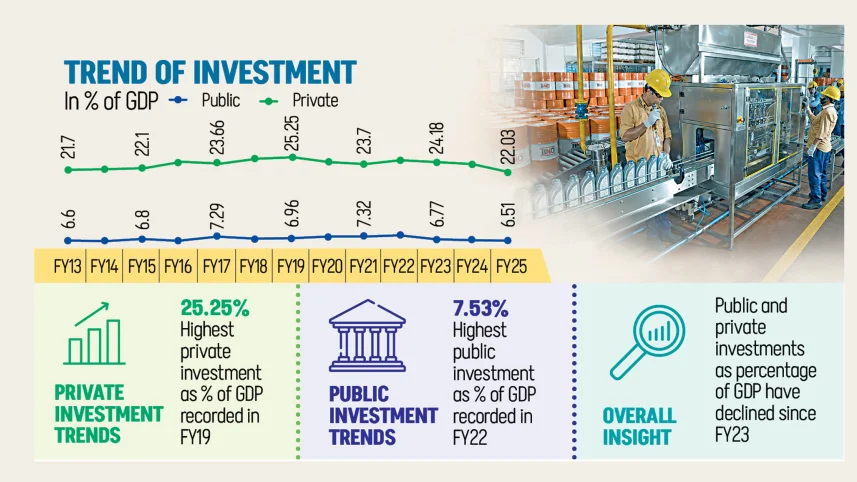
It should aim for concrete targets -- state-owned banks to reduce NPL ratios to below 10% by FY2029; private banks to below 5%. Private investment has already fallen to 22.48% of GDP, its lowest in over a decade. The budget should be aimed for restoring credit confidence.

Third: Prepare for LDC graduation

Bangladesh has applied for a three-year deferral of its LDC graduation, originally due in November 2026. The deferral buys time but with the November 2029 window and the ART’s market-access conditions making export diversification a matter of economic survival, it does not substitute for preparation.

The FY2027 budget must allocate specifically to support compliance infrastructure around labour rights and environmental standards that GSP+ demands, invest in product diversification beyond basic apparel into higher-value textiles, pharmaceuticals, and light manufacturing, and create a dedicated export competitiveness fund to support SME exporters through the transition.

Concrete allocations should include: (i) a Tk 500 crore GSP+ compliance fund covering ILO convention ratification, factory auditing, and environmental monitoring; (ii) a Tk 2,000 crore export diversification facility with sectoral disbursement targets; and (iii) a mandate for at least three export-oriented clusters in pharmaceuticals, light engineering, and technical textiles to secure anchor investments before the extended preparatory period closes in November 2029. Special purpose vehicles with transparent governance and performance-linked funding should drive these clusters.

Fourth: Protect the vulnerable through targeted social investment

The recovery process will disproportionately burden the poor. The government’s Family Card, Farmer’s Card, and related schemes signal the right direction but this must be backed by design. These programs must be well-targeted, time-bound, and structured as productive investments in human capital rather than open-ended entitlements.

Conditionalities such as school attendance for education transfers and health screenings for nutrition support are essential to generate measurable returns. Education, health, and agricultural productivity spending must be prioritized. Domestic food prices for rice, edible oil, and sugar remain elevated above international benchmarks, partly due to oligopolistic market structures that the government should disrupt through strategic procurement and competition policy.

Fifth: Signal to investors that Bangladesh is open for business

Political uncertainty suppressed investment throughout FY2025. Foreign exchange reserves have partially recovered with BPM6-method reserves crossing $30 billion by May 2026, against a crisis low of $20 billion in 2023. But it remains vulnerable to external energy shocks.

Maintaining adequate reserve cover ideally above four months of import payments is a macroeconomic prerequisite for the investor confidence this budget must project. A rules-based investment climate characterized by predictable taxation, property rights, streamlined bureaucracy, and an independent judiciary is worth more than any tax holiday.

The FY2027 budget should announce concrete institutional reforms: An independent revenue authority, a public investment management framework, and a credible medium-term fiscal strategy.

The government must also address the ART’s strategic constraints: The prohibition on trade agreements with non-market economies limits Bangladesh’s options with China, while export control alignment and digital trade obligations require domestic legislative changes this budget should provision for.

Bangladesh’s government has a rare opportunity: A strong electoral mandate, an inherited reform agenda, and an international community ready to support success. The FY2026-27 budget is the first real test of whether that opportunity will be seized.

The numbers in this budget will matter far less than the credibility of the commitments behind them and a finance minister who internalizes that distinction will use this budget as a reform contract.

Md Rubaiyath Sarwar is Managing Director, Innovision Consulting.​
 

Latest Posts

Back