[🇧🇩] Bangladesh Police and Rapid Action Battalion

[🇧🇩] Bangladesh Police and Rapid Action Battalion
191
9K
More threads by Saif

G Bangladesh Defense

Police should act, prevent crime

SYED FATTAHUL ALIM

Published :
Jun 15, 2026 23:25
Updated :
Jun 15, 2026 23:25
1781590062899.webp


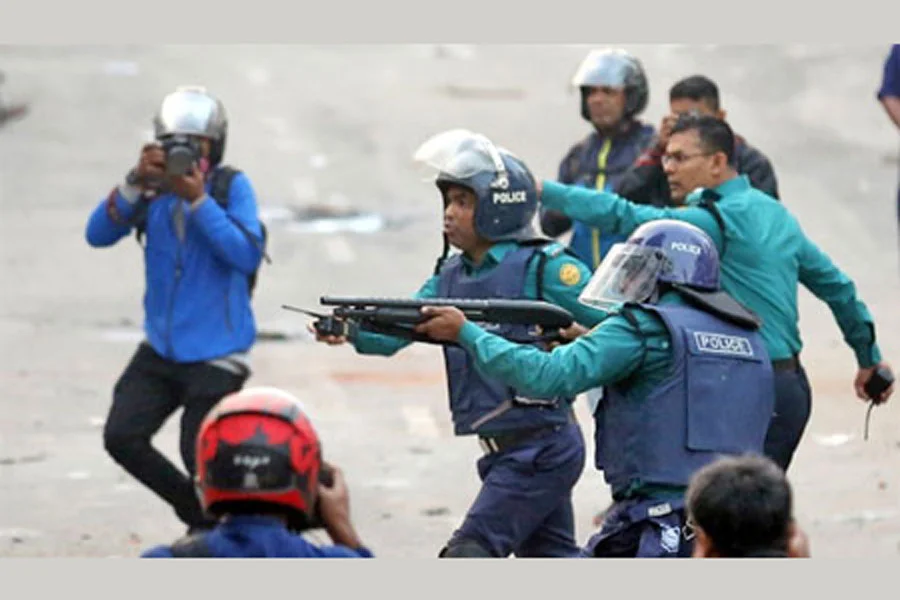
Of late, the violent crimes has not only increased in number, but their nature has also changed. Consider the sharp rise in crimes involving rape and murder of the vilest kind in the victims' supposedly secure homes, incidents of shooting to death in broad daylight, vigilantes beating suspected outlaws to death, eruption of gang wars leading to shootouts and resulting deaths, to mention but a few of the grave offences taking place about every day. Records with Bangladesh Police show that between January and May this year (2026), the number of murders committed was1,452, while that of kidnapping was 437. The cases of robbery or burglary are not included here. On the other hand, in nine months since July 2025, cases of repression against women and children saw their highest rise in April, 2026, marking a 35.4 per cent surge over the previous month of March. However, experts often question the veracity of the crime statistics produced by the authorities concerned. For, year-on-year, comparison in crime rates usually shows a declining trend, which may not quite reflect the real-world situation.

However, the recent spike in the incidence of violent crimes such as hacking to death of a mother and her teenage daughter in their house in the Anowara upazila of Chattogram by unidentified criminals, or the killing of a youth with sharp weapon after calling him out of his houses by one of the victim's close acquaintances in Khulna city in broad daylight, or the shooting and critically injuring of the listed criminal, Yasin Khan Palash or Kayla Palash in broad daylight last Friday near Rampura TV centre in the Hatirjheel area of the capital city, shooting to death of BNP leader Rafiqul Islam on the same day in the Labonchora area in Khulna-it all loks like an unleashed demon that has gone on a killing spree. However, committing deadly violence by desecrating a place of worship is rare in this country. Perhaps, criminals have by now grown bolder and are no more respecters of religious shrines. Last Sunday during the Fazr prayers at the West Kashipur Power Plant Jam-e-Masjid in Daulatpur of Khulna city, assailants entered the mosque, opened fire and injured two individuals, one of whom was reportedly in critical condition.

The critically injured was learnt to be the secretary of the mosque committee. Whatever the motive of the assailants, the choice of a mosque to attack their targeted persons shows that it is an instance of perpetrating crime with no holds barred. Why have the violence-mongers or criminals turned so desperate? Is it just that we are witnessing a complete breakdown in law and order during a government that is hardly three months in office? Is Home Minister Salahuddin Ahmed aware that all such deadly crimes are taking place under his watch? The patten of crime points to something sinister about them. It appears, all the criminal activities from the incidents of rape and killing of women and children to hacking of women and girls in their homes to gunning down of members of crime syndicates to shooting of political leaders and so on are well-orchestrated. The government seems to be either clueless about what lies behind the spate of murders and rapes or is considering those as nothing serious. If the government is too complacent and unconcerned about these violent crimes, the victims and their families cannot just resign to fate and accept the tragedies befalling them as normal. So, the government has a duty to protect the citizens from the machete-wielding and gun-toting gangs, who have, as though, gone on a rampage through the country. It is not enough that law enforcement department is quick to act after a deadly crime has taken place. In fact, it is pointless to shut the proverbial stable door after the horse has bolted. The police and their intelligence networks should rather be more proactive and be able to save lives by preventing serious crimes from happening in the first place.​
 

Police step out in new colours as uniform rollout begins

District units adopt dark blue, metropolitan police light olive, with khaki trousers for all

Star Online Report

1782951811467.webp

Photo: Courtesy

Bangladesh Police introduced new uniforms on Wednesday, with some officers beginning duty in dark blue or light olive shirts paired with khaki trousers.

The new uniforms were visible at the inauguration of the newly-built Barkau Police Camp under the Purbachal New City Project, where Inspector General of Police (IGP) Ali Hossain Fakir wore a dark blue shirt with khaki trousers, while Dhaka Metropolitan Police (DMP) Commissioner Mosleh Uddin Ahmed wore a light olive shirt with khaki trousers.

DMP Media and Public Relations Additional Deputy Commissioner Niaz Mehedi told The Daily Star that officers have started wearing the new uniforms from Wednesday, though distribution is still ongoing. The rollout will be gradual, he said.

The Police Headquarters issued a notification on June 18 revising the dress code and reinstating dark blue and light olive shirts. It also introduced khaki trousers for all personnel, the first such change since 2004.

According to the notification, district police and most units will wear dark blue shirts, while metropolitan police will wear light olive shirts. Trousers for all personnel will be khaki.

The revised dress code will not apply to Armed Police Battalion (APBn), Special Security and Protection Battalion (SPBn), Special Branch, Criminal Investigation Department (CID) and Rapid Action Battalion (Rab), whose existing uniforms will remain unchanged.

The uniform change follows ongoing discussions on police reform, including a decision last year to revise the dress code. The previous iron-grey uniform was introduced on November 25 last year.​
 

Government orders 33 senior police officers into retirement

bdnews24.com

Published :
Jul 05, 2026 23:08
Updated :
Jul 05, 2026 23:14

The government has ordered 33 senior police officers, including deputy inspectors general (DIGs) and additional DIGs, into retirement.

The home ministry announced the decision in a notification on Sunday.

Most of the officers were serving as superintendents of police (SPs) in different districts during the 2018 general election.​

1783301297535.webp


1783301332869.webp
 

Govt transfers four DIGs
United News of Bangladesh . Dhaka 21 July, 2026, 22:01

1784678465018.webp


Representational image | File photo

The government has transferred four deputy inspectors general of the police in the latest reshuffle in the police administration.

Besides, an earlier transfer order involving DIG Miah Masud Karim of the Criminal Investigation Department (CID) has been cancelled.

The Ministry of Home Affairs issued a notification in this regard on Tuesday.

According to the notification, Mymensingh Range DIG Md Ataul Kibria has been transferred and posted as DIG of the CID, while Khulna Metropolitan Police Commissioner Mohammad Zahidul Hasan replaced Kibria.

Sylhet Metropolitan Police (SMP) Commissioner Abdul Quddus Chowdhury has been posted as Chattogram Range DIG, while DIG Sarwar Murshed Shamim of the Police Headquarters has been appointed as SMP commissioner.

The notification also said the earlier order issued on June 28 transferring CID's DIG Miah Masud Karim to the Armed Police Battalion has been cancelled.​
 

Govt sends 17 police officers, including DIGs, ADIGs, into retirement

Staff Correspondent
Dhaka

1784849394975.webp

Home Ministry logo

The government has retired 17 senior police officers from public service, including three officers holding the rank of Deputy Inspector General (DIG).

The decision was announced in a gazette notification issued today, Thursday, by the Police-1 Branch of the Public Security Division under the Ministry of Home Affairs.

The notification, signed by Senior Secretary Monzur Morshed Chowdhury, states that the officers have been retired in the public interest under Section 45 of the Government Service Act, 2018.

Those retired include three DIGs, 12 additional DIGs and two officers holding the rank of Superintendent of Police (SP).

According to the notification, the retired officers include Highway Police DIG Mohammad Abdullahil Baki, Bangladesh Police Academy (Sardah) DIG Md Walid Hossain, and CID DIG Sana Shaminur Rahman.

The additional DIGs retired are Mohammad Sarwar Hossain and Rebecca Sultana of the CID; Bidhan Tripura and Sultana Nazma Hossain of the Tourist Police; AKM Iqbal Hossain of the Police Staff College; Saheli Ferdous of the Armed Police Battalion (APBn); Mohammad Tabarak Ullah of the Bangladesh Police Academy, Sardah; Hasina Rahman of Police Telecom; Faisal Mahmud of the Central Police Hospital under Police Headquarters; Kaniz Fatema of Police Headquarters; Jesmin Begum of the Naval Police; and DMP Additional DIG Mosammat Farida Yasmin.

The list also includes Mohammad Habibur Rahman, deputy commissioner of the Rangpur Metropolitan Police, and Abdur Rahim Shah Chowdhury, superintendent of police of TDS. The notification states that the retired officers will receive retirement benefits in accordance with the applicable rules. It also says that the order, issued in the public interest, takes immediate effect.​
 

Renaming Rab as SRB is not reforming

Proposed law risks preserving the very structures that enabled Rab’s abuses

1787096971015.webp

VISUAL: STAR

A post-uprising government’s recognition that retaining the Rapid Action Battalion (Rab)—a security force that has earned global notoriety for its egregious disregard for human rights—is no longer tenable is a welcome first step towards restoring the rule of law. According to an official release, the cabinet on Monday approved a draft law titled “Special Response Battalion (SRB) Act, 2026,” which, if enacted, would effectively rename Rab as SRB. But rebranding without substantive internal reforms falls short of the expectations of human rights advocates and the victims of past abuses committed by Rab.

Reportedly, the new force would be a specialised unit of the police—essentially the same status Rab had on paper. Like Rab, SRB would continue to be headed by a serving additional IGP and remain under the command of the IGP. The draft law also provides for the transfer of Rab’s manpower, orders, powers, facilities, funds, assets, accounts, records and other property to SRB. Most strikingly, members of the armed forces would continue to serve in SRB on deputation. Cases filed by Rab would also continue as though they had been filed by SRB. Existing Rab regulations would likewise remain in force, with necessary adaptations, until rules for the new force are framed. In other words, what we are seeing is textbook repackaging, which could allow the force to continue operating with little or no meaningful accountability.

These, one may recall, are precisely the concerns that led the United States to impose sanctions on senior Rab commanders as well as the force itself. The Office of the United Nations High Commissioner for Human Rights (OHCHR), which investigated killings and other violations committed by security forces during the July uprising, recommended, among other measures, “dissolving the Rapid Action Battalion and return personnel not involved in serious violations to their respective units.”

The proposed law and the conversion of Rab into a new force through the wholesale transfer of existing personnel, including those serving on deputation from other forces, clearly depart from these recommendations. Thousands of victims of abuses allegedly committed by Rab members, including so-called “crossfire” killings and enforced disappearances, are still waiting for justice and compensation. Allowing personnel implicated in such abuses to continue their law-enforcement roles under a new institutional identity would be deeply unjust. The policing duties assigned to SRB also appear inconsistent with the rationale for creating a specialised force, which should be assigned clearly defined special duties.

The government, in response to concerns of abuse, may argue that it has introduced a safeguard by proposing a multiparty grievance-redressal committee to handle complaints. But this mechanism is also problematic. Unless the committee is genuinely independent, adequately empowered and protected from the influence of security forces, it is unlikely to provide credible investigations or effective remedies.

We, therefore, call upon the government to undertake broader consultations on the draft legislation and make necessary changes before proceeding. Such consultations could include open hearings before the parliamentary standing committees. The abolition of Rab must be substantive, not cosmetic. It must be accompanied by credible accountability for past crimes, justice and reparations for victims, and safeguards against the continued militarisation of a civilian law-enforcement institution.​
 

Armed Police Battalion to get criminal investigation powers

Cabinet approves draft law expanding force’s operational and legal mandate

Star Online Report


1787614828737.webp


The government has decided to grant the Armed Police Battalion (APBn) powers to investigate criminal offences and conduct operations.


The Cabinet today approved the draft Armed Police Battalion Act, 2026, which contains provisions allowing members of the force to investigate criminal offences in compliance with the Code of Criminal Procedure and other existing laws.

The proposed law also includes provisions for trials through the formation of special courts and summary courts.

The decision was taken at the 18th Cabinet meeting held at the Secretariat, with Prime Minister Tarique Rahman in the chair, according to a press release issued by the Cabinet Division.

The release said the existing Armed Police Battalions Ordinance, 1979 had been updated and drafted in Bangla as the Armed Police Battalion Act, 2026.

Armed Police Battalion will operate under the control and supervision of an additional inspector general of police.

APBn will be responsible for maintaining public safety and ensuring the security of VIPs and government-declared installations.

They will also take action against those involved in terrorism, narcotics, human trafficking, rape and crimes against humanity, and assist other law enforcement agencies, according to the press release.​
 

RAB to be renamed as SRB, bill placed in parliament


1788477174262.webp


The government has proposed replacing the Rapid Action Battalion (RAB) with a new specialised police unit, the Special Response Battalion (SRB), amid objections from opposition lawmakers who demanded a detailed parliamentary discussion before creating another elite force.

Home Minister Salahuddin Ahmed on Thursday placed the Special Response Battalion (SRB) Bill, 2026, in parliament.

The bill seeks to repeal the legal provisions under which RAB was formed and establish the SRB as a specialised unit under the police, reports UNB.

Opposition Chief Whip Nahid Islam objected to the bill’s introduction, saying RAB had become nationally and internationally controversial over allegations of enforced disappearances, extrajudicial killings and secret detention during the previous government.

He said all political parties had pledged before the election to abolish RAB and questioned the move to establish what he described as another institution under a different name.

“RAB should be abolished. If a specialised unit is needed, there should first be a detailed discussion in parliament,” Nahid said.

Opposition Leader Shafiqul Rahman also supported the abolition of RAB but called for further consideration before establishing a new agency.

In response, Home Minister Salahuddin said the government’s electoral commitment was that there would be no organisation called RAB, and the bill was intended to fulfil that commitment while retaining the need for a specialised police unit.

He said the fact that a former Inspector General of Police, Benazir Ahmed, had been accused of wrongdoing could not be a reason to abolish the police force itself.

The minister said the proposed SRB would have stronger provisions for accountability and transparency than RAB. He urged opposition lawmakers to participate in the parliamentary committee’s scrutiny of the bill and place their recommendations there.

The bill provides for the transfer of RAB’s manpower, orders, powers, authority, facilities, funds, cash and bank deposits, liabilities, contracts, movable and immovable property, registers and records to the SRB.

Under the proposed law, the SRB would be a specialised unit under the police. It would be formed through the posting or deputation of police personnel, members of other disciplined forces and a prescribed number of officers and employees, according to government requirements.

The unit would have a flag, emblem and specified uniform prescribed by rules. Its Director General would be a serving police officer not below the rank of Additional Inspector General of Police.

The SRB would have powers to investigate criminal offences and conduct searches, arrests and seizures. It would also have its own detention facilities, malkhana and interrogation rooms.

The bill proposes a multi-member grievance redress committee to address complaints from citizens and internal grievances of unit members.

According to the statement of objects and reasons, the new unit is needed to assist the police and other law enforcement agencies in maintaining public security, preventing and suppressing terrorism, organised crime and other serious offences, and responding rapidly and effectively to special situations.

The proposed law also seeks to ensure the rule of law, human rights, transparency, effective oversight and accountability in the exercise of the specialised unit’s powers.

The bill was eventually introduced by the home minister and sent to the Parliamentary Standing Committee on the Ministry of Home Affairs for scrutiny and submission of its report within four working days.

APBN to get investigation powers

The home minister also placed the Armed Police Battalions (APBN) Bill, 2026, seeking to repeal the existing ordinance and introduce a new legal framework for the force.

The proposed law provides for APBN units under the police, including the Special Security and Protection Battalion, Hill Battalion and Airport Battalion, along with any other battalions prescribed by the government.

The bill would empower APBN to investigate criminal offences and, subject to the Code of Criminal Procedure and other existing laws, enter premises, conduct searches, seize property and make arrests.

It also sets out disciplinary and conduct rules for APBN members. They would generally be barred from membership of or direct or indirect involvement with any organisation, although membership of professional associations related to their professional development or the interests of APBN would be allowed.

APBN members would also be prohibited from publishing or helping to publish information or documents in electronic media or newspapers without prior permission from the competent authority.

The bill was also sent to the Parliamentary Standing Committee on the Ministry of Home Affairs for scrutiny.​
 

Latest Posts

Back