Feed

[🇧🇩] Strategic Aspect of Bangla-Japan Relation

[🇧🇩] Strategic Aspect of Bangla-Japan Relation
100
6K
More threads by Saif

G Bangladesh Defense

Japan Festival returns to Dhaka after seven years

Japan Festival 2026 was held at Bangladesh Shilpakala Academy (BSA) on Friday, bringing together Japanese traditional performances, martial arts, music, cuisine and hands-on cultural experiences.

The Embassy of Japan in Bangladesh, in cooperation with the Ministry of Cultural Affairs and Bangladesh Shilpakala Academy, organised the festival, which was held in Bangladesh for the first time in seven years, reports UNB.

Japanese Ambassador Saida Shinichi and Minister of Cultural Affairs Nitai Roy Chowdhury attended the opening ceremony, where they delivered remarks.

Following the opening ceremony, visitors enjoyed a series of performances showcasing different aspects of Japanese culture.

The stage programme featured an introduction to Kabuki, followed by a Nihonbuyo performance, a form of traditional Japanese dance. Demonstrations of Karate and Kendo were also presented during the programme.

The Japanese singer duo Bajna Beat later performed at the festival, joining Bangladeshi artists for a special musical presentation celebrating cultural exchange between the two countries.

The programme concluded with a performance of Kabuki Shishi, a traditional Japanese dance, presented by Japanese dancer Senju Einojo.

Alongside the stage performances, the festival featured a range of Japanese cultural exhibition stands and interactive activities. Visitors had the opportunity to experience Sado, the traditional Japanese tea ceremony, as well as view displays of Bonsai and Ikebana.

Japanese cuisine prepared by a chef from the Embassy's official residence was also served to visitors.

Students attending the festival also had the opportunity to consult an adviser about study-abroad opportunities in Japan.

The festival provided visitors with an opportunity to experience the diversity of Japanese culture through traditional arts, performance, cuisine and other cultural practices, while also highlighting cultural exchanges between Japan and Bangladesh.​
 

PM's Upcoming Japan Tour: Dhaka to seek $1.0 billion budget-support credit
Funds meant for tackling shocks from energy crisis, ME conflict


1791676817074.webp


Bangladesh is set to seek US$1.0 billion in budget support from Japan during Prime Minister Tarique Rahman's tour later this month.

Officials have said the total sum will be sought in two instalments--$500 million in the current fiscal year and as much in the next year.

The prime minister is expected to undertake a 4-day Japan tour on October 26 for talks aimed at advancing bilateral cooperation, particularly in fields of trade, investment and economy.

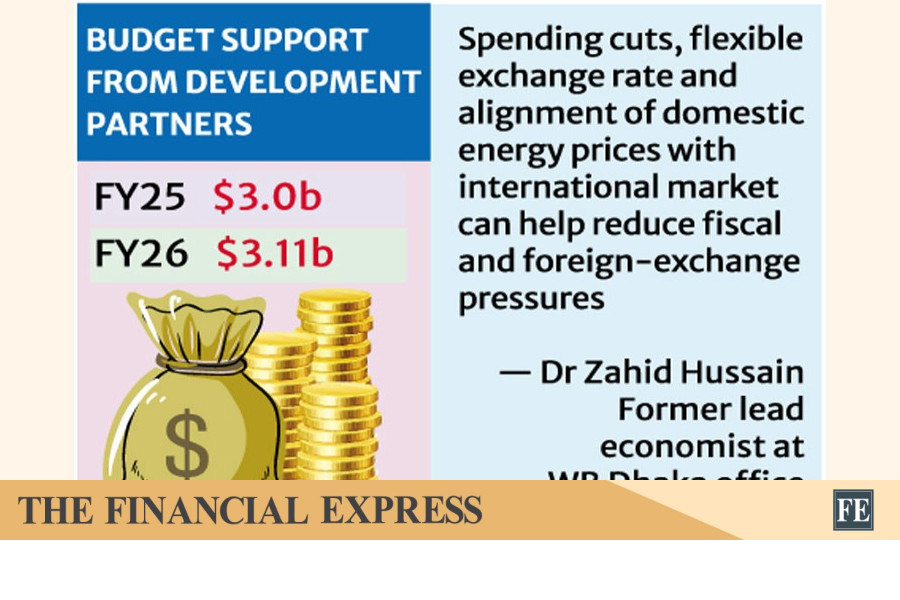
The country received some $3.11 billion in budget support from the development partners in the fiscal year 2025-26 to tackle the economic shocks stemming from the prolonged conflicts in the Middle East.

Bulk of the money went for financing higher import costs of fuel oils, liquefied natural gas (LNG) and food items in particular.

Most of the amount came from the World Bank, the Asian Development Bank (ADB), Japan International Cooperation Agency (JICA) and the Asian Infrastructure Investment Bank (AIIB).

In FY 2024-25, Bangladesh had received some $3.0 billion in budget -support credits from the development partners.

However, according to Finance Division officials, the country is yet to receive any budget-support credit during the last three months of the current fiscal year.

Final negotiation is now set to begin to secure some $100 million from the OPEC Fund for International Development (OFID) as budget support that the government sought from the agency last year to cushion shocks from energy crisis. In FY'25, Bangladesh got $110 million from OFIDF as budget support.

According to officials concerned, presently no discussion is ongoing with the Japan International Cooperation Agency or JICA for any budget-support credit. In the last fiscal year, Bangladesh got $316 million from JICA and $414 million in FY'25.

Thus, the budget credit will be sought from JICA to manage higher spending for sourcing fuel oils and liquefied natural gas as their prices mounted due to conflict in the Middle East.

At present, initial discussion is going on with the Asian Development Bank to secure a number of budget-support credits but those may not be finalised before next March, officials say.

Bangladesh's economy began facing severe crisis since early 2022 when Russia invaded Ukraine that caused huge disturbance to the global economy, pushing up inflation significantly across the world.

The price hike of key commodities globally and fall of remittance inflows and export earnings had lowered the foreign-exchange reserves, forcing the government to take severe austerity measures.

To tackle the crises the government was forced to seek financial support from the International Monetary Fund (IMF) to support its dwindling economy. Subsequently, the IMF in January 2023 approved $4.7-billion loan for Bangladesh.

The Middle East conflicts early this year further pushed up fuel-oil and LNG prices following production and transportation disruptions, making the government spend millions as subsidy.

The subsidy spending is growing over the years, raising the operating expenditure of the government. So the government is looking for higher budget-support funds, to tackle the energy-price shock.

Dr Zahid Hussain, a former lead economist at the World Bank's Dhaka office, earlier told The Financial Express getting budget-support credit from development partners in many aspects depends on government's comfort position with the IMF.

"We need to cut budgetary spending as much as possible to face the crisis," he said, adding that containing spending will help lower import and thus the requirement of foreign currency will lessen.

He has suggested maintaining exchange-rate flexibility and ensuring that no gap remains between domestic and international energy prices.​
 

PM's Japan visit to prioritise economic partnership, investment: Humaiun

BSS
Dhaka


1791678768336.webp

BNP acting chairman Tarique Rahman File photo

State Minister for Foreign Affairs Humaiun Kobir today, Saturday said strengthening bilateral relations, deepening economic partnerships and increasing investment would be Bangladesh's main priorities during Prime Minister Tarique Rahman's upcoming visit to Japan.

"Our main priorities during the Japan visit will be to strengthen bilateral relations, deepen economic partnerships and increase investment," he told journalists after attending a seminar titled "From Workforce to Strategic Partnership: Reimagining Bangladesh-KSA Relations".

Prime Minister Tarique Rahman will leave for a four-day visit to Japan on 26 October.

Humaiun Kobir said Bangladesh would prioritise trade, investment and development partnerships across various sectors during the visit, consistent with its approach to engagement with other countries.

Bangladesh now seeks reciprocal investment partnerships with countries around the world in clearly defined areas of cooperation, he added.

Describing Japan as one of Bangladesh's largest and longstanding development partners, Humaiun said Japanese investment in several mega projects had helped build strong diplomatic and investment ties between the two countries.

He recalled that the prime minister had previously attended an energy summit in Japan as an invited guest of the Japanese premier when that country faced an energy crisis.

The state minister said that engagement had helped foster the Japanese government's confidence in Bangladesh's prime minister.

The forthcoming visit would feature detailed discussions on sector-specific cooperation and opportunities for reciprocal investment, he said.

Regarding Prime Minister's Saudi Arabia visit, Humaiun Kobir said Saudi Arabia's Crown Prince had invited Prime Minister Tarique Rahman to visit the Kingdom and the premier had accepted the invitation.

"He has accepted and will do so at some point very soon," he said.

The Saudi Crown Prince had also expressed interest in visiting Bangladesh, Humaiun said, adding that Dhaka would welcome him at a mutually convenient time.

Responding to a question on protecting the holy cities of Makkah and Madinah, Humaiun said Bangladesh's position was clear and uncompromising.

He said Bangladesh, as one of the world's largest Muslim countries, would stand ready to provide necessary support if its cooperation or assistance was sought for initiatives to protect the Muslim world's holy sites and mosques.

The seminar was jointly organised by the Bangladesh Institute of International and Strategic Studies (BIISS) and the Center for Migration Studies of North South University (NSU).

Foreign Ministry Secretary (Bilateral) Dr Md Nazrul Islam and Expatriates' Welfare and Overseas Employment Secretary Md Mokhtar Ahmed spoke as special guests.

BIISS Director General Major General A S M Ridwanur Rahman and NSU Vice-Chancellor Professor Abdul Hannan Chowdhury also addressed the seminar.​
 

Marubeni eyes new investments in Bangladesh

Star Business Report

1791764168434.webp

A delegation from Japan’s Marubeni Corporation, led by its President and CEO Masayuki Omoto, meets Commerce Minister Khandakar Abdul Muktadir at the ministry in Dhaka on Sunday. Photo: The Ministry of Commerce

Japanese conglomerate Marubeni Corporation is interested in expanding its existing investments in Bangladesh and entering new industrial sectors, including fertiliser production, information technology and ship recycling.

The corporation also sees opportunities to modernise the Karnaphuli Fertilizer Company (KAFCO), improve natural gas efficiency and increase fertiliser production capacity. The Japanese trading group is an equity investor in KAFCO.

Marubeni President and CEO Masayuki Omoto discussed the investment opportunities at a meeting with Commerce Minister Khandakar Abdul Muktadir at the commerce ministry office in Dhaka yesterday, according to a press ministry statement.

Omoto also expressed interest in new investments and technological cooperation in the production of diammonium phosphate (DAP) and triple superphosphate (TSP) fertilisers.

Highlighting Bangladesh’s potential in the information technology sector, he noted that hundreds of Bangladeshi engineers employed by Bangladesh Japan Information Technology (BJIT), a joint investment venture, were providing services to international markets, including Japan.

He said there were further opportunities to expand cooperation in artificial intelligence and IT offshoring.

The discussions also covered investment in modern, environmentally friendly technologies for the ship recycling industry, a proposal for Toyota vehicle manufacturing and ensuring an uninterrupted electricity supply to economic zones.

Small modular reactor (SMR) technology was also discussed as a potential option for ensuring long-term energy security, the ministry statement said.

Muktadir said the government was prioritising the simplification of company registration, trade licensing and investment approval procedures. It was also working to ensure that foreign investors could repatriate profits and capital.

He assured that Japanese companies looking to expand their investments in Bangladesh would receive the necessary government support.

The minister said Japanese technology, expertise and investment could play a significant role in developing Bangladesh’s manufacturing industries.

There were opportunities to expand joint ventures in shipbuilding and ship recycling, automobiles, agro-based industries and high-technology sectors, he said, adding that the government was advancing necessary reforms to facilitate investment in these areas.

He also said efforts were underway to move the jute industry beyond conventional products towards diversified, higher-value goods. Priorities included developing new products by blending jute fibres with cotton, viscose and polyester, improving seeds and expanding research activities.

Both sides also discussed the importance of deepening Bangladesh-Japan economic relations, capitalising on the potential benefits of the Economic Partnership Agreement (EPA) between the two countries, and expanding long-term partnerships in industry and technology.

Marubeni, one of Japan’s major general trading companies, operates across sectors ranging from food and agriculture to energy, infrastructure and technology. The group reported revenue of ¥7.79 trillion in the fiscal year ended March 2025 and employed more than 52,000 people worldwide, according to its Integrated Report 2025 and financial results.

In Bangladesh, Marubeni has a business and capital alliance with local IT service company BJIT Group. Under the alliance announced in April 2023, Marubeni invested in BJIT Ltd, the group’s core company, and BJIT Global Pte Ltd, which manages overseas sales, to expand offshore digital transformation services, according to a Marubeni announcement.

Marubeni has also installed about 1,300 megawatts of gas-fired and hydropower plants in Bangladesh and supplied the entire railway system for Dhaka Metro Rail’s MRT Line 6, according to a company statement issued in April 2023.​
 

Tarique Rahman’s Japan visit: Turning trust into tangible gains

Zillur Rahman

Prime Minister Tarique Rahman should arrive in Tokyo with a clear message: Bangladesh is ready to become a dependable economic and strategic partner for Japan. But goodwill alone will not be enough. He must show what Bangladesh can offer, how it intends to protect investment and why Japan should place greater confidence in its future.

The reported four-day visit, beginning on October 26, is expected to focus on economic cooperation, investment and a possible arrangement for Bangladeshi workers. These are promising areas, but negotiations are not achievements. The visit should produce practical commitments that both countries can follow through on.

Japan has been one of Bangladesh’s most trusted development partners. Its contributions to infrastructure development have been substantial. The challenge now is to build on that relationship through stronger trade, industrial investment, skilled employment and maritime cooperation.

The partnership has a long history. Japan recognised Bangladesh in February 1972, and Sheikh Mujibur Rahman visited Tokyo the following year. President Ziaur Rahman visited in 1978 and 1980. An air services agreement and the first bilateral meeting on commerce and economic cooperation in 1980 showed that relations were moving beyond diplomatic goodwill.

Begum Khaleda Zia’s visits in 1994 and 2005 carried this engagement forward. The 2002 technical cooperation agreement provided an institutional framework, while her July 2005 talks with Prime Minister Junichiro Koizumi gave the relationship a wider economic and strategic direction. Their joint statement recognised Bangladesh as a bridge between South and East Asia and placed Japan within Dhaka’s “Look East” diplomacy. Investment, technology, training and good governance were already priorities. Two decades later, the question is how much Bangladesh has delivered on them.

The 2014 comprehensive partnership and the 2023 strategic partnership deepened cooperation in infrastructure, connectivity and economic security. Tarique Rahman inherits these commitments, along with the responsibility to make them work. Relations with Japan must remain a national priority, not a political possession that changes hands with each government.

Bangladesh offers more than a need for development assistance. It has a sizeable domestic market, a growing industrial base and a strategic position on the Bay of Bengal. Japan wants reliable supply chains, commercial opportunities and secure maritime routes. Dhaka should understand these interests and negotiate from a position of confidence.

1792282060814.webp

The seventh Bangladesh–Japan Foreign Office Consultations (FOC) were held in Dhaka on August 12, 2026. Foreign Secretary Asad Alam Siam and Japanese Senior Deputy Foreign Minister Namazu Hiroyuki led their respective delegations. Photo: MOFA, Bangladesh

Matarbari’s deep-sea port and the Bay of Bengal Industrial Growth Belt, or BIG-B, illustrate the possibilities. Together, they could strengthen logistics, energy and industrial connectivity, including links with India's northeast.

Yet geography does not guarantee success. A modern port is of limited value without efficient customs, dependable transport, competitive charges and industries that generate cargo. Bangladesh has spent too many years celebrating ambitious projects before asking whether they will deliver. Matarbari must not become another example. The government should be clear about the costs, deadlines and benefits, particularly when regional connectivity is involved.

The immediate trade priority is the Economic Partnership Agreement signed on February 6, 2026, Bangladesh’s first. Covering far more than tariffs, it includes customs, services, investment, electronic commerce, procurement, labour and environmental provisions. The Tokyo visit should help turn this agreement into something businesses can use. That will require administrative preparation, clear rules and support for exporters.

With Bangladesh scheduled to graduate from least developed country status on November 24, 2026, although it has requested an extension, preparation is urgent. Whatever happens to the timetable, the country cannot depend indefinitely on preferential market access.

Japanese assistance with product testing, certification and supplier development could help Bangladeshi firms meet demanding international standards. Footwear, processed foods, light engineering and technology services deserve attention alongside garments.

Investment is another area where opportunity and frustration coexist. Japan’s foreign ministry recorded 338 Japanese companies operating in Bangladesh as of October 2025. A JETRO survey presented in March 2026 found that 56.9 per cent of surveyed firms planned to expand within one or two years.

That interest is encouraging, but investors will judge Bangladesh by their everyday experience. Delayed approvals, inconsistent tax decisions, unreliable utilities and difficulties in resolving disputes can undermine even attractive investment prospects.

A successful visit should leave behind more than a joint declaration. Bangladesh needs a clear plan to implement the Economic Partnership Agreement, firm infrastructure deadlines, specific reforms to improve the investment climate, a credible worker recruitment system and concrete commitments on maritime and humanitarian cooperation.

The Japanese-backed economic zone at Araihazar should become a working example of how Bangladesh can do better. Businesses need predictable services, published deadlines and effective grievance mechanisms. Routine problems should not require intervention from the highest levels of government.

Financial discipline matters equally. JICA’s June 2026 emergency support agreement offers up to ¥50 billion for economic resilience and a stable energy supply, with a published annual interest rate of 3.05 per cent. Such financing can help, but every commitment must be assessed against its economic benefits, repayment obligations and currency risks.

Bangladesh cannot afford projects that look impressive at inauguration but become costly burdens afterwards. Transparent procurement, timely completion and sound financial management are essential. Energy cooperation should also place greater weight on efficiency, grid reliability and renewables rather than creating further dependence on imported fuels.

Employment cooperation could produce some of the visit’s most direct benefits. Japan needs skilled workers, and Bangladesh has young people seeking opportunities. But sending workers abroad is not simply a matter of signing an agreement.

Language proficiency, technical training and recognised qualifications must match employers’ needs. Recruitment costs should be reasonable, contracts should be understandable and workers should be protected against exploitation. Success should be measured by actual placements, wages and working conditions, not ambitious recruitment announcements.

Security cooperation is also growing. The defence equipment and technology transfer agreement signed on February 3, 2026, established a framework for future transfers. Japan’s handover of five patrol boats in July under its Official Security Assistance programme added a practical maritime dimension.

Bangladesh should focus on surveillance, search and rescue, disaster response, training and maintenance. It must also preserve strategic flexibility. Japan is a US ally, while Bangladesh has important relationships with India, China and others. Cooperation with one partner need not come at the expense of another. Sovereignty, international law and independent decision-making should remain the guiding principles.

1792282115543.webp

Prime Minister Tarique Rahman meets a Japanese delegation led by Parliamentary Vice-Minister for Foreign Affairs Shimada Tomaki at the Prime Minister’s Office on July 1, 2026. Discussions covered key issues, including the energy crisis, airport terminal development and Rohingya repatriation. Photo: PMO

The Rohingya crisis also deserves attention. In March 2026, Japan announced ¥2.57 billion in additional assistance for refugees and host communities. Bangladesh should seek continued humanitarian support and stronger diplomatic engagement towards safe, voluntary and dignified repatriation. Instability across the border threatens the very regional connectivity both countries hope to develop.

Nor should Bangladesh forget the seven Japanese citizens killed in the July 2016 terrorist attack while working on preparations for Dhaka’s mass transit development. Japan continued supporting Bangladesh afterwards. Protecting foreign professionals and everyone working for the country’s development is an obligation that goes beyond diplomacy.

A successful visit should leave behind more than a joint declaration. Bangladesh needs a clear plan to implement the Economic Partnership Agreement, firm infrastructure deadlines, specific reforms to improve the investment climate, a credible worker recruitment system and concrete commitments on maritime and humanitarian cooperation.

Ultimately, the harder test lies at home. The 2005 joint statement recognised the importance of governance to investment. That lesson remains unfinished. Predictable rules, credible courts, accountable institutions and respect for contracts will attract lasting Japanese investment more than repeated assurances in Tokyo.

Tarique Rahman has an opportunity to build on a relationship nurtured by successive generations of leaders. Japan’s trust is a national asset. The visit should honour that history, but its success will be judged by something more immediate: better jobs, stronger businesses and lasting opportunities for Bangladeshis.

Zillur Rahman is a political analyst and President of the Centre for Governance Studies (CGS). He hosts Tritiyo Matra on Channel i and writes on geopolitics, strategic affairs and governance.​
 

Latest Posts

Back
PKDefense - Recommended Toggle Create