New Tweets

[πŸ‡§πŸ‡©] Bangladesh-Qatar Relation---- In The Midst of Middle Eastern Turmoil.

G Bangladesh Defense
[πŸ‡§πŸ‡©] Bangladesh-Qatar Relation---- In The Midst of Middle Eastern Turmoil.
16
2K
More threads by Saif


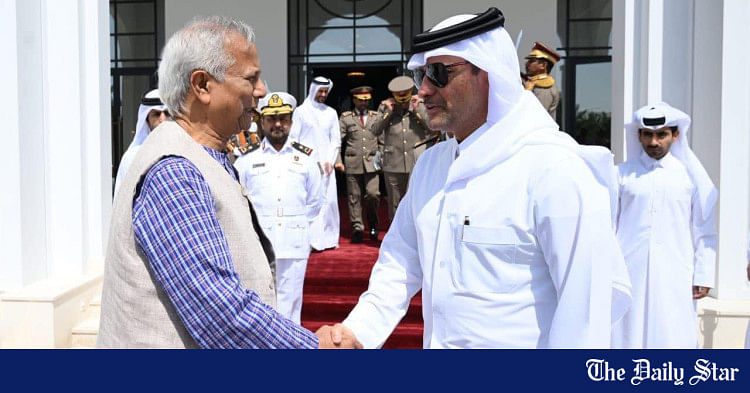
Dhaka-Doha Ties: Mutual interests may lead to strategic partnership
Say experts about Qatar emir's recent visit

Amid geopolitical shifts, Bangladesh's emergence as an economic and diplomatic power in the Indo-Pacific region and mutual interests in trade and commerce may lead both Dhaka and Doha to elevate the existing ties into strategic partnership, said experts.

Experts said this after Qatar Emir Sheikh Tamim bin Hamad Al Thani concluded his two-day visit to Bangladesh on Wednesday.

While much of the talks during Al Thani's visit were focused on trade and investment, they say, there is a scope and need to strengthen the bilateral ties.

"In the Middle East, the perception of Bangladesh is changing. Traditionally seen as a supplier of workers, the Middle East is now looking at Bangladesh as an emerging economic and diplomatic power," said Prof Shahab Enam Khan of the International Relations Department at Jahangirnagar University.

Qatar must have studied how Bangladesh, a large market and an investment destination in the Indo-Pacific region, is maintaining a balancing act with global and regional powers like the US, Russia, China and India, he told The Daily Star.

Bangladesh's image as a moderate Muslim country is also a plus point for Qatar, he added.

On the other hand, Qatar also maintains a fine balance in its relationships with the Middle East countries as well as global powers.

With a huge sovereign wealth fund of $475 billion, the energy-rich country is also focusing on diversifying its trade and investment, Prof Shahab Enam said.

Considering all these issues, there is a mutual interest for both countries to enhance their economic and diplomatic ties, he added. "Qatar can think of Bangladesh as an important ally, knowing its growing capacity," he said.

In a strategic relationship, two countries engage not only in trade and economic sectors but also in defence, security, investments and other areas in the international forums where their interests converge.

The visit by the Qatar emir on April 22-23 came a year after Prime Minister Sheikh Hasina's visit to Doha.

The two leaders discussed the Gaza war and called for the global leaders to take effective measures for a durable solution to the Palestinian crisis. They also talked about the repatriation of the Rohingyas.

On the trade front, the bilateral meeting in Dhaka discussed expediting collaboration on trade and investment, energy and power, manpower, defence, education, maritime security, port management, agriculture and food security and resulted in ten deals.

Deals have been also agreed on how to avoid double taxation on goods, prevent fiscal evasion, cooperation in the legal field, youth and sports, diplomatic training and establish the Bangladesh-Qatar joint business council to boost bilateral trade, which now stands at more than $3.5 billion, with Bangladesh importing some $2.70 billion worth of LNG, fertiliser and other petroleum products.

They also discussed the welfare of nearly 4 lakh Bangladeshi workers in the Gulf nation.

"If you notice, Qatar has taken an integrated approach to enhance the economic, diplomatic and political relationships," said Prof Shahab Enam.

"The emir visited all the three Asian countries -- Bangladesh, Philippines and Nepal -- that have large numbers of people working in Qatar. There are security dynamics at play here," he said.

Qatar does not want extremist elements in its workforce, he added.

Prof Delwar Hossain of the International Relations Department at Dhaka University told The Daily Star that the signing of the new deals has given the already good bilateral relationship a stronger institutional framework.

He mentioned that due to both nations' efforts to expand their trade and investments and their diplomatic influence, their bilateral relations have the potential to thrive.

Bangladesh's growing interest in the Indian Ocean region is also something that Qatar has an interest in -- call it port management, shipping or energy, he said.

"The visit by the Qatar emir demonstrates high-level political will and now the concerned officials need to follow up and implement the ideas mooted efficiently," Prof Delwar said.

And the sentiment is mutual.

On Tuesday, Qatari newspaper Peninsula Qatar reported that the relations between Bangladesh and Qatar witnessed remarkable development in recent years through mutual visits at various levels and fruitful cooperation.

This "reflects the keenness of the leadership of the two countries to develop these relations and advance them into strategic partnerships and further progress and prosperity".​
 
Analyze

Analyze Post

Add your ideas here:
Highlight Cite Respond

Deepening Qatar-Bangladesh relations
Kamal Uddin Ahmed 29 April, 2024, 22:45

1714434645484.webp

A handout photo released on April 22 by the Press Information Department shows emir of Qatar Tamim Bin Hamad Al-Thani, centre, inspecting a ceremonial guard of honour on his arrival in Dhaka. | β€” Agence France-Presse/Bangladesh PID

WITH one of the highest GDP per capita incomes today, the state of Qatar in the Gulf has been ruled by the Al-Thani royal dynasty since 1868. The World Bank estimated Qatar's GDP at $236.26 billion in 2022. Bilateral relations between Qatar and Bangladesh have improved dramatically in recent years.

Qatar's emir Sheikh Tamim bin Hamad Al Thani paid a two-day state visit to Bangladesh beginning on April 22 at the invitation of the government. The primary goal of the visit was to strengthen and expand the ties and collaboration between the two countries. A high-level official entourage accompanied him on his first visit to Bangladesh. It demonstrates a shared desire to further reinforce bilateral relations.

Notably, the former ruler of Qatar, Sheikh Hamad bin Khalifa Al Thani, the architect of the contemporary Qatar and its foreign policy, paid a ceremonial visit to the country in April 2005 and laid the groundwork for bilateral collaboration. That year, the two countries signed a memorandum of understanding for Foreign Office consultation.

In 2013, Sheikh Tamim bin Hamad Al Thani became the emir of Qatar, wielding absolute power. His government aspires to achieve 'economic and social modernisation' as outlined in Qatar's National Vision 2030, a goal to transform the country into a highly advanced one.

Exclusive one-to-one discussions on a range of important issues such as trade and investment promotion and protection, energy and power, and human resources supply took place between Qatar's emir Sheikh Tamim and Bangladesh's prime minister Sheikh Hasina. This was followed by a combined productive summit, during which Bangladesh and Qatar solidified their relationship by signing as many as ten documents.

These included five agreements and five memorandums of understanding. The five agreements encompass various areas of cooperation, including legal matters, investment promotion and protection, taxation, maritime transit, and the establishment of a joint business council. The five memorandums included cooperation on human resources, cooperation on port management, cooperation on higher education and scientific research, cooperation in youth and sports issues and cooperation in diplomatic training.

Sheikh Tamim commended both sides for signing the key agreements and memorandums and recognised the important role of the hard-working Bangladeshi expatriates in the economic development of Qatar.

Sheikh Tamim also held a summit with the president, Mohammed Shahab Uddin, at Bangabhaban and exchanged views on a number of mutual issues. Shahabuddin highlighted bilateral economic cooperation and sought further investments from Qatar in the special economic zones of the country and also invited the business moguls to recruit more work forces from Bangladesh.

Qatar gave diplomatic recognition to Bangladesh in March 1974. While Bangladesh launched its mission in Doha in June 1975, almost seven years later, Qatar opened its diplomatic mission in Dhaka in 1982. Both are predominantly Muslim countries and continue to support each other in the international fora.

The reciprocal political and economic relations between supposedly 'democratic' Bangladesh and authoritarian monarchy Qatar have been quite productive, particularly over the last decade. The key determinants of their relationships are mutual respect, a shared vision of prosperity and peace, and a common religious tradition.

At the invitation of the emir of Qatar, Sheikh Hasina made a three-day official visit to Qatar in May 2023. She addressed the Qatar Economic Forum debates. Graced by global leaders in business and government, the organisation is renowned as a dominant voice for trade and investment.

Sheikh Hasina reviewed Bangladesh's trade and investment prospects and invited Qatari business elite to invest in the country. Notably, she paid two visits to Qatar in 2023. Thus, Hasina's formal visits and high-level engagements and deliberations have resulted in warm and friendly bilateral relations between the two countries.

In fact, Sheikh Hasina continues to prioritise partnerships with Qatar, primarily for three reasons: (a) it has developed as an important commercial partner; (b) the third-largest destination for Bangladeshi workers after Saudi Arabia and Malaysia; and (c) a major exporter of LNG and urea fertiliser to Bangladesh.

Bangladesh imports about 800,000 tonnes of urea fertiliser annually from Qatar Fertiliser Company Ltd under a 2009 memorandum of understanding.

Bangladesh also relies heavily on Qatar for energy supplies, with Petrobangla inking a new agreement with Qatar Energy in June 2023 to secure an ongoing supply of liquefied natural gas. Qatari gas remains in high demand globally, especially following Russia–Ukraine in February 2022. The new agreement will deliver extra LNG for 15 more years, from 2026 to 2040, ensuring Bangladesh's energy security. On the other hand, the energy deal enhances Qatar's geopolitical influence in Bangladesh.

Oil and gas-rich Qatar is a top trading partner of Bangladesh in the Middle East. Qatar's total exports to Bangladesh amounted close to $2.74 billion during 2022, which was only $4.5 million in 2000. On the other hand, Bangladesh's export to Qatar increased to $89.43 million in 2022 from meagre $2.37 million in 2000. Bangladesh has been making efforts to increase its exports to Qatar and currently exporting ready-made garments, vegetables, tea and processed foods.

Qatar has partnerships with some of the world's best universities to provide world-class education. More than one hundred Bangladeshi students are studying in Qatar as part of the Qatar Foundation scholarship programme. The Qatari government provided about $1.27 million in March 2023 to support Bangladesh's education sector. The funding aimed to assist approximately 650,000 primary students who were not in school.

Sheikh Tamim's visit to Bangladesh is an important milestone in strengthening the relationship between the two nations. The relationship is growing rapidly, as evidenced by Qatar's commitment to Bangladesh as a valuable commercial and economic partner. Bangladesh should prioritise the prompt execution of the agreements and memorandums signed during the visit to leverage this progress. This will not only foster a stronger strategic collaboration but also elevate their alliance to unprecedented levels.

Bangladesh can leverage its partnership with Qatar to drive economic growth, enhance security, and promote regional stability by enhancing trade and investment ties, strengthening economic cooperation, promoting people-to-people ties, and expanding security cooperation. Bangladesh should make efforts to increase trade volumes and attract Qatari investments in key sectors like infrastructure development, energy and manufacturing.

Dr Kamal Uddin Ahmed is a former professor and chairman at the political science department in the University of Dhaka.​
 
Analyze

Analyze Post

Add your ideas here:
Highlight Cite Respond

Yunus invites Qatari businessmen to explore opportunities in Bangladesh

1742342259764.webp

Photo: CA's press wing

Qatar has extended its full support to the reform agenda of Bangladesh's interim goverment, its Ambassador Seraya Ali Al-Qahtani said today.

Ambassador Al-Qahtani called on Chief Adviser Professor Muhammad Yunus at the state guest house Jamuna, where he conveyed the message from his government.

"Qatar is eager to provide all sorts of support to Bangladesh," the Qatari ambassador told the CA.

"This is wonderful," Yunus said, thanking the Qatar emir for the support and for being a close friend of Bangladesh.

The chief adviser stressed the need for a deepening trade and investment relationship with Qatar. He invited Qatari businesspeople to invest in Bangladesh and relocate their factories to the country's many economic zones.

"Bangladesh is now ready for business. We want Qatari businessmen to explore opportunities here in Bangladesh," he said, adding that Dhaka would hold an investment summit in early April.

The Qatari ambassador appreciated the invitation, saying he hopes more business people from his country will visit Bangladesh very soon.

Yunus highlighted the reform agenda of his government and the work of the consensus commission to hold dialogue with the political parties.

He said he is expected to visit Qatar next month to attend an international conference in the gas-rich Gulf kingdom.​
 
Analyze

Analyze Post

Add your ideas here:
Highlight Cite Respond
  • Like (+1)
Reactions: Bilal9

$37m dues in LNG import to be paid to Qatar soon: Alam
FE Online Desk
Published :
Apr 22, 2025 21:44
Updated :
Apr 22, 2025 22:04

1745365683543.webp


Chief Adviser’s Press Secretary Shafiqul Alam on Tuesday said the deposed Sheikh Hasina government did not pay dues of hundreds of millions of US dollars in LNG imports from Qatar.

β€œHowever, the interim government has taken an initiative to pay dues in LNG imports, and all the dues will be paid within a day or two,” he said on the sidelines of the Earthna Summit in Doha.

Alam said the interim government has already paid a large portion of the dues for LNG imported from Qatar, reports BSS.

US$37 million in importing LNG from Qatar is yet to be paid, but the government will pay the amount within a day or two, he added.

Earlier in the day, Saad bin Sherida Al Kaabi, Qatar Minister of State for Energy Affairs, called on Chief Adviser Professor Muhammad Yunus on the sidelines of the Earthna Summit in Doha.

Foreign Adviser Md Touhid Hossain, National Security Adviser Dr Khalilur Rahman, Energy Adviser Muhammad Fouzul Kabir Khan, and Principal Coordinator on SDG Affairs Lamiya Morshed were, among others, present at the meeting.​
 
Analyze

Analyze Post

Add your ideas here:
Highlight Cite Respond

Bangladesh wants to be beacon of hope for world: Professor Yunus
Bangladesh Sangbad Sangstha . Doha, Qatar 22 April, 2025, 14:42

1745369266377.webp

Chief adviser Professor Muhammad Yunus addresses the opening session of the Earthna Summit 2025 in Qatar on Tuesday. | UNB photo

Noting that Bangladesh wanted to stand as a beacon of hope for the world, chief adviser Professor Muhammad Yunus on Tuesday placed six proposals at Earthna Summit in Doha of Qatar, saying the path to a sustainable and equitable future lies in collective action.

β€˜My country, Bangladesh, now stands at a turning point to forge a new social contract in which the state and its people, especially its youth, co-create a future rooted in inclusion, tradition, justice, dignity, and opportunity,’ he said.

While delivering his keynote speech at the summit, Yunus said that first, the world had to expand financial inclusion to reach all marginalised communities empowering individuals with the financial tools they needed to build livelihoods and participate fully in the economy.

β€˜Second, we must champion social business as a powerful tool for addressing social and environmental challenges, fostering enterprises that prioritise purpose over profit.’

Thirdly, he said that the world had to recognise the crucial role of youth as agents of change, creating platforms for their voices to be heard and investing in their skills and potential.

β€˜Fourthly, we must work towards peace and justice globally, recognising that these are fundamental prerequisites for sustainable development and the well-being of all humanity,’ he said.

In his fifth proposal, Yunus said that the moral obligation of the global community should not be forgotten for providing necessary financing for undertaking the aforementioned activities.

He said that developed countries had to meet their ODA commitments, particularly the 0.2 per cent GNI target for the LDCs, which remained at 0.09 per cent.

β€˜Enhanced concessional financing, with disaster clauses, is critical for sustaining development momentum including in the graduating countries,’ the chief adviser said.

β€˜Finally, we must create another culture; a counter-culture based on a different lifestyle. This lifestyle will be rooted in zero waste, zero carbon, and an economy based primarily on zero personal profit, i.e., on social business,’ he said.

He mentioned a social contract in which financial inclusion and the empowerment of marginalised communities become integral.

Noting that Bangladesh wanted to stand as a beacon of hope for the world, he invited its friends and partners to rewrite inclusive social contracts and to explore the role of social business, financial inclusion, and microfinance in fostering sustainable development and economic opportunities for the marginalised.

β€˜Let us be bold. Let us build a world where no one is too poor to dream and no dream is too big to achieve. I leave you with this: the future is not something we inherit. It is something we create. And each one of us has a role to play,’ Yunus said.

The chief adviser described how the youth of a country imbued with a sense, purpose and awakening can break free from the oppression of a tyrant and write a new future for their country that will be embedded in the virtues of democracy, equality and non-discrimination.

In July 2024, he said that Bangladesh experienced a historic, youth-led mass uprising that began as a protest against discrimination evolved into a nationwide call for justice, good governance, and accountability.

This movement led and planned by the Bangladeshi youth happened simultaneously both on the streets and online, he said.

Meanwhile, the chief adviser urged the global leaders not to forget Palestine and Rohingyas crises, saying the Palestinians are not expendable.

β€˜The world must not ignore the humanitarian crises that affect people from Palestine to the Rohingyas in Bangladesh,’ he said, adding, β€˜impunity and blatant disregard for human rights are threats to development anywhere in the world.’

β€˜The ongoing suffering in Palestine concerns not just a region, but all of humanity. Palestinians are not expendable,’ he added.

Professor Yunus, also the 2006 Noble Peace Laureate, said that the protracted crisis in Myanmar continued to threaten regional stability.

The chief adviser said that although the world dreamt for a resilient, prosperous, and sustainable future for all, there were various threats that could derail the future development.

β€˜We live in a time of profound uncertainty, where multilateralism is under serious threat, climate change is accelerating, geopolitical tensions are rising, and humanitarian crises are deepening,’ he noted.

β€˜Emerging norms, technologies, and governance models are rapidly reshaping our world, rendering many past assumptions obsolete. The urgency for renewed regional and global cooperation has never been greater,’ he said.

β€˜Peace and stability are fundamental prerequisites for any meaningful and sustainable development,’ he opined.

He highlighted that the climate crisis was also intensifying and the fact that funding for the global effort in this regard might dwindle in future.

He also said that access to finance was critical for sustainable development, good governance and empowerment of women and youth.

β€˜In this venture of ours of a new kind of economics-one that centres on people, not just profit; one that builds resilience instead of deepening inequality can play a prominent role,’ he said.

Earlier, Professor Yunus held a meeting with Sheikha Moza bint Nasser, mother of the amir of the State of Qatar and chairperson of Qatar Foundation, on the sidelines of the summit.

He also joined a meeting with Sheikh Thani bin Hamad bin Khalifa Al-Thani, chairperson of Qatar Fund for Development. Besides, he held a meeting with Nawaf Abdullah Al Hammadi, assistant CEO for international operations sector of Qatar Charity.

Bangladesh ambassador to Qatar Md Nazrul Islam received Professor Yunus upon his arrival at Hamad International Airport on Monday.​
 
Analyze

Analyze Post

Add your ideas here:
Highlight Cite Respond

Yunus meets Qatar defence minister in Doha
FE Online Desk
Published :
Apr 23, 2025 20:21
Updated :
Apr 23, 2025 20:21

1745451087291.webp


Chief Advisor Muhammad Yunus has met with the Qatar Deputy Prime Minister and Minister of State for Defence Affairs Sheikh Saoud bin Abdulrahman bin Hassan bin Ali Al Thani on the sidelines of the Earthna Summit.

They discussed professional development and enhancing relations between the armed forces of the two countries in Doha on Wednesday, reports BSS.

Yunus expressed gratitude for accepting the proposal and agreeing to send 725 Bangladeshi army personnel to different branches of the armed forces of Qatar.

He was optimistic that the initiative would professionally benefit the armed forces of the two countries and also strengthen mutual relations in the process.

Yunus assured Saoud that the Bangladesh Armed Forces would utilise three-decades worth of experience, discipline and professionalism acquired from the United Nations peacekeeping missions to assist in the development of the Qatari Armed Forces.

He said that inducting Bangladeshi army personnel into the Qatar Armed Forces would open new avenues of cooperation and forge a solid foundation for the people of the two countries to develop relations.

Yunus arrived in Qatar for a four-day visit on Monday night. The following day, he delivered a speech at the Earthna Summit. He held several meetings on the sidelines of the conference as well.​
 
Analyze

Analyze Post

Add your ideas here:
Highlight Cite Respond

Yunus seeks greater Qatari investment, offers exclusive economic zone

1745456050351.webp

Photo: CA GOB

Chief Adviser Professor Muhammad Yunus has called for deeper economic cooperation with Qatar, inviting investment across key sectors and offering an exclusive economic zone in Bangladesh for Qatari manufacturers, including defence equipment plants.

He made the proposal during a high-level meeting and luncheon hosted by Qatar's Deputy Prime Minister and Defence Minister Dr Saoud bin Abdulrahman Al Thani.

The information was shared through a Facebook post from the chief adviser's official profile.

During the meeting, Yunus emphasised Bangladesh's readiness to facilitate Qatari industrial ventures by offering streamlined investment opportunities and infrastructure support. He also expressed gratitude for Qatar's decision to recruit 725 Bangladeshi troops and urged for expanded recruitment to further strengthen the Qatari security forces.

Later, at a separate meeting with Qatar's Commerce Minister Sheikh Faisal bin Al Thani in Lusail City, the chief adviser discussed the expansion of bilateral trade and investment. He highlighted opportunities in Bangladesh's transportation, banking, and hospitality sectors, noting that recent economic reforms have significantly improved the country's investment climate.

"Our aim is to turn Bangladesh into an economic and manufacturing hub," the chief adviser said.

In the afternoon, Deputy Prime Minister Hamad bin Abdulaziz Al-Qawari hosted the chief adviser for a tea party, where discussions centred on mutual interests, particularly enhancing manpower cooperation through increased recruitment of Bangladeshi workers.

Earlier in the day, Yunus joined a high-level meeting on the Rohingya crisis, calling for redoubled global efforts to highlight the plight of the long-persecuted Myanmar Muslim community.

Sheikha Hind bint Hamad Al Thani, CEO of the Qatar Foundation, also spoke at the meeting and expressed her willingness to visit Bangladesh soon.

Yunus was accompanied by Foreign Adviser Touhid Hossain, Energy Adviser Fouzul Kabir Khan, National Security Adviser Dr Khalilur Rahman, BIDA Executive Chairman Chowdhury Ashik Mahmud bin Harun, and Senior Secretary Lamiya Morshed.​
 
Analyze

Analyze Post

Add your ideas here:
Highlight Cite Respond

Qatar PM-CA talks on ties in finance, investment
Host nods as CA seeks support for building new Bangladesh

FE REPORT
Published :
Apr 25, 2025 00:08
Updated :
Apr 25, 2025 00:08

1745541628115.webp

Chief Adviser Professor Muhammad Yunus holds a meeting with Qatar Prime Minister Sheikh Mohammed bin Abdulrahman bin Jassim Al Thani at his office in Doha, Qatar, on Thursday. β€” PID

inset-p1Qatar extended unqualified support as Chief Adviser Prof Muhammad Yunus sought full diplomatic, financial and investment support of the wealthy Gulf state for building a "new Bangladesh" to unlock opportunities for nearly 180 million people.

The assurances came from Prime Minister of Qatar Sheikh Mohammed bin Abdulrahman bin Jassim Al Thani when the head of interim government of Bangladesh met the host at his office in Doha on Thursday, discussing matters of bilateral cooperation and international issues of mutual interest.

Sheikh Mohammed bin Abdulrahman bin Jassim Al Thani, also the foreign minister of Qatar, extended his full support for the leadership of the Chief Adviser and assured him of all possible help in rebuilding Bangladesh, said a spokesman for the CA Office.

One of the most influential leaders in the Middle East, the Qatari Prime Minister said he would designate one of his close aides to take the relationship with Bangladesh to a new high.

"We count on your continued leadership," Sheikh Mohammed told Professor Yunus on a note of confidence that Bangladesh would come out of this reform and rebuilding process much stronger.

"We need your support to build the country of the dream of our youth," Professor Yunus said.

The Qatari Prime Minister also urged the Bangladesh leader to send a technical team to Qatar to hold discussions on wide-ranging cooperation.

The discussion also centered on the Rohingya crisis, with the Chief Adviser calling for all possible support "to make sure Rohingya people can return home with dignity".

The Chief Adviser also thanked the host Prime Minister for helping organise a high-level dialogue on the Rohingya crisis on the sidelines of the Earthna Summit.

The Qatari Prime Minister appreciated Bangladesh's role in hosting more than one million Rohingya refugees in the country. He called for mobilising more international support to resolve the crisis, while reiterating continued support of Qatar for the Rohingya refugees in Bangladesh and for sustainable resolution of the issue.

The two leaders also discussed the Gaza situation. Professor Yunus regretted that much of the world is still silent over the plight of the Gazans. The Prime Minister of Qatar expressed his appreciation of the position of Bangladesh on this issue.

The Bangladesh Chief Adviser also thanked Al Jazeera, which he visited Wednesday, for covering the Gaza crisis despite enormous challenges.

He sought Qatari support for Bangladesh's female sports athletes, including providing training and building facilities for them.

He invited the Qatari Prime Minister to visit Bangladesh at a convenient time-a request gladly accepted by Sheikh Mohammed.

Foreign Adviser Touhid Hossain, Energy Adviser Fouzul Kabir Khan, National Security Adviser Dr Khalilur Rahman and SDG Affairs Coordinator Lamiya Morshed, among others, attended the meeting.​
 
Analyze

Analyze Post

Add your ideas here:
Highlight Cite Respond

Latest Posts

Back
PKDefense - Recommended Toggle