☕ Support Us
[🇧🇩] - Bangladesh Tourism | Page 7 | PKDefense

[🇧🇩] Bangladesh Tourism

Reply (Scroll)
Press space to scroll through posts
G Bangladesh Defense
[🇧🇩] Bangladesh Tourism
64
4K
More threads by Saif


Govt prioritising sustainable, green tourism: Adilur
Bangladesh Sangbad Sangstha . Dhaka 04 August, 2025, 22:57

Industries adviser Adilur Rahman Khan today said that the interim government has been prioritising sustainable and green tourism by taking various initiatives to strike a balance between economic growth, environmental protection, and cultural conservation.

‘Despite its vast potential, the contribution of the tourism sector to Bangladesh’s national economy remains low. Compared to other countries, Bangladesh’s tourism sector is still lagging behind,’ he said.

The Industries Adviser made the remarks while inaugurating a four-day international workshop titled ‘Workshop on Sustainable Practices in Green Tourism’ at a hotel in Dhaka.

According to a press release issued by the Ministry of Industries, Chowdhury Ashik Mahmud Bin Harun, executive chairman of the Bangladesh Investment Development Authority (BIDA), attended the event, which was presided over by ministry secretary Md Obaidur Rahman.

Adilur said Bangladesh is home to the world’s largest mangrove forest-the Sundarbans-and the longest sea beach in Cox’s Bazar. The country also boasts historic sites like Mahasthangarh, Paharpur, Sonargaon, Rampal, Bajrayogini, and the naturally scenic Chattogram Hill Tracts, which attract both domestic and foreign tourists.

Speaking at the event, BIDA executive chairman Chowdhury Ashik Mahmud Bin Harun said green tourism is one of the fastest-growing sectors globally. He noted that the global eco-tourism market is worth around $600 million but remains largely concentrated in small communities.

Ashik emphasized that Bangladesh has significant potential for developing sustainable and green tourism.

The National Productivity Organization (NPO), Bangladesh, and the Asian Productivity Organization (APO), Japan, have jointly organized the workshop. Representatives, policymakers, researchers, and tourism entrepreneurs from 24 APO member countries are attending the event. Md. Nurul Alam, Director General of NPO, delivered the welcome address.

The four-day workshop will feature 15 sessions focused on tourism, sustainable eco-tourism, and climate change. Representatives from APO member countries will present research papers and concept notes on sustainable tourism.​
 

Treasure trove of tourism in Bangladesh still untapped
By Kamrun Nahar Sumy 04 April, 2024, 23:36

1764122516772.webp


Marzia Islam is a young professional with an unwavering passion for exploring her country whenever she can steal a break from her bustling life.

However, her solo adventures often leave her feeling weary due to security concerns, and she seeks the comforting company of her family or friends, even though the destinations are always teeming with enthusiastic travellers.

Many people involved in the tourism industry, including avid travellers like Marzia Islam, a schoolteacher in Dhaka, consistently express their frustration.

They believe that despite the immense potential of places ranging from enchanting coastlines to majestic mountains, religious, historical, or archaeological sites, Bangladesh is still struggling to showcase its treasures to foreign tourists who frequently visit other South and Southeast Asian countries in close proximity.

Despite recent improvements in connectivity and infrastructure development across the country, the tourism industry has yet to realise its full potential, primarily due to various lingering barriers.

They believe there should be a special focus on ensuring the safety and security of women travellers, considering that almost half of the country's population is female.

However, many believe that if Bangladesh could capitalise on the treasure trove of its scenic beauty, historical, religious, and archaeological potentials, the country could earn a significant amount of foreign currency, much like its counterparts in South and Southeast Asia.

People in the sector believe it could have been a game-changer.

With the recent development of transportation infrastructures and connectivity, there is also an added opportunity.

While domestic travel in Bangladesh has risen significantly in recent years, the vast potential to tap foreign currency through this sector mostly remains untapped due to the lack of branding, irregularities, and bureaucratic complexity.Best vacation packages

Bangladesh, endowed with scenic natural beauties and diverse historical and archaeological sites, along with various ethnic communities, has a broad scope to make tourism a major source of foreign exchange earnings and create employment opportunities, much like the Readymade Garments (RMG) industry, which is the main source of the country’s foreign currency earning.

According to the Bangladesh Bureau of Statistics, based on the data of the 2018-19 fiscal year, tourism's contribution to the gross domestic product (GDP) is estimated at 3.02 per cent or Tk 76,690.7 crore, with more than 90 per cent coming from domestic tourism. In contrast, tourism in neighbouring India accounts for 4.6 per cent of its GDP, Sri Lanka nearly 12 per cent, Nepal 6.7 per cent, and Maldives more than 28 per cent, with the majority coming from international tourists.

Although the country has witnessed a boost in domestic tourism, largely due to available information shared on social media, insiders in the tourism sector blame inadequate branding, visa complications, limited real-time online/offline information, a tendency to charge excessive prices from tourists, and social conservatism for the meagre number of foreign tourists.

The country currently ranks 100th out of 117 countries in the world on the Travel and Tourism Development Index 2021, released by the World Economic Forum in 2022, while Asian countries like Singapore, Thailand, India, Sri Lanka, and Pakistan rank 9th, 36th, 54th, 74th, and 83rd, respectively.

Shiblul Azam Koreshi, the president of the Tour Operators Association of Bangladesh (TOAB), highlighted that foreign tourists, especially those who arrive with visas on arrival, endure three to four hours of lengthy and complex procedures at airports.

These procedures naturally create a negative impression of the country.

Additionally, visiting the Chittagong Hill Tracts, one of the main tourist attractions, requires government permission due to security concerns in the region. It may take 15 to 20 days to obtain approval, and sometimes tourists have to return without visiting the area, noted the TOAB President.

He suggested easing visa-on-arrival, immigration, and customs procedures, introducing e-visas, and increasing the number of countries offering on-arrival visas.

He also proposed promoting Bangladesh abroad through high commissions and other means to encourage foreign tourists to consider Bangladesh as an extended destination.

Sohag Biswas, who frequently travels both domestically and internationally on a bicycle, mentioned that inadequate accommodation and poor hygiene outside Dhaka pose significant challenges for the tourism sector to flourish.

‘You may find accommodation in districts, but it is almost impossible to find accommodation in upazilas,’ said the excursionist.

Established in 1972 with the aim of transforming Bangladesh into an appealing tourist destination, Bangladesh Parjatan Corporation (BPC), a statutory board under the Ministry of Civil Aviation and Tourism, operates 23 hotels and motels, along with seven restaurants and 11 bars across the country, as per the BPC website.

Additionally, projects worth Tk 305 crore to establish hotels and motels are being implemented in some districts, including Bagerhat and Barishal.

Md. Rahat Anwar, the chairman of BPC, stated that BPC, which focuses on nature and archaeology-based tourism, has played a pioneering role in promoting tourism across the country by developing tourist destinations that have subsequently attracted investments from the private sector.

He believes that while BPC has made good progress as a profitable entity with 50 commercial units, initiatives to attract more domestic and foreign tourists need to be taken by enhancing accommodation facilities, food quality, and promotional activities.

To attract and facilitate tourists, especially foreigners, BPC has introduced several tourist buses with skilled tour guides, cultural programs presented by local ethnic communities, and souvenir shops. Most of these initiatives are currently available in Cox's Bazar and the Chittagong Hill Tracts.

Additionally, BPC has trained approximately 60,000 people through its National Hotel & Tourism Training Institute.

In 2022, around 529,000 foreigners visited the country on tourist visas, although there is no data on how many visited Bangladesh solely for touring purposes, according to an official from the Bangladesh Tourism Board.

The visitors were predominantly from India (around 80 per cent) and China (approximately 10 per cent).

In the country with a population of over 169.8 million, there are approximately two crore domestic travellers, and an estimated 38 lakh Bangladeshi residents travel abroad yearly, as per BTB data.

Tourism experts anticipate a significant increase in the number of domestic and foreign tourists, thanks to the recent inauguration of the Padma Bridge, which links 21 districts in the southern region of the country.

The forthcoming opening of the Dhaka and Dhaka-Cox's Bazar rail line and the Karnaphuli Tunnel are expected to enhance travel convenience to the popular tourist district further.

The Bangladesh Tourism Board (BTB), responsible for marketing and branding the tourism industry at home and abroad, has initiated a few promotional activities but has yet to complete a comprehensive travel database.Best vacation packages

Abu Tahir Muhammad Zaber, the CEO of BTB, mentioned that BTB currently has no promotional activities specifically for domestic travellers.

Instead, it promotes Bangladesh through social media sites, a website named 'Beautiful Bangladesh,' and high commissions to attract foreign tourists.

With the goal of attracting around 56 lakh international tourists and increasing employment to two crore and 20 lakhs by 2041 (from the current 51,30,000 formal and informal employees), Bangladesh has prepared its first-ever tourism master plan to develop sustainable tourism in the country.

The master plan identified 1,498 tourist spots in the country and laid out a strategy to promote them both domestically and internationally by setting up unique entertainment facilities with separate zones for foreigners, according to a BTB official.

The national tourism organisation, which promotes the country with slogans such as 'Beautiful Bangladesh' and 'Mujib’s Bangladesh,' is currently working on building a comprehensive travel database and developing an app.

This app will enable tourists to easily book hotels, flights, and rental cars and provide information about tourist attractions.

Professor Santus Kumar Deb, chairman of the Tourism and Hospitality Management Department at Dhaka University, emphasised that proper branding is crucial not only to generate foreign currency from this sector but also to attract more domestic tourists.

He pointed out that tourists are only aware of around 100 to 150 popular spots and stressed the importance of promoting other tourist destinations.

He added that promotion through digital marketing, especially social media, should be emphasised, as online travel marketing is considered an effective tool to reach many people at once.

In 2022, the online travel market in Southeast Asia was estimated to be about $17 billion, with forecasts indicating it could reach $44 billion by 2025.

Apu Nazrul, a tour operator at Bangladesh Tourism Guide, believes that Bangladesh has yet to establish sustainable tourism due to the unplanned commercialization of tourist spots, which is destroying the natural beauty of these locations. He also mentioned a tendency to charge excessive prices from tourists, especially during holidays and weekends when tourists visit with friends and family.

Furthermore, tourists and service providers often litter the sites, polluting the environment, causing disappointment.

Professor Santus emphasised the need to monitor hotels, motels, and restaurants to mitigate price-related issues and maintain quality hygiene.

Ensuring safety and security, establishing an adequate number of planned accommodations with reservations for female tourists, and implementing a proper waste management plan are essential steps to make the sector sustainable.

However, the tourism sector is yet to become female-friendly, considering that over 50.43 per cent or more than 8.57 crore of the country's population are females.

Nusrat Jahan Rizvy, a tour coordinator for a women's travel group with around 75,000 members named Vromonkonna- Travelettes of Bangladesh, stated that service providers seldom allow female travellers to book accommodation outside Dhaka. Female travellers can only secure rooms in hotels that are relatively expensive, such as 3-star hotels in popular spots like Cox's Bazar. She also mentioned that using public transportation at night, staying outside after evening hours, or exploring hard-to-reach areas poses significant challenges for female tourists due to security concerns and social norms.

The BPC chairman suggested that females can easily book accommodations offered by BPC.

He believes that district administrations should enhance security measures for tourists and establish a pricing chart for food, accommodation, and transportation, with regular monitoring in place.

While infrastructure development has improved the prospects of the tourism industry, unplanned infrastructure has also negatively impacted its success. Some regions have experienced unusual and prolonged floods attributed to this unplanned development and the ongoing climate crisis in recent years.

The BPC chairman noted that the number of tourists has declined due to floods in the CHT and recommended inter-departmental cooperation among government agencies for development plans.

The World Travel and Tourism Council forecasted that the sector would grow its GDP contribution to $15.5 trillion by 2033, representing 11.6 per cent of the global economy and employing 430 million people worldwide, with almost 12 per cent of the working population employed in the sector.

Bangladesh can also unlock its vast potential by implementing a sustainable tourism plan and adopting effective branding strategies, as the country owns three UNESCO World Heritage Sites – the world's largest mangrove forest housing the Royal Bengal Tigers in the Sundarbans, the historic Buddhist Vihara at Paharpur, and the iconic Saat Gombuj Mosque in Bagerhat – along with the world's longest sea beach, stunning mountains, picturesque rivers, and a culture rich in hospitality and local traditions.​
 

Tourism picks up as hotels, resorts report 60% occupancy

1765761928795.webp

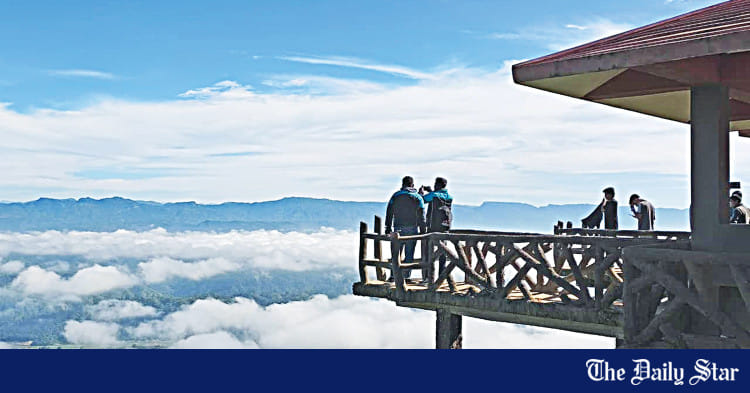
Tourists capture photos and enjoy the views at Double Hands View Point on Bandarban-Thanchi road, as the tourism sector bounces back after last year’s dip. The photo was taken recently. Photo: Mong Sing Hai Marma

Hotels and resorts in major tourist destinations across Bangladesh are reporting 60 percent to 80 percent occupancy this December, showing strong demand and a busy holiday season.

Business owners said that political instability last December had caused a drop in tourism, but this year, visitor numbers have returned to normal levels.

The peak tourism season in the country runs from November to April. According to the Bangladesh Bureau of Statistics, tourism accounted for 3 percent of the country's GDP and 8 percent of total employment in the fiscal year 2018-19.

Abdul Awal, group director of sales and marketing at Sea Pearl Beach Resort in Cox's Bazar, said the resort is seeing a seasonal increase in business, with occupancy around 60 percent, similar to 2023.

"2024 was an exception due to political uncertainty, but the current performance reflects a return to normal patterns," he said.

Awal added that most visitors stay for two days, as Cox's Bazar has limited attractions beyond the beach. "Group bookings, conventions, and incentive travel continue to be our strongest business segments," he said.

Rana Karmakar, operations manager of Mermaid Beach Resort in Cox's Bazar, said that despite the upcoming election, business is doing well this December.

"Reservations are better than in 2024, which was an unpredictable year due to significant political uncertainty. Compared to 2023, reservations are also strong and broadly similar," he said.

Karmakar added that occupancy in December is currently around 80 percent, similar to December 2023, which is generally satisfactory.

However, he noted a decline in out-of-house restaurant guests, particularly foreign tourists. "Earlier, many tourists who could not stay at the resort would eat at the restaurant at least once during their visit, but that is no longer the case," he said.

He attributed this to reduced tourist movement caused by security concerns and poor road conditions.

Md Bahar Khan, senior supervisor of The Palace Luxury Resort in Bahubal, Habiganj, said that average occupancy this December is around 60 percent, slightly lower than December 2023.

"We are seeing a lower response this year due to political uncertainty and ongoing road construction on the Dhaka–Sylhet route, which has increased travel time," he said. Despite this, he described business as moderately stable during the peak season.

Imranul Alam, managing director of Tour Group Bangladesh, which runs resorts and other tourism businesses across the country, said business is performing reasonably well, but profits have dropped to about one-third of the level recorded in 2023.

"Although there is a demand for travel to Saint Martin's Island, the shortage of ship tickets and long, uncomfortable journeys have significantly discouraged tourists," he said.

Alam added that many regular visitors who previously travelled every year are no longer coming and have discouraged their friends and family based on recent experiences.

He further said, "The journey to Saint Martin's now takes more than six hours by sea, in addition to long boarding and disembarkation times and severe congestion at the jetty. These issues have reduced tourist mobility and shortened travel plans."

"Visitors are becoming more selective, opting for higher-end resorts to justify the increased travel expenses," he added.

"Overall occupancy for Sajek resorts in December is around 70 percent," said Suparna Deb Barman, president of the Cottage Malik Samity of Sajek, a forum of resort owners.

"Sajek is no longer empty at any time, with visitors coming even on weekdays. Fridays and Saturdays are the busiest, but tourist activity continues throughout the week. On dates like December 26 and 27, accommodations are fully booked," Barman said.

She added, "The season here gradually starts in August and lasts through February, with activity peaking during this period."

Md Rafeuzzaman, president of the Tour Operators Association of Bangladesh, said, "This December is performing better than December 2024, with bookings close to a normal season."

He added, "Although political tensions ahead of the upcoming election have slowed tourism, the sector is expected to improve further in 2026 once a new government is in place."​
 

Members Online

Latest Posts

Latest Posts