Godi Media, Palkee Sharma and her incessant attacks.
Are they so bored that they have to pick at every little event in Bangladesh??
We have a huge trade deficit with China and it was decided that we should balance it by exporting mangoes which would otherwise spoil anyway, in the Bangladesh heat.
Exporting agro products "under cold chain" logistics is relatively new/unimproved in Bangladesh, as is agro processing, just like rest of South Asia. We'd like to improve success in this sector to the point where Thai, Vietnamese and Filipinos have it. And reduce spoilage and wastage.
China is a huge market and mangoes there don't taste the same like ours, so why not.
"...Mangoes are entering the Chinese market duty-free under a new trade facilitation framework, helping address the bilateral trade imbalance and boosting agricultural exports."
“This is just the beginning. We are working to open up new markets in Japan and Europe for Bangladeshi agricultural products,” (Prof. Muhammad Yunus) said at the Air Shipment Departure Ceremony for the consignment bound for Changsha, Hunan Province."
All Indian govt. has done for the last 50 years is block Bangladeshi exports to India using every "fikir" known to them (including non-tariff barriers and other excuses). Bangladeshis don't want to do business with Indian administration anymore.
Having the requisite amount of foreign currency to meet import bills as well as external debt obligations is a constant challenge being faced by Bangladesh economy. Aside from export of manpower and service, commodity export is the standard affair to earn foreign currency. B
thefinancialexpress.com.bd
Focusing on export of agro-based products
SYED FATTAHUL ALIM
Published :
Jun 29, 2025 21:51
Updated :
Jun 29, 2025 21:51
Having the requisite amount of foreign currency to meet import bills as well as external debt obligations is a constant challenge being faced by Bangladesh economy. Aside from export of manpower and service, commodity export is the standard affair to earn foreign currency. But Bangladesh's export basket could not be expanded significantly beyond apparel products so far. Other manufacturing sectors include leather and leather products, home textiles and the emerging fields of pharmaceuticals and light engineering. But their full potential is yet to be exploited. However, agriculture, the largest sector of the economy, which employs about 43 per cent of the country's entire labour force and contributes about 14.23 per cent to the GDP, is yet to come of age so far as its full export potential is concerned. In FY2023-24, for instance, agriculture's share of the total export earning was only 2.17 per cent at US$ 965 million. Notably, the country's major exportable agricultural products include frozen fish, shrimp, tea, spices, fruits and processed agricultural products. Agro-processing, especially the food processing industry contributes about 1.7 per cent to the GDP and employs 250,000 people.
Since jute, a traditional export item, was declared an agricultural product in 2023 by the government of the time, its status should remain as such so that it may get all the policy support and other benefits that other agricultural products draw from the government. Agricultural products in FY2023 earned US$912 million from exports. If the export earnings from jute and jute products (US$912 billion in FY23) were also accounted for, the total earning from agricultural exports in FY23 would be twice the amount.
At a recent roundtable held in the city, experts and those concerned in the export of agricultural products pointed out how Bangladesh was missing out on the opportunity that the agro-processing sector holds. The global market for agricultural market was US$1.6 trillion in 2022 and is projected to grow to US$2.2 trillion by 2032, according to the Agricultural Commodity Market Research. Bangladesh's agricultural commodity sector with its present worth at around a billion dollar is nowhere near neighbouring India's around US$49 billion dollar in FY24 and with a 2.4 per cent share of the global agricultural export market. India is a very big country with its equally large agricultural sector and a comparable export market. In that case, Vietnam may be a better candidate for comparison with Bangladesh. But there, too, Bangladesh simply bears no comparison. With its USD62.4 billion agricultural commodity export in 2024, which marked an 18.5 per cent increase over the previous year (2023)'s, Vietnam is placed among the world's top 15 agri-product exporters. With more than double the population of Vietnam and a very fertile deltaic plainland, Bangladesh should have been able to fare better in terms of agricultural production and exports. True, Vietnam has far bigger landmass than Bangladesh, but that is not entirely arable due to its rugged central highlands. In fact, it is the government's policy towards agriculture that has enabled that country's (agricultural) products to compete in the global market better than ours.
To compete in the global market, the first condition to meet is the quality of the agricultural products. This requires agricultural practices that are up to internationally accepted standards. Does Bangladesh have required facilities to certify its products that are accredited by the International Organization for Standardization (ISO)? Is certification by the country's own testing body, Bangladesh Standards and Testing Institution (BSTI), acceptable to all importing countries? These are the issues that would matter most if Bangladesh is to carve out a niche in the global agricultural product market.
Is it not paradoxical that Bangladesh has not been able to make its mark in the global agri-product market so far despite the fact that it ranks third in the world as the producer of rice, vegetables and onions; second as the producer of jute and jute goods; fourth in tea production and seventh in potato and mango production? Even rice production has increased in the Barishal region by 1.5 times, thanks to modern cultivation techniques, though its agricultural lands shrank by 6.0 per cent between 2014 and 2019 due to urbanization. These are clear indications of how the immense potential of the country's agriculture is being wasted due to lack of focus and the required practices. As noted in the foregoing, to compete internationally, the first condition of Good Agricultural Practices (GAP) has to be fulfilled. That involves maintaining soil quality, optimum water usage, integrated pest management, moderate use of chemical and organic fertilizers as well as eco-friendly resources and post-harvest handling. To ensure safety of agricultural products for both domestic and overseas consumers risks of microbial, viral and toxin-related contamination have to be removed. Evidently, the primary conditions to meet in ensuring those issues is the standard practice of hygiene, managing water quality and safe handling of inputs. It is a whole host of good practices that protects soil, environment and minimise pollution. Also, protection of workers' health is an issue that should be addressed through providing them with necessary training, protective equipment and, most importantly, safe working conditions. High quality agricultural products also require having proper storage facilities for agricultural products.
President of Bangladesh Agro-processors' Association (BAPA), Md. Abul Hashem, reportedly told a recent discussion event in the city that if proper policy support from the government is assured, Bangladesh, within the next three years, will be able to earn thrice the amount it now does (around US$1.0 billion) from agricultural products export. Apart from that the areas needing urgent addressing, he pointed out, include absence of internationally recognised testing facilities since BSTI's certification is not globally accepted, acute shortage of technical experts and farmers lacking required skill in fertiliser application. All these factors together militate against quality of agricultural products. It is worthwhile to note that though the Small and Medium Enterprises (SMEs) are the backbone of the agro-processing sector, they lack the capacity to meet the compliance criteria of the global market. That brings us to the issue of initiating skill development training for workers employed in the SMEs as well as developing management skills of those operating the SMEs on a massive scale.
The government has a huge stake in developing the agricultural sector as part of diversifying the country's export basket so that the economy may survive the post-graduation challenges of a highly competitive world market.
Much ado over nothing - as usual. Another BJP attempt to bad-mouth Bangladesh' interim govt. using its media.
Export of Bangladeshi Mangos to China is not the same as Hasina's Mango diplomacy and symbolic gifting of Mangos to Indian leaders.
Bangladesh has set up a commercial Mango export logistics cold-chain with Chinese Customs and Agri-import authorities. Chinese market has a large demand for Bangladeshi mangoes (because of their unique taste) so that demand is being met by establishing Chinese pest-checking facilities in Mango growing areas of Bangladesh. It involves rapid export by airfreighting items to Dhaka (capital) and then airfreighted to Kunming and Changsha, which are the nearest large cities across the China-Myanmar-Bangladesh border.
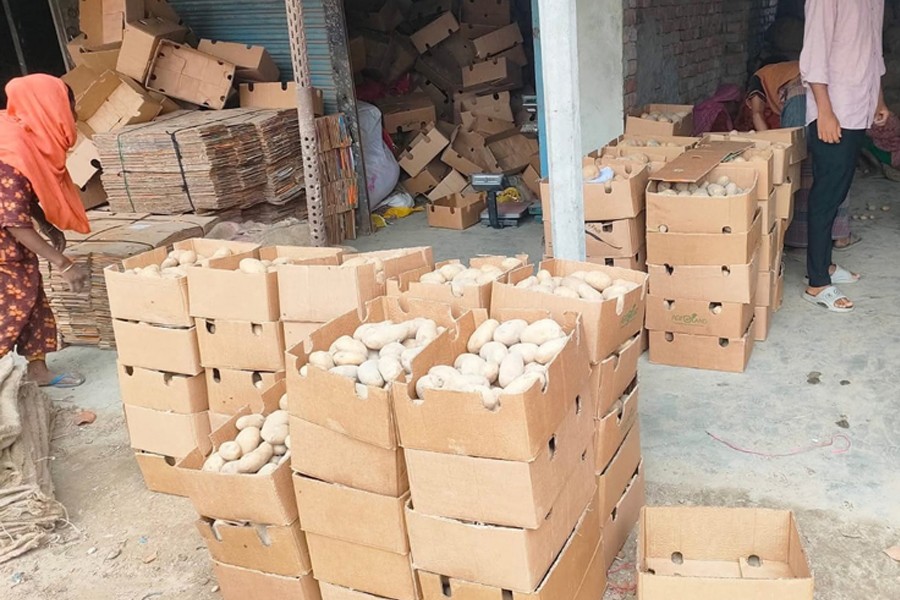
Potato exports from the northern district of Bogura have soared this year, with shipments reaching 36,009 tonnes between February and June-more than double the volume exported during the same period last year. Last year exports of the tuber crop from this district were merely 16000 tonnes. This s
thefinancialexpress.com.bd
Potato exports from Bogura surge to 36,009 tonnes in Feb-Jun
The sharp rise in exports has fetched an estimated US$ 6.15 million
A Correspondent
Published :
Jul 02, 2025 09:52
Updated :
Jul 02, 2025 09:52
Potato exports from the northern district of Bogura have soared this year, with shipments reaching 36,009 tonnes between February and June-more than double the volume exported during the same period last year.
Last year exports of the tuber crop from this district were merely 16000 tonnes.
This sharp rise in exports has fetched an estimated US$ 6.15 million.
According to the people familiar with the development, bulk of the potatoes was shipped from Shibganj Upazila, followed by Kahaloo and Sherpur.
The export destinations were more than 30 countries, including Malaysia, Indonesia, Saudi Arabia, Singapore, Thailand, Japan, the UAE, and Nepal.
The most commonly exported varieties were 'Lal Pakri' and 'Diamond', both known for their superior quality and shelf life-two critical factors for export viability.
"This year export marks a significant improvement in volume, thanks to quality production and strong demand from international markets," said Momota Haque, senior agricultural marketing officer of the Department of Marketing in Bogura.
Despite the success, local exporters have voiced frustration over trade barriers with neighbouring India.
For the past four months, shipments to Nepal and Bhutan remained closed due to logistical disruptions in Siliguri, a key Indian transit point. The landlocked Nepal and Bhutan had strong demand for the Bogura produced potato.
"We could have exported even more if we weren't facing obstacles in sending potatoes to Nepal and Bhutan," said an exporter based in Bogura wishing not to be named.
Mukul Hossain, a veteran potato trader and local representative of Agrotech BD Company, said he alone exported 3,375 tonnes this season-spread across 250 containers, each with a capacity of 13.5 tonnes.
He sold high-quality potatoes to Malaysia's Farmers Agro Ltd at Tk520 per maund.
The largest exporter from the region, however, was Ms. Sagar Traders, also based in Shibganj.
Md. Sujan Islam, owner of Sagar Traders, said his firm has been exporting vegetables-including cauliflower and cabbage-since 2014. Last year, he alone shipped 12,300 tonnes of potatoes abroad.
Agriculture Information Service, a government agency, said the district began exporting potatoes in 1998. In 1999, just 126 tonnes were sent to Singapore, Malaysia, Sri Lanka, and some Middle Eastern countries. Today, Malaysia alone absorbs nearly 80 per cent of the district's export volume.
Experts say policy-level support and structural reforms are necessary to sustain and expand this export boom.
Faridur Rahman Farid, Assistant Agriculture Extension Officer, suggested the formation of designated export zones with contract growers to ensure consistent quality and supply. He also recommended raising the export incentive on raw potato shipments from the current rate to as high as 30 per cent.
"Increasing export bonuses and encouraging new companies to join the sector could significantly boost our performance," Mr Farid said.
The boom in exports coincides with a record harvest in the region.
According to the Department of Agricultural Extension (DAE), potatoes were cultivated on 60,435 hectares in the district this season-exceeding the target of 55,060 hectares.
Favourable weather contributed to an impressive yield of approximately 1.45 million tonnes, up from the initial target of 1.2 million tonnes.
"We've always known Bogura to be a potato heartland. Now, it's gaining a global identity too," said potato trader Badiuzzaman.
While speaking at an event on the second day of the two-day (December12-13) potato festival 2025 held in the city, experts highlighted the potential of potato as an exportable agricultural commodity of Bangladesh. Notably, the country exported over 62,000 tonnes of potato worth US$14 million last f
thefinancialexpress.com.bd
Potato can be a lucrative export crop
SYED FATTAHUL ALIM
Published :
Dec 14, 2025 23:23
Updated :
Dec 14, 2025 23:33
While speaking at an event on the second day of the two-day (December12-13) potato festival 2025 held in the city, experts highlighted the potential of potato as an exportable agricultural commodity of Bangladesh. Notably, the country exported over 62,000 tonnes of potato worth US$14 million last fiscal year (FY2024-25). Of course, the country, according to the Bangladesh Bureau of Statistics (BBS) experienced a record harvest of potato last fiscal year at 1.5 million tonnes, which far exceeded annual domestic demand for the tuber at around 9.0 million tonnes. Of the total domestic demand, however, 1.0 million tonnes of potato would be used as seeds, while the rest 8.0 million would go for the public's consumption. A portion of the potato is processed in the form of chips and crackers. But the surplus production has also left many farmers broke as the price of potato in the market has fallen sharply. In this harvest season, the wholesale prices of the vegetable have gone below even its production costs. The reason is, a large number of farmers had gone for cultivation of potato last fiscal year, FY25. The previous fiscal (FY 2023-24)'s production shortfall and the consequent spike in the farm produce's price as well as last season's good weather was a reason that many farmers even borrowed money to invest in potato cultivation. Now, such low price of potato this year may have discouraged many farmers to go for potato cultivation this year.
As told by the adviser to the ministries of agriculture and home affairs of the interim government at the said festival, potato also saw bumper harvests in 2010, 2014, 2015 and 2017 overshooting domestic demands. Unfortunately, such instances of bumper harvests of potato have not been an unmixed blessing for its farmers. Reports say, farmers in the last season planted this crop on 4.92 lakh hectares, which was 8 per cent higher on a year-on-year basis. So, potato production also increased proportionately by 9.0 per cent Year-on-Year (YOY). In consequence, potato growers this year may either avoid cultivating the crop at all, or allocate fewer acreage of their lands for growing potato which might lead to production shortfall next year pushing up the tuber's price sky-high compelling the government to import potato. Such rise and fall in the production of this highly potential agricultural product has been taking place over the decades, thanks to the lack of a consistent policy of the government towards the potato growers. So, when the potato growers are in deep financial crisis due to falling price following overproduction, the government may come up with help for farmers by way of procuring potato directly from them. Also, consumption of potato could be promoted through, say including 10 kilogrammes per household in the government's social safety net schemes.
In a similar vein, its export could be encouraged by providing businesses concerned with incentives similar to those extended traditionally to the apparel sector. Experts at the said potato festival organised by the Bangladesh Cold Storage Association (BCSA) said, the global potato industry is currently valued at US$120 billion, but Bangladesh, though an agriculture-based country has less than 0.01 per cent share of the world market. M Masrur Reaz, Chairman, Policy Exchange of Bangladesh, said during his presentation at the event that addition of processed agricultural products, such as from potato, can reduce significantly the country's reliance on a single export product and contribute to strengthening its long-term economic resilience. That would, however, require strong policy support, incentives and regulatory reforms, he added. In fact, so far the agricultural products like potato, have not been given as much emphasis as other sectors such as the Readymade Garment (RMG) enjoy. But the challenge of export diversification that Bangladesh is facing now could be met by the potato, among other agricultural products. Globally, for instance, potato accounts for 4.0 per cent of the total crop production. In this context, Asia contributes 54 per cent to global potato production, while Bangladesh ranks among top ten potato growers in Asia, after China and India.
Given Bangladesh's extreme vulnerability to climate change, potato as a climate-resilient agricultural crop has its natural advantage over other local crops. In fact, potato was not part of the country's crops before 18th century. The Portuguese traders first brought it to India in the early 17th century. It remained mainly a curiosity during its early stage of introduction in the subcontinent. By the late 18th century, the British East India Company familiarised the crop in this part of the world. By the 1850s, it gained popularity in Bengal especially under British Kolkata. Seeing that now it has become an essential food crop in Bangladesh, it is hard to believe that potato was ever a novelty in this land.
In ancient times, however, the crop was originally grown in the high altitudes of the Andes mountains of South America where other crops could not grow. It was cultivated mainly in Peru and Bolivia during Inca civilization. Later, the Spanish conquistadors brought it to Europe in the 16th century. But it took centuries before the crop became popular in Europe in the 18th and 19th centuries. Gradually, it became the staple for the masses in Europe. Now it has been turned into a global staple.
Against this backdrop, as Bangladeshi farmers can grow large quantities of this global staple that can be exported after meeting domestic demand, the government should not consider it just as another agricultural product of the country. To encourage potato growing farmers, the government needs first to dispel their fears about the hazards of overproduction they face every alternate season. When its production is prioritised as an export commodity, farmers, provided they receive the matching backing from the government, will be encouraged to grow the crop with due enthusiasm. But the government in that case cannot limit itself to just making promises of support. On the contrary, it should come up with a detailed plan on providing the support including fiscal incentives for the potato growers. At the same time, the required infrastructure for storage of potage has to be developed. Entrepreneurs in the agri-sector interested in potato crop should also be offered necessary incentives to promote its export.
Seed planting in major potato-producing districts was largely completed by November 30
www.thedailystar.net
Farmers reduce potato acreage for next year after huge losses
Farm workers are planting potato seeds in fields at Mondolerhat village in Lalmonirhat sadar upazila. After suffering huge losses last season, farmers have reduced cultivation area this season, hoping for better prices. Photo: S DILIP ROY
After suffering staggering losses from a bumper harvest and low prices this year, potato farmers across Bangladesh are going for reduced cultivation to avoid a repeat of the crisis, indicating a lower supply next year.
Data from the Department of Agricultural Extension (DAE) show that potatoes have been planted on 3.77 lakh hectares (per hectare = 2.47 acres) this season, a drop of 23.4 percent from last year's 4.92 lakh hectares. The cultivated area is also 0.9 lakh hectares short of the government's target for the October-November planting window.
According to the Agriculture Information Service, the potatoes planted during this period will be harvested between February and April, forming the first batch of fresh supply for 2026.
Seed planting in major potato-producing districts was largely completed by November 30, said Md Mosharraf Hossain Molla, chief scientific officer at the Tuber Crop Research Center of the Bangladesh Agricultural Research Institute.
The late planting season is still underway and may add another 5 percent to 10 percent of land nationwide over the next week, he added.
Md Obaidur Rahman Mondol, director of the DAE's field service wing, said many growers failed to recover production costs last year. "To avoid similar losses, farmers have understandably reduced the area under potato cultivation this season."
Potato is Bangladesh's leading vegetable and one of the country's most important food crops, playing a crucial role in food security. Encouraged by high prices last year, farmers expanded acreage at an unprecedented rate, targeting higher profit this year. Instead, it triggered a severe market glut due to an excessive harvest.
According to the Bangladesh Bureau of Statistics, potato output reached a historic high of 1.15 crore tonnes this year, far exceeding annual domestic demand of around 90 lakh tonnes.
Cultivation rose 8 percent year-on-year to 4.92 lakh hectares in fiscal year 2024-25 (FY25), while overall production increased 9 percent from 1.06 crore tonnes the previous year.
The oversupply sent prices tumbling, forcing many farmers to sell potatoes for as little as Tk 9-Tk 11 per kilogramme (kg), well below the government's estimated average production cost of Tk 14. In the northern region, production costs were even higher, at around Tk 20 per kg, according to official data.
The losses have left deep scars.
Shahjahan Ali, a farmer from Kurigram, said he made a substantial profit last year by cultivating potatoes on 25 bighas in late 2023, selling at Tk 40-Tk 42 per kg against a production cost of Tk 25.
Hoping to ride the wave, he doubled his acreage to nearly 50 bighas in 2024. While the harvest was good, prices collapsed to Tk 9 per kg with costs remaining unchanged. He suffered losses of about Tk 16 per kg.
"I have managed to repay only one-fifth of my loans," he said. "Lenders frequently visit my home and are threatening legal action."
This season, he has decided not to cultivate potatoes at all.
Haraprasad Roy from Lalmonirhat had a similar experience. After earning strong returns last year, by cultivating potatoes on 1.5 acres in 2023.
With production cost per kg at Tk 10-Tk 12, and wholesale price at Tk 40-Tk 42 per kg, he made huge profit. He expanded cultivation to five acres targeting more profit this year.
"Production costs rose to Tk 18-Tk 20 per kg, but selling prices fell to around Tk 10. I borrowed Tk 6 lakh from NGOs and financial institutions for cultivation and have so far been able to repay only Tk 2 lakh," he said.
Like Ali, he too plans to scale back cultivation to just one acre this season.
Mohammad Lutfur Rahman of Gaibandha said he expanded potato cultivation from 10 bighas in 2023 to 16 bighas in 2024, and suffered staggering losses.
"I borrowed Tk 3.5 lakh from NGOs to grow potatoes and have repaid less than half so far," he said.
Due to the losses, he plans to cultivate potatoes on only one-third of last season's land. "I am a farmer. If I leave the land uncultivated, I will have nothing to eat."


 Bangladesh Defense