โ˜• Support Us โ˜•
[๐Ÿ‡ง๐Ÿ‡ฉ] - Bangladesh Vietnam Relation: Reject Competition, Embrace Collaboration | PKDefense

[๐Ÿ‡ง๐Ÿ‡ฉ] Bangladesh Vietnam Relation: Reject Competition, Embrace Collaboration

Reply (Scroll)
Press space to scroll through posts
G Bangladesh Defense
[๐Ÿ‡ง๐Ÿ‡ฉ] Bangladesh Vietnam Relation: Reject Competition, Embrace Collaboration
4
1K
More threads by Saif

Saif

Senior Member
Joined
Jan 24, 2024
Messages
16,044
Likes
8,048
Nation

Axis Group

Reject competition, embrace collaboration​


1710285058995.png

ILLUSTRATION: BIPLOB CHAKROBORTY

If we take a small step back from our usual negative understanding of competition between countries which are targeting a similar market, we can find a point where competition can be churned into something positive, benefiting both countries equally. For instance, what if Bangladesh and Vietnamโ€”two close competitors in the current global manufacturing landscapeโ€”looked for a path towards mutual prosperity through strategic collaborations instead of competition alone? There is indeed untapped potential for Bangladesh to leverage Vietnam's strengths and accelerate its economic development. As Bangladesh and Vietnam edge towards celebrating 51 years of diplomatic relations, the two countries can benefit from strategic partnerships that transcend competition, thus leveraging each other's strengths for the prosperity of both.

The economic landscapes of Bangladesh and Vietnam at the moment reflect contrasting trajectories against a global backdrop of economic uncertainty post Covid and recovery from the pandemic's impacts. Here, Bangladesh's economic growth on paper and in figures remains strong. For instance, Bangladesh's poverty rate dropped as low as 12.9 percent in 2021 from 80 percent in 1971; the annual gross domestic product (GDP) growth rate has been, on average, 6.4 percent between 2016 and 2021. On the other hand, Vietnam's economic growth on paper is also decent. For example, poverty has declined significantly from 14 percent in 2010 to 3.8 percent in 2020; and GDP grew by eight percent in 2022 alone.

Bangladesh's GDP for 2023 was $1.131 trillion, whereas Vietnam's was $426 billion. Regarding per capita income (PCI) in 2022, Bangladesh counted $1,853, while Vietnam saw a PCI of $4,164. Despite having a larger GDP, Bangladesh's low PCI is best explained by its higher population. In 2022, Bangladesh had a population of 165.16 million, whereas Vietnam had 99.5 million people. For a nuanced understanding of these statistics and figures, it should be noted that they are not always representative of the whole picture, as they do not account for inequality, commodity price hikes, environmental well-being, and so onโ€”although in many cases, these numbers help to understand the overall size and potential capacity of a country's economy.

Both Bangladesh and Vietnam share some similarities and have some differences in terms of their respective major industries. For Bangladesh, the major industries are ready-made garments (RMG), textiles, agriculture, and pharmaceuticals, whereas for Vietnam they are RMG, agriculture, manufacturing (electronics and automobiles), and tourism. Against this backdrop, then, there are a few nuances that are inferable.

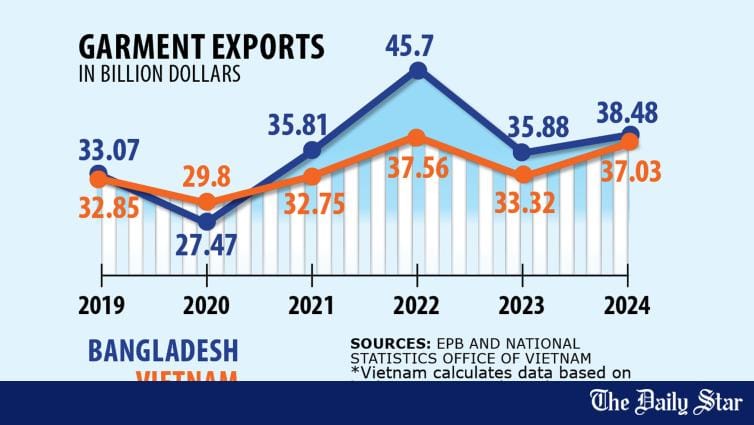
RMG reigns supreme in both countries, serving as their economic crown jewels. Both countries are close competitors and have been in the top five positions globally for many years. However, key differences lie in their approaches. Bangladesh focuses on cost-effectiveness, attracting buyers thanks to competitive wages and high production volumes. Conversely, Vietnam is increasingly shifting towards higher-value garments, capitalising on its skilled workforce and embracing technological integration in the RMG industry.
Although both countries have a robust agricultural backbone, the focus for each is different. Bangladesh shines when it comes to rice and jute production, while Vietnam excels in cultivating coffee, fruits, and aquaculture. These variations reflect their contrasting geographiesโ€”Bangladesh's fertile plains versus Vietnam's diverse topography. But both countries are actively pursuing agricultural modernisation and diversification to ensure future sustainability.

In manufacturing, Vietnam boasts burgeoning electronics and automobile industries, attracting substantial foreign investment. Its focus on high-tech goods signifies Vietnam's aspirations to climb the value chain and diversify its export basket. In contrast, Bangladesh's manufacturing sector remains nascent, primarily concentrated in light engineering and essential goods. This gap reflects varying levels of infrastructure development, technological know-how, and foreign investment attraction.

The economic landscapes of Bangladesh and Vietnam present a promising avenue for collaboration, especially considering the significant milestone both countries aim to achieve: a bilateral trade target of $2 billion in 2023, after achieving $1.5 billion the year prior. The optimism surrounding this target is based on the healthy economic relations which have already seen the bilateral trade turnover increase, reaching $1.1 billion in the first nine months of 2022 alone. Therefore, the shared ambition for economic expansion has pushed both of these countries to aim to achieve upper-middle-income status by 2030, followed by a transition to developed, high-income status in the early 2040s.

The potential free trade agreement (FTA) between Bangladesh and Vietnam strategically leverages their synergistic strengths for mutual benefit. The proposed areas of consideration include areas of collaboration that span beyond mere trade, such as investments in special economic zones, ICT sector cooperation, textile and garment industry collaboration, and more. Both countries have young, sizable populations (with Bangladesh having an edge with a much larger population) and geographical advantages that facilitate trade, with Bangladesh positioned strategically between China, India, and Vietnam on a long coastline along the East Asian trade corridor.


The major export items from Vietnam to Bangladesh include clinker, cement, mobile phones, and steel billet, whereas Bangladesh exports textiles, leather, medicine, shoe materials, and sesame to Vietnam. Vietnam's investment in Bangladesh further bolstered this dynamic trade relationship, highlighting a diversified and mutually beneficial economic engagement.

Strategic initiatives and high-level engagements are crucial for achieving the full potential of a Bangladesh-Vietnam collaboration. As it stands, both countries are keen on exploring a free trade agreement to improve their economic ties, with discussions focusing on areas relating to trade and commerce, investment, energy, halal trade, tourism, culture, education, health, defence, and security. In particular, the proposal for a bilateral FTA is vital to ensuring competitive advantages in the global market, especially as Bangladesh prepares to graduate from its least developed country status in 2026. This also extends to Vietnam, which officially achieved lower middle-income status in 2011 but is now cutting it close in the timeline of achieving its aim of gaining upper middle-income status by 2030.

The path forward for Bangladesh and Vietnam is clearโ€”collaboration, not competition. By focusing on strategic partnerships, leveraging comparative advantages, and addressing common challenges, these two nations can set a precedent for how developing countries can achieve mutual prosperity. The journey requires commitment, flexibility, and a willingness to explore new avenues for cooperation. The rewardsโ€”economic diversification, innovation, and sustainable developmentโ€”are immense and worth the effort. As Bangladesh and Vietnam continue to explore the possibilities of their partnership, the international community will undoubtedly watch with interest, perhaps seeing in their example a template for future cooperation among nations.

Ahmad Tousif Jami is a research assistant at the Department of Global Studies and Governance (GSG) of Independent University, Bangladesh (IUB).
 

50th anniversary of Vietnam-Bangladesh diplomatic relations​

A bond developed over our love for independence​


1710285221614.png

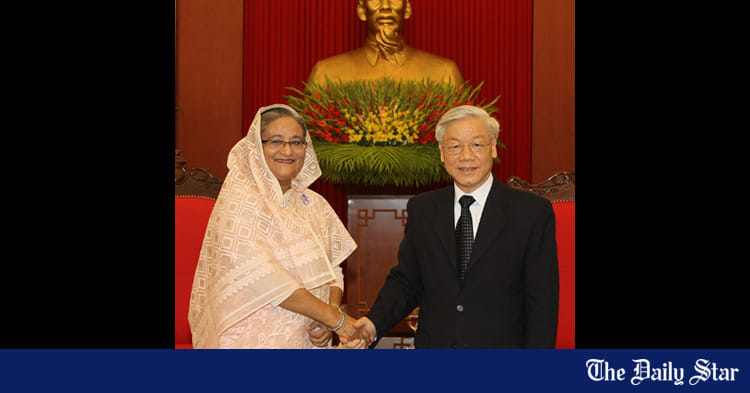
Prime Minister Sheikh Hasina met the General Secretary of the Communist Party of Vietnam Nguyen Phu Trong during her visit to Vietnam in 2012. PHOTO: COURTESY

Those of us who were born in the 50s grew up with the Vietnamese's struggle for national independence. Vietnam's victory over French occupation in 1954 was a household story in the mid-and-late 50s, and we felt a natural sympathy for the underdog and fellow third-world country. Our interest in Vietnam intensified after the US launched in 1963 a full-scale war against North Vietnam, which began a spate of killing and maiming an umpteen number of people by indiscriminate bombing and spraying of agent orange from the air.

As young people, being proselytised by the global events of the 60s, we embraced the Vietnamese tragedies as our own and any reports of US new aggression agitated our adolescent minds. For instance, the My Lai massacre would never erase from our consciences.

The names of the great Vietnamese leaders โ€“ Ho Chi Minh and General Giap were firmly embedded in our hearts and minds. Little did we realise that the humbuggery of that January wintry afternoon at our youthful age indeed planted the seeds of patriotism in our conscience. And, only three years later, in 1971, when my country came under such an ordeal, it didn't take a moment's hesitation for me to join our Liberation War as a freedom fighter to liberate the country from the hands of the enemies. Indeed, General Giap's book "Dien Bien Phu", was my most valued possession during the Liberation War. What was even more fated was that one day I would come to Vietnam as the Ambassador of my country.

In September 1945, the great leader and the founding father of modern Vietnam, Ho Chi Minh, known as Uncle Ho, declared the independence of Vietnam in front of a mammoth crowd. In his independence speech, he thundered, "We, (the) members of the Provisional Government of the Democratic Republic of Vietnam, solemnly declare to the world that Vietnam has the right to be a free and independent country, and is so already. The entire Vietnamese people are determined to mobilise all their physical and mental strength, to sacrifice their lives and property to safeguard their independence and liberty".

One could find an echo to Bangabandhu's March 7 speech calling upon his people to be ready to fight the enemy with whatever they could lay their hands on: "The struggle this time is the struggle for independence. The struggle this time is the struggle for freedom. Once we have spilled our blood, if necessary, we will spill more blood. Yet we will snatch our independence. I ask you all to prepare yourselves to fight the enemy, with whatever you can lay your hands on".

In my mind, the above sentiments, expressed by the respective leaders in words coming from their hearts, are the philosophical foundation for building strong ties between Vietnam and Bangladesh.

In February 1973, the People's Republic of Bangladesh established diplomatic relations with the Democratic Republic of Vietnam, and then with the Provisional Revolutionary Government of the Republic of South Vietnam โ€“ a formal governmental structure to the National Liberation Front of South Vietnam representing the Southern people. Right after that, Vietnam opened its resident mission in Dhaka in early 1974; however, it closed its Embassy in 1982 due to economic constraints. Vietnam reopened its mission in Dhaka in 2003. On the other hand, Bangladesh opened its Mission in Hanoi in 1993.

In the past 50 years, the bilateral relations have prospered by leaps and bounds, covering the entire gamut of cooperation: political, economic, cultural and people-to-people interaction. There have also been several high-level visits, including at the highest level, between the two countries over the years. These visits have added fresh impetus to the already excellent bilateral relations between Bangladesh and Vietnam.

The two countries share common membership in a number of international and regional organisations. They have also signed several agreements, protocols, and MOUs related to trade and other areas of mutual interest.

The bilateral trade between the two countries is currently valued at nearly USD 1.5 billion, which has the potential to surpass USD 2 billion in the next couple of years. Bangladesh's exports to Vietnam consist of pharmaceutical products, jute and jute goods, and scrap iron, while Vietnam exports to Bangladesh communication equipment, cement and clinker, gravel and crushed stone.

As we celebrate the 50th anniversary of the establishment of diplomatic relations with Vietnam, given that we have multifaceted similarities with Vietnam, our relationship could also be expanded, encompassing several areas for mutual benefit.

Ashraf ud Doula is a former Bangladesh Ambassador to Vietnam.​
 

Another shipment of 29,000 MT rice arrives at Ctg port
BSS
Published :
Mar 22, 2025 19:50
Updated :
Mar 22, 2025 19:50

1742693142868.png

A ship carrying 29,000 metric tonnes of fine rice from Vietnam has arrived at Chittagong Port.

The vessel, named MV OBE Dinares, carried the third shipment of rice under the Government-to-Government (G2G) agreement signed on February 3 this year, according to a PID release issued on Saturday.

As part of the agreement, a total of 100,000 metric tonnes of rice is being imported from Vietnam. So far, 30,300 metric tons have been shipped through two previous shipments.

The rice on board has already undergone sample testing, and preparations are in place to begin the unloading process shortly. Necessary measures have been taken for a smooth operation.​
 

Vietnam-Bangladesh direct flights likely from 2026

bdnews24.com
Published :
Dec 23, 2025 21:47
Updated :
Dec 23, 2025 21:47

1766534959455.webp


Vietnamese Ambassador to Bangladesh Nguyen Manh Cuong has said the aviation authorities in Bangladesh and Vietnam are now in the final stage of considering the new Air Services Agreement which will facilitate the establishment of official direct flight connecting Hanoi and Dhaka in 2026.

Once the direct flight is launched, it will help strengthen and deepen the traditional friendship, especially the people-to-people relations and tourism.

โ€œThere is no doubt that the traditional friendship and cooperation between Vietnam and Bangladesh is indeed growing stronger and moving toward a very bright future,โ€ the Ambassador told reporters at the Embassy on Monday evening.

He said there are still many untapped potentials that both sides should further cooperate to explore in the coming time.

The government of Vietnam always cherishes the close ties between the two countries and stands ready to work with the government of Bangladesh in order to elevate their mutually beneficial cooperation to a higher level.

The Embassy of Vietnam in Bangladesh will continue working closely with all Bangladeshi authorities and friends to become the bridge connecting the two countries, for the sake of peace, development and happiness of the two peoples, he said.

Highlighting the economic and trade cooperation, the envoy said the bilateral trade volume in recent years always exceeds 1 billion USD, which is a great signal for the continued cooperation between the two governments and business communities.

In the 11 months of 2025, the trade volume reached 1.06 billion USD. Vietnam's exports contributed about 951,6 million USD whereas Bangladesh's exports are estimated at nearly 115 million USD.

The Ambassador said the cultural cooperation and people-to-people relations also greatly contribute to the long-lasting trust and friendship of the two countries.

The people of both countries are interested in learning about each otherโ€™s country, culture, cuisine, lifestyle, and so on.

โ€œMore exchange activities have been held between two countries, like delegations of businessmen, traders, investors coming to explore the market; artists, performers to attend the diplomatic events; students coming to study or in exchange programs; journalists, reporters to make the news and an increasing number of tourists,โ€ he said.

At multilateral forums, he said Vietnam and Bangladesh always highly appreciate the support that the two countries have given to each other.

Vietnam expresses interest and supports Bangladesh's candidacy for the UN Economic and Social Council (ECOSOC) for the 2025-2027 term; the Council of Administration of the Universal Postal Union (UPU) for the 2026-2029 term; and the chairmanship of the 43rd UNESCO General Assembly.

Bangladesh also supports Vietnamโ€™s candidacy for the UN Human Rights Council for the 2026-2028 term.​
 

Members Online

Latest Posts

Latest Posts