[🇧🇩] Banking Industry in Bangladesh

Quick Reply ✓ Posted!
[🇧🇩] Banking Industry in Bangladesh
446
21K
More threads by Saif

G Bangladesh Defense

11th Annual Banking Conference begins at BIBM today

The Bangladesh Institute of Bank Management (BIBM) will hold the two-day 11th Annual Banking Conference at its Mirpur-2 premises in Dhaka from today, Wednesday, 28 October 2026. Bangladesh Economic Report

Md Mostaqur Rahman FCMA, Governor of Bangladesh Bank and Chairman of the BIBM Governing Board, will attend the inauguration as Chief Guest, according to a media release.

The inaugural session will take place in the BIBM Auditorium.

Dr. Prashanta Kumar Banerjee, Professor of BIBM and Chair of the Conference Organizing Committee, will deliver the address of welcome.

Dr. Zaidi Sattar, Chairman of the Policy Research Institute of Bangladesh (PRI), will present the keynote speech on “Bangladesh Banking System and Monetary-Fiscal-Trade Policy Coordination for Macroeconomic Stability and Growth.”

The following will speak as Special Guests: Dr. Md. Kabir Ahmed, Deputy Governor, Bangladesh Bank; Mr. Jean Pesme, Division Director, World Bank-Bangladesh and Bhutan; Mr. Abdul Hai Sarker, Chairman, Bangladesh Association of Banks (BAB) and Chairman, Dhaka Bank PLC; Mr. Mashrur Arefin, Managing Director & CEO, City Bank PLC, and Chairman, Association of Bankers Bangladesh Limited (ABB)

Dr. Wahiduddin Mahmud, Distinguished Economist and Former Professor of the Department of Economics, University of Dhaka, will speak as Guest of Honor. Bangladesh Economic Report

The Chief Guest will then address the gathering and formally inaugurate the conference.

Books will be unveiled, and Dr. Md. Ezazul Islam, Director General of BIBM, will deliver a speech as Conference Chair.

The conference will feature 13 plenary sessions and the presentation of 104 research articles.

More than 800 participants are expected, including experts, bankers, researchers and students from home and abroad.

The media partners of the event are DBC, Daily Bonik Barta, Dhaka Stream and The Business Standard.​
 

BB should have equal authority over public and private banks


1793231315769.webp


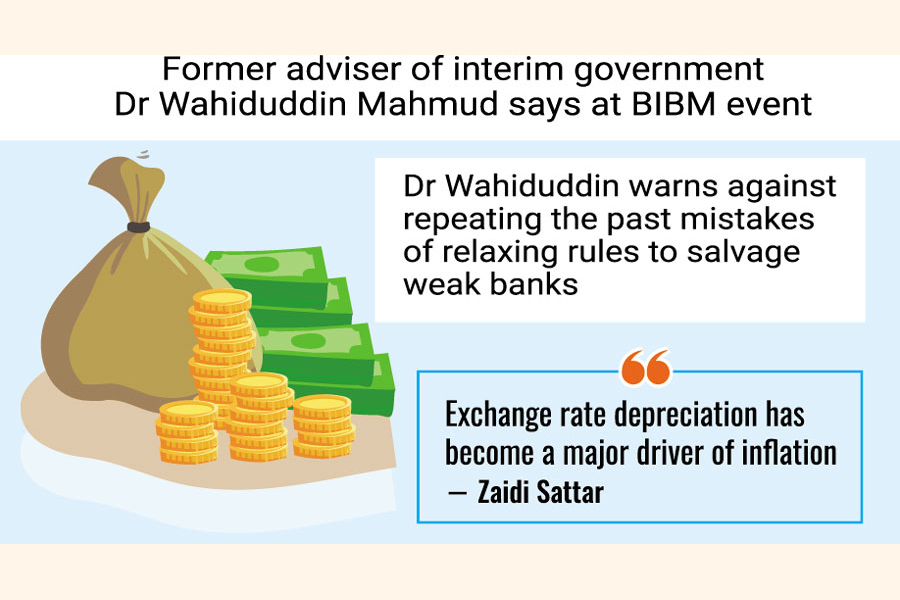
Former adviser of the interim government Dr Wahiduddin Mahmud has said the culture of bank-loan default has transformed into a culture of looting, badly impacting the banking sector.

"That is why the financial sector has reached its current state," he said at the inaugural session of a two-day annual banking conference organised by the Bangladesh Institute of Bank Management (BIBM) in the capital on Wednesday.

Recalling earlier banking reforms, he said considerable efforts had been made to curb loan default through rules and regulations, as well as restore discipline in the sector.

"We managed to come out of the culture of loan default after much effort. We also brought some private banks closer to international standards.

"But afterwards, a culture of bank looting emerged. This is more serious. Money was taken out of banks without following any rules and regulations," he said.

Dr Mahmud said Bangladesh had repeatedly failed to learn from its past banking experience.

Private banks were allowed to be established in the late 1980s without an adequate regulatory framework, he said, resulting in sponsor directors borrowing an amount equivalent to around one-third of some banks' deposits.

"There should have been rules on whether a group or family could control multiple banks. This should come under an anti-trust law. We still do not have an anti-trust or anti-monopoly law," he said.

He also criticised political influence over state-owned banks, saying such institutions had often been used to distribute political patronage.

"Using the banking or financial sector for political patronage is absolutely inappropriate," he said, adding that the Bangladesh Bank should have equal authority over state-owned and private banks.

He warned against repeating the previous policy of relaxing regulations to rescue weak banks.

"Now, to rescue weak banks, we may have to relax some rules again. But where is the guarantee that we will not repeat the same process that brought us to the current situation?" he asked.

Policy Research Institute (PRI) Chairman Dr Zaidi Sattar said the banking sector was facing severe balance sheet stress, marked by exceptionally high non-performing loans (NPLs), provisioning shortfalls, and widespread undercapitalisation.

"Bangladesh can neither restore growth with a crippled banking system nor defeat inflation through high interest rates alone," he said while discussing the country's macroeconomic challenges.

Dr Sattar said exchange rate depreciation has become a major driver of inflation, raising the domestic cost of imported fuel, food, intermediate goods, and capital machinery.

He noted that the taka had depreciated from around Tk 86 per US dollar in May 2022 to about Tk 123, representing roughly 40 per cent depreciation.

He proposed a "compensated depreciation" policy involving tariff reductions to offset the inflationary impact of currency depreciation and improve export competitiveness.

Tariffs could be reduced by 10-20 per cent, he suggested.

Bangladesh Bank Deputy Governor Dr Md Kabir Ahmed said the current banking crisis had developed through a chain of external shocks, reserve depletion, exchange rate pressure, corporate sector stress, and rising banking sector risks.

As non-performing loans increased, capital weakened, provisioning capacity declined, and credit growth slowed, eventually affecting economic growth, he said.

He said the central bank's immediate response had been to rebuild foreign exchange reserves and maintain exchange rate stability.

The banking regulator rebuilt reserves to roughly six months of import cover before the Iran-US conflict and avoided purchasing dollars during the conflict, helping preserve exchange rate stability, he also said.

Dr Ahmed said the banking sector must now be repaired because banks are the principal suppliers of capital to the real economy.

Association of Bankers, Bangladesh (ABB) Chairman and City Bank Managing Director and CEO Masrur Arefin said recent reforms and restructuring of bank boards could pave the way for recovery, but he warned that the damaged culture could not be corrected overnight.

He expressed concern over virtually stagnant credit growth, saying businesses remained reluctant to open large letters of credit for capital machinery and factory expansion.

Sluggish imports and exports also reflected weak economic activity, he said, noting that the Purchasing Managers' Index (PMI) had fallen to 48 from around 57-58 earlier, indicating contraction.

Mr Arefin said business confidence remained weak despite political stability following the election, while cash flow problems were discouraging businesses from expanding.

Bangladesh Association of Banks (BAB) Chairman Abdul Hai Sarker said policies designed for developed economies should not be imposed mechanically on developing countries.

Policy, he said, must reflect a country's level of development, institutional capacity, and national circumstances. Applying developed countries' compliance standards without adequate support could ultimately make developing countries unable to comply, he said.

Chairing the conference, BIBM Director General Dr Md Ezazul Islam called this year's conference theme "both timely and compelling".

High financing costs, subdued investment, infrastructure bottlenecks, and global uncertainty had intensified economic challenges, he said, while weaknesses in governance, asset quality, and accountability had eroded confidence in financial intermediation.

"Banking, above all, rests on trust," he said. "Without it, savings cannot be efficiently channelled into productive investment."

He called for a practical, credible, and balanced reform agenda, including stronger corporate governance, improved asset quality, and capital adequacy. World Bank Division Director for Bangladesh and Bhutan Jean Pesme also spoke in the opening session of the conference.​
 

Banking sector recovery expected by March-April 2027: BB


1793231756502.webp


Bangladesh Bank (BB) is implementing a series of reforms to restore stability in the banking sector, improve governance and normalise investment and credit flows, with visible improvements in banks' financial conditions expected by March-April next year.

"The central bank is prioritising control of non-performing loans (NPLs), assessment of asset quality, addressing capital shortfalls, strengthening corporate governance and improving risk management," said BB Deputy Governor Dr Md Habibur Rahman today (Wednesday), BSS reports.

He made the remarks while speaking as a special guest at the inaugural session of the 11th Annual Banking Conference (ABC) 2026, organised by the Bangladesh Institute of Bank Management (BIBM).

Renowned economist and former interim government adviser Dr Wahiduddin Mahmud, a former professor of economics at Dhaka University, attended the programme as the chief guest.

Other special guests included Jean Pesme , World Bank Division Director for Bangladesh and Bhutan; Mohammad Abdul Hai Sarker, chairman of the Bangladesh Association of Banks (BAB) and Dhaka Bank PLC; and Mashrur Arefin, managing director and CEO of City Bank PLC and chairman of the Association of Bankers, Bangladesh Limited (ABB).

Dr Habibur Rahman said the first phase of measures to address the banking sector's challenges focused on rebuilding foreign exchange reserves, settling outstanding external liabilities and maintaining exchange rate stability.

The target of building foreign exchange reserves sufficient to cover nearly six months of import expenditure has also been achieved, he said.

Drawing lessons from the global financial crisis and the Southeast Asian financial crisis, he said, the central bank is prioritising financial stability, in line with the approach adopted by central banks in other countries.

An initiative has also been taken to amend the Bangladesh Bank Order to strengthen the central bank's role in maintaining financial stability, he added.

Explaining the ongoing banking reforms, the deputy governor said asset quality reviews were being conducted to assess banks' actual financial conditions and restore confidence among depositors and investors.

The reviews have already been completed in 15 banks, while assessments of the remaining banks are progressing with support from the World Bank, he said.

The banking sector's non-performing loan ratio, which stood at 36 percent in December 2025, has declined to 31 percent, he said, expressing hope that it would fall further significantly by December this year.

The Money Loan Court Act and the new Special Asset Management Act would help accelerate the recovery of defaulted loans, he added.

Restoring the financial capacity of state-owned and private banks facing capital shortfalls is another major priority of the central bank, Dr Habibur Rahman said.

The central bank is working with the Finance Ministry on the issue. If the planned measures are implemented as intended, visible improvements in banks' financial conditions are expected by March-April 2027, he said.

He noted that conventional policies alone might not always be sufficient to address a financial crisis, making exceptional measures necessary in certain circumstances.

During the 2008 global financial crisis in the United States, liquidity support and government investment were used to help banks and financial institutions recover. Bangladesh is also focusing on improving banks' financial health, governance and transparency after containing risks, he said.

The deputy governor stressed the need for independent decision-making by bank boards, accountability of management and effective authority for risk management and compliance departments.

He urged banks to make lending decisions based on borrowers' repayment capacity, cash flows and realistic business prospects rather than influence or personal relationships.

Proper loan classification, adequate provisioning and sound capital planning are also essential to restoring discipline in the banking sector, he added.

Dr Habibur Rahman emphasised regular stress testing to strengthen banks' liquidity and capital management.

Banks must assess their capacity to withstand simultaneous shocks, including declining export orders, rising energy costs, exchange rate fluctuations and pressure from deposit withdrawals, he said.

He also called for stronger cybersecurity, measures to prevent digital fraud and improved capacity to ensure uninterrupted customer services.

The central bank is taking an initiative to establish a 'Bank Restructuring and Resolution Fund' to address the problems of weak banks and financial institutions.

The proposed fund would provide an effective and cost-efficient mechanism for resolving distressed institutions without increasing dependence on government funds, he said.

The deputy governor also stressed the need to modernise the central banking system to harness regional economic opportunities.

Initiatives are underway to expand the use of technology in banking, establish performance-based management and promote cashless transactions, he said.

Alongside the existing Bangladesh Electronic Funds Transfer Network (BEFTN), Real Time Gross Settlement (RTGS), National Payment Switch Bangladesh (NPSB) and Bangla QR systems, an inclusive payment system is planned for introduction next year.

The proposed system would make person-to-person digital transactions easier, he said.

Corporate restructuring and related risk management have also been included in future plans to prevent financial distress at large corporate groups from adversely affecting multiple banks.

He further said an initiative was underway to implement a Tk 60,000 crore package by rearranging existing assets and financing within the financial system, without creating excessive inflationary pressure.

Addressing researchers, academics and bankers, Dr Habibur Rahman underscored the importance of evidence-based policymaking, improving loan quality and expanding safe financial inclusion.

He called for continuous monitoring by policymakers, effective resolution of problems in weak institutions and measures to protect depositors' interests.

Banks, meanwhile, must ensure good governance, identify risks at an early stage and provide fair and quality services to customers, he said.

Expressing optimism about the country's economic prospects, the deputy governor said the main objective was to build a banking system capable of harnessing Bangladesh's skilled workforce, entrepreneurs and economic potential.​
 

BB autonomy remains elusive amid IMF reform demands

Md Mehedi Hasan

The IMF-World Bank annual meetings in Thailand ended amid growing pressure on the global economy, particularly on low-income and fragile countries, from conflicts, trade tensions, energy insecurity and the uneven impact of artificial intelligence.

The International Monetary Fund (IMF) stressed the importance of central bank independence for price stability and credible policymaking. Mohammed Aljadaan, chair of the International Monetary and Financial Committee, also called for credible medium-term fiscal plans and structural reforms at a press briefing on October 17.

When the IMF approved a $4.5 billion support programme for Bangladesh in 2023, it included around half a dozen reform conditions, including ensuring central bank independence.

The BNP-led government decided in May this year to leave the programme eight months before its scheduled expiry. It later sought a new package, according to a June 3 statement by Ivo Krznar, the IMF’s mission chief for Bangladesh. Central bank independence could again be a condition of the new programme.

A STALLED REFORM

The political changeover in August 2024 exposed deep-rooted weaknesses in the banking sector, which had been hit by scams during the Awami League-led government’s 16-year rule. The central bank’s lack of independence was widely seen as a major factor behind the problems.

The interim administration, under then Bangladesh Bank (BB) governor Ahsan H Mansur, moved to amend the Bangladesh Bank Order 1972 to strengthen the central bank’s autonomy. BB sent a draft amendment to the finance ministry, but it remained pending until the February 12 national election.

Then finance adviser Salehuddin Ahmed said the next government would pass it.

However, central bank autonomy remains elusive. Economists and banking experts have criticised the dual-control system under which BB and the finance ministry’s Financial Institutions Division share oversight of the banking sector.

Before taking office, Finance Minister Amir Khosru Mahmud Chowdhury pledged, “When we come to power, there will be no dual control in the banking sector.”

Arief Hossain Khan, executive director and spokespersonof BB, told The Daily Star that the draft amendment was sent to the finance ministry during the interim administration, but he did not know what happened to it afterwards.

Fahmida Khatun, distinguished fellow at the Centre for Policy Dialogue, said central bank independence was essential to restore good governance in banking, ensure sound policymaking and improve transparency.

“Politically influential people sit on the boards of various banks, so they try to interfere in policymaking,” she said. The BNP had pledged to ensure central bank independence before taking office. Given the time that has passed, the government should fulfil that promise and start work immediately, she added.

INDEPENDENCE NEEDS ACCOUNTABILITY

Zahid Hussain, a former lead economist at the World Bank’s Dhaka office, said the need for a merit-based, independent central bank had long been established. The key question now was how to ensure accountability.

Independence means freedom from fiscal dominance, or control by the finance ministry, he said. In the past, finance secretary Abdur Rouf Talukder, who later became BB governor, effectively controlled the central bank.

A truly independent central bank would make policy decisions on technical and merit-based grounds, but it would also need effective accountability mechanisms, Zahid said.

He said amendments to the Bangladesh Bank Order drafted in 2025 were intended to strengthen autonomy. The changes were also required under the IMF programme and linked to the release of the next loan tranche.

According to Zahid, Salehuddin held up the draft for about four months before clearing it in October 2025. However, he returned it without directing anyone to send it to the president for promulgation as an ordinance. Salehuddin later argued that an elected government should take the step, by which time the February election was approaching, Zahid said.

Zahid pointed to the United States, where the Federal Reserve chair can stand firm despite public criticism from the president because the institution faces scrutiny through other channels. These include questions from financial journalists, press conferences, and regular Senate and congressional hearings.

Google News LinkFor all latest news, follow The Daily Star's Google News channel.
In Bangladesh, the central bank governor is supposed to answer to a parliamentary committee, but the committee rarely meets, perhaps once every three to four months. Lawmakers are often occupied with constituency issues and development allocations, Zahid said. The response to this weakness, he added, was to “cut off the head to cure the headache”.

He acknowledged that Salehuddin had a valid concern about weak parliamentary oversight, as the new parliament was not yet fully functional. But accountability should also come from the media, civil society and think tanks.

For instance, the governor could hold quarterly press briefings to explain the Monetary Policy Statement. The IMF programme proposes strengthening existing accountability mechanisms, Zahid said, although it remains unclear how this will be done.

REFORMS CAN BEGIN NOW

Zahid said several steps could be taken immediately, including forming a search committee, preparing a shortlist, holding interviews and requiring the selected candidate to appear before a parliamentary committee, as in the United States.

Bangladesh recently replaced its central bank governor and named a successor within two hours, he noted. Appointments and removals should instead follow a transparent process free from political interference. Legal safeguards are also needed to prevent the government from abruptly dismissing a governor simply because it disagrees with their decisions.

Clear rules on the composition of the search committee and criteria for assessing candidates would prevent arbitrary appointments, Zahid said. He added that these reforms would not conflict with Salehuddin’s concerns.

He cited regional examples to show that central bank autonomy can take different forms. India’s Reserve Bank does not enjoy the same level of independence as central banks in developed countries, but remains a centre of excellence.

Raghuram Rajan, appointed before Narendra Modi became prime minister, had pledged to act independently of the government but was later pushed to resign, Zahid recalled. The current governor also works independently, backed by strong legal protections, he said.

The central banks of Thailand, South Korea and Vietnam also enjoy considerable autonomy, while Nepal’s central bank maintains a reasonable degree of distance from political influence, Zahid added.​
 

Why are foreign banks moving away from Bangladesh?
The decisions by Standard Chartered and HSBC to wind down their retail banking operations in Bangladesh have raised several questions. Does this signal a crisis of confidence among international banks in the Bangladeshi market, or does it reflect a shift in global banking strategies? Mamun Rashid examines the issue.

Mamun Rashid

1794180628375.webp


At one time, the presence of international banks in Bangladesh’s banking sector was regarded as a symbol of professionalism, modern technology, superior customer service and good governance. Over the years, several generations of customers have developed relationships of trust and confidence with institutions such as Standard Chartered and HSBC.

It is therefore only natural that Standard Chartered Bank’s decision to sell its retail banking business in Bangladesh, following HSBC’s earlier announcement that it would wind down its retail banking operations, has raised questions: Are international banks losing confidence in the Bangladeshi market, or is the international banking business model itself undergoing a fundamental transformation?

To find answers to these questions, we need to examine global banking strategies, competition in the local market and the economics of operating costs.

First, one point needs to be made clear: withdrawing from retail banking does not necessarily mean leaving Bangladesh altogether. Retail banking includes services such as deposits from individual customers, credit cards, home loans, personal loans, payment services and wealth management.

Corporate banking, international trade finance, treasury operations and institutional banking, on the other hand, are separate business segments. In many cases, international banks are scaling back their retail banking operations while placing greater emphasis on these other areas of business.

One of the most important reasons behind this shift is the economics of banking operations. A multinational bank has to bear more than just the costs of running branches and providing customer services. It must also make substantial investments in global technology infrastructure, cybersecurity, anti-money laundering measures, international sanctions screening, risk management, capital preservation and group-level oversight.

A significant portion of these costs does not decline even when the number of customers falls. Consequently, unless a bank has a sufficiently large customer base, deposit portfolio, loan book and transaction volume in a particular country, its operating costs per customer tend to rise.

Profitability is not the only consideration in a bank’s business decisions; the return generated on invested capital is equally important. If a bank invests substantial amounts of money in operating retail banking in a particular country but earns relatively modest profits, it will naturally consider alternative opportunities if the same capital could generate higher returns in another market or in corporate banking. In other words, the efficient allocation of capital has now become one of the key considerations in the business strategies of international banks.

In Bangladesh, domestic banks have extensive branch networks, long-standing customer relationships and a deep understanding of the needs of local businesses and consumers. At the same time, the expansion of mobile financial services, internet banking and digital payments has transformed the way banking services are delivered to customers.

At one time, international banks enjoyed a significant competitive advantage in credit cards, technology, international transactions and customer service. Over time, however, domestic banks have also increased their investments in these areas. As a result, much of the competitive advantage once enjoyed by foreign banks has diminished. Nevertheless, the expansion of digital services does not necessarily mean that all domestic banks are now capable of providing services that meet international standards.

Bangladesh’s banking sector is currently grappling with problems such as non-performing loans, capital shortfalls, weak corporate governance, irregularities and a crisis of depositor confidence.

Such business restructuring is by no means confined to Bangladesh. Around the world, major banks are increasingly seeking to concentrate their capital in markets and business segments where they can generate relatively higher profits and better returns on investment. India offers an important example in this regard. In 2023, Citibank N.A. sold its consumer banking business in India to Axis Bank.

Standard Chartered has also sold its personal loan portfolio to Kotak Mahindra Bank and, in 2026, entered into an agreement to transfer a large portfolio of credit card customers to Federal Bank. However, the bank is also pursuing a strategy of maintaining relationships with high-net-worth customers.

There are similar precedents in Pakistan, where the local operations of RBS, Barclays and HSBC have been transferred to various domestic banks. These experiences demonstrate that when strong local banks develop the necessary capabilities, opportunities emerge for them to acquire businesses relinquished by international banks.

HSBC’s decision in Bangladesh should also be viewed as part of its broader global reassessment. The bank has decided to restructure its retail banking operations in several markets, including Australia, Indonesia and Sri Lanka. Therefore, global strategy, capital management and profitability considerations have played important roles in its decision to scale back operations in Bangladesh. At the same time, the country's own market conditions cannot be ignored.

Bangladesh’s banking sector is currently grappling with problems such as non-performing loans, capital shortfalls, weak corporate governance, irregularities and a crisis of depositor confidence. Politically influenced lending, loans to related parties and the failure to take effective action against major loan defaulters have further exposed the sector’s institutional weaknesses. According to data published by Bangladesh Bank, by the middle of 2026, nearly one-third of the country's total banking sector loans had become non-performing. The World Bank has also highlighted capital weaknesses in the country's banking system.

In such circumstances, the withdrawal of two prominent international banks from retail banking could create negative perceptions among investors and customers. However, it would be inaccurate to interpret these decisions as evidence of a complete loss of international confidence in Bangladesh's economy or banking sector. Withdrawing from retail banking and completely exiting a country are two different things.

If international banks continue their corporate banking, trade finance and institutional banking operations, their long-term business interest in Bangladesh cannot be dismissed. The real question, rather, is how Bangladesh can ensure a business and regulatory environment that sustains international banks' interest in investing in the country.

The transfer of foreign banks' retail banking businesses to domestic banks could also create new opportunities. An acquiring bank can gain access to deposits, credit card customers, skilled employees and an established customer base all at once. This reduces the time and investment required to develop a new market from scratch.

However, acquiring a large portfolio does not automatically guarantee success. Such transactions also involve significant challenges, including assessing loan quality, retaining customers, integrating technology systems, ensuring cybersecurity and protecting customers' personal information. Bangladesh Bank must therefore ensure proper valuation of the businesses, assess the financial capacity of acquiring institutions and safeguard the interests of both customers and employees.

The key challenge facing Bangladesh’s banking sector today is to restore institutional credibility. This requires appointing qualified and competent individuals to bank boards, ensuring transparency in lending, controlling related-party lending, taking effective measures to recover non-performing loans, and ensuring independent and rigorous oversight by the regulatory authorities. Domestic banks must not limit themselves to competing over branch expansion or customer acquisition. They must also ensure efficient capital allocation, sound risk management, technological capabilities and compliance with international standards.

The withdrawal of international banks from retail banking should therefore not be viewed from a single perspective. While it reflects a shift in global banking strategies, it also presents an opportunity for domestic banks in Bangladesh to demonstrate their capabilities. However, acquiring the customers or business portfolios of foreign banks is relatively easy. The real challenge lies in retaining those customers’ trust and ensuring that they continue to receive services that meet international standards.

* Mamun Rashid is the Lead Partner at Financial Excellence Limited​
 

PKDefense Forums: Country-by-Country Military Discussions

Log In Register Forums
Back