Bangladesh Defense

Saif
Senior Member
- Joined
- Jan 24, 2024
- Messages
- 22,305
- Likes
- 9,875
- Nation

- Axis Group


Banks back away from Standard Chartered Bangladesh retail business sale
Weak private-sector credit growth and the cost of taking on 1,500 employees deter buyers, with City Bank the only lender to sign an NDA
Banks back away from Standard Chartered Bangladesh retail business sale
Weak private-sector credit growth and the cost of taking on 1,500 employees deter buyers, with City Bank the only lender to sign an NDA
Md Mehedi Hasan
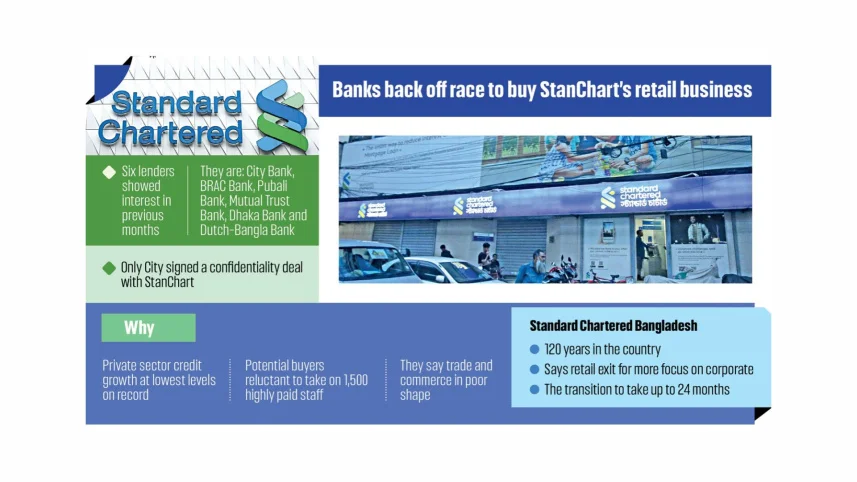
Most of the top local banks that lined up to buy the retail business of Standard Chartered Bangladesh are now leaving the race, officials at the banks say, indicating that the business sale by the foreign lender announced last month might be challenging.
For taking over the local retail business of the British multinational bank, at least six commercial lenders showed strong interest over the months. They include BRAC Bank, City Bank, Pubali Bank, Mutual Trust Bank, Dhaka Bank and Dutch-Bangla Bank.
So far, only City Bank has signed a non-disclosure agreement (NDA) with Standard Chartered Bangladesh.
Officials of BRAC, Pubali and Mutual Trust told The Daily Star that their banks have decided in principle not to engage with the deal under its current conditions. Officials at other lenders said Dutch-Bangla Bank does not have the capacity under current conditions for the takeover.
The main attraction for most of the local commercial lenders was the low-cost deposits portfolio of Standard Chartered Bangladesh’s retail banking. They now ask what they would do with that money if lending keeps sliding.
In September, credit to the private sector grew by just 4.17 percent, down from 4.75 percent in August, according to Bangladesh Bank. Senior central bank officials said they cannot recall such a slump, and that growth has not been this weak since at least 1993.
“We have decided not to proceed now,” said a top official at one of the banks that lined up for the retail business buying.
“Private sector credit growth is at a historic low. What would we do with their low-cost deposits? Where would we lend? That is why we have backed away from their plan,” he said.
“It is not a good time for Standard Chartered to sell its retail business because trade and commerce are in poor shape,” he added, while speaking on condition of anonymity.
The size of the retail banking staff at Standard Chartered Bangladesh is also another issue.
The foreign lender has around 1,500 employees on high salaries and has made it a condition of the sale that the buyer takes them on. Many potential buyers said they would struggle to absorb such a large, highly paid workforce.
“What would we do with such a large payroll? What outcome would we get?” the official of the potential buyer asked.
Another senior official said his bank has also stepped back for the same reason. “We do not want to take over the bank’s retail business. We have stepped back because of the 1,500 employees, whose salary packages are very high.”
Selling the retail business is not easy, he said, and taking it over along with 1,500 employees would be difficult. “Many banks simply do not have the capacity to bear the cost of these staff.”
In a statement in early October, Standard Chartered Bangladesh announced the sale of its wealth and retail banking business as it sharpens its focus on corporate and investment banking. Many local lenders had been in talks with the bank for a long time before the formal announcement.
Standard Chartered Bangladesh said the transition of the Wealth and Retail Banking (WRB) business is expected to take 18 to 24 months, subject to the deal process and regulatory approvals.
The first official said Standard Chartered makes decisions from a global perspective, but circumstances differ from country to country.
“Its plan should be customised. A plan that succeeded in Sri Lanka cannot simply be replicated in Bangladesh. Every country’s situation is different,” he said. “If it cannot find a buyer, it may put its plan on hold. But backing out after announcing a decision would damage its reputation.”
Meanwhile, a City Bank official, who also asked not to be named, said the bank is the only one to have signed an NDA but is still watching the situation before making any further decision.
Abdul Hai Sarker, chairman of Dhaka Bank, told The Daily Star, “We are thinking it over. They have 1,500 employees who are highly paid.”
“We haven’t moved forward yet. Discussions are ongoing. We are trying to see whether this would be profitable. Taking on 1,500 employees would be a burden. That is one issue,” he said.
The London-based multinational has operated in Bangladesh for 120 years. Five years ago, it had 24 branches and around 90 ATM booths.
It now has 18 branches and 70 self-service terminals, including ATMs and cash recycling machines, according to its website.
When contacted, Bitopi Das Chowdhury, head of corporate affairs, brand and marketing at Standard Chartered Bangladesh, said the bank will not comment because of the need to maintain confidentiality under the NDA with prospective buyers.
Last year, HSBC Bangladesh announced winding down its retail banking operations in the country.
STAFF SEEK 10 YEARS’ PAY AS SEVERANCE
Employees of Standard Chartered Bangladesh have formally asked for an enhanced settlement package after the proposed sale of the WRB business to another bank, according to a letter seen by The Daily Star.
In the letter, dated October 5, 2026 and addressed to the bank’s chief executive, an “Affected Employee Group” acknowledges that strategic decisions rest with the global group but says the impact on staff warrants transparent and fair talks.
The group demands severance equal to 120 months of last drawn gross salary and full payment of the 5 percent Workers’ Profit Participation Fund.
It also demands a waiver of outstanding loans and credit card liabilities, with the bank covering any extra interest once staff lose the employee rate after their loans move to another bank.
It asks for protection of performance bonuses and quarterly incentives for 2026-28, and for settlement of share-plan benefits and gratuity, including for staff with less than five years of service.
The group also wants promotions and fair increments for those who have spent three or more years in one role. During the transition, it says, no employee should be placed on a performance improvement plan or terminated, except for disciplinary reasons.
It wants standard messaging for clients about the transfer and direct consultations with affected employees before any final arrangements are made.
Weak private-sector credit growth and the cost of taking on 1,500 employees deter buyers, with City Bank the only lender to sign an NDA
Md Mehedi Hasan
Most of the top local banks that lined up to buy the retail business of Standard Chartered Bangladesh are now leaving the race, officials at the banks say, indicating that the business sale by the foreign lender announced last month might be challenging.
For taking over the local retail business of the British multinational bank, at least six commercial lenders showed strong interest over the months. They include BRAC Bank, City Bank, Pubali Bank, Mutual Trust Bank, Dhaka Bank and Dutch-Bangla Bank.
So far, only City Bank has signed a non-disclosure agreement (NDA) with Standard Chartered Bangladesh.
Officials of BRAC, Pubali and Mutual Trust told The Daily Star that their banks have decided in principle not to engage with the deal under its current conditions. Officials at other lenders said Dutch-Bangla Bank does not have the capacity under current conditions for the takeover.
The main attraction for most of the local commercial lenders was the low-cost deposits portfolio of Standard Chartered Bangladesh’s retail banking. They now ask what they would do with that money if lending keeps sliding.
In September, credit to the private sector grew by just 4.17 percent, down from 4.75 percent in August, according to Bangladesh Bank. Senior central bank officials said they cannot recall such a slump, and that growth has not been this weak since at least 1993.
“We have decided not to proceed now,” said a top official at one of the banks that lined up for the retail business buying.
“Private sector credit growth is at a historic low. What would we do with their low-cost deposits? Where would we lend? That is why we have backed away from their plan,” he said.
“It is not a good time for Standard Chartered to sell its retail business because trade and commerce are in poor shape,” he added, while speaking on condition of anonymity.
The size of the retail banking staff at Standard Chartered Bangladesh is also another issue.
The foreign lender has around 1,500 employees on high salaries and has made it a condition of the sale that the buyer takes them on. Many potential buyers said they would struggle to absorb such a large, highly paid workforce.
“What would we do with such a large payroll? What outcome would we get?” the official of the potential buyer asked.
Another senior official said his bank has also stepped back for the same reason. “We do not want to take over the bank’s retail business. We have stepped back because of the 1,500 employees, whose salary packages are very high.”
Selling the retail business is not easy, he said, and taking it over along with 1,500 employees would be difficult. “Many banks simply do not have the capacity to bear the cost of these staff.”
In a statement in early October, Standard Chartered Bangladesh announced the sale of its wealth and retail banking business as it sharpens its focus on corporate and investment banking. Many local lenders had been in talks with the bank for a long time before the formal announcement.
Standard Chartered Bangladesh said the transition of the Wealth and Retail Banking (WRB) business is expected to take 18 to 24 months, subject to the deal process and regulatory approvals.
The first official said Standard Chartered makes decisions from a global perspective, but circumstances differ from country to country.
“Its plan should be customised. A plan that succeeded in Sri Lanka cannot simply be replicated in Bangladesh. Every country’s situation is different,” he said. “If it cannot find a buyer, it may put its plan on hold. But backing out after announcing a decision would damage its reputation.”
Meanwhile, a City Bank official, who also asked not to be named, said the bank is the only one to have signed an NDA but is still watching the situation before making any further decision.
Abdul Hai Sarker, chairman of Dhaka Bank, told The Daily Star, “We are thinking it over. They have 1,500 employees who are highly paid.”
“We haven’t moved forward yet. Discussions are ongoing. We are trying to see whether this would be profitable. Taking on 1,500 employees would be a burden. That is one issue,” he said.
The London-based multinational has operated in Bangladesh for 120 years. Five years ago, it had 24 branches and around 90 ATM booths.
It now has 18 branches and 70 self-service terminals, including ATMs and cash recycling machines, according to its website.
When contacted, Bitopi Das Chowdhury, head of corporate affairs, brand and marketing at Standard Chartered Bangladesh, said the bank will not comment because of the need to maintain confidentiality under the NDA with prospective buyers.
Last year, HSBC Bangladesh announced winding down its retail banking operations in the country.
STAFF SEEK 10 YEARS’ PAY AS SEVERANCE
Employees of Standard Chartered Bangladesh have formally asked for an enhanced settlement package after the proposed sale of the WRB business to another bank, according to a letter seen by The Daily Star.
In the letter, dated October 5, 2026 and addressed to the bank’s chief executive, an “Affected Employee Group” acknowledges that strategic decisions rest with the global group but says the impact on staff warrants transparent and fair talks.
The group demands severance equal to 120 months of last drawn gross salary and full payment of the 5 percent Workers’ Profit Participation Fund.
It also demands a waiver of outstanding loans and credit card liabilities, with the bank covering any extra interest once staff lose the employee rate after their loans move to another bank.
It asks for protection of performance bonuses and quarterly incentives for 2026-28, and for settlement of share-plan benefits and gratuity, including for staff with less than five years of service.
The group also wants promotions and fair increments for those who have spent three or more years in one role. During the transition, it says, no employee should be placed on a performance improvement plan or terminated, except for disciplinary reasons.
It wants standard messaging for clients about the transfer and direct consultations with affected employees before any final arrangements are made.