[🇧🇩] Banking Industry in Bangladesh

Quick Reply ✓ Posted!
[🇧🇩] Banking Industry in Bangladesh
446
21K
More threads by Saif

G Bangladesh Defense

Banks back away from Standard Chartered Bangladesh retail business sale

Weak private-sector credit growth and the cost of taking on 1,500 employees deter buyers, with City Bank the only lender to sign an NDA

Md Mehedi Hasan
1794268733382.webp


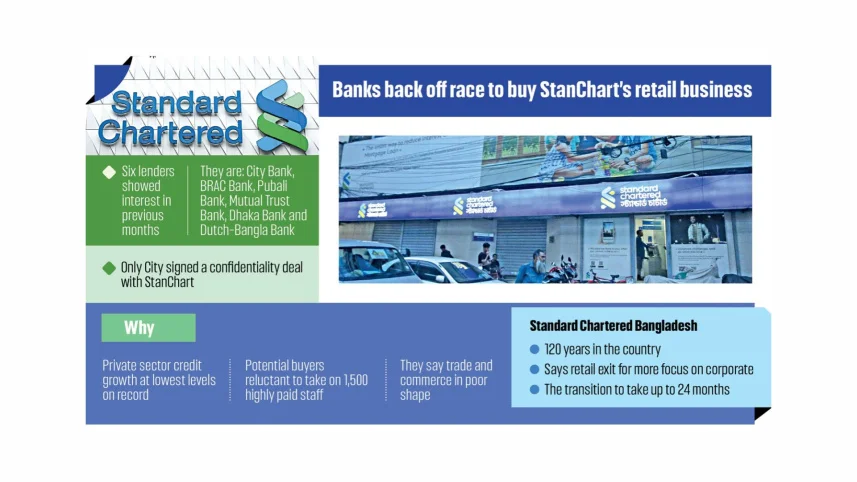
Most of the top local banks that lined up to buy the retail business of Standard Chartered Bangladesh are now leaving the race, officials at the banks say, indicating that the business sale by the foreign lender announced last month might be challenging.

For taking over the local retail business of the British multinational bank, at least six commercial lenders showed strong interest over the months. They include BRAC Bank, City Bank, Pubali Bank, Mutual Trust Bank, Dhaka Bank and Dutch-Bangla Bank.

So far, only City Bank has signed a non-disclosure agreement (NDA) with Standard Chartered Bangladesh.

Officials of BRAC, Pubali and Mutual Trust told The Daily Star that their banks have decided in principle not to engage with the deal under its current conditions. Officials at other lenders said Dutch-Bangla Bank does not have the capacity under current conditions for the takeover.

The main attraction for most of the local commercial lenders was the low-cost deposits portfolio of Standard Chartered Bangladesh’s retail banking. They now ask what they would do with that money if lending keeps sliding.

In September, credit to the private sector grew by just 4.17 percent, down from 4.75 percent in August, according to Bangladesh Bank. Senior central bank officials said they cannot recall such a slump, and that growth has not been this weak since at least 1993.

“We have decided not to proceed now,” said a top official at one of the banks that lined up for the retail business buying.

“Private sector credit growth is at a historic low. What would we do with their low-cost deposits? Where would we lend? That is why we have backed away from their plan,” he said.

“It is not a good time for Standard Chartered to sell its retail business because trade and commerce are in poor shape,” he added, while speaking on condition of anonymity.

The size of the retail banking staff at Standard Chartered Bangladesh is also another issue.

The foreign lender has around 1,500 employees on high salaries and has made it a condition of the sale that the buyer takes them on. Many potential buyers said they would struggle to absorb such a large, highly paid workforce.

“What would we do with such a large payroll? What outcome would we get?” the official of the potential buyer asked.

Another senior official said his bank has also stepped back for the same reason. “We do not want to take over the bank’s retail business. We have stepped back because of the 1,500 employees, whose salary packages are very high.”

Selling the retail business is not easy, he said, and taking it over along with 1,500 employees would be difficult. “Many banks simply do not have the capacity to bear the cost of these staff.”

In a statement in early October, Standard Chartered Bangladesh announced the sale of its wealth and retail banking business as it sharpens its focus on corporate and investment banking. Many local lenders had been in talks with the bank for a long time before the formal announcement.

Standard Chartered Bangladesh said the transition of the Wealth and Retail Banking (WRB) business is expected to take 18 to 24 months, subject to the deal process and regulatory approvals.

The first official said Standard Chartered makes decisions from a global perspective, but circumstances differ from country to country.

“Its plan should be customised. A plan that succeeded in Sri Lanka cannot simply be replicated in Bangladesh. Every country’s situation is different,” he said. “If it cannot find a buyer, it may put its plan on hold. But backing out after announcing a decision would damage its reputation.”

Meanwhile, a City Bank official, who also asked not to be named, said the bank is the only one to have signed an NDA but is still watching the situation before making any further decision.

Abdul Hai Sarker, chairman of Dhaka Bank, told The Daily Star, “We are thinking it over. They have 1,500 employees who are highly paid.”

“We haven’t moved forward yet. Discussions are ongoing. We are trying to see whether this would be profitable. Taking on 1,500 employees would be a burden. That is one issue,” he said.

The London-based multinational has operated in Bangladesh for 120 years. Five years ago, it had 24 branches and around 90 ATM booths.

It now has 18 branches and 70 self-service terminals, including ATMs and cash recycling machines, according to its website.

When contacted, Bitopi Das Chowdhury, head of corporate affairs, brand and marketing at Standard Chartered Bangladesh, said the bank will not comment because of the need to maintain confidentiality under the NDA with prospective buyers.

Last year, HSBC Bangladesh announced winding down its retail banking operations in the country.

STAFF SEEK 10 YEARS’ PAY AS SEVERANCE

Employees of Standard Chartered Bangladesh have formally asked for an enhanced settlement package after the proposed sale of the WRB business to another bank, according to a letter seen by The Daily Star.

In the letter, dated October 5, 2026 and addressed to the bank’s chief executive, an “Affected Employee Group” acknowledges that strategic decisions rest with the global group but says the impact on staff warrants transparent and fair talks.

The group demands severance equal to 120 months of last drawn gross salary and full payment of the 5 percent Workers’ Profit Participation Fund.

It also demands a waiver of outstanding loans and credit card liabilities, with the bank covering any extra interest once staff lose the employee rate after their loans move to another bank.

It asks for protection of performance bonuses and quarterly incentives for 2026-28, and for settlement of share-plan benefits and gratuity, including for staff with less than five years of service.

The group also wants promotions and fair increments for those who have spent three or more years in one role. During the transition, it says, no employee should be placed on a performance improvement plan or terminated, except for disciplinary reasons.

It wants standard messaging for clients about the transfer and direct consultations with affected employees before any final arrangements are made.​
 

Bangladesh's banking sector: Ailments and remedies

Bangladesh's banking sector has been vital to the country's economic development. By mobilising savings and providing credit, banks have supported industrialisation, trade, investment and employment. Access to bank financing has helped Bangladeshi entrepreneurs establish businesses, expand production, adopt new technologies and reach international markets. The growth of the ready-made garment industry, other manufacturing activities and services has been closely tied to the expansion of banking services.

Banks have therefore played a significant role in building a dynamic private sector and transforming Bangladesh's economy.

However, weak governance, poor lending practices, political interference, and inadequate regulatory enforcement have undermined the banking sector's potential to contribute further. High levels of non-performing loans (NPLs), serious capital shortfalls, and financial distress at several institutions now threaten the sector's capacity to support productive investment.

NPLs accounted for 33.2 per cent of total outstanding loans as of June 2026, according to the Banking Sector Update of Bangladesh Bank (banking sector update june 2026.pdf). The Monetary Policy Review 2025-26 of Bangladesh Bank shows that the banking system's capital-to-risk-weighted-assets ratio fell to negative 2.64 per cent in December 2025. This indicates serious weaknesses in asset quality and banks' capacity to absorb losses.

Such crisis extends beyond banking. Weak banks struggle to finance businesses, and uncertainty about their financial health erodes depositor confidence. Private-sector credit growth has slowed sharply, contributing to subdued investment and economic activity. Credit to the private sector increased by 4.75 per cent in August 2026 compared to the previous year.

Bangladesh has pursued financial-sector reforms for more than three decades. Yet serious weaknesses persist. Hence, the central question is why successive reforms have failed to establish lasting financial discipline and what must change this time.

The roots of Bangladesh's banking crisis: Weaknesses in the banking sector initially emerged in state-owned institutions, where politically influenced lending, poor credit appraisal and ineffective recovery were common. From the 1980s, the growth of private commercial banks increased competition, improved services and expanded access to credit, but also introduced new governance challenges.

In several private banks, concentrated ownership gave influential shareholders the power to interfere with lending decisions. Connected lending, excessive exposure to large business groups, and weak board oversight undermined credit discipline. Some banks became closely associated with their owners' financial interests instead of operating as independent financial intermediaries.

Bangladesh Bank introduced prudential requirements for loan classification, provisioning, capital adequacy, and borrower exposure, but enforcement was inconsistent. Repeated rescheduling and restructuring allowed some borrowers to delay repayment without demonstrating a credible ability to repay. Lengthy legal proceedings further weakened recovery.

These failures reinforced one another. Poor lending generated NPLs, reducing earnings and eroding capital. Weak capital constrained new lending, while regulatory concessions often delayed the recognition of losses.

Stricter classification and disclosure requirements have recently revealed previously concealed weaknesses. The rise in reported NPLs reflects more accurate recognition of existing problems. But recognising losses must be followed by recovery, restructuring and accountability.

Financial indicators reveal deep weaknesses across banks: The CAMELS framework assesses banks across capital adequacy, asset quality, management, earnings, liquidity and sensitivity to market risk. Bangladesh's banking indicators show substantial differences across institutions.

Bangladesh Bank's June 2026 data show NPL ratios of 43.2 per cent for state-owned commercial banks, 33.2 per cent for specialised banks and 31.6 per cent for private commercial banks. Foreign banks recorded a much lower ratio of 6.5 per cent.

Differences within private banking are also significant. Fourth-generation private banks recorded the highest NPL ratio of 51.6 per cent, compared with 35.2 per cent for first-generation, 19.9 per cent for second-generation, 30.4 per cent for third-generation and 3.1 per cent for fifth-generation banks. Full-fledged Islamic banks recorded NPL of 58.9 per cent. Although individual institutions within each category differ, these figures demonstrate the uneven distribution of banking distress.

These differences underscore the importance of professional management, prudent lending, and effective risk controls. Foreign banks generally have stronger internal controls, although their business models and customer bases differ from those of domestic banks. Some domestic banks have also performed relatively well, thanks to sound governance and diversified lending. Ownership alone does not determine performance. The decisive factors are independent credit decisions, effective board oversight and consistent regulatory enforcement.

Liquidity and solvency must also be distinguished. Some banks face acute cash shortages, while others have surplus liquidity. Temporary liquidity support may help a solvent bank, but it cannot restore an institution whose losses have depleted its capital. Such banks require restructuring or resolution.

Previous reforms failed to address governance weaknesses: The Financial Sector Reform Programme of the 1990s introduced major prudential and operational reforms. Later programmes aimed to modernise management and strengthen supervision. In 2007, major state-owned banks were corporatised to give them greater commercial autonomy.

These initiatives produced some improvements but did not fundamentally change institutional incentives. Political influence over appointments, management and lending continued, while accountability for poor decisions remained weak.

1794353713746.webp


Repeated recapitalisation of state-owned banks highlights the limits of reform without accountability. Public funds were used to improve weak banks, but capital shortfalls returned because lending practices and governance did not improve enough.

Private banks faced similar problems from shareholder influence, connected lending, and weak supervision.

Recent reforms must be judged by their implementation: Since August 2024, the government has taken several important measures to address weaknesses in the banking sector. These include changes to the boards of troubled banks, independent asset-quality reviews, stricter loan classification, risk-based supervision, and the introduction of a bank-resolution framework.

The Bank Resolution Ordinance 2025 created legal mechanisms to restructure and resolve distressed banks. Such a framework is necessary because conventional supervision is insufficient when banks have already accumulated large losses. Resolution arrangements should allow authorities to protect essential banking services and depositors while ensuring that losses are recognised and allocated according to the law.

The International Monetary Fund (IMF)'s January 2026 Article IV assessment emphasised the need for a comprehensive banking reform strategy, including reliable estimates of capital shortfalls, clear arrangements for fiscal support, and legally sound restructuring and resolution plans. It also recommended asset quality reviews for systemically important and state-owned banks and cautioned against unsecured liquidity injections into weak institutions.

In June 2026, the World Bank approved US$ 450 million under the Financial Sector Support Project II. The project aims to strengthen deposit protection, modernise Bangladesh Bank's supervisory systems, improve emergency liquidity arrangements, and support the restructuring of state-owned banks.

These initiatives can strengthen institutional capacity, but their effectiveness will depend on implementation.

What must be done differently this time: First of all, the government must establish clear political ownership of banking reform by committing to end interference in bank appointments, lending decisions, and regulatory enforcement. This commitment must apply equally to state-owned and private institutions.

A comprehensive reform strategy should assess each bank's financial condition, capital needs, governance weaknesses, and recovery prospects. It should distinguish viable institutions that need corrective measures from non-viable institutions that require resolution.

The Ministry of Finance should develop restructuring strategies tailored to each state-owned bank. Each strategy should set out commercial and public-service objectives, capital requirements, management responsibilities, and measurable performance targets. Any recapitalisation should be conditional on credible reforms and independent monitoring. The fiscal costs must be transparently disclosed. Public support should not become an open-ended commitment to cover recurring losses.

Bangladesh Bank must complete independent asset quality reviews, enforce provisioning requirements, monitor large-borrower exposures and act promptly when banks fail to meet prudential standards.

Risk-based supervision should be supported by reliable financial data and stronger analytical capacity. The planned adoption of expected-credit-loss accounting under International Financial Reporting Standard 9 (IFRS 9) should improve the recognition of potential losses, provided that implementation is supported by adequate training, data systems and supervisory verification. IFRS 9 is an international accounting standard that requires banks to estimate potential loan losses in advance and set aside sufficient funds to cover them, rather than waiting for borrowers to default.

Bank boards and management must take direct responsibility for maintaining lending discipline. Independent directors should exercise meaningful oversight, risk-management departments should have sufficient authority, and internal audit findings should prompt corrective action.

Loan recovery and insolvency proceedings should be more effective. Faster case resolution and stronger enforcement would limit deliberate delays and strengthen the credibility of repayment obligations.

Reforms should follow a clear sequence. During the first six months, priority should be given to transparent financial diagnostics, identifying non-viable institutions, and preparing recovery plans for major distressed loans. In the next phase, spanning one to two years, the focus should shift to restructuring weak banks, improving loan recovery, strengthening governance, and implementing supervisory reforms. Over the following three to five years, the goal should be sustained improvements in capital adequacy, profitability, institutional independence, and financial accountability.

Progress should be assessed against measurable indicators, including actual cash recovery, new loan defaults, provisioning coverage, capital adequacy, profitability, governance compliance and depositor confidence.

The present crisis offers an opportunity to break this pattern. Success, however, will depend on consistent rule enforcement, professional management, transparent acknowledgement of losses, and credible consequences for financial misconduct. The goal should be a banking system that protects savings, allocates credit efficiently, supports productive investment, and operates within enforceable rules.

The writer is an economist and Distinguished Fellow, Centre for Policy Dialogue (CPD).​
 

Repairing & reforming the banking industry

1794353888051.webp


Bangladesh's banking difficulties are often discussed through defaulted loans and capital shortages. Their consequences, however, reach families protecting savings, businesses meeting repayment commitments and institutions maintaining sound standards. Banks lend largely with depositors' money, so weak lending and recovery can put education funds, retirement savings and productive investment under pressure. Repairing the industry should therefore protect depositors, support viable borrowers and preserve well-managed institutions. The objective is to restore confidence through fair treatment, credible accounts and dependable financial services, while creating conditions that make responsible behaviour worthwhile.

The scale of the challenge requires sustained attention. Bangladesh Bank data put classified loans at Tk 6.06 trillion in June 2026, equivalent to 32.78 per cent of outstanding loans. Although the ratio declined from 35.73 per cent in September 2025, the amount increased from Tk 6.04 trillion. This illustrates why a falling ratio alone cannot establish recovery. Progress should also be assessed through actual repayments, fewer fresh defaults and stronger borrower finances. Recognising previously concealed problems is a necessary step towards repair, even when disclosure initially makes the position appear more difficult.

Capital weakness reinforces the need for accurate accounts. The World Bank reported a system-wide capital-to-risk-weighted-assets ratio of negative 2.6 per cent at the end of December 2025. Capital provides a cushion against losses, making its restoration essential to depositor protection. Yet difficulties are unevenly distributed: central bank data reported that ten of 61 banks held more than 72 per cent of non-performing loans (NPLs) in June 2026. Institution-specific assessments would allow authorities to concentrate resources where weaknesses are greatest while enabling better-managed banks to continue financing customers.

Reliable reporting should distinguish cash recovery from restructuring, write-offs and changes in classification. A revised repayment schedule offers a route to recovery, but its success depends on payments received. Similarly, writing off a loan changes its accounting treatment without necessarily ending recovery rights. Clear disclosure of these differences would help depositors and investors understand what has improved and what remains unresolved. Independent asset reviews, realistic provisioning and credible capital plans can give reform a firmer basis than changes in headline indicators alone.

Responsible borrowers have a direct interest in this process. When banks absorb unpaid loans, rebuild capital and manage uncertain cash flows, they may increase lending margins, require additional collateral or limit new credit. Businesses that repay regularly can consequently face tougher financing conditions. A viable manufacturer seeking working capital may struggle while a repeatedly rescheduled borrower receives further attention. Reform should address this imbalance by improving recovery and making credit decisions reflect each customer's risk. Better treatment of reliable borrowers would support investment and help rebuild confidence in banking relationships.

Banking weakness also interacts with broader economic constraints. Bangladesh Bank's July-December 2026 monetary policy statement estimated private-sector credit growth at 5.5 per cent in June 2026. Costly borrowing, subdued demand and economic uncertainty affect both lending and investment. Bank repair should therefore accompany improvements in energy supply, business conditions and policy predictability. Credit programmes can assist productive firms, but lending targets should remain consistent with repayment capacity. Sustainable growth requires businesses with viable prospects and lenders able to assess them responsibly.

An effective recovery strategy must distinguish genuine financial distress from wilful default. A business facing lost orders or an unexpected disruption may benefit from restructuring. Deliberate non-payment, fund diversion or collusive lending requires a different response. These cases involve governance and control failures alongside credit losses. Banks should investigate the causes, preserve evidence and pursue appropriate remedies. Recovery teams could prioritise cases by likely recoverable value and agree documented settlements where these offer better results. Smaller borrowers should have access to timely review, so that limited administrative resources do not make workable solutions unnecessarily difficult.

Fair procedures would protect legitimate borrowers from indiscriminate treatment while ensuring that those able to repay cannot obtain an advantage simply by withholding payment.

Repeated concessions can affect competition beyond banking. A firm that retains cash by avoiding debt service may gain room to reduce prices, extend customer credit or expand faster than a competitor meeting its obligations. Such behaviour cannot be inferred from low prices alone, but persistent relief without verified need can create unequal conditions. Policies should preserve viable enterprises and employment while requiring meaningful borrower participation. The aim is to improve recoverable value without making default a more attractive business strategy than regular repayment.

Restructuring is most useful when a credible business can recover. Relief could be tied to verified cash flows, transparent accounts, a borrower contribution and achievable repayment milestones. Large or connected exposures deserve independent review. Authorities should set clear consequences for missed commitments and assess whether further assistance improves recovery prospects. The International Monetary Fund (IMF)'s January 2026 assessment highlighted how deferred provisions and immediate reclassification of restructured loans could obscure financial weakness. Sustained repayment should demonstrate improvement before troubled accounts are treated as healthy. This would preserve flexibility while maintaining discipline.

Stronger governance would help these arrangements work consistently. Banks should identify ultimate owners, assess exposures across related borrowing groups and prevent conflicted directors from influencing credit decisions. Risk and compliance teams need authority to challenge proposals, and credit officers need support when professional judgment conflicts with influential interests. Exceptions should be recorded, justified and reviewed. Accountability should cover borrowers as well as directors, managers and others who enabled improper lending. Clear responsibilities can reduce uncertainty and help staff apply standards fairly.


1794353923248.webp


Government and Bangladesh Bank have complementary responsibilities in restoring discipline. Some distressed loans, particularly those involving fraud, asset diversion or persistent refusal to pay, require legal powers beyond a bank's operational capacity. Policymakers could strengthen debt enforcement, improve court capacity and support lawful asset recovery, including cross-border cooperation where necessary. Timely proceedings and proportionate remedies would reduce incentives to delay repayment while safeguarding due process. Regulatory bodies should also publish decision criteria, explain significant exceptions and review their own performance. Credible reform requires accountability within the institutions directing it.

Depositor protection should remain central throughout restructuring. Most savers neither selected the borrowers nor approved the loans that damaged bank finances. Authorities should prepare access to protected deposits and essential payments before implementing major changes. Bangladesh Bank's monetary policy statement reports an increase in formal deposit coverage from Tk 0.1 million to Tk 0.2 million. Customers need clear information on eligibility, payment timing and balances beyond the applicable limit. Finance-company depositors also require clarity about relevant legal arrangements. Branch staff and helplines should provide the same guidance, with accessible arrangements for elderly customers and others who cannot rely on digital channels. Operational preparation matters because protection becomes meaningful when people can actually use it. Where withdrawals face lawful restrictions, consistent explanations, realistic timetables and effective complaint handling would help families plan.

Bank restructuring needs similarly practical measures of success. Bangladesh Bank reports that five Shariah-based lenders were merged into Sammilito Islami Bank with a Tk 200 billion government capital injection. Combining institutions can support recovery, but the resulting bank still needs sound management, adequate capital and a workable business plan. Authorities should disclose recognised losses, recoveries and service reliability. Any public support should carry clear conditions and reporting obligations. Taxpayers benefit when assistance restores essential services and limits future losses, alongside a credible effort to recover funds from responsible parties.

Sound banks should retain the capacity to serve their own depositors and customers. Before a merger or other transfer of responsibilities, independent reviews should establish asset quality, integration costs and additional capital requirements. Funding arrangements must make the distribution of losses clear. Contributions to common protection or resolution mechanisms should be transparent and proportionate, with attention to institutions' financial capacity. Well-managed banks can support recovery through continued lending and reliable services; preserving their strength is itself an important reform objective.

Bangladesh Bank's move towards risk-based supervision is welcome because it directs attention to institutions and activities presenting greater risk. Its effectiveness, however, depends on practical understanding of risk management and compliance across the industry. Compliance should be integrated into decisions on lending, operations and reporting, with clear responsibilities for business teams, control functions and boards. Assessment should cover liquidity, operational resilience and cybersecurity alongside loan quality. Staff should be encouraged to report concerns in good faith, with protection against retaliation. These arrangements would make compliance a shared professional responsibility rather than an exercise confined to specialist departments. Training, realistic implementation plans and regular supervisory feedback would help banks strengthen this culture.

Supervisors should test whether audit findings are resolved and early warnings produce timely corrective action.

Data quality is a crucial foundation for these improvements. Boards and supervisors need dependable information on overdue accounts, connected exposures, collateral values and capital needs. Technology can improve reporting and identify emerging risks, provided records are accurate and systems are properly governed. Bangladesh Bank's planned adoption of expected-credit-loss accounting in 2027 could support earlier recognition of deterioration. Preparatory work should include data validation, staff training and independent review of assumptions. Digital systems become useful safeguards when decision-makers act on their findings and remain accountable for exceptions.

Leadership appointments deserve equal attention. Integrity is essential, but it should be supported by relevant expertise, sound judgment and demonstrated professional performance. Claims of honesty alone offer an uncertain basis for selecting senior executives, board directors or policymakers. Transparent selection criteria, checks on conflicts of interest and assessment of experience can improve appointment decisions. Subsequent performance reviews should examine financial stewardship, compliance and treatment of customers. Capable leaders with independence and clear responsibilities are better placed to manage complex risks and protect the interests of depositors, borrowers and the public.

Technology adoption and financial inclusion should continue, including careful consideration of digital banks. I remain cautiously supportive of digital-bank licensing, with emphasis on sound asset quality and services that reach underserved customers. The value of a new licence should extend beyond providing another channel for existing services. Rural and small-business lending may require close follow-up, particularly where borrower information and legal enforcement are limited. Applicants should demonstrate how they will verify customers, monitor loan use and recover debts, using lawful partnerships where appropriate. Proportionate supervision, cybersecurity safeguards and accessible complaint handling would help innovation develop responsibly.

Banking repair should be supported by comprehensive medium- and long-term reform measures across the financial system. Banks currently bear substantial demands for financing, including activities with high risk or long repayment periods that can strain their risk management systems and culture. Stronger finance companies, insurance providers and securities markets could offer appropriate alternatives and distribute financing risks more effectively. Medium-term measures should improve governance, disclosure, supervision and investor protection across these sectors. Longer-term initiatives could expand credible corporate bond markets, equity financing, suitable insurance products and institutional investment. Financing should match the nature and duration of the underlying activity, with risks borne by institutions and investors equipped to assess them. Regulators also need to monitor exposures between sectors so that diversification does not conceal concentrated risks or weak underwriting. Coordination among regulators, with clear milestones and periodic review, would help reduce excessive dependence on bank lending without simply transferring weaknesses elsewhere.


1794353959456.webp


This broader approach should recognise sound finance companies and other well-performing non-bank financial institutions alongside sound banks. Institutions maintaining adequate capital, reliable reporting and responsible customer treatment could benefit from proportionate approval procedures, appropriate access to funding programmes and opportunities to provide specialised financial services. Eligibility should depend on verified performance and suitability for the programme concerned. Incentives should encourage productive financing and sound risk management, while common prudential standards continue to apply. Recognising responsible institutions would help attract investment and expand credible alternatives for savers and businesses.

Responsible borrowers also need visible recognition. Banks could use verified payment histories and current financial strength to offer eligible customers lower risk margins, reduced fees, faster renewals and proportionate collateral requirements. Smaller firms should understand how to qualify for these benefits and for publicly supported credit programmes. Bangladesh Bank could encourage disclosure of lending policies and review whether reliable customers receive fair access. Past repayment deserves consideration alongside present financial capacity. Such incentives would reward discipline without weakening assessment or creating an automatic entitlement to subsidised loans.

Implementation should combine transparency with meaningful consultation. Depositors, businesses and financial institutions can help identify practical difficulties in proposed measures. Consultation works best when it improves rules and service arrangements through an open process. Progress reports should track actual recoveries, renewed defaults after restructuring, capital restoration and dependable deposit services. They should also explain public costs and credit reaching viable firms. Clear definitions and reporting dates would make these measures easier to assess. Consistent disclosure, followed by visible correction where plans fall short, would provide a credible basis for rebuilding trust.

Bangladesh has institutions that maintained standards and businesses that honoured their commitments through difficult conditions. Reform should build on that capacity. Protecting depositors, recognising responsible borrowers and supporting sound institutions would connect financial repair with productive economic activity. Immediate recovery measures need to fit within a coherent programme of better governance, enforceable obligations and broader financing options. With careful sequencing and measurable commitments, the industry can regain stability while offering fairer opportunities to those whose savings, repayment discipline and professional conduct sustain it.

Dr Shah Md Ahsan Habib is a Professor at BIBM and has professional engagement with Dnet Bangladesh, Knowledge Hub Institute (KHI), and IPDC Finance PLC.​
 

REGULATORY BAILOUT FOR TROUBLED ISLAMI BANK

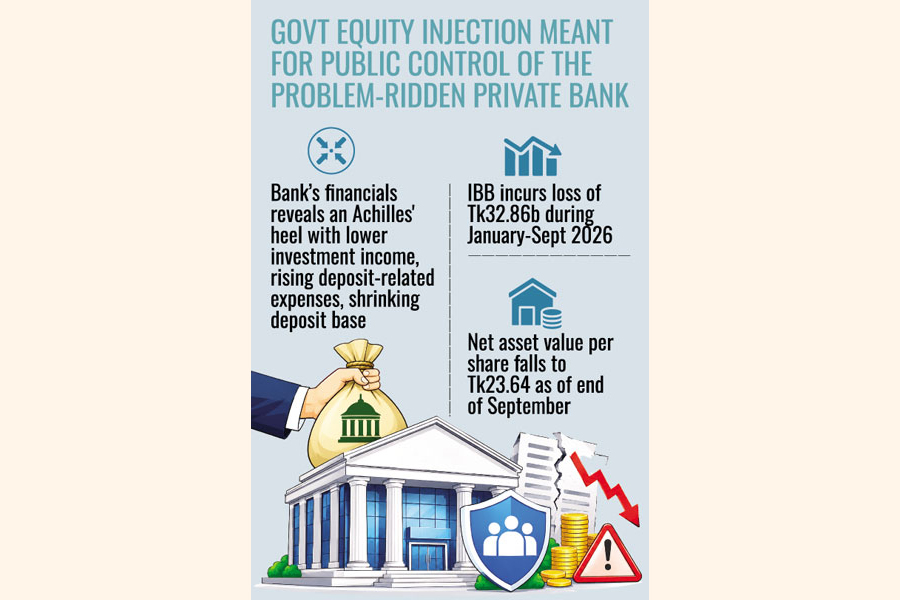
Tk 60b govt equity injection likely for bank's revival


1794437608616.webp


A Tk 60-billion government equity injection into the scam-hit Islami Bank Bangladesh is under consideration to gain public control of the private commercial lender, sources say.

The regulatory move comes as the lender grapples with massive financial losses, alleged fund embezzlement, non-performing investments and a severe erosion of its capital base, said central-bank sources.

Through a letter sent to the Financial Institutions Division (FID) on November 9, the central bank sought to know whether the government would agree to support the proposed capital enhancement of the private commercial bank.

The Banking Regulation and Policy Department of the Bangladesh Bank (BB) sent the letter to the FID, referring to a proposal submitted by Islami Bank Bangladesh PLC on April 4 this year.

Under the proposal, the bank wants to raise its paid-up capital to Tk 76.10 billion from the existing Tk 16.10 billion through the issuance of 6.0 billion ordinary shares at a face value of Tk 10 each.

The proposed shares, worth Tk 6.0 billion, would be placed privately with the government and/or eligible government institutions as strategic equity investors, mentioned the letter.

The scam-hit bank has also submitted a Capital Restoration Plan for 2027-2033 as part of its proposal, according to the BB.

The proposed capital feeding would account for around 79 per cent of the bank's enlarged paid-up capital, potentially giving the government or participating state institutions a controlling stake in the bank.

The central bank has said the decision on the government's strategic participation in the capital of a bank rests solely with the government. It has, consequently, sought the FID's views as to whether the government is willing to support the proposed investment.

However, the central bank's letter did not specify the amount of investment to be made by the government, the institutions that might participate in the proposed share subscription or the timeframe for a government decision.

The proposal, if approved, could significantly change the ownership structure of Islami Bank through a substantial state-backed equity investment.

Contacted, an official of the FID said, "We have received the proposal and working on the issue."

The proposed intervention comes against the backdrop of years of alleged financial irregularities involving influential business interests, particularly parties connected to the embattled S Alam Group, which took the bank's control in 2017.

Fund embezzlement by connected parties and large legacy exposures have emerged as major reasons behind the bank's deteriorating financial condition.

Its latest disclosures identify these irregularities as key contributors to the continued rise in classified and non-performing investments, restricting income generation and weakening cash flow and profitability due to irregular repayments.

The bank's financial disclosures also point to lower investment income, rising deposit-related expenses and a shrinking deposit base.

Allegations of large-scale fund diversions during the S Alam Group's period of influence have intensified scrutiny of past lending decisions and the beneficiaries of major investments.

According to unaudited financial statements, Islami Bank incurred a consolidated loss of Tk 32.86 billion during January-September period of 2026, compared to a profit of approximately Tk 1.0 billion in the same period a year earlier.

Consolidated loss per share stood at Tk 20.41, against earnings per share of Tk 0.62. The July-September quarter alone recorded a loss of approximately Tk 19.70 billion.

Consolidated net asset value per share fell to Tk 23.64 at the end of September from Tk 44.52 at the end of December 2025, reflecting the growing burden of non-performing investments and difficulties recovering funds from troubled exposures.

According to its 2025 annual report, the bank faced a required provisioning amount of Tk 925.37 billion but maintained only Tk 79.22 billion, leaving a shortfall of Tk 846.15 billion under the reported calculation.

Its capital-to-risk-weighted-assets ratio stood at 6.42 per cent on a standalone basis and 6.60 per cent on a consolidated basis, far below the regulatory requirement of 12.50 per cent. The proposed investment could strengthen the bank's capital position and give the government a significant ownership stake, depending on the transaction's structure and terms.

However, the shareholding arrangement, valuation, funding source and implementation mechanism remain independently unconfirmed.

The proposal also raises questions about using taxpayers' money to recapitalise a bank whose financial difficulties are linked to alleged large-scale irregularities and unrecovered investments, a retired high official said.

Meanwhile, the bank's board has decided to increase its authorised capital from Tk 20 billion to Tk 100 billion.

Disclosed on November 5, the proposal requires approval from the central bank, other regulators and shareholders at an extraordinary general meeting. While this would expand the bank's capacity to issue shares, it would not automatically inject fresh funds or resolve the existing capital shortfall.

A fresh equity injection may offer temporary relief but cannot independently address underlying governance and asset-quality problems.

The government and the central bank must also ensure transparent valuation, shareholder protection, recovery of diverted funds and accountability for those involved in financial irregularities.​
 

Our banking future cannot come at the cost of data privacy

Md Nazmul Hossen


1794440836076.webp

FILE VISUAL: COLLECTED

In August 2025, at least 54 customers of a multinational bank in Bangladesh reported that a total of Tk 27 lakh had been fraudulently transferred from their credit cards to unknown bKash and Nagad accounts without any OTP being shared. The bank initially refused to treat the transactions as fraud because they were OTP verified. If fraudsters can compromise the very systems responsible for delivering our security codes, how safe is the data we hand over to banks every day?

This question becomes more urgent as the country’s banking sector embraces artificial intelligence. From detecting suspicious transactions to assessing loan eligibility, AI is transforming financial services. However, this smartness comes with the invisible risk to the security of personal and financial data. Bank balances, transaction histories, and shopping patterns all become part of the database that AI learns from. As mobile financial services expand, data accumulates on bank and fintech servers. The more centralised the data, the more catastrophic a single leak becomes.

Banks rely on National ID information for customer verification. The 2023 leak of NID and birth registration data of millions of citizens from a government service exposed its vulnerability. When names, addresses, and dates of birth fall into criminal hands, fake bank accounts and fraudulent loans become easy. A 2025 Financial Consumer Protection Survey found that nearly 30 percent of digital financial service users in Bangladesh did not have a PIN or password on their phone to protect their accounts. Among those who did, 45 percent shared it with others, typically family members.

Article 43 (b) of the constitution recognises citizens’ right to the privacy of correspondence and communication. But informational privacy has yet to become a standalone right. The Personal Data Protection Act, 2026 covers identifiable financial information but lacks AI-specific provisions, such as the right to explanation for automated decisions or mandatory algorithmic audits. Section 7 of the Bankers Books Evidence Act, 2021 imposes strict restrictions on disclosing customer information without prescribed conditions, but enforcement remains weak. Chapter 14 of the Bangladesh Banks Guideline on ICT Security (4.0) warns about AI risks, including flawed algorithms, biased outcomes, and cyber attacks, However, it is a guideline, not a binding law. The Bangladesh Bank began drafting an integrated AI policy for the banking sector in late 2025, forming a seven-member team to prepare guidelines and announcing plans to develop its own large language model (LLM) to reduce dependence on foreign AI tools. However, the broader policy had yet to be officially published as of November 2026. On November 1, the central bank reiterated that it was working on a separate AI-focused cybersecurity policy for banks and financial institutions.

In June 2026, the central bank instructed its officials not to input confidential or sensitive banking information into AI tools like ChatGPT, Gemini or Claude, citing cross-border data transfer risks. Meanwhile, a study by the Bangladesh Institute of Bank Management found that nearly 60 percent of local banks lack any policy for using AI in cybersecurity.

Internationally, three cases offer lessons. In Germany in 2023, the Court of Justice of the European Union (CJEU) ruled in OQ v Land Hessen (SCHUFA) that an automated credit score constitutes an automated individual decision when a lender relies heavily on it to determine whether to grant credit. For Bangladesh, this means automated credit scores used in loan approvals should be subject to legal safeguards for automated decision-making, including customers’ right to understand how these scores influence lending decisions. In 2025, in Austria, the CJEU clarified in CK v Magistrat der Stadt Wien (Dun and Bradstreet) that trade secrecy cannot be used as a blanket excuse to deny a customer meaningful information about the logic of an AI decision. The data protection law must close the path for banks to refuse a customer’s right to explanation by citing trade secrets. In Poland, Toyota Bank Polska was fined approximately Tk 1.6 crore in 2025 for failing to properly document customer profiling and for not ensuring the independence of its data protection officer. This means mandatory data protection impact assessments must be conducted before AI-driven profiling, and the DPO must report directly to the board.

Three things become clear. First, despite laws and guidelines, practical enforcement and accountability are lacking. Second, citizens often don’t know who is taking their data, how long it is kept, or whether it is being used to train AI models. Third, without an independent and empowered supervisory body, laws remain on paper.

There is a path forward. First, banks must stop collecting excessive data, ensure strong encryption and limited access, and conduct regular security audits. Second, data usage terms with third-party technology providers must be clarified. Third, in automated decisions, customers must have the right to an explanation and access to human review. Fourth, Bangladesh Bank must finalise and publish its long-delayed AI policy for the banking sector. And last, digital literacy must be expanded. Mass awareness must be built about keeping OTPs secret, not clicking unknown links, and checking app permissions. A protection framework combining law, technology, and awareness is essential, one where the banking sector becomes modern but citizens’ personal data remains intact.

Md Nazmul Hossen is LLM student at Bangladesh University of Professionals and an apprentice lawyer.​
 

PKDefense Forums: Country-by-Country Military Discussions

Log In Register Forums
Back