[🇧🇩] Banning Awami League, Chhatra League and Jubo League

Quick Reply ✓ Posted!
[🇧🇩] Banning Awami League, Chhatra League and Jubo League
94
6K
More threads by Saif

G Bangladesh Defense

Court will decide whether Awami League will be banned: Zahed Ur Rahman

Special Correspondent
Dhaka
Updated: 23 Jun 2026, 15: 58
1782277454191.webp

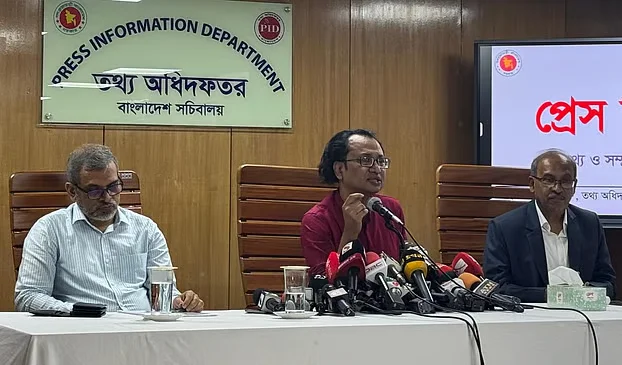
Zahed Ur Rahman, Information and Broadcasting adviser to Prime Minister Tarique Rahman. On 23 June 2026 at a regular press briefing held at the Secretariat Prothom Alo

Zahed Ur Rahman, Information and Broadcasting adviser to Prime Minister Tarique Rahman, has said that the government does not believe the Awami League, whose activities are currently banned, will be able to do “very much”.

He added that while the party's activities remain banned at present, the court will determine whether the party itself will ultimately be banned.

Zahed Ur Rahman made the remarks on Tuesday while responding to journalists' questions at a regular press briefing held at the Secretariat.

During the briefing, he also highlighted various government activities, including Prime Minister Tarique Rahman's visits to Malaysia and China.

A journalist asked about the deployment of the Army in three cities and three districts surrounding the anniversary of the Awami League, the presence of activists from various political parties in the field, and the government's measures and position on the issue.

In response, Zahed Ur Rahman said that he believed political parties had taken to the field for a “symbolic” reason.

Explaining his position, he said, “It is a banned organisation. Actually, calling it a banned organisation is not entirely accurate. Technically speaking, if we refer to Awami League by name, it is important to clarify whether the party itself will be banned. That determination will be made by the court, by the ICT (International Crimes Tribunal). Following the trial, it will be determined whether they (Awami League) were involved in crimes against humanity. What has happened so far is that, while they remain under trial, their activities will remain prohibited under the Anti-Terrorism Act 2009.

Therefore, their programmes are prohibited. If this party now seeks to take to the streets with any programme, it is engaging in an unlawful act. Naturally, the government will take action in such circumstances. Political parties actually have nothing to do here. They may be present symbolically because the Awami League is claiming that it will be able to do many things.”

The adviser continued, “Regarding the deployment of the Army, I would say that this does not mean they (the Awami League) are capable of doing very much. Personally, I do not believe the Awami League possesses that level of moral courage. At the very least, one needs a certain degree of moral courage. We have a saying, “The guilty ones protest too loudly.” For the Awami League to speak loudly before us, we need to lose our memory first. Everyone would have to suffer from dementia. Only then could the Awami League ever speak boldly in front of us. Before that, I do not think so. Therefore, they do not possess that moral courage. And if there is no moral courage, looters, mafias and thieves generally do not possess much moral courage either.”

Zahed Ur Rahman further said, “People had stood in front of guns during July 2024 because they possessed moral courage. They were not opportunists. They loved the country. They wanted to improve this nation. Despite so many bullets and so many deaths, people returned the next day and stood there again. Therefore, there is no reason to believe they (the Awami League) can achieve anything significant. Nevertheless, the government must do what is necessary. In those districts where it considered the risk to be somewhat higher—because they may still have the capacity to carry out limited acts of sabotage, and because they have substantial financial resources that could potentially be used for such activities—the Army has been deployed in areas considered more vulnerable in the interest of public safety. This does not mean that the government believes the Awami League is capable of doing a great deal. I certainly do not believe that.”

Also present at the press briefing were Sayed Abdal Ahmed, principal information officer of the Press Information Department, and Md Yasin, additional secretary of the Ministry of Information and Broadcasting.​
 

What is the political future of Awami League?

Flash rallies, campaigns on social media, and discussions on television talk shows, brought one question back into focus: can Awami League, whose activities remain banned, return to Bangladesh's political arena?

Mohammad Jalal Uddin Sikder

1783390649435.webp

Flag of Awami League

Flash rallies, campaigns on social media, and discussions on television talk shows, brought one question back into focus: can Awami League, whose activities remain banned, return to Bangladesh's political arena? Mohammad Jalal Uddin Sikder explores the answer to that question.

On 24 May 2025, I wrote a column in Prothom Alo on how likely is the return of the deposed autocrat. Drawing on the study ''The Post-Exile Fate of Leaders: A New Dataset'' by Osaka University researchers Masanori Kubota, Kaoru Hidaka, and Taku Yukawa, I sought to show that among the 91 autocratic leaders who went into exile between 1970 and 2014, only 19 per cent managed to return to their countries and become heads of state again. Those who did return had spent an average of 6.6 years in exile.

A year later, that discussion has resurfaced in Bangladesh. This time, however, the issue is not centered on a single individual but on the political future of the Awami League. Supporters' flash rallies in different places, new campaigns on social media, and discussions on television talk shows have all brought the same question back into focus: Can Awami League, whose activities remain banned, return to Bangladesh's political arena?
Is the interim government's failure enough?

Comparative political research clearly shows that a deposed political party is less likely to return to power through its own strength than through the weaknesses of the governments that succeed it.

Following the mass uprising of 2024, the interim government led by Professor Muhammad Yunus assumed office. At the time, public expectations were high. People hoped that law and order would improve quickly, the administration would begin functioning normally, the economy would stabilise, and the prolonged political crisis would come to an end.

The reality, however, proved far more difficult. Protests over a range of issues, some well-founded, others less so, along with attacks on and vandalism of various institutions, mob violence, administrative weakness, economic uncertainty, and allegations of abuse of power all contributed to growing public disappointment. It was in this context that some people began saying, "Things were better before."

Recent comparative political research describes this phenomenon as "political nostalgia." In other words, when a new government fails to meet public expectations, many people begin to view the previous government more favourably than the current one.

This is where some observers make a significant mistake. They assume that once people start expressing such sentiments, the return of Awami League becomes only a matter of time. The research findings, however, negate such perceptions.

Canadian political scientists James Loxton and Scott Mainwaring, in their book ''Life After Dictatorship: Authoritarian Successor Parties Worldwide,'' argue that while the failure of a new government can create an opportunity for a deposed ruling party, it never guarantees that party''s return to power.

If a segment of the Bangladeshi public has become disillusioned during the tenure of the interim government, that is part of the country''s political reality. But does such disappointment automatically translate into support for Awami League?

Is Sheikh Hasina bigger than Awami League?

Some believe that if Sheikh Hasina returns to Bangladesh, Awami League will regain its strength. Same say the party has no future without her. International research, however, suggests that the issue is not so straightforward. According to political scientists James Loxton and Scott Mainwaring, no political party can endure over the long term by relying solely on a single leader. To regain public trust, a party must learn from its past mistakes, present a new message, and convince voters that it has genuinely changed.

In Bangladesh's case, however, one important point must be kept in mind. It would be mistaken to assume that the political experiences of Europe, Africa, or Latin America apply directly to Bangladesh. Politics in South Asia is shaped to a considerable extent by personalities, political families, and emotional loyalties. In countries such as India, Pakistan, Sri Lanka, and Bangladesh, political dynasties have played significant roles for decades. As a result, Bangladesh's political landscape cannot be fully explained through Western political theories alone.

It is also true that no political party can sustain itself over the long term solely on the basis of a family legacy or the popularity of a single leader. India's National Congress is a prime example. Despite the legacy of the Nehru-Gandhi family, the party has not been able to regain its former position.

Similarly, the return of the Marcos family in the Philippines was not due to family name alone. It also depended on rebuilding the party organisation, adopting new political strategies, and making a concerted effort to regain public trust.

Political science research reaches the same conclusion. In ''Building Democratic Institutions: Party Systems in Latin America,'' political scientists Scott Mainwaring and Timothy R. Scully argue that a political party's long-term success depends less on the popularity of a single leader than on the degree to which the party is institutionally strong and well institutionalised.

The same question applies to Bangladesh. The issue is not simply about Sheikh Hasina. The real question is whether Awami League can adapt to the country's new political realities. Can it learn from its past mistakes and develop a new generation of leadership? Or will it continue to rely primarily on memories of its past popularity? The answers to these questions will determine the party's future.

Are there permanent enemies in politics?

Any discussion of Awami League's future also raises another question: under the current political circumstances, could Awami League one day reach an understanding or accommodation with any of its present-day rivals?

To many, the question may seem unrealistic. Yet political history has repeatedly produced outcomes that once appeared unimaginable.

Bangladesh's own political history provides a striking example. After independence, relations between the Jatiya Samajtantrik Dal (JSD) and Awami League were marked by intense conflict. JSD's role in the political developments of 1975 remains the subject of debate to this day. Yet in later years, a faction of JSD (now JASAD) forged a political understanding with Awami League, joined it in political movements, and even became part of the government.

Likewise, during the anti-Ershad movement of the 1990s, Awami League and Jamaat-e-Islami campaigned on various issues while pursuing the same immediate political objective. Later, in the run-up to the 1996 election, political circumstances also gave rise understanding between them.

Political history, both in Bangladesh and abroad, shows that long-standing political adversaries have at times worked together out of necessity. For that reason, the possibility of some form of accommodation between Awami League and Jamaat, NCP, or BNP cannot be dismissed as impossible.

In other words, Bangladesh's history demonstrates that the notion of permanent friends or permanent enemies in politics does not always correspond to political reality.

Research in comparative politics points to the same conclusion. In ''The Theory of Political Coalitions,'' political scientist William Riker, and in ''A Behavioral Theory of Competitive Political Parties,'' political scientist Kaare Strøm, argue that political parties do not form alliances solely on the basis of ideological affinity. Prospects for future power, electoral calculations, parliamentary dynamics, and strategic necessity often play equally important roles in coalition-building.

In light of these theoretical perspectives, it is reasonable to ask whether the Awami League could ever reach some form of political understanding with Jamaat-e-Islami or the National Citizen Party (NCP). Or even with Bangladesh Nationalist Party (BNP)?

It is impossible to answer that question at present. The outcome will depend not only on decisions made by party leaders but, perhaps more importantly, on whether such a move would be acceptable to grassroots supporters.

For Awami League, the mass uprising of 2024 was not merely a political defeat; it was also a profound psychological shock for thousands of its leaders and activists. Many party members have fled the country, gone into hiding, faced criminal cases, or found themselves socially isolated. For many, these experiences are not only political but deeply personal.
As a result, even if Awami League's top leadership were to consider a new political accommodation for strategic reasons in the future, an important question would remain: how readily would the party's grassroots members accept such a decision?

The same question applies to the other political parties as well. If NCP builds its political identity around the legacy of the 2024 mass uprising, would its leaders and activists be willing to accept an accommodation with Awami League? Jamaat-e-Islami has long been one of Awami League's fiercest political critics; would its members readily accept such an arrangement? The same questions would arise with respect to any understanding between the Awami League and BNP. At present, there is no way of knowing the answers.

Political history, both in Bangladesh and abroad, shows that long-standing political adversaries have at times worked together out of necessity. For that reason, the possibility of some form of accommodation between Awami League and Jamaat, NCP, or BNP cannot be dismissed as impossible. At the same time, it would be equally incorrect to regard such an outcome as inevitable.

Who bears the greatest responsibility?

The next question is: on whom does Awami League''s future depend most?

Many would probably answer: on Awami League itself. International research, however, suggests that the answer is not quite so simple. In ''Retrospective Voting in American National Elections,'' American political scientist Morris Fiorina argues that, in the end, voters judge not past governments but the government currently in power.

Bangladesh is no exception. If a BNP-led government argues that the country's problems are solely the fault of Awami League and the interim government, the public may accept that explanation for a time. Over time, however, people will evaluate the incumbent government on the basis of its own performance, its governance, economic management, maintenance of law and order, efforts to combat corruption, and commitment to democratic norms. Herein lies the greatest clue to Awami League's possible return.

Another important question is how Awami League should be dealt with. One principle should be kept in mind: in a democratic state, it is not the government''s role to preserve or eliminate any political party, but to uphold the rule of law. The courts are responsible for judging crimes, while the people decide the outcome of political competition. Allegations of extrajudicial killings, enforced disappearances, and other crimes committed during the Awami League's time in power must certainly be investigated and, where appropriate, prosecuted. Conflating criminal accountability with political competition ultimately puts democracy itself at risk.

For that reason, relying solely on administrative measures to suppress the Awami League's political activities could prove counterproductive in the long run. International experience suggests that when political parties are excluded from the political arena, they often seek to portray themselves as victims of persecution in order to generate public sympathy.


Finally, let us return to the central question: Can Awami League return to Bangladesh's political arena? At present, no one knows the answer. History shows, however, that no political party survives solely on its own strength, nor does it return to power merely because of its opponents' weaknesses. In the end, a party's future is determined by public support, its ability to adapt and change, its commitment to good governance, and the dynamics of democratic competition.

* Mohammad Jalal Uddin Sikder is a teacher and researcher in the Department of Political Science and Sociology at North South University.​
 

Opposition MPs demand Awami League be tried as a party at ICT

Govt vows swift justice, says party already under investigation

Star Online Report

1784073167460.webp

File photo

Opposition lawmakers on Tuesday called for the Awami League to be tried as a political party at the International Crimes Tribunal (ICT), accusing it of committing genocide during the July 2024 mass uprising, destroying democratic institutions and looting national resources during its time in office.

Responding to the demands, cabinet members said investigations into the Awami League as an organisation had already begun.

They also stressed that under Bangladesh's laws there is no provision for a convicted person to surrender, and that convicted criminals would be arrested immediately upon entering the country.

The issue was raised during a discussion on "recent debates on the July Uprising and the genocide trial" under Rule 68 of the Rules of Procedure in the parliament. The notice was moved by National Citizen Party (NCP) MP Akhter Hossen.

Opposition Chief Whip Nahid Islam said Awami League committed genocide, destroyed democracy, dismantled institutions and looted the country's resources.

He stressed that those involved in the killings during the July Uprising must be brought to justice.

Nahid, also the convener of NCP, alleged that Awami League, together with sections of the Indian media, had attempted to defame the July Uprising.

He expressed regret that some members of the ruling party, whom he described as former allies and key stakeholders in the uprising, were now speaking against it.

Akhter Hossen called for the return of "fallen autocrat" Sheikh Hasina and all those involved in genocide and crimes against humanity during the July 2024 mass uprising so that their punishment could be enforced without delay.

"We call on the government to increase the number of prosecution teams, expand the courts and tribunals, and appoint more investigating officers, so that trials at the International Crimes Tribunal can be completed swiftly," he said.

Referring to cases filed across the country, he said hundreds of cases had been lodged but no charge sheets had yet been submitted. He demanded that investigations be completed quickly, charge sheets filed and all those involved in genocide and crimes against humanity brought under the law.

Jamaat MP Mir Ahmad Bin Quasem said no new investigation report had been submitted to the ICT over the past six months.

He alleged that the investigation agency and the tribunal were underfunded and understaffed, and that the government had taken no effective initiative to properly oversee the cases.

Gono Adhikar Parishad MP and State Minister for Expatriates' Welfare Nurul Haque Nur appealed to the prime minister and all concerned to build political consensus on the trial of fascism.

He said no fascist force should be allowed to return to power in the future, take anti-people positions or carry out killings and massacres, adding that Awami League must be tried as a political party.

Opposition Leader Shafiqur Rahman said those who participated in the July mass uprising must never be forgotten, arguing that doing so would amount to betraying the nation.

Alongside ensuring benefits and opportunities for the July fighters, he demanded justice for those responsible for the July killings and said the nation would not tolerate any delay in the judicial process.

He also accused a section of media of helping the ousted regime evolve into a dangerous autocracy and questioned what action had been taken against those outlets.

He alleged they were again attempting to create confusion while the government was not giving the issue due importance.

Shafiqur further said there had been provocations along the border but the government had remained silent.

Google News LinkFor all latest news, follow The Daily Star's Google News channel.
"We want to make it clear -- this is an independent country. We will guard every grain of sand of this land," he said.

Home Minister Salahuddin Ahmed said relations with neighbouring countries should be based on mutual dignity, respect and equality.

Referring to the demand for Sheikh Hasina's return from India, he said, "From the interim government until now, we have been pressing for her return. Under the extradition treaty with the neighbouring country, we demand her return so she can face trial."

He added that, if necessary, the number of tribunals, prosecution teams, investigation teams and logistics teams would be increased.

"Our foremost objective is to establish justice in this country," he said.

Citing a United Nations report, the home minister said 1,400 people had been martyred and pledged that justice would be ensured for all of them.

He added that, besides the cases before the ICT, many other cases were being tried under the Penal Code in different parts of the country and that those proceedings would also be concluded.

He urged everyone to uphold the spirit of July without politicising it.

"We will never use the spirit of July for politics, and we will forbid others from doing so," he said.

Law Minister Md Asaduzzaman said that since the current government assumed office, 16 investigations had been completed, of which 12 investigation reports had been submitted. Four charges had already been framed and three cases had been decided.

He said investigations had already begun into both the Shapla Chattar massacre and the Awami League as an organisation. Plans had also been taken to launch investigations into the July killings across districts nationwide.

The law minister further alleged that threats were being issued from Delhi because of divisions among those who believe in the spirit of July.

"They are saying there will be surrender. But there is no opportunity to surrender under Bangladesh's existing laws. Convicted criminals will be arrested the moment they enter Bangladesh's borders. This is the government's commitment," he said.​
 

No scope for AL (activities banned) to participate in local govt elections: State Minister

Staff Correspondent
Bogura
Published: 11 Sep 2026, 19: 25

1789193520213.webp

State Minister for Local Government Mir Shahe Alam speaks to the media Prothom Alo file photo

As an organisation, whose activities have been banned in the country, Awami League will not be allowed to participate in elections, said State Minister for Local Government Mir Shahe Alam.

He made this remark on Friday, after an event releasing fish fry into a pond at the Shibganj Upazila Parishad premises in Bogura.

The State Minister for Local Government said, "Until the ban on this party is lifted, the fascist Awami League and its affiliated organisations have no right to participate in any political programme in Bangladesh, let alone run in elections. If they do so, they will be brought under the law. Law enforcement agencies will take action against them."


'Not right to ask questions about Awami League at this moment'

The State Minister for Local Government also stated that he feels embarrassed when questioned about a banned organisation. "It is neither right nor appropriate to ask questions about Awami League at this moment. Awami League is a banned organisation," he said.

Mir Shahe Alam further said, "Since the activities of the Awami League is banned, they do not have the right to participate in elections party-wise. They also have no right to hold any meetings, rallies or processions. They do not even have the scope to conduct political activities by opening party offices."

Explaining the government's stance on local government elections, the State Minister stated that democratic institutions and the electoral system in the country were damaged during the previous autocratic regime. One of the main mandates of the current government is to conduct elections across five tiers of local government in a free, fair and neutral manner.

There is a clear directive from Prime Minister Tarique Rahman to make these elections acceptable to the people at all costs. An allocation of nearly Tk 60 billion has been kept in the budget for this purpose. The election commission is taking all the necessary preparations.

Referring to legal changes in local government elections, Mir Shahe Alam said that under the amended law, there is no scope to use party nominations or party symbols in local government elections this time. The elections will be held on completely non-partisan and general symbols.

However, the State Minister stated that the BNP has made a policy decision to endorse single candidates to maintain the party's ‘chain of command’ at the grassroots level.

He said that if there are multiple candidates in any union, attempts will be made to reach an understanding at the local level. Otherwise, organisational action may be taken for breach of party discipline.

Regarding the commencement of work on major development projects in Bogura, including an EPZ (Export Processing Zone), an airport and the Bogura-Sirajganj railway line, Mir Shahe Alam said that only six months have passed in the government's tenure. Regular administrative processes for implementing large-scale projects take some time. However, Bogura will see visible progress on these projects by December, he said.

Earlier, the State Minister for Local Government inaugurated the programme by releasing fish fry into the Shibganj Upazila Parishad pond under the revenue sector for the 2026-27 fiscal year. Officials of the Shibganj upazila administration, local public representatives, teachers, students and political leaders were present at the event.

Later, the State Minister visited talent hunt examination centres for teachers and students in Shibganj and Mokamtola upazilas. In addition, to ensure safe commuting for students, he handed over two school buses in favour of Shibganj Grammar School and College and Betgari Mir Shahe Alam Girls' High School.​
 

People will not allow Awami League in politics anymore: Home Minister

Staff Correspondent

1794006910434.webp

Home Minister Salahuddin Ahmed speaks as the chief guest at the 104th annual religious conference of Al-Jamiatul Islamia Azizul Uloom Babunagari Madrasa in Fatikchhari, Chattogram, on 7 Nov. Collected

The people of the country will never allow Awami League to practice politics again, said Home Minister Salahuddin Ahmed.

He made the statement as the chief guest while addressing the 104th annual religious conference of Al-Jamiatul Islamia Azizul Uloom Babunagar Madrasa in Fatikchhari, Chattogram, ahead of Jummah prayers on Friday. The second day of the conference was presided over by Shah Muhibbullah Babunagari, Ameer of Hefazat-e-Islam Bangladesh.

In his address, the home minister said, "We agree on one point. The people of this country will never again allow those who carried out mass killings, shed the blood of religious scholars for 16 long years and turned mosques into places of bloodshed to engage in politics. We want to take the country out of the state governance policies of fascist Sheikh Hasina and restore the spirit of the Liberation War and the country's previous state policies. We will once again incorporate firm faith and trust in Almighty Allah into the Constitution’s preamble and the principles of state governance."

State Minister for Religious Affairs Shamim Kaiser Lincoln, local Member of Parliament Sarwar Alamgir, Raozan MP Gias Uddin Quader Chowdhury, Rangunia MP Hummam Quader Chowdhury, Chattogram Deputy Commissioner Zahidul Islam Miah and Chattogram Superintendent of Police Masud Alam, among others, were also present on the occasion.

1794006940801.webp

State Minister for Religious Affairs Shamim Kaiser Lincoln, local Member of Parliament Sarwar Alamgir, Raozan MP Gias Uddin Quader Chowdhury, Rangunia MP Hummam Quader Chowdhury, Chattogram Deputy Commissioner Zahidul Islam Miah and Chattogram Superintendent of Police Masud Alam, among others, were also present on the occasion.CollectedHefazat-e-Islam Bangladesh Ameer Shah Muhibbullah Babunagari presides over the conference. Photo: Collected

The home minister continued, "We have been freed from the hands of anti-Islamic forces. Over the past 16 to 17 years, nearly 3,000 people have been victims of enforced disappearance and torture. I was one of them. People have faced oppression and torture in various ways. We want to restore the dignity we have lost."

Salahuddin Ahmed said those who were doing politics in the name of religion had no connection with Islam through their actions. They were only creating disorder in the country. He called for governing the state and conducting politics by following the fundamental principles of Islam.

Referring to BNP Chairperson Khaleda Zia, the home minister said people had suffered for a long time because of injustice, misrule and corruption. He also remarked that even someone like Khaleda Zia had to die without receiving proper medical treatment.

On Awami League's return to politics, Salahuddin Ahmed said those who had stood against democracy and fled the country in the face of the mass uprising will not be allowed to engage in politics in Bangladesh again.

Speaking about the July mass uprising and the July Charter, the home minister said the government is committed to implementing the charter formulated through the election. At the same time, Islamic values will be reflected in the Constitution, he added.

Addressing ongoing demonstrators, he said, "To those creating confusion in the name of protests, I want to say, criticise us, but let it be constructive criticism. You can cooperate with the government, but do not conspire against the people of the country."

1794006975852.webp

Hefazat-e-Islam Bangladesh Ameer Shah Muhibbullah Babunagari presides over the conference. Collected

The home minister added, "We want to keep this country united and achieve economic development and prosperity, increase exports, create employment and generate electricity in every sector. We will gradually move towards prosperity, taking everyone along. The economic condition of the people of this country must improve. The living standards of all religious scholars and students of Qawmi madrasas must also improve."

State Minister for Religious Affairs Shamim Kaiser Lincoln, local Member of Parliament Sarwar Alamgir, Raozan MP Gias Uddin Quader Chowdhury, Rangunia MP Hummam Quader Chowdhury, Chattogram Deputy Commissioner Zahidul Islam Miah and Chattogram Superintendent of Police Masud Alam, among others, were present on the occasion.​
 

PKDefense Forums: Country-by-Country Military Discussions

Log In Register Forums
Latest
Back