[🇧🇩] Budget For 2026-2027

[🇧🇩] Budget For 2026-2027
63
718
More threads by Saif

G Bangladesh Defense

Can next budget meet enormous challenges?

SYED FATTAHUL ALIM

Published :
Jun 07, 2026 23:01
Updated :
Jun 07, 2026 23:01
1780875988792.webp


A nation's budget for a particular financial year involves the government's comprehensive financial plan outlining its expected revenues and proposed expenditures for the next 12-month accounting period. Actually, the budget reflects the government's economic policies. From the outlines of the proposed budget as provided by the government and discussed by experts, it is going to mark a shift from a debt-driven expansion to one that is focused on macroeconomic stabilisation, broad-based welfare and deregulation. The deregulation understandably involves reducing bureaucratic barriers and slashing the cost of business. Core measures would include separating customs into policy and implementation wings, extending duty-free bonded warehouse privileges to all exporters and establishing a single-point approval system for business licences and registrations.

Since the incumbent government inherited a fragile economy characterized by high inflation and declining private investment, the government's fiscal strategy aims to address these issues through several policy pillars. So, instead of the past practice of heavy central bank borrowing and printing money, the government, as part of investment-led growth, plans to promote domestic production by way of introducing a stimulus package of Tk 600 billion targeting agriculture, CMSMEs and export diversification. To control inflation and ensure social safety, the budget would expand social safety nets prioritising relief for low- and middle-income groups that includes a system of family cards and agricultural loan waivers. On the other hand, to manage inflation, it would maintain subsidies on food, fuel and fertilizers. Also, to offset a record low in private sector credit, the fiscal policy would support local industries including high-tech and locally made brands.

At the same time, to improve the investment climate, the budget would emphasise tax predictability for the business community and offer mechanisms like refunds for excess minimum tax payments. In a similar vein, the government plans to restore soundness of the banking sector, reduce reliance on expensive energy imports by reforming oligarchic market structure to lower LPG and LNG prices. In fact, these are but the wish list that the government plans to implement as part of its fiscal strategy as envisaged in the upcoming budget as proposed. But can the government implement it as planned? Economists consider the Tk9.30 trillion budget for FY27 highly ambitious and therefore not realistic. As such, the budget would face severe implementation hurdles primarily driven by sluggish revenue collection, high inflation, mounting external debt and the banking sector instability. Development spending is particularly at risk, with the Annual Development Programme (ADP) facing chronic underspending due to structural inefficiencies. ADP consistently sees spending rates stuck between 80 per cent and 85 per cent. Implementation of ADP is routinely bottlenecked by delayed procurement processes, poor project design, and complex land acquisition in a densely populated country. The National Board of Revenue (NBR) historically misses its targets, recording a massive structural shortfall. In the previous fiscal year, for instance, the NBR faced unprecedented shortfall. It fell drastically short of its revised target of over Tk4.31 trillion for the July-April, i.e., 10-month period. Despite managing a 10.6 per cent year-on-year growth during this timeframe, it was insufficient to meet the highly ambitious target set for the year. In this connection, some policy think tanks pointed out that the original full-year targets were operationally unrealistic.

That points to deep structural weaknesses, stalled automation and a lack of separation between tax policy and tax implementation. Unsurprisingly, the tax-to-GDP ratio languished between 6.8 per cent to 7.3 per cent. In that case, bankrolling the humongous budget remains questionable seeing that the tax administration has been persistently failing to meet targets year after year. So, reaching the ambitious Tk 6.95 trillion revenue target is severely hindered by systemic tax exemptions and large-scale revenue leakages. Persistent inflation has eroded the general consumers' purchasing power. This inflates government expenditure on subsidies (food, electricity, agriculture) while simultaneously shrinking the overall disposable income of citizens. A significant portion of the budget is devoured by rising domestic debt and interest payments. High government borrowing from the banking sector restricts credit flow to the private sector. Additionally, bad loans and non-performing loans (NPLs) threaten overall banking stability. Private sector credit growth has plummeted to historic lows, stalling industrial growth. The government must shift focus away from theoretically broadening coverage to actually restructuring the NBR. Phasing out inefficient tax exemptions for large conglomerates that generate limited employment will help create a level playing field for all businesses.

To prevent crowding out the private sector, the government should rely more on concessional external financing for high-return projects rather than borrowing from domestic banks. Instead of merely making routine financial statements, development projects should feature strict execution plans and routine monitoring frameworks. Allocating funds to digitised one-stop service platforms will expedite infrastructure delivery. To protect the vulnerable groups amid high inflation, the government can scale up well-targeted programmes, while eliminating overlapping benefits to reduce leakages. These are but some of the prescriptive suggestions as provided by economists and other experts on the subject in different discussion forums from time to time. But can the newly elected BNP government deliver which is only three months in office after February 12's parliamentary election? Given the hurdles as noted in the foregoing, the government is going to come up against enormous challenges. The new administration has no doubt to navigate severe geopolitical and fiscal headwinds including an energy and fiscal emergency that has constrained both public and private sector credit. Most importantly, it will have to focus on addressing the issue of unemployment aggressively. In addition to adopting traditional approach of job creation in the public and private sector, the government should work to expand climate resilient employment. On this score, the BNP government's ambitions programme of excavating and re-excavating 200,000 km of canals and rivers can go a long way towards creating immediate employment opportunity for rural labourers. Educated unemployed youths, on the other hand, can be inspired to create jobs rather than look for employment.

In this regard, the government should give formal recognition to and extend budgetary support for freelancers, content creators and make use of the digital economy to tap into the country's youth demography. Finally, the government has to contain non-performing loans (NPLs) and recapitalise sound banks so that sovereign credit borrowing does not crowd out credit availability for private business. Support for micro-level, small and medium enterprises should lie at the heart of creating jobs for the country's youths.​
 

A LITMUS TEST FOR BNP GOVT AFTER 19 YEARS
Tk 9.38t big budget comes tomorrow
Jasim Uddin Haroon

Published :
Jun 10, 2026 00:12
Updated :
Jun 10, 2026 00:12

1781070304920.webp


A litmus test comes for a BNP regime after 19 years as the new government prepares to present tomorrow a hugely deficit budget after return to power through the much-hyped February-12th polls.

A BNP-led government had last presented its budget for the nation for the fiscal year 2006-07 under then finance minister M. Saifur Rahman.

Finance and Planning Minister Amir Khosru Mahmud Chowdhury is expected to place his maiden budget for FY2026-27 in parliament tomorrow, against the backdrop of political upheavals and economic disruptions.

The proposed budget size has been set approximately at Tk 9.38 trillion with a projected deficit of Tk 2.43 trillion, according to some officials at the finance division.

To finance the deficit, the government pins hope on mobilising Tk 1.27 trillion, or about 52 per cent of the gap, from domestic sources, mostly from banking sources. The remaining Tk 1.16 trillion, or around 48 per cent, is expected to come from foreign loans and grants.

Of the domestic financing target, Tk 1.12 trillion is likely to be borrowed from the banking system while Tk 150 billion will be raised through savings certificates and other sources.


The budget is expected to be presented under the theme 'Economic Democratisation and Deregulation: Bangladesh's Journey towards a Trillion-Dollar Economy'.

The proposed budget will be the first full-fledged fiscal plan of the BNP-led administration and is expected to be presented in the presence of Prime Minister Tarique Rahman and other MPs-mostly new to the parliamentary business and budget-making.

The government has set GDP-growth target at 6.5 per cent for FY2026-27 and aims to bring inflation down to 7.5 per cent.

However, inflation remained elevated at 9.42 per cent in May, according to the latest data from Bangladesh Bureau of Statistics (BBS).

Total revenue mobilisation which has an ambitious target of Tk 6.95 trillion is also anticipated to remain a major concern.


Data from the National Board of Revenue (NBR) show that the revenue shortfall reached Tk 1.045 trillion during the first 10 months of FY2025-26.

Against a revised target of Tk 4.31 trillion, revenue collection stood at Tk 3.27 trillion through April, highlighting the difficulty of achieving fiscal targets "amid a challenging economic environment", economists predict.

They say curbing inflation, strengthening revenue collection and reducing reliance on bank borrowing will be among the government's key economic priorities in the coming fiscal year.

"The budget will be closely watched for signals on whether the government intends to continue its reform agenda or not," says Dr Mustafizur Rahman, distinguished fellow of the CPD.

Private investment, which believed to remain at the bottom, could gain momentum if the budget includes measures to stimulate investment activity, Dr Rahman said recently.​
 

Largest budget in the works

Outlay to focus on economic recovery, jobs and electoral pledges amid high inflation

Rejaul Karim Byron

1781072095358.webp


The BNP-led government, which swept into power with a two-thirds majority in February, is set to unveil the country’s largest budget yet, hinging on an ambitious revenue target and a bold plan to draw on foreign assistance.

Tomorrow, Finance Minister Amir Khosru Mahmud Chowdhury will deliver his first budget, whose theme will be “Economic democratisation and decentralisation, Bangladesh in the trillion-dollar economic march”. The budget will cross the Tk 9 lakh crore mark for the first time in history.

Although the finance minister has not mentioned specific figures in budget discussions, he has said the upcoming budget will be quite large to support economic recovery.

Broadly, three main objectives will be set: reviving the economy, implementation of the government’s electoral pledges and turning towards a high growth trajectory to expand employment.

For three consecutive years, GDP growth has been on a downward trend.

In the last fiscal year, growth fell below 4 percent, the first time since the global coronavirus pandemic in fiscal 2019–20.

Development partners have forecast that growth will remain below 4 percent this fiscal year as well. Meanwhile, since 2023, inflation has stayed above 9 percent.

In the upcoming fiscal year, the GDP growth target is expected to be 6.5 percent growth and the inflation target 7.5 percent.

To achieve this, the revenue target will be set at Tk 695,000 crore, 90 percent of which will have to be borne by the National Board of Revenue.

Last fiscal year, the NBR collected Tk 369,528 crore. Based on current trends, officials estimate that the NBR revenue may reach Tk 400,000 crore this year.

That means next year’s collection will have to increase by Tk 200,000 crore to hit the target.

Meeting this revenue target will be the biggest challenge for the finance minister in managing large expenditure expectations.

Beyond revenue collection, deficit financing will rely on about $11 billion in foreign assistance, including roughly $3 billion in budget support. This target is being set without any loan from the International Monetary Fund.

In the first 10 months of the fiscal year, $4 billion in foreign assistance has been utilised. By June, including budget support, $7 billion is expected to be used.

Therefore, removing obstacles to project implementation funded by foreign aid and securing budget support through reforms will be another major challenge in the upcoming budget.

The budget deficit is expected to be set at Tk 243,000 crore, or 3.55 percent of GDP, which is below the globally accepted level of 5 percent of GDP.

Under the previous Awami League-led government, budget deficits were proposed between 4 and 5 percent, though during COVID it exceeded 6 percent in one year.

In the interim period, due to stagnation and indecision in development spending, this fiscal year’s original budget set the deficit at 3.6 percent of GDP.

While revenue collection will fall short, not all of the government’s planned expenditure will be spent either, said a finance ministry official. As a result, the actual deficit at the end of the fiscal year may come down to around 3 percent.

In the upcoming fiscal year, the government is setting an expenditure target of Tk 938,000 crore, which is 19 percent higher than this fiscal year’s revised budget.

The government aims to boost public investment in line with its electoral pledges.

Already, a Tk 300,000 crore annual development programme has been approved, which is 50 percent higher than this fiscal year.

However, challenges remain regarding implementation capacity.

Meanwhile, out of the Tk 638,000 crore operating budget, about Tk 450,000 crore may be allocated for interest payments, partial implementation of the new pay scale and subsidies.

From the next fiscal year, partial implementation of the Pay Commission’s recommendations will begin.

According to the government’s plan, this will be completed over three fiscal years, with 50 percent of the basic pay becoming effective in the upcoming fiscal year.

As a result, an additional Tk 35,000 crore will be allocated for salaries, allowances and pension benefits of government officials and employees. The total allocation in this sector will stand at Tk 166,000 crore.

Allocations for subsidies and incentives may amount to Tk 126,125 crore and for interest payments Tk 142,000 crore.

Last fiscal year, Tk 122,000 crore was allocated for interest payments, but the actual expenditure reached Tk 134,430 crore. It may reach Tk 140,000 crore this fiscal year.

“To manage the situation, there is no alternative to increasing domestic resource mobilisation,” said Mustafizur Rahman, distinguished fellow at the Centre for Policy Dialogue.

At the same time, in the case of new loans, greater emphasis must be placed on project selection, expenditure control, timely implementation and skilful negotiation of loan conditions.

“Otherwise, the pressure of debt repayment may intensify in the coming years,” he said.

In its election manifesto, the government highlighted the education and health sectors.

Accordingly, in the upcoming fiscal year, more than Tk 100,000 crore will be allocated to three ministries and divisions related to education, and more than Tk 60,000 crore will be allocated to two divisions related to the health ministry.

However, implementation remains a bigger challenge than allocation in these two sectors. How this challenge will be addressed will become clear during budget execution.

In this budget, Khosru will announce a new initiative called the Creative Economy.

As part of this, Tk 500 crore will be allocated in this year’s budget, of which the government will provide Tk 200 crore and the Bangladesh Bank will contribute Tk 300 crore from its CSR fund.

In his budget speech, Khosru will highlight the potential of the creative economy and present its framework.

Broadly, the creative economy encompasses film, dance, music, drama, publishing, advertising, architecture, fine arts, crafts, design, software, video games, and similar industries.​
 

Generous steps taken in budget to lure investors
PM tells parliament, pledges business-friendly ambiance for all to promote job generation

FE REPORT

Published :
Jun 11, 2026 08:57
Updated :
Jun 11, 2026 08:57

1781157123047.webp

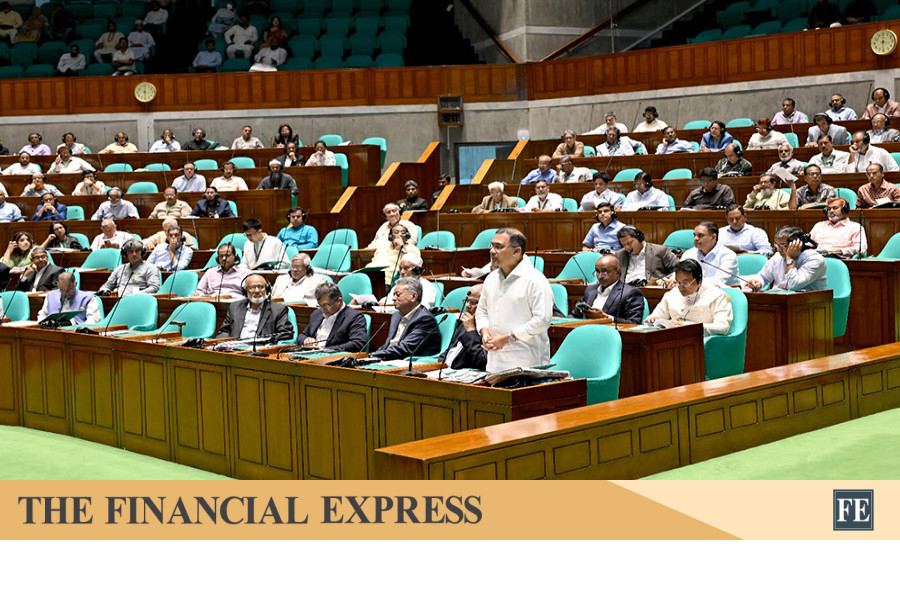
Prime Minister and Leader of the House Tarique Rahman seen speaking at the Jatiya Sangsad (JS) — PMO photo via BSS

A business-friendly environment is being created where everyone can operate businesses smoothly and generate employment opportunities, says Prime Minister Tarique Rahman while also pledging investment-acceleration measures.

"We want to create opportunities for everyone to do business in a conducive environment and create jobs. The current budget has been prepared with that objective in mind," he told parliament Wednesday.

The Prime Minister says the government has undertaken a series of measures to simplify investment procedures and attract both local and foreign investors.

He made the remarks while responding to a question from Cumilla-10 lawmaker Md Mobasher Alam Bhuiyan during the question-answer session on the fourth day of the second session and first budget session of the 13th parliament. The sitting, which began at 3:00pm, was chaired by Speaker Hafiz Uddin Ahmad Bir Bikram.

The Prime Minister notes that restoring economic discipline and fostering business-friendly environment are essential for building a stronger economy.

He mentions that import-and export-registration services are now being provided online within a shorter timeframe through the Office of the Chief Controller of Imports and Exports.

To strengthen the investment climate, the government has updated the export policy and is in the process of revising the Import Policy Order 2026-2029 to enable foreign investors to enter the market more easily.

The government has also taken steps to remove non-tariff barriers to imports for export-oriented industries. The scope of free-of-charge (FOC) imports is being expanded for both bonded and non-bonded enterprises.

Also, import-payment procedures are being simplified, while importers will be allowed to import goods through contractual arrangements without letters of credit (LCs), irrespective of value limits.

Bangladesh has also adopted trade-facilitation measures in line with international standards to ensure faster and more transparent trade processes through the implementation of World Trade Organisation agreements.

The Prime Minister further says the Bangladesh Investment Development Authority is implementing a range of policy and institutional reforms to attract domestic and foreign investment, improve the ease of doing business and accelerate industrialisation.

Among the key initiatives, the government has moved to integrate the Bangladesh Investment Development Authority, Bangladesh Economic Zones Authority, Public-Private Partnership Authority and Bangladesh Hi-Tech Park Authority to reduce institutional complexities and improve service delivery for investors.

To make Bangladesh a more attractive investment destination, the government has also initiated reforms to simplify capital-and profit- repatriation procedures.

At present, foreign investors often face delays and uncertainty in remitting capital and earnings abroad following share sales, business transfers or closures due to complex valuation requirements and extensive documentation.

A national committee on capital repatriation, formed in coordination with Bangladesh Bank, has reviewed the existing framework and prepared a package of reform proposals. It is now at the final stage of approval.

"The government has also launched a comprehensive overhaul of licensing and approval procedures to make investment processes faster, simpler and more predictable," adds the Prime Minister.​
 

Market opens upbeat ahead of national budget announcement

FE ONLINE REPORT

Published :
Jun 11, 2026 11:46
Updated :
Jun 11, 2026 11:46

1781157624616.webp


Stocks opened higher on Thursday, extending the market's recent rally as investors positioned themselves ahead of the national budget announcement, amid expectations of market-friendly measures and regulatory reforms.

Finance Minister Amir Khosru Mahmud Chowdhury is scheduled to unveil the FY2026-27 national budget in parliament later in the day, with investors closely watching for initiatives aimed at revitalising the capital market and supporting broader economic growth.

Investor sentiment also received a boost as the newly reconstituted Bangladesh Securities and Exchange Commission (BSEC) recently lifted the floor price restrictions on Beximco and Islami Bank Bangladesh PLC, bringing an end to a controversial market intervention that had remained in place for nearly four years.

The benchmark DSEX index of the Dhaka Stock Exchange (DSE) advanced 19 points, or 0.34 per cent, to 5,535 by 11:00 am.

Although Beximco shares hit the lower circuit breaker for a third straight session, Islami Bank rebounded sharply at the opening after two days of correction following the withdrawal of the floor price. Their impact on the broader market remained limited.

Beximco was excluded from the benchmark index in the latest annual rebalancing, while around 88 per cent of Islami Bank's shares are held by sponsor-directors, reducing the stocks' influence on overall market movements.

Market operators said investors are increasingly hopeful that the reconstituted BSEC will prioritise transparency, strengthen corporate governance and restore confidence in the capital market. Repeated government assurances regarding stock market development have also encouraged investors to increase their exposure to equities.

Turnover on the premier bourse reached Tk 3.20 billion within the first hour of trading, indicating strong investor participation.

Market breadth remained positive, with 207 issues advancing, 107 declining and 70 remaining unchanged.

Far East Knitting emerged as the day's most actively traded stock by turnover, with shares worth Tk 148 million changing hands by 11:00 am.

The Chittagong Stock Exchange (CSE) also witnessed a positive trend. The CASPI gained 42 points to 15,290, while the CSCX rose 23 points to 9,389 by 11:00 am.​
 

Budget today in tough times
Khosru walks tightrope in making ends meet

Jasim Uddin Haroon

Published :
Jun 11, 2026 00:18
Updated :
Jun 11, 2026 00:18

1781157893249.webp


Amir Khosru walks a tightrope in making ends meet as he presents today his maiden national budget suiting the BNP-led government's economic priorities amid persistent inflationary pressure, sluggish private investment and weak employment generation.

The fiscal 2026-27 budget also happens to be the first of the BNP-led administration that assumed office following the February-12th general election held against the backdrop of political upheavals and uprising.

The Finance and Planning Minister, Amir Khosru Mahmud Chowdhury, is set to place in parliament at 3:00pm the national budget with a record-high outlay.

It will also be the party's 17th budget since fiscal year 1976-77 and Bangladesh's 55th since independence.

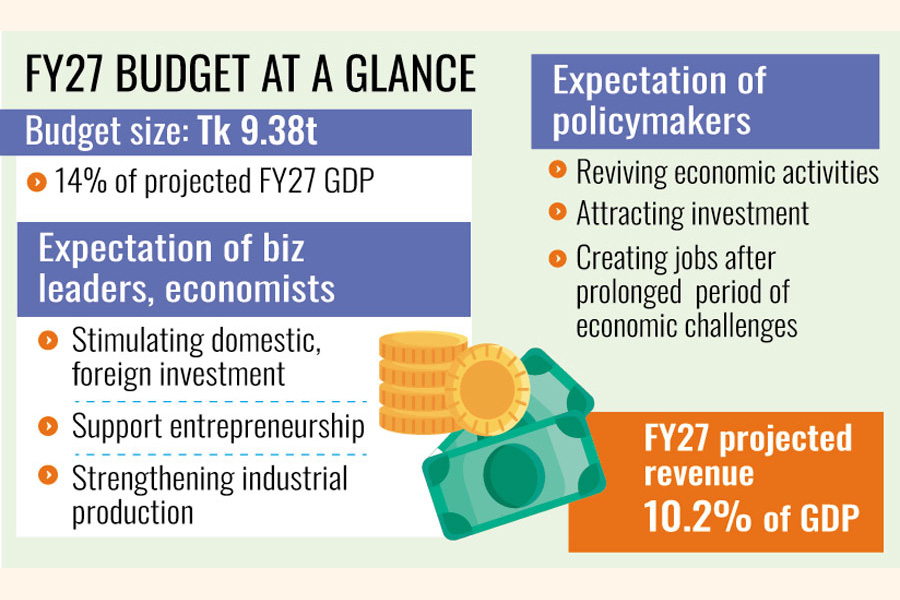
The proposed budget is estimated at Tk 9.38 trillion which is equivalent to around 14 per cent of the country's projected gross domestic product (GDP) for FY2027.

Policymakers are expected to use the budget as key instrument for reviving economic activity, attracting investment and generating employment following a prolonged period of economic challenges from within and without.

The BNP government has repeatedly pledged to restore business confidence by addressing structural bottlenecks and reviving closed industrial units and creating a more investment-friendly environment.

The budget is, therefore, expected to contain a range of fiscal and policy incentives aimed at encouraging both new and existing private-sector enterprises.

Business leaders and economists are closely watching the budget for measures that could stimulate domestic and foreign investment, support entrepreneurship and strengthen industrial production.

Many expect tax incentives, regulatory reforms and sector-specific support programmes to feature prominently in the budget proposals.

At the same time, the government faces a difficult fiscal challenge.

The revenue target for FY2027 is projected at around 10.2 per cent of the GDP, a level many economists believe will be difficult to achieve given the country's historically low tax-to-GDP ratio.

Economists argue that broadening the tax base and revamping tax administration could help increase revenue collection.

However, they caution that achieving a significant jump in revenue within a single fiscal year may prove difficult without comprehensive reforms.

"To my mind, the tax picture might be some brighter once the tax base is widened," says Dr Zahid Hussain, an independent economist.

He also says that borrowing from the banking sector might lead to higher interest rate and crowding-out effect.

While policy measures aim at easing supply-side constraints could help boost investment and employment, "the benefits are unlikely to materialise immediately".

Structural reforms often require time before translating into higher private-sector activity, stronger job creation and sustainable economic growth.

"The budget's broader significance lies in whether it can balance the government's growth ambitions with the need to contain inflation, maintain macroeconomic stability and strengthen public finances," he notes.

The leading economists also say the effectiveness of the proposed measures, rather than their scale alone, will determine whether the government succeeds in reviving business confidence and accelerating economic recovery.​
 

BNP govt set to unveil ambitious budget built around big targets

For the first time, the finance minister may also publish a Citizens’ Budget booklet, designed to present budget information in a simplified format for the general public. The Ministry of Finance believes this initiative will make the budget more accessible and easier to understand.

Fakhrul Islam


1781158373607.webp

Probable budget of FY2026-27 at a glance Infograph prepared by Asad/Prothom Alo

The Bangladesh Nationalist Party (BNP) government is placing strong emphasis on fulfilling its election manifesto commitments, boosting investment and employment, and reviving a troubled economy through its first national budget.

The budget also sets highly ambitious revenue targets. As the budget expands in size, so too does the fiscal deficit, necessitating increased borrowing to bridge the gap.

Finance and Planning Minister Amir Khasru Mahmud Chowdhury is set to present a Tk 9.3 trillion (938,000 crore) budget for the next fiscal year in Parliament today, Thursday. It will be the first budget of his career as finance minister and the first budget of the BNP government formed following the national election held in February.

The finance minister has repeatedly said he wants the benefits of the budget to reach grassroots communities. As part of that objective, allocations for social protection programmes could rise to nearly Tk 1.5 trillion (150,000 crore). At least eight new schemes, including the Family Card programme, are expected to be introduced.

The minister also aims to promote the creative economy and improve the ease of doing business.

He has repeatedly spoken of the need for the “democratisation of the economy” and has pledged to reflect that vision in the budget. He has also indicated that he intends to pursue extensive deregulation, reducing government controls wherever possible.

Despite fiscal pressures, the budget may include a partial implementation of a new pay scale for government employees in the coming fiscal year.

The finance minister has repeatedly said he wants the benefits of the budget to reach grassroots communities. As part of that objective, allocations for social protection programmes could rise to nearly Tk 1.5 trillion (150,000 crore).
For the first time, the finance minister may also publish a Citizens’ Budget booklet, designed to present budget information in a simplified format for the general public. The Ministry of Finance believes this initiative will make the budget more accessible and easier to understand.

The original budget for the current fiscal year stood at Tk 7.9 trillion (790,000 crore). The proposed budget is Tk 1.48 trillion ( 148,000 crore) bigger, representing an increase of nearly 19 per cent.

The finance minister has repeatedly defended the larger budget, arguing that higher public spending would support economic growth.

Speaking at a consultation meeting organised by the Federation of Bangladesh Chambers of Commerce and Industry (FBCCI), he openly stated that the economy could not move forward without increased expenditure.

According to Finance Division sources, the government is targeting GDP growth of 6.5 per cent in the next fiscal year, while inflation is projected at 7.5 per cent. Inflation currently remains above 9 per cent.

Revenue collection is expected to be targeted at Tk 6.95 trillion (695,000 crore). Including anticipated grants of Tk 61.5 billion (6,150 crore), total government income is projected to exceed Tk 7 trillion (700,000 crore).

Significant pressure on revenue collection and the reality

Of the total revenue target, more than Tk 6 trillion (600,000 crore) will need to be collected by the National Board of Revenue (NBR) alone.

The central question is how much of the budget can actually be implemented. Is such a large increase in revenue collection achievable within a single year?------Zahid Hussain, former Lead Economist at the World Bank’s Dhaka office.

The NBR collected Tk 3.7 trillion (370,000 crore) in FY 2024–25. Under the revised budget for the current fiscal year, its collection target was set at Tk 5.03 trillion (503,000 crore). However, during the first 10 months of the fiscal year, from July to April, revenue collection fell short by Tk 697.82 billion (69,782 crore). Collections during the period amounted to nearly Tk 3.27 trillion (326,928 crore).

The government is also projecting Tk 250 billion (25,000 crore) in non-NBR revenue for the next fiscal year, compared with Tk 81.92 billion (8,192 crore) collected in FY 2024–25.

Non-tax revenue (NTR) is expected to generate Tk 660 billion (66,000 crore). Although the original target for the current fiscal year was Tk 460 billion (46,000 crore), the revised budget raised that figure to Tk 650 billion (65,000 crore).

More borrowing, lower interest allocation

More than Tk 1.27 trillion (127,000 crore) may be allocated for interest payments in the next fiscal year.

The Finance Division had previously estimated that interest costs could reach Tk 1.58 trillion (158,000 crore). These payments relate to both domestic and foreign loans undertaken by the government.

Interest payments are considered mandatory expenditures and now constitute one of the largest components of government operating expenditure. The burden has reached a level that is increasingly putting pressure on other budget priorities.

How govt plans to finance deficit

The size of the economy is projected to reach Tk 68.30 trillion (6,830,024 crore) in the coming fiscal year.

The budget deficit, excluding grants, is expected to stand at 3.6 per cent of GDP, equivalent to Tk 2.43 trillion (243,000 crore).

To finance this gap, the government plans to borrow Tk 1.27 trillion (127,000 crore) from domestic sources and a net Tk 1.09 trillion (109,850 crore) from foreign sources.

My concern is that this could negatively affect investment, economic growth and employment. Under those circumstances, the government will also find it difficult to bring inflation under control-----Zahid Hussain, former Lead Economist at the World Bank’s Dhaka office.

In gross terms, the government intends to secure over Tk 1.55 trillion (155,850 crore) in external borrowing, of which Tk 460 billion (46,000 crore) will be used to repay existing foreign loans.

Of the domestic borrowing target, Tk 1.12 trillion (112,000 crore) is expected to come from the banking sector, which is Tk 60 billion (6,000 crore) lower than the revised target for the current fiscal year.

The government also plans to raise Tk 85 billion (8,500 crore) through the sale of National Savings Certificates.

Concerns over implementation

Speaking to Prothom Alo, Zahid Hussain, former Lead Economist at the World Bank’s Dhaka office, said the expansion of the budget itself was not the central issue.

“The central question is how much of the budget can actually be implemented,” he said. “Is such a large increase in revenue collection achievable within a single year? Likewise, based on past experience, the government may struggle to secure the volume of foreign borrowing it is projecting to finance expenditure and the deficit.”

He warned that if external financing falls short, the government will once again have to rely heavily on domestic sources, particularly bank borrowing.

“If government borrowing from banks rises significantly, the private sector will have less access to credit,” Zahid Hussain argued. “My concern is that this could negatively affect investment, economic growth and employment. Under those circumstances, the government will also find it difficult to bring inflation under control.”​
 

What are the 10 broad priorities in the new budget?

Star Business Report

1781159429854.webp

Star Online Graphics

Within the next couple of hours, Finance Minister Amir Khosru Mahmud Chowdhury is going to place his budget proposal before parliament.

It will be the first budget to be tabled by Chowdhury, a former commerce minister during the previous tenure of the BNP government.

He is expected to unveil 10 priorities on which he has framed the fiscal proposals for FY2026-27, aiming to accelerate economic growth to 6.5 percent and bring down inflation to 7.5 percent which has severely impacted the living standards of the majority of the population.


Here are the 10 priorities.

Development for all

The government aims to establish a discrimination-free, inclusive economy by ensuring the fair participation and partnership of all people, classes, sectors, and regions.

Quality education and healthcare for all

The fiscal plan intends to transform the youth into capable human resources through a value-based, skills-oriented, and realistic education system as a fundamental right. It also seeks to ensure quality universal healthcare for all.

Universal social security

The budget looks to strengthen the foundation of a welfare state by building a social security system for citizens of all ages and levels, adopting a universal, life-cycle-based safety net approach.

Investment-led, employment and productive economy

The goal is to create entrepreneurs and generate employment and income opportunities for the youth through planned industrialisation, export diversification, and expanded technology-based economic activities, while establishing agriculture as a strategic sector for production, livelihood, and national food security.

Deregulation and an affordable, simplified business environment

Chowdhury aims to build a transparent, easy, and affordable business-friendly environment by avoiding delays and unnecessary bureaucracy through deregulation.

Stability of the financial sector

The proposal focuses on restoring the confidence and accountability of depositors by enforcing discipline, transparency, and accountability in the banking and financial sectors, alongside encouraging investment through capital market reforms.

Energy security

The government plans to build self-reliant energy security by ensuring an uninterrupted supply of electricity and fuel to maintain productive continuity, while developing an affordable, reliable, and environment-friendly power system.

Development of information and communication technology

The priority is to transform Bangladesh into one of the world's leading ICT exporters by building a future-oriented, dynamic, and technologically inclusive nation.

Life, nature, environment, and water resources management

The budget targets a sustainable, green, and environmentally resilient future by mitigating climate change impacts, driving public-led afforestation, embedding environmental checks in development, restoring river navigability, and reviving canal excavation programmes.

Transparent, efficient, and accountable institutions and administrative systems

The final priority aims to make public investment implementation efficient and effective, while building merit-based, accountable institutions to develop sustainable national capacity.​
 

Latest Posts

Back