Home Watch Videos Wars

[🇧🇩] China is a Time Tested Friend and a Strategic Partner of Bangladesh

[🇧🇩] China is a Time Tested Friend and a Strategic Partner of Bangladesh
259
10K
More threads by Saif

G Bangladesh Defense

China proposes deals on economic policy, green-carbon development​

Meant for likely signing during PM's Beijing trip​


1709081435747.webp

MIR MOSTAFIZUR RAHAMAN
Published :​
Feb 28, 2024 00:12
Updated :​
Feb 28, 2024 00:12


Bangladesh and China are in discussion on signing two accords on 'cooperation on economic development policy' and 'promoting green and low- carbon development' during prime minister's anticipated Beijing trip, highly placed sources said.

Recently, China forwarded drafts of the memorandum of understandings (MoUs) to the foreign ministry in Dhaka through the Bangladesh Embassy in Beijing, a senior official said.

"The drafts were sent by the Department of International Cooperation of the National Development and Reform Commission (NDRC) of China with the expectation of their signing during an anticipated official visit of the Honorable Prime Minister of Bangladesh to China," he said.

''It reflects the commitment and seriousness of Chinese side to make Honorable Prime Minister's visit a substantive one," reads a letter sent by the Beijing mission.

Asked about the matter, an official, requesting anonymity, told the FE that China had proposed the trip in March but the Bangladesh side informed Beijing that it would be too early.

"The visit may take place anytime before June," he hints about Sheikh Hasina's second foreign trip so far envisaged after her assumption of office for a fourth straight term.

The NDRC, considered planning commission of China, is a ministerial-level important department of the Chinese State Council.

The main functions of NDRC include formulation and implementation of strategies for national economic and social development, medium-and long-term development plans.

In the letter the NDRC has referred to the meeting between M. A. Mannan, the then Planning Minister of Bangladesh, and Cong Liang, Vice Chairman of the NDRC, in July 2023 where the two parties agreed to promote exchange and cooperation in the field of economic-development policy.

According to the draft MoU on cooperation on economic development policy, both sides 'will, under the guidance of the important consensus of the national leaders of the two countries, focus on policy exchange and experience sharing in macro-economy, industrial development, planning and sustainable development etc in conjunction with their respective functions, so as to serve practical cooperation' between them.

The drat deal on green-carbon development states: 'based on the principles of equality and mutual benefit, the parties will carry out green and low-carbon- development cooperation according to different national circumstances, with the goal of promoting green and low-carbon economic and social development and promote sustainable development.

The Parties fully recognize the measures and achievements of respective ecological environment protection. The Parties shall adhere to the harmony of humans and nature, take up our responsibility for the entire human civilization, and promote the coordination and unity of economic development and ecological environment protection.'

About addressing calamities brought by climate change, the draft says, 'The Parties recall the goal of Article 2 of the Paris Agreement to hold global average temperature increases to less than 2°C and to work towards limiting temperature increases to 1.5°C. The Parties reaffirm that the Paris Agreement will be implemented to reflect equality and the principle of common but differentiated responsibilities and respective capabilities.

The Parties promise to take ambitious climate actions based on their respective national circumstances. The Parties are willing to carry out policies dialogue and enhance cooperation.

The Chinese Party is willing to share with the Bangladesh Party the theory and practical experiences of Xi Jinping Thought on Ecological Civilization, and jointly make positive contributions to global ecological civilization development.'

According to the draft both sides will work to strengthen policy exchange and cooperation in energy conservation and efficiency improvement, adhere to the principle of "energy efficiency first", and focus on the design and implementation of energy-saving policies such as energy-saving and carbon- reduction measures, technology promotion, energy-efficiency standards, and whole-society energy-saving actions.

The draft also states that parties encourage enterprises, social organizations, and research institutions of both countries to carry out exchange and cooperate on energy-saving in key areas such as industry, agriculture, transportation, construction and end-use energy products and equipment.

It also incorporates a clause on 'Dealing with Plastic Pollution' that says the parties recall the United Nations Environment Assembly Resolution 5/14, 'Ending Plastic Pollution: Towards an International Legally Binding Instrument', reaffirming the threat of plastic-waste pollution to the natural environment and humanity.

The MoU also has provisions for cooperation on food loss and waste reduction and environmental protection.​
 
Analyze

Analyze Post

Add your ideas here:
Highlight Cite Fact Check Respond
  • Love (+3)
Reactions: Bilal9

Bangladesh seeks more Chinese investment in power, energy sector
United News of Bangladesh . Dhaka | Published: 16:44, Mar 04,2024

1709598005140.webp


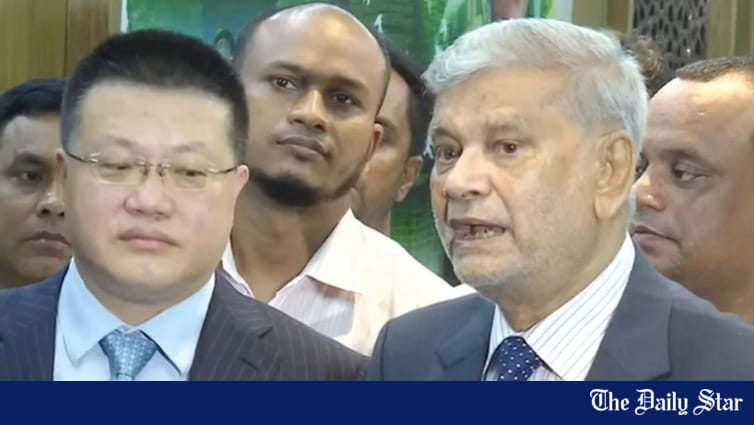
State minister for power, energy and mineral resources Nasrul Hamid and Chinese ambassador to Bangladesh Yao Wen pose for a photo at the state minister’s office in Dhaka on Monday.—UNB photo

Bangladesh has expressed a keen interest in expanding China’s involvement in the power and energy sector. State minister for power, energy and mineral resources Nasrul Hamid conveyed this strategic vision during a meeting with Yao Wen, the Chinese ambassador to Bangladesh, emphasising the need for a substantial $30 billion investment over the next five years.

The meeting, held at the state minister’s office on Monday, covered a wide array of mutual interests, laying the groundwork for deeper cooperation between the two nations.


‘We are looking forward to China playing a more substantial role. Bangladesh’s power and energy sector needs $30 billion in investment over the next five years,’ stated Hamid.

He welcomed ambassador Yao, highlighting China’s long-standing friendship. ‘Chinese companies are making significant contributions to the expansion of the power and energy sector,’ the state minister said.

He also offered to form a special team to explore the potential fields of investment. ‘A specialised team can be formed to increase investment in the sector,’ he said.


Responding to the warm reception and the call for increased investment, ambassador Yao reiterated China’s commitment to strengthening bilateral ties. China’s cooperation with Bangladesh is growing, Yao remarked.

It’s essential for both nations to come together to strengthen the area of cooperation, he added.

The Chinese envoy hoped that Bangladesh would be more prosperous, stronger and a developed nation in the next five years.

They also discussed various issues including Chinese funded projects, setting up lithium battery factory, semi-conductor factory, electric vehicles, battery storage system, smart meter, solar and wind power project, electricity from waste, and gas extraction.​
 
Analyze

Analyze Post

Add your ideas here:
Highlight Cite Fact Check Respond
  • Like (+1)
Reactions: Bilal9

Political trust between Bangladesh, China: Xi Jinping​

26 Mar 2024, 1:27 pm

xipi.jpg


NN Online Report:

Over the past 53 years, Bangladesh has steadfastly upheld its independence, strived to develop its economy and improve people’s livelihood, and made remarkable achievements, laying a solid foundation for realizing the dream of “Sonar Bangla”, Chinese President Xi Jinping said a letter of congratulation to Bangladesh President Mohammed Shahabuddin, on the occasion of the 53rd anniversary of the Independence of the People’s Republic of Bangladesh.

Xi Jinping pointed out that China and Bangladesh are traditional friendly neighbors, and the friendship between the two countries has grown from strength to strength. In recent years, our two countries have enjoyed solid and profound political trust, and fruitful practical cooperation in various fields, bringing tangible benefits to the two peoples.

Xi Jinping emphasized that he attaches great importance to the development of China-Bangladesh relations and stands ready to work with President Mohammed Shahabuddin to further advance high-quality Belt and Road Cooperation and deepen China-Bangladesh Strategic Partnership of Cooperation.

On the same day, Chinese Premier of the State Council Li Qiang and Member of the Political Bureau of the CPC Central Committee and Foreign Minister Wang Yi sent messages of congratulation separately to Prime Minister Sheikh Hasina and Foreign Minister Dr. Hasan Mahmud respectively.​
 
Analyze

Analyze Post

Add your ideas here:
Highlight Cite Fact Check Respond
  • Love (+3)
Reactions: Bilal9

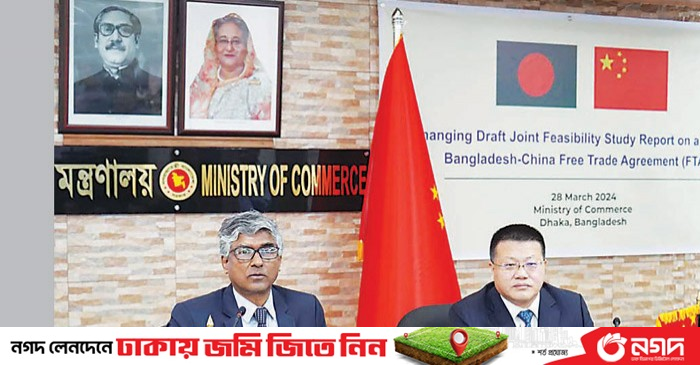
Bangladesh wants to sign FTA with China by 2026
Staff Correspondent | Published: 23:41, Mar 28,2024

1711665596779.webp


Commerce ministry senior secretary Tapan Kanti Ghosh and China ambassador to Bangladesh Yao Wen are present at a press conference at the commerce ministry conference room in the capital Dhaka on Thursday. — PID photo

Commerce ministry senior secretary Tapan Kanti Ghosh on Thursday said that the government had taken a policy decision for signing free trade agreement with China and the commerce ministry was working in an aim to conclude the FTA negotiation by 2026.

At a joint press conference on exchange of draft feasibility study reports on the proposed FTA between Bangladesh and China held at the commerce ministry conference room in the capital Dhaka, the commerce secretary said that after graduation of Bangladesh from a least developed country to a developing one in 2026, duty benefits for the country would shrink.

‘We want to conclude the FTA negotiation with China by 2026 to balance post-graduation challenges. If the negotiation is not completed in time, the discussions will go on and we will request China to extend duty-free market access for the interim period until the negotiation ends,’ Tapan Kanti said.

During China president Xi Jinping’s visit to Bangladesh on October 14-15, 2016, a memorandum of understanding was signed on launching the joint feasibility study of China-Bangladesh free trade agreement.

As per the MoU, joint working group was formed to conduct the feasibility study and the first meeting of the group was held on June 20-21, 2018 in Beijing.

The next meeting of the working group would be held in Dhaka soon to finalise the draft feasibility study reports, the commerce secretary said.

He said that Bangladesh’s graduation from LDC to a developing country was a significant achievement and it would create new opportunities in trade and investment but it would also create some new challenges.

China ambassador to Bangladesh Yao Wen said that after the graduation of Bangladesh from LDC in 2026, China would provide support to mitigate the post-graduation challenges.

He said that the FTA between the two countries would effectively promote Bangladesh’s exports to China.

Citing the experience of signing FTA between China and other countries, the ambassador said that China and Mauritius signed an FTA in 2019 and exports of Mauritius to China increased by 15 per cent.

In the same way, after signing an FTA in 2022, exports of Cambodia to China increased by 13 per cent in 2023, he said.

The Chinese ambassador said that the FTA would also extend investment opportunity which would then increase the exports of Bangladesh not only to China but also other markets.

Citing the trade imbalance, Wen said that although the bilateral trade between the two countries was largely in favour of China, Bangladesh imported textile and other machineries from China and produced apparel to export to the US and the EU.

The envoy said that Chinese businesses were interested in making investment in Bangladesh’s ICT, agricultural processed industry and renewable energy.

‘China is determined to support Smart Bangladesh and to enhance its competitiveness,’ the ambassador said.​
 
Analyze

Analyze Post

Add your ideas here:
Highlight Cite Fact Check Respond
  • Love (+3)
Reactions: Bilal9

FTA with China may cost Bangladesh Tk 15,000cr a year: study​

It may also boost Chinese investment, study finds

1711751116145.webp


Bangladesh may lose nearly Tk 15,000 crore per year in revenues from import duties if a proposed free trade agreement (FTA) is signed with China, according to a new study.

However, at the same time, Bangladesh stands to gain billions of dollars if Chinese investors come here with investment proposals under the FTA, the study also said.

These are the preliminary findings of a joint feasibility study conducted by Bangladesh and China as they look to begin negotiations for the FTA, said a senior official of the commerce ministry, asking not to be named.

The countries signed a memorandum of understanding in October 2016 to conduct the joint feasibility study. In June 2018, the countries began conducting a preliminary study on the proposed FTA, the senior official also said.

Two different studies were conducted, he added. Bangladesh conducted a study on trade in services while China conducted a study on trade in goods.

Senior Commerce Secretary Tapan Kanti Ghosh and Chinese Ambassador to Bangladesh Yao Wen exchanged the documents of the preliminary studies at a press conference held at the commerce ministry office in Dhaka yesterday.

In the preliminary study, there is no exact figure of how much either country may benefit, added the official.

However, the Chinese government will have to facilitate local companies who want to invest in Bangladesh, the official said.

He added that it was just the beginning of negotiations and it may take a long time to complete as the commerce ministry will hold a series of meetings with government officials and private sector stakeholders for their opinions.

Currently, China is Bangladesh's single largest trading partner, with the bilateral trade amounting to $24 billion.

Bangladesh exported goods to China worth $677 million and imported goods worth $22.90 billion from China in fiscal year 2022-23, according to data from the commerce ministry.

At the press conference, Ghosh said the government has engaged major trading partners in negotiations for FTAs, economic partnership agreements, comprehensive economic partnership agreements, and preferential trade agreements.

The aim is to retain duty preferences after Bangladesh makes the United Nations country status graduation from a least developed to a developing country in November 2026.

China currently provides duty benefits for 98 percent of Bangladeshi products.

If negotiations take a long time, Bangladesh will seek the continuation of LDC benefits from China until the signing of the FTA, Ghosh said.

He added that more detailed studies need to be conducted before the FTA can be signed.

Yao Wen said China has been negotiating with Bangladesh mainly to overcome economic challenges and to increase trade between the two countries.

An FTA may address those challenges and exports from Bangladesh to China may eventually increase if facilities can be created.

Currently, China has 22 FTAs with 29 countries, including nations like Mauritius and Cambodia, he added.

Citing an example, the Chinese envoy said exports from Mauritius to China increased by 15 percent and exports from Cambodia to China rose by 30 percent after the signing of the FTAs.

This indicates mutual trade benefits after the signing of trade deals, he said, adding that Bangladesh could export more jute and jute goods, leather and leather goods, and aquatic products to China.

Among agricultural products and those of agro-processing, mangoes, jackfruits, and juice products could also be good items for export from Bangladesh to China.

On the other hand, Chinese investment could bolster the IT and agricultural sectors and can make Bangladesh a manufacturing hub in South Asia if the FTA is signed, the ambassador also said.

Currently, China is the second largest source of foreign direct investment (FDI) for Bangladesh.​
 
Analyze

Analyze Post

Add your ideas here:
Highlight Cite Fact Check Respond
  • Love (+3)
Reactions: Bilal9

Posts you haven't read yet..

Members Online

No members online now.

Latest Posts

Back
 
G
O
 
H
O
M
E