Home Login Watch Videos Wars

[🇧🇩] China is a Time Tested Friend and a Strategic Partner of Bangladesh

[🇧🇩] China is a Time Tested Friend and a Strategic Partner of Bangladesh
258
10K
More threads by Saif

G Bangladesh Defense

China second biggest investor in Bepza zones after Bangladesh

1738020831983.webp


Chinese investment in all eight export processing zones (EPZs) of the Bangladesh Export Processing Zones Authority (Bepza) and its economic zone in Chattogram is only exceeded by domestic investment, show documents of the government agency.

So far, companies from a total of 38 countries have invested in the Bepza EPZs. Bangladesh ranks first in terms of investment, with 148 of its local companies having vested interests in these industrial enclaves.

China holds the second position as 108 of its companies have invested in EPZs, while South Korea follows with 62 companies.

The number of foreign firms invested in local EPZs also includes 30 from Japan, 19 from India, 19 from the UK, 17 from the US, 10 from Canada, seven from Sri Lanka, and six from the Netherlands.

Bepza Chairman Major General Abul Kalam Mohammad Ziaur Rahman informed that US President Donald Trump has announced plans to impose a 10 percent tariff on Chinese goods from February 1.

"This will raise the price of Chinese products in the American market. Consequently, the products will lose competitiveness," he said.

So, many Chinese entrepreneurs have started relocating their industries to other countries, with Vietnam, Cambodia, Indonesia, Sri Lanka, Myanmar, and Bangladesh becoming their preferred destinations.

"Among these, Bangladesh ranks as the top choice," Rahman said.

"We are seeing significant interest from Chinese firms to invest in the country. Just three or four days ago, we received a proposal for a $150 million investment," he added.

Rahman also highlighted the demographic challenges in China.

"The number of young people in China has decreased, leading to a shortage in its workforce. As such, those available are demanding significantly higher wages."

The Bepza chief addressed concerns regarding foreign direct investment (FDI) in Bangladesh, particularly in the aftermath of last August, when the Awami League government was ousted by a mass uprising.

"Numerous investors are actively reaching out with plans for new investments, which reaffirms the country's potential for FDI," he said.

At present, there are 449 industrial establishments operating in the eight EPZs under Bepza and the BEPZA Economic Zone in Chattogram.

They have generated employment for 524,385 people, with a total investment of $6,914 million.

The combined area of the eight EPZs and BEPZA Economic Zone is only 3,445 acres. However, these industrial areas contributed 29 percent of the country's total FDI in fiscal 2023-24.

Data from the Bangladesh Bank shows that FDI inflows amounted to $1,468 million in the last fiscal year, with $424 million of the total coming as investments in the EPZs.

Ashraful Kabir, member for investment promotion at BEPZA, noted that by reducing reliance on garment making, the EPZs are strengthening the country's economic foundation through product diversification and export expansion.

"Beyond garments and garment accessories, 48 percent of the products manufactured in the EPZs are now diversified items," he said.

Bepza began developing its ninth industrial area, the Bepza Economic Zone, in 2018 on 1,138 acres of land in Mirsarai, Chattogram.

The project, which is still underway, aims to construct 539 industrial plots and 45 factory buildings.

So far, 42 domestic and foreign investors have signed agreements with Bepza to collectively invest $970.91 million in this zone. Of the planned industrial plots, 249 have already been allocated.

Bepza has also initiated land development for two EPZs in the Jashore and Patuakhali districts.

The Patuakhali EPZ, spanning 410.78 acres, will feature 306 industrial plots. It is expected to attract investment of $1,530 million, generate $1,836 million in annual exports, and create 100,000 opportunities for direct employment and 200,000 opportunities for indirect employment.

The Jashore EPZ, covering 503 acres, will comprise 400 industrial plots. Bepza anticipates that this zone will draw investments of $2,000 million, generate $2,400 million in annual exports, and create 150,000 direct jobs and 300,000 indirect jobs.​
 
Analyze

Analyze Post

Add your ideas here:
Highlight Cite Fact Check Respond

China-funded Mongla seaport dev project gets going
FHM HUAMAYN KABIR
Published :
Jan 28, 2025 00:20
Updated :
Jan 28, 2025 00:20

Close on the heels of Dhaka-Beijing talks for an update on relations, the interim government may approve the much-awaited China-funded Mongla-seaport-development project tomorrow (Wednesday), officials said.

The project was sent back from the Executive Committee of the National Economic Council (ECNEC) in 2020 as the ousted Sheikh Hasina government favoured a similar project proposed to be funded by India, they said Monday.

The Planning Commission (PC) is going to place the stalled project proposal before the ECNEC, expected to convene Wednesday.

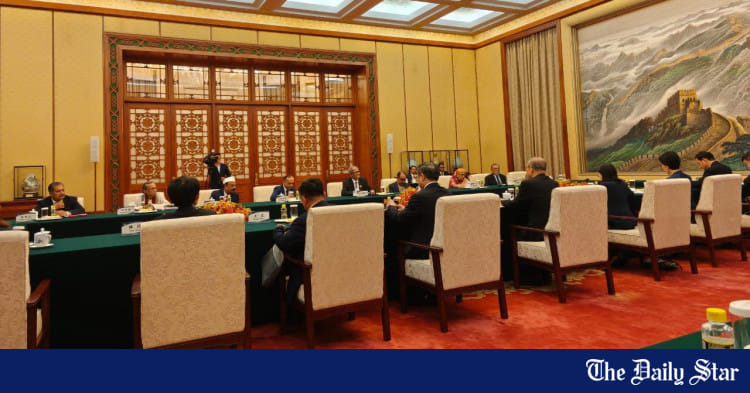
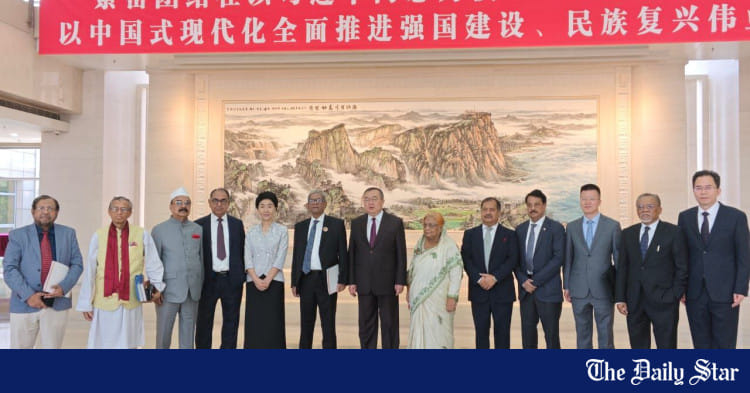
Issues involving the Dhaka-Beijing cooperation, apparently are gathering pace following Foreign Affairs Adviser Touhid Hossain's maiden China mission after the August-5th student-mass uprising brought regime change. He came back from China on January 23 after the four-day visit when he had talks with the Chinese foreign minister.

"We are going to place the China-funded Tk40.68-billion project for the Mongla port upgrading as Bangladesh's current interim government is also interested to build good relations with Beijing like with other neighbouring countries," says a senior PC official.

China has assured Bangladesh of providing Tk 35.93 billion or US$335.78 million worth of loan for implementing the proposed port-development project, deemed important as the Mongla is set to become a regional porting hub.

Earlier in 2020, the past government allowed Indian financial support for a separate project on upgrading the Mongla seaport, now gaining prominence with major communications-infrastructure development done by China in the region connecting the capital, Dhaka.

Currently, the Mongla Port Authority (MPA) under the Ministry of Shipping has been implementing the Tk60.15-billion project since 2020 for upgrading the port with part financing of Tk44.59 billion from Indian loans.

During the visit of the Foreign Adviser, China proposed to Bangladesh government for making investment in Mongla-seaport development, among other areas of cooperation.

Dhaka considered the proposal on a positive approach as it wants more concessional loans and their speedy confirmation from Beijing to upgrade infrastructures as a couple of the assured loans is pending for years, said government officials.

A few years back, Beijing proposed to invest in Bangladesh's second-largest port, Mongla, for the development, a senior Economic Relations Division (ERD) official said.

Earlier, the project was put on hold by the deposed Sheikh Hasina government allegedly on "geopolitical considerations" in September last year, he added.

Another PC official says they had scrutinised the China-funded project proposal more than a month back.

"Now the government high-ups have given the green signal to place the proposal before the next ECNEC meeting for approval. So, we are going to place," the PC official adds.

The MPA more than a month back sought approval for Tk 40.68 billion as cost of 'Expansion and Modernization of Mongla Port Facility Project' where China has proposed to provide Tk 35.93 billion (nearly US$335.78 million) in loan.

"We have scrutinised the project and sent to Planning Adviser Dr Wahiduddin Mahmud for endorsement before placing to the ECNEC more than three weeks ago. Now he has given the green signal for placing before the ECNEC," says another PC official.

The MPA signed a memorandum of understanding (MoU) with China Civil Engineering Construction Corporation (CCECC) on August 24, 2021 and the latter submitted its financial bid and technical proposal on January 28, 2023.

The CCECC will be assigned to build two new container jetties, a loaded container yard, an empty container yard and a hazardous cargo-handling yard.

Expansion and Modernisation of Mongla Port Facility project was listed among the 27 development projects that China pledged to fund by signing an umbrella deal back in 2016 during President Xi Jinping's visit to Dhaka.

Construction of two container jetties will enhance Mongla seaport's container-handling capacity by 394,000 twenty-foot-equivalent units (TEUs) per annum.

Following construction of many mega-infrastructures, particularly in Bangladesh's southern part-especially the Padma Bridge-the Mongla seaport's importance has increased manifold with vistas of opportunities in trade and connectivity opening up.

It has now become nearest seaport to the capital, Dhaka, and recently many international shipping lines have shown interest in plying to the port.

The entire western part of Bangladesh and its adjoining areas are considered hinterland, having a unique opportunity to play vital role in the arena of international and regional trade and economy, officials told their Chinese counterparts regarding the importance of the project.

In unlocking its potential the Mongla seaport recently registered a record in terms of ship arrivals, cargo handling, and revenue earning.

In 2020, the port saw a turnout of 970 ships-the highest in its 70-year history. It earned a profit of Tk 1.30 billion from the limited-scale port operations.​
 
Analyze

Analyze Post

Add your ideas here:
Highlight Cite Fact Check Respond
  • Love (+3)
Reactions: Bilal9

China to upgrade Mongla port
Staff Correspondent 03 February, 2025, 00:41

1738538430633.webp

Mongla port. | File photo

The interim government on Sunday approved a project aiming at upgrading the container terminal at the Mongla port in Bagerhat with a loan of Tk 3,592.90 crore from China.

The Bangladesh government will contribute the remaining Tk 475.33 crore to the overall project cost of Tk 4,068.23 crore approved by the executive committee of the National Economic Council at the Planning Commission at Agargaon in the capital Dhaka.

At a post-meeting briefing, planning adviser Wahiduddin Mahmud said that the port would be developed as a hub, serving the regional countries like Bhutan and Nepal.

China has long been showing a keen interest in financing the project, he said.

Shipping ministry officials said that the same project had been submitted to the ECNEC in 2020 seeking approval, but the proposal was sent back then.

Under the project now to be concluded in 2028, the port authorities will construct a container terminal with equipment, delivery yard, multi-storied car sheds, removal of sinking wreckages and improvement of main roads.

Lack of infrastructures in the port has failed to attract ships, with about 40 per cent of its berthing facility remaining unutilised.

At present, the port authorities have been implementing several projects, including the upgrading of Mongla port project at Tk 6,015 crore since 2020 with Tk 4,459 crore from an Indian loan.

The planning adviser said that foreign loans were bad, but those became burden if not invested in viable projects.

Fearing that the overall debt payment would face more pressure in the coming days due to the implementation of the mega projects by the ousted Awami League regime, he suggested higher revenue mobilisation by the National Board of Revenue.

The day’s meeting, presided over by chief adviser Muhammd Yunus, approved 13 projects at Tk 12,532.28 crore. Of the cost, Tk 4,097.23 crore will come from the local sources and Tk 7,328.95 crore from the foreign sources.

Of the approved 13 projects, nine are new projects while four are revised projects.

The other projects include Uttar Kattali catchment sanitation in Chattogram metropolis (Tk 2,797.22 crore), improved seed production and development of rice, wheat and corn, 3rd phase (Tk 474.68 crore), modernisation and development (2nd phase) of seed production, processing and distribution management of BADC (Tk 292.86 crore), food safety testing capacity development (Tk 2,409.70 crore), digging some four evaluation-cum-development wells of Titas and Kamta fields (Tk 1,255 crore), conducting three-seismic survey at Habiganj, Bakhrabad and Meghna fields (Tk 454.25 crore) and digging Sylhet-12 number well (oil well) (Tk 255.25 crore).​
 
Analyze

Analyze Post

Add your ideas here:
Highlight Cite Fact Check Respond

Tapping into China’s industrial relocation
A golden opportunity for Bangladesh?


1738797011764.webp

Chinese Foreign Minister Wang Yi tells Chief Adviser Prof Muhammad Yunus that China wants to invest in the production of solar panels in Bangladesh, on September 25, 2024. PHOTO: CA OFFICE

Over the last four decades, China has established itself as the leading hub for manufacturing on a global scale. In the late 1970s and early 1980s, the implementation of economic reforms under Deng Xiaoping facilitated the entry of foreign direct investment (FDI) in China's economy, prompting numerous companies to shift their manufacturing operations to the country. Nonetheless, the persistent difficulties faced by the world's second largest economy, including geopolitical tensions with the United States, environmental regulations and overcapacity in manufacturing have led China to relocate various industries to friendly nations in Southeast Asia, South Asia and Central Asia. It's pertinent to analyse China's industrial relocation and how Bangladesh can benefit from it.

Why are Chinese industries relocating?

First, China is undergoing a significant transformation, influenced by a variety of economic, geopolitical, environmental and policy issues. This transition is driving Chinese companies, especially in low-end manufacturing, to explore alternative regions that provide improved market access with greater outputs. China has been experiencing an upsurge in production wages and production costs in recent times, which has led to a decline in the cost competitiveness, once considered to be the strength of Chinese economy. Furthermore, stringent environmental regulations have led to a shift in compliance expenses that's influencing rendering domestic industry to other regions. Last year, Chinese Premier Li Qiang outlined the yearly economic growth target of five percent during his inaugural working report at the National People's Congress. He emphasised the need for a significant advancement through the acceleration of industry modernisation and the "development of new quality productive forces." The approach that Li Qiang spoke of entails a systematic transition towards high-end, smart and clean manufacturing sectors, with a strategic relocation of several domestic industries to emerging economies in their geographical proximity. In the context of emerging economies, Bangladesh presents itself as a suitable region for attracting these shifting industries.

Additionally, the ongoing tensions in US-China trade and broader decoupling trends are prompting Chinese firms to adopt a "China Plus One" strategy aimed at diversifying their production bases to mitigate geopolitical risks. Southeast and South Asia have emerged as significant relocation centres in response to rising tariffs and intensified trade barriers between China and Western countries. Chinese firms recognise that the developing nations in South and Southeast Asia possess adaptable tariff regulations when engaging with the US and Western markets. In the same scenario, Chinese FDI in Mexico reached a 13-year high in 2023, with capital expenditure surging to $5.6 billion, up significantly from $267 million in 2018. This "near-shoring" move was intended to exploit benefits of exporting goods to the US produced in Mexico under the USMCA agreement.

Moreover, in the context of China's recent five-year plans, it is evident that the country is strategically shifting its focus from its previous role as the "world's factory," which was characterised by the production of low-cost, low-tech goods supported by competitive labour costs and supply chain efficiencies. China's new industrial policy of "Made in China 2025" aims to enhance the manufacturing capabilities of Chinese industries, transitioning from labour-intensive operations to a more technology-driven, sophisticated industrial hub. The focus on high-tech productive forces, including electric vehicles (EVs), artificial intelligence (AI), and cutting-edge semiconductors, is expediting the relocation as well.

Bangladesh as a potential destination

Bangladesh has always been a viable destination for Chinese firms as it offers some significant benefits that Chinese companies enjoy at home. Till date, Bangladesh can offer the most competitive wages compared to other viable destinations in the region. The average monthly wage of an industrial worker still remains below $150 that makes it lucrative for manufacturing industries. Additionally, the young labour force in Bangladesh presents a significant long-term benefit for industrial production. The country boasts a demographic dividend where more than 65 percent of its population is under 35 years old. Moreover, the geographical location of Bangladesh in the crossroad of the Indo-Pacific region makes it a suitable transportation and logistical hub for international shipping of produced goods. As of present circumstances, Bangladesh can offer duty-free access to European markets as well with zero tariffs on EBA (Everything but Arms) scheme and curtailed tariffs on goods exported to the US, Japan, Australia and other countries. Bangladesh also offers dedicated Export Processing Zones (EPZs) and Special Economic Zones (SEZs) for attracting FDI, especially in the coastal region.

Chinese industries relocating matter for Bangladesh

The Bangladesh Economic Zones Authority (BEZA) has established a structured timeline aimed at operationalising five economic zones within the next two years, out of a total of 100 proposed zones all over Bangladesh. These zones are vital for attracting FDI from Chinese firms aiming to relocate their operations. It is noteworthy that China holds the second position after Bangladesh; 108 companies have invested in EPZs. According to data from the Bangladesh Bank, FDI inflows reached $1.46 billion in FY2023-24, with $424 million of this total attributed to investments in the export processing zones. Ashraful Kabir, who serves as a member for investment promotion at BEZA, highlighted that in addition to RMG products and accessories, 48 percent of the products manufactured in the EPZs have now diversified into other categories. He noted that decreasing dependency on RMG production allows the EPZs to enhance Bangladesh's economic stability by promoting product diversification and expanding export opportunities. Chinese firms invested $283 million in FY2023-24, and China is the third largest FDI source for Bangladesh that stands with $1.56 billion in total as of June 2024.

It is worth noting that the growth in the manufacturing sector has been sluggish compared to the service sector. In 2013, the number of economic units of the industrial sector was 9.2 million, which increased to 1.04 million in 2024. The growth rate has increased by 15.38 percent in a decade. The slow rate of pace in Bangladesh's economy does not end here; the number of unemployed people in the country has increased to 2.66 million, according to the Bangladesh Bureau of Statistics (BBS) for the period of July-September 2024. Bangladesh must feel the urge to attract Chinese industries to invest and increase FDI to overcome this stagnation. The head of the Chinese Communist Party's (CCP) International Department, Liu Jianchau, said to Bangladesh Foreign Affairs Adviser M Touhid Hossain during his recent visit that China is thinking of relocating its industries and they are considering Bangladesh as an option. They also think that exporting the manufactured goods to other countries from Bangladesh and the matter of incentives in exports will be beneficial to China.

Challenges ahead

However, the existing infrastructure presents significant challenges with shortage of energy and port delays contributing to increased expenses and diminished investor trust. The government has initiated large-scale EEZs; however, the pace of project implementation is not satisfactory. It is an undeniable fact that Bangladesh has administrative inefficiency and bureaucratic complexities in attracting foreign investment, which introduces an additional layer of complexity. Policy reforms are needed now to attract Chinese investment despite advantages. Tax concessions, tax holiday, and ease of doing business should be prioritised to attract relocating industries. Bangladesh has a shortage of skilled labour force to propel newly relocated industries. It will continue to be a significant area of concern if no comprehensive action plan from the government is taken.

Foreign investors endure significant challenges in Bangladesh due to intricate, often bureaucratic, approval procedures from various government agencies that must be fixed to harness relocating Chinese industries. Regional competitors like Vietnam and Indonesia have already streamlined their investment frameworks to facilitate the relocation of Chinese industries. Should Bangladesh not implement necessary reforms to its regulatory framework and expedite investment processes, it may face significant challenges in maintaining its competitive edge in international trade.

Md Sakib Hossain is a political and international relations analyst based in Dhaka.​
 
Analyze

Analyze Post

Add your ideas here:
Highlight Cite Fact Check Respond

Bangladesh takes steps to address China’s concerns over textbooks, map
UNB

Published :
Feb 13, 2025 20:35
Updated :
Feb 13, 2025 20:35

1739495384319.webp


Bangladesh has said it has taken measures to address some objections raised by China regarding two Bangladeshi textbooks and the map displayed on the website of the Survey of Bangladesh.

The Chinese Embassy in Dhaka informed Bangladesh through a diplomatic note on November 28, 2024, about China’s objections to the map used in the textbook, the inconsistency of the data, and a boundary line mentioned in the Survey of Bangladesh, Spokesperson at the Ministry of Foreign Affairs Mohammad Rafiqul Alam told reporters at a media briefing on Thursday.

In view of this, he said, the Ministry of Foreign Affairs has requested the authorities concerned to review the matter and take necessary measures.

Alam said the Ministry of Foreign Affairs is in regular contact with the authorities concerned regarding the progress of the matter.

Beijing, as reported by media, asserted that in addition to this “factual discrepancy”, both the textbooks and the survey department’s website have incorrectly portrayed Hong Kong and Taiwan as separate countries instead of recognising them as part of China.​
 
Analyze

Analyze Post

Add your ideas here:
Highlight Cite Fact Check Respond

Members Online

Latest Posts

Back
PKDefense
G
O
 
H
O
M
E