[🇧🇩] China is a Time Tested Friend and a Strategic Partner of Bangladesh

[🇧🇩] China is a Time Tested Friend and a Strategic Partner of Bangladesh
309
13K
More threads by Saif

G Bangladesh Defense

Bangladesh, China sign 13 MoUs to deepen cooperation across key areas

UNB
Beijing
Published: 25 Jun 2026, 21: 34
1782431694742.webp

Collage BSS

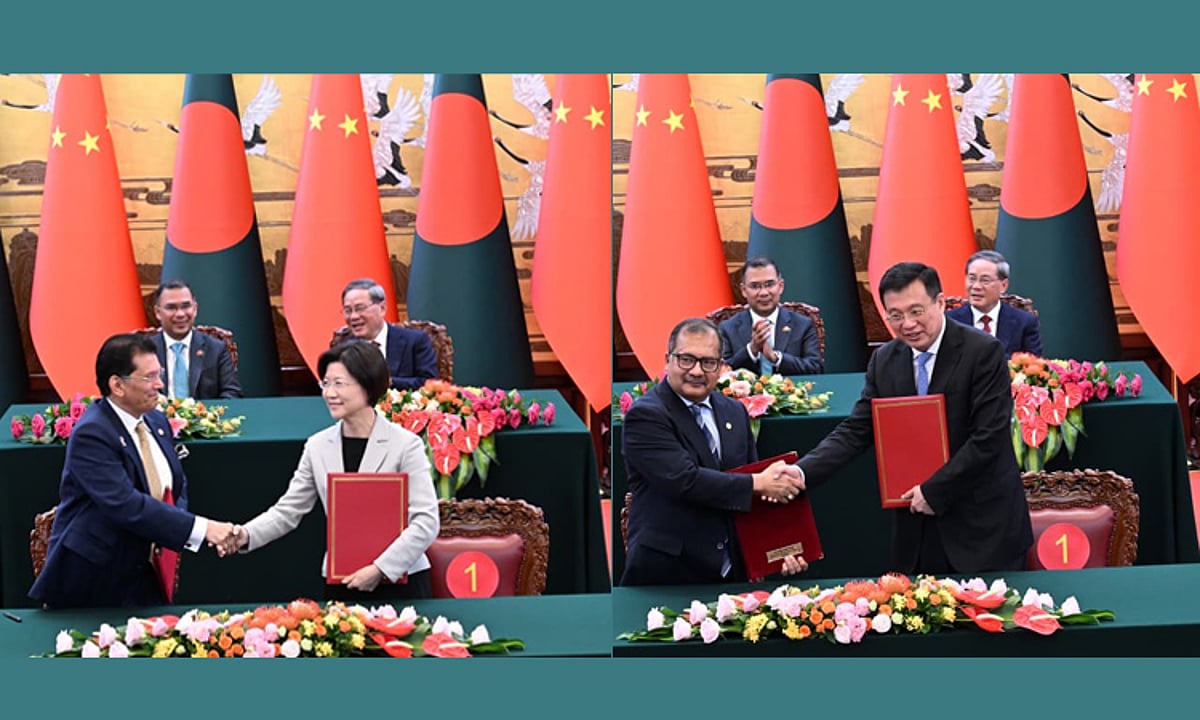
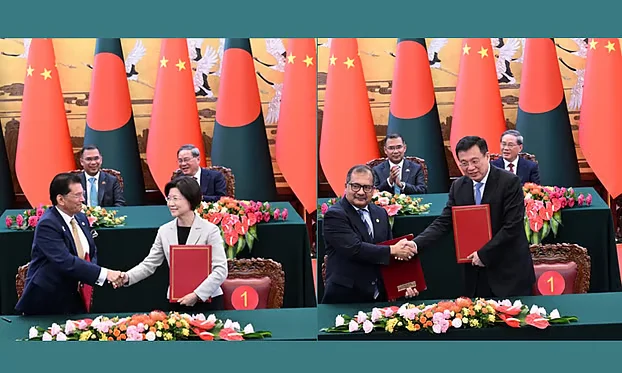
Bangladesh and China today, Thursday signed 13 Memorandums of Understanding (MoUs) covering various areas of cooperation between the two countries.

The MoUs were signed following bilateral talks between Prime Minister Tarique Rahman and Chinese Premier Li Qiang at the Great Hall of the People in Beijing, focusing on Bangladesh-China relations, trade, investment, infrastructure development and other issues of mutual interest.

Prime Minister Tarique Rahman led the Bangladesh delegation while Chinese Premier Li Qiang headed their side during the talks.

The signing of the MoUs is expected to elevate bilateral cooperation between the two countries to a new level.

The MoUs were signed by Foreign Minister Khalilur Rahman, Information and Broadcasting Minister Zahir Uddin Swapon, and two senior Bangladeshi officials.

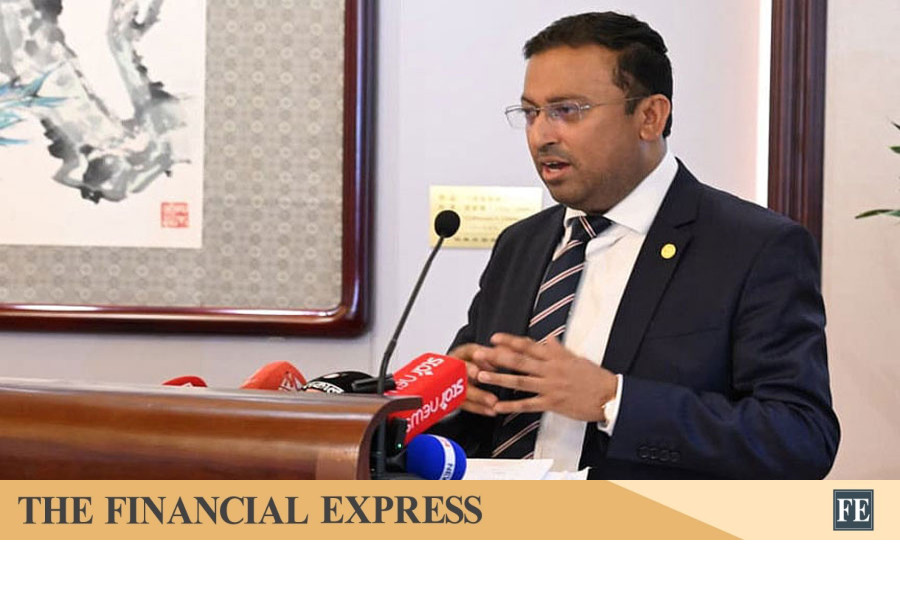
Briefing reporters in the evening at the Fang Fei Hall of Diaoyutai Hotel, Prime Minister's Office (PMO) Spokesperson Mahdi Amin said the agreements cover a number of aeras, including investment cooperation, trade expansion, human resource development, education, health and media collaboration.

Investment cooperation, promotion of green development, and the formulation of joint action plans to strengthen bilateral collaboration have also been covered, he said. “The discussions also focused on enhancing Bangladesh’s export capacity to increase shipments to the Chinese market, as well as expanding development cooperation in various sectors,” he said.

Mahdi Amin noted that both sides discussed ways to improve the terms of Chinese concessional loans to Bangladesh, including the possibility of lowering interest rates and extending grace periods.

“MoUs were also signed under the framework of the Global Development Initiative (GDI), covering cooperation in health, education, manpower capacity building, and other development-related areas aimed at strengthening institutional and human resource capacities,” he added.

A different cooperation plan on human resource development was also signed, while another MoU was concluded to facilitate the export of Bangladesh's national fruit, jackfruit, to China, the PMO spokesperson added.
1782431724782.webp

BSS

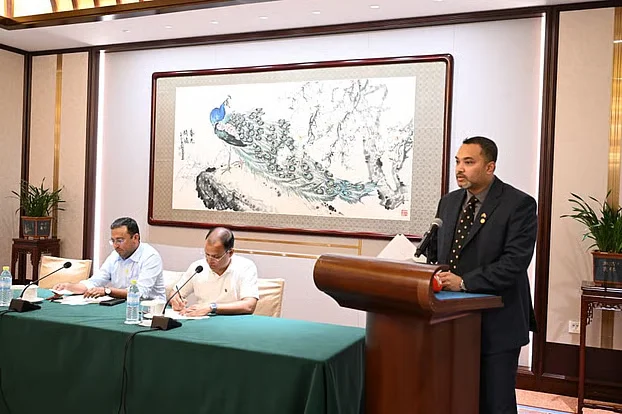
He said two separate MoUs were signed on introducing Mandarin language education in school curriculum in Bangladesh and enhancing cooperation in technical and vocational education.

The two sides also agreed to expand cooperation in the media sector of the two countries and strengthen collaboration among think tanks of Bangladesh and China, said Mahdi Amin, also prime minister’s adviser.

Four MoUs were signed involving state-owned television channels and newspapers of the two countries to enhance exchanges and cooperation, he said.

About the investment-related MoU, the PMO spokesperson said a deal was inked to attract greater Chinese investment in the economic zones of Anwara in Chattogram and Mongla in Bagerhat.

“There is a separate MoU on how we can set up new Chinese factories, Chinese production facilities in the economic zones in Bangladesh... and generate employment through them," he said.

About four MoUs related to media cooperation, a press release from the PMO said the four important documents were signed with China's Xinhua News Agency and China Media Group (CMG).

Information and Broadcasting Minister Swapon signed the instruments on behalf of Bangladesh.

According to the PMO release, the MoUs will promote bilateral cooperation in news and information exchange, establish long-term partnerships in the media sector, facilitate joint research on issues relating to Global South media, and expand cooperation and experience-sharing in broadcasting and the use of technology.

The MoUs are expected to further strengthen the long-standing friendship between Bangladesh and China and open new avenues of cooperation in the media and information sectors.

Earlier in the day, the Communist Party of China (CPC) and the Bangladesh Nationalist Party (BNP) signed an MoU to enhance communication between the two parties.

BNP Joint Secretary General (International Affairs) Humaiun Kobir and Minister of the International Department of the Communist Party of China Central Committee Liu Haixing signed the MoU on behalf of their respective parties in the presence of BNP Chairman and Prime Minister Tarique Rahman at the Diaoyutai State Guest House in Beijing.

Under the MoU, the two parties are expected to enhance communication and cooperation, particularly in the fields of media, think tanks, people-to-people exchanges and initiatives aimed at improving living standards.​
 

Xi says China will stay Bangladesh's 'trusted friend', pledges ‘long-term’ support

bdnews24.com

Published :
Jun 26, 2026 17:12
Updated :
Jun 27, 2026 02:18

1782516500834.webp


Chinese President Xi Jinping has pledged “long-term” support for Bangladesh's development, promising to back Prime Minister Tarique Rahman’s economic vision.

The Prime Minister’s Foreign Affairs Advisor Humaiun Kobir shared details of the high-level meeting at a press conference held at the Diaoyutai State Guesthouse on Friday afternoon.

He said the Chinese president explicitly assured the premier during their talks at the Great Hall of the People that Beijing would remain a “trusted friend” to Dhaka, anchoring a permanent commitment to the nation's economic transformation.

"China will stand by [Tarique] in implementing his development vision," Xi said, according to Kobir.

Xi also praised Tarique's development thinking and expressed full confidence in his leadership, he said.

The Chinese president added that Tarique's visit would further accelerate Bangladesh's development.

According to the advisor, Beijing has backed Bangladesh’s aspirations to join BRICS (a coalition of Brazil, Russia, India, China and South Africa for economic coordination) and become a partner in the Shanghai Cooperation Organisation (SCO).

The Chinese leadership also extended its backing for Dhaka’s interests in the Regional Comprehensive Economic Partnership (RCEP) to help the South Asian nation gain wider access to regional markets.

On investment, Kobir said meetings with Chinese businesses and industry representatives during the visit could yield several billion dollars in potential investment, with discussions also held on concessional loans and grants.

"Grant-based financing is shrinking globally, but China has committed more than $300 million in grants.”

Before meeting Xi, Tarique held talks with Zhao Leji, chairman of the Standing Committee of the National People's Congress, described by Advisor Kobir as China's third most influential leader.

Zhao reaffirmed China's support for Bangladesh's development and prosperity under Tarique's leadership and pledged continued cooperation across health, education, skills development, technical training, water resources and river management.

Zhao said Bangladesh and China working together could become a united force representing the interests and aspirations of the Global South, Kobir added.

The advisor called the overall visit "historic and transformative”.

"This visit has not only been historic but has ushered in a new era," he said. "It has made Prime Minister Tarique Rahman's leadership, Bangladesh's development vision and his thinking on regional cooperation and stability more acceptable to world leaders."​
 

Bangladesh, China agree to elevate ties with new strategic roadmap in 15-point joint declaration

bdnews24.com

Published :
Jun 26, 2026 20:25
Updated :
Jun 26, 2026 20:25

1782516781842.webp


Bangladesh and China have pledged to take their bilateral relationship to a new level, agreeing to build a "China-Bangladesh community with a shared future in the new era" under a 15-point joint declaration issued at the end of Prime Minister Tarique Rahman's official visit to Beijing.

The joint declaration, released on Friday, says the two countries will elevate their comprehensive strategic cooperative partnership to bring greater benefits to their peoples.

Among the key outcomes are China's support for the Teesta River Comprehensive Management and Restoration Project, plans to explore a "2+2" dialogue mechanism on diplomacy and defence, and Beijing's commitment to help facilitate a mutually acceptable solution to the Rohingya crisis through engagement with Myanmar.

The declaration also outlines expanded cooperation in trade, investment, industry, education, public health, culture and defence, stronger collaboration under the Belt and Road Initiative (BRI), exploration of direct connectivity between the two countries, and China's support for Bangladesh's participation in BRICS and its application to become a partner of the Shanghai Cooperation Organization (SCO).

Tarique visited China from Jun 22 to 26 at the invitation of Chinese premier Li Qiang.

During the visit, he met Chinese President Xi Jinping, held bilateral talks with Li, and met Zhao Leji, chairman of the Standing Committee of the National People's Congress.

The declaration says the leaders held in-depth discussions on bilateral ties as well as regional and international issues of common interest and reached broad consensus.

Relations since 1975 Enter a New Phase

The two sides said China and Bangladesh have steadily strengthened political mutual trust, traditional friendship and practical cooperation since establishing diplomatic relations in 1975.

China congratulated Bangladesh on the successful general election held in February 2026, expressed support for the new government's governance, and acknowledged its "Bangladesh Before All" policy.

Bangladesh, in turn, said China's 15th Five-Year Plan will create important development opportunities for the country.

More High-Level Dialogue

The two governments agreed to maintain the momentum of high-level exchanges, strengthen cooperation among governments, legislative bodies and political parties, and increase exchanges of governance experience.

They also agreed to establish a strategic dialogue mechanism between their foreign ministers and explore a "2+2" dialogue mechanism involving diplomacy and defence.

Bangladesh Reaffirms One-China Policy

The declaration says Bangladesh reaffirmed its firm commitment to the one-China principle, recognising that there is but one China, Taiwan is an inalienable part of the People's Republic of China, and the government in Beijing is the sole legal government representing the whole of China.

Bangladesh also reaffirmed its opposition to any form of "Taiwan independence" and expressed support for China's efforts towards national reunification.

China, meanwhile, reiterated its support for Bangladesh's national independence, sovereignty and territorial integrity, while respecting the country's chosen development path.

Stronger Cooperation Under the Belt and Road Initiative

The two countries agreed to deepen high-quality cooperation under the Belt and Road Initiative and align development plans more closely.

China said it will continue supporting both major infrastructure projects and "small and beautiful" livelihood projects, while assisting Bangladesh's industrialisation, agricultural modernisation and broader economic and social development within its capacity.

Trade, Investment and Industry

The communiqué says the two countries will strengthen cooperation in trade, e-commerce, industrial and supply chains and investment to enhance Bangladesh's export capacity and jointly uphold the multilateral trading system.

Bangladesh expressed appreciation for China's zero-tariff treatment covering 100 percent of tariff lines and pledged to provide a more favourable environment for Chinese investment.

The two sides also agreed to jointly advance the Mongla Port Facilities Modernization and Expansion Project and the development of the Chinese Economic and Industrial Zone in Chattogram.

Exploring New Connectivity

Bangladesh and China agreed to deepen cooperation in connectivity, science and technology, information and communications, green energy, photovoltaic technology, disaster prevention and climate change.

They also agreed to explore new options for regional connectivity, including direct connectivity between the two countries.

China Backs Teesta Project

One of the most significant elements of the communiqué is China's support for the Teesta River Comprehensive Management and Restoration Project.

The two countries agreed to strengthen cooperation in integrated water resources management, planning, hydrological forecasting, flood prevention, disaster reduction, river dredging and related technology sharing.

China said it will provide support for the Teesta project within its capacity and help experts from both countries expedite the project's feasibility study.

The two sides also agreed to strengthen cooperation in maritime affairs.

Defence Cooperation to Deepen

The communiqué says defence cooperation will be expanded through exchanges, visits and training.

The two countries also agreed to maintain mutual understanding and engagement on United Nations peacekeeping affairs.

Education, Health and People-to-People Exchanges

Bangladesh and China commended the successful celebration of the 50th anniversary of diplomatic relations and the Year of China-Bangladesh People-to-People Exchanges in 2025.

They agreed to deepen cooperation in media, think tanks, education, films, publishing, youth, sports and culture.

China will continue providing opportunities for Bangladeshi students to study in China, while both sides will strengthen cooperation between universities and vocational institutions, human resource development, public health and traditional medicine.

Bangladesh also welcomed cooperation from Chinese provincial authorities, particularly Yunnan Province, in healthcare.

China Supports Bangladesh's BRICS, SCO Ambitions

Bangladesh expressed support for President Xi Jinping's vision of building a community with a shared future for humanity and his Global Initiatives, while expressing readiness to work with China in implementing them.

China, in turn, reaffirmed support for Bangladesh playing a greater role in multilateral institutions, backed Bangladesh's participation in BRICS, and supported its application to become a partner of the Shanghai Cooperation Organization.

The two countries also pledged to promote broader regional multilateral cooperation.

Support for the Un-Based International Order

The communiqué reaffirms both countries' commitment to the United Nations-centred international system, international law and the principles of the UN Charter.

The two sides also pledged to promote an equal and orderly multipolar world and inclusive economic globalisation.

They further agreed to uphold the outcomes of World War II, oppose any revival of fascism or militarism, and support the post-war international order established under the Cairo Declaration, the Potsdam Proclamation and the UN Charter.

China to Continue Facilitating Rohingya Solution

Bangladesh welcomed China's constructive role in addressing the Rohingya crisis, while China commended Bangladesh for providing humanitarian assistance to forcibly displaced people from Myanmar's Rakhine State.

China said it supports Bangladesh and Myanmar in finding a mutually acceptable solution through friendly consultations and will continue facilitating the process to the best of its capabilities.

The declaration notes that the two countries signed a number of cooperation documents during the visit covering development cooperation, human resources, agriculture, education, trade and investment, and media cooperation.

Tarique thanked the Chinese government and people for the warm hospitality extended to him and his delegation and invited the Chinese leadership to visit Bangladesh at a mutually convenient time.​
 

Bangladesh to open investment office in China
PM urges Chinese entrepreneurs to invest in prospective

FE REPORT

Published :
Jun 26, 2026 08:15
Updated :
Jun 26, 2026 08:15

1782517084182.webp


Bangladesh's first investment office will be opened in China very soon, Prime Minister Tarique Rahman announced Thursday in Beijing while inviting Chinese investors to invest in Bangladesh to avail newer business opportunities.

Bangladesh is becoming a "competitive, reliable and profitable destination for manufacturing and industrial investment" as economic and administrative reforms are opening up new vistas of opportunities in the country, he told his business audience.

The visiting prime minister was addressing an event titled 'Invest in Bangladesh', jointly organised by China Council for the Promotion of International Trade (CCPIT) and Bangladesh Investment Development Authority (BIDA), in the Chinese capital.

More than 80 senior executives and owners of leading Chinese companies attended the event.

The prime minister outlined the government policies and initiatives aimed at attracting investment and generating employment, said a PMO spokesman, adding that Chinese business leaders also presented their investment plans, expectations, and proposals.

Tarique Rahman notes that the government is implementing a special 180-day action plan to ensure an investment-friendly environment.

The initiatives include the development of economic zones in Anwara and Mongla, and special incentives for priority sectors. He also announces that new investment licences will be issued within less than 15 days.

Tarique Rahman, also chairman of the ruling BNP, held a party-to-party meeting with Liu Haixing, Minister of the International Department of the Communist Party of China, at the Diaoyutai state guesthouse.

During the meeting, the premier called for a closer partnership aimed at long-term economic cooperation, sustainable growth, and mutual prosperity between Bangladesh and China, according to Mahdi Amin.

Senior executives from several major industrial groups met with the premier during his stay in China.

Representatives from the China International Development Cooperation Agency, China Railway Construction Corporation, China Road and Bridge Corporation, along with investors, ministers, and other prominent figures, also met with him to discuss ways to expand investment and trade and contribute more effectively to Bangladesh's development journey.

The Prime Minister arrived in Beijing Wednesday from Chinese city of Dalian for scheduled talks with top leaders of China.​
 

China proposes Bangladesh-Myanmar-China economic corridor: PMO spokesperson

For the first time, Bangladesh and China have reached an understanding on a “2+2 dialogue” mechanism covering foreign affairs and defense, Mahdi Amin told the media.

BSS
Beijing
Updated: 26 Jun 2026, 17: 14

1782517328253.webp

Prime Minister’s Office spokesperson Mahdi Amin briefs newspersons at the Diaoyutai State Guesthouse in Beijing, China on 26 June 2026 BSS

China on Friday proposed the establishment of an economic corridor linking Bangladesh, Myanmar and China aimed at further deepening regional connectivity and trade.

“Today, Prime Minister Tarique Rahman had detailed discussions with Chinese President Xi Jinping on connectivity... A proposal came there on how an economic corridor could be established from Bangladesh to China via Myanmar,” said Prime Minister’s Office spokesperson Mahdi Amin.

He said this while briefing newspersons at the Diaoyutai State Guesthouse in Beijing, China following Prime Minister Tarique Rahman’s meeting with Chinese President Xi Jinping at the Great Hall of the People in the morning.

During the meeting, the two leaders discussed various bilateral issues relating to connectivity, people to people contact, further enhancing bilateral ties and regarding Chinese support for modernising Chittagong and Mongla sea ports.

Providing details, the PMO spokesperson said the main objective of this economic corridor would be to expand Bangladesh’s economy, increase economic transactions, and further enhance multimodal transportation.

Mahdi Amin also said that China expressed interest in further modernising Chittagong port to make it as a regional business hub.

“We want to work on how this port can be developed into a regional hub that will serve not only Bangladesh but also other countries,” he added.

We want to deepen ties in culture, media, technology, knowledge transfer, and employment generation
Mahdi Amin, PMO Spokesperson.

Apart from this, he said that China has shown interest in upgrading Mongla port and making it more progressive and service-oriented as discussions were held on these matters.

Amin said Bangladesh and China are eager to further strengthen people-to-people contact in line with their broader bilateral relationship.

“We want to deepen ties in culture, media, technology, knowledge transfer, and employment generation,” he added.

He said that both the countries want greater interaction between their people in areas like heritage, information, and technology, and that these issues were discussed by the two leaders.

China will help simplify visa processing and expressed interest in supporting the introduction of modern medical systems in Bangladesh, including robotic surgery and hospital development.

He also noted that Mandarin is being prioritised as a third language in Bangladesh’s education system, along with technical and vocational education.

1782517396638.webp

Prime Minister’s Office spokesperson Mahdi Amin briefs newspersons at the Diaoyutai State Guesthouse in Beijing, China on 26 June 2026 BSS.

China is eager to assist Bangladesh in both areas based on its own experience by providing teachers and infrastructural support for Chinese language education, he said.

Speaking regarding healthcare, Amin said China will help simplify visa processing and expressed interest in supporting the introduction of modern medical systems in Bangladesh, including robotic surgery and hospital development.

He said many Bangladeshis travel abroad for medical treatment, and China is willing to facilitate easier visa processing and other forms of cooperation to support Bangladeshi patients seeking treatment overseas.

Reiterating the importance of people-to-people ties, he said Bangladesh wants stronger relations between the peoples of the two countries in the fields of culture, media, technology, knowledge transfer, and employment generation.

On the Rohingya issue, Amin said Bangladesh’s position remains clear: the country wants the Rohingyas, who took shelter to Bangladesh to return to their homeland Myanmar in a safe, voluntary, and dignified manner.

Mandarin is being prioritised as a third language in Bangladesh’s education system, along with technical and vocational education-----Mahdi Amin, PMO Spokesperson.

He said China has assured Bangladesh that whenever necessary, it will facilitate dialogue with Myanmar regarding Rohingya repatriation.

“We will pursue the voluntary and dignified repatriation of the Rohingya, which, according to us, was achieved only during the tenures of the Shahed President Ziaur Rahman and former Prime Minister Begum Khaleda Zia. We will begin discussions on this issue going forward,” he said.

Amin also mentioned that for the first time, Bangladesh and China have reached an understanding on a “2+2 dialogue” mechanism covering foreign affairs and defense.

Representatives from the foreign and defense ministries of both countries will hold regular dialogues in future, and the details of the instrument are being worked out, he added.

He said that China reaffirmed its respect for Bangladesh’s sovereignty, independence, and territorial integrity, and emphasised that each country should pursue its own independent and sovereign foreign policy.

Regarding BRICS, Amin said China welcomed Bangladesh’s future application for membership.

He also noted that China congratulated Bangladesh on its recent success in UN-related election and that Bangladesh thanked China for its support.

Finally, he said President Xi Jinping praised Tarique Rahman’s leadership and assured China’s long-term support for Bangladesh’s development.

Prime Minister’s Foreign Affairs Adviser Humaiun Kobir and Deputy Press Secretary Jahidul Islam Rony were also present at the press conference.​
 

The real question behind Tarique Rahman's China visit

M Humayun Kabir

The Prime Minister's first trip to Beijing has prompted considerable strategic speculation. In my reading, the visit is dominated by something less dramatic and more pressing: our internal compulsions. It is those compulsions that drive a country's foreign policy, and in our case, they are economic before they are strategic.

What Bangladesh wants

Three needs shape what Dhaka is asking for.

The first is financial support. The economy is in poor shape, and a government in that position turns to its friends. The precedent is instructive. In 2024, the then-prime minister went to Beijing and sought about $5 billion in budget support; the Chinese did not agree, as the underlying economic conditions did not justify it, and the visit ended on a sour note. The basic structure of the economy has not improved since; if anything, it is weaker, so securing some financial support will again be a priority.

1782518936511.webp

The Prime Minister's first trip to Beijing has prompted considerable strategic speculation. Photo: PMO Bangladesh

The second is investment, because employment is among our most serious problems. Here, the Prime Minister is expected to press for Chinese investment, and the government has just designated a dedicated Chinese Economic and Industrial Zone to encourage Chinese firms to take Bangladesh seriously and utilise its opportunities as a free trade zone.

The third is infrastructure, where China is already our foremost partner. Press reports suggest Dhaka is seeking around $6 billion in infrastructure support, and this is the area where Beijing is most likely to respond positively, because it holds the surplus capacity it can transfer to help build ours.

Financial support, investment, infrastructure: these are what we want.

What China wants in return

China's expectations matter just as much.

First, Beijing will want Bangladesh to reaffirm the One-China policy, a constant in its diplomacy. Bangladesh has supported it consistently and will be glad to do so again.

Second, China would like Bangladesh to be more deeply integrated into the Belt and Road Initiative across infrastructure, finance, agriculture, and renewable energy.

Third, Beijing is advancing its broader frameworks, including the Global Development Initiative. I believe Bangladesh can be receptive to the GDI in particular because development cooperation is the least contentious of these initiatives and carries limited strategic implications; when it comes to more security-oriented frameworks, Dhaka is likely to be more cautious.

There is also a real convergence of interest in technology and energy. China has world-leading capacity in semiconductors, electric vehicles and solar power, and these are precisely the areas where it can support us. Bangladesh has lagged behind its neighbours here; Nepal is now the largest market for Chinese electric vehicles in South Asia, and with energy security back in focus, the government is looking at electric vehicles and renewables afresh. The presence of the energy adviser in the delegation indicates that this will be discussed seriously. Cooperation on agriculture and education may follow.

We urgently need to strengthen our capacity to absorb and utilise external support, and that requires meaningful reform, stronger institutions, and effective implementation mechanisms.
Defence is the more uncertain area. Since Bangladesh is among the largest buyers of Chinese military equipment, Beijing would like to build on that. How far Dhaka is willing to go at this stage is not clear.

Reading the geopolitics

The geopolitical dimension warrants a more measured assessment. On the Teesta, the Foreign Secretary has indicated that Bangladesh is reviewing the process and may discuss the project's feasibility with China rather than its financing. That distinction is deliberate. It reassures our regional partners and helps keep Bangladesh out of unnecessary geopolitical contention, which is a positive outcome. As long as the engagement remains on the economic side, the geostrategic competitors are willing to accept it; only if Bangladesh moves too far into the BRI and its security frameworks do things become difficult.

The Malaysia stop should be read in the same spirit. It signals that Bangladesh does not wish to be drawn into an adversarial Indo-Chinese frame, and our neighbours will understand the message. I sense that we continue to remain engaged with both sides, conscious of each other's concerns and respectful of them. I do not believe this government is any more inclined than its predecessors to become part of that competition. We will pursue our interests, but within the same established framework.

So this visit is not a departure from our established way of doing things. It is more bilateral than geopolitical, aimed at addressing domestic challenges, and it will be cautious. Most of the understandings will be in infrastructure, employment, financial support, and energy, the areas where we need urgent help and where China has the capacity we would like to tap. Nothing very large in geopolitical terms should be expected.

The question we keep avoiding

There is a more difficult question underlying all of this, and it concerns us rather than China. China is not the easy partner we sometimes assume it to be. Beijing is tough. It declined the previous government's request precisely because a weakened financial system offered no assurance that the money could be repaid, a lender's logic, not a political one.

1782519012106.webp

Prime Minister Tarique Rahman is scheduled to meet Chinese President Xi Jinping on June 26, 2026. Illustration: Khairul Hassan Jahin

Vietnam offers a useful point of comparison. It maintains a close security relationship with the United States. It attracts substantial Chinese investment at the same time because it has the capacity to handle both. Our constraint is our own capacity to absorb. We are slow, our processes are heavily bureaucratic, and our collective ability to turn agreements into delivered projects is limited.

The conclusion, then, is not about leaning towards Beijing or away from it. We urgently need to strengthen our capacity to absorb and utilise external support, and that requires meaningful reform, stronger institutions, and effective implementation mechanisms. Without that domestic preparation, no agreement, whether with China, India, or the United States, will deliver its full potential. The Prime Minister can secure agreements in Beijing, but their implementation will depend on our capacity to deliver at home.

M Humayun Kabir is president of the Bangladesh Enterprise Institute (BEI) and a former ambassador of Bangladesh to the United States. This article was transcribed by Khairul Hassan Jahin.​
 

Latest Posts

Back