Donate ☕
201 Military Defense Forums
[🇨🇳] - Chinese Navy | PKDefense
Home Post Alerts Inbox Watch Videos

[🇨🇳] Chinese Navy

Reply (Scroll)
Press space to scroll through posts
G   Chinese Defense
[🇨🇳] Chinese Navy
17
2K
More threads by ghazi

ghazi

A Legend
Moderator
Joined
Jan 25, 2024
Messages
111,139
Likes
867
Nation

Residence

The People's Liberation Army Navy(also known as People's Navy, Chinese Navy, or PLA Navy) is the maritime service branch of the People's Liberation Army, and the largest navy per number of ships in the world.

The PLAN traces its lineage to naval units fighting during the Chinese Civil War and was established on 23 April 1949.

Until the late 1980s, the PLAN was largely a riverine and littoral force (brown-water navy). In the 1990s, following the fall of the Soviet Union and a shift towards a more forward-oriented foreign and security policy, the leaders of the Chinese military were freed from worrying overland border disputes. Traditionally subordinated to the PLA Ground Force, PLAN leaders were now able to advocate for renewed attention toward the seas.

Chinese military officials have outlined plans to operate in the first and second island chains, and have worked towards blue water capability.[8] Chinese strategists talk about the development of the PLAN from a green-water navy into "a regional blue-water defensive and offensive navy."[9] As the PLAN has expanded into a blue-water navy, regular exercises and naval patrols have increased in the South China Sea within the Nine-dash line, the Senkaku Islands/Diaoyutai in the East China Sea, and the island of Taiwan, which it all claims as its territory.

The People's Republic of China (PRC) along with the Republic of China (ROC), Vietnam, Brunei, Malaysia, and the Philippines claims a significant amount of maritime boundary located within the South China Sea. Some exercises and patrols of the PLA NAVY in recent years went as close as the coastline of Japan, Taiwan, and Alaska within their EEZ although undisputed territorial waters have been not been crossed except in cases of innocent passage.
 
Analyze

Analyze Post

Add your ideas here:
Highlight Cite Fact Check Respond
Chinese Navy Next Generation Frigate Starts Builder Trials

Chinese Type 054B frigate on Huangpu River

The Hudong-built Type 054B frigate sailing up the Huangpu River in Shanghai. Image via Chinese social media.

[H1]Chinese Navy Next Generation Frigate Starts Builder Trials[/H1]
[H2]Speedy progress for program to field a new mid-sized combatant for the People's Liberation Army Navy (PLAN).[/H2]
Alex Luck
18 Jan 2024

The first Type 054B-frigate built by Hudong in Shanghai has started builder trials. This key step saw confirmation through imagery shared on Chinese social media. The Chinese Navy next generation frigate got caught by enthusiasts sailing up the Huangpu River, apparently returning from a trial back to Hudong's construction facilities further upstream on the river.

The ship still features the red anti-rust coating prominently on its deck. The unfinished state suggests further painting and other work is yet to follow, before the frigate will be handed over to PLAN for service trials and commissioning. The frigate was originally launched on August 26 at the Hudong-Zhonghua-yard in Shanghai.

[H3]Further confirmation on armament specifications[/H3]

6068fa37ly1hluhznt8pbj23y82mt1l0-1024x683.jpg


A good look at the 32 cell-VLS for HQ-16 SAM, behind the new 100mm main gun and ahead of the CIWS, likely a Type 1130. Image via Chinese social media.

The new images reveal further details and characteristics of this successor to the venerable Type 054A-frigate, which saw production in large numbers over the past 15 years. For weaponry the VLS is the H/AKJ-16-design with 32 cells similar to 054A featuring HQ-16-type medium range surface to air- and Yu-8 ASW-missiles.

Furthermore the Type 054B design features slant carriers supporting two quadruple box launchers for anti-ship missiles amidships. An exact type remains unconfirmed and YJ-83 or YJ-12 AShM are both plausible candidates. Other already confirmed armament includes the 100mm main gun, a gun CIWS, likely the Type 1130, a HQ-10 missile CIWS, and lightweight torpedo-launchers.

[H3]Propulsion arrangement will not include gas turbines[/H3]

53466310756_7a7fe637f9_k-1024x683.jpg


The smokestack arrangement can be glimpsed on this image, suggesting CODAD-propulsion. Image via Sino defence forum, originally Chinese social media.

Significantly the new images also settle speculation on the type of propulsion. A closer look at the smokestack arrangement clarifies that Type 054B will indeed feature CODAD – combined diesel and diesel-propulsion. As such the new design remains in line operationally with the preceding Type 054A. Earlier speculation including here on Naval News considered a switch including a gas turbine in the setup.

The selection of CODAD however may represent PLAN preference for careful and considered evolution in modern ship designs over too many radical shifts in short succession. This choice likely also reflects the intention to mass-produce a modern frigate design while ensuring affordability and reliability in equal measures.

[H3]Signature reduction efforts observable throughout the hull[/H3]

6068fa37ly1hluhzq2stwj23fy2anb2a-1024x683.jpg


Midship section, featuring space for AShM box launchers. Note the covered vent next to the RHIB-bay. Image via Chinese social media.

A prominent design element of Type 054B appears to be widespread optimization of the hull, resulting in a more stealthy combatant. This includes shielding for both radar- and infrared-signatures, beyond overall hull shaping. The most obvious design feature here is the fitting of various covers over vents and openings on the frigate.

The general implementation is not a first, as the Type 055 large destroyer shows very similar design aspects. Type 054B however seems to take signature reduction measures even further. Notable features include a cover for the starboard bow anchor, something not seen on previous Chinese combatants. Prominent shrouds also cover large vents on both sides next to the RHIB bays.


53379498908_da0823eb08_k-1024x550.jpg


An earlier image of the second Type 054B fitting out at Huangpu. Note the sensor mast amidship still missing here, the large vent next to RHIB bay exposed and the missing CIWS. Image via Chinese social media.

One more Type 054B is in the late stages of fitting out at the Huangpu Shipyard in Guangzhou. The second hull should commence her own trials in the near future. No further units of Type 054B appear to be under construction at this stage.

The construction pace may suggest a lengthy trial phase before moving to proper volume production. A cautious initial phase followed by large volume production would mirror PLAN-procurement with the Type 054A frigate and the Type 052D destroyer. In any case this program for a Chinese Navy next generation frigate appears to be well on track for now.
 
Analyze

Analyze Post

Add your ideas here:
Highlight Cite Fact Check Respond
  • Like (+1)
Reactions: Bilal9
 
Analyze

Analyze Post

Add your ideas here:
Highlight Cite Fact Check Respond
  • Like (+1)
Reactions: Bilal9
Chinese Carrier Aviation in 2024 – The Year So Far

Chinese aircraft carrier Liaoning in Dalian.

Chinese aircraft carrier Liaoning in Dalian, towards the end of her recent midlife modernization. Image via Chinese social media.

[H1]Chinese Carrier Aviation In 2024 – The Year So Far[/H1]
[H2]New imagery reveals important development steps for Chinese carrier aviation. While the new KJ-600 was spotted on aircraft carrier Fujian, the next gen J-35 and catapult variant of J-15 also made new appearances.[/H2]
Alex Luck
31 Mar 2024

Chinese efforts modernising and expanding indigenous carrier aviation capabilities have taken several notable development steps over the last few months. The newest aircraft carrier Fujian, currently fitting out in Shanghai, is of course a significant motivating force behind all these programs. The catapult-equipped carrier, a first for China, will possibly undergo her first sea trial within weeks.

However, recently observed developments also carry operational implications for PLAN's current force of two STOBAR (ramp launch) -equipped carriers Liaoning and Shandong. This article aims to provide a brief overview and update regarding relevant recent events.

[H3]KJ-600 carrier-borne AEWC aircraft[/H3]

006UU68Rly1ho0ofhjuk7j30zj0oe75l-1024x703.jpg


KJ-600 airframe 7106 in an image circulated on Chinese social media.

The KJ-600 is China's incoming fixed wing airborne early warning and control (AEWC)-platform. The aircraft is in overall configuration similar to the E-2 Hawkeye-series of aircraft operated by the US Navy. First flight for the type occurred in August 2020. Assuming imagery of flying airframes with serial numbers is reliable, at least six prototypes or pre-production aircraft, numbered 7101 through 7106, exist so far.

Furthermore the type in December 2023 has started to appear at China's land-based catapult testing facility at the Huangdicun naval aviation base. In addition a mockup of the KJ-600 is now also present on the aircraft carrier Fujian, in addition to mockups of fighter jet types J-15 and J-35.

006UU68Rly1ho0ofgjm9qj30s70fvaap.jpg


What appears to be KJ-600 airframe 7103 flying overhead in image shared on Chinese social media in late March 2024.

The observation of additional flying prototypes in addition to land-based catapult testing and mock-up testing on Fujian suggests the overall effort is proceeding relatively smoothly. It is unclear at this stage whether China intends to also introduce a cargo-variant of the KJ-600 for carrier onboard delivery (COD)-roles similar to what the USN does with the C-2 Greyhound.

Furthermore it is also questionable whether the type will see service off Liaoning and Shandong. Given the STOBAR-carriers respective design-inherent limitations for aircraft launch and stowage, this seems unlikely, but remains to be confirmed.

[H3]J-35 new generation carrier-borne fighter[/H3]

53579244935_51f19f83b7_k-1024x648.jpg


J-35 flying overhead. Image via Sinodefenceforum.com, originally Chinese social media, circulated in early March.

The J-35 represents the next generation of carrier-based fighter capability for PLAN, complementing and eventually replacing the Sukhoi Su-33 derived J-15. The first flight of J-35, itself a heavily revised development of the earlier FC-31 developed by Shenyang Aircraft Corporation (SAC), occurred on October 29, 2021. It remains unclear how many J-35 are flying so far. Two flying prototypes or pre-production airframes appeared in Chinese social media imagery in late March. A mockup of the type started to appear on carrier Fujian in November 2023.

Importantly another mockup also started to appear on carrier Liaoning in February 2024. The first PLAN aircraft carrier, commissioned in 2012, was then just completing her midlife refit (MLU) and has since completed a first post-MLU sea trial.

This appearance heavily hints at PLAN intentions to operate this new generation fighter from both the existing STOBAR-carriers and new catapult equipped hulls. Such a step seems logical also in light of PLAN's requirement to complement and eventually replace its Russian-legacy J-15 across all carriers.

J-35-2x-20240328-Captain%E5%B0%8F%E6%BD%87.jpg
Two

J-35 flying overhead in an image circulated in March 2024 on Chinese social media.
Similar to KJ-600 the appearance of more flying airframes in addition to mockup-testing onboard both carriers Fujian and Liaoning supports the notion that the overall J-35 program is progressing well.

Whether the second carrier in service, Shandong, will see similar work in the near future remains to be seen. It is also conceivable that the newer carrier is already capable of supporting J-35. Alternatively the ship may undergo modification at a later stage, when her own MLU is due.
 
Analyze

Analyze Post

Add your ideas here:
Highlight Cite Fact Check Respond
  • Like (+1)
Reactions: Bilal9
[H3]J-15 carrier-borne fighter[/H3]

008eh9pugy1hlkxu1bs5oj31ew140dwr-1024x805.jpg


J-15 fighter tied up in launch position on aircraft carrier Shandong. Image via Chinese social media, originally Chinese state media.

The J-15 represents PLAN's current carrier-borne fighter capability and is in use on both Liaoning and Shandong. Based on observed numbered airframes seventy or more airframes are in service to supply aircraft for the two STOBAR-carriers and land-based training capacity. Beyond the original STOBAR-fighter variant J-15 has seen further development. This includes a two-seater version for training, the J-15S, but also a variant optimised for electronic warfare dubbed J-15D.

In addition a version capable of catapult-launch is in active development and designated J-15B. This model is a continuation of work started with an airframe commonly referred to as J-15T. The original prototype first appeared in land-based testing around 2016.

img-170754748045788e133b21ad19d89f7e21ec65f18e67470ac823a8042ff33f4266002c04062d0-1024x576.jpg


J-15B landing at land-based PLA training facility. Image via Twitter/X account "@sugar_wsnbn", originally Chinese state media.

Observable development on J-15D has been prolonged, with the configuration flying first in 2016. It remains unclear, to what degree the type will see introduction across China's aircraft carrier fleet. At least one airframe continues active testing and the latest imagery of this effort dates from late March. Two mockups of the type have also previously appeared on Liaoning.

J-15D-mock-ups-2x-on-Liaoning.jpg


An older image showing two J-15D mockups on aircraft carrier Liaoning. Note that the real J-15 is a dual seater. Image via Sinodefenceforum.com.

As for the catapult-launch capable variant J-15B, the most recent imagery again dates to March this year. Pictures circulated on social media show two airframes apparently conducting testing at land-based facilities.

The fact that one mockup is present on Fujian suggests that development of the type for operational fielding is proceeding. The relative weighting of the program compared to J-35 and the resulting fleet mix onboard Fujian remains to be seen. It is conceivable that J-15B will become the new standard fighter also replacing older J-15 onboard Liaoning and Shandong. This requirement may arise, once airframes reach the end of useful life or obsolescence due to fitted equipment.

[H3]Carrier Fujian approaching first sea trial[/H3]

005Au85Pgy1ho9gax4z88j30lz0x442x.jpg


Aircraft carrier Fujian fitting out at Jiangnan. Note deck markings being applied and both KJ-600 and J-15 mockup parked between bow catapults. Image via Chinese social media.

In conclusion the recent months have shown lively activity for the development of Chinese carrier aviation. The ongoing testing of all three relevant fixed wing-aviation programs for PLAN suggests healthy progress in fielding an expanded and more modern carrier aircraft-capability. The most important next step in this regard is indubitably the first sea trial for carrier Fujian.

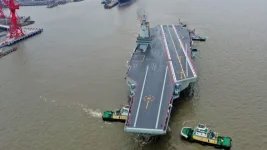
The third Chinese carrier, and the first equipped with catapults for aircraft-launch, has earlier this year returned to her fitting out-berth, after completing some cleanup work in drydock. Most recently the ship has seen her life-rafts fitted and application of flightdeck markings is also currently underway. As such a first sea trial within weeks appears plausible now.
 
Analyze

Analyze Post

Add your ideas here:
Highlight Cite Fact Check Respond
  • Like (+1)
Reactions: Bilal9

Members Online

⤵︎

Latest Posts

Latest Posts